The squatter family: those cute – and seemingly precocious – little Carolina chickadees!

Carolina chickadee IMG_3138©Maria de BruynresI have two bird boxes in my yard designed to attract brown-headed nuthatches (Sitta pusilla). While I do have these birds at my feeders, they have not deigned to create nests in the boxes; one is still empty and the other was occupied by a family of squatters – darling little Carolina chickadees (Poecile carolinensis). I don’t know if this pair had had kids together before, but sometimes these birds retain their bonds for several years.

In addition to the nuthatch boxes, I have five bluebird boxes and cCarolina chickadee eggs IMG_4429©Maria de Bruynhickadees had begun nests in two others. It is not uncommon for them to begin a couple nests and then finally settle on one. On 12 April, I discovered that Mom had laid five white with brown-specked eggs in a nice soft nest made of moss, soft grasses and some down, even using a bit of pillow stuffing I had left out for interested nest-builders.

Ten days later, 22 April, I opened the box to see if everything was ok and surprised her sitting on the nest. (I had tapped on the box beforehand in case she would want to leave for a bit; didn’t happen!) She gazed at me in alarm and then began dipping her head and beating her wings against the nest; this is called a snake display to warn off predators.

Carolina chickadee IMG_4623©Maria de BruynCarolina chickadee IMG_4624©Maria de Bruynres

Carolina chickadee nestlings IMG_4680©Maria de BruynresTwo days later, I opened the box and discovered the eggs had hatched – I think she had been brooding them two days earlier since the babies didn’t seem quite as naked as I expected. That would mean they hatched after only about 10 days (and the average seems to be 12-15 days of incubation according to websites).

Both parents take on feeding their offspring. In warmer weather, they search for insects among foliage and under tree bark, sometimes hanging upside down to get a meal. This pair also visited the nearby feeders, obviously intent on teaching their young that suet, dried meal worms and seeds are also good to eat.

carolina chickadee IMG_6507©Maria de BruynCarolina chickadee IMG_3021©Maria de Bruyncarolina chickadee IMG_6378©Maria de Bruyn

Carolina chickadee IMG_3129©Maria de Bruyncarolina chickadee IMG_6702©Maria de Bruyn

Like the nuthatches and robins, the parents were also fastidious about cleaning the nest; and these almost full-grown young seemed to be pooping a lot!

Carolina chickadee IMG_6420©Maria de BruynCarolina chickadee IMG_6430©Maria de Bruynrescarolina chickadee IMG_6380©Maria de Bruyn
The young usually fledge about 16-19 days after hatching. If these birdlets had hatched on 22 April, I figured they would be ready to leave the nest around 7 May. Despite being sick with an infection that was keeping me mostly supine, I couldn’t let the opportunity for observation go by. So on the 5th of May, I roused myself for a sit-down in the yard in the early afternoon. I first waited until the parents had both left and carefully lifted the bird box door to see a bright-eyed, pretty much full-grown chick staring at me. S/he scooted back and it looked like there were only two others – so the other two siblings had already fledged. This did seem to be a very precocious family!

Carolina chickadee nestling IMG_4820©Maria de BruynresCarolina chickadee nestling IMG_4824©Maria de Bruynres

Carolina chickadee IMG_6407©Maria de BruynThis might be one of the chicks that fledged earlier. When a fledgling is begging for food, it quivers its wings rapidly. Females also do this before the young leave the nest when they want the male to feed them.

Because I was feeling fairly ill, I had to stop watching the parents go to and fro after a couple hours. On 6 May, I ventured outside in the early afternoon, hoping against hope that I might just be lucky enough to see the last chicks fledge. And I did!

Each chickcarolina chickadee IMG_6817©Maria de Bruyn spent time looking out of the box before venturing out. One took a flying leap and swerved up into a tree.


No. 2 spent some time calling (the parents were still coming in regularly with meals!), then launched itself and landed on some nearby branches.

carolina chickadee IMG_6810©Maria de Bruyncarolina chickadee IMG_6831©Maria de Bruyn

No. 3 spent time flexing its wings before venturing forth.

carolina chickadee IMG_6894©Maria de Bruyncarolina chickadee IMG_6939©Maria de Bruyn
I did check the box to be sure they were all out and then watched as the parents called to them as they flitted about the various trees behind the nest box. If I’d felt better, I would have stayed to observe a bit longer but I was pretty satisfied with having seen the fledging!.

carolina chickadee IMG_6951©Maria de Bruynres

The next morning, a pair of Carolina wrens was already bringing in twigs and placing them atop the chicarolina chickadee IMG_7357©Maria de Bruynresckadees’ nest (after removing some remaining fecal matter). One chickadee ventured back to peer into the box but the wren pair loudly chased the original owner away.


All in all, some very cool days, with some mental delight balancing out the physical distress for me.

If you liked this blog, please let me know by liking or leaving a comment here on the blog page. Thanks!

And for those who want more details on chickadees’ lives, see:
http://animaldiversity.ummz.umich.edu/accounts/Parus_carolinensis/
More spring flowers – at home and in the wild

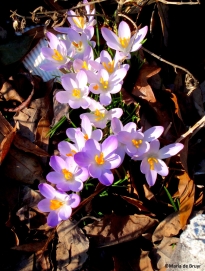
Up until 2 a.m. crocus IMG_3724©Maria de Bruyn resworking on an advocacy paper and then awakened by a tornado alert on my cell phone at 5 a.m. a few days ago, seeing bright flashes of lightening through the blinds and hearing rumbling thunder as the rain poured down. After what seemed like a somewhat lengthy and lingering winter, we’ve had a rather wet spring with temperatures yo-yo-ing. The flowers seemed a bit confused, too, but they have been blooming albeit not always when expected!Pear blossom IMG_3985©Maria de Bruyn res
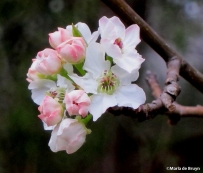
 

My yard is quite enjoyable in the spring, with a variety of cultivated and wild-growing flowers. The cheerful violet crocuses (Crocus) were the first to greet me in delightful profusion, while the early blooming pear tree (Pyrus) only had a few blossoms this year, apparently confused by warm spring days alternating with freezing mornings.

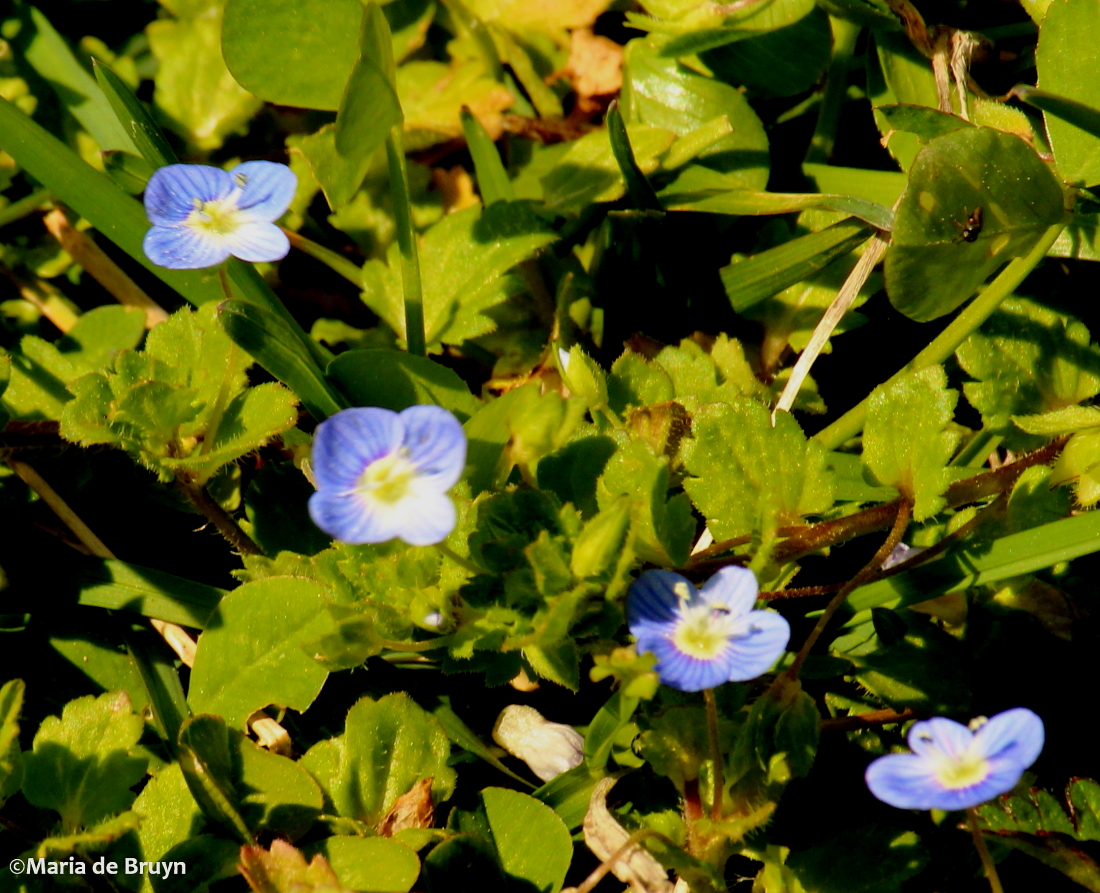
A rapidly spreading invader, the purple deadnettle (Lamium purpureum) has moved into my flowerbeds, obviously feeling that it should be nestled in among the African daisies and tulips. It’s fine with me; I leave them be with their lovely little blossoms. The cute little Persian speedwell (Veronica persica) is sticking to the “lawn” – I wouldn’t mind if the grass were gradually all replaced with this wildflower, clover and moss.

Purple deadnettle IMG_4522©Maria de Bruyn res Persian speedwell IMG_6519©Maria de Bruynres

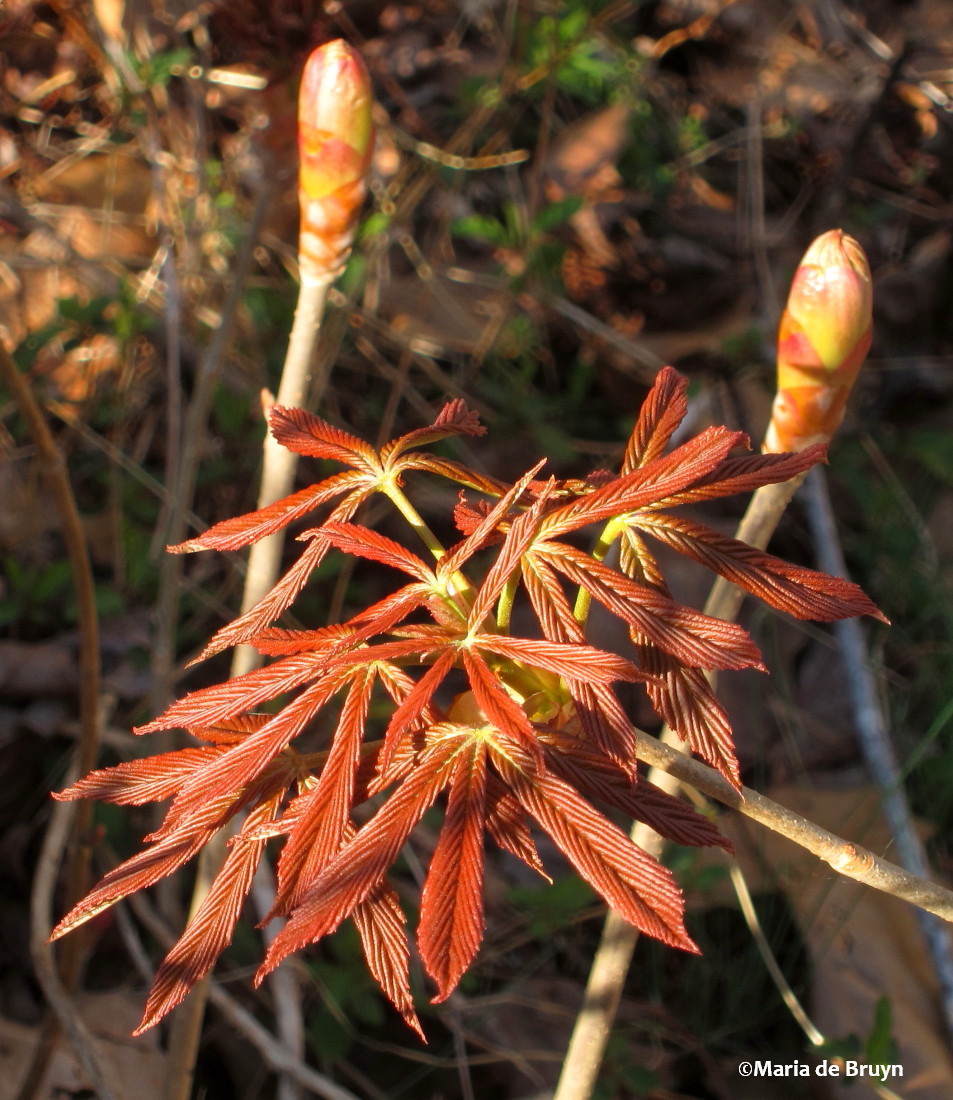
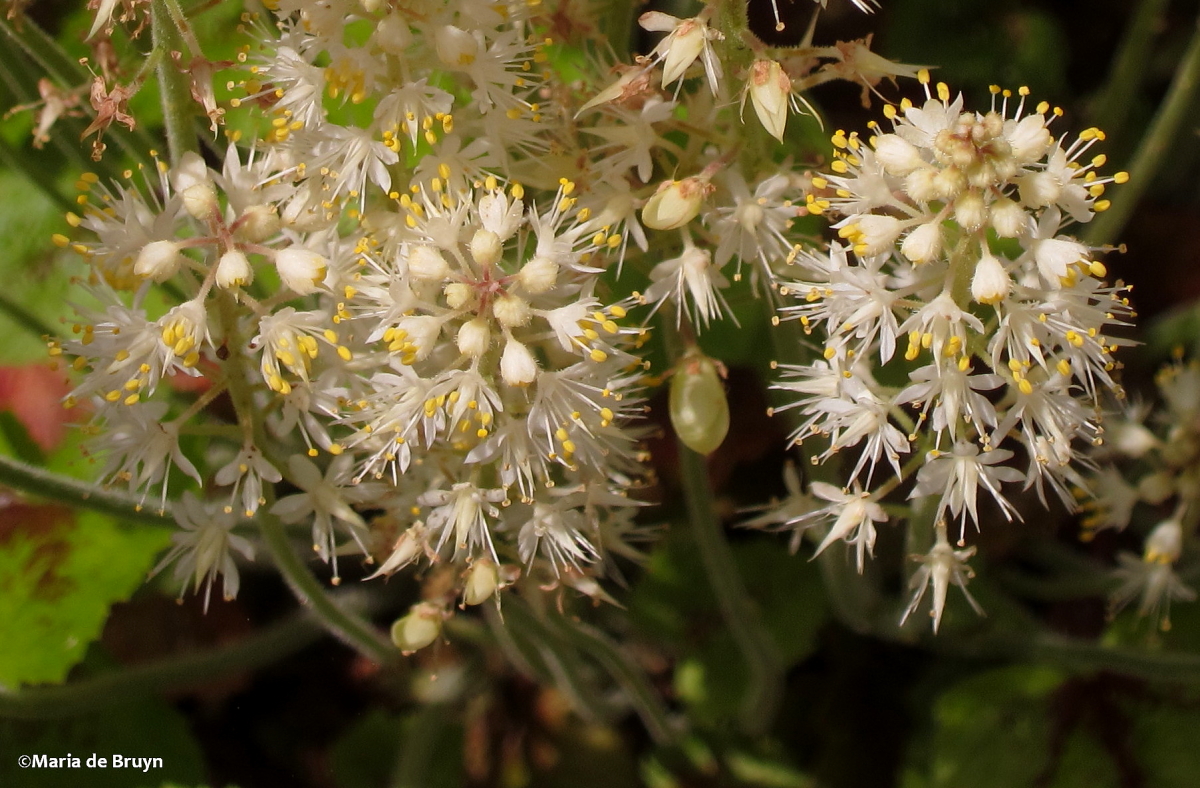
Painted buckeye IMG_3887©Maria de Bruyn resThe painted buckeyes (Aesculus sylvatica) have now bloomed but were also very pretty when they first began growing, like this specimen near Bolin Creek. Sweet Betsy (Calycanthus floridus) had reached a good size at the Botanical Garden, where the mountain witch alder (Fothergilla major) was also showing off its flowers. The foamflower (Tiarelia cordifolia var. collina) was half-way through its cycle and being visited by lots of bees.

sweet betsy IMG_4263©Maria de BruynresMountain witch alder IMG_4552©Maria de Bruyn

Foamflower IMG_4532©Maria de Bruynres

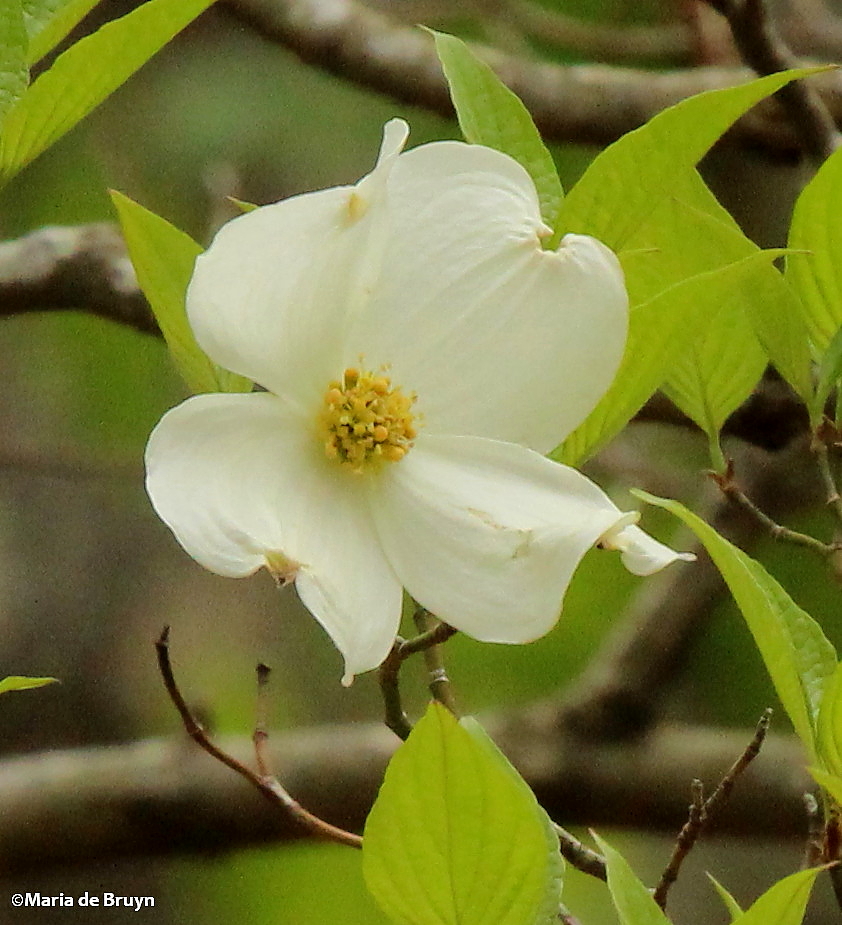
At Mason Farm Biological Reserve, the dogwood (Cornus) was lovely; the tree in my yard didn’t flower this year but the leaves still look healthy. On the ground, the Jack-in-the-pulpit (Arisaema triphyllum) was really abundant in places, some plants with green “tubes” and others with purple-striped ones.

dogwood IMG_9380©Maria de BruynresJack in the pulpit IMG_0833©Maria de Bruyn res

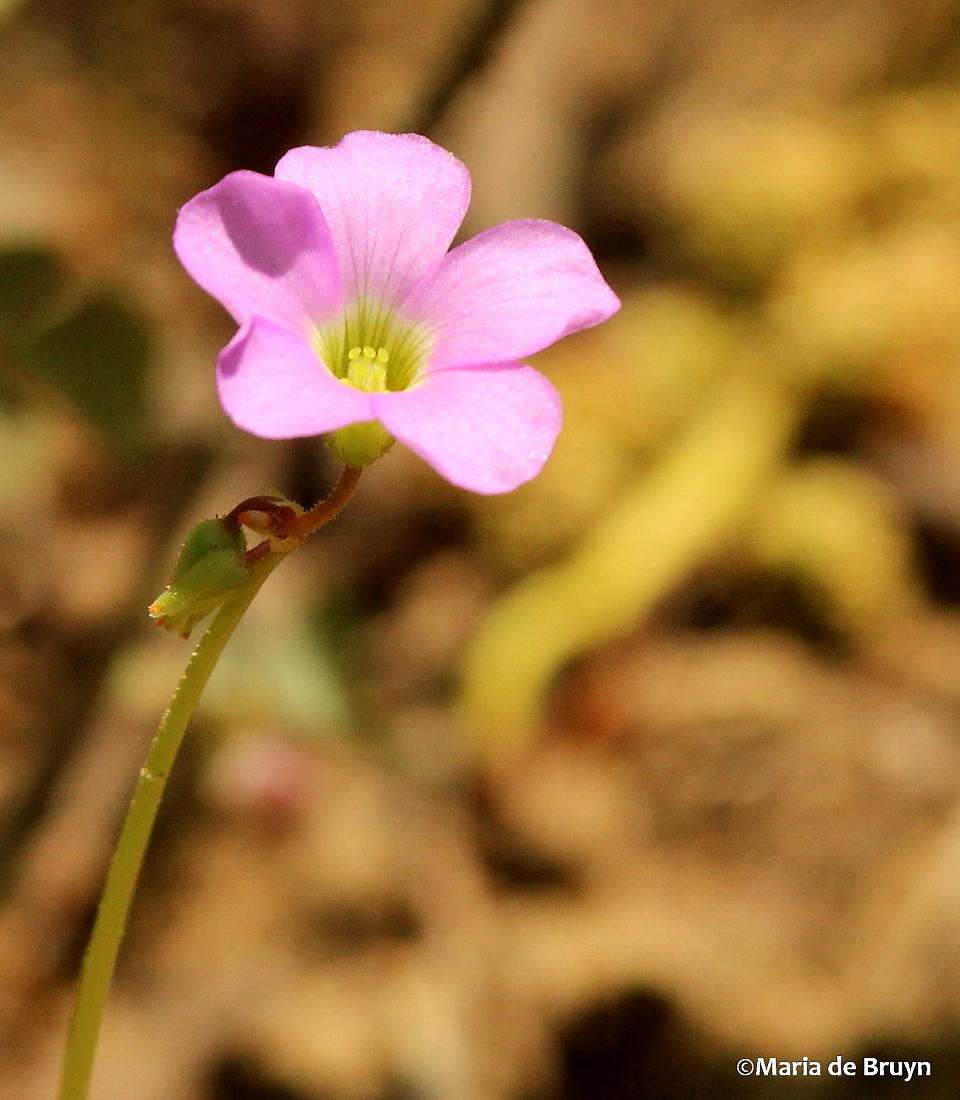
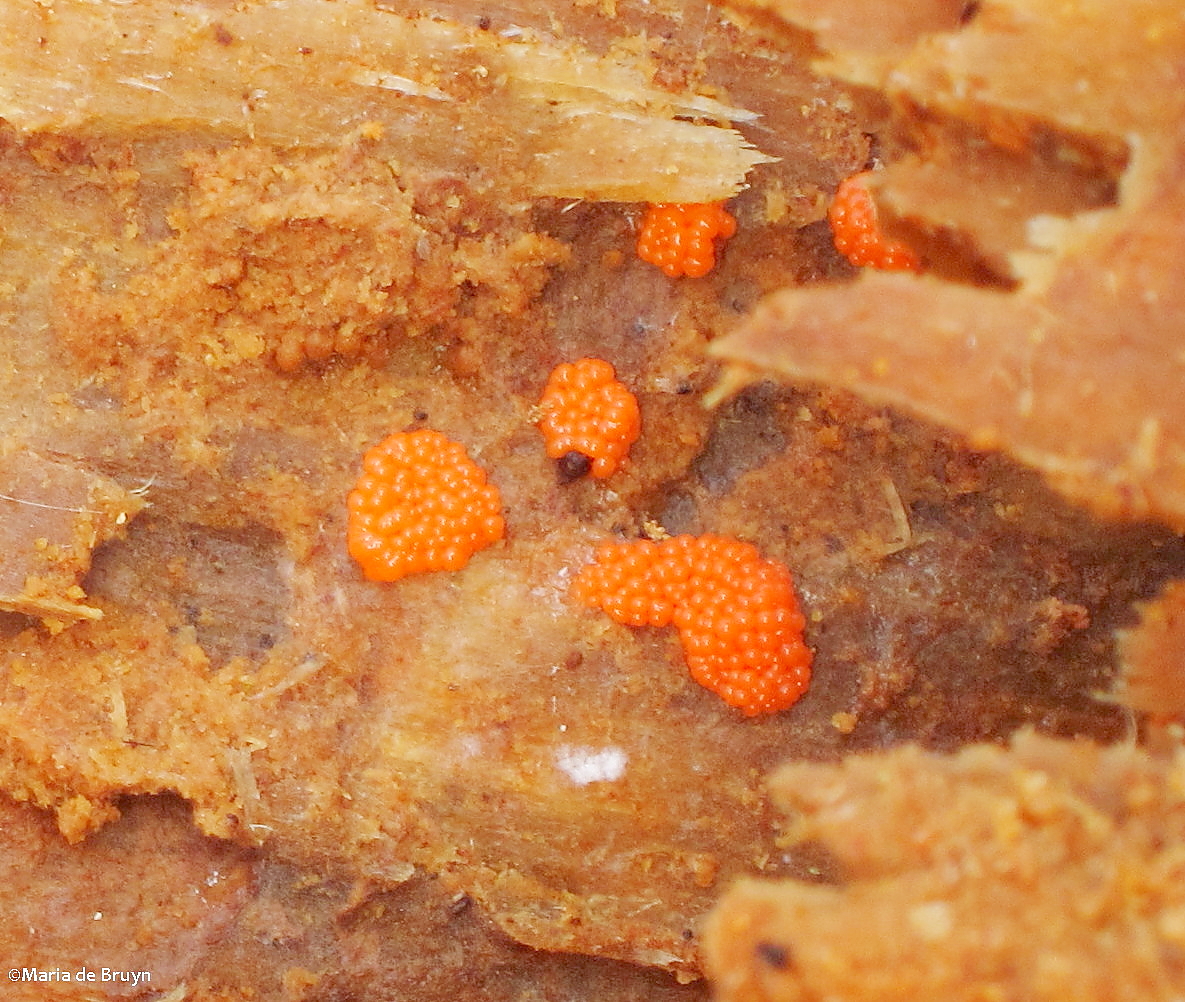
Two plants were a bit mysterious. When I first saw the violet word sorrel (Oxalis violacea), I stared at it for a time as it seemed to be growing out of a clump of clover leaves. However, the flower didn’t look like clover; I finally decided it must be an unusual kind. The man in charge of Mason Farm, a botanist, set me straight fortunately. The other mystery concerned some clumps of red globules. An entomologist who was present told me they were insect eggs; bug experts on BugGuide, however, concurred that this had to be a slime mold. Interesting that insect eggs and slime mold can look so similar!

Violet wood-sorrel IMG_0827©Maria de BruynresSlime mold IMG_4092©Maria de Bruyn

Next blog – some spring wildlife and then back to birds!


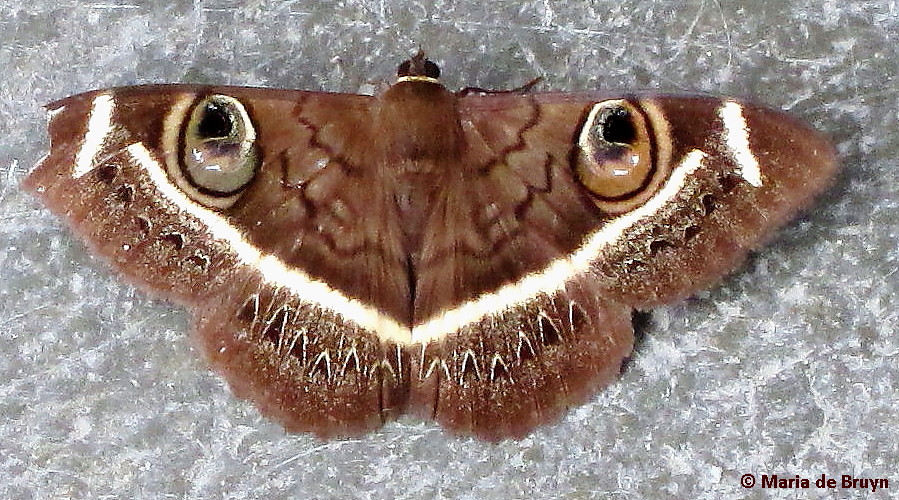
Moths to rival butterflies!

Friendly probole moth IMG_9681©Maria de BruynresThe past week has been incredibly busy with work and the next couple weeks will be so as well. But I hope to stick somewhat to my weekly schedule of (hopefully) entertaining and perhaps educating you a bit on the wonderful wildlife around us!

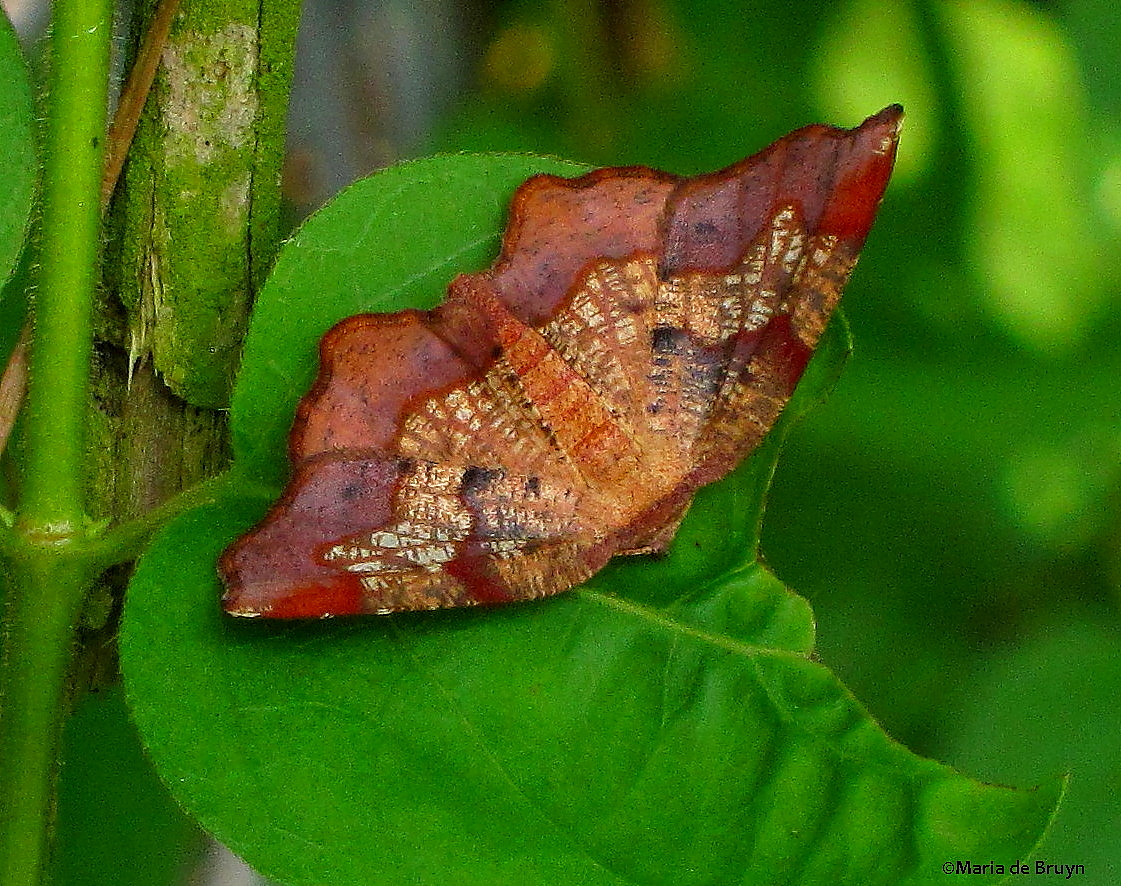
Today, I was pleasantly surprised to find that a fellow Project Noah member, Jacob Gorneau, had mentioned me in his article about National Moth Week (http://nationalmothweek.org/2014/02/23/project-noah-hosts-the-second-annual-national-moth-week/), What he quoted me as saying – “I really did think of butterflies as being the beauties and moths as the plain cousins. It’s great to have learned so much about the beauty of moths!” – was  a result of having participated in that annual week. Just like birders do bird counts, “moth-ers” do moth counts. And it was through my joining in on that activity that I learned to appreciate just how gorgeous moths can be – like that Friendly Probole Moth (Probole amicaria) at the top of this blog! Here are a few more beauties I’ve seen over time.

Polka-dot wasp moth IMG_0107VThis polka dot wasp moth (Syntomeida epimoth, Cream-striped owl IMG_6548© Maria de Bruynlais) was visiting a plant in Mexico. And this is a cream-striped owl moth (Cyligramma latona), which was a welcome surprise in Namibia.

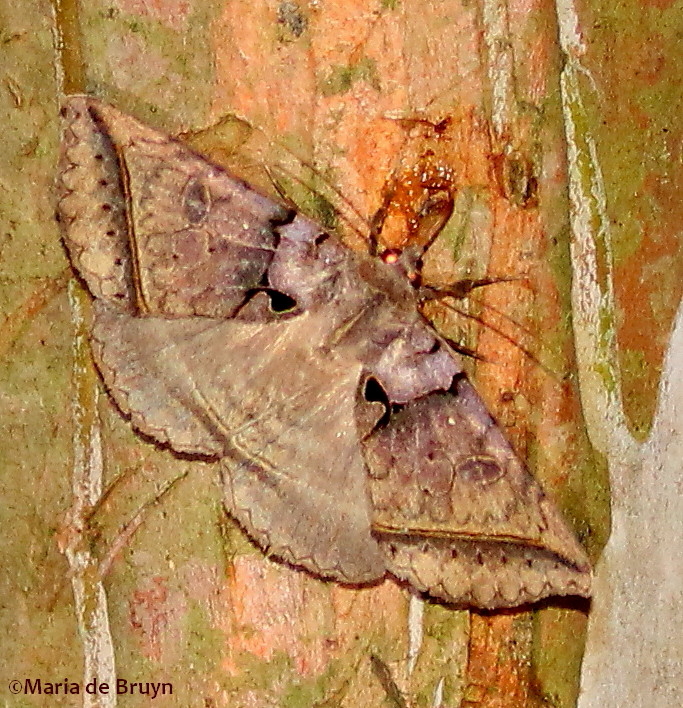
Zale moth IMG_4866©Maria de BruynMy backyard also reveals some interesting specimens. Moth Week induced me to go outside at night with a flashlight and I found these beauties on my crepe myrtle trees. Left is a Zale moth and below a black bit moth (Celiptera frustulum).

Black bit moth IMG_4867©Maria de Bruyn2

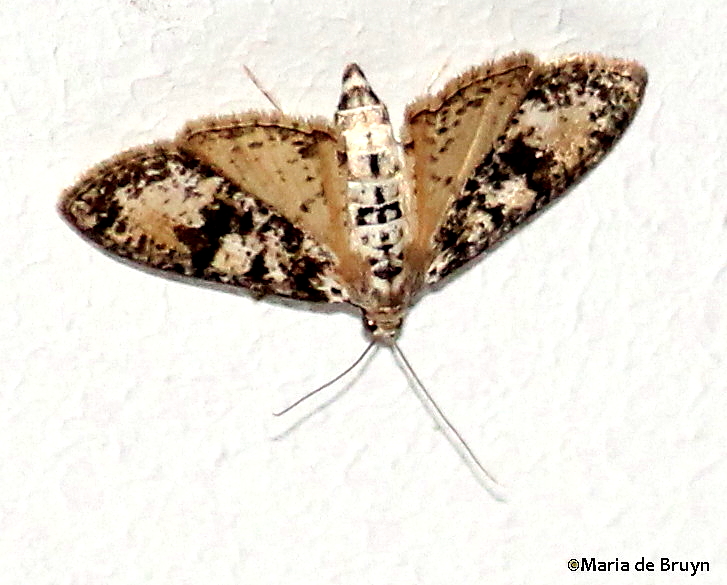
Splendid palpita moth IMG_4696©Maria de BruynThis splendid palpita moth (Palpita magniferalis) was on the ceiling of the roof overhanging my front porch. Gorgeous pattern, don’t you think?

Next week, I’ll share a few more of these beauties!

Squirrels love fruit!

eastern gray squirrel IMG_1449©Maria de Bruyn res

As you may know, our furry, agile, smart little friends, the Eastern gray squirrels (Sciurus carolinensis), are fond of all kinds of vegetable matter. Acorns, nuts and seed are a favorite: they will chew through the screen of a backyard porch to get to bird seed (as my neighbors learned after leaving a bag of it there), chew through the plastic lids of food buckets in which I was keeping bird seed outside (the seed is now kept indoors) and spend lots of time contemplating how they can overcome baffles and other barriers designed to keep them off bird feeders.

At my house, they are somewhat lucky since I also put some seed under feeders for the ground-feeding birds such as dark-eyed juncos, white-throated sparrows, mourning doves, Eastern towhees and sometimes Northern cardinals and blue jays. The squirrels will amiably scurry about beside the birds to consume some sunflower seeds or millet. I also give the squirrels a treat now and then by putting out fruit bought from the reduced-produce rack at the supermarket, where I can buy veggies that the supermarket would otherwise throw away.

IMG_8399©Maria de BruynEastern gray squirrel IMG_5039©Maria de Bruyn

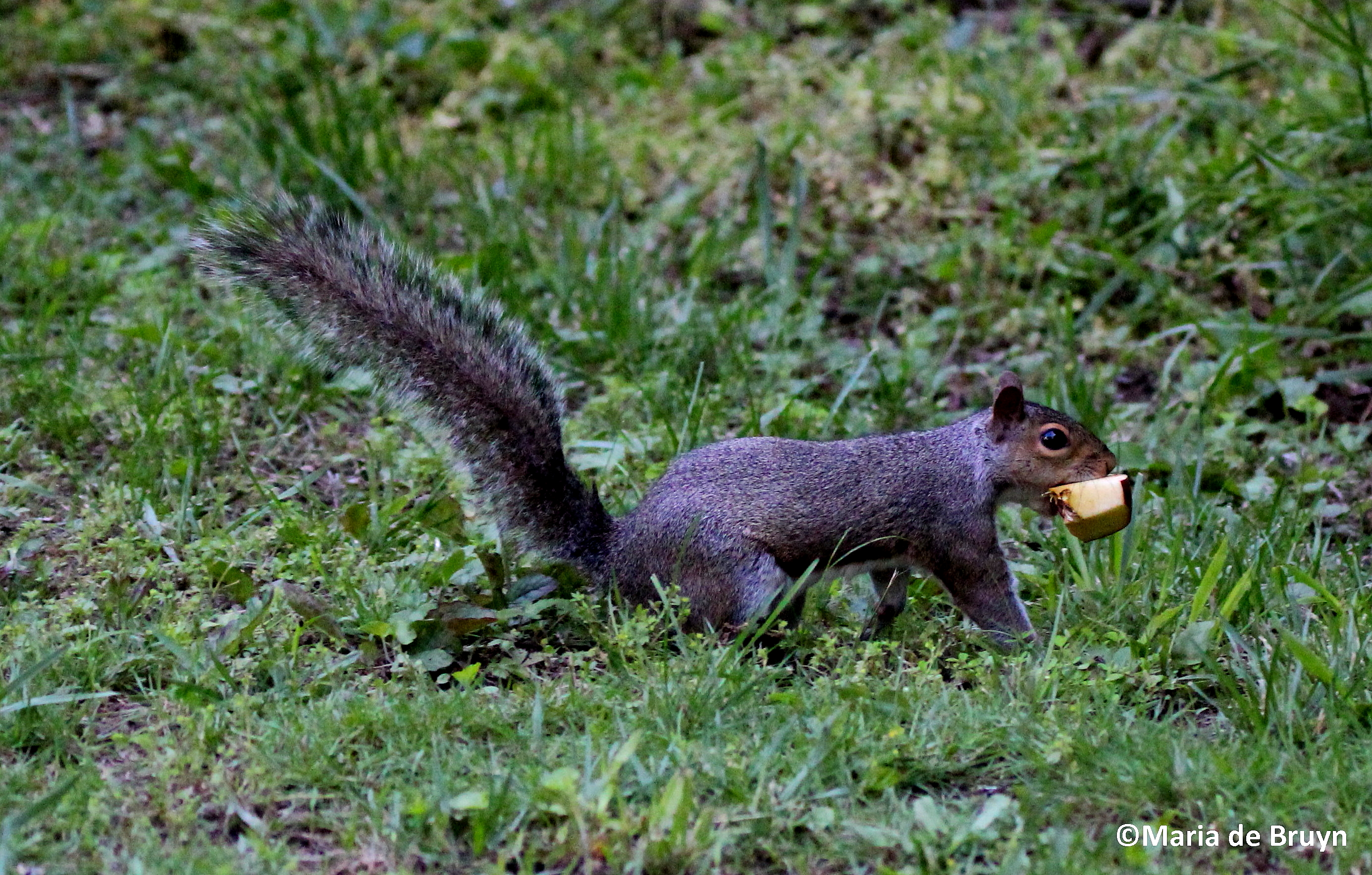
Apples are a common treat and the squirrels often eat those on the spot, although they may feel a need to carry away their meal to enjoy it at some distance from their family members. Blueberries and plums are nice, too.

Eastern gray squirrel IMG_7166©Maria de BruynEastern gray squirrel IMG_3723©Maria de Bruyn 2013 (2)

The squirrels’ tastes in fruit have surprised me on occasion though. After learning that banana peels mushed up at the base of azaleas will help their growth and blooming, I took to putting overripe bananas by those plants. Sometimes, when checking the next day, I would find the peels someplace else in the yard and then realized that squirrels enjoy a tasty banana now and then. When I put out oranges in an attempt to attract orioles, the citrus didn’t last long once the resident tree rodents discovered them.

eastern gray squirrel IMG_8424©Maria de Bruyn

Squirrels will hoard food for later consumption, hiding the fruits of their labor in numerous spots around their territory. According to Wikipedia, each squirrel will make several thousand such caches every season! If they think they are being watched, they will also pretend to bury food in a cache, while actually hiding the morsel in their mouth to bury it someplace else later. Clever indeed!

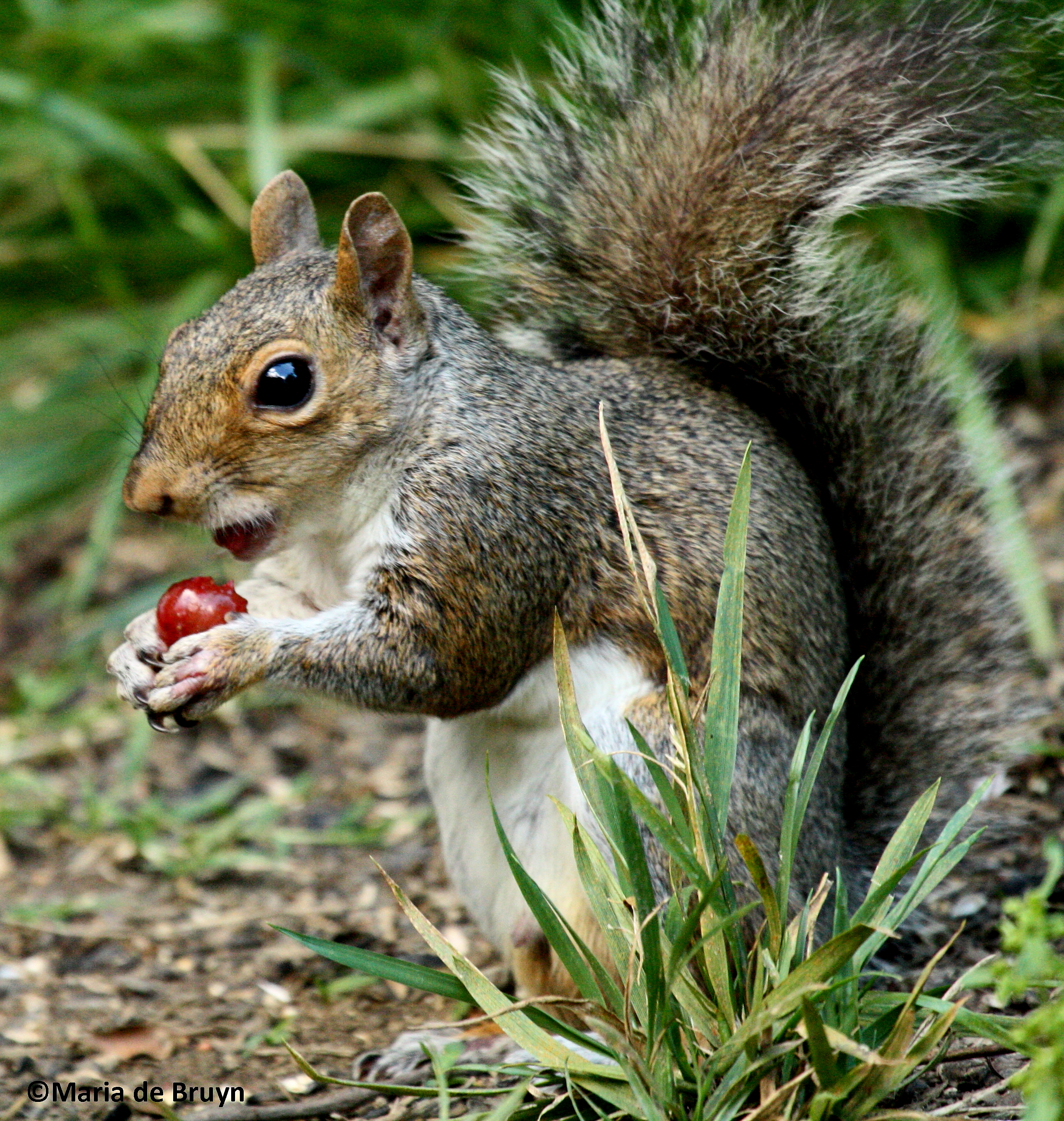
Eastern gray squirrel IMG_8965©Maria de BruynI must admit, though, that I had not expected to see a squirrel assiduously burying grapes one day. Researchers have found that that they will eat the most perishable acorns right away, while caching those that will stay preserved the best. So what made this squirrel think that the grapes she was burying would last underground? Unless this was one sneaky squirrel who was just temporarily hiding her/his bounty until s/he could enjoy those grapes in relative solitude.

I’m looking forward to spring when I can sit outside to watch the squirrels ‘ behavior some more; the yard can be a real learning lab!

For more information see: http://articles.courant.com/2004-10-21/features/0410210319_1_squirrels-bury-acorn

Do deer like treats? Of course, they do!

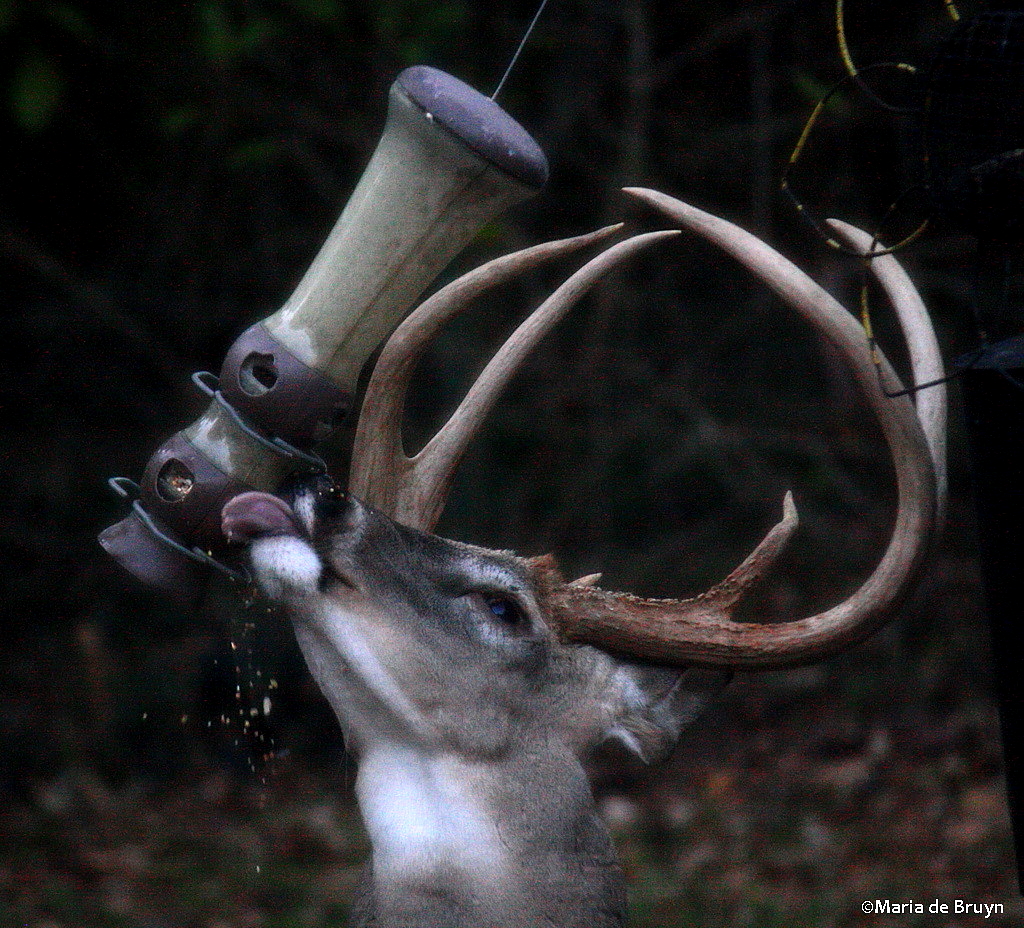
deer bird seed IMG_3127© Maria de BruynAnyone who has lived in proximity to white-tailed deer (Odocoileus virginianus) know that they have a great appetite for all types of vegetation, including garden flowers that people plant in their yards. This has been a cause of strife between humans and the deer (at least, from the humans’ point of view), even though I and other people have found that deer repellants – both home-made and store-bought – work really well to keep deer from eating plants we wish to keep.

I also have a 5-foot fence around my vegetable garden. In theory, the deer could jump this but the trick is to make the garden long and narrow since the deer calculate how much space they have to land on the other side of the fence. If it looks like the space is too small, they won’t try to jump eveIMG_5431© Maria de Bruynn if they see and smell delicious veggies inside – I know this is true as I’ve watched them figuratively “lick their lips” outside my garden but never attempt to get into it.

The deer’s four-chambered stomach enables it to eat a variety of food. In spring and summer, they prefer green plants, including grasses; in the autumn, they go for corn, acorns and other nuts. In the winter-time, deer eat twigs and buds of trees. They also eat fruit, such as the berries on privet trees, lichens and other fungi.

Stip at apple treeStip and privet IMG_1648© Maria de Bruyn

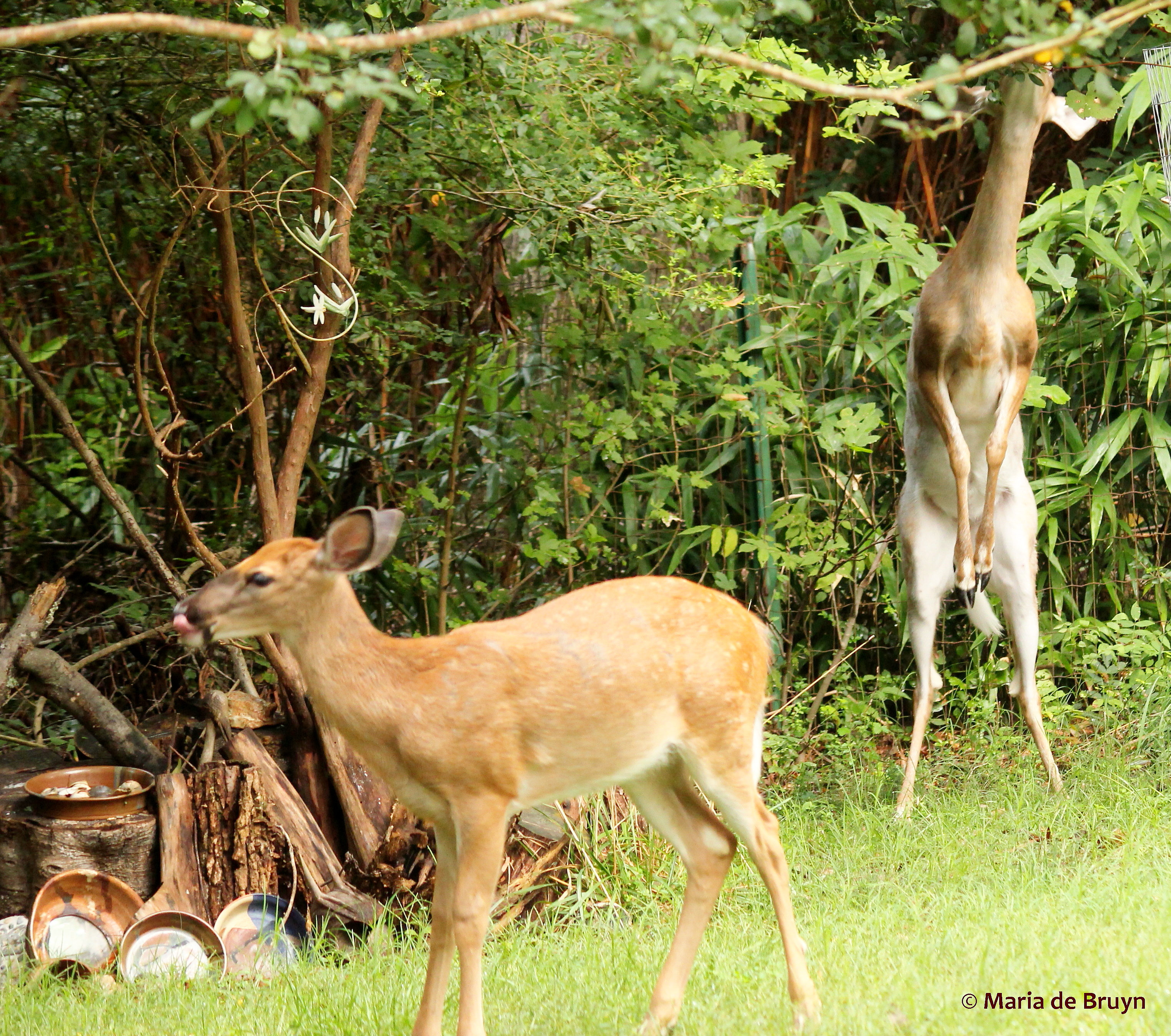
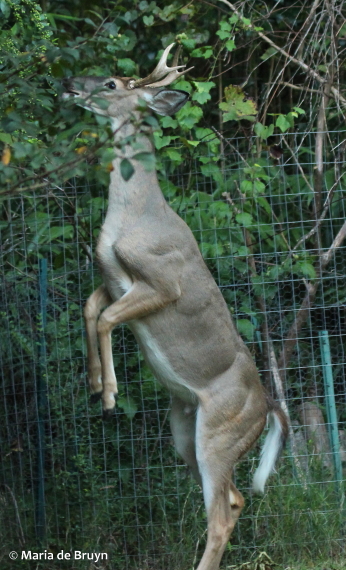
To get to the privet berries, they need to reach the tree branches and their good sense of balance comes in handy. The does do it often in my back yard and the fawns watch them carefully so they can try it, too. Surprisingly, the fawns can stand on their hind legs pretty well when they are only a few months old.

Nezhoni and apple tree 3©Maria de BruynBuck and privet IMG_5243© Maria de Bruyn

Besides privet berries, they like grape leaves (which can be high when the grapevines climb up the privet) and apples. The big bucks will also have a go at it but I don’t see them lifting their bulky bodies up often.

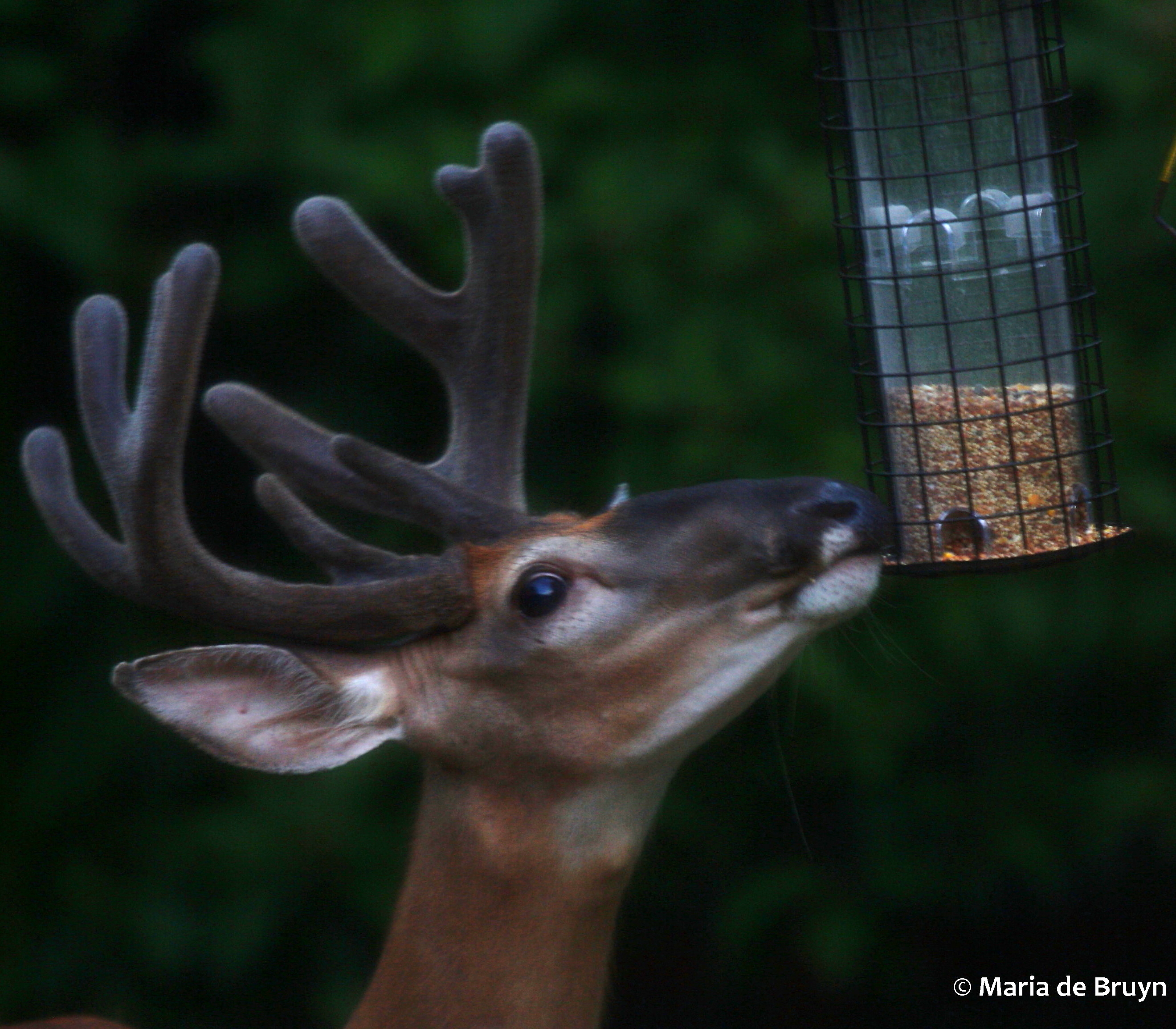
The deer also enjoy treats, just as we may like sweets and birds have a fondness for suet. Bird seed is one treat they like. If the deer are very hungry, they can lick up all the bird seed put out for the ground feeders, but when they are feeling well fed, they will just have a little and leave seed for the birds (and squirrels). The deer’s fondness for bird seed can be strong; if you don’t hang your feeders high enough, they can clean out a feeder in a short time.

emptying bird feeder at night©Maria de Bruynwhite-tailed deer MdB 3 buck

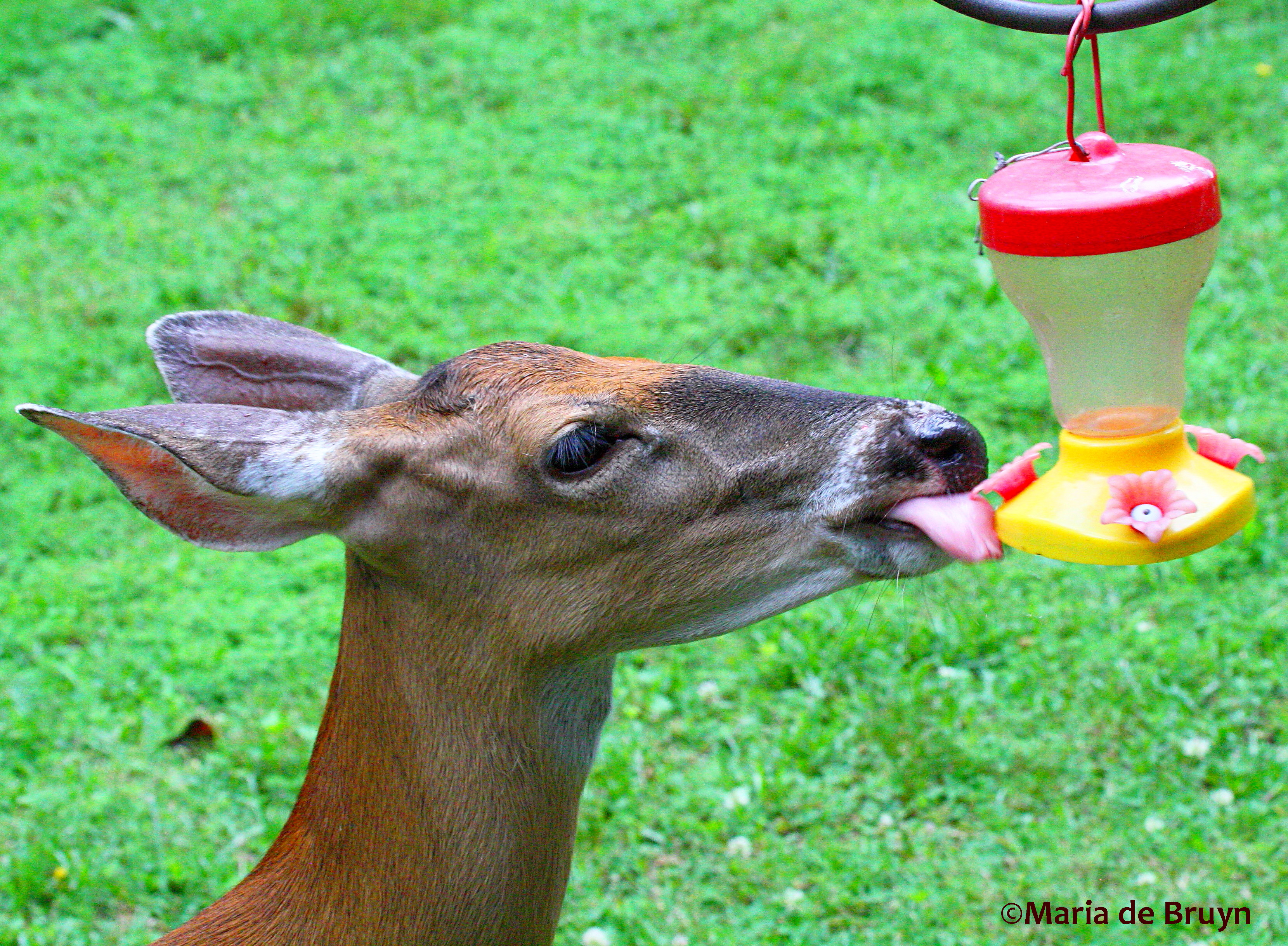
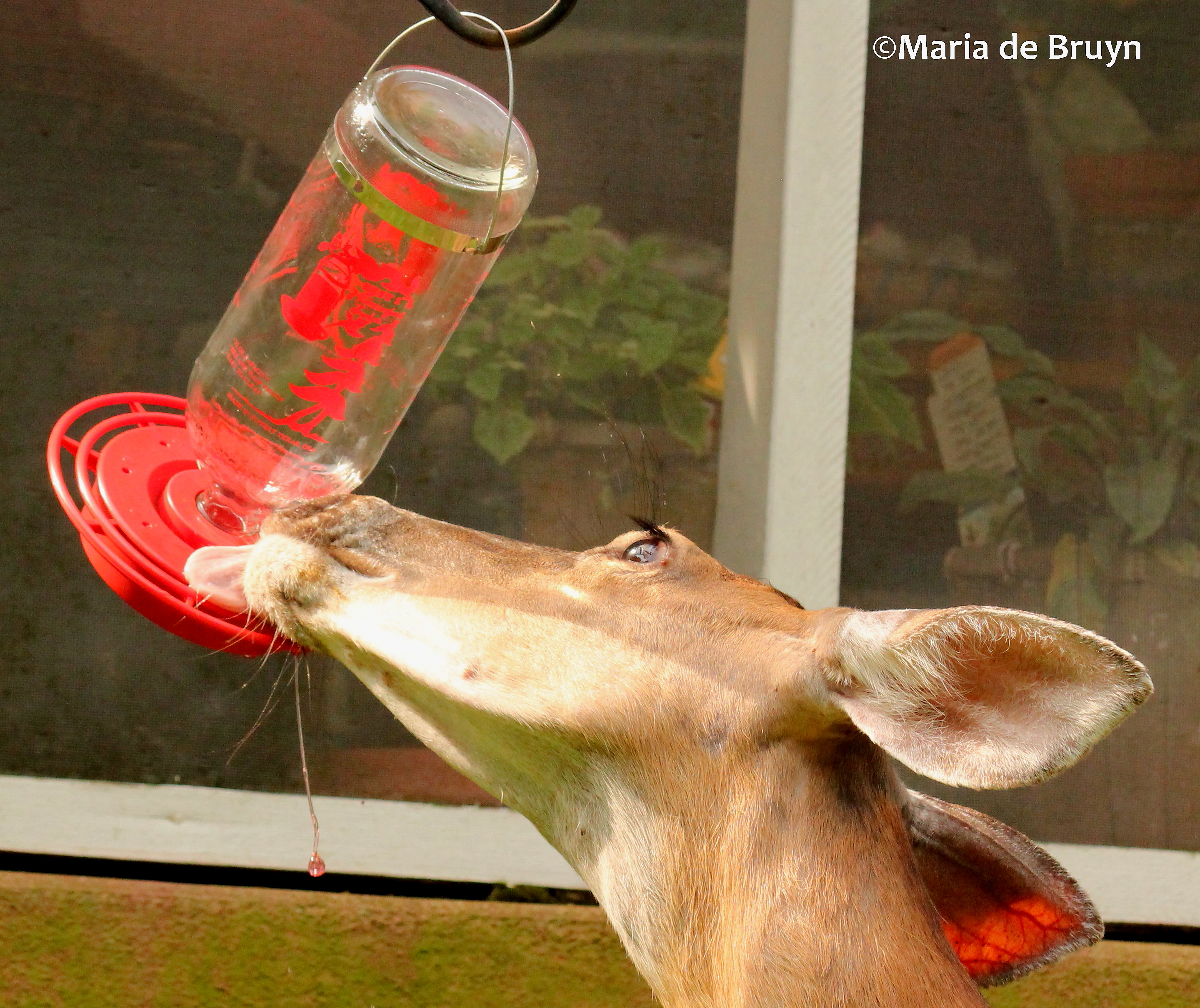
My biggest surprise concerning a deer treat came from Schatje, my “dear deer” friend of five years. One summer, I noted that the hummingbird feeder was emptying quickly and I just thought the hummers were very thirsty. Then one day, I looked outside to see Schatje enjoying a sweet drink. It turned out she was extremely fond of nectar and eventually I had to hang the feeder higher so she wouldn’t drink all the contents a couple times a day!

white-tailed  deer Schatje 1 ©Maria de Bruyn signedSchatje nectar IMG_1727©Maria de Bruyn

This winter has been especially cold and the local deer family have had to rely on their winter diet of fungi, leaves and twigs a lot. Though they likely are not anticipating spring, I’m sure they will be glad when it gets here, just like me!

Next week: squirrel treats