Belted kingfishers and me

Belted kingfisher IMG_9360f© Maria de Bruyn

Since my “career” as a birder is still rather short, especially in comparison to some birders I know, I still quite regularly see “lifers”. These are first-time spottings of birds in the wild when you can identify them reliably. While I enjoy seeing the more common birds in my area time and again, it is the lifers that often evoke a happy grin when I get a good photo. More often than not, though, my first photos of a lifer are a bit blurry, partial as the bird is hidden in foliage or otherwise imperfect. It is only with repeated sightings that the photos seem to improve – though that also isn’t always the case.

An example of this is my “relationship” with the belted kingfisher (Megaceryle alcyon).  Although worldwide there are more than 90 species of kingfishers, the United States and Canada only have three and it is the belted variety that is most often seen. “Belted” refers to the band of bluish-gray color across the white underparts of the bird’s body; both males and females have this. Females also have a reddish color band, making them even more attractive than the males, which is not so usual among our avian friends.

The first time I saw a belted kingfisher was in October 2012; it was Belted kingfisher IMG_9690Dacross Jordan Lake, about a 30-minute drive from my home, in a tree. Only when it flew by once at high speed was I able to get a half-way decent shot of what I think was a female.

My next sightings were in a mangrove swamp in Mexico in December 2013. One day, I saw a female fly by over the mangrove trees in the distance.

Belted kingfisher IMG_9364F© Maria de BruynTwo days later, at the same place, I saw male. What was exciting about that spotting was that the bird began fishing right in front of me. He would circle the swamp, hover a couple seconds and then fold his wings to drop like a bullet into the water, completely submerging. The action was fast and my photos were blurred again, but I was able to document that he had caught a meal.

Belted kingfisher IMG_1853© Maria de BruynBelted kingfisher IMG_1855© Maria de BruynBelted kingfisher IMG_1860© Maria de Bruyn

Belted kingfisher IMG_1864© Maria de BruynBelted kingfisher IMG_5279©Maria de BruynresMy fourth sighting was in the late afternoon this past week, January 2014. As I was walking in a forested area near a creek, I saw a flash of a blue head and white on the wings and at first thought that a blue jay had streaked by me. But then the odd, kind of loud warbling call caught my attention – it was definitely not a jay. The bird perched on a tree limb about 100 feet or more ahead of me and I suspected that it might be a kingfisher but doubted it, too, as I thought they needed to be around more open bodies of water. This is not the case – they just need to be around water that doesn’t freeze over so they always have access to their fishy diets, as well as amphibians, small crustaceans, insects, small mammals and reptiles. They nest in burrows dug horizontally into the banks of waterways and both parents cooperate in feeding and raising the young.

Belted kingfisher IMG_5442©Maria de BruynresBelted kingfisher IMG_5388©Maria de Bruynres

I began taking photos from far away as I neared the kingfisher; when I would get within about 30 feet, he would take off again. This scenario repeated itself over and over again as I tried to get some shots of the bird not hidden by branches, twigs and dried foliage. I finally did get some photos, again not of the best quality as it was getting towards dusk and the bird was still pretty far away.

Belted kingfisher IMG_5420©Maria de BruynresBoth sexes have a dark head with crested feathers and quite large bills; this juvenile – male, I believe – showed his crest over and over as he called and bobbed up and down on his various perches. I think it is the crest that helped give him a – what struck me as – crabby look. He was very impressive though.

Belted kingfisher IMG_5442©Maria de Bruynres

When I next see a belted kingfisher, it won’t be a “lifer” sighting but my goal now is to get a good close-up shot; time will tell if I succeed!

Next blog: deer and their efforts to get food

Deer and their curiosity

Don-tso and Schatje were both very sweet animals who enriched my life, but they were very different personalities. Don-tso, whose Native American name represented a spirit who sits by your shoulder and warns you of danger, lived up to that name. She was a delicate small cat, rescued as a feral kitten from the streets of Amsterdam, who remained anxious and extremely cautious throughout her life. Even after a decade, I could not approach and pick her up; time spent on my lap was always on her terms and at times of her choosing. She was nevertheless very loving and brave.

Schatje (Dutch word for “dear”) was a wild deer who chose to befriend me and one other neighbor, approaching us as a young doe. We are usually warned not to let urban deer grow accustomed to us as this can endanger them – when they trust people, it makes them vulnerable to those who want to hurt or eradicate them. Schatje was so persistent, however, that I broke that rule and got to know her very well over a five-year period.

Jonahay and Schatje IMG_1752 ©Maria de BruynBoth Don-tso and Schatje were very curious. This came home to me one summer day when a strange incident occurred. My other cat, Jonahay, had become agitated when Schatje came near and when I tried to move him away, he displaced his aggression and attacked Don-tso who was nearest to him. As I tried to intervene between Jonahay and Don-tso, I felt a nudge behind me – Schatje had marched up and was trying to get a good look at what was happening! As she approached, little Don-tso gathered up her courage and stood her ground – she was actually ready to spring at Schatje, who was considerably larger! I finally got Don-tso and Jonahay into the house and things calmed down.

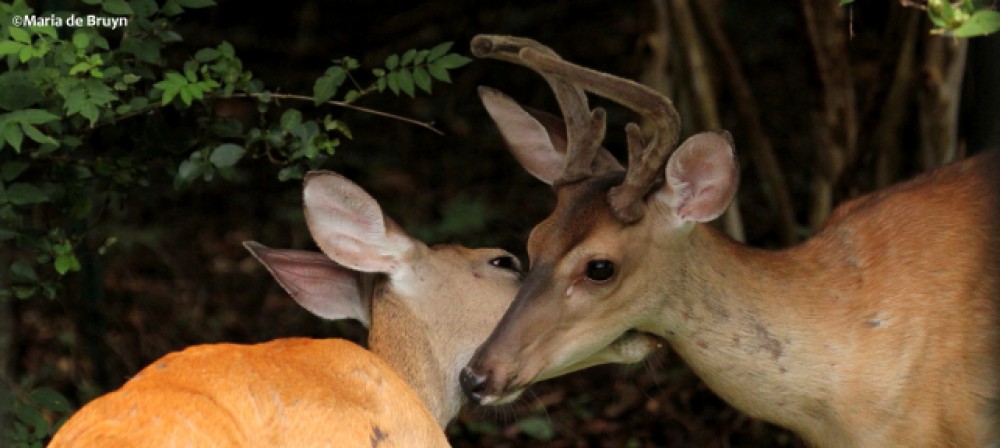
Don-tso says not too close M de BruynOver the years, as I’ve watched Schatje’s family and other deer visit my yard, it’s become apparent how observant and curious they are. Undoubtedly, their curiosity plays a role in their survival skills – it pays for them to notice changes in the environment that could pose a danger or threat to their well-being. Sudden changes – movement and sound – will evoke the well-known white-tailed deer response where they raise their tails like warning flags and stamp their feet.

Ne-zhoni alarm©Maria de Bruyn

In other cases, however, when something in the environment has changed during their absence, they will investigate. Scientists believe that this curiosity provides them with information that can be helpful in knowing, for example, where they might find new sources of food or possible obstacles in their way when they want to make a quick escape. When I have made new additions to my yard, some of the deer – most noticeably Schatje and her offspring – have taken quite some time to examine them through sight, smell and touch.

Schatje looks at bird photo ©Maria de Bruyn

If new yard art moves, it may take a while before they approach and some individuals will never get close. Others are braver, however, like these young ones; the doe exploring the whirling bird did so after about four days of cautious investigation, coming a bit closer each day.

deer with whirling bird IMG_5574© Maria de Bruyn resattracted to toys ©Maria de Bruyn

 The deer can also be curious about other animals, like this fawn who wanted to get close to a squirrel – who definitely was not interested in any togetherness.

Deer with squirrel IMG_2151©Maria de BruynWhile I may not meet another deer who is as trustingly curious as Schatje, her descendants will most likely continue to explore my yard and satisfy their curiosity about any changes happening here. And in doing so, they will help satisfy some of my curiosity about deer behavior!

Resplendent remiges and rectrices – bird beauty from behind

The other day asMourning dove IMG_6565©Maria de Bruyn res I was photographing birds at my feeders, I was struck by the beauty of this bird’s feathers as they lay across its back. The muted colors are wonderful and the scalloped-edge pattern is marvelous. It made me take a look at other birds’ feathers as seen from behind and how they vary in position and shape. I hope you enjoy this short tour and have some fun identifying the birds shown – many are very easy for experienced birders but perhaps some are not for beginning birdwatchers. The answers will be added to the blog next week.

So, we are focusing here on flight feathers, namely the remiges and rectrices. The remiges – or wing feathers – help the bird get lift when flying and support the bird during flight. The rectrices – tail feathers – give the bird stability and provide control.

Red fox sparrow IMG_5745© Maria de Bruyn resHouse finch M de Bruyn resCardinal IMG_6227©Maria de Bruyn res

The outer “vane” (part of the feather above the shaft) is narrower than the inner vane, so the wing feathers are asymmetrical. The tail feathers, on the other hand, are symmetrical in shape and pattern. The “primary” wing feathers are narrower and can be rotated individually, while the secondary remiges are shorter and lie together, even when the bird is flying.

In some species, the wing feathers may reveal a spot of color on the bird’s back when they are not folded completely over one another.

Yellow-rumped warbler IMG_6461©Maria de BruynresHouse finch IMG_6255©Maria de Bruyn res

The feathers also serve other functions, such as keeping the bird warm and dry.

Ruby-throated hummingbird IMG_4221©Maria de BruynresMandarin duck IMG_1605©Maria de Bruyn resHoopoe IMG_4314©Maria de Bruyn res

In some species, the males develop especially resplendent rectrices in thRed-collared widowbird 390©Maria de Bruynreseir breeding plumage – a definite attempt to attract mates.

Interestingly, the total weight of a bird’s feathers is about 2-3 times more than the weight of its bones!

One final quiz question – which bird has the fewest overall feathers and which species has the most?

Next week: curious deer

Big Blue – my avian nemesis!

Over the past few years, I’ve become an avid birder, at least from the standpoint of photographing the different species I see and trying to get interesting shots of their behavior. And while I’ve grown to love the beauty in each type of bird, there is one particular individual that I would rather not see in my yard.

Great blue heron IMG_7612©Maria de Bruynres

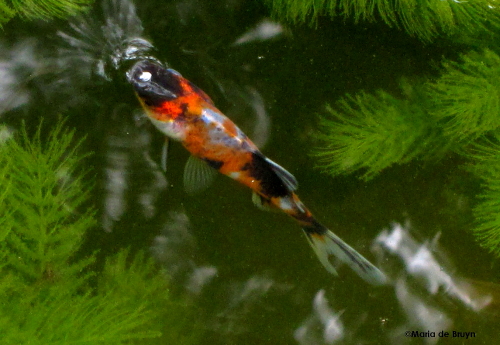
What has caused this aversion, you might ask? It’s related to my pond and fondness for the fish that have populated it. At one time, I had a lovely group of goldfish, butterfly koi, shubunkins, comets and one medium-sized koi, whom I named Big Guy (or Girl, depending on my perception that day). The first predator to get some of them was a turtle, who I admired near the pond one day, not realizing that it would go into the pond and then not be able to get out.

painted turtle IMG_8914

Turtle unfortunately accounted for the disappearance of a few smaller fish, until I finally figured out that I needed to put in a larger log for it to climb out on. (This turtle would NOT let me catch it.)

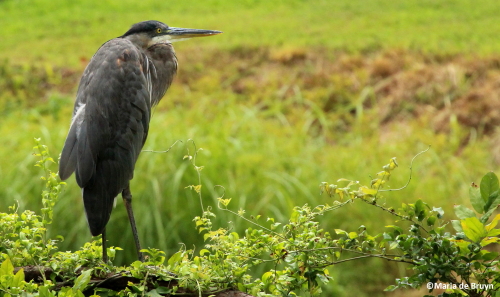
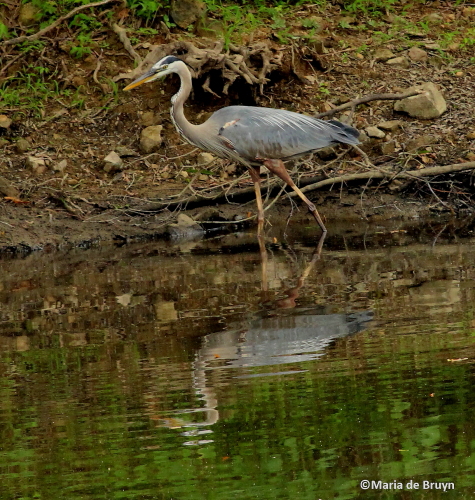
But then my real nemesis appeared – Big Blue (a name given by my neighbor, Kevin), a great blue heron (Ardea Herodias). I had seen Big Blue at a large neighborhood pond and admired the grace of this large bird.

Great blue heron IMG_7482© Maria de BruynresGreat blue heron IMG_7465© Maria de Bruynres

Big Blue at the neighborhood pond

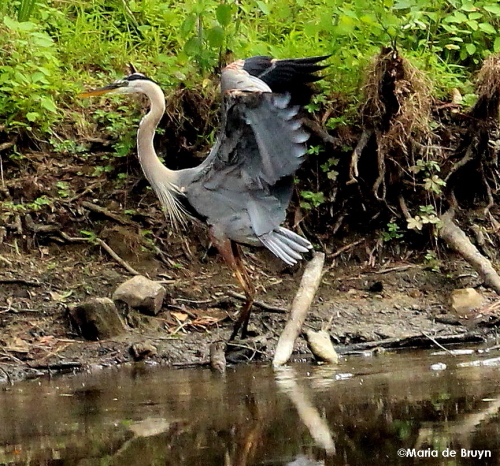
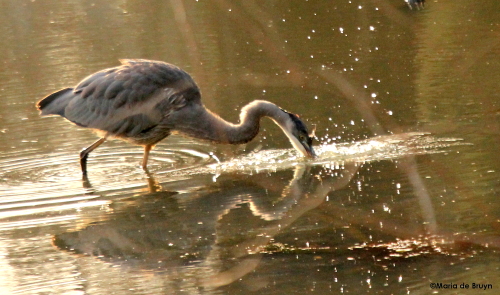
However, the first time Big Blue visited my yard – to my knowledge – I caught sight of him (or her) standing in my small pond with one of my biggest goldfish hanging from his beak. I ran out into the yard, uselessly yelling for him to drop the fish. He stared at me and didn’t move until I was about three feet away – impressing me with his large size. (He was only about 6 inches shorter than me!) Then he lifted off with his prize meal.

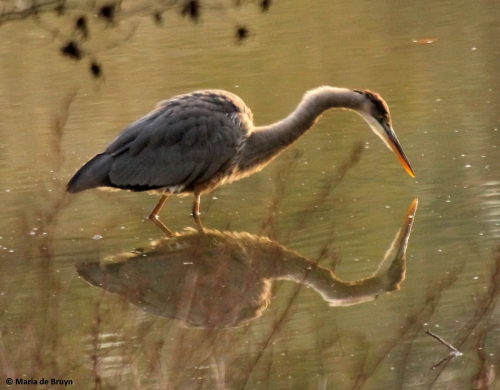
Great blue herons, the largest North American heron species, have a varied diet that includes small fish, as well as shrimp, crabs, rodents, other small mammals, frogs, salamanders, lizards, snakes, crayfish, dragonflies, grasshoppers, aquatic insects and even small birds. Their main hunting technique is to wade slowly in shallow water, sometimes diving headfirst into the water to quickly spear their prey with their sharp long bills.

Great blue heron IMG_9216© Maria de BruynGreat blue heron IMG_9158©Maria de Bruynres

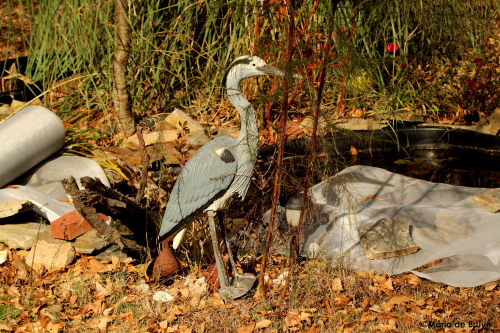
Covering my pond with netting was not an option. I had used netting to protect some plants and then had to rescue a small bird and an anole that had gotten tangled up. The owner of the store where I bought my fish (sadly closed now after many decades of running their family business) recommended I buy a life-like statue of a heron to position by the pond. He had done this at his own pond and said it kept the herons away as they are solitary hunters and don’t want others in their territory. He said Big Blue would see the statue and fly on. So I installed the statue, changing its position from time to time.

This seemed to work for many months but the past weeks I was very busy and didn’t change the stationary bird’s place. Then I noticed that my family of three bullfrogs were gone and Big Guy had gone missing (all the fish would come to the surface when I gave them pellet meals and Big Guy was gone. A gorgeous red, black and white goldfish with wavy fins was also gone. Inexplicably, the statue was also facing a different direction!

Fishy IMG_8951© Maria de Bruynres

Goldfish IMG_8917© Maria de Bruynres

Apparently, Big Blue must have had a tussle with the imposter and discovered he was not real, leaving him free to take up fishing in my pond again. I realized this about 2 weeks ago, when I saw Big Blue at the pond’s edge. I ran out to chase him off and he flew up to a neighbor’s tree. Now the pond is partly covered with some metal fencing laid over one end; it has tiny holes so no animals can get caught in it. The fish can hide under that and the smaller birds can still perch on sticks to get a drink. As it’s getting colder, the fish are also going into hibernation so – hopefully – they will make it through the winter!

Heron statue IMG_2917©Maria de Bruynres

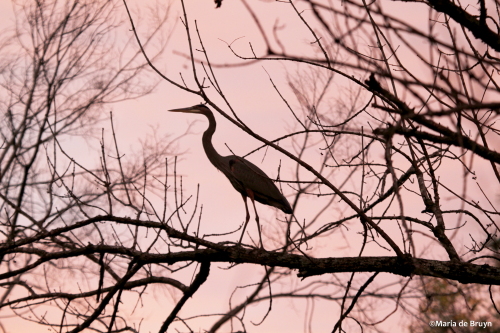
I have never seen Big Blue with a mate at the large neighborhood pond and sincerely hope that he will remain a bachelor. I admire his beauty but don’t want a family of herons using my pond as a restaurant!

IMG_0108©Maria de Bruynres

Next blog: Caterpillars with fuzzy hair-dos