Squirrels love fruit!

eastern gray squirrel IMG_1449©Maria de Bruyn res

As you may know, our furry, agile, smart little friends, the Eastern gray squirrels (Sciurus carolinensis), are fond of all kinds of vegetable matter. Acorns, nuts and seed are a favorite: they will chew through the screen of a backyard porch to get to bird seed (as my neighbors learned after leaving a bag of it there), chew through the plastic lids of food buckets in which I was keeping bird seed outside (the seed is now kept indoors) and spend lots of time contemplating how they can overcome baffles and other barriers designed to keep them off bird feeders.

At my house, they are somewhat lucky since I also put some seed under feeders for the ground-feeding birds such as dark-eyed juncos, white-throated sparrows, mourning doves, Eastern towhees and sometimes Northern cardinals and blue jays. The squirrels will amiably scurry about beside the birds to consume some sunflower seeds or millet. I also give the squirrels a treat now and then by putting out fruit bought from the reduced-produce rack at the supermarket, where I can buy veggies that the supermarket would otherwise throw away.

IMG_8399©Maria de BruynEastern gray squirrel IMG_5039©Maria de Bruyn

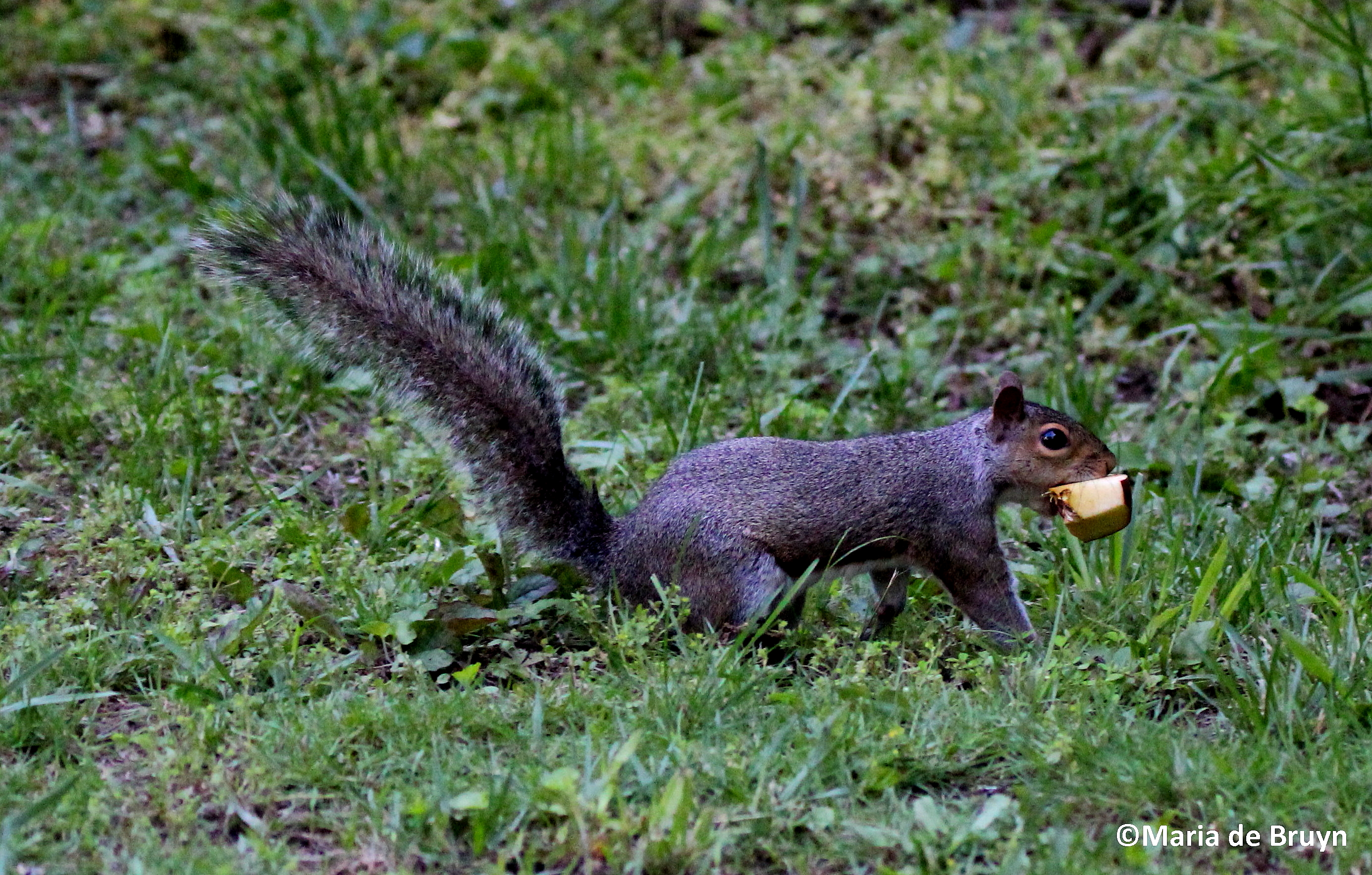
Apples are a common treat and the squirrels often eat those on the spot, although they may feel a need to carry away their meal to enjoy it at some distance from their family members. Blueberries and plums are nice, too.

Eastern gray squirrel IMG_7166©Maria de BruynEastern gray squirrel IMG_3723©Maria de Bruyn 2013 (2)

The squirrels’ tastes in fruit have surprised me on occasion though. After learning that banana peels mushed up at the base of azaleas will help their growth and blooming, I took to putting overripe bananas by those plants. Sometimes, when checking the next day, I would find the peels someplace else in the yard and then realized that squirrels enjoy a tasty banana now and then. When I put out oranges in an attempt to attract orioles, the citrus didn’t last long once the resident tree rodents discovered them.

eastern gray squirrel IMG_8424©Maria de Bruyn

Squirrels will hoard food for later consumption, hiding the fruits of their labor in numerous spots around their territory. According to Wikipedia, each squirrel will make several thousand such caches every season! If they think they are being watched, they will also pretend to bury food in a cache, while actually hiding the morsel in their mouth to bury it someplace else later. Clever indeed!
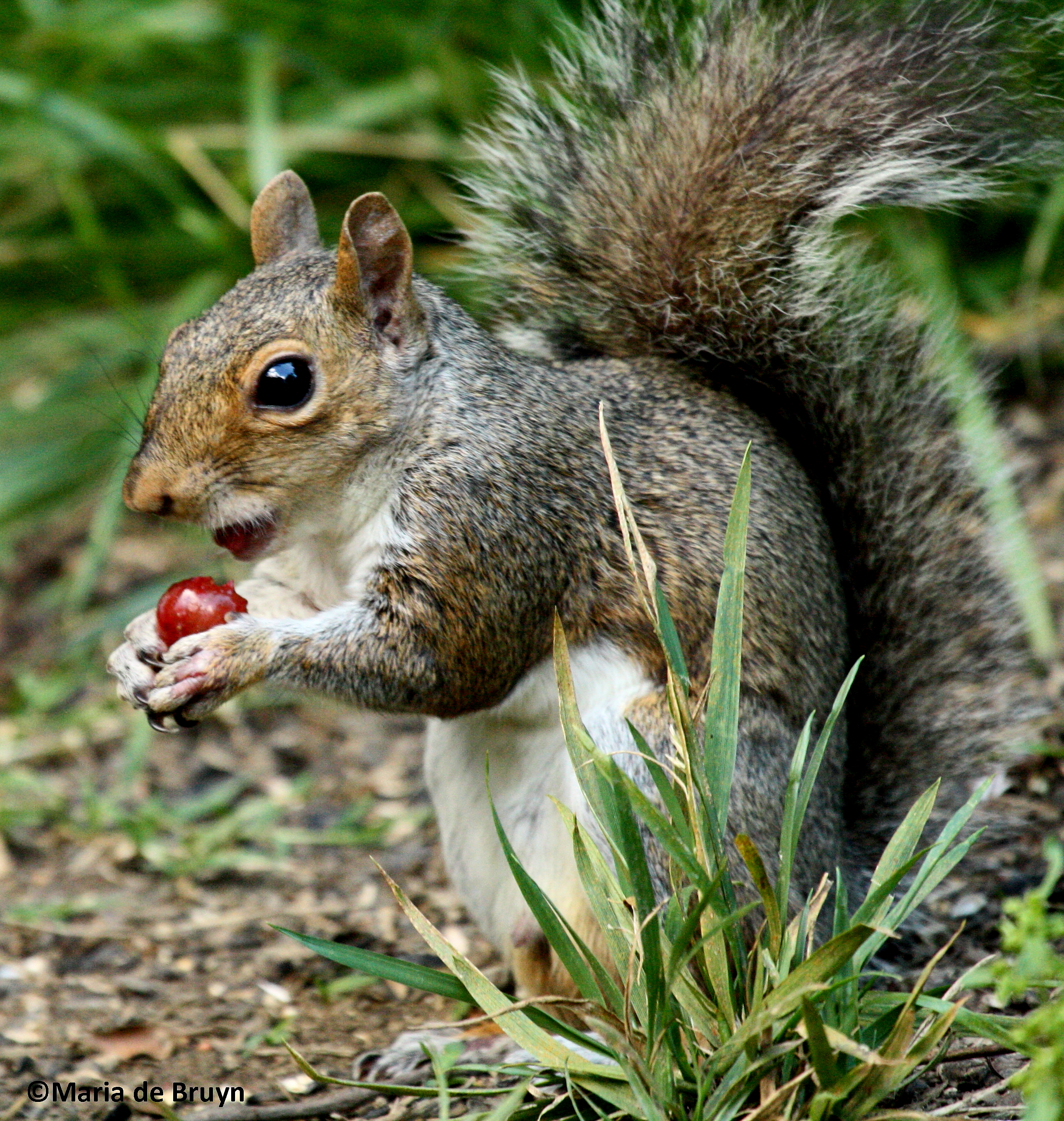
Eastern gray squirrel IMG_8965©Maria de BruynI must admit, though, that I had not expected to see a squirrel assiduously burying grapes one day. Researchers have found that that they will eat the most perishable acorns right away, while caching those that will stay preserved the best. So what made this squirrel think that the grapes she was burying would last underground? Unless this was one sneaky squirrel who was just temporarily hiding her/his bounty until s/he could enjoy those grapes in relative solitude.

I’m looking forward to spring when I can sit outside to watch the squirrels ‘ behavior some more; the yard can be a real learning lab!

For more information see: http://articles.courant.com/2004-10-21/features/0410210319_1_squirrels-bury-acorn

Do deer like treats? Of course, they do!

deer bird seed IMG_3127© Maria de BruynAnyone who has lived in proximity to white-tailed deer (Odocoileus virginianus) know that they have a great appetite for all types of vegetation, including garden flowers that people plant in their yards. This has been a cause of strife between humans and the deer (at least, from the humans’ point of view), even though I and other people have found that deer repellants – both home-made and store-bought – work really well to keep deer from eating plants we wish to keep.

I also have a 5-foot fence around my vegetable garden. In theory, the deer could jump this but the trick is to make the garden long and narrow since the deer calculate how much space they have to land on the other side of the fence. If it looks like the space is too small, they won’t try to jump eveIMG_5431© Maria de Bruynn if they see and smell delicious veggies inside – I know this is true as I’ve watched them figuratively “lick their lips” outside my garden but never attempt to get into it.

The deer’s four-chambered stomach enables it to eat a variety of food. In spring and summer, they prefer green plants, including grasses; in the autumn, they go for corn, acorns and other nuts. In the winter-time, deer eat twigs and buds of trees. They also eat fruit, such as the berries on privet trees, lichens and other fungi.

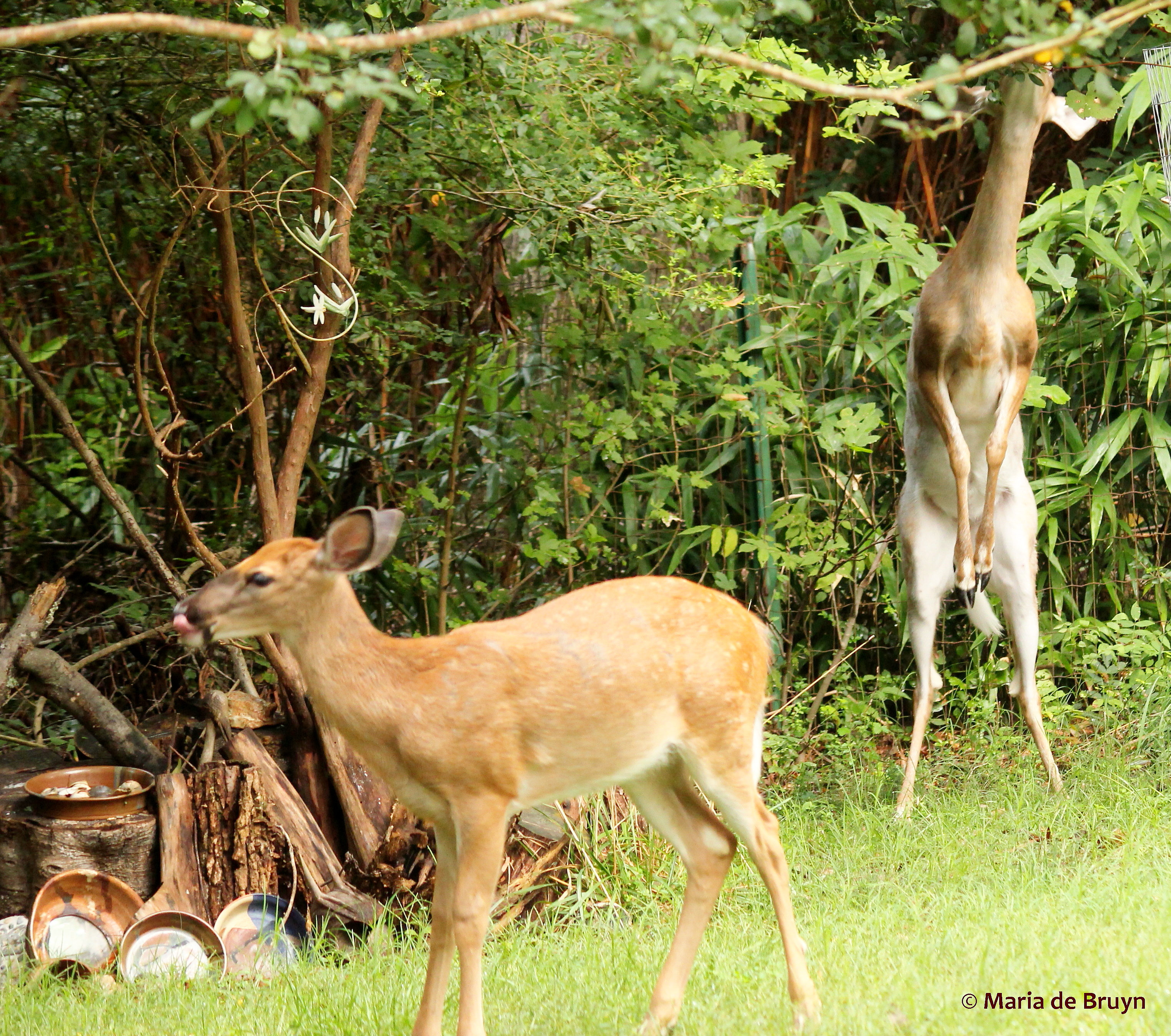
Stip at apple treeStip and privet IMG_1648© Maria de Bruyn

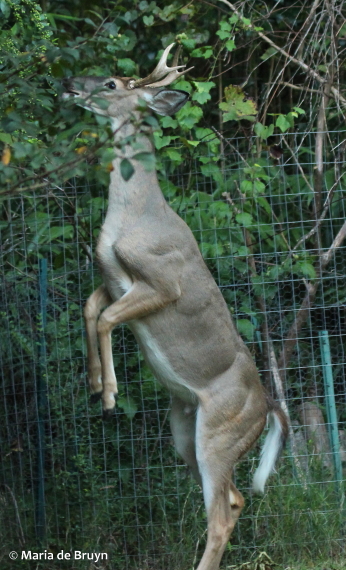
To get to the privet berries, they need to reach the tree branches and their good sense of balance comes in handy. The does do it often in my back yard and the fawns watch them carefully so they can try it, too. Surprisingly, the fawns can stand on their hind legs pretty well when they are only a few months old.

Nezhoni and apple tree 3©Maria de BruynBuck and privet IMG_5243© Maria de Bruyn

Besides privet berries, they like grape leaves (which can be high when the grapevines climb up the privet) and apples. The big bucks will also have a go at it but I don’t see them lifting their bulky bodies up often.

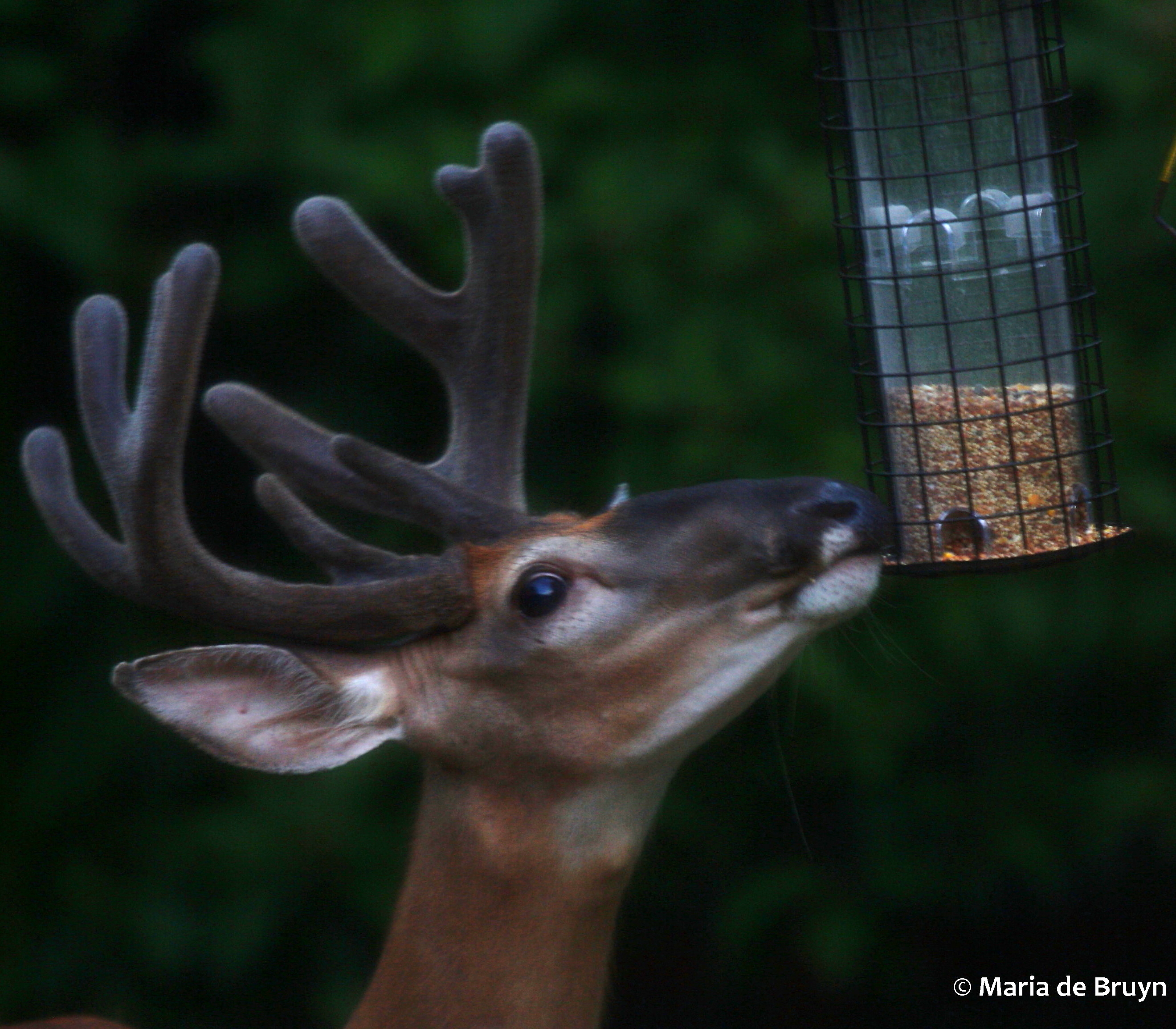
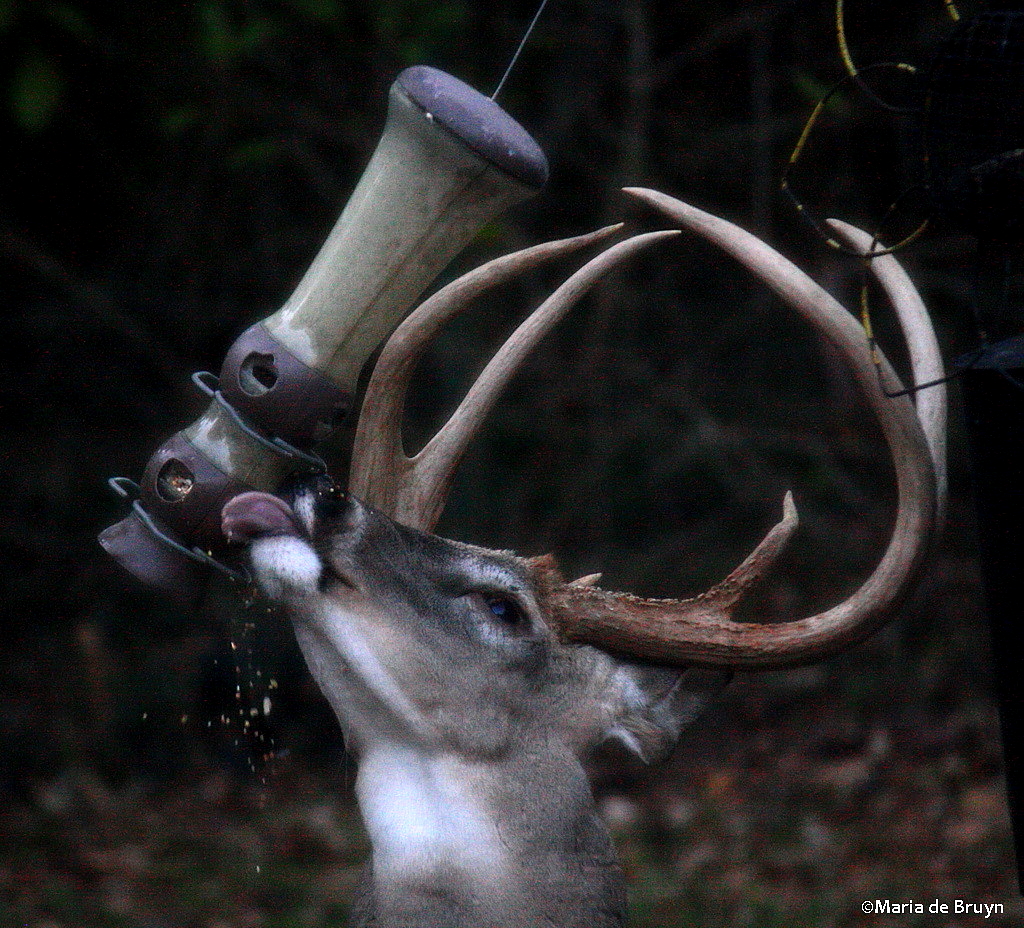
The deer also enjoy treats, just as we may like sweets and birds have a fondness for suet. Bird seed is one treat they like. If the deer are very hungry, they can lick up all the bird seed put out for the ground feeders, but when they are feeling well fed, they will just have a little and leave seed for the birds (and squirrels). The deer’s fondness for bird seed can be strong; if you don’t hang your feeders high enough, they can clean out a feeder in a short time.

emptying bird feeder at night©Maria de Bruynwhite-tailed deer MdB 3 buck

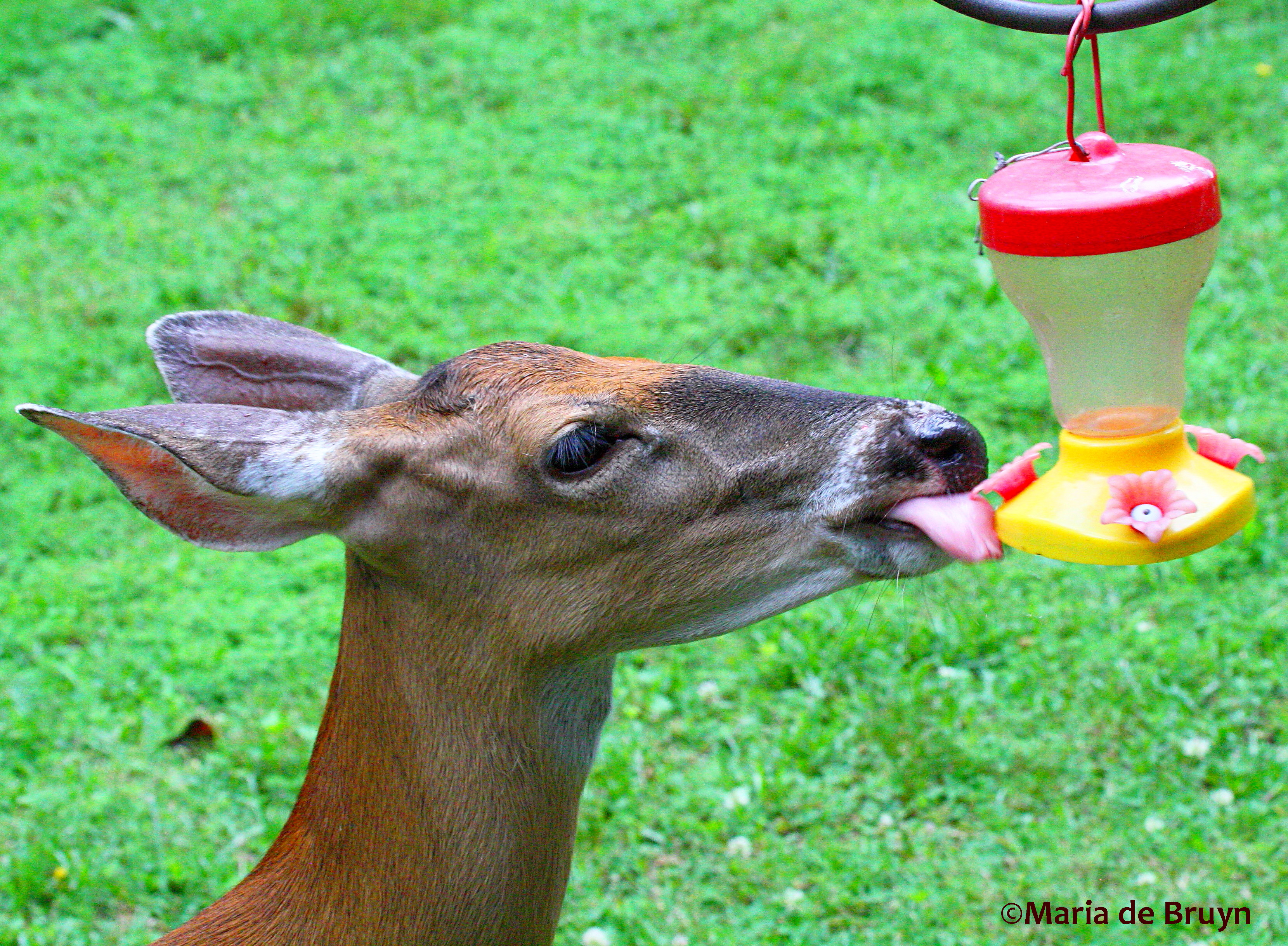
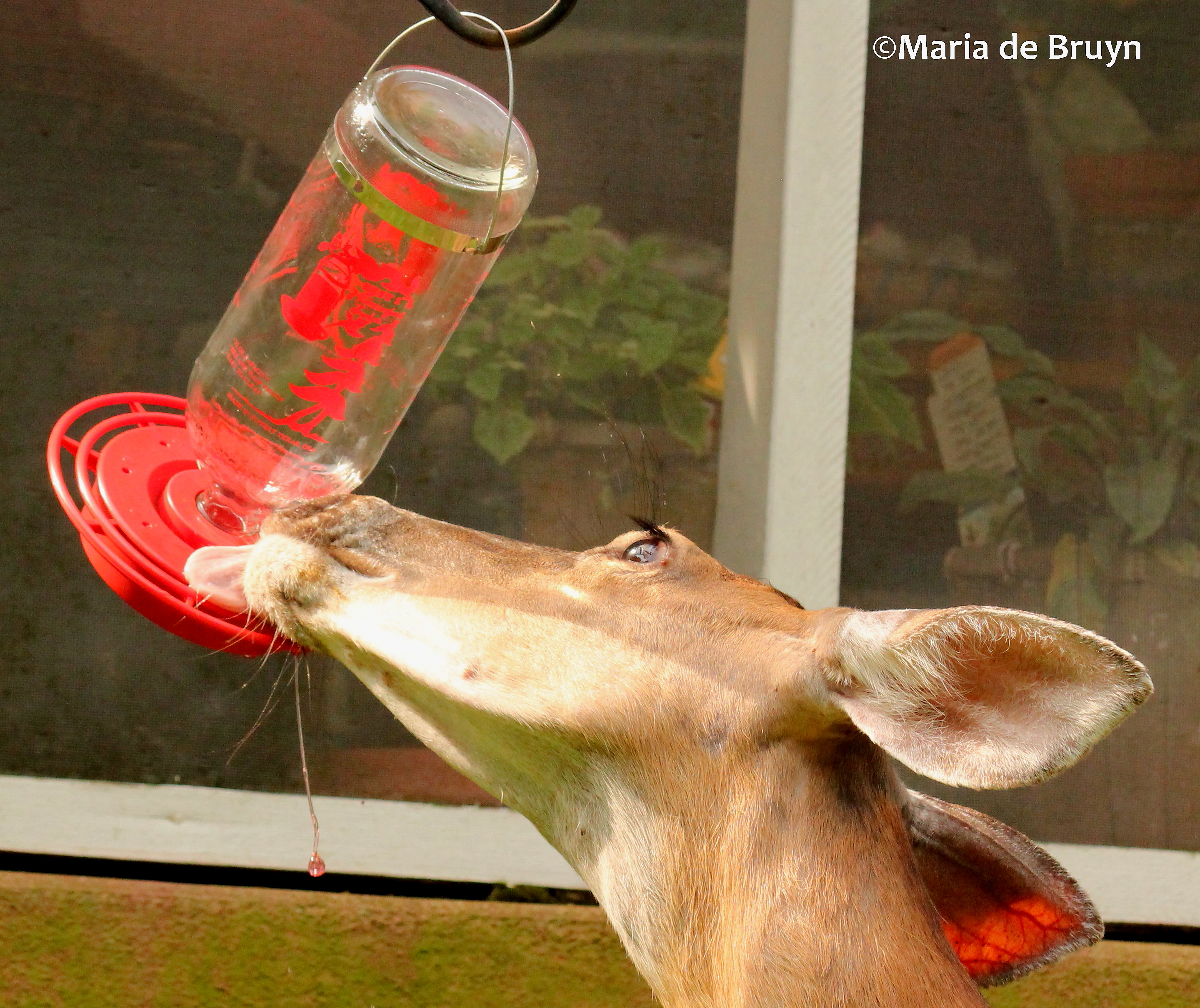
My biggest surprise concerning a deer treat came from Schatje, my “dear deer” friend of five years. One summer, I noted that the hummingbird feeder was emptying quickly and I just thought the hummers were very thirsty. Then one day, I looked outside to see Schatje enjoying a sweet drink. It turned out she was extremely fond of nectar and eventually I had to hang the feeder higher so she wouldn’t drink all the contents a couple times a day!

white-tailed  deer Schatje 1 ©Maria de Bruyn signedSchatje nectar IMG_1727©Maria de Bruyn

This winter has been especially cold and the local deer family have had to rely on their winter diet of fungi, leaves and twigs a lot. Though they likely are not anticipating spring, I’m sure they will be glad when it gets here, just like me!

Next week: squirrel treats

Belted kingfishers and me

Belted kingfisher IMG_9360f© Maria de Bruyn

Since my “career” as a birder is still rather short, especially in comparison to some birders I know, I still quite regularly see “lifers”. These are first-time spottings of birds in the wild when you can identify them reliably. While I enjoy seeing the more common birds in my area time and again, it is the lifers that often evoke a happy grin when I get a good photo. More often than not, though, my first photos of a lifer are a bit blurry, partial as the bird is hidden in foliage or otherwise imperfect. It is only with repeated sightings that the photos seem to improve – though that also isn’t always the case.

An example of this is my “relationship” with the belted kingfisher (Megaceryle alcyon).  Although worldwide there are more than 90 species of kingfishers, the United States and Canada only have three and it is the belted variety that is most often seen. “Belted” refers to the band of bluish-gray color across the white underparts of the bird’s body; both males and females have this. Females also have a reddish color band, making them even more attractive than the males, which is not so usual among our avian friends.

The first time I saw a belted kingfisher was in October 2012; it was Belted kingfisher IMG_9690Dacross Jordan Lake, about a 30-minute drive from my home, in a tree. Only when it flew by once at high speed was I able to get a half-way decent shot of what I think was a female.

My next sightings were in a mangrove swamp in Mexico in December 2013. One day, I saw a female fly by over the mangrove trees in the distance.

Belted kingfisher IMG_9364F© Maria de BruynTwo days later, at the same place, I saw male. What was exciting about that spotting was that the bird began fishing right in front of me. He would circle the swamp, hover a couple seconds and then fold his wings to drop like a bullet into the water, completely submerging. The action was fast and my photos were blurred again, but I was able to document that he had caught a meal.

Belted kingfisher IMG_1853© Maria de BruynBelted kingfisher IMG_1855© Maria de BruynBelted kingfisher IMG_1860© Maria de Bruyn

Belted kingfisher IMG_1864© Maria de BruynBelted kingfisher IMG_5279©Maria de BruynresMy fourth sighting was in the late afternoon this past week, January 2014. As I was walking in a forested area near a creek, I saw a flash of a blue head and white on the wings and at first thought that a blue jay had streaked by me. But then the odd, kind of loud warbling call caught my attention – it was definitely not a jay. The bird perched on a tree limb about 100 feet or more ahead of me and I suspected that it might be a kingfisher but doubted it, too, as I thought they needed to be around more open bodies of water. This is not the case – they just need to be around water that doesn’t freeze over so they always have access to their fishy diets, as well as amphibians, small crustaceans, insects, small mammals and reptiles. They nest in burrows dug horizontally into the banks of waterways and both parents cooperate in feeding and raising the young.

Belted kingfisher IMG_5442©Maria de BruynresBelted kingfisher IMG_5388©Maria de Bruynres

I began taking photos from far away as I neared the kingfisher; when I would get within about 30 feet, he would take off again. This scenario repeated itself over and over again as I tried to get some shots of the bird not hidden by branches, twigs and dried foliage. I finally did get some photos, again not of the best quality as it was getting towards dusk and the bird was still pretty far away.

Belted kingfisher IMG_5420©Maria de BruynresBoth sexes have a dark head with crested feathers and quite large bills; this juvenile – male, I believe – showed his crest over and over as he called and bobbed up and down on his various perches. I think it is the crest that helped give him a – what struck me as – crabby look. He was very impressive though.

Belted kingfisher IMG_5442©Maria de Bruynres

When I next see a belted kingfisher, it won’t be a “lifer” sighting but my goal now is to get a good close-up shot; time will tell if I succeed!

Next blog: deer and their efforts to get food

Owls – raptors with fantastically functional feathers

Barred owl IMG_9617© Maria de Bruyn resThe owl is the wisest of all birds because the more it sees, the less it talks. – African Proverb

The world likes to have night-owls, that it may have matter for wonder. – German proverb

Sayings about wise owls are well known and may account for the names given to a group of owls – a wisdom, study or parliament. On the other hand, in some cultures, owls are associated with bad luck, death and the stealing of souls. Owl fossils date back as far as 58 million years ago! These appealing birds have been depicted in in cave paintings in France, in Egyptian hieroglyphics and in Mayan art. There are about 200 species of owls around the world and they are found on all continents except Antarctica and a few remote islands.

Owl anatomy

Barred owl eye feathers IMG_9802©Maria de BruynresOwls have interesting anatomical features. Like humans, they have binocular vision as a result of their upright posture and forward-facing eyes. A circle of feathers around each eye, as seen in the barred owl  (Strix varia) here, can be adjusted to focus and channel sound to their ears (which are asymmetrical in many species!). These feathers can magnify sound as much as 10 times, giving them acute hearing.

Barred owl IMG_9832©Maria de Bruyn signed res

Like bald eagles, owls have three eyelids: one is used to blink, another for sleeping and the third – the nictitating membrane – helps them keep their eyes clean and healthy. Because they cannot turn their eyes within their bony eye sockets, owls must rotate their heads up to 270 degrees to look around. They are far-sighted and cannot see clearly right in front of their eyes, but their distance vision is very good, especially in low light.

Barred owl IMG_9117©Maria de Bruyn resOwl feathers have fringes with different degrees of softness, which helps muffle sound when they fly.

Screech owl IMG_3069©Maria de Bruyn resSome owls, like the Eastern screech owl (Megascops asio) have tufts of feathers on their heads; the function of these might be to indicate a bird’s mood, to show aggression or to help keep the bird camouflaged.

Screech owl rehabilitated by CLAWS that serves as an educational bird

Behaviors

Different owl species make different sounds for finding mates or announcing their presence to potential competitors. These sounds help ornithologists and birders locate and identify species.  For example, the barred owl is said to have a call that sounds like “who cooks for you?”

These carnivorous birds usually swallow their prey whole (depending on the size of the animals such as fish, mice, rats, hares). Scientists who study their diets use owl pellets as an aid; the owls regurgitate bones, scales and fur in these pellets. The larger owls will also detach body parts they don’t wish to eat. For example, colleagues speculated that it was a great horned owl (Bubo virginianus) that took down a red-tailed hawk (Buteo jamaicensis) at a local nature reserve recently, leaving behind an entire wing that wouldn’t have provided much nutrition.

great horned owl IMG_3065©Maria de Bruyn resred-tailed hawk IMG_2745©Maria de Bruyn res

Great horned owl rehabilitated by CLAWS in Chapel Hill, NC. This bird was shot in the eye and cannot be released again; it serves as an educational bird.

The main threats to owl survival today include habitat loss, pesticides and human predation due to negative superstitions. There are fortunately efforts to preserve owls where they may be seen as beneficial. For example, a barn owl may eat up to 1000 mice each year, so that farmers try to attract them to help control rodents in agricultural fields. Projects to re-introduce barn owls (Tyto alba) are taking place in the Czech Republic and the United States. The local Audubon Society to which I belong has a barn owl project, in which they have placed barn owl nest boxes in various places in an effort to attract these birds as more permanent residents. It would be very cool to see the boxes occupied one day!

Barn owl project IMG_6412© Maria de BruynBarn owl box IMG_2501©Maria de Bruyn

Check out CLAWS, a wildlife rescue and rehabilitation center in North Carolina! http://www.nc-claws.org/

Deer and their curiosity

Don-tso and Schatje were both very sweet animals who enriched my life, but they were very different personalities. Don-tso, whose Native American name represented a spirit who sits by your shoulder and warns you of danger, lived up to that name. She was a delicate small cat, rescued as a feral kitten from the streets of Amsterdam, who remained anxious and extremely cautious throughout her life. Even after a decade, I could not approach and pick her up; time spent on my lap was always on her terms and at times of her choosing. She was nevertheless very loving and brave.

Schatje (Dutch word for “dear”) was a wild deer who chose to befriend me and one other neighbor, approaching us as a young doe. We are usually warned not to let urban deer grow accustomed to us as this can endanger them – when they trust people, it makes them vulnerable to those who want to hurt or eradicate them. Schatje was so persistent, however, that I broke that rule and got to know her very well over a five-year period.

Jonahay and Schatje IMG_1752 ©Maria de BruynBoth Don-tso and Schatje were very curious. This came home to me one summer day when a strange incident occurred. My other cat, Jonahay, had become agitated when Schatje came near and when I tried to move him away, he displaced his aggression and attacked Don-tso who was nearest to him. As I tried to intervene between Jonahay and Don-tso, I felt a nudge behind me – Schatje had marched up and was trying to get a good look at what was happening! As she approached, little Don-tso gathered up her courage and stood her ground – she was actually ready to spring at Schatje, who was considerably larger! I finally got Don-tso and Jonahay into the house and things calmed down.

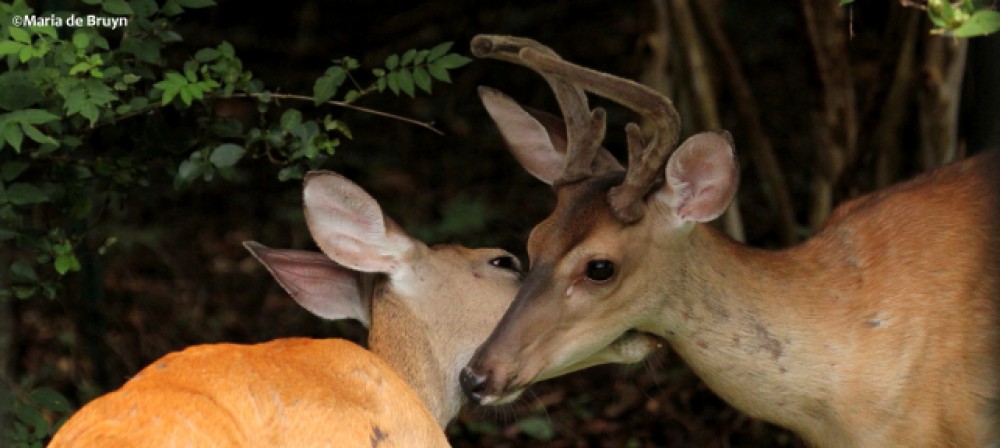
Don-tso says not too close M de BruynOver the years, as I’ve watched Schatje’s family and other deer visit my yard, it’s become apparent how observant and curious they are. Undoubtedly, their curiosity plays a role in their survival skills – it pays for them to notice changes in the environment that could pose a danger or threat to their well-being. Sudden changes – movement and sound – will evoke the well-known white-tailed deer response where they raise their tails like warning flags and stamp their feet.

Ne-zhoni alarm©Maria de Bruyn

In other cases, however, when something in the environment has changed during their absence, they will investigate. Scientists believe that this curiosity provides them with information that can be helpful in knowing, for example, where they might find new sources of food or possible obstacles in their way when they want to make a quick escape. When I have made new additions to my yard, some of the deer – most noticeably Schatje and her offspring – have taken quite some time to examine them through sight, smell and touch.

Schatje looks at bird photo ©Maria de Bruyn

If new yard art moves, it may take a while before they approach and some individuals will never get close. Others are braver, however, like these young ones; the doe exploring the whirling bird did so after about four days of cautious investigation, coming a bit closer each day.

deer with whirling bird IMG_5574© Maria de Bruyn resattracted to toys ©Maria de Bruyn

 The deer can also be curious about other animals, like this fawn who wanted to get close to a squirrel – who definitely was not interested in any togetherness.

Deer with squirrel IMG_2151©Maria de BruynWhile I may not meet another deer who is as trustingly curious as Schatje, her descendants will most likely continue to explore my yard and satisfy their curiosity about any changes happening here. And in doing so, they will help satisfy some of my curiosity about deer behavior!