Resplendent remiges and rectrices – bird beauty from behind

The other day asMourning dove IMG_6565©Maria de Bruyn res I was photographing birds at my feeders, I was struck by the beauty of this bird’s feathers as they lay across its back. The muted colors are wonderful and the scalloped-edge pattern is marvelous. It made me take a look at other birds’ feathers as seen from behind and how they vary in position and shape. I hope you enjoy this short tour and have some fun identifying the birds shown – many are very easy for experienced birders but perhaps some are not for beginning birdwatchers. The answers will be added to the blog next week.

So, we are focusing here on flight feathers, namely the remiges and rectrices. The remiges – or wing feathers – help the bird get lift when flying and support the bird during flight. The rectrices – tail feathers – give the bird stability and provide control.

Red fox sparrow IMG_5745© Maria de Bruyn resHouse finch M de Bruyn resCardinal IMG_6227©Maria de Bruyn res

The outer “vane” (part of the feather above the shaft) is narrower than the inner vane, so the wing feathers are asymmetrical. The tail feathers, on the other hand, are symmetrical in shape and pattern. The “primary” wing feathers are narrower and can be rotated individually, while the secondary remiges are shorter and lie together, even when the bird is flying.

In some species, the wing feathers may reveal a spot of color on the bird’s back when they are not folded completely over one another.

Yellow-rumped warbler IMG_6461©Maria de BruynresHouse finch IMG_6255©Maria de Bruyn res

The feathers also serve other functions, such as keeping the bird warm and dry.

Ruby-throated hummingbird IMG_4221©Maria de BruynresMandarin duck IMG_1605©Maria de Bruyn resHoopoe IMG_4314©Maria de Bruyn res

In some species, the males develop especially resplendent rectrices in thRed-collared widowbird 390©Maria de Bruynreseir breeding plumage – a definite attempt to attract mates.

Interestingly, the total weight of a bird’s feathers is about 2-3 times more than the weight of its bones!

One final quiz question – which bird has the fewest overall feathers and which species has the most?

Next week: curious deer

Weaver birds – avian architects par excellence!

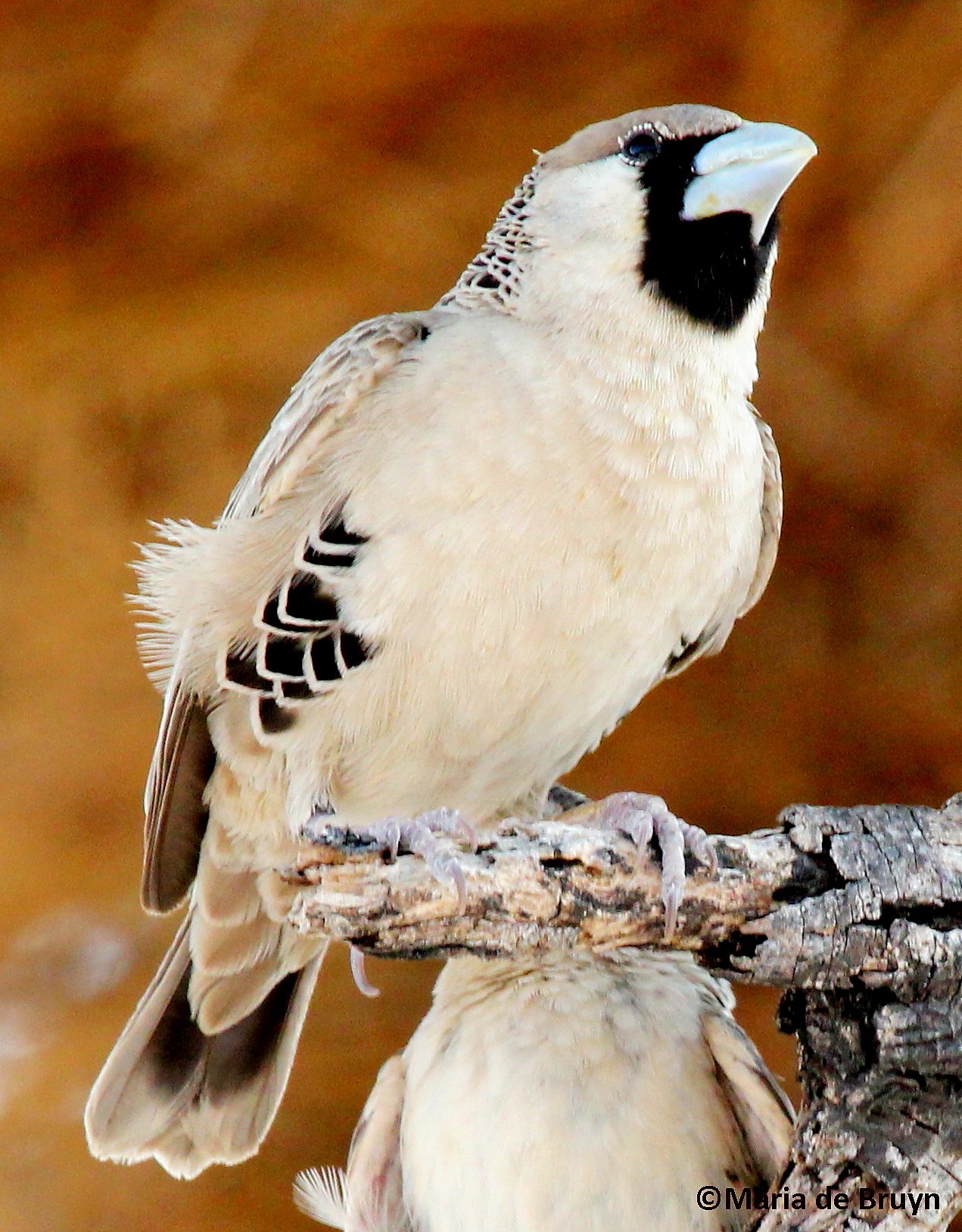
sociable weaver IMG_4297©Maria de BruynWatching different species of birds build their nests in the spring can be quite entertaining, but the most amazing nests that I’ve been privileged to see can’t be found in my immediate environment — those of the sociable weaver birds (Philetairus socius geminus), which I encountered in Namibia. (Their architectural feats are rivaled by those of the bower birds, which I haven’t been able to see in person yet – maybe one day!).

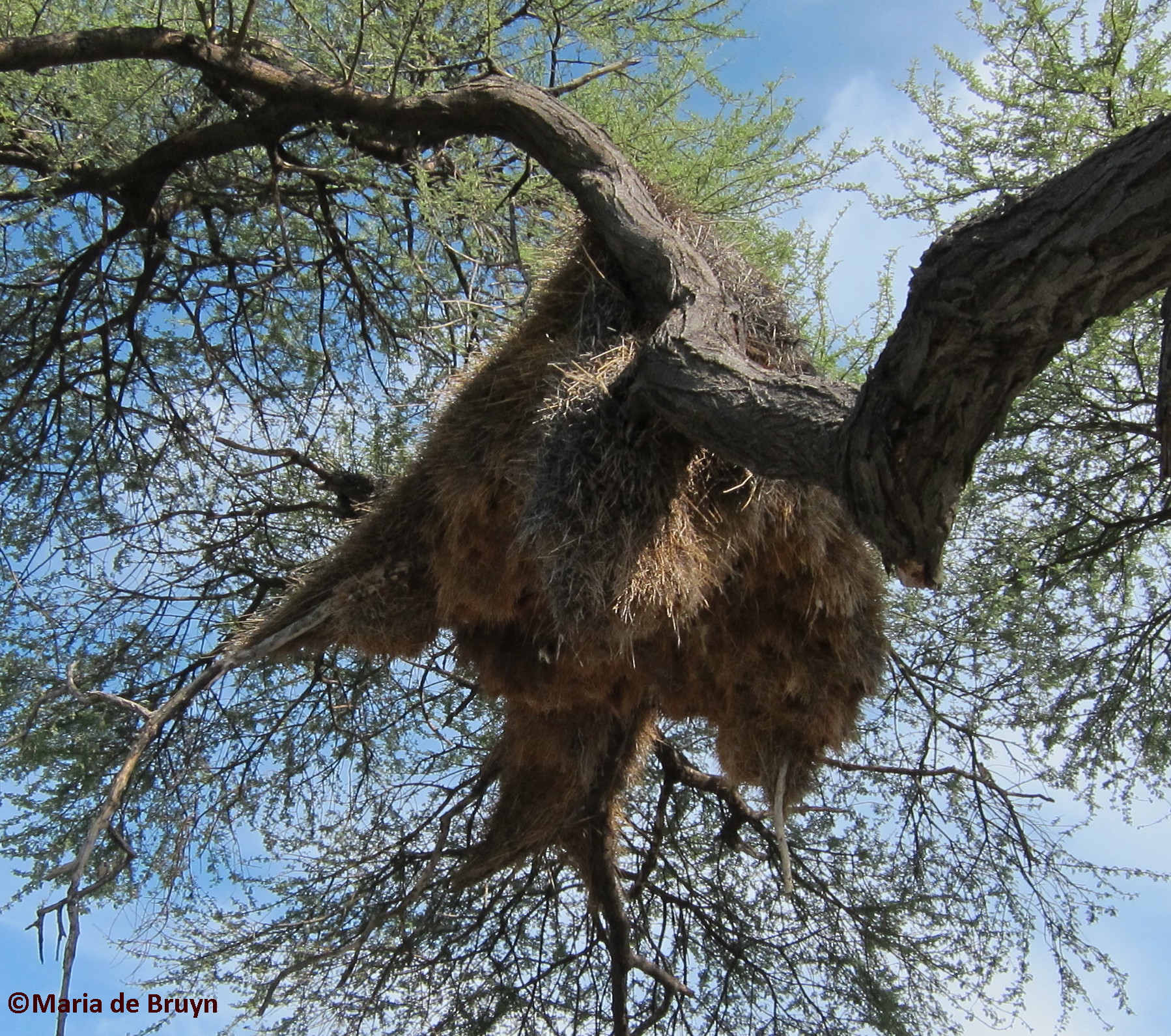
The sociable weavers are birds native to Southern Africa, where stiff grasses grow that are a main component of their large communal nests. The males build these shared homes in trees and on telephone and utility poles; they are the largest nests built by any bird and can house more than 100 pairs of several generations. Some nests have been occupied for more than a century and may weigh several tons!

Sociable weaver bird nest IMG_6610 ©Maria de Bruynres

sociable weaver bird nest IMG_6604©Maria de Bruyn

The nests are a technological marvel, highly structured and providing a more advantageous temperature inside compared to outside. The central chambers retain heat and are used for roosting at night. The birds use the outer rooms in the daytime to get some shade. The nesting chambers are lined from top to bottom with soft plant material, fur, cotton, and fluff, while sharp spikes of straw or twigs protect the entrances against predators such as Cape cobra snakes. Some birds appear to be caught, however.

sociable weaver IMG_4290©Maria de Bruynsociable weaver birds IMG_4284©Maria de Bruyn

The sociable weavers may not breed during periods of low rainfall and a considerable number (sometimes more than half) of the birds in a colony may not breed in a given season. Under typical conditions, sociable weaver birds raise up to four broods per breeding cycle, with nearly all pairs being assisted by helpers; for example, older birds may help care for younger siblings and unrelated hatchlings. Interestingly, other species of birds may also share these nests, including red-headed finches, rosy-faced lovebirds, pied barbets, familiar chats, ashy tits and pygmy falcons.

 baglafecht weaver IMG_1506 MdBweaver bird nest IMG_3560 ©Maria de BruynBaglafecht weaver (Ploceus baglafecht) in Kenya

Among other types of weaver birds, the males also are the nest builders, hoping to attract females with beautifully constructed homes. They can use their strong, conical beaks and feet to actually tie knots in the grasses used to form the nests, making the nests sturdier.

Weaver bird nests IMG_6570©Maria de Bruynresweaver bird nests IMG_6552©Maria de Bruynres

The male sparrow weavers of Africa build “apartment-house” nests, in which numerous birds live in separate but neighboring flask-shaped homes that are entered through tubes at the bottom.

The buffalo weavers, on the other hand, make large stick nests that are untidy outside but may have spherical woven nests inside.

red-billed weaver ©Maria de Bruyn

Red-billed buffalo weaver (Bubalornis niger) in South Africa

The bluebirds and robins here can make some nice-looking nests, but the weaver bird nests are among my real favorites!

Next blog: to be determined!

Caterpillars with fuzzy hair-dos

This past year, I was having trouble getting good shots of birds hidden in foliage so, inspired by fellTiger moth caterpillar 3 IMG_8012©Maria de Bruynow contributors to Project Noah, I tried my hand at photographing more insects. This opened up another fascinating wildlife world to me and I’ve been learning about different species of flies, bees, hoppers, and moths.

I had always thought of butterflies as the “beauties” of the insect kingdom but found out that the moths can be simply stunning (another blog to come). Moth caterpillars are really interesting, too – and there are so many kinds with fuzzy bodies. At an early stage, their hairs or bristles (setae) may be short, as seen in this Tiger moth IMG_0332©Maria de Bruynpale tiger moth; as they grow, the setae become longer like those in the dark tiger moth.

TheSycamore tussock moth IMG_0144©Maria de Bruyn Sycamore tussock moth caterpillar (Halysidota harrisii) is a fancy variety, with hairs  that give its face a bit of an “old man” look (droopy mustaches). Though not considered one of the stinging caterpillars (read on to find out about them), the hairs have been known to cause hives if a person touches them. If one lands on you, use a twig or leaf to remove it gently.

The BandeBanded tussock moth IMG_3930©Maria de Bruynd tussock moth (Halysidota tessellaris) shown below also has a beautiful caterpillar with long tufts on its head and posterior.

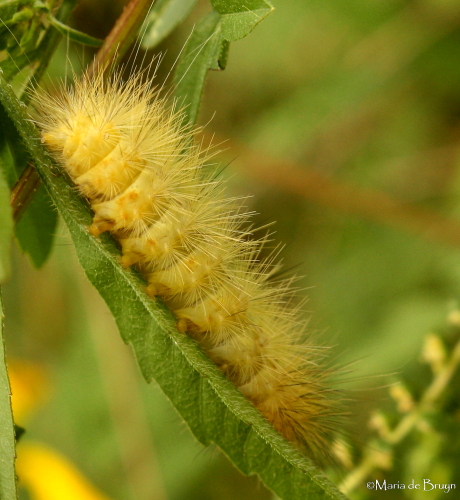
Two caterpillars have been nicknamed woolly bears. The Virginia tiger moth (Spilosoma virginica) caterpillar, which can vary widely in color, is known as the yellow woolly bear in its pale color variation.

Virginia tiger moth caterpillar IMG_0917©Maria de BruynVirginia tiger moth IMG_9202©Maria de Bruyn res

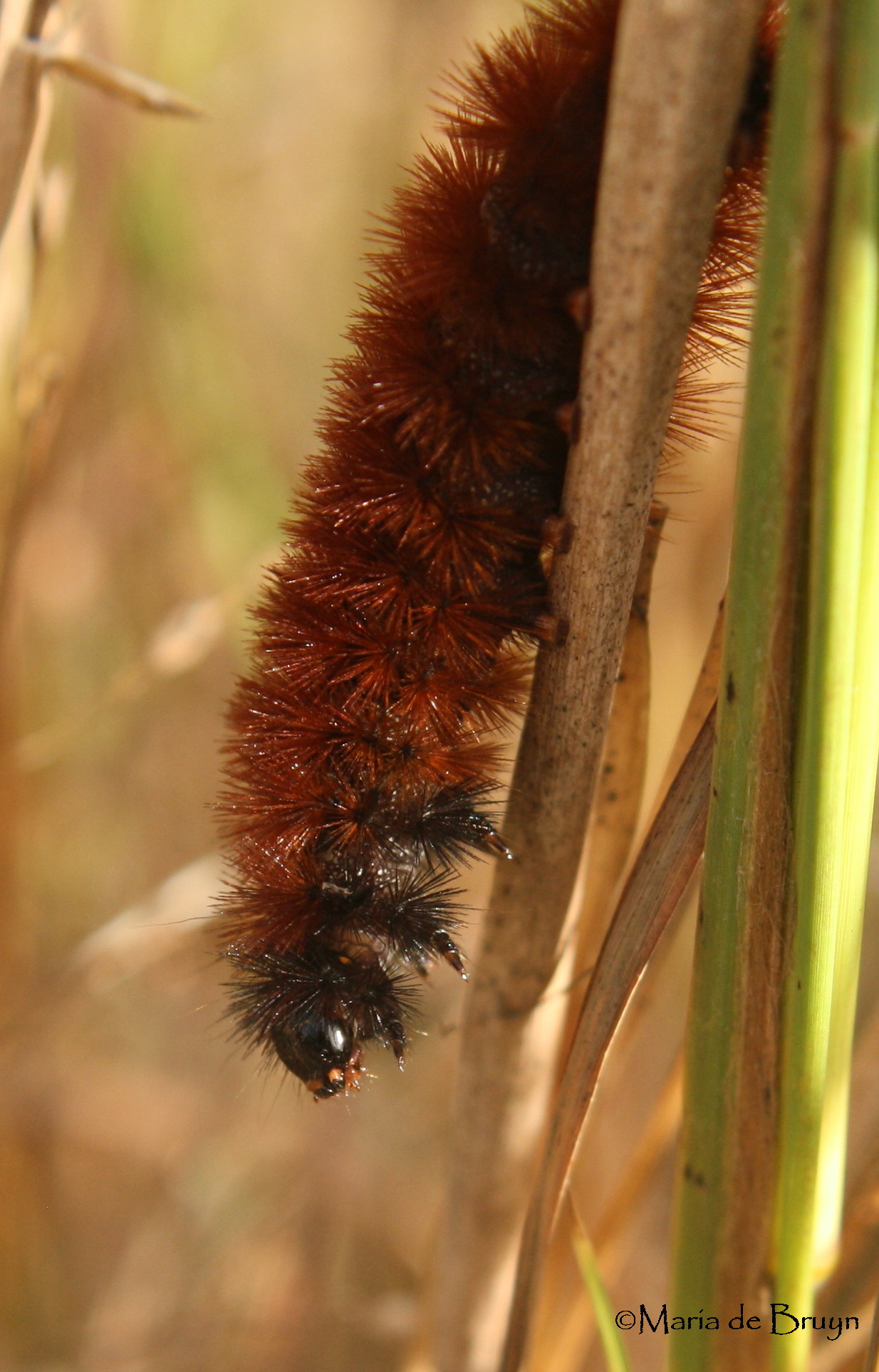
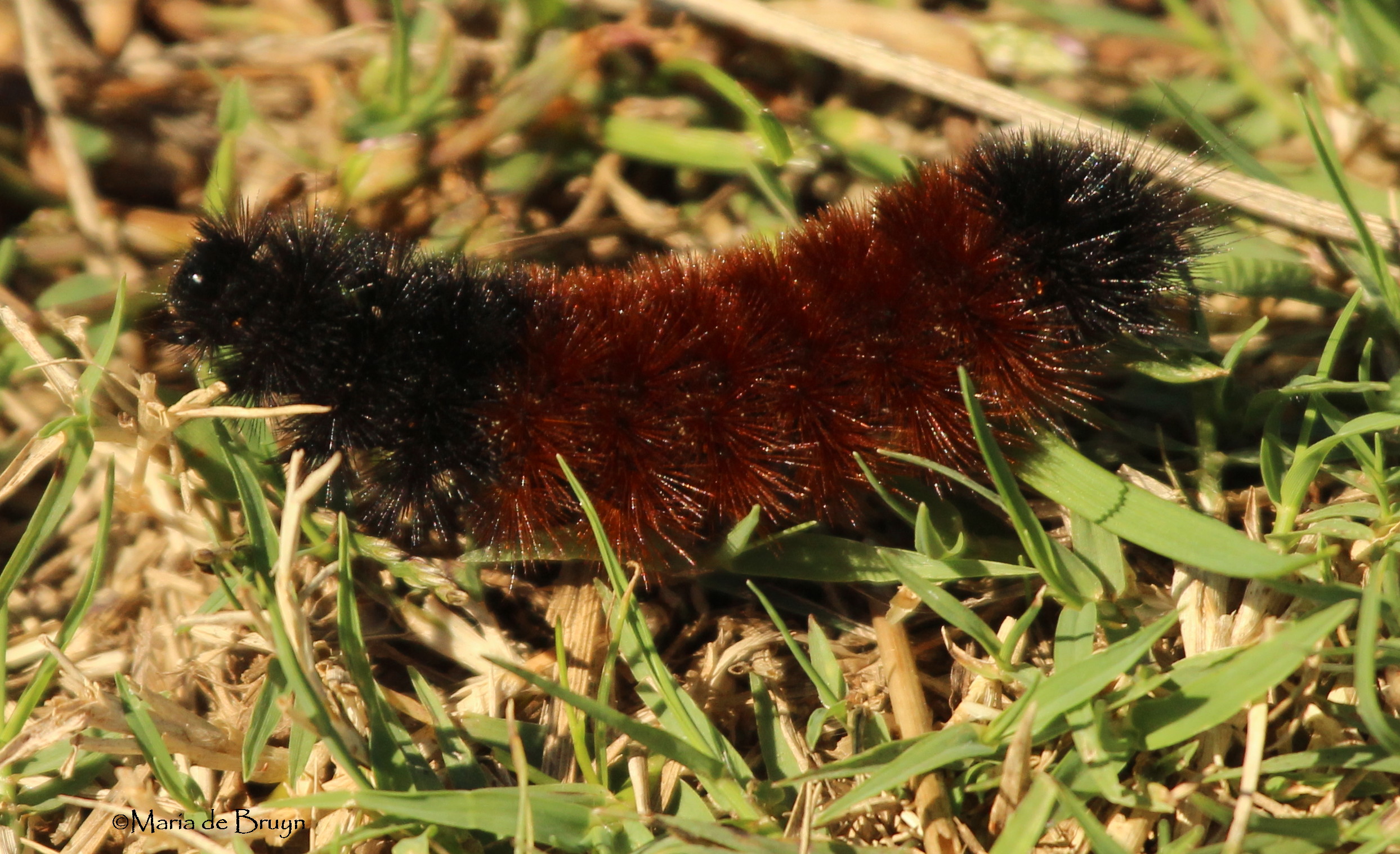
The banded woolly bear caterpillar of the Isabella tiger moth (Pyrrharctia Isabella) even has whole festivals devoted to it in places like Banner Elk, a mountain town in North Carolina. There is a myth that if this caterpillar has a thick brown stripe, the winter will be mild; if the brown stripe is narrow, we will have a severe winter. This year, I saw caterpillars with narrow and wide stripes, so I wonder what it will be.

Isabella tiger moth IMG_8604©Maria de Bruyn

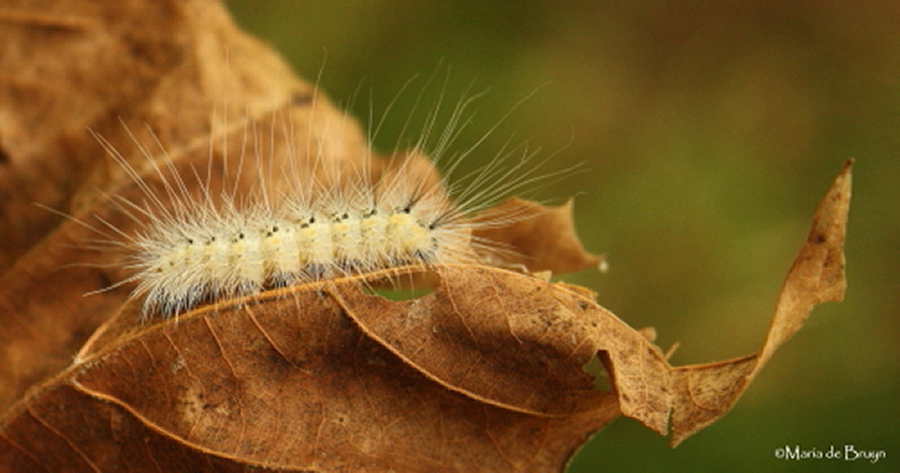
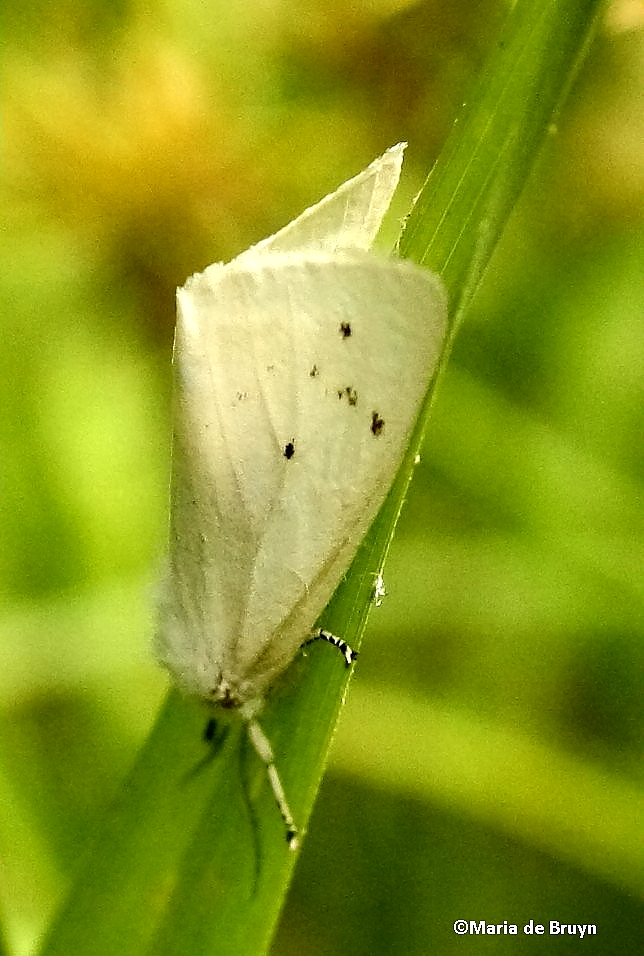
The Fall webworm moth caterpillar (Hyphantria cunea) is especially well-known for the communal webbed nests that they create on shrubs and in trees. They can vary in color from yellow to gray with two light stripes along their sides. The adult moth is a beauty; in the northern states, it is mostly white but in the South it can have dark spots on its fore-wings.

Fall webworm moth IMG_9141©Maria de Bruyn resFall webworm moth Hyphantria IMG_6582 ©Maria de Bruyn signed

Some of the hairy caterpillars are known as “stinging caterpillars”. They do not inject venom like bees and wasps but their hollow hairs contain toxins, which are designed to protect them from predators. When another being – including humans – brushes against the hairs, they break away and release the toxin. This can cause varying reactions, including mild to intense burning, stinging pain and itching. Depending on the species, a person might also experience rashes, swelling and inflammation, numbness and even fever and nausea. The reactions can be especially serious for people with sensitive skin and allergies.

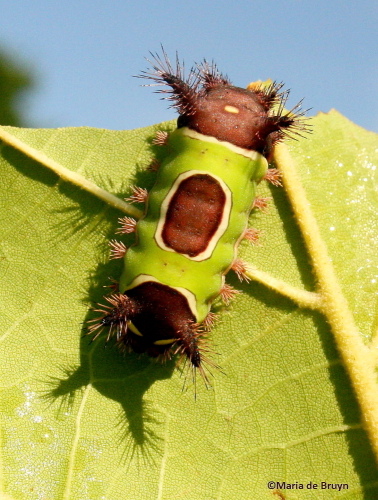
Saddleback caterpillar moth IMG_2647©Maria de BruynresI didn’t know about this until this year; fortunately, I did not pick up any of the stinging caterpillars since I try not to disturb the creatures I photograph. That was a good decision when I came across the Saddleback moth caterpillar  (Acharia stimulea), which is quite an eye-catching individual. This slug-type caterpillar isn’t quite as hairy as some other species but causes some of the more severe reactions. I hope to find some new hairy caterpillars next year!

Next blog: Weaver bird nests

Big Blue – my avian nemesis!

Over the past few years, I’ve become an avid birder, at least from the standpoint of photographing the different species I see and trying to get interesting shots of their behavior. And while I’ve grown to love the beauty in each type of bird, there is one particular individual that I would rather not see in my yard.
Great blue heron IMG_7612©Maria de Bruynres

What has caused this aversion, you might ask? It’s related to my pond and fondness for the fish that have populated it. At one time, I had a lovely group of goldfish, butterfly koi, shubunkins, comets and one medium-sized koi, whom I named Big Guy (or Girl, depending on my perception that day). The first predator to get some of them was a turtle, who I admired near the pond one day, not realizing that it would go into the pond and then not be able to get out.

painted turtle IMG_8914

Turtle unfortunately accounted for the disappearance of a few smaller fish, until I finally figured out that I needed to put in a larger log for it to climb out on. (This turtle would NOT let me catch it.)

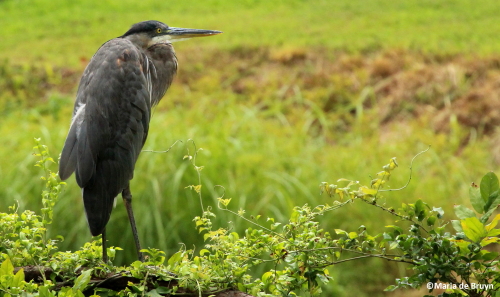
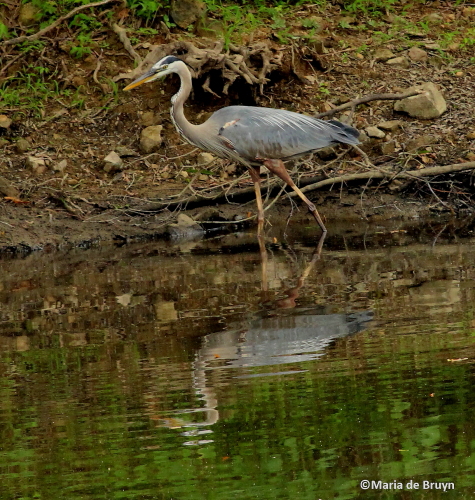
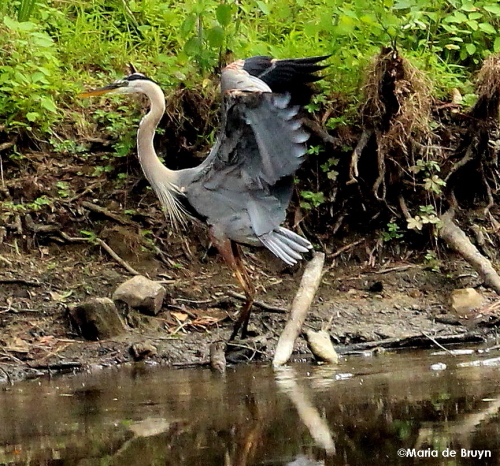
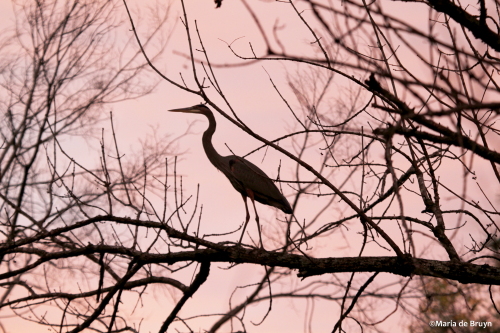
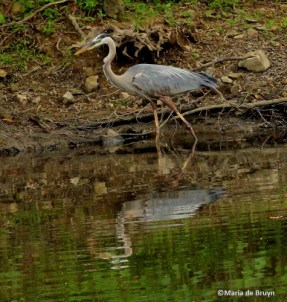
But then my real nemesis appeared – Big Blue (a name given by my neighbor, Kevin), a great blue heron (Ardea Herodias). I had seen Big Blue at a large neighborhood pond and admired the grace of this large bird.
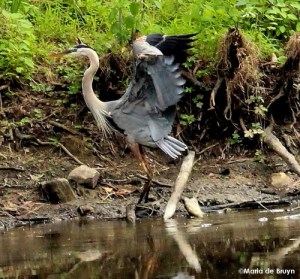
Great blue heron IMG_7482© Maria de BruynresGreat blue heron IMG_7465© Maria de Bruynres

Big Blue at the neighborhood pond

However, the first time Big Blue visited my yard – to my knowledge – I caught sight of him (or her) standing in my small pond with one of my biggest goldfish hanging from his beak. I ran out into the yard, uselessly yelling for him to drop the fish. He stared at me and didn’t move until I was about three feet away – impressing me with his large size. (He was only about 6 inches shorter than me!) Then he lifted off with his prize meal.

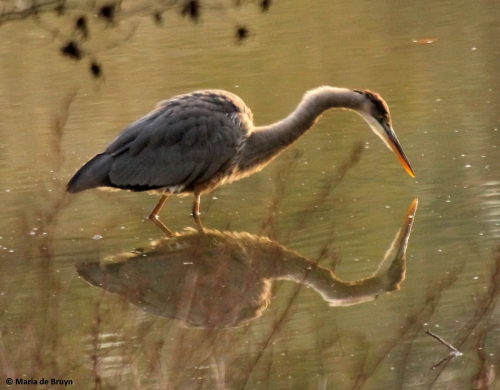
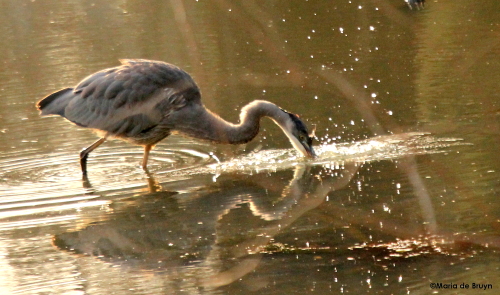
Great blue herons, the largest North American heron species, have a varied diet that includes small fish, as well as shrimp, crabs, rodents, other small mammals, frogs, salamanders, lizards, snakes, crayfish, dragonflies, grasshoppers, aquatic insects and even small birds. Their main hunting technique is to wade slowly in shallow water, sometimes diving headfirst into the water to quickly spear their prey with their sharp long bills.
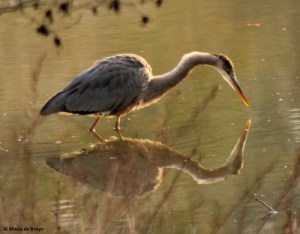
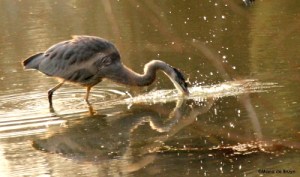
Great blue heron IMG_9216© Maria de BruynGreat blue heron IMG_9158©Maria de Bruynres

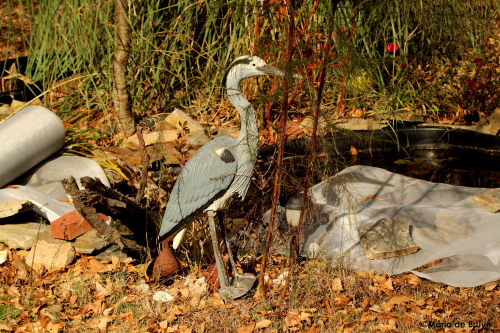
Covering my pond with netting was not an option. I had used netting to protect some plants and then had to rescue a small bird and an anole that had gotten tangled up. The owner of the store where I bought my fish (sadly closed now after many decades of running their family business) recommended I buy a life-like statue of a heron to position by the pond. He had done this at his own pond and said it kept the herons away as they are solitary hunters and don’t want others in their territory. He said Big Blue would see the statue and fly on. So I installed the statue, changing its position from time to time.

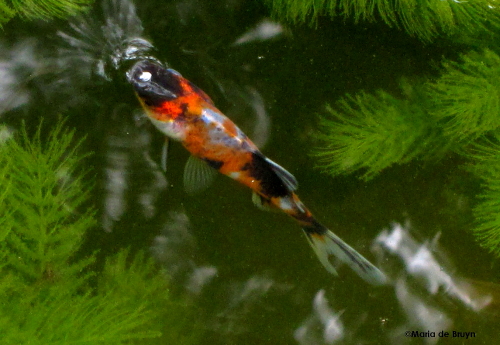
This seemed to work for many months but the past weeks I was very busy and didn’t change the stationary bird’s place. Then I noticed that my family of three bullfrogs were gone and Big Guy had gone missing (all the fish would come to the surface when I gave them pellet meals and Big Guy was gone. A gorgeous red, black and white goldfish with wavy fins was also gone. Inexplicably, the statue was also facing a different direction!
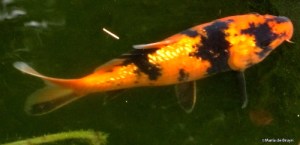
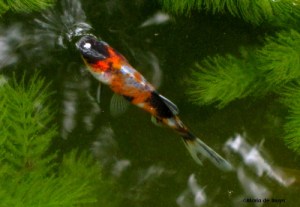
Fishy IMG_8951© Maria de Bruynres

Goldfish IMG_8917© Maria de Bruynres

Apparently, Big Blue must have had a tussle with the imposter and discovered he was not real, leaving him free to take up fishing in my pond again. I realized this about 2 weeks ago, when I saw Big Blue at the pond’s edge. I ran out to chase him off and he flew up to a neighbor’s tree. Now the pond is partly covered with some metal fencing laid over one end; it has tiny holes so no animals can get caught in it. The fish can hide under that and the smaller birds can still perch on sticks to get a drink. As it’s getting colder, the fish are also going into hibernation so – hopefully – they will make it through the winter!
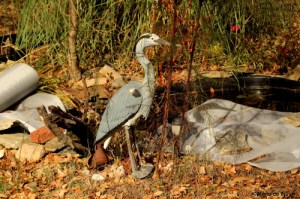
Heron statue IMG_2917©Maria de Bruynres

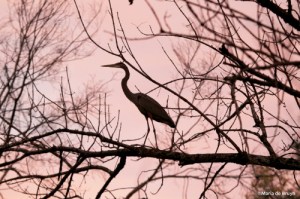
I have never seen Big Blue with a mate at the large neighborhood pond and sincerely hope that he will remain a bachelor. I admire his beauty but don’t want a family of herons using my pond as a restaurant!
IMG_0108©Maria de Bruynres

Next blog: Caterpillars with fuzzy hair-dos
Animals that carry ticks

Thanks for visiting my blog! So, this edition is about a part of my beautiful world that is actually not so appealing to me, but it does represent some of my learning about nature over the past few years. The photos aren’t beautiful, but they do show something interesting (at least to me). Be forewarned! (And next week, back to some nice bird photos.)

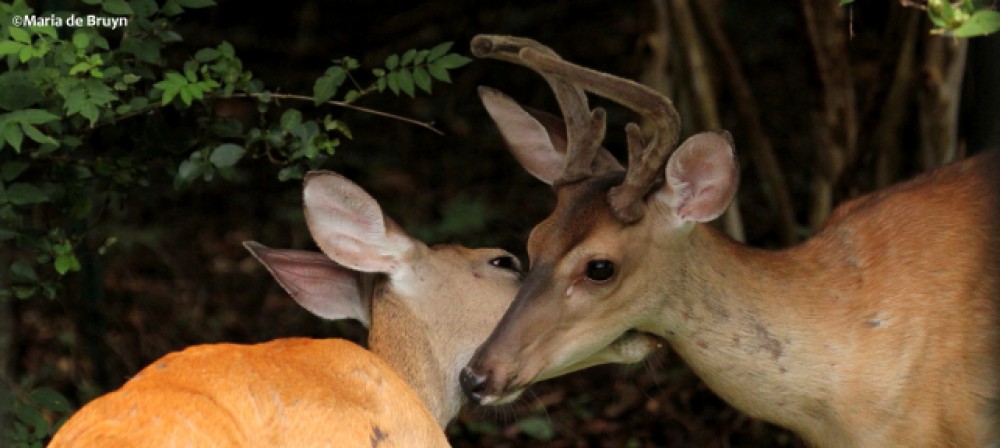
Many proponents of getting rid of deer in our town argue that this will help eradicate the ticks that carry Lyme disease, Rocky Mountain spotted fever and other tick-borne diseases. It is true that ticks get on the deer, but what many people don’t know is that other animals transport these nasty little bloodsuckers as well.

According to the NC State University Department of Entomology, ticks go through four stages in their development – egg, larva, nymph, adult. The developing ticks need blood meals, with most species taking it from a different type of host at each stage. As seen in the photo of the poor white-tailed deer (Odocoileus virginianus) below, the ticks start out tiny but swell up tremendously when they have had a meal.

deer with several ticks IMG_6000 ©Maria de Bruynres

The larvae of the dog tick (Dermacentor variabilis), which can carry Rocky Mountain spotted fever, take blood from white-footed field mice and pine or meadow voles (Microtus pennsylvanicus), like the one pictured here. The nymphs go for somewhat bigger mammals such as opossums or raccoons, while the adults prefer meals from humans and dogs. Black-legged tick (Ixodes scapularis) larvae and nymphs feed on small mammals and lizards, while the nymphs and adults also seek out larger mammals, including dogs and deer. Eastern cottontail rabbits (Sylvilagus floridanus) are another tick host.

meadow vole IMG_4712©Maria de BruynRabbit with tick  IMG_8196©Maria de Bruynres

In the past couple years, the first wildlife that I have seen carrying ticks in the spring are birds – common grackles (Quiscalus quiscula) seem to be a favorite host, although I’ve seen them on other birds as well. The ticks can sense body heat and will even drop down from a tree onto another living species. This undoubtedly accounts for the first tick that gave me a bite requiring antibiotics to prevent Rocky Mountain spotted fever. It was during a visit to an exotic wildlife sanctuary that has been surrounded by an electric fence for more than 30 years so that no deer have been there for decades.

Common grackle 4 ©Maria de BruynCommon grackle 1 ©Maria de Bruyn

Ticks also wait in the grass to latch onto animals – and people – walking by. Fortunately, I’ve never found ticks on my indoor-outdoor cat, but I have found them on me after being in the yard and out on nature walks. Different techniques for loosening their grip have worked well – a new skill that I had never anticipated learning. There are few animal species that I really dislike, but I must admit that ticks are definitely one of them. But I also know now that eradicating deer is not the solution to getting rid of the ticks.

Next blog: Big Blue – my avian nemesis!