 During my trip to Yellowstone National Park, I had the privilege of seeing what birders call “lifers” – bird species that one sees for the first time. One spectacular sighting – for me – was of sandhill cranes (Grus canadensis). I didn’t spot them first; I was traveling with two photographers from Michigan who were used to seeing these beautiful birds in their backyards. We had already passed but they kindly returned so I could take a few photos – and then to our delight, the pair of birds performed their mating dance for us!
These birds mate for life and may live to a considerable age. The oldest known sandhill crane was 36.5 years old.
 While many of these birds are grayish in color, some have rusty orange coloring, attributable to iron-rich mud in their environment. In Yellowstone, the birds use their long bills to spread the reddish mud over their feathers when they preen and this helps to camouflage them when nesting. Cranes that are not yet mature also have reddish upper parts. Their heads are topped by a red patch.

These birds have very long legs and necks as you can see. Their windpipes curl up in the sternum and give their sounds a lower pitch. Mated pairs will sing in unison, with the female calling twice for every call that her mate makes.
The males dance when they display to one another. Courtship dances can involve bowing followed by leaps into the air. They may stretch their wings and pump their heads as well.


The pair would dance and stop, dance and stop. A real pas de deux (in French and ballet terms)!


Perhaps some ballet terminology was inspired (unconsciously) by the graceful cranes.

Grand jeté (jump from one foot to the other)

Sur les pointes (on tiptoes)

Demi-plié (Half-bend of the knees)


Fondu (sinking down)
Dancers have tried to mimic cranes and while they created a beautiful dance, the sandhill cranes had more varied moves.


The courtship dance was a tour de force and a highlight of my first day at this national park. In hindsight, I wish I had taped it but I was so enthralled, I forgot. 🙂
 While ospreys are one of my favorite large birds, the gorgeous ruby-crowned kinglet (Regulus calendula) has won my heart among my tinier feathered friends. Today I’m sharing some portraits of kinglets made the past couple months (in my yard and at Bolin Creek greenway in Chapel Hill, Jordan Lake woods, Sandy Creek Park in Durham).
 hes or 10-11 cm long), this kinglet is in almost constant motion, which makes getting good portraits a bit of a challenge. Despite this high level of activity, however, research has shown that the ruby-crowned kinglet only uses up to 10 kcal a day in energy. (Sometimes I think this holds true for me as well as the weight I want to lose just stays in place.)
 Their main diet consists of insects, including spiders, ants, wasps, beetles and aphids. They will also occasionally eat seeds, fruit and sap.


 Most of the time, the male’s beautiful little red crest (which gives the species its name) remains hidden unless it gets excited about something.


 In my pursuit of portraits, I’ve found that just as I think I have the bird in focus, it has disappeared from my viewfinder and I need to look up and around to locate it again..Given its diminutive size, one wouldn’t expect that the female lays up to 12 – twelve! – eggs in its nest, which is elastic and can expand as the brood grows. The male and female stay together until the chicks fledge at about 2 months and they will defend the nest against intruders.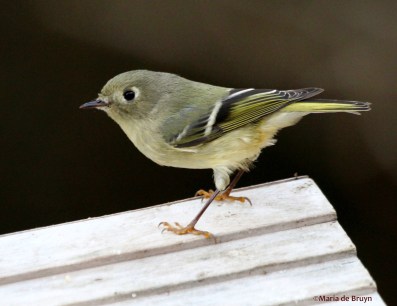
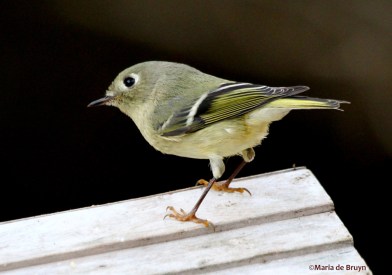
 Sometimes, I hear the chittering call before I see the tiny wonder and only very rarely get to enjoy its longer
  What is very cool for me is that my visitor can become very friendly indeed. Last year, on two occasions, I was carrying a replenished suet feeder outside when the kinglet flew in to perch on it as I held the feeder in my hands – giving me a great close-up view. I look forward to seeing if the kinglet will favor me with an up-close-and-personal meeting again this coming winter!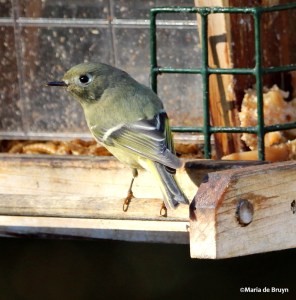
 My beautiful world