The beautiful “baker” bird

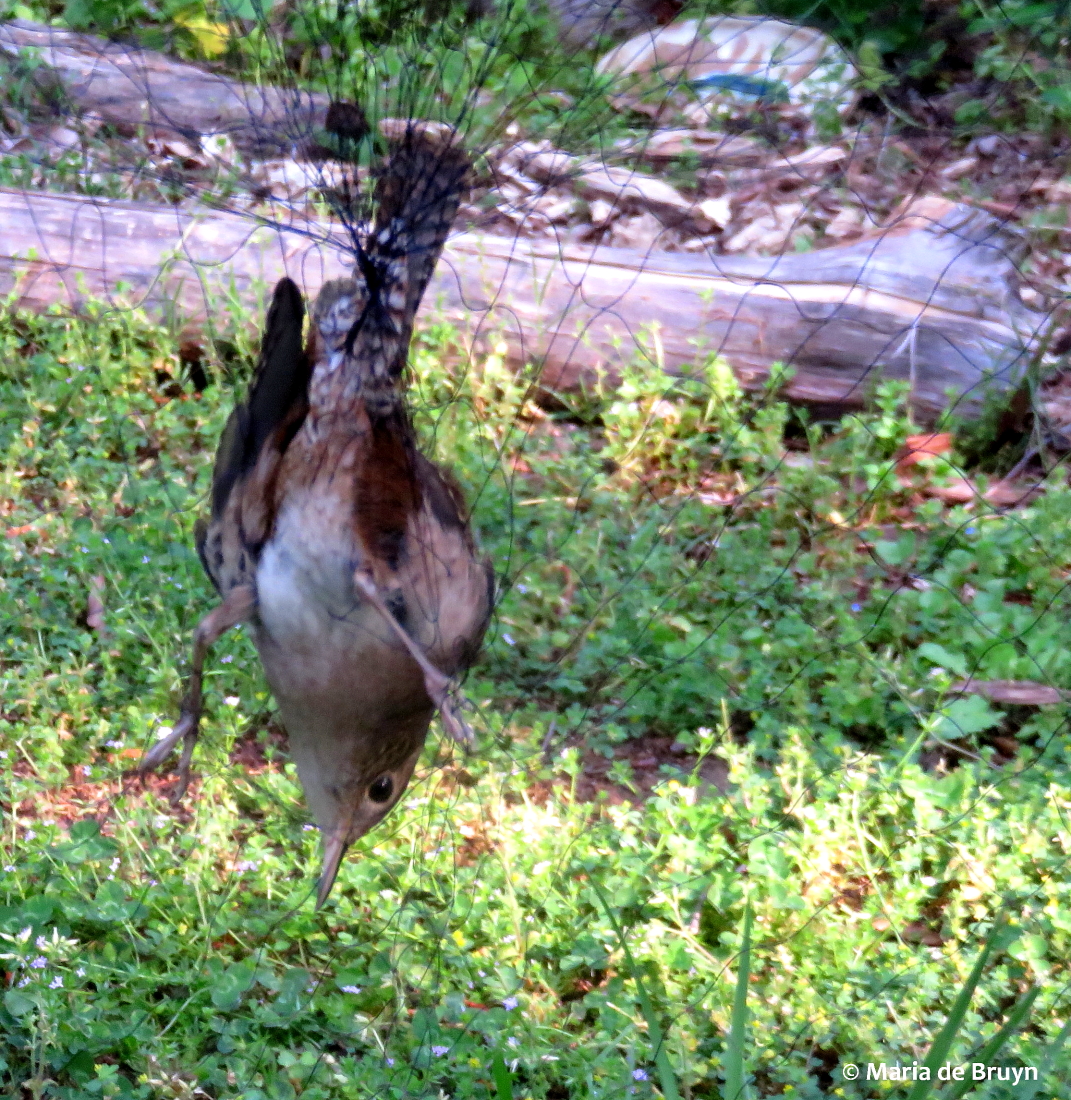
Recently, I’ve had the good fortune to observe a small bird at close quarters that I had only seen in a couple glimpses in the past, the ovenbird (Seiurus aurocapilla). Like the ruby-crowned and golden-crowned kinglets, this little avian also has a stripe atop its head. Like the golden-crowned kinglet, the stripe is always visible and orange in color, blending in nicely with its other muted brownish and cream colors.


The ovenbird gets its name from the shape of its nest, which is built on the ground in a shape reminiscent of an outdoor or Hopi oven. It is domed and has a side entrance and can be difficult to see.

The ovenbirds spend the winters in the Caribbean region and Central America and then come North for the summer breeding season. My sightings of the singing male have been at our local nature reserve, Mason Farm Biological Reserve, where I volunteer as an invasive plant eradicator and sometime planter of native flowers.


The male sings a three- to-five note call in the spring as part of his courting behavior and the call varies among individuals. When males are in neighboring territories, they will sing together in duets and it can be difficult to know how many birds are singing.


The sound is so loud that you expect to see a much larger bird and his song inspired poet Robert Frost to dedicate a poem to him.


If he is sitting on a branch, you can eventually find him but it can be a challenge since they prefer to reside in forests with heavy canopy cover so that it is fairly dark.


Once you see him, you may be able to watch for a while as they don’t seem to be very wary of people. This individual let me observe as he groomed on a low tree branch, pausing now and again to let out a few notes.


These birds prefer areas with heavy leaf litter for their homes – the leaves provide cover for their ground nests and they blend in really, really well as they scurry about foraging in the leaves for insects, worms and snails to eat. Both the females and males participate in feeding the fledglings until they can fly at about 30 days.

When they emerge into a patch with a bit of sunlight filtering down through the leaves overhead, you have a bit better chance to see them. Otherwise, you may end up staring at ground cover until you catch a bit of movement and can zero in on the motion to see them.


Photographing the bird is a challenge since they spend their time in areas with so little direct light. My first photos were a bit dark, but then I increased the ISO on my camera considerably (a tip from fellow photographer, Mary – thanks!) and the photos were a bit better. Still, the somewhat darker photos reflect the environment in which you discover these little troubadour warblers. Now that I know where to look for them, I hope to see them more often in years to come.

Back to blogging with the golden crowns!

Litter boxes scrubbed, bird feeders filled, other chores waiting but I’ve decided to end my blogging hiatus on this rainy and somewhat gloomy Sunday morning. This and my next blog will feature two of my favorite birds and then I hope to treat you with a nesting saga as spring is well underway.

With a lovely ruby-crowned kinglet visiting my yard every year for the past four years, I’ve developed a particular fondness for this tiny avian species. This past autumn and winter, my partiality expanded to include their jeweled cousins, the golden-crowned kinglets (Regulus satrapa), who seemed to have favored our geographical area with an irruption (an ecological term for a sudden increase in an animal population). Whereas in previous years, I felt lucky to catch a glimpse of a golden crown during their months-long stay in North Carolina, they appeared to be everywhere this past winter and in full view to boot.


The golden-crowned kinglets are about the same size as the ruby crowns and similar in overall body color except that they also have a black eyebrow stripe.

While the ruby-crowned males only flash their red crests when mating or upset, however, the golden crowns have a permanent yellow stripe atop their heads.


The male golden crowns can sometimes be distinguished by the fact that there will be a hint of red in their golden crest.


Like the ruby crowns, these little insect foragers are in constant movement as they scour branches, shrubs and plants for a meal. Their varied diet includes beetles, flies, crickets, butterflies, spiders, and bees and wasps. In the winter, they will also eat some seeds.


Searching for the insects often means they hang upside down from branches as they look at the underside and in crevices for their next bite to eat.


They also hover mid-air to snatch an insect or fly.

The golden crowns sometimes sit still a bit longer than ruby crowns so that you have a chance to get off a few photographic shots before they resume their dietary searching. And this year, one of those photos placed me among the winners in a small local competition.

These birds are not much bigger than hummingbirds, but like the hummers, they also undertake a long migration twice yearly. Their winters are spent throughout North America but for breeding they travel to the far North and mountainous Northwestern areas of this hemisphere.

This year, many places had mild winters but if they arrive in the North before spring-like temperatures arrive, they are able to survive nights as cold as –40 degrees; sometimes, they huddle together to keep a bit of warmth. Their lifespan is several years, with the oldest recorded golden crown being a banded male who was at least 6 years and 4 months when he was recaptured in Minnesota in 1976.


This species prefers life in coniferous forests but it seems if a few spruce and pines are around, they will settle in. I saw them in a small and somewhat sparsely vegetated area near a senior center, an arboretum, along the Haw River, and in the woods and bogs of various nature reserves.


In the United States, the number of golden-crowned kinglets declined 75% between 1966 and 2014. Habitat loss has contributed to this. However, spruce reforestation in the Eastern USA may have contributed to a more recently seen increase in numbers of kinglets. I’m very glad that they are not (yet) an endangered species and I hope we get to see them a lot next winter, too!

Warbler watching and migration – a shared pleasure for birders!

black-and-white-warbler-i77a3458-maria-de-bruynAutumn migration in North America has been underway for some weeks and our bird populations in North Carolina are changing in composition. Some birds stay year-round – for example, I see robins, blue jays, Carolina wrens, Carolina chickadees and tufted titmice in all seasons to my great delight. However, other birds who have been here since spring are now getting ready to leave for a southerly jaunt to a place that will be warmer for them in winter – most of the ruby-throated hummingbirds and some gray catbirds have departed already. (I have had a catbird stay year-round but others leave.) Many black and white warblers (Mniotilta varia) will be leaving, too.

american-redstart-i77a4367maria-de-bruyn-resThe Nature Conservancy has noted that the autumn songbird migration is one of the top four migrations in this state. The Audubon Society has even published a guide to this migration and when certain species usually begin their travels. (Left: American redstart male)


This seasonal event means that dedicated birders make special efforts to visit places where it’s likely we’ll see warblers. Many of North America’s 50 species don’t eat seed or suet, so you won’t find them visiting your feeders often. I have found, however, that pine warblers (Setophaga pinus) and yellow-rumped warblers (Setophaga coronata) are pretty social and those who are here for the winter are already joining my “regular” birds at feeding stations. The pine warblers especially like suet (female left, male right below).

pine-warbler-i77a0184-maria-de-bruyn-res        pine-warbler-i77a0409-maria-de-bruyn-8-x-10

The yellow rumps are still looking around a lot for insects; this one snagged a skipper butterfly.

yellow-rumped-warbler-i77a5552-maria-de-bruyn-res

In the autumn, many of these songbirds no longer have their beautiful breeding plumage, which is often so distinctive that you can identify them easily, especially the males. I was lucky enough to see some of those beauties during spring migration as well as in the summer for the ones that spend the warmer months here.

prothonotary-warbler-i77a2854-maria-de-bruyn-res   prothonotary-warbler-i77a9933-maria-de-bruyn-res

Prothonotary warbler male (Protonotaria citrea)

yellow-throated-warbler-img_0418-maria-de-bruyn        prairie-warbler-i77a1622-maria-de-bruyn-res

Yellow-throated (Setophaga dominica) & prairie warblers (Setophaga discolor)

american-redstart-i77a7811-maria-de-bruyn-res


The warblers’ non-breeding coloration is frequently duller and drabber than their breeding plumage. Often only experienced birders can tell some species apart on first sight. Added to that is the fact that young birds don’t yet have their adult plumage and the immature males often look just like adult females. So it is a challenging time for identification, especially for me, but an exciting time for discoveries.


blackpoll-warbler-i77a1289-maria-de-bruyn-resGetting photos of these lovely birds can be tricky since they move about a lot in search of their insect meals. It is ultimately the pursuit of those culinary delights that leads the warblers to migrate South, since the insect population declines dramatically in areas with cold weather.

Nature photographer Mary had discovered a spot where the warblers could bathe in a relatively protected fashion; she kindly shared the location with some of us and a number of avid birders sat with her for hours waiting for the birds to appear. Some of our more “common” avian friends used the site, too, including a gray catbird (Dumetella carolinensis) and a brown thrasher (Toxostoma rufum).

gray-catbird-i77a4922maria-de-bruyn-res    brown-thrasher-i77a4880maria-de-bruyn-res

northern-waterthrush-i77a5013maria-de-bruyn-res


A Northern waterthrush (also a warbler, Parkesia noveboracensis) found the spot enticing.

The trees around the water hosted birds as they looked for insects, like the black-throated blue warblers below (Setophaga caerulescens), seen a few weeks apart.


black-throated-blue-warbler-i77a8117-maria-de-bruyn-res  black-throated-blue-i77a4426maria-de-bruyn-res

A female American redstart (Setophaga ruticilla) spent time working the shrubs surrounding the creek with some success.

american-redstart-i77a4981maria-de-bruyn-res    american-redstart-i77a4996maria-de-bruyn-res

The male redstarts hopped about the branches and rocks hanging over the creek for a while before venturing below to bathe.

american-redstart-i77a7628-maria-de-bruyn-res american-redstart-i77a4217-maria-de-bruyn-res

american-redstart-i77a4477maria-de-bruyn-res  american-redstart-i77a4480maria-de-bruyn-res

The birds appeared to enjoy their bathing spot immensely, sometimes dipping under water over and over again.

american-redstart-i77a4685-maria-de-bruyn-res  american-redstart-i77a4693-maria-de-bruyn-res

american-redstart-i77a4658-maria-de-bruyn   american-redstart-i77a4629-maria-de-bruyn-res

american-redstart-i77a4710-maria-de-bruyn-res


They also didn’t mind sharing the space with each other (or sometimes other species)..

magnolia-warbler-i77a2250-maria-de-bruyn-res


The Magnolia warblers (Setophaga magnolia) did the same, giving me some good looks and making my first in-person sighting of this species (lifer!) quite special.


magnolia-warbler-i77a5161-maria-de-bruyn-res    magnolia-warbler-i77a5184-maria-de-bruyn-res

chestnut-sided-warbler-i77a5210-maria-de-bruyn-res


The chestnut-sided warbler (Setophaga pensylvanica)was a very vigorous bather!

chestnut-sided-warbler-i77a5230-maria-de-bruyn-res

chestnut-sided-warbler-i77a5207-maria-de-bruyn-res    chestnut-sided-warbler-i77a5203-maria-de-bruyn-res

hooded-warbler-i77a4728-maria-de-bruyn-res


A male hooded warbler (Setophaga citrina) made a brief appearance one day, followed by some female and male common yellowthroats (Geothlypis trichas).


common-yellowthroat-i77a4431maria-de-bruyn-2common-yellowthroat-i77a4316maria-de-bruyn-res

Another water body that provided me with some excellent views of warblers was the Haw River. In the small town of Bynum, a bridge crosses the river and gives birders a great vantage point to see birds in the tree canopy close to eye level. There I was able to see two more lifers a couple weeks ago – the first was a bay-breasted warbler (Setophaga castanea).

bay-breasted-warbler-i77a1004-maria-de-bruyn-res    bay-breasted-warbler-i77a1003-maria-de-bruyn-res

blackpoll-warbler-i77a1315-maria-de-bruyn-resThis beauty was followed by another that had me confused. At first, I thought I was seeing a kinglet but this bird was a bit large and then as I got closer looks, I realized it looked like a bay-breasted warbler but had yellow feet. A search on the Internet showed I had seen a blackpoll warbler (Setophaga striata), likely a non-breeding male. Experts on an American Birding Association Internet site confirmed the ID for me.

blackpoll-warbler-i77a1320-maria-de-bruyn-res    blackpoll-warbler-i77a1329-maria-de-bruyn-res

black-and-white-warbler-i77a7204-maria-de-bruyn-resMy migration warbler watching culminated with some exciting finds in my own yard. I was surprised by several I hadn’t seen at home before, including common yellowthroats, a black and white warbler looking for insects in my willow oak and a gorgeous Northern parula (Setophaga americana), who even came to my feeders before pursuing a caterpillar in a Rose of Sharon nearby.

northern-parula-i77a7131-maria-de-bruyn-res   northern-parula-i77a7117-maria-de-bruyn-res

northern-parula-i77a7076-maria-de-bruyn-res


I’m now hoping to see some birds that breed further North during the summer arrive here for their late fall/winter/early spring sojourn, such as a ruby-crowned kinglet who has spent time with me each winter for the last three years. Next time I’ll share some of my pollinator sightings with you, in the hope you find them as fascinating as me. Have a nice day!
My hummer summer, part 2 — beauty in flight, beauty at rest

ruby-throated-hummingbird-i77a8438-maria-de-bruynIn my previous blog, I mentioned that the ruby-throated hummingbirds (Archilocus colubris) had a greater variety of flowering plants to visit in my yard this year and that increased the size and diversity of their nectar buffet. The availability of multiple food sources also meant that they spent a bit more time visiting – they didn’t just dash to a feeder, perch or hover for a drink and then take off. They visited feeders, different blooms and took little rests between meals, giving me numerous chances to watch them and practice my hummingbird photography – a win-win for both us!

ruby-throated-hummingbird-i77a7246-maria-de-bruyn-res


One of their favorite flowers were the lantanas (Lantana), which are also a favorite of mine as they attract many smaller pollinators such as bees and butterflies and are still profusely blooming in the latter half of October.


ruby-throated-hummingbird-i77a6866-maria-de-bruyn-res

ruby-throated-hummingbird-i77a7168-maria-de-bruyn-res

ruby-throated-hummingbird-i77a1023-maria-de-bruyn-res


This year, several types of sage brightened my gardens. Some deep blue Brazilian sage plants (Salvia guaranitica), kindly donated to me by Gail, a fellow birder, added color and provided the hummers with deep blooms into which they could insert their long bills.


ruby-throated-hummingbird-i77a1315-maria-de-bruyn-res

ruby-throated-hummingbird-i77a7519-maria-de-bruyn-resA small-leaf sage (also known as Festival or little-leaf sage, Salvia microphylla “San Carlos Festival”) provided an ongoing splash of deep red blooms that attracted the hummers over and over again. This plant not only graced the garden in the summer but is still blooming profusely now, making it another one of my favorites. A couple other different red sages and a red beebalm (Monarda didyma) were good nectar choices but they didn’t bloom as long or in such abundance. Perhaps next year, they will have gained strength.

ruby-throated-hummingbird-i77a7782-maria-de-bruyn-res

ruby-throated-hummingbird-i77a1160-maria-de-bruyn-resThe two stonecrop plants (Hylotelephium Autumn joy), in my front garden, with their rounded bunches of little pink flowers, had hummer visitors on a few occasions, but these are not one of their preferred blooms. The milkweed plants (Asclepias syriaca) also only had a few visits as far as I could tell.


ruby-throated-hummingbird-i77a1086-maria-de-bruyn-res


And it was the same story for the blue balloon flower (Platycodon grandiflorus), which does get its fair share of bees.


ruby-throated-hummingbird-i77a2198-maria-de-bruyn-resI had planted cardinal flowers (Lobelia cardinalis), which unfortunately didn’t get any flowers. I did see a bird visiting this plant species near Bolin Creek, however. The same happened with a trumpet vine (Campsis radicans), but at a vine cluster near the Haw River I saw how they inserted their heads entirely into the tubular blooms.

ruby-throated-hummingbird-i77a5851-maria-de-bruyn-res

ruby-throated-hummingbird-i77a6177-maria-de-bruyn-res


In between feedings, the hummingbirds will perch to watch for intruders into “their space”. But they also will take sun-baths, pointing their faces upward and puffing themselves up.

ruby-throated-hummingbird-i77a8401-maria-de-bruyn-res


They will then change shape, stretching their necks and spreading their wings and tail feathers to expose as much of their bodies as possible to the sunlight.

ruby-throated-hummingbird-i77a6885maria-de-bruyn-res   ruby-throated-hummingbird-i77a6891maria-de-bruyn-res

They may relieve themselves while they are in flight and then later take a little power nap of a few seconds.

ruby-throated-hummingbird-i77a1170-maria-de-bruyn-res       ruby-throated-hummingbird-i77a0553-maria-de-bruyn-res

ruby-throated-hummingbird-i77a7826-maria-de-bruyn-res

Grooming is also a frequent activity – these little avians make sure that they stay just as beautiful as the sweet flowers that they frequent!

ruby-throated-hummingbird-i77a6905-maria-de-bruyn-res   ruby-throated-hummingbird-i77a8283-maria-de-bruyn

When the males turn their heads so that the light hits them in different ways, they do a nice job of demonstrating that their bright gorget colors are not in the feathers themselves but the result of prism cells in their feathers that change how the light is reflected depending on the angle we see.
ruby-throated-hummingbird-i77a1126-maria-de-bruyn-res    ruby-throated-hummingbird-i77a1120-maria-de-bruyn-res

ruby-throated-hummingbird-i77a6366-maria-de-bruyn-resWhen they’re done sun bathing, grooming and resting, the hummingbirds need to take off again. However, their feet are so tiny that they can’t walk and, when they lift off, they also don’t have the foot strength to push.  So they rise into the air using the power of their wings, quickly flapping as they set off and rapidly reaching their usual rate of about 50-53 beats per second.
ruby-throated-hummingbird-2-i77a5105-maria-de-bruyn-res

ruby-throated-hummingbird-i77a9703-maria-de-bruyn-res

ruby-throated-hummingbird-i77a7167-maria-de-bruyn-resMy last summer hummingbird residents appear to have left for their Central American wintering grounds on 7 October, just before Hurricane Matthew arrived in North Carolina. I really hope that they were able to get through the windy environment without problems as they began their long migratory journeys and I am already looking forward to seeing them arrive next spring. In the meantime, I’m keeping a couple feeders up in case another hummer species decides to over-winter here – and the Carolina chickadees (Poecile carolinensis), Northern cardinals (Cardinalis cardinalis) and tufted titmice (Baeolophus bicolor) can continue to use the ant guards over the feeders as their preferred watering holes.


Nest Watch citizen science – 2016 edition

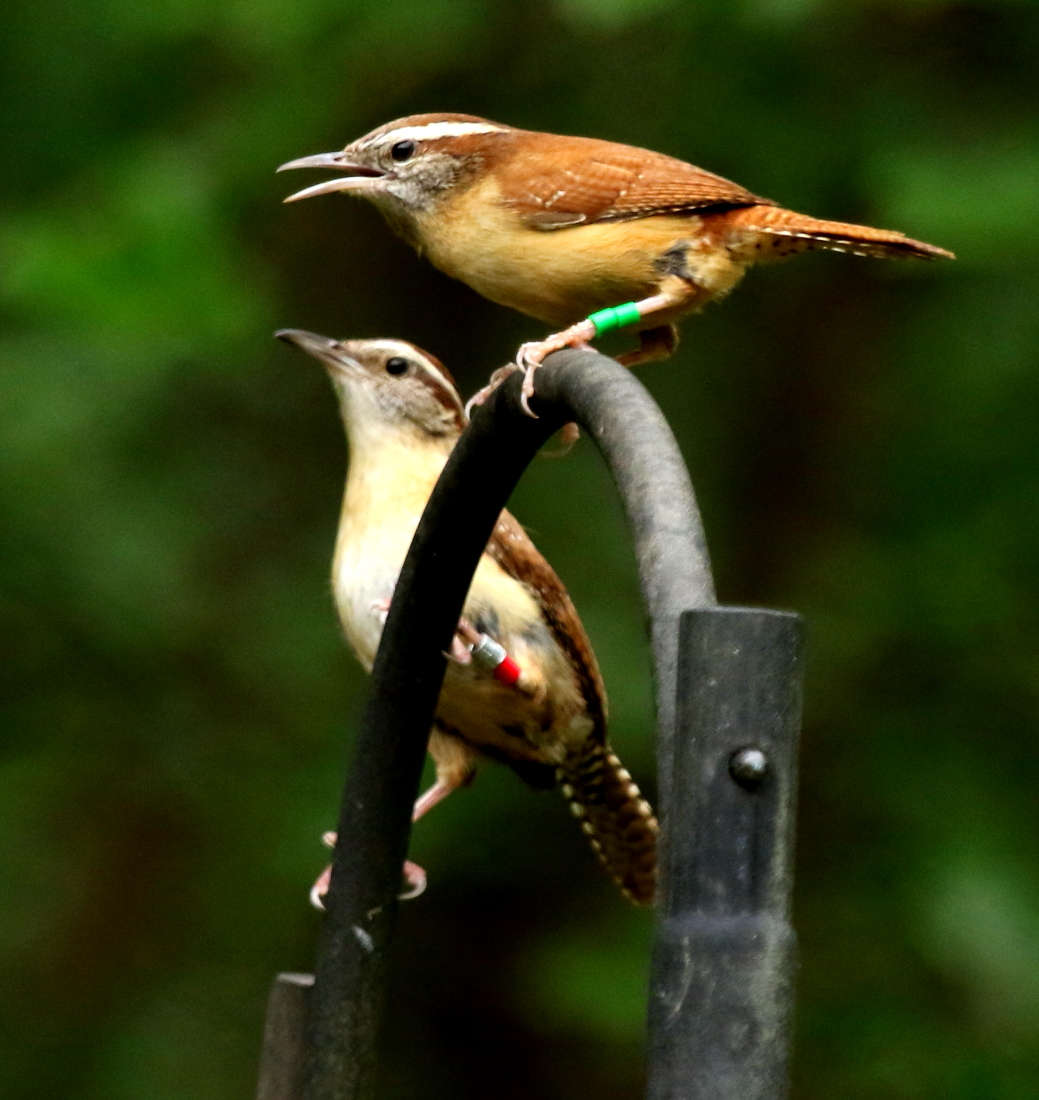
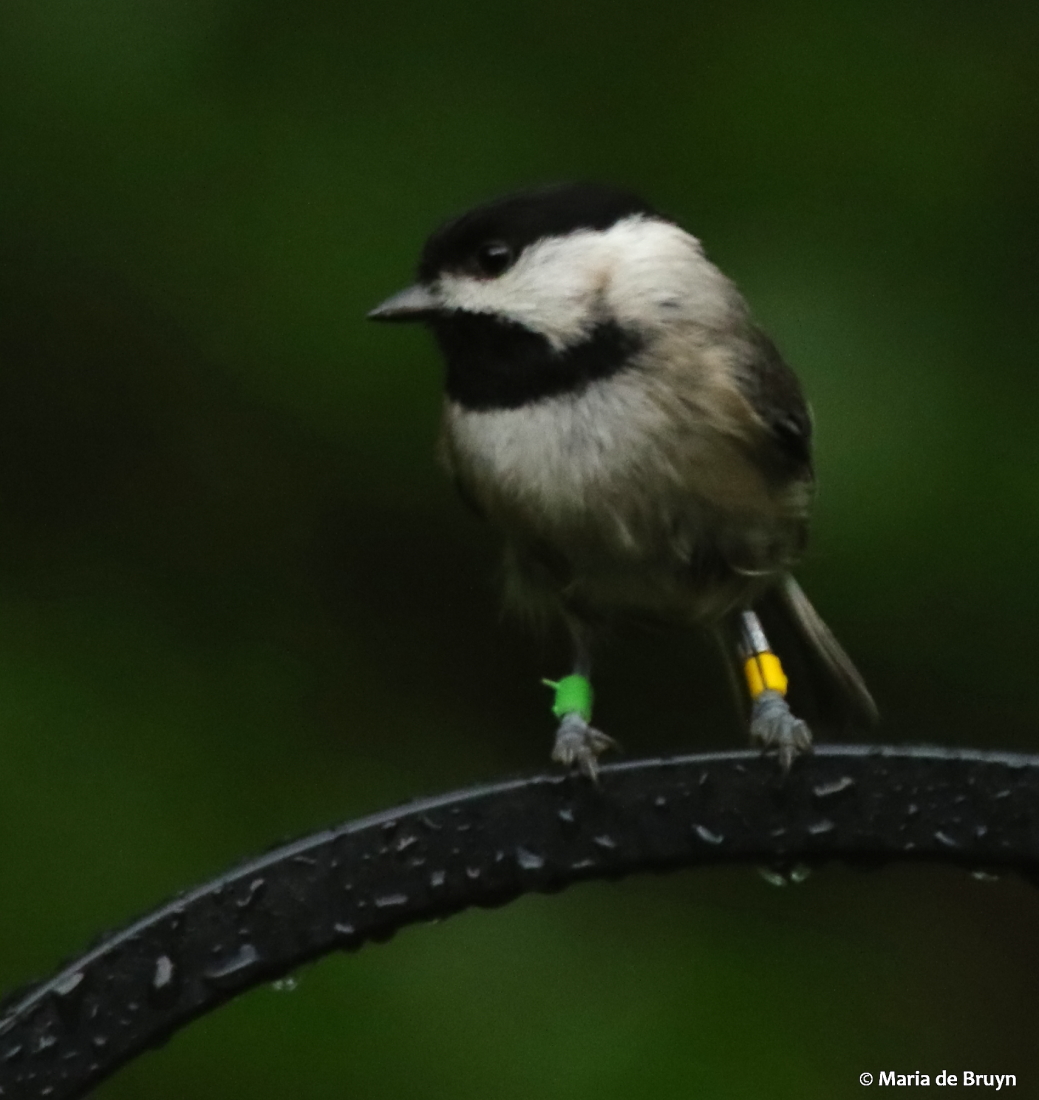
Carolina wren Renee and Riley I77A9074© Maria de Bruyn resLast year, I became a Nest Watch volunteer, which involves having birds banded in your yard so that you can follow and report to researchers the birds’ presence over time as they visit and leave your yard.

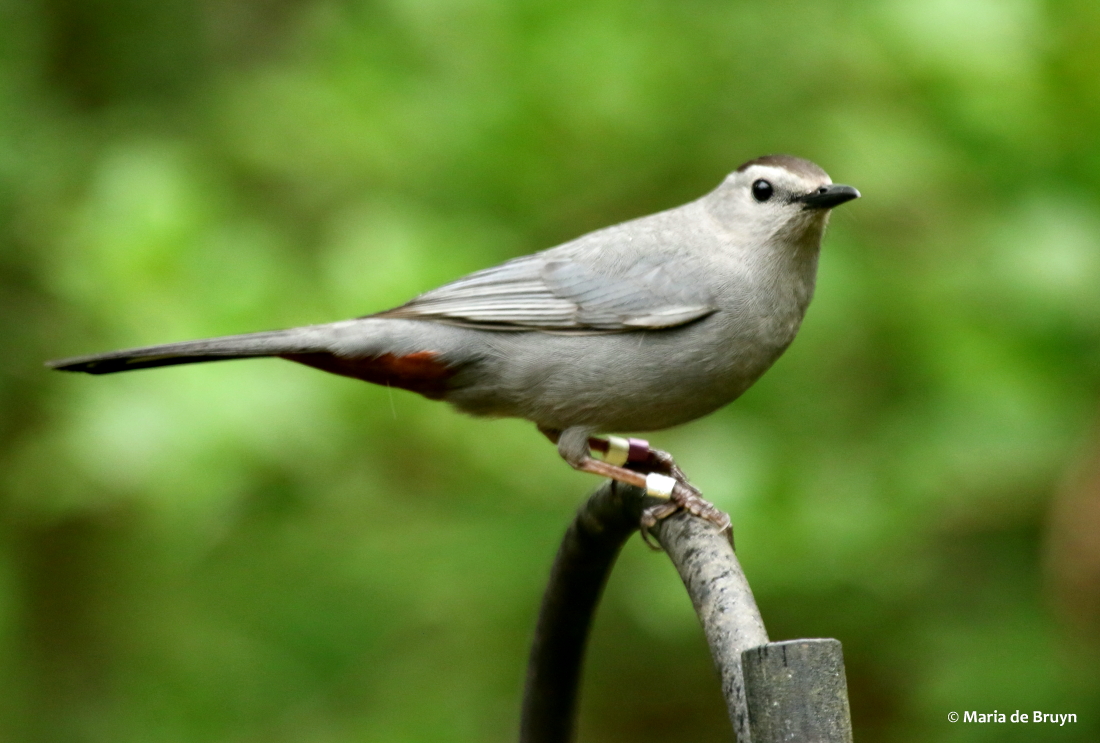
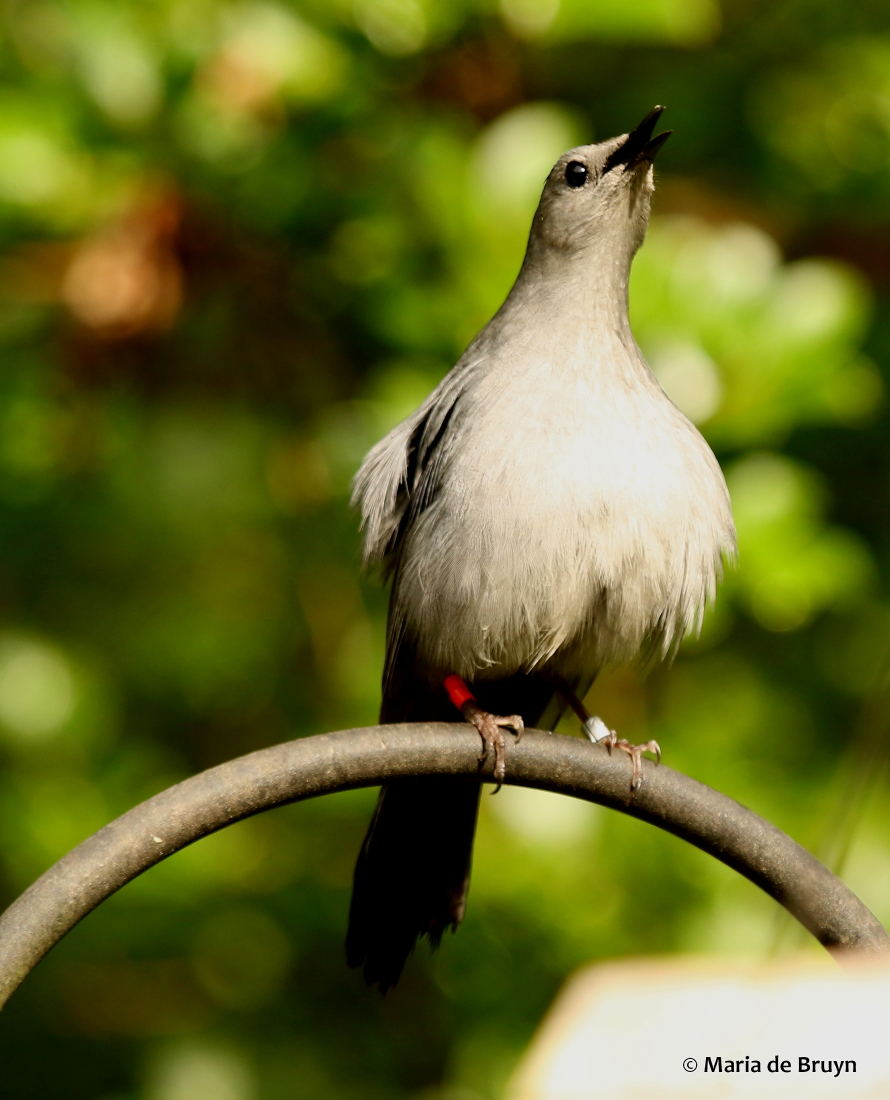
In 2015, we banded six birds. If a bird is only a temporary visitor or if it died outside the yard due to disease, old age or predation, you just won’t see it again and have no idea what became of it. The American robin (Turdus migratorius) that was banded last year never returned. If the birds stick around, however, you have the enjoyment of observing birds you get to know. The three gray-headed catbirds (Dumetella carolinensis) stayed around all summer and fall, and two of them – Camden and Corey – returned to my yard from winter migration a few days ago. They have been accompanied by females whom they appear to be assiduously courting.
gray-headed catbird Camden I77A8990© Maria de Bruyn res

gray-headed catbird Corey I77A8083© Maria de Bruyn res

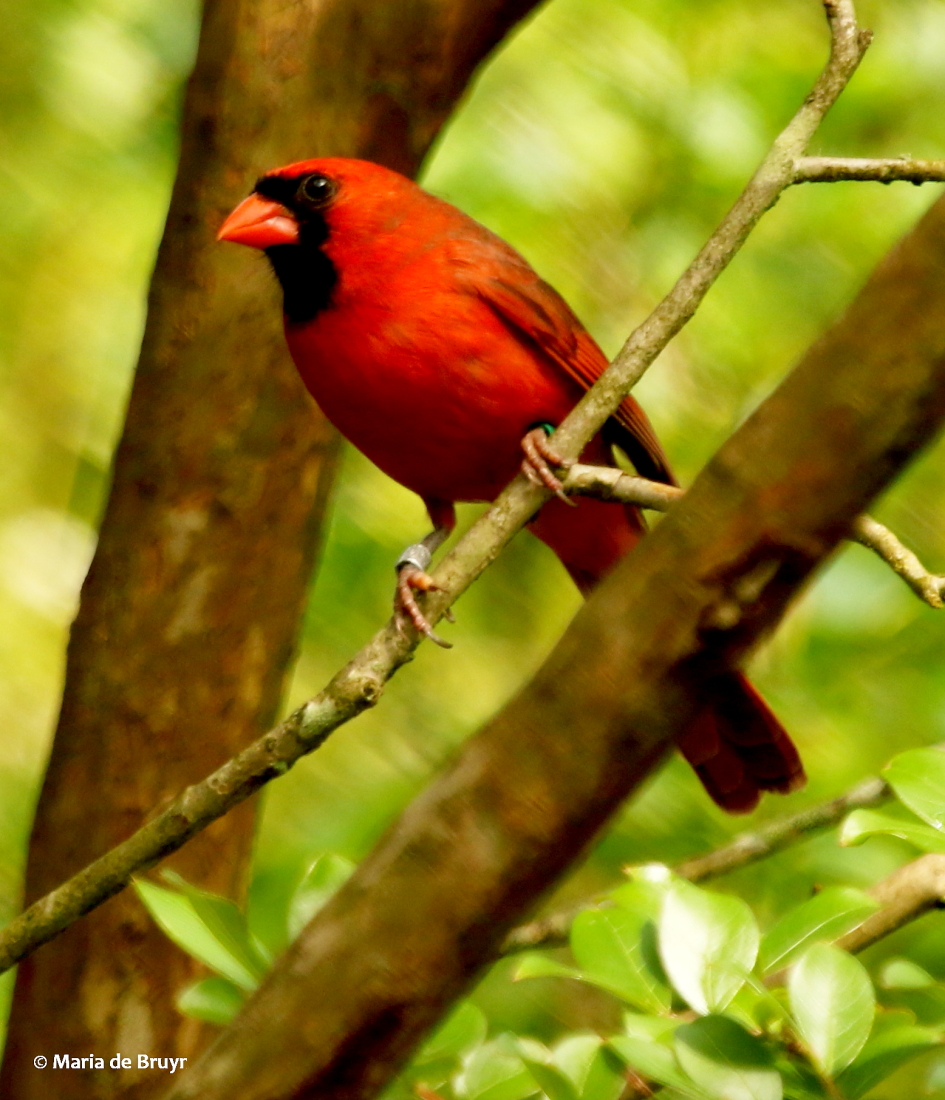
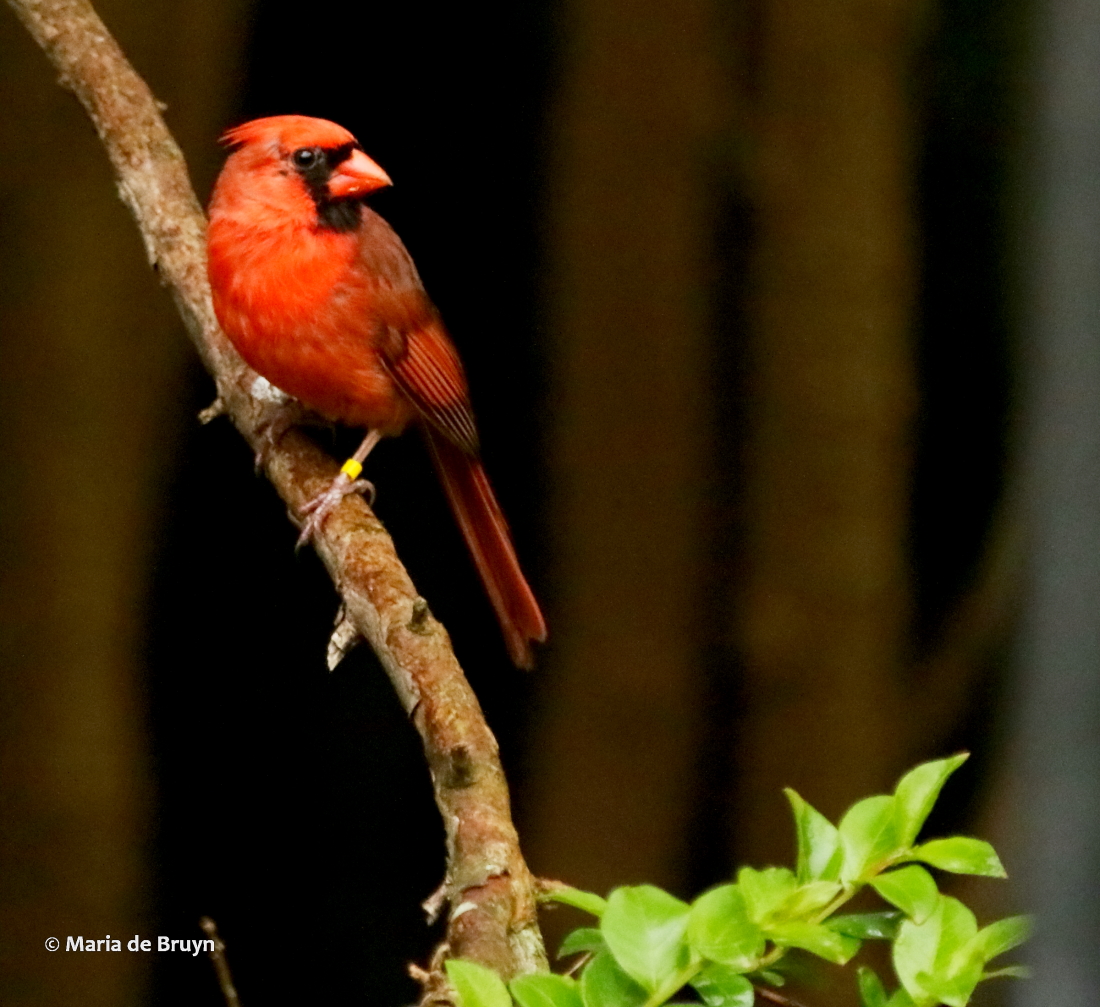
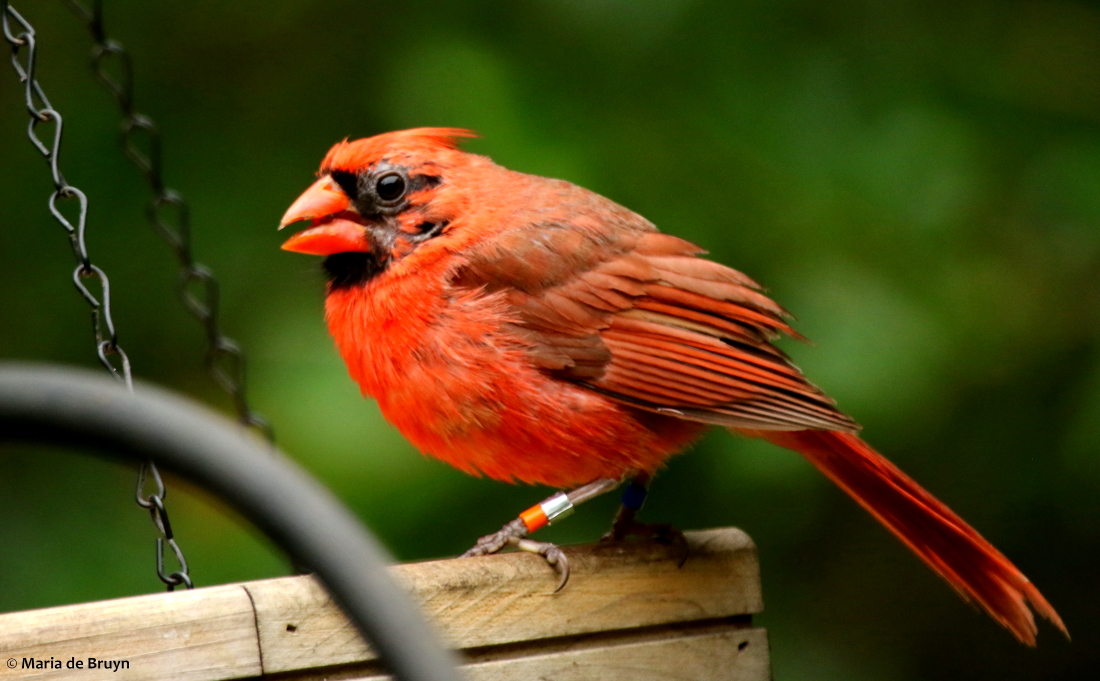
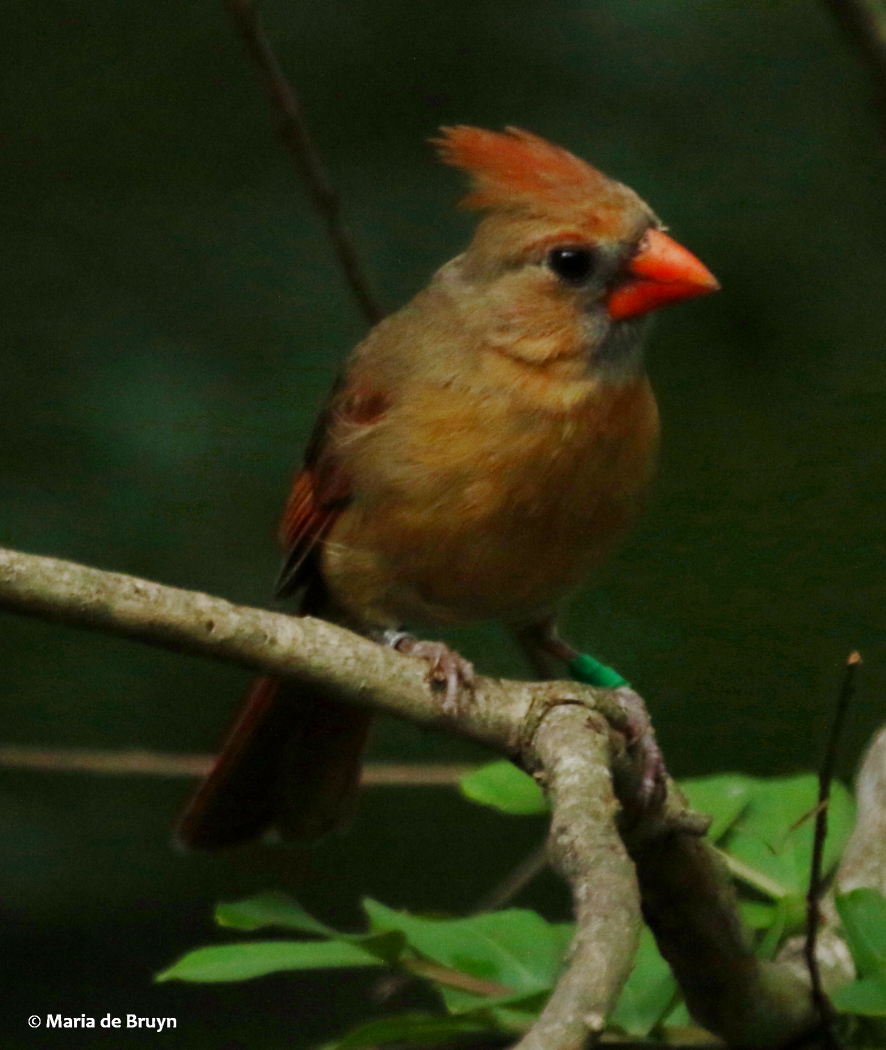
Northern cardinal Clancy I77A8123© Maria de Bruyn resOne Northern cardinal (Cardinalis cardinalis) was banded last year, but Clancy only stayed a few days and then disappeared for the rest of the summer, fall and winter. He suddenly appeared yesterday – perhaps encouraged to spend time at the feeders by the other birds with bracelets.

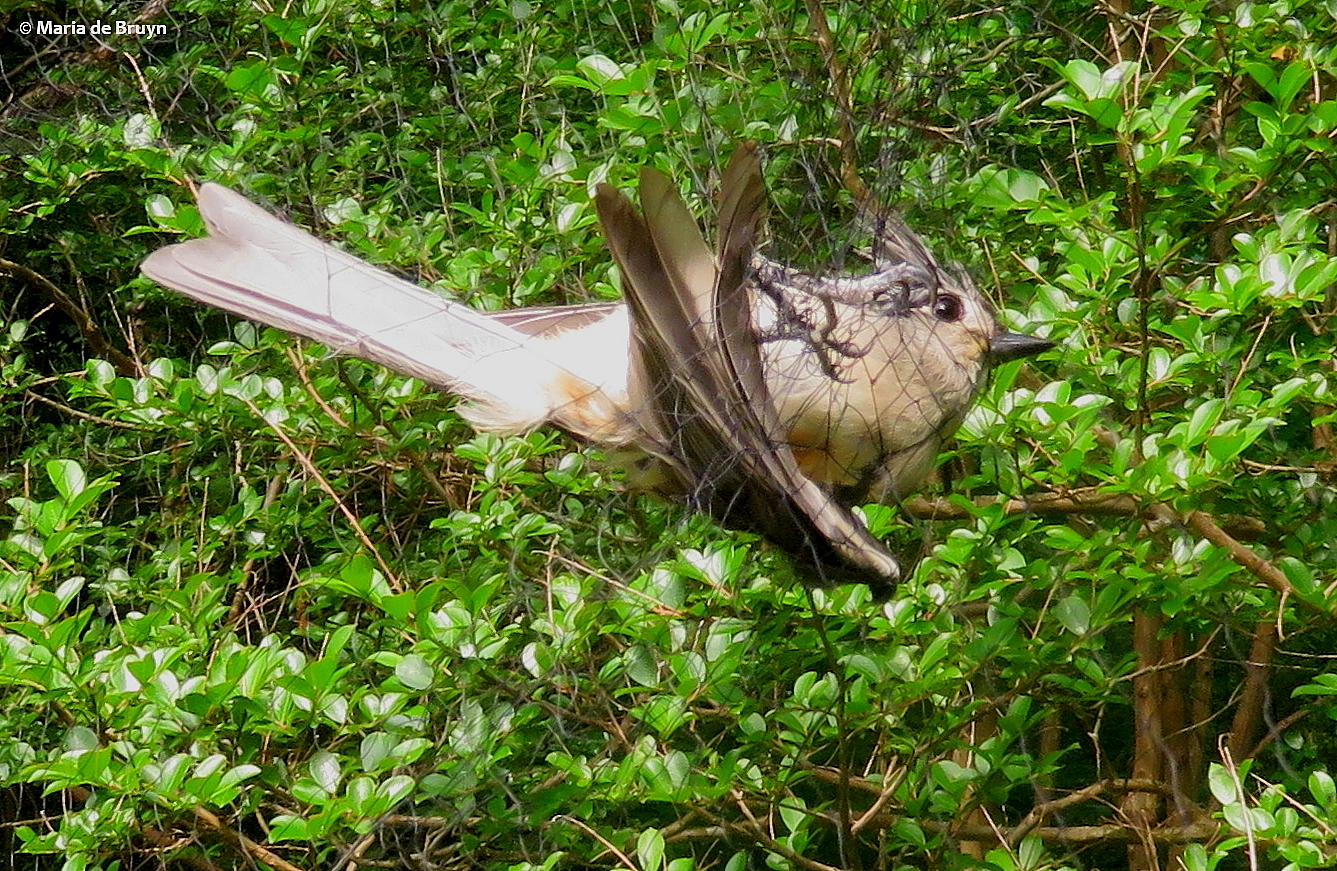
Three days ago, a second round of banding was done and we put the colorful anklets on a total of 10 birds. They were caught in two mist nets – one near my back garden and one near the backyard feeders.

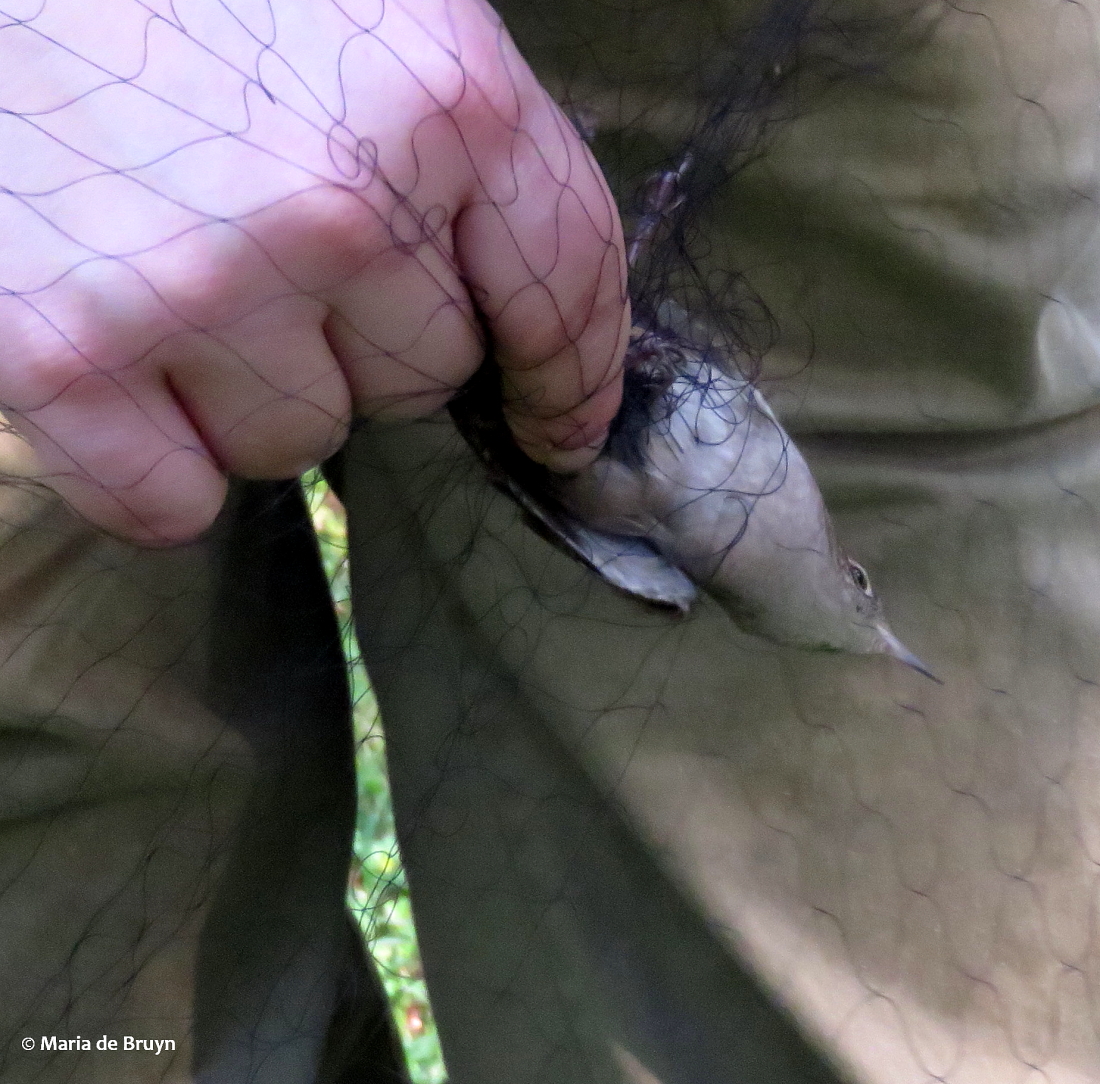
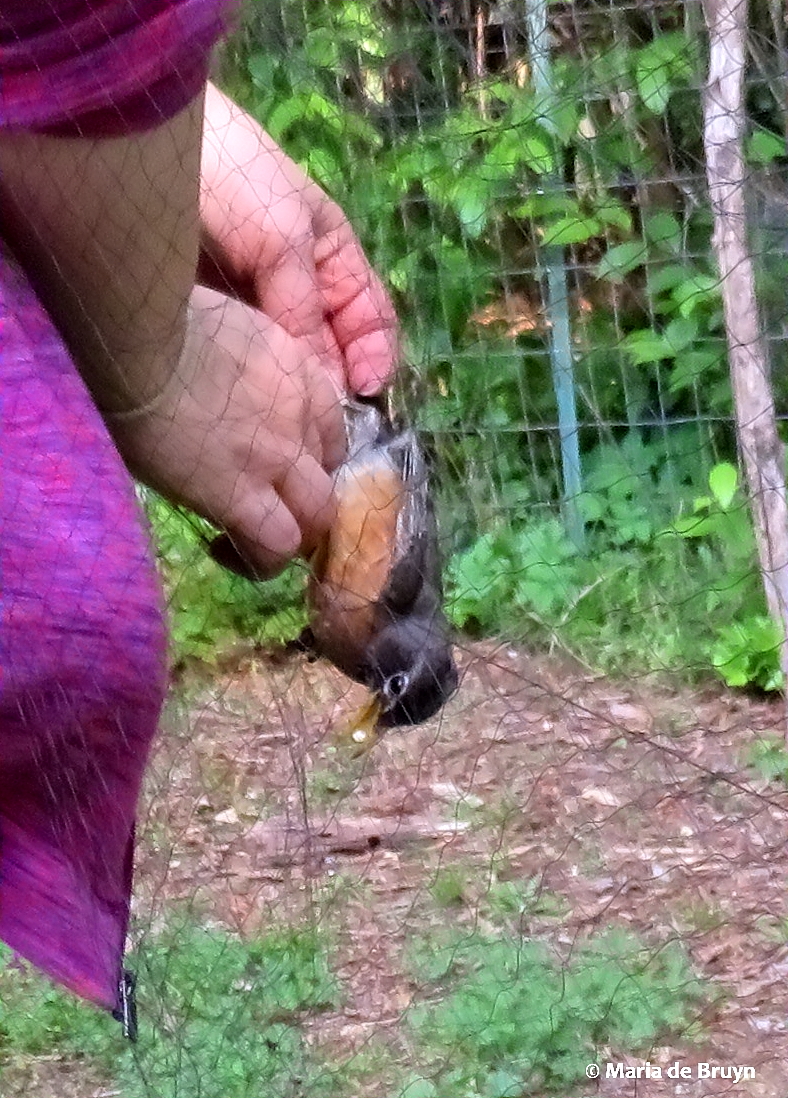
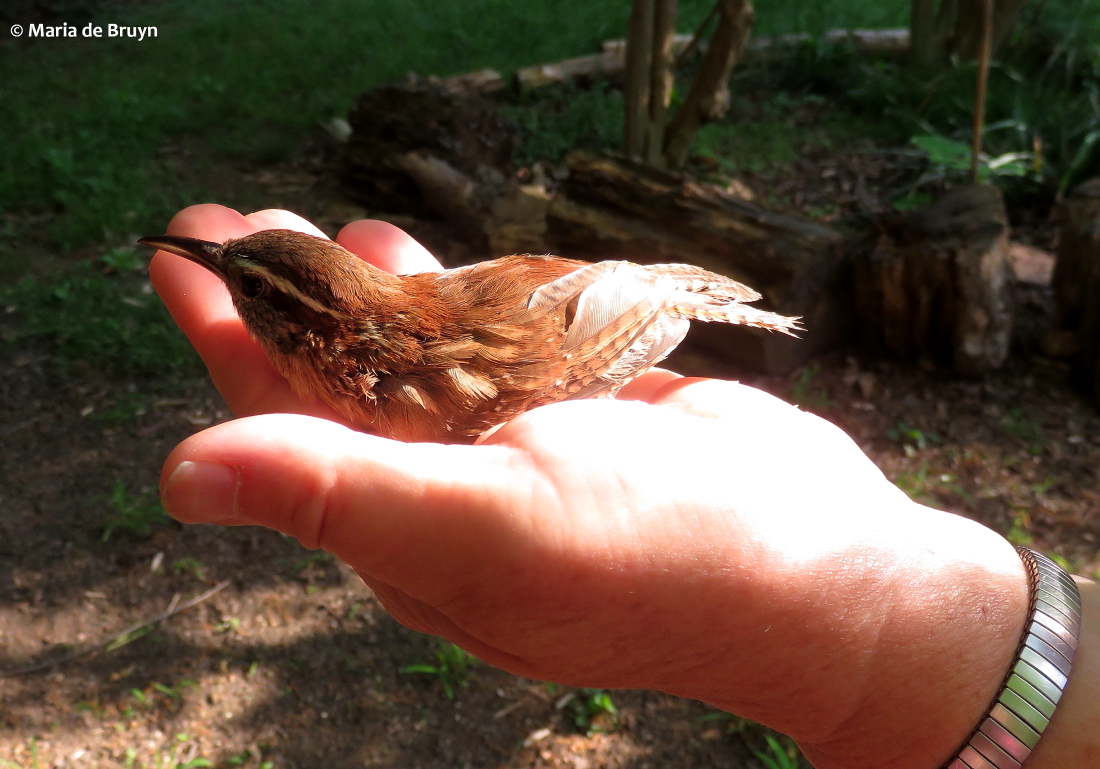
Northern cardinal Camilla I77A9127© Maria de Bruyn resThe nets had just been installed when our first visitor, a female Northern cardinal, was caught. She was not happy and when put in a bag until she could be banded, weighed, examined and measured, she did not remain still and calm. She had a little wait, however, as a female Carolina wren (Thryothorus ludovicianus) flew into the other net at just about the same time, followed by her mate within seconds. As the cardinals can tolerate being in a bag better than the smaller birds, the two wrens were banded first. Alicia let the first one go and then I released the second one, who rested on my palm for a bit. He felt so nice and soft!

Carolina wren Riley IMG_3832© Maria de Bruyn res

Forty-five minutes later, playback of a house wren’s song (Troglodytes aedon) led to the capture of a male who immediately came to investigate who was invading his territory. His mate, who was busy putting the finishing touches on a nest in a box near the mist net, didn’t go near the net.

house wren Hans IMG_3842© Maria de Bruyn reshouse wren Hans IMG_3844© Maria de Bruyn res

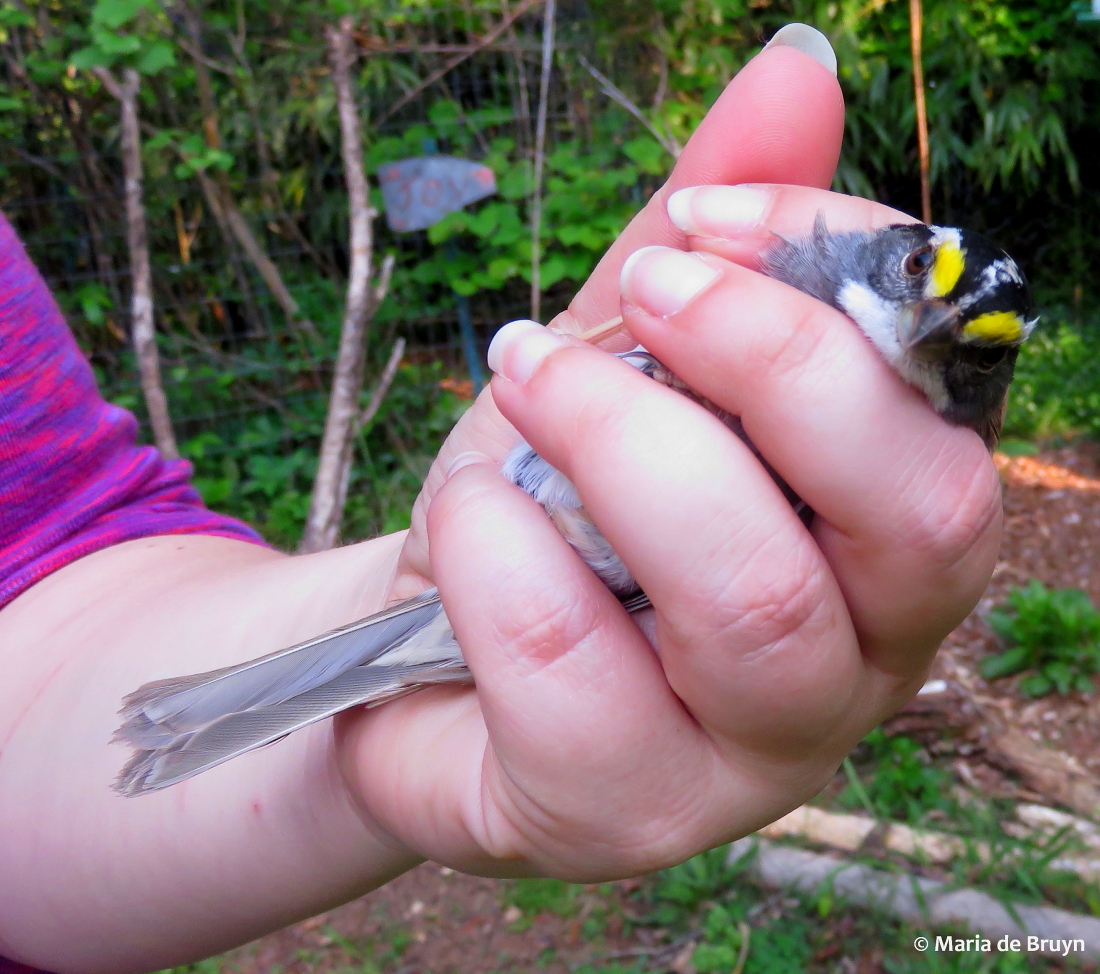
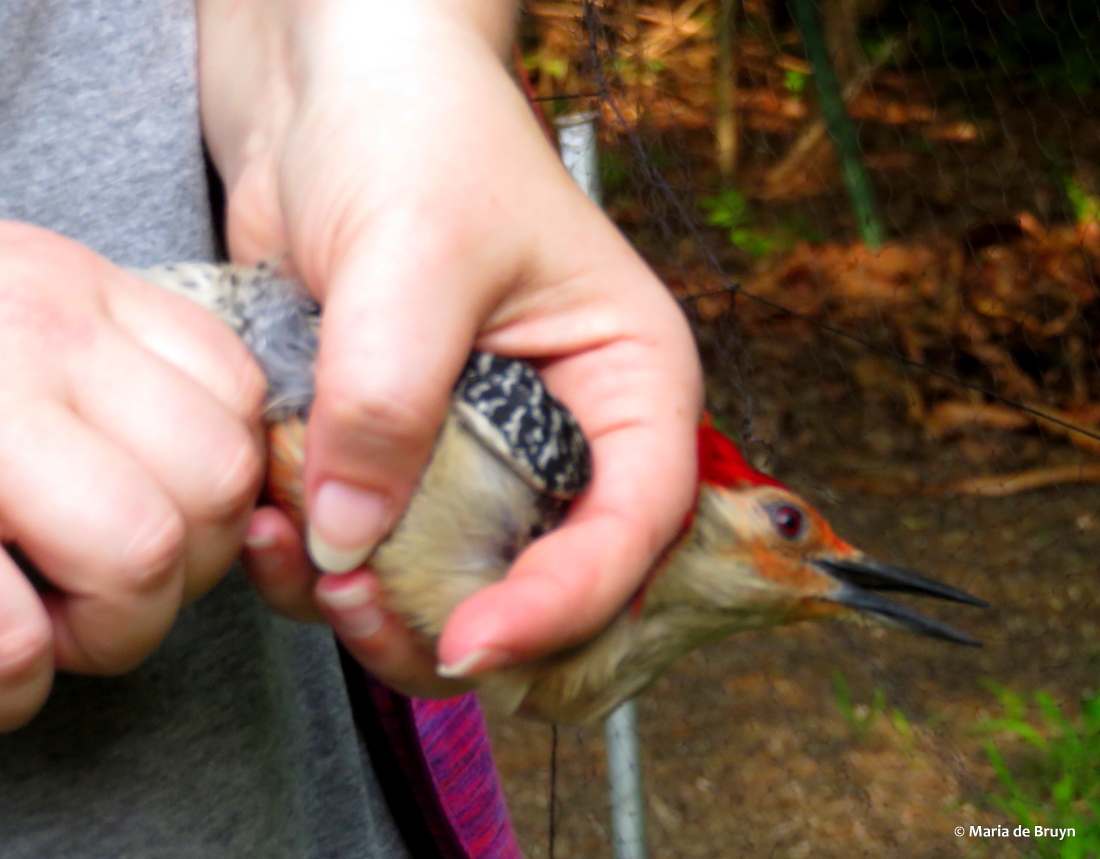
A few birds not targeted for the study ended up tangled in a net. A white-throated sparrow (Zonotrichia albicollis) had beautiful vivid breeding colors on his head. A red-bellied woodpecker (Melanerpes carolinus) was not calm like the sparrow, fluttering his wings constantly as Alicia, the bird bander, got him loose.

white-throated sparrow IMG_3837© Maria de Bruyn res red-bellied woodpecker IMG_3822© Maria de Bruyn res

Next up were a male cardinal and a female American robin. Like last year, the birds were measured and weighed. Although about the same length, the weight difference between the heaviest Northern cardinal we banded (41.2 oz) and the American robin was striking (79.6oz). The robin’s fondness for worms and other dietary preferences helps account for this. When I let her go, she didn’t feel very heavy in my hand as she rested a second before flying off.

American robin Raisin IMG_3854© Maria de Bruyn

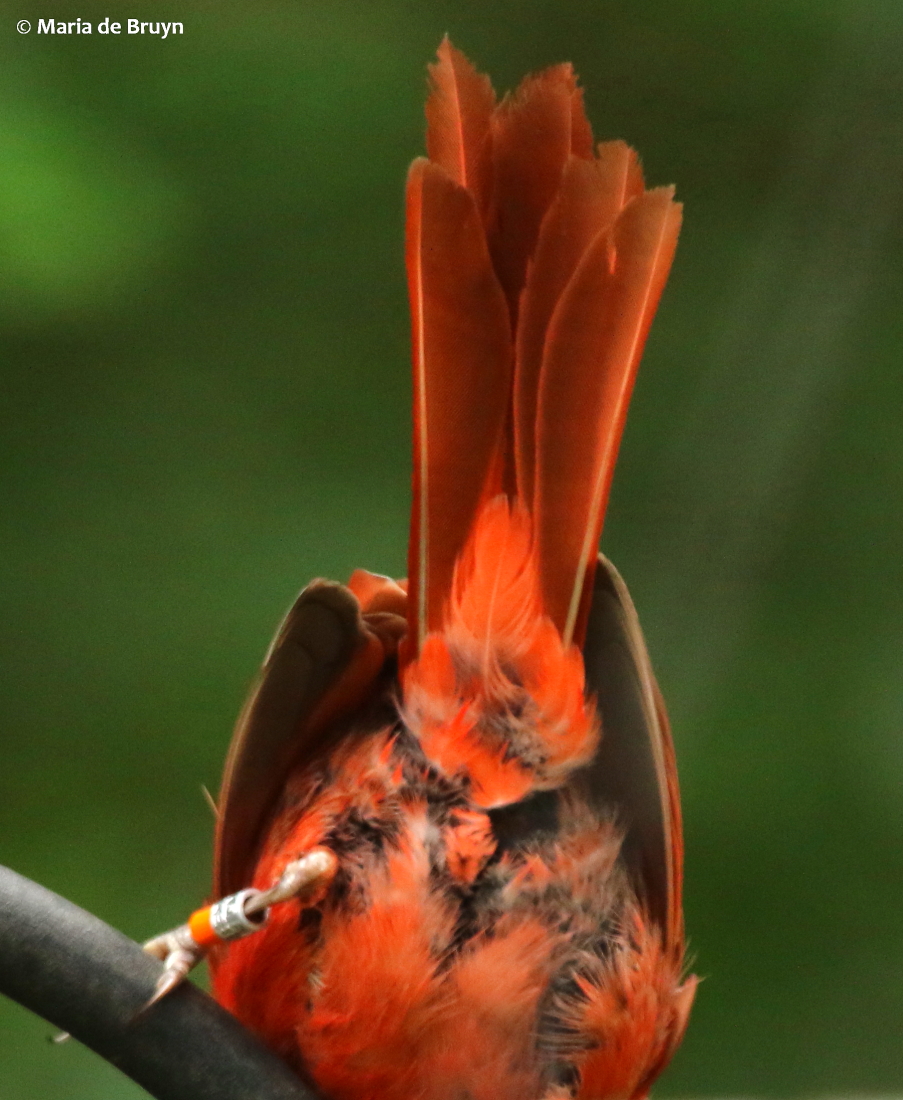
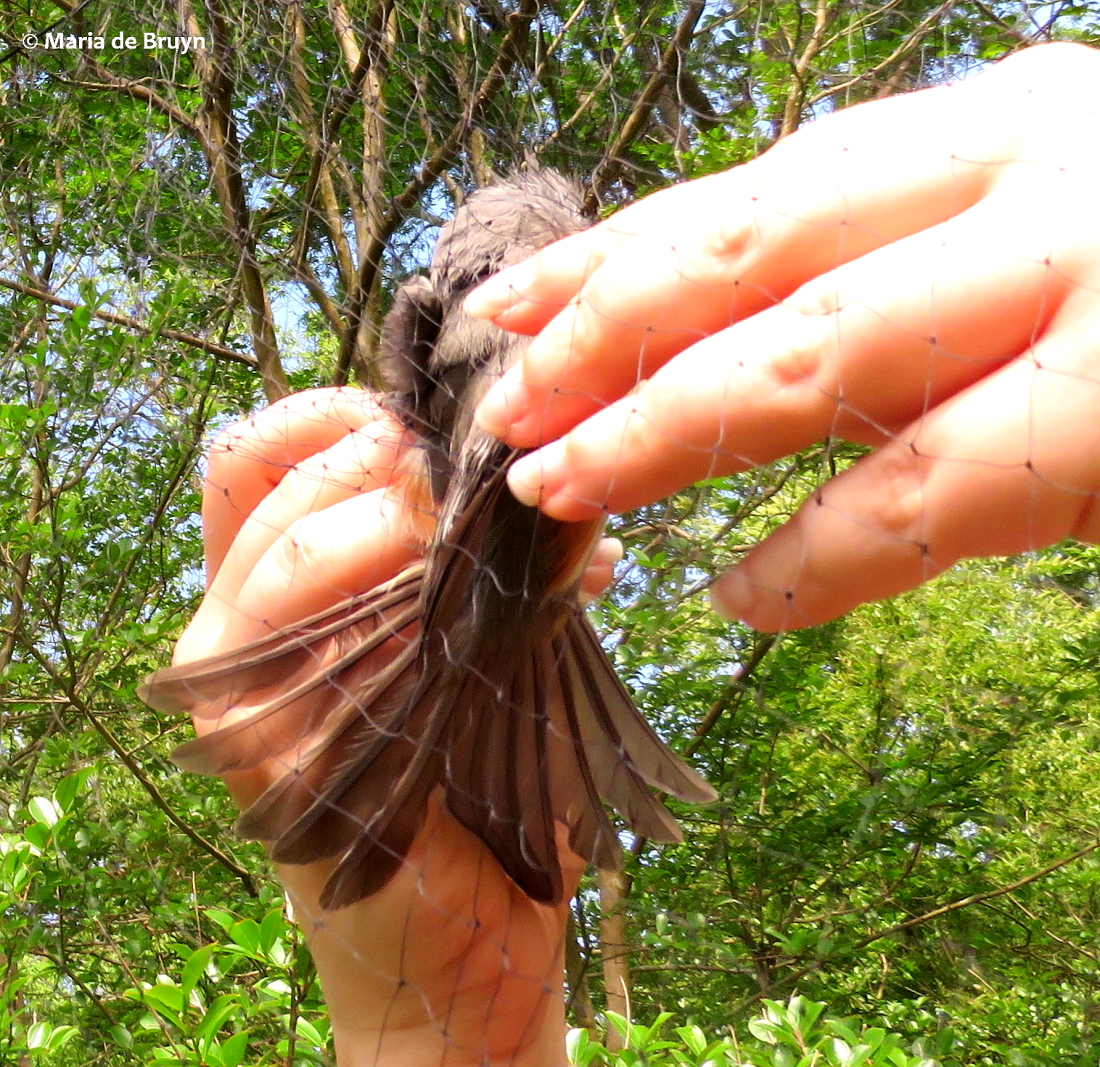
Except for birds that were molting their tail feathers, Alicia also removed the third left tail feather; this is done primarily for stable isotope analysis, which allows a researcher to estimate where the bird was when that feather was grown.

Northern cardinal Crake I77A0559© Maria de Bruyn res

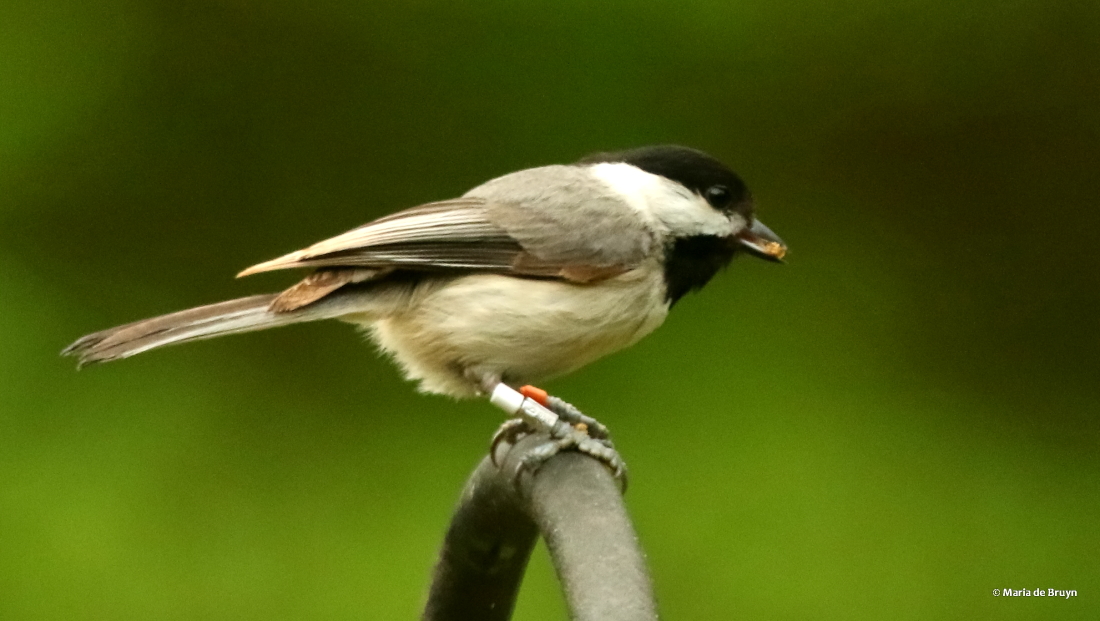
Carolina chickadee Chancey I77A7762© Maria de Bruyn resThe catbirds avoided the mist nets skillfully this year. Playback of their songs drew them to the vicinity but the two pairs visiting the feeders were more interested in chasing each other away from the territory. Alicia hoped that we could get a Carolina chickadee (Poecile carolinensis); with playback we got a male and then, 45 minutes later after banding another cardinal, we got a pair of them.

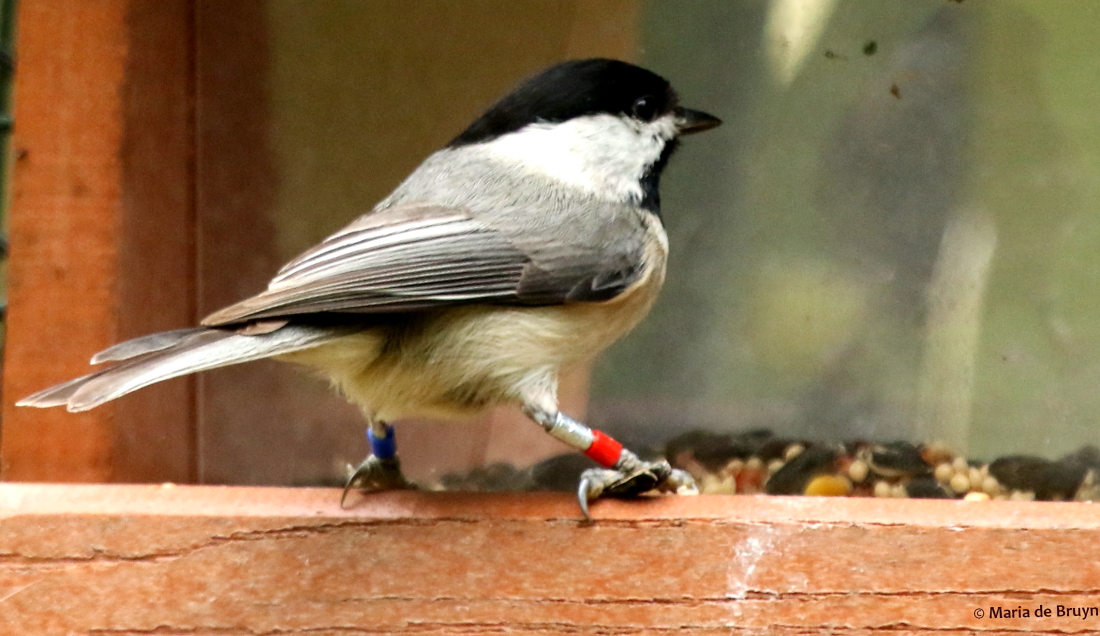
Carolina chickadee Chase I77A0348© Maria de Bruyn res Carolina chickadee Chantal I77A9525© Maria de Bruyn res

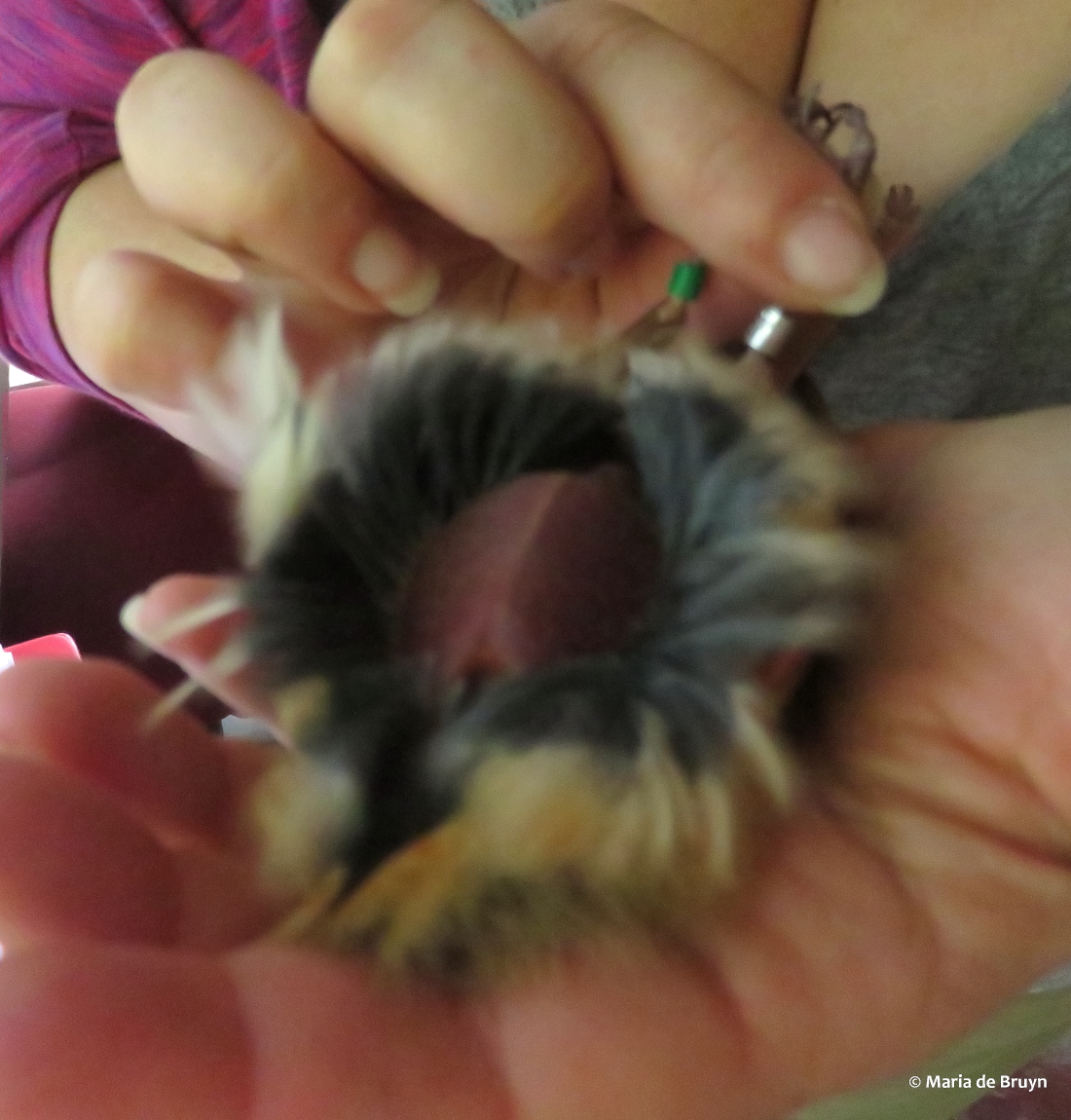
Alicia blew on the birds’ undersides (forgive the blurry photo) to assess fat reserves, which are stored along the flanks and up near the furcula by the collar bone. She could also determine sex that way and thought that one chickadee might be developing an egg – hopefully, one of the females who lost a nest to predators in my yard a week ago. The last male chickadee released was out of sorts after the experience; before leaving my hand to fly off rapidly, he turned and bit me as a parting shot.

Carolina wren Renee IMG_3813© Maria de Bruyn res Carolina chickadee IMG_3856© Maria de Bruyn res

Alicia had remarked that she hoped no tufted titmouse (Baeolophus bicolor) would be caught; they are not part of the study and she said they are so feisty that their bites can be a bit painful like those of the cardinals. Unfortunately, one leaving a feeder did end up in a net and lived up to its reputation as a feisty bird. A chipping sparrow (Spizella passerina), who was the last bird in a net remained fairly calm as the net was removed from its claws.

tufted titmouse IMG_3858© Maria de Bruyn res

Tufted titmouse IMG_3861© Maria de Bruyn res

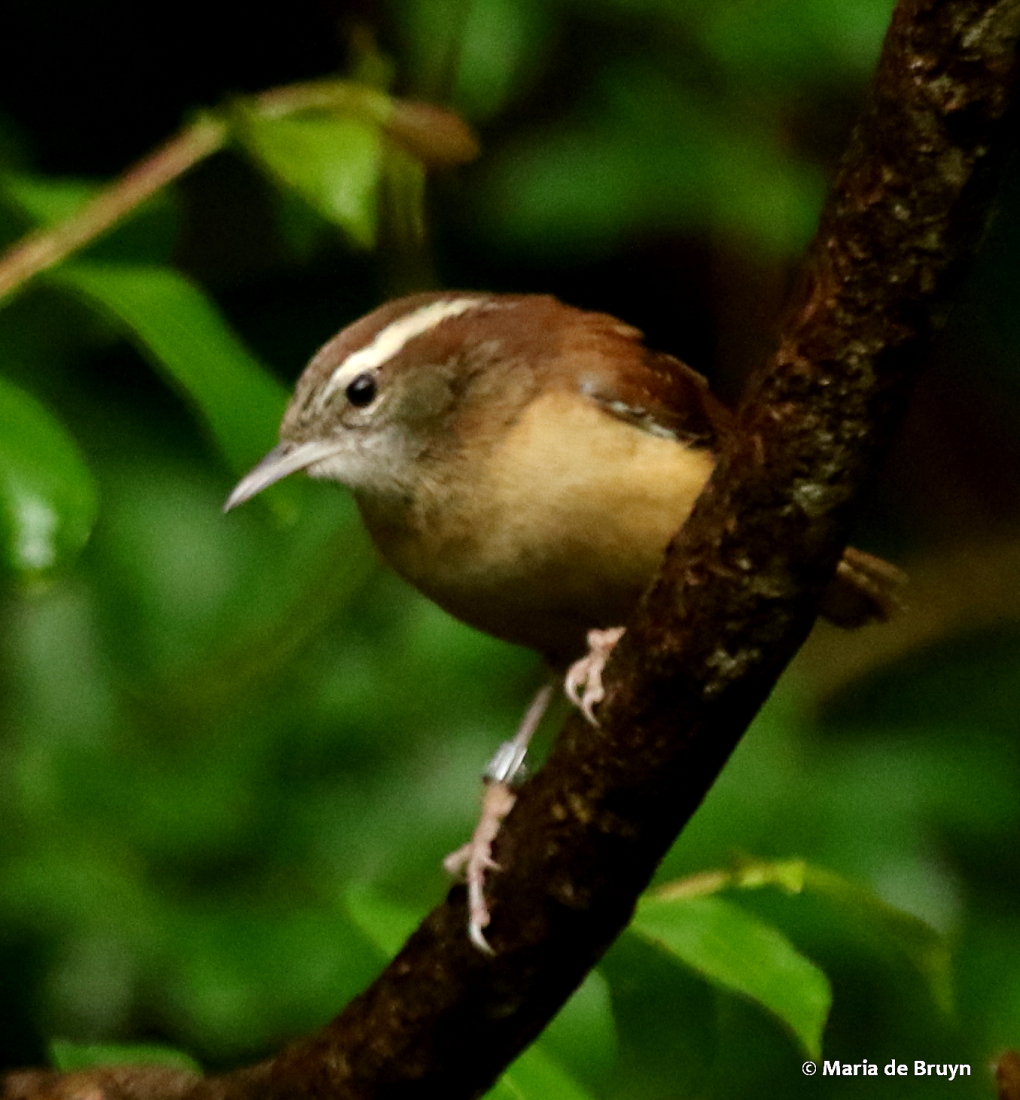
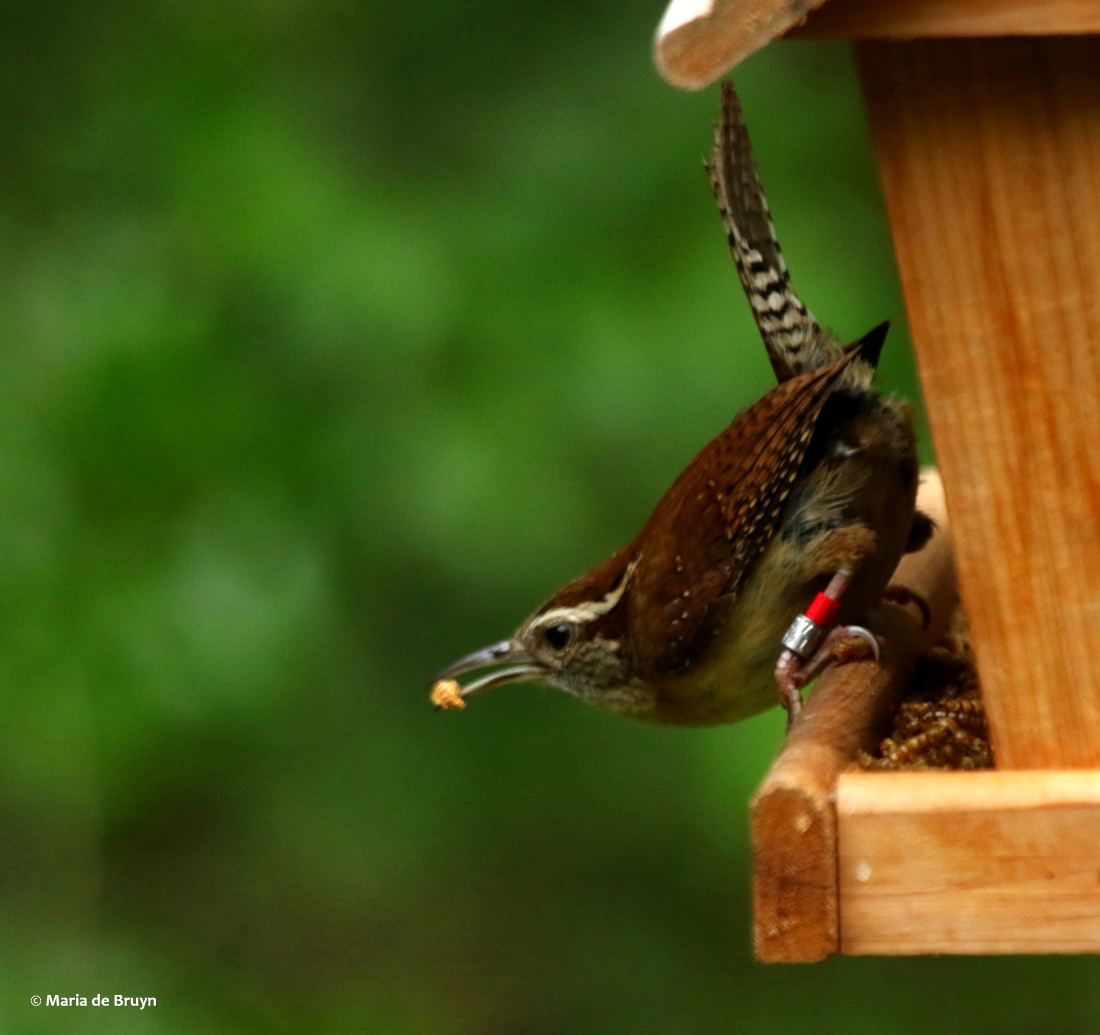
Yesterday, I spent some time watching the feeders and yard to see if all the banded birds had left. Luckily, some of them showed up and were here again today. So here are a few of “my birds” with bling – this is a truly enjoyable citizen science project. 🙂

Northern cardinal Clarence I77A0124© Maria de Bruyn res Northern cardinal Crake I77A0593© Maria de Bruyn res

Clarence                                                                       Crake

Carolina wren Renee I77A9354© Maria de Bruyn resCarolina wren Riley I77A0508© Maria de Bruyn res

Renee and Riley Carolina wrens