Living above a restaurant

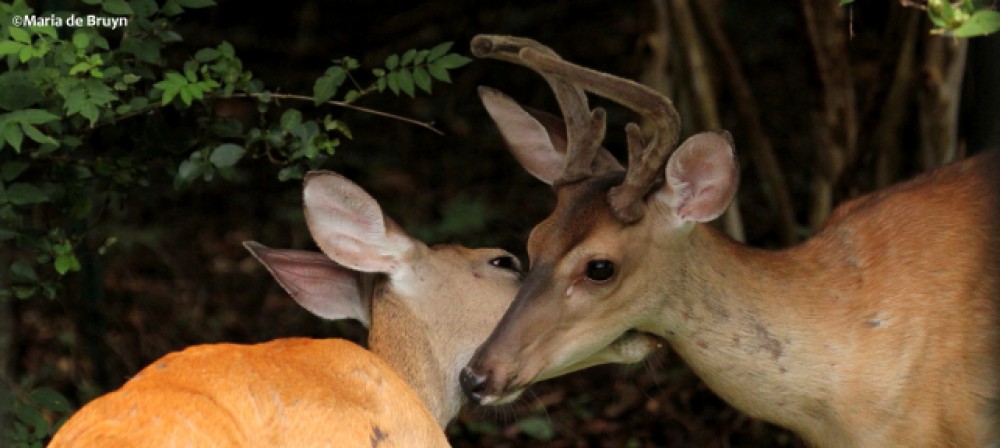
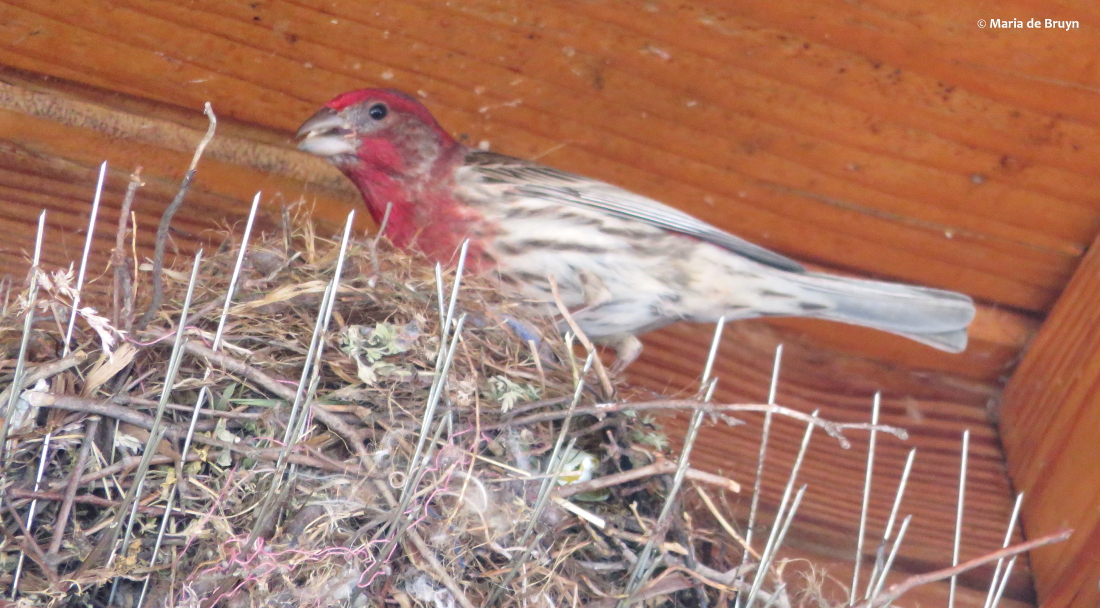
house finch nest 1 IMG_4358© Maria de Bruyn resAt one point in Amsterdam, I lived in a room with a shared kitchen and toilet above a butcher shop. It was a cramped space but I made some nice friends there. Eventually, I painted the hallway with flowers and snails to bring a bit of nature inside. Today, on my way to a prompt writing session, I saw that some birds also choose to live above commercial establishments, including those who established homes above one of my favorite restaurants, El Tigre.

House finch nest 1IMG_4373© Maria de Bruyn res


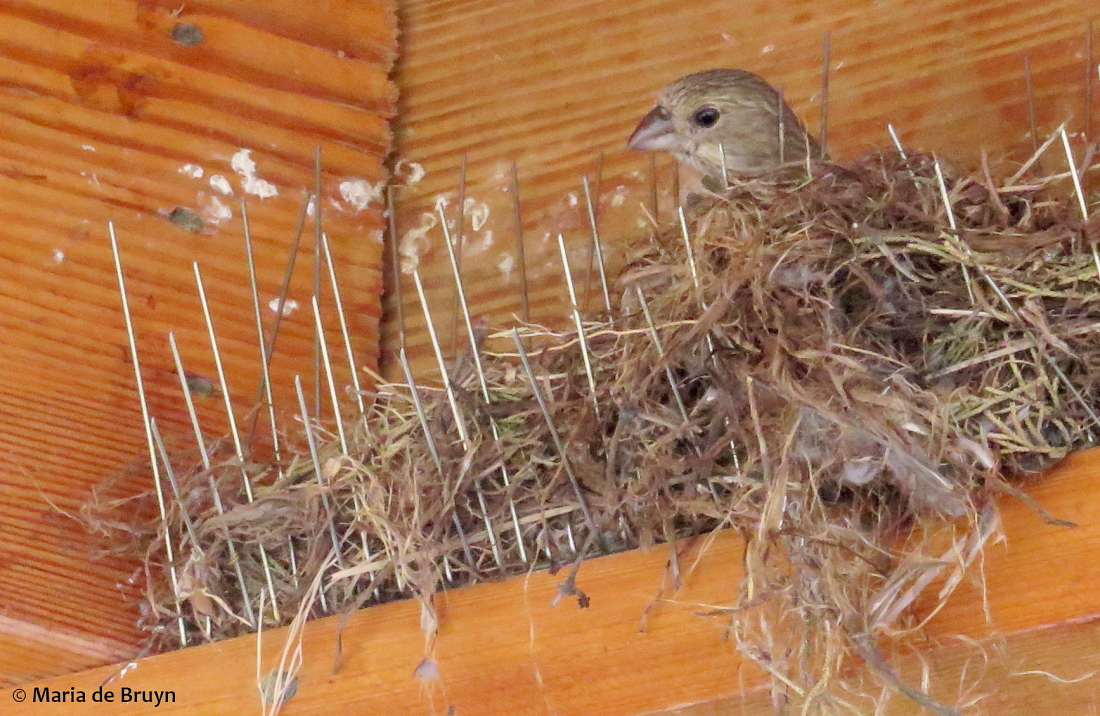
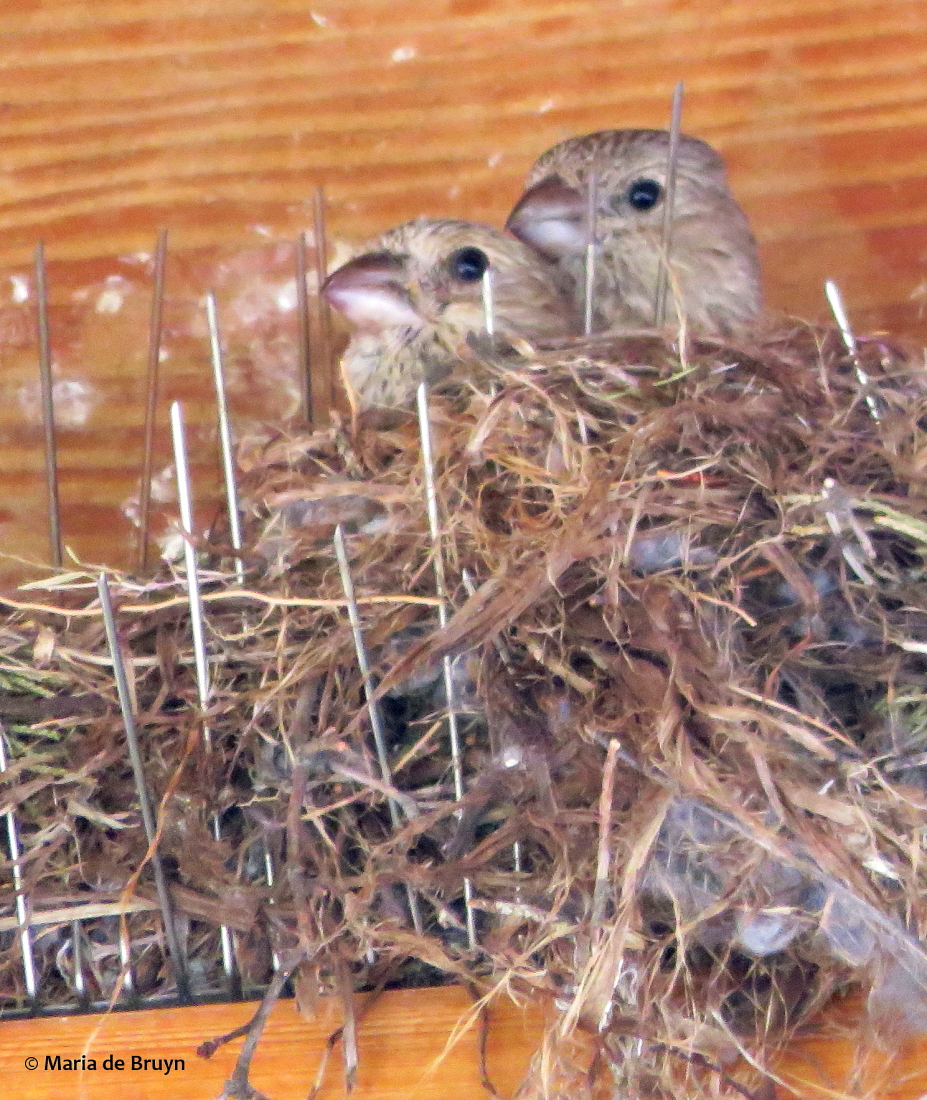
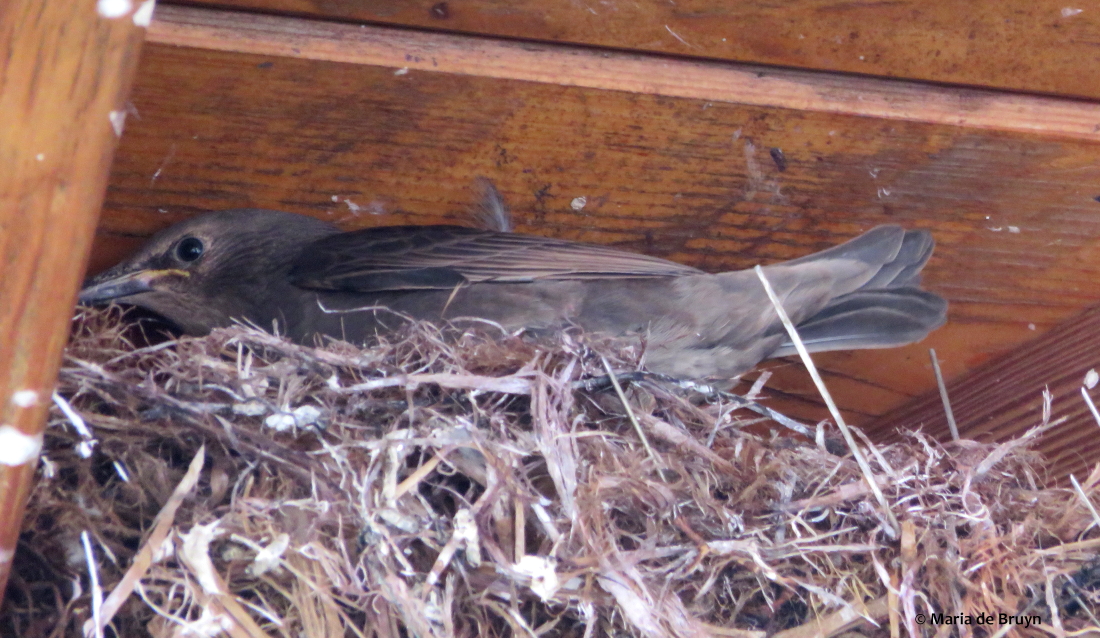
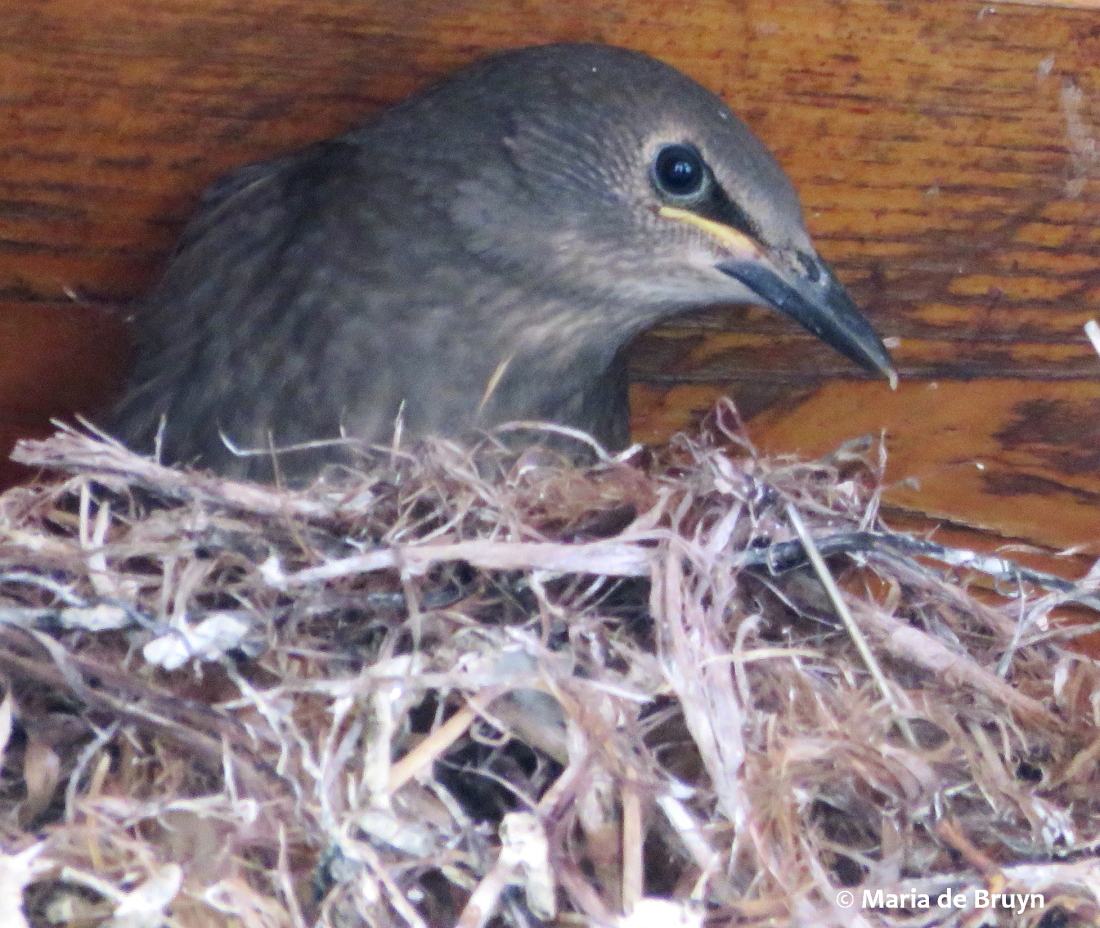
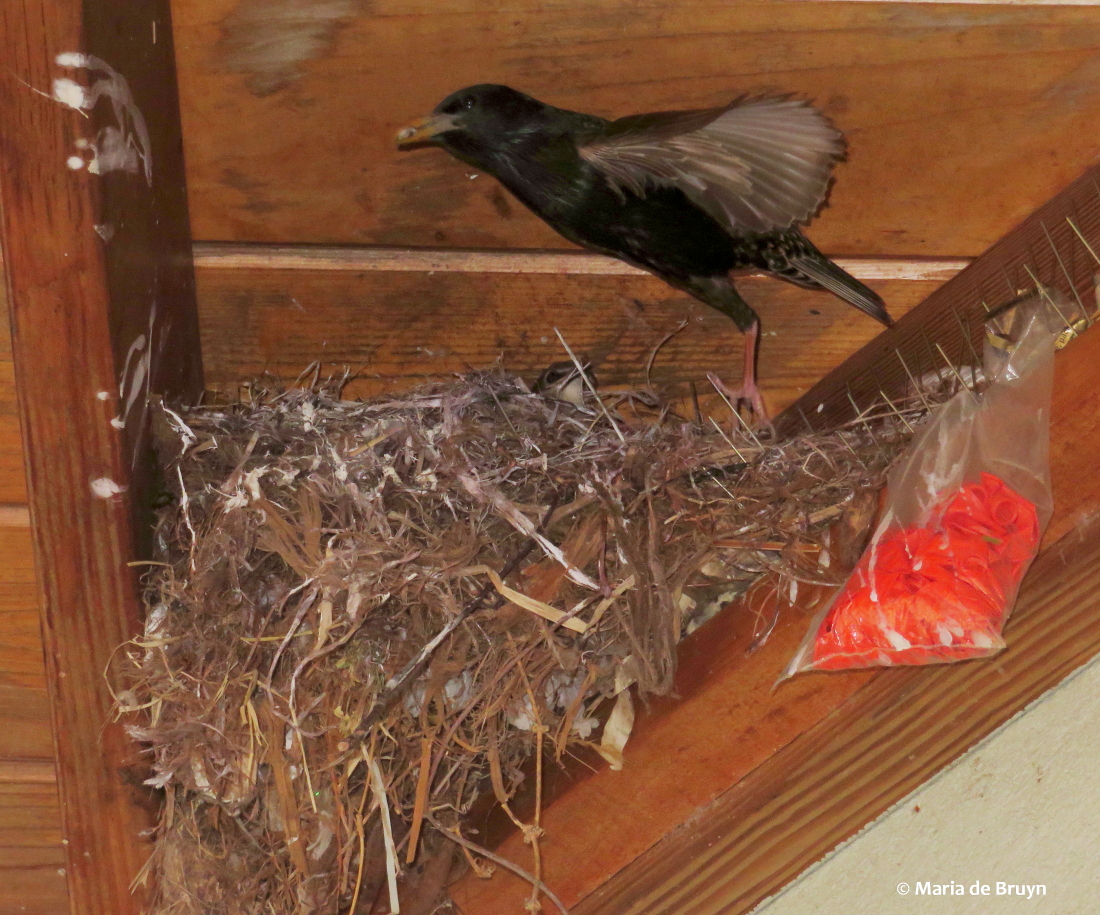
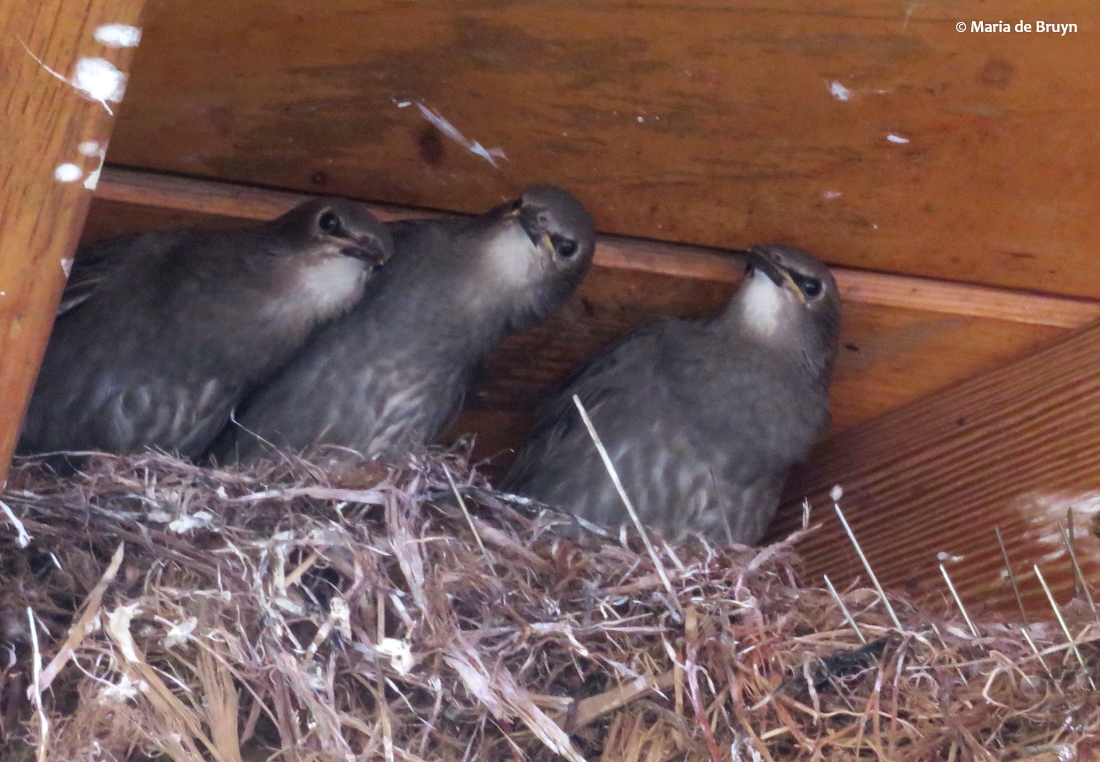
There were three nests (at least – I didn’t look around to the other wall), with house finches (Haemorhous mexicanus) on either side of a European starling (Sturnus vulgaris) home in the middle. Nest 1 had a female bird visiting while a couple stayed inside.


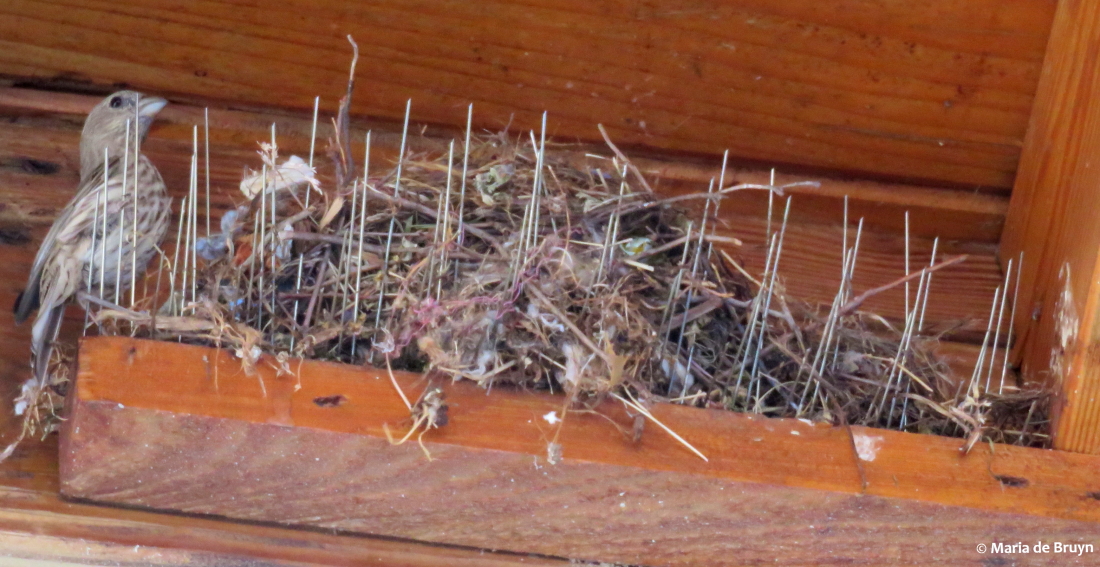
The other finch nest was attended by both mother and father.

house finch nest 3 IMG_4375© Maria de Bruyn res house finch nest 3 IMG_4351© Maria de Bruyn res

house finch nest 3 IMG_4396© Maria de Bruyn res

European starling IMG_4390© Maria de Bruyn resThe nest with starlings had rather large babies in it. At one point, an adult bird flew in with a worm or insect but then took off before feeding anyone – perhaps alarmed when it saw me watching the nest. The babies didn’t say much, in contrast to the somewhat older baby starlings in my yard who make quite a racket asking to be fed.

European starling IMG_4387© Maria de Bruyn resEuropean starling IMG_4347© Maria de Bruyn res


European starling IMG_4397© Maria de Bruyn res

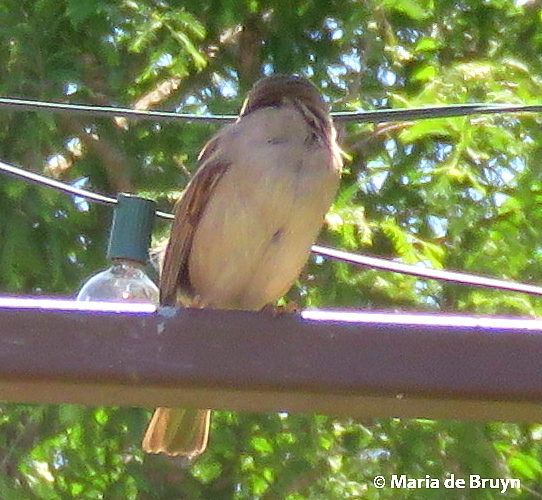
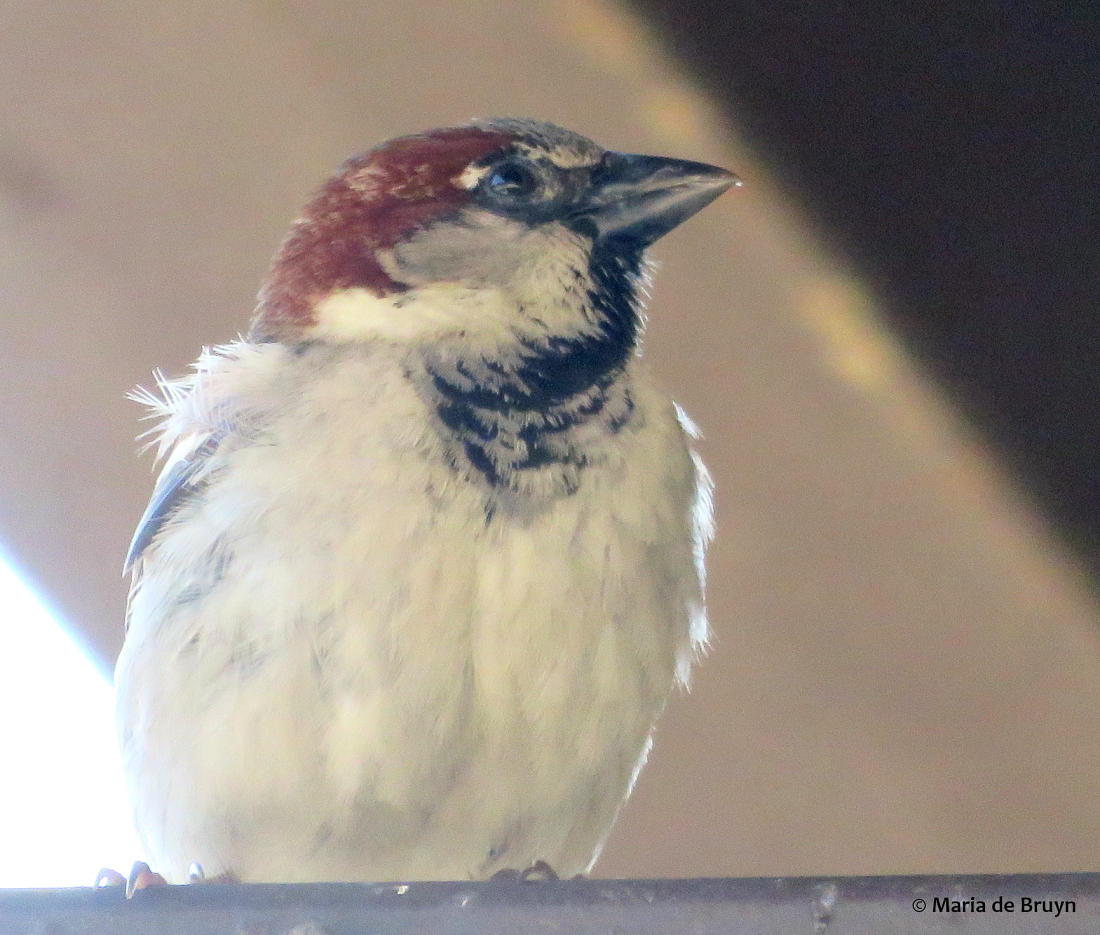
I wasn’t the only observer, however; a couple house sparrows (Passer domesticus) were also observing the comings and goings to and from the nests.

house sparrow IMG_4412© Maria de Bruyn res house sparrow IMG_4355© Maria de Bruyn res

I had a busy day and didn’t think I’d get to do much nature observation – but then those adaptable birds showed me that even in an urban environment, I can grab a few moments to see what other species are doing on a lovely spring day!


Nest Watch citizen science – 2016 edition

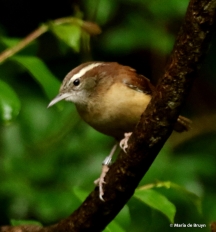
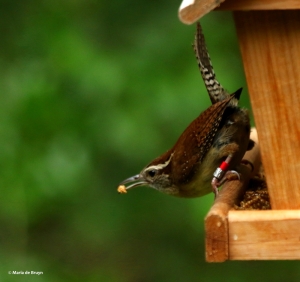
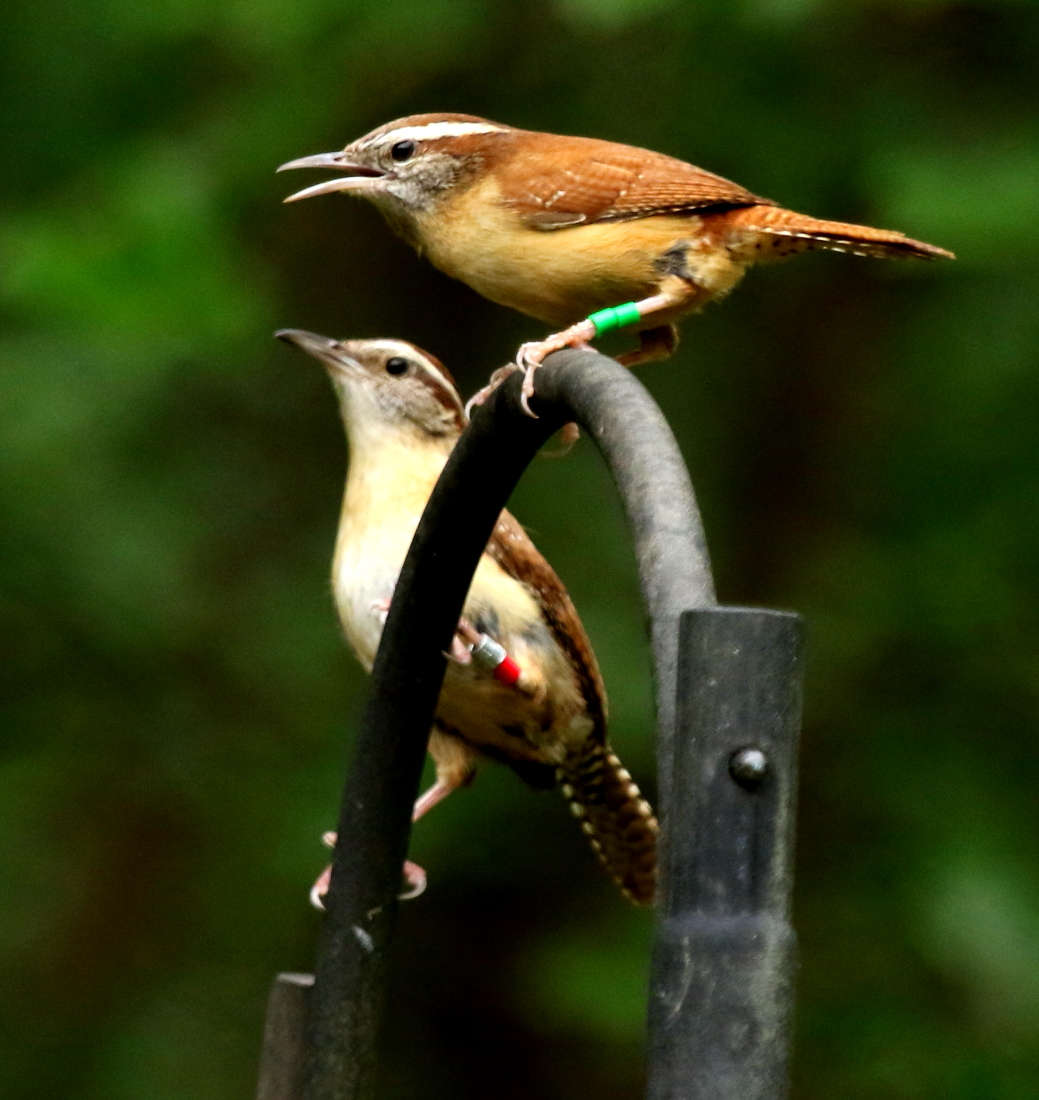
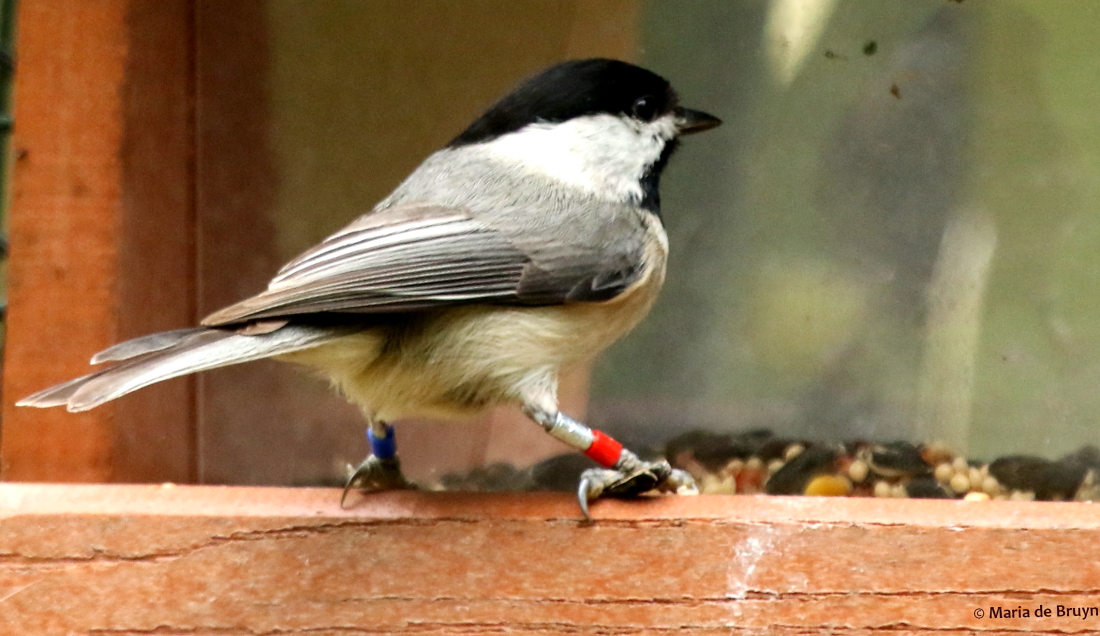
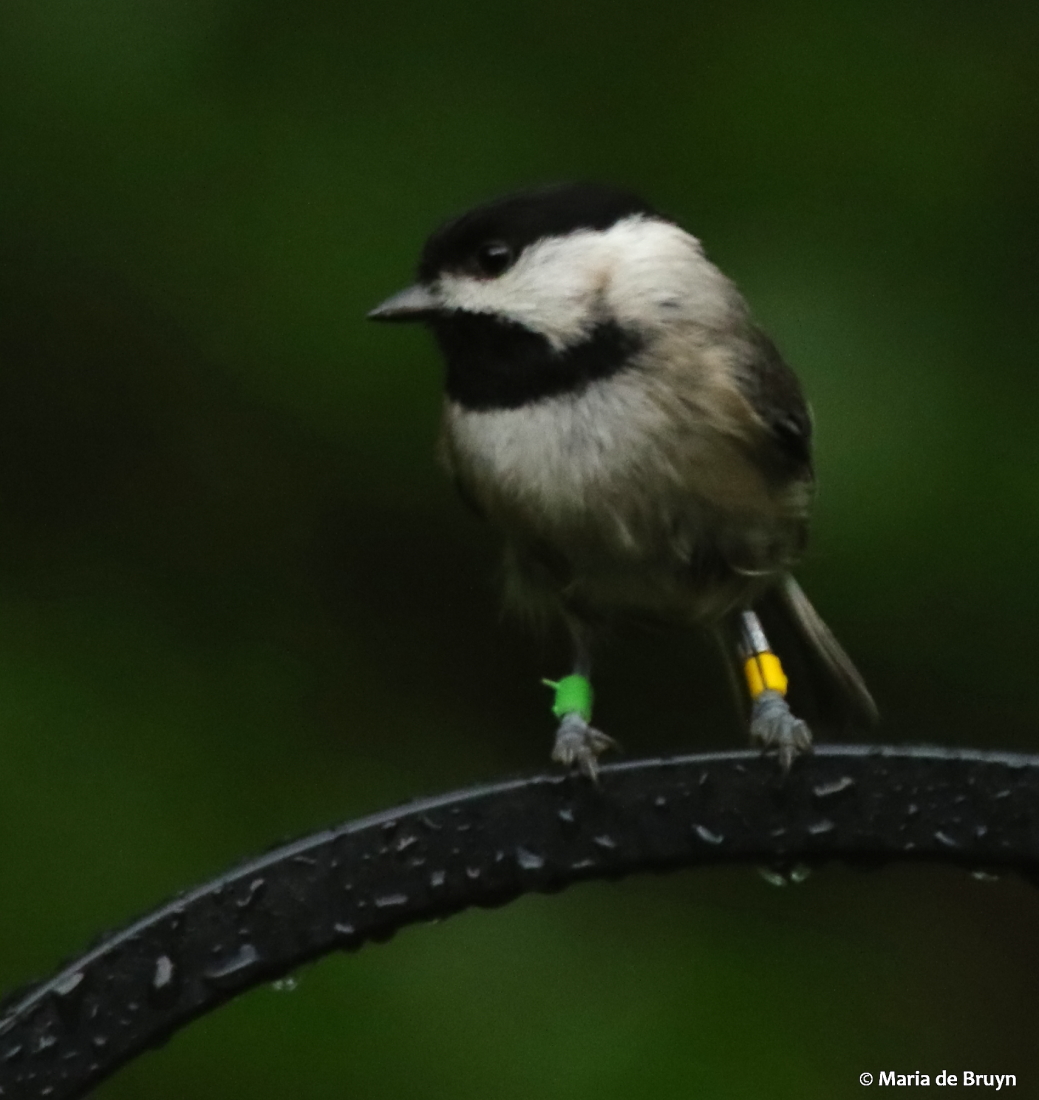
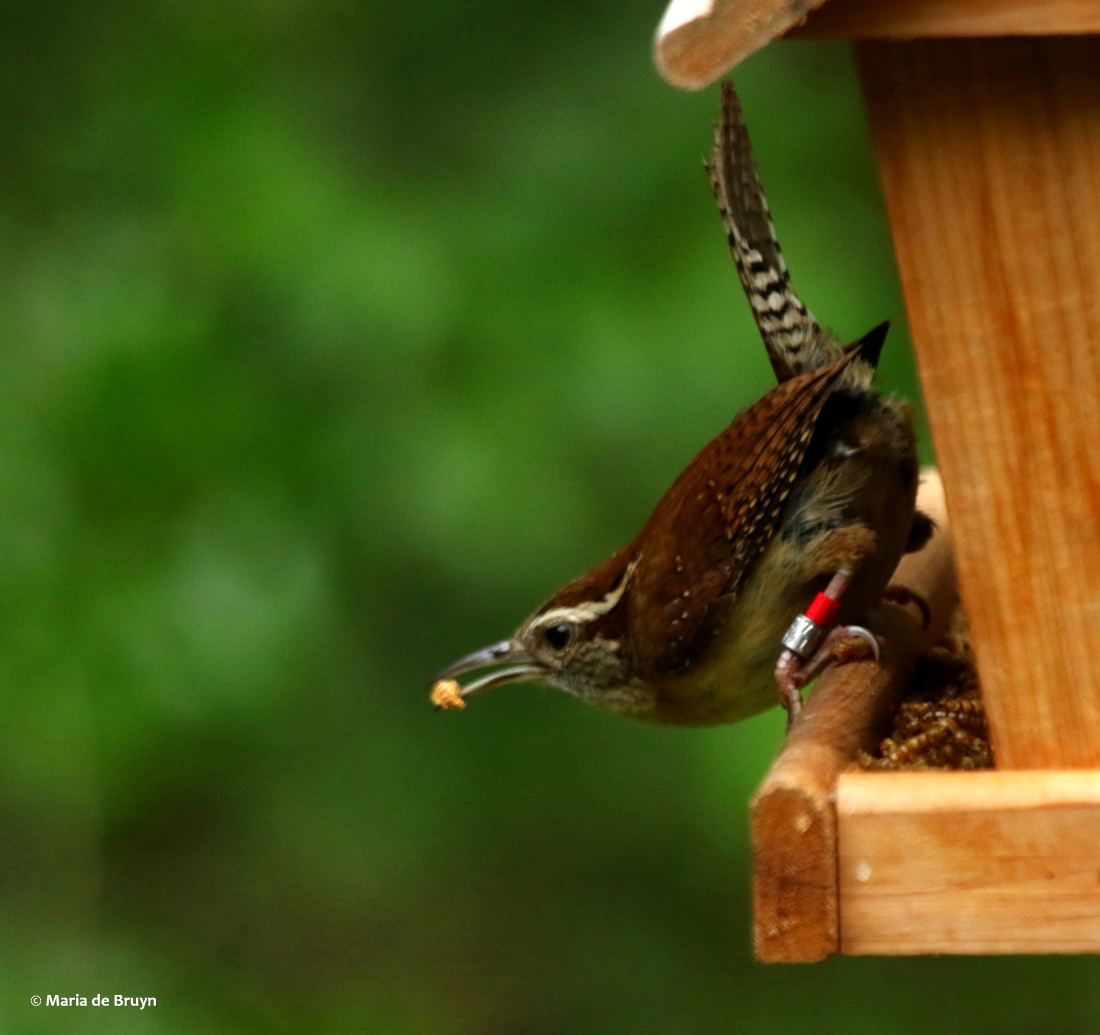
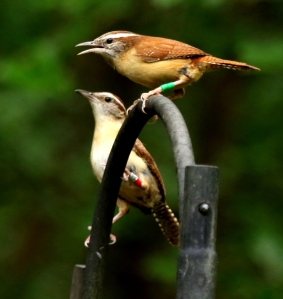
Carolina wren Renee and Riley I77A9074© Maria de Bruyn resLast year, I became a Nest Watch volunteer, which involves having birds banded in your yard so that you can follow and report to researchers the birds’ presence over time as they visit and leave your yard.

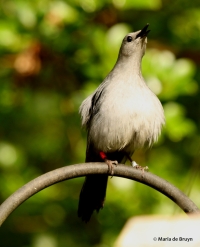
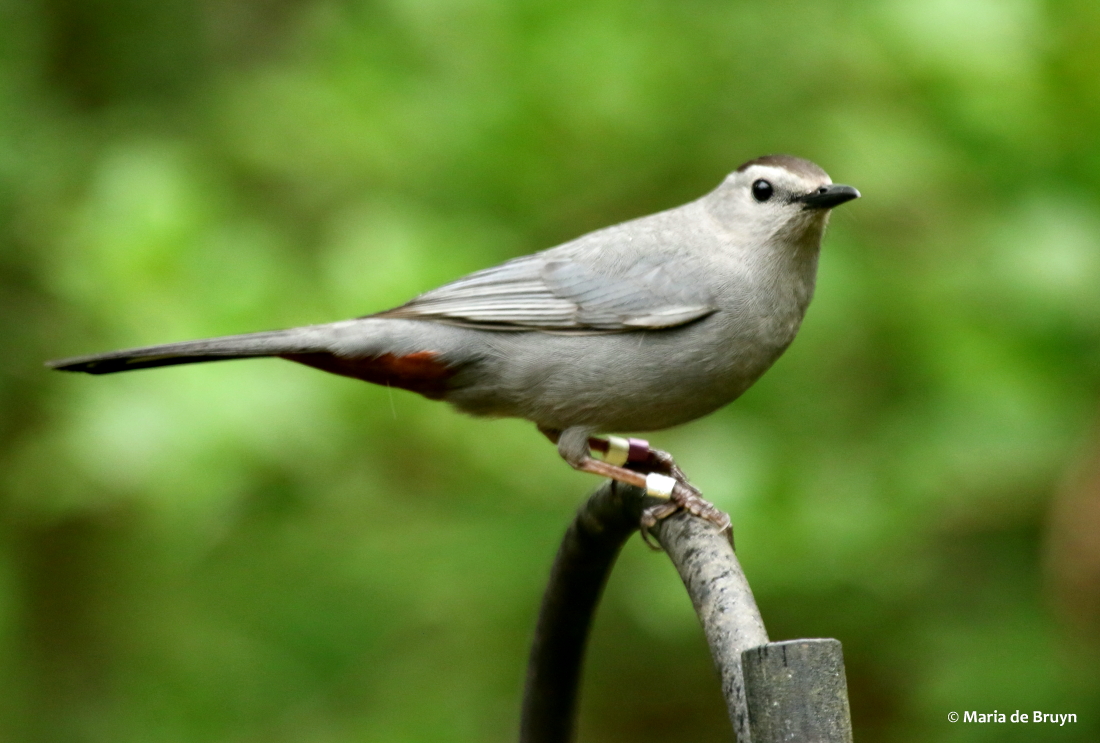
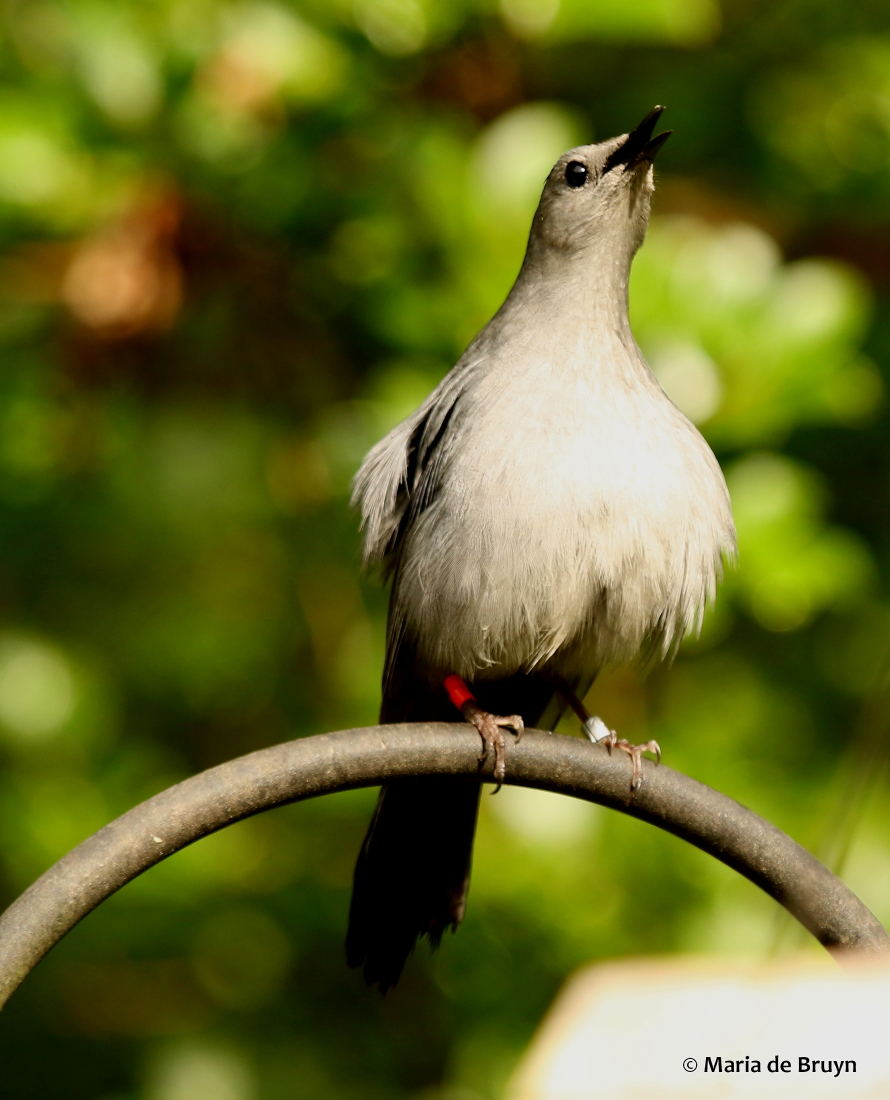
In 2015, we banded six birds. If a bird is only a temporary visitor or if it died outside the yard due to disease, old age or predation, you just won’t see it again and have no idea what became of it. The American robin (Turdus migratorius) that was banded last year never returned. If the birds stick around, however, you have the enjoyment of observing birds you get to know. The three gray-headed catbirds (Dumetella carolinensis) stayed around all summer and fall, and two of them – Camden and Corey – returned to my yard from winter migration a few days ago. They have been accompanied by females whom they appear to be assiduously courting.
gray-headed catbird Camden I77A8990© Maria de Bruyn res

gray-headed catbird Corey I77A8083© Maria de Bruyn res

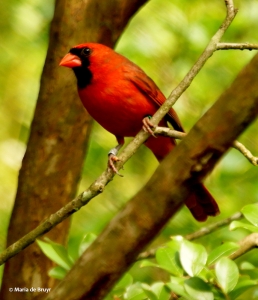
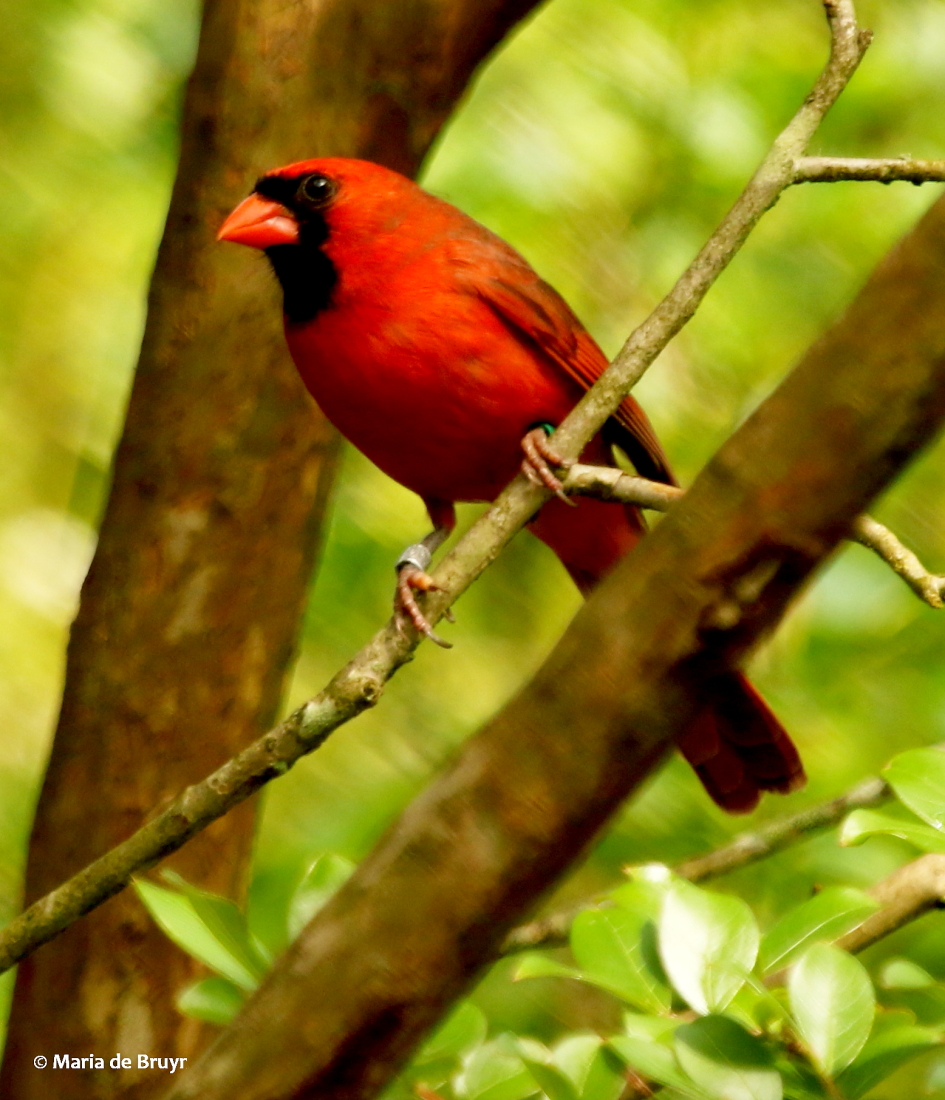
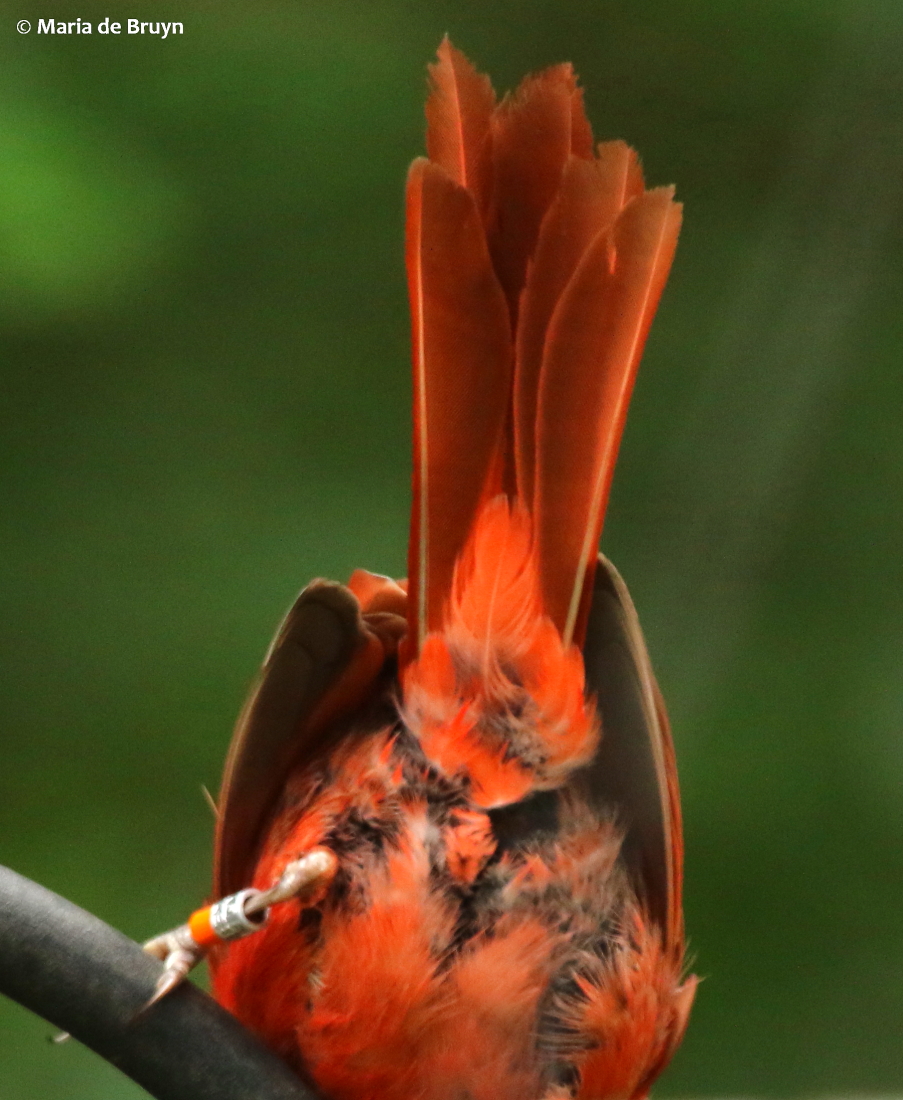
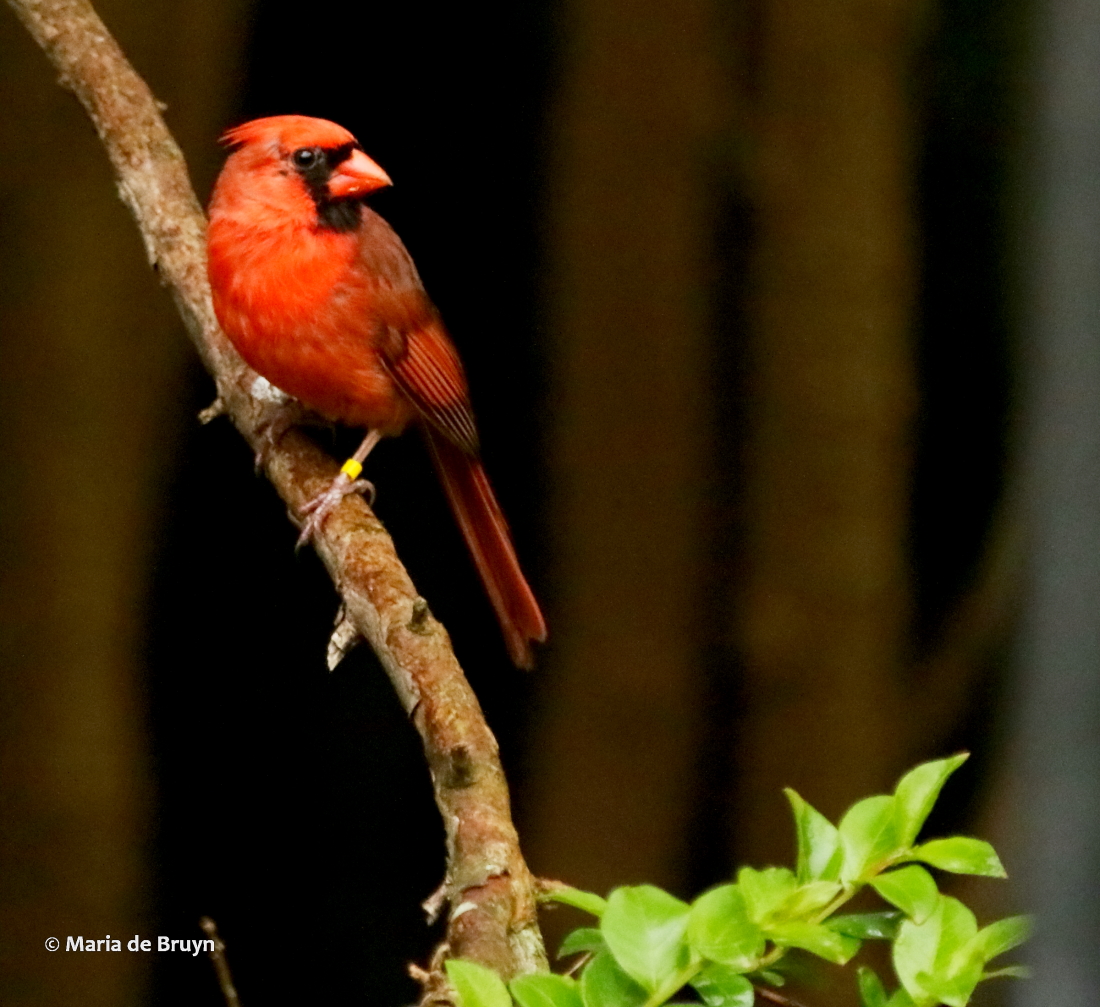
Northern cardinal Clancy I77A8123© Maria de Bruyn resOne Northern cardinal (Cardinalis cardinalis) was banded last year, but Clancy only stayed a few days and then disappeared for the rest of the summer, fall and winter. He suddenly appeared yesterday – perhaps encouraged to spend time at the feeders by the other birds with bracelets.

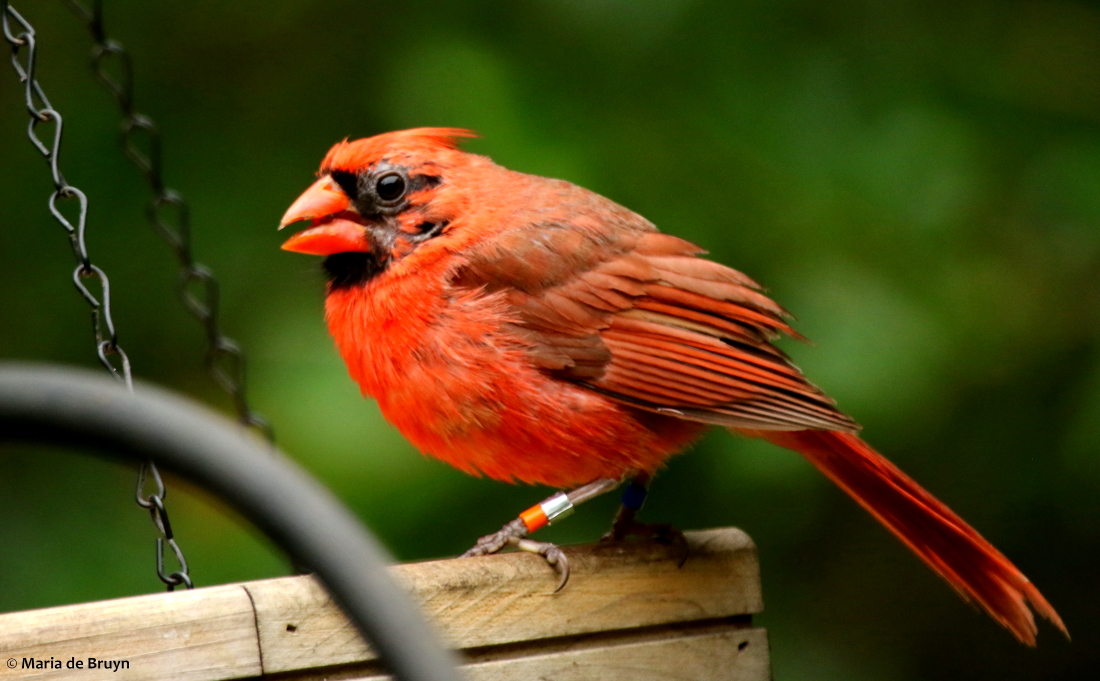
Three days ago, a second round of banding was done and we put the colorful anklets on a total of 10 birds. They were caught in two mist nets – one near my back garden and one near the backyard feeders.
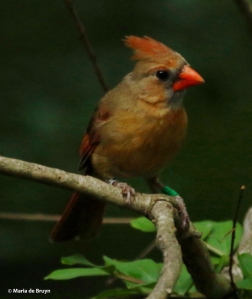
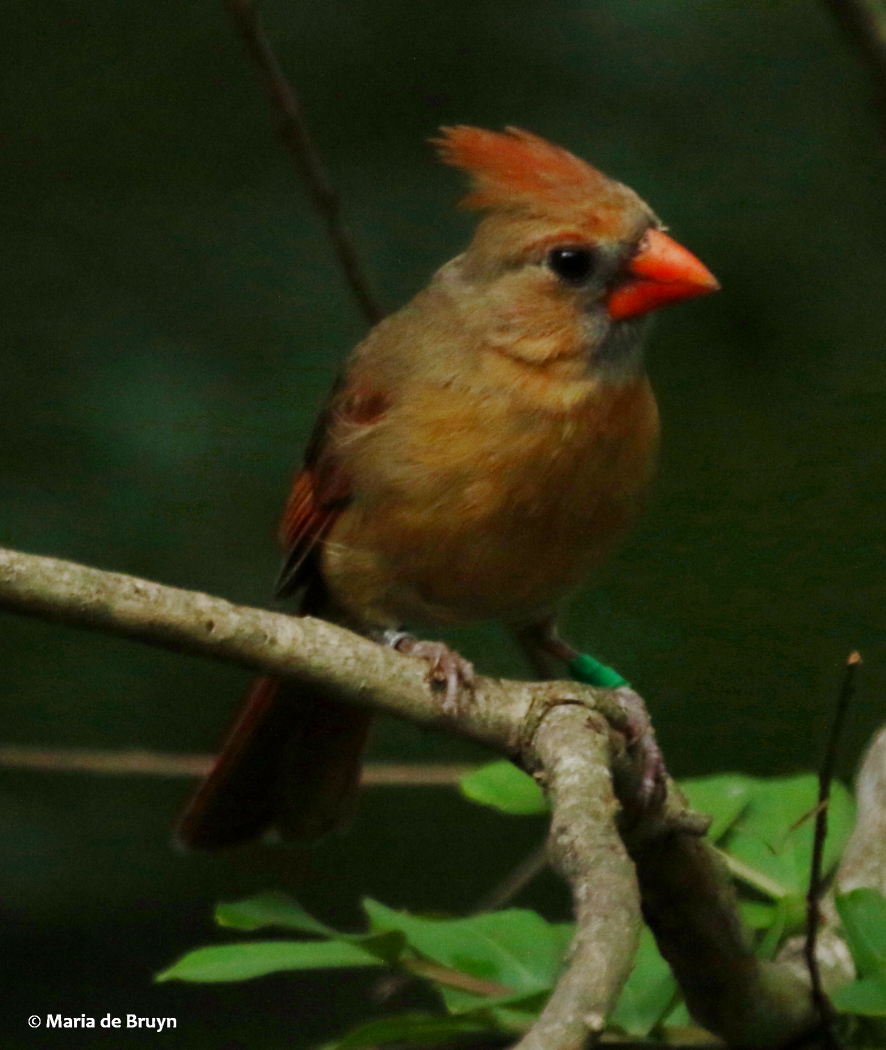
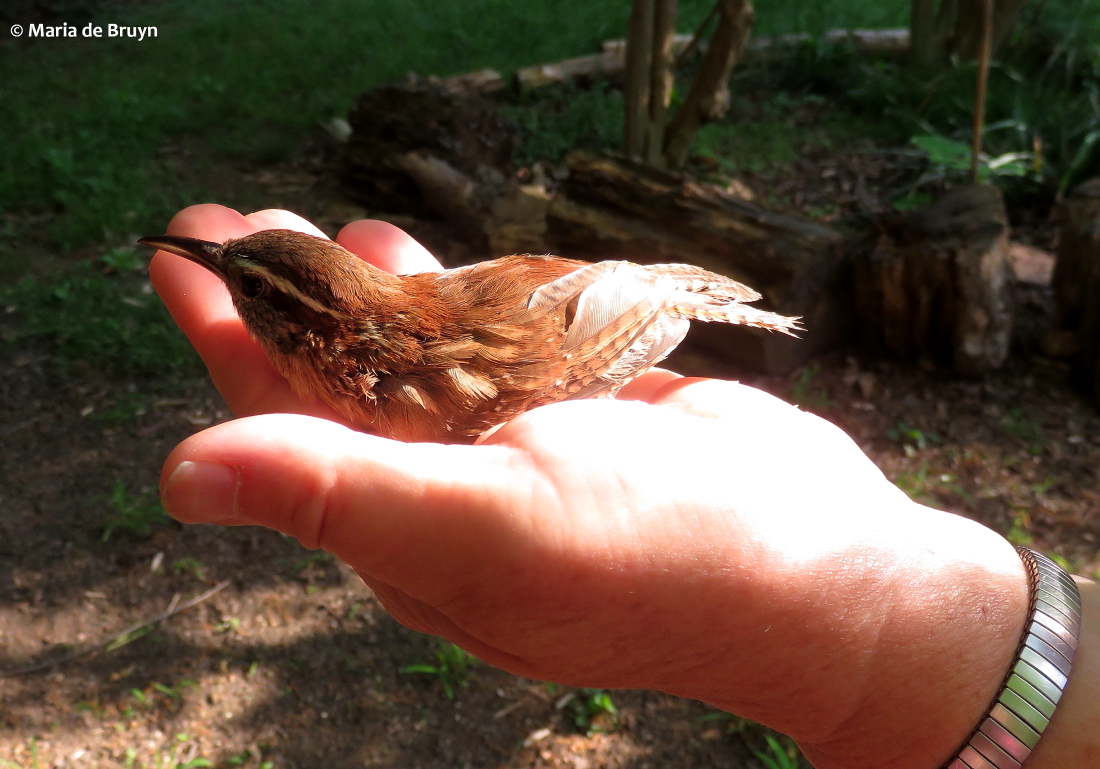
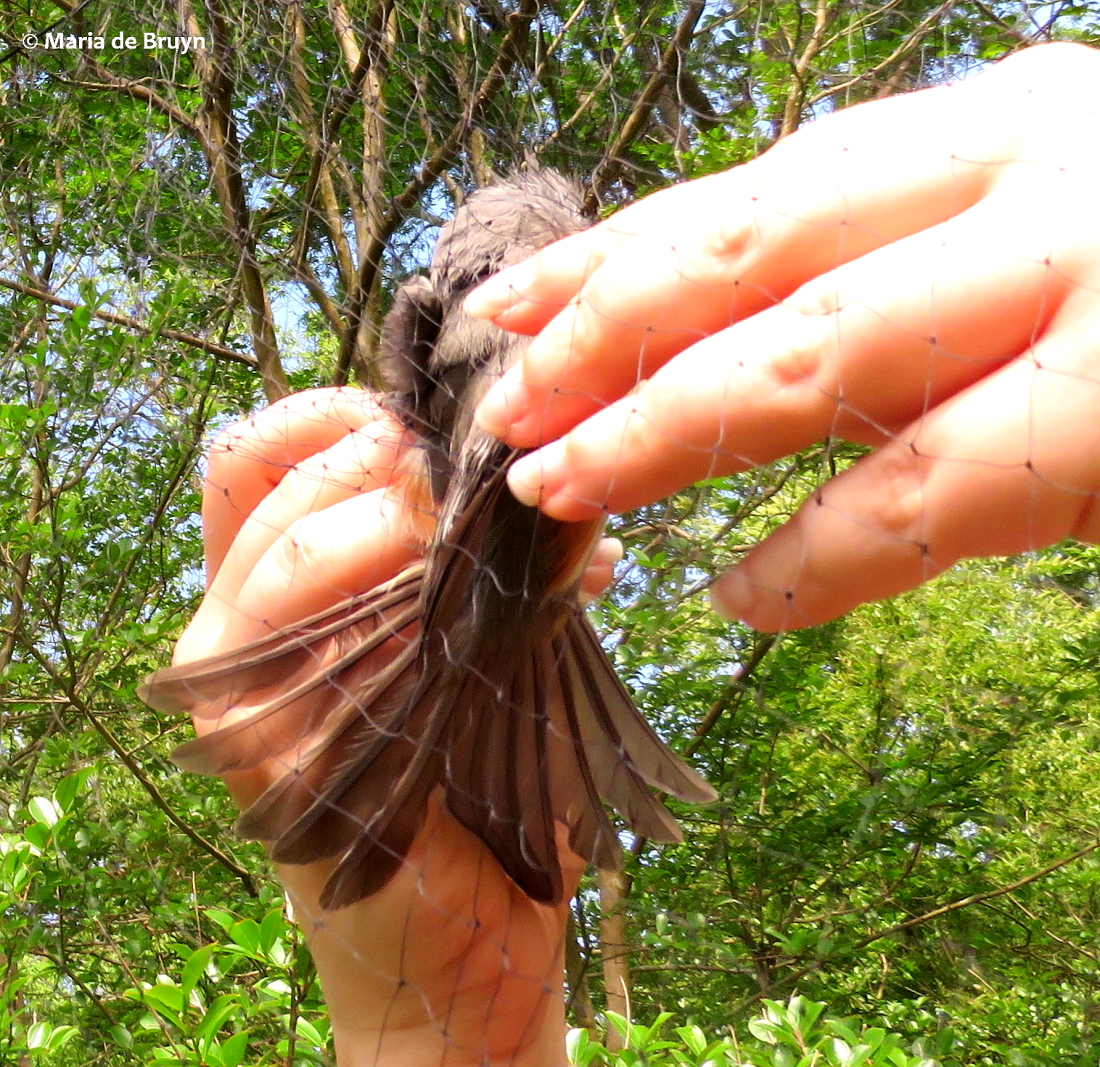
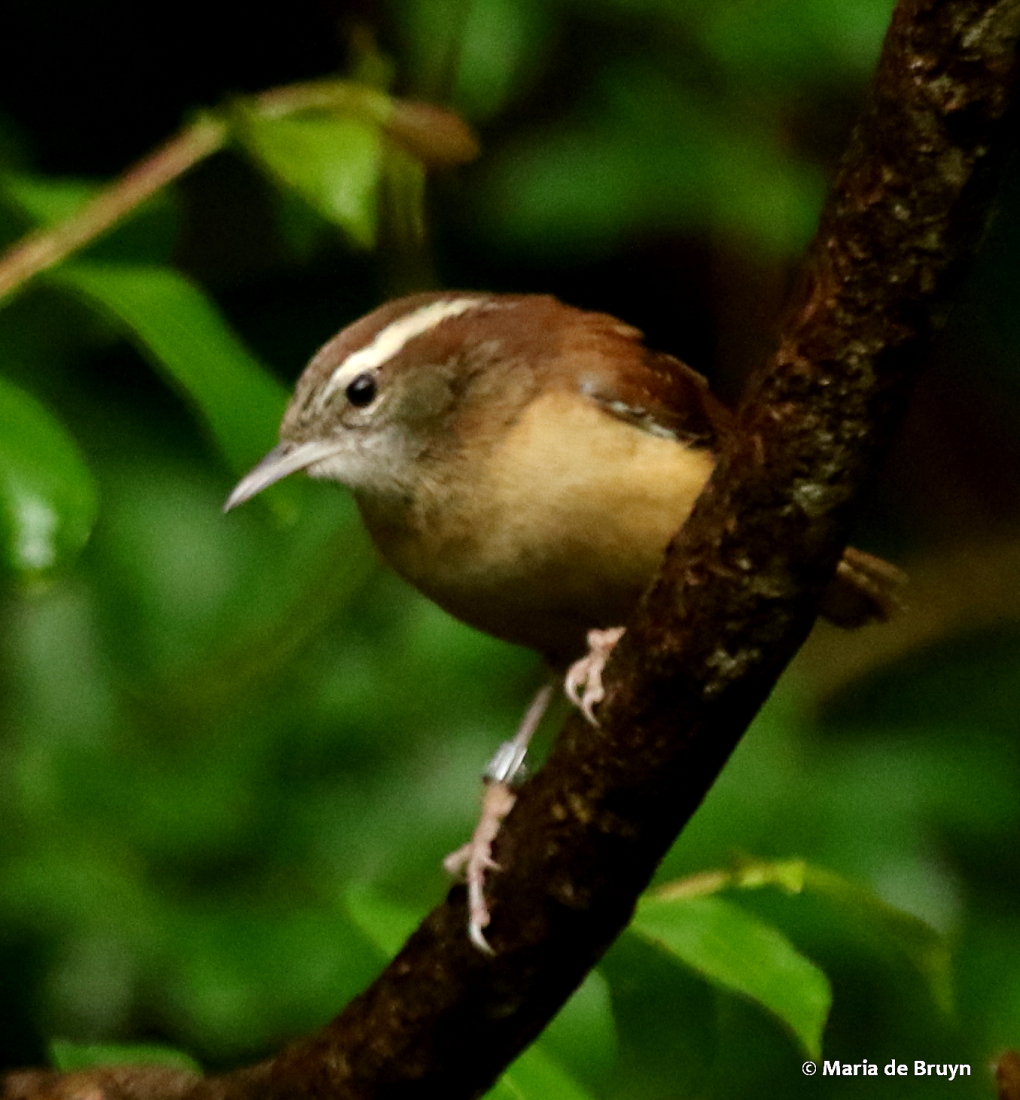
Northern cardinal Camilla I77A9127© Maria de Bruyn resThe nets had just been installed when our first visitor, a female Northern cardinal, was caught. She was not happy and when put in a bag until she could be banded, weighed, examined and measured, she did not remain still and calm. She had a little wait, however, as a female Carolina wren (Thryothorus ludovicianus) flew into the other net at just about the same time, followed by her mate within seconds. As the cardinals can tolerate being in a bag better than the smaller birds, the two wrens were banded first. Alicia let the first one go and then I released the second one, who rested on my palm for a bit. He felt so nice and soft!
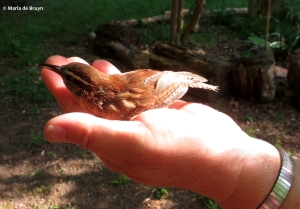
Carolina wren Riley IMG_3832© Maria de Bruyn res

Forty-five minutes later, playback of a house wren’s song (Troglodytes aedon) led to the capture of a male who immediately came to investigate who was invading his territory. His mate, who was busy putting the finishing touches on a nest in a box near the mist net, didn’t go near the net.
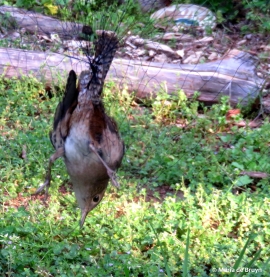
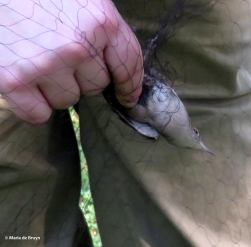
house wren Hans IMG_3842© Maria de Bruyn reshouse wren Hans IMG_3844© Maria de Bruyn res

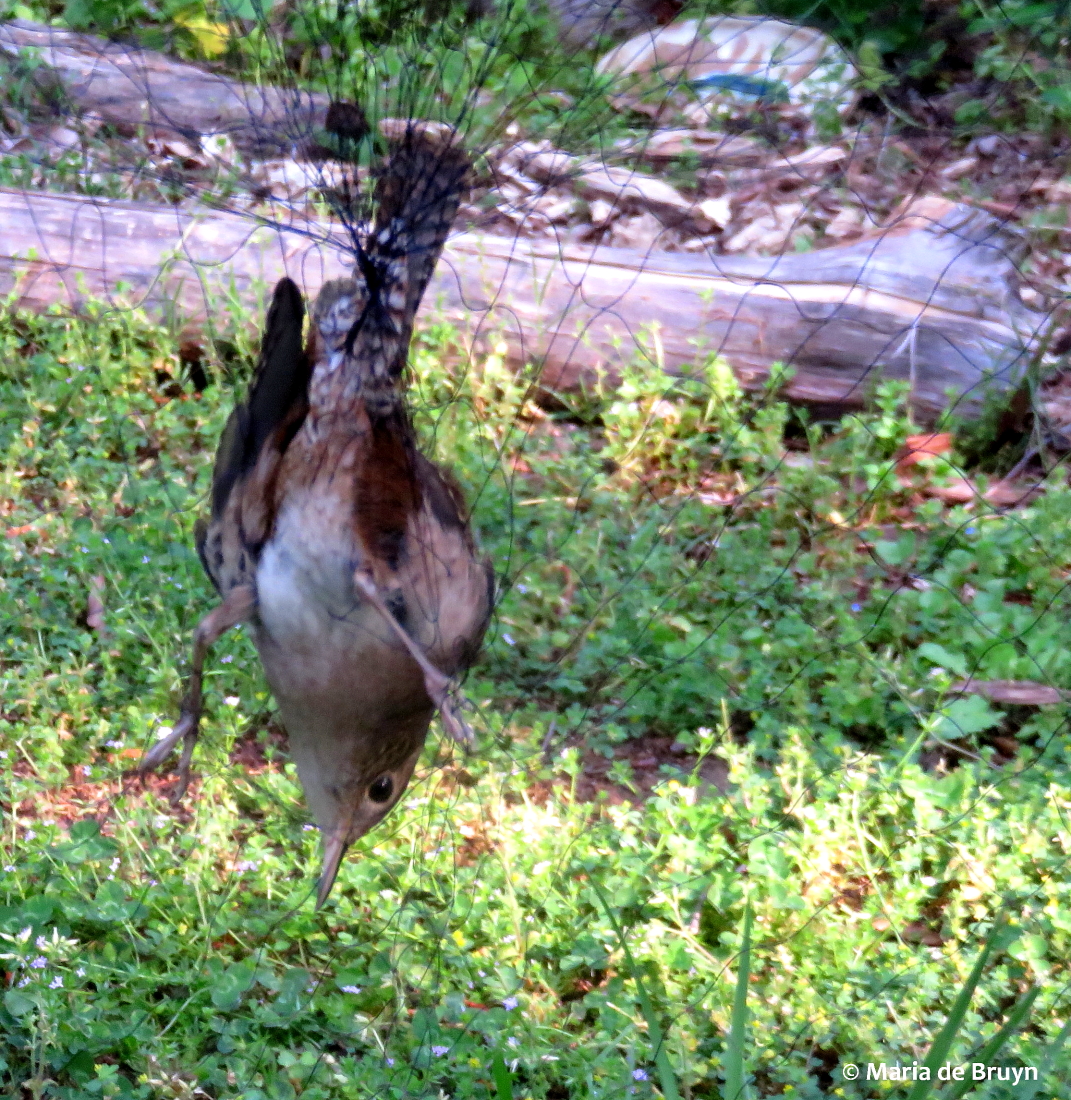
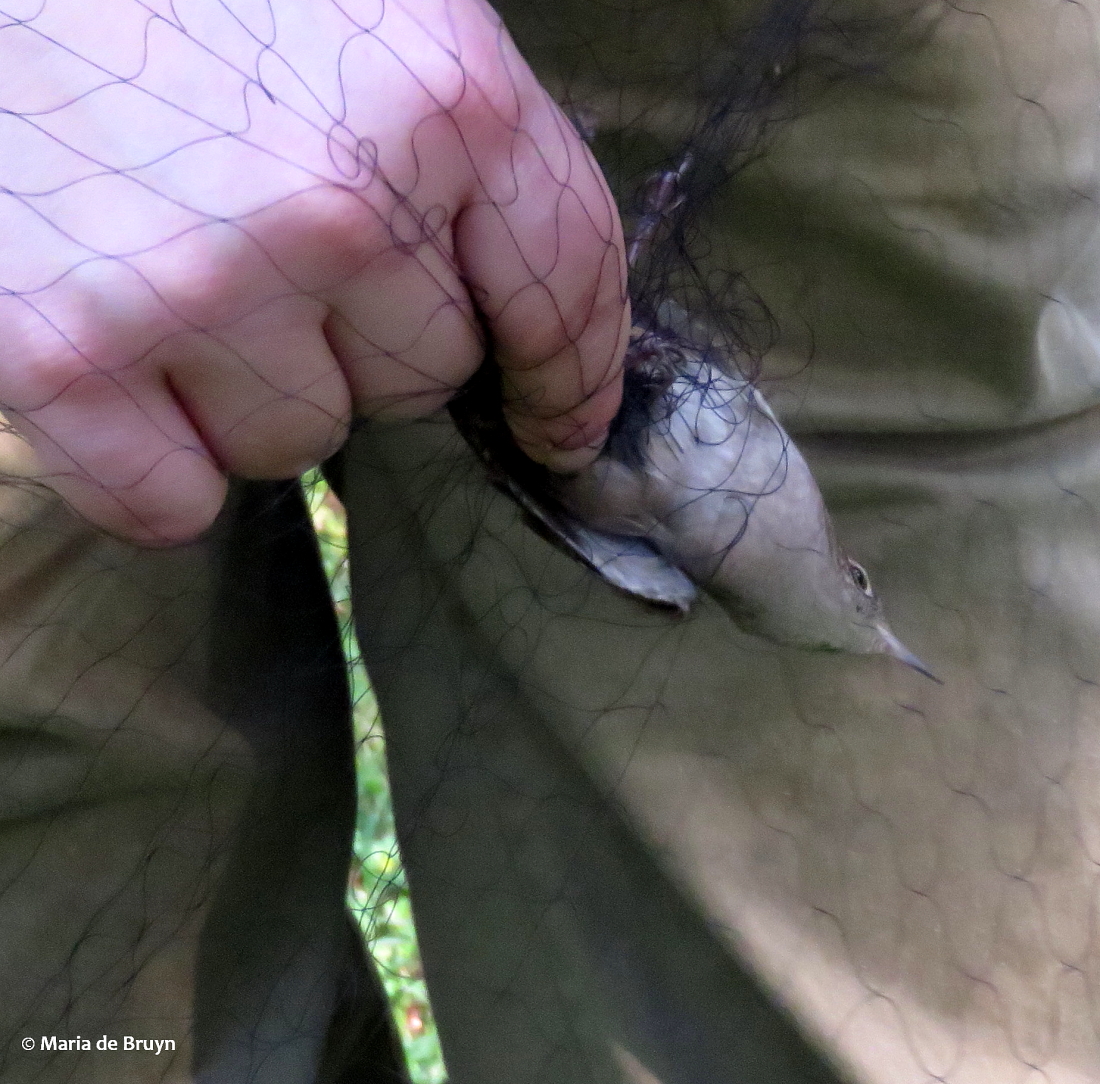
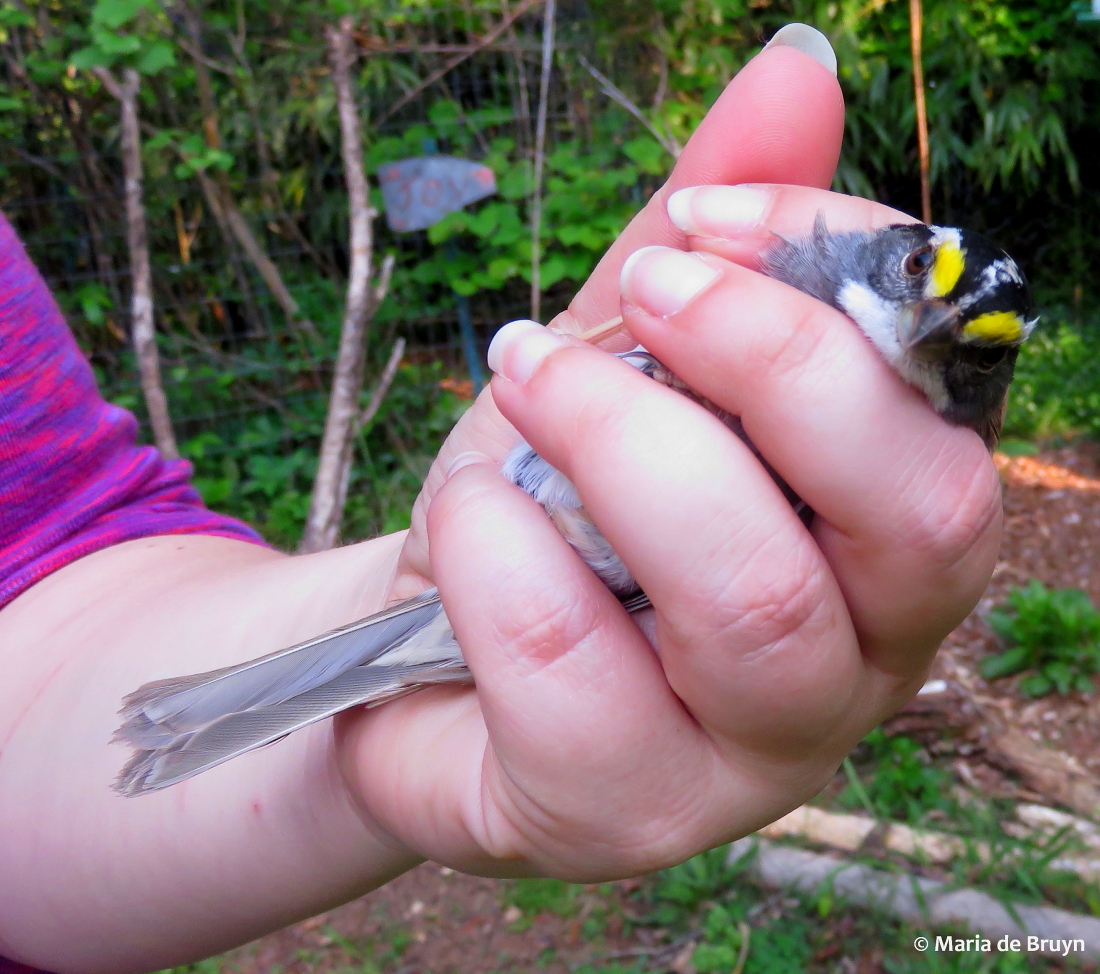
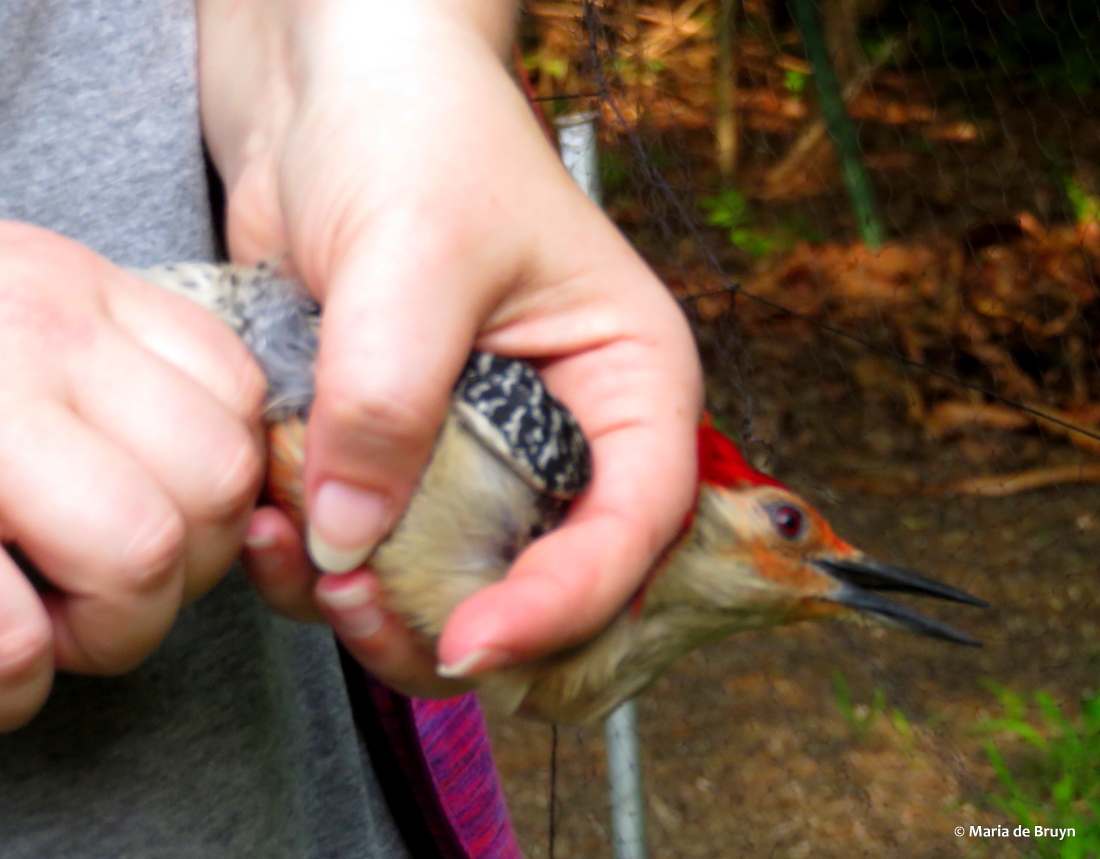
A few birds not targeted for the study ended up tangled in a net. A white-throated sparrow (Zonotrichia albicollis) had beautiful vivid breeding colors on his head. A red-bellied woodpecker (Melanerpes carolinus) was not calm like the sparrow, fluttering his wings constantly as Alicia, the bird bander, got him loose.
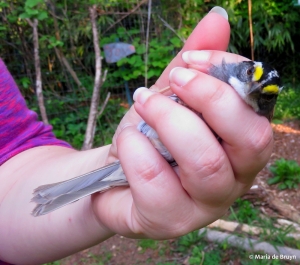
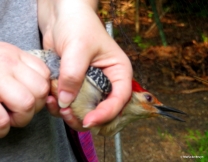
white-throated sparrow IMG_3837© Maria de Bruyn res red-bellied woodpecker IMG_3822© Maria de Bruyn res

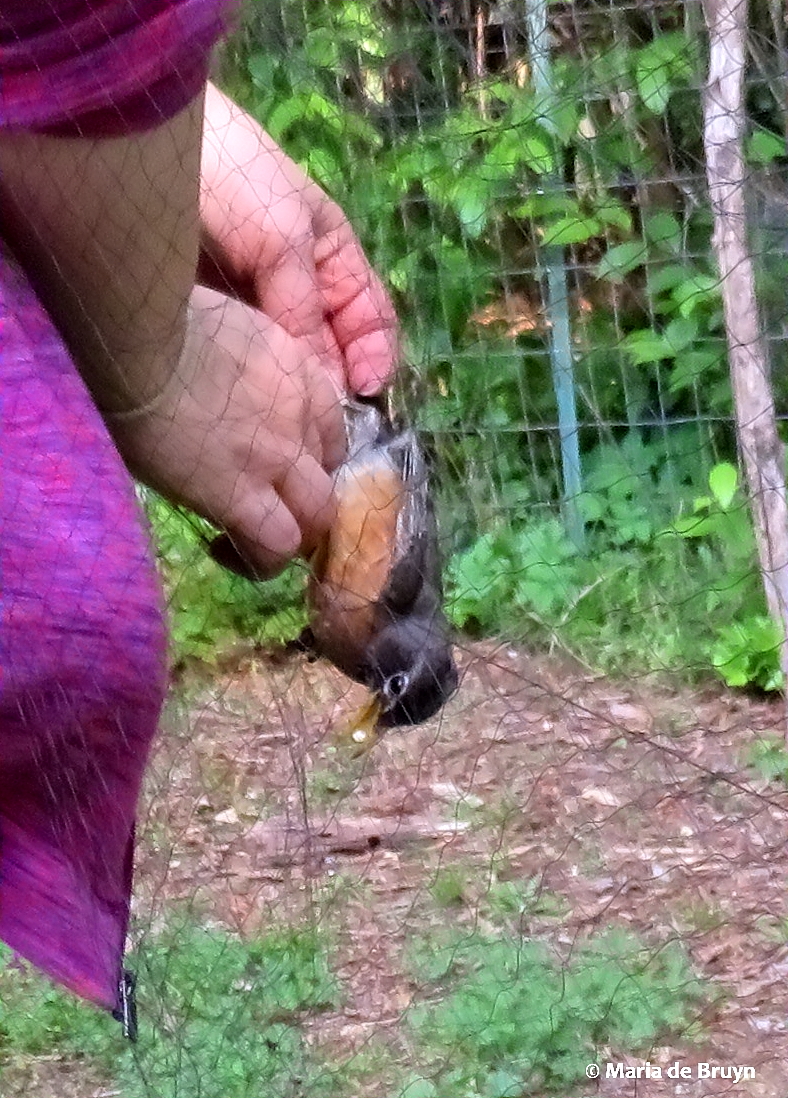
Next up were a male cardinal and a female American robin. Like last year, the birds were measured and weighed. Although about the same length, the weight difference between the heaviest Northern cardinal we banded (41.2 oz) and the American robin was striking (79.6oz). The robin’s fondness for worms and other dietary preferences helps account for this. When I let her go, she didn’t feel very heavy in my hand as she rested a second before flying off.
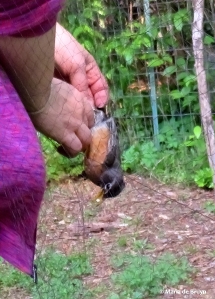
American robin Raisin IMG_3854© Maria de Bruyn

Except for birds that were molting their tail feathers, Alicia also removed the third left tail feather; this is done primarily for stable isotope analysis, which allows a researcher to estimate where the bird was when that feather was grown.
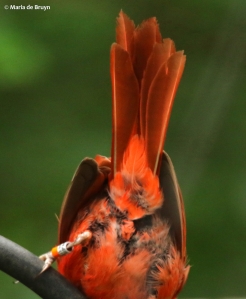
Northern cardinal Crake I77A0559© Maria de Bruyn res

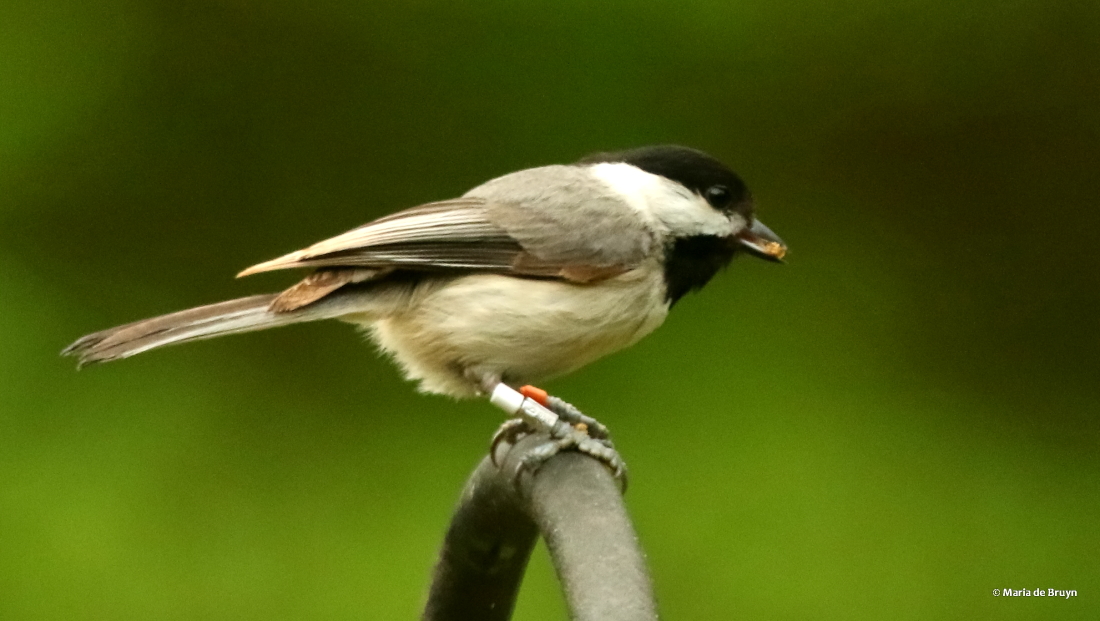
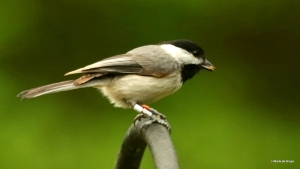
Carolina chickadee Chancey I77A7762© Maria de Bruyn resThe catbirds avoided the mist nets skillfully this year. Playback of their songs drew them to the vicinity but the two pairs visiting the feeders were more interested in chasing each other away from the territory. Alicia hoped that we could get a Carolina chickadee (Poecile carolinensis); with playback we got a male and then, 45 minutes later after banding another cardinal, we got a pair of them.
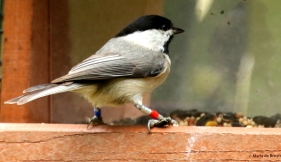
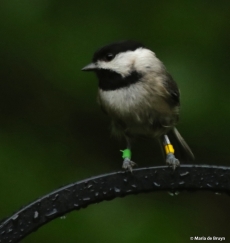
Carolina chickadee Chase I77A0348© Maria de Bruyn res Carolina chickadee Chantal I77A9525© Maria de Bruyn res

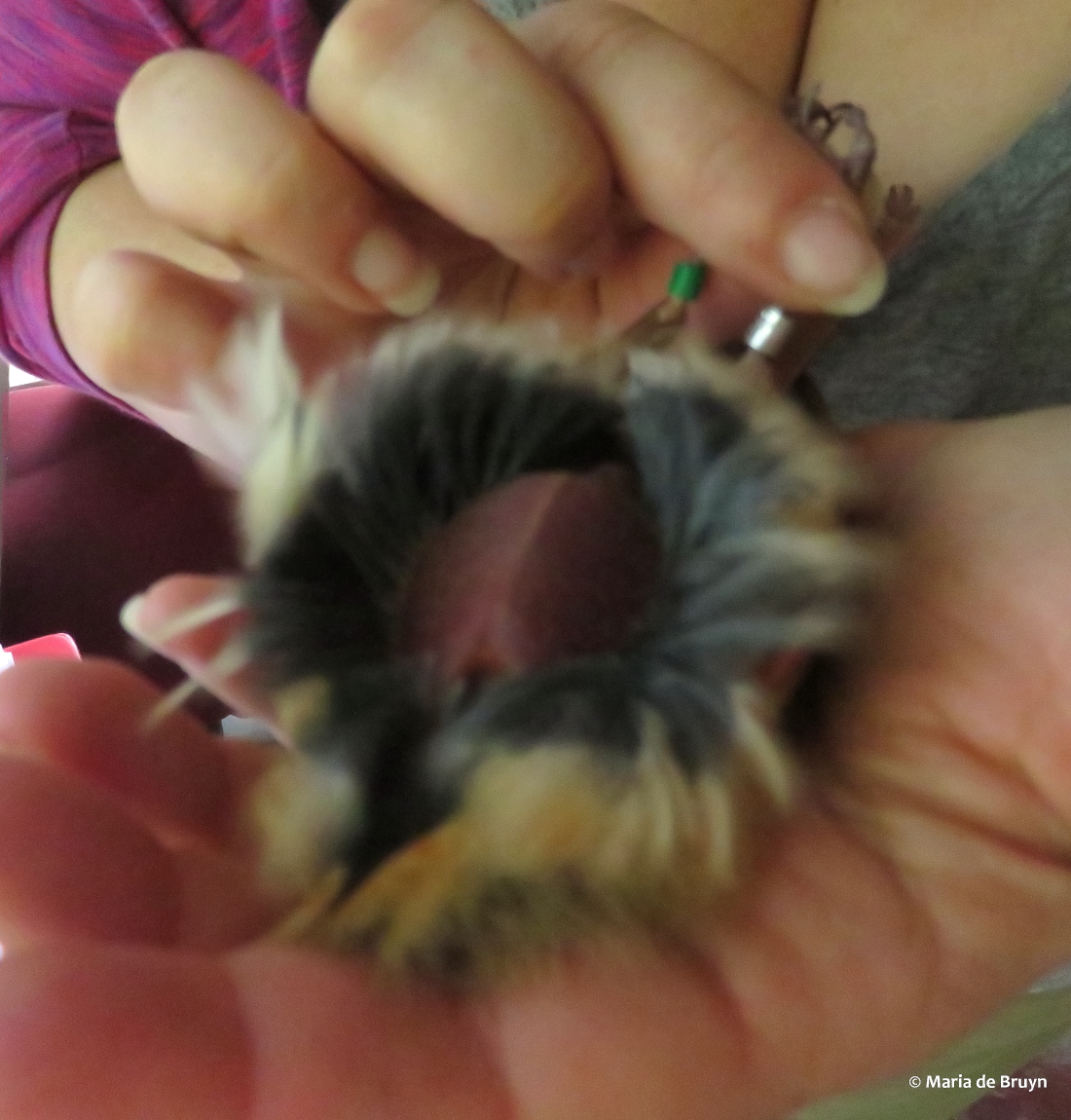
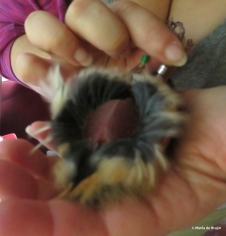
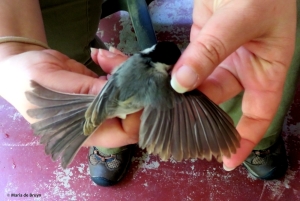
Alicia blew on the birds’ undersides (forgive the blurry photo) to assess fat reserves, which are stored along the flanks and up near the furcula by the collar bone. She could also determine sex that way and thought that one chickadee might be developing an egg – hopefully, one of the females who lost a nest to predators in my yard a week ago. The last male chickadee released was out of sorts after the experience; before leaving my hand to fly off rapidly, he turned and bit me as a parting shot.
Carolina wren Renee IMG_3813© Maria de Bruyn res Carolina chickadee IMG_3856© Maria de Bruyn res

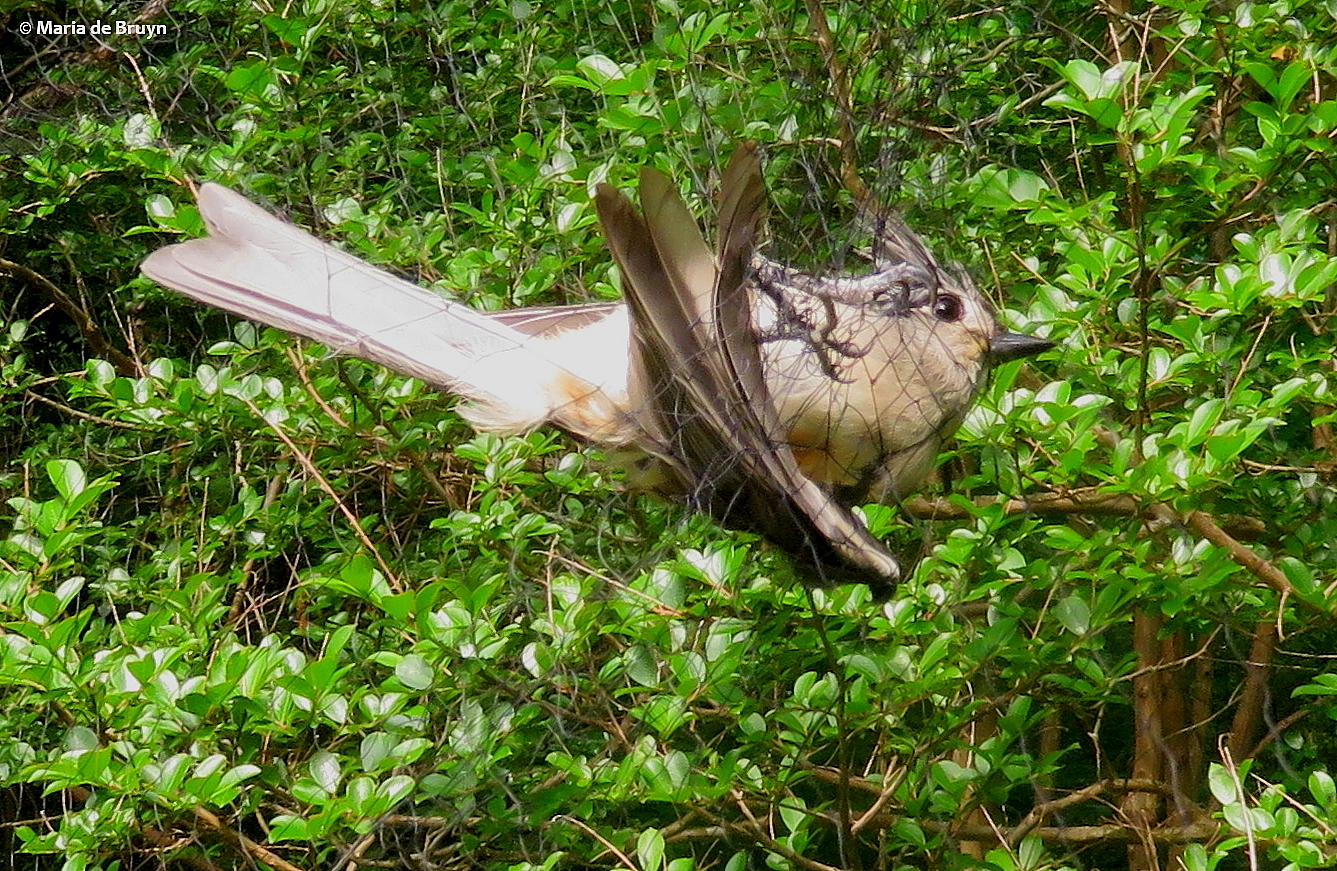
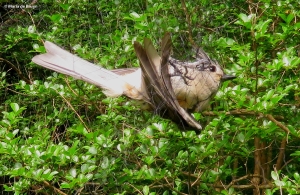
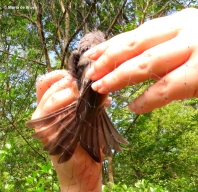
Alicia had remarked that she hoped no tufted titmouse (Baeolophus bicolor) would be caught; they are not part of the study and she said they are so feisty that their bites can be a bit painful like those of the cardinals. Unfortunately, one leaving a feeder did end up in a net and lived up to its reputation as a feisty bird. A chipping sparrow (Spizella passerina), who was the last bird in a net remained fairly calm as the net was removed from its claws.
tufted titmouse IMG_3858© Maria de Bruyn res

Tufted titmouse IMG_3861© Maria de Bruyn res

Yesterday, I spent some time watching the feeders and yard to see if all the banded birds had left. Luckily, some of them showed up and were here again today. So here are a few of “my birds” with bling – this is a truly enjoyable citizen science project. 🙂
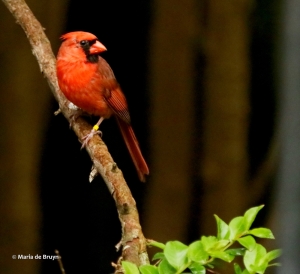
Northern cardinal Clarence I77A0124© Maria de Bruyn res Northern cardinal Crake I77A0593© Maria de Bruyn res

Clarence                                                                       Crake

Carolina wren Renee I77A9354© Maria de Bruyn resCarolina wren Riley I77A0508© Maria de Bruyn res

Renee and Riley Carolina wrens


A walk in the woods with a bit of local history

Ken Moore IMG_6384© Maria de Bruyn resOn a sunny afternoon in mid-April, volunteers at the North Carolina Botanical Garden (NCBG) had the chance to learn about Bill Hunt, a horticultural expert who donated hundreds of acres of land for environmental conservation to the University of North Carolina. Hunt’s work laid the foundations for the expansion of the Garden with the Hunt Arboretum and the Piedmont Nature Trails in woods behind the cultivated gardens. The trails were “re-dedicated” during a walk to commemorate the Garden’s first public offering, which was originally dedicated on 10 April 1966. A walk in the woods was quite a nice way to help celebrate the NCBG’s 50th birthday.

Ken Moore IMG_6398© Maria de Bruyn resWe learned about how the Nature Trails were created and maintained from Ken Moore, retired assistant director of the NCBG and the Garden’s first employee.

Moore was accompanied by other Garden staff who offered other interesting tidbits of information. For example, Johnny Randall, NCBG Director of Conservation, told us about how Mr. Hunt visited his rhododendron bushes along Morgan Creek and invited friends to swim at Elephant Rock and to forest picnics at his personal grill located creekside, all the while wearing a suit and tie in his beloved woods.

elephant rock IMG_6443© Maria de Bruyn resHunt barbecue IMG_6436© Maria de Bruyn res

Staff pointed out some of the lovely native plants seen in the springtime woods, including plants that were rescued from other sites such as the trilliums.

Sweet Betsy IMG_6405© Maria de Bruyn res Virginia pennywort IMG_6411© Maria de Bruyn res

Sweet Betsy (Trillium cuneatum)                 Virginia pennywort (Obolaria virginica)

The woodsorrels have three-lobed, clover-like leaves.

Common yellow woodsorrelIMG_6429© Maria de Bruyn   Violet woodsorrel IMG_6423© Maria de Bruyn res

.Common yellow woodsorrel (Oxalis stricta)   Violet woodsorrel (Oxalis violacea)

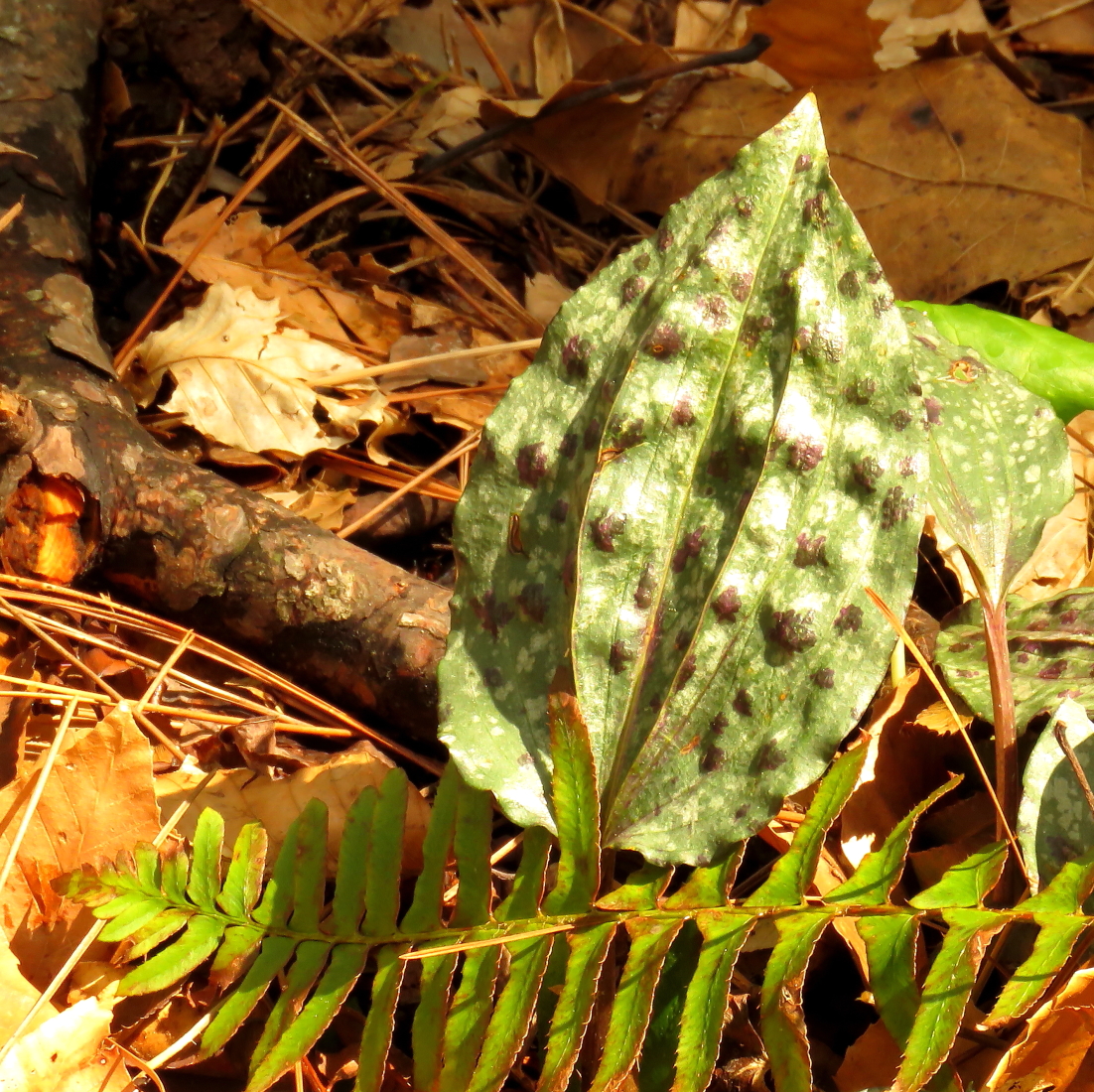
Indian plantain IMG_6439© Maria de Bruyn res         Spotted wintergreen IMG_6434© Maria de Bruyn res

Indian plantain (Arnoglossum plantagineum)   Spotted wintergreen (Chimaphila maculata)

We also heard about the non-native and invasive plants that were planted along the Nature Trails before conservationists were aware of how they out-competed native plants for space and nutrients. They pointed out that we should remove such vegetation during our volunteer hours and from our own gardens at home, such as Oriental false hawksbeard (Youngia japonica (L.)), which I realized is nestling in in my yard, too.

Special attention was given to the plant with the delightful name of Italian lords-and-ladies (Arum italicum). There were many clumps of these large-leaved flowers and numerous specimens were blooming. While Ken told us how to identify male and female plants so we could eradicate them, other staff demonstrated how to uproot them with gusto.

Italian lords-and-ladies IMG_6481© Maria de Bruyn res          Italian lords-and-ladies IMG_6494© Maria de Bruyn res

Listening IMG_6499© Maria de Bruyn res

As we climbed out of the woods after a couple hours, some last words were said about invasive plants and then Ken sped ahead to greet everyone as we re-entered the demonstration gardens. He kindly offered participants a small booklet about Bill Hunt’s life, a nice gift to commemorate 50 years of the Garden. It will be interesting to think about what the next 50 years might bring.

Ken Moore Ed Harrison IMG_6524© Maria de Bruyn resrue anemone windflower IMG_6450© Maria de Bruyn res                       IMG_6466© Maria de Bruyn res

IMG_6468© Maria de Bruyn res                   IMG_6458© Maria de Bruyn res Wild comfrey (right, Cynoglossum virginianum)

A wildflower walk with surprises!

owl IMG_3036© Maria de Bruyn resThis past Saturday morning, we awoke to water streaming from the heavens in quite a heavy downpour. A local conservation group, Friends of Bolin Creek, had scheduled a wildflower walk to see some of our ephemeral spring blooms but the wet conditions were not inviting. A decision to postpone the walk to early afternoon was taken – and the weather-people had gotten it right – the sun began shining at mid-day and the temperature rose, creating lovely conditions for a walk after all. A large owl (later revealed to be granddaughter Kate of the group’s president) greeted the small group of intrepid walkers and we set off to see what we could find.

Southern arrowwood IMG_3039© Maria de Bruyn res

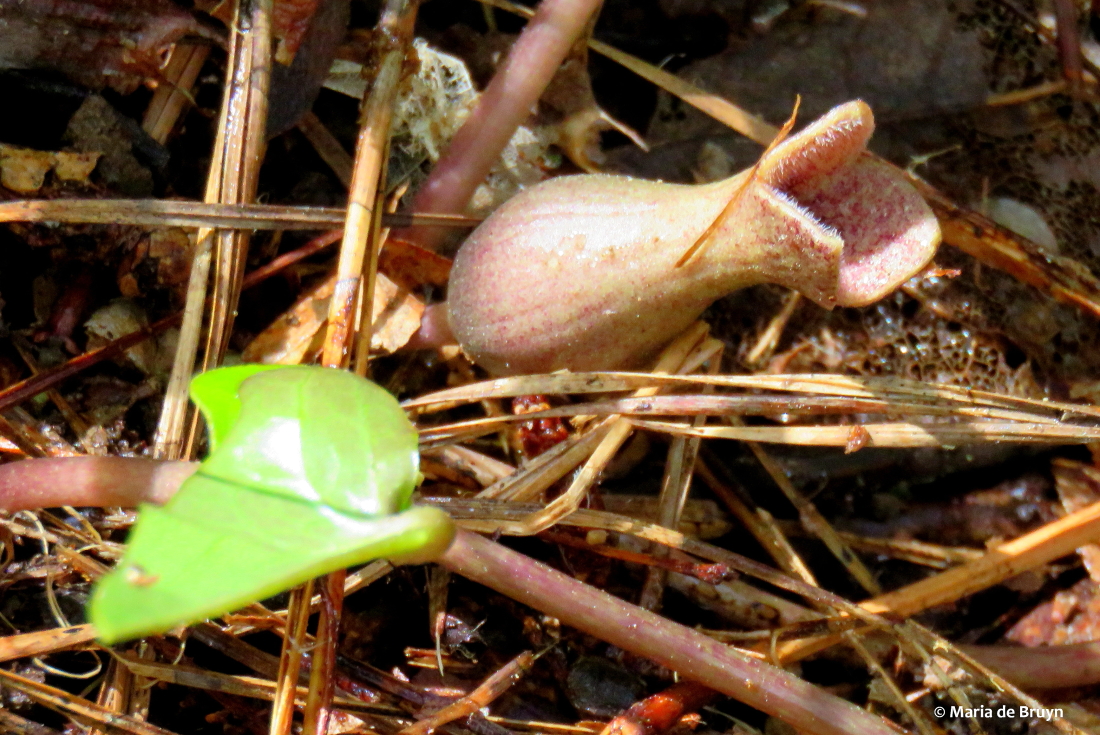
Our first flowers were the not-yet-open blooms of a Southern arrowwood (Viburnum dentatum). We passed numerous black and yellow millipedes on the paths and then found another millipede species (Narceus americanus) curled up next to a little brown jug (also known as arrowleaf heartleaf, Hextastylis arifolia var arifolia).

millipede IMG_3052© Maria de Bruynlittle brown jug IMG_3048© Maria de Bruyn

We came across other nice specimens of the plant, including one with four small flowers.

little brown jug IMG_3138© Maria de Bruynlittle brown jug IMG_3141© Maria de Bruyn

The painted buckeye trees (Aesculus sylvatica) were blooming profusely with their greenish-yellow flowers.

painted buckeye IMG_3070© Maria de Bruynpainted buckeye IMG_3492© Maria de Bruyn


Eastern spring beauty IMG_3089© Maria de Bruyn


Clusters of Eastern spring beauties (Claytonia virginica) were in their vicinity.


star chickweed IMG_3095© Maria de Bruyn


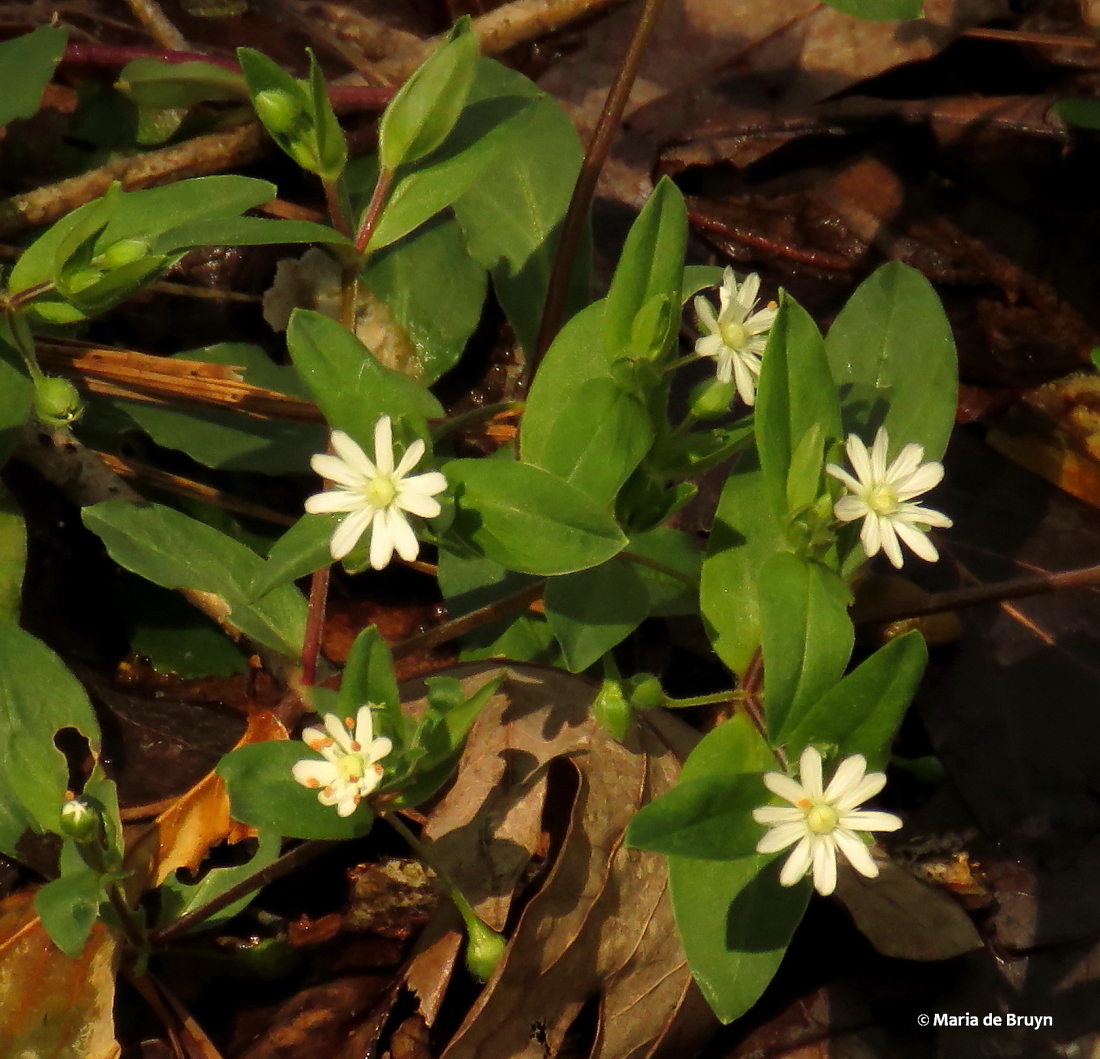
Some of the star chickweeds (Stellaria pubera) were near another white bloom, the rue anemones (Thalictrum thalictroides).


rue anemone IMG_3110© Maria de Bruyn rue anemone IMG_3109© Maria de Bruyn

Both the trout lilies (Erythronium americanum) and cranefly orchids (Tipularia discolor) had already bloomed, the trout lilies about 7-10 days ago and the orchids in the winter (when there are no leaves). One orchid had left behind its brown stalk as a witness to the flower that had seen the light.

trout lily IMG_3156© Maria de Bruyncranefly orchid IMG_3148© Maria de Bruyn

Tiny bluets (Houstonia pusilla) in clusters here and there provided some variation from the ubiquitous white blooms that we were seeing. The mayapples (Podophyllum peltatum) were just emerging and it will be a little while before we see their flowers emerge underneath the leafy umbrellas.

tiny bluet IMG_3118© Maria de Bruynmayapple IMG_3196© Maria de Bruyn


Bolin creek IMG_3165© Maria de BruynThe creek was running high and fast and we debated on crossing it at the first branch. Only two of us had wellingtons (and one lady found that her boots leaked); others were wearing running and walking shoes but everyone made it across by using stones, canes and walking sticks that some of our group had brought along. Our immediate reward was a view of a gorgeous pinxterbloom wild azalea (Rhododendron periclymenoides).

pinxterbloom azalea IMG_3174© Maria de Bruyn

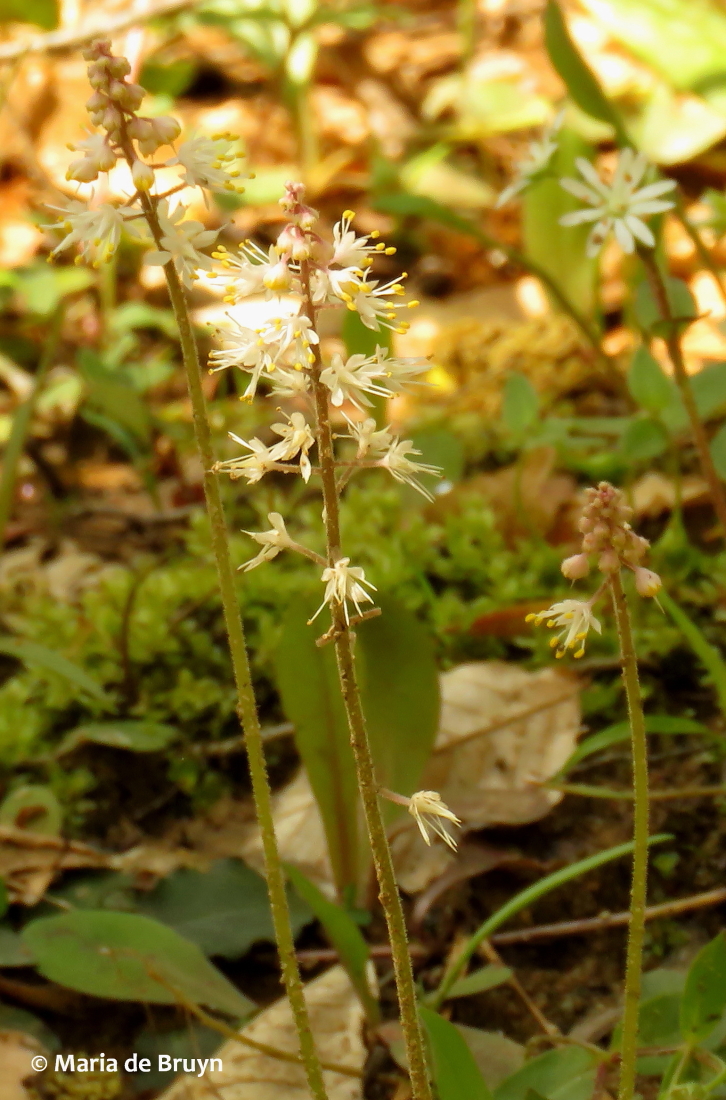
foamflower IMG_3180© Maria de Bruyn


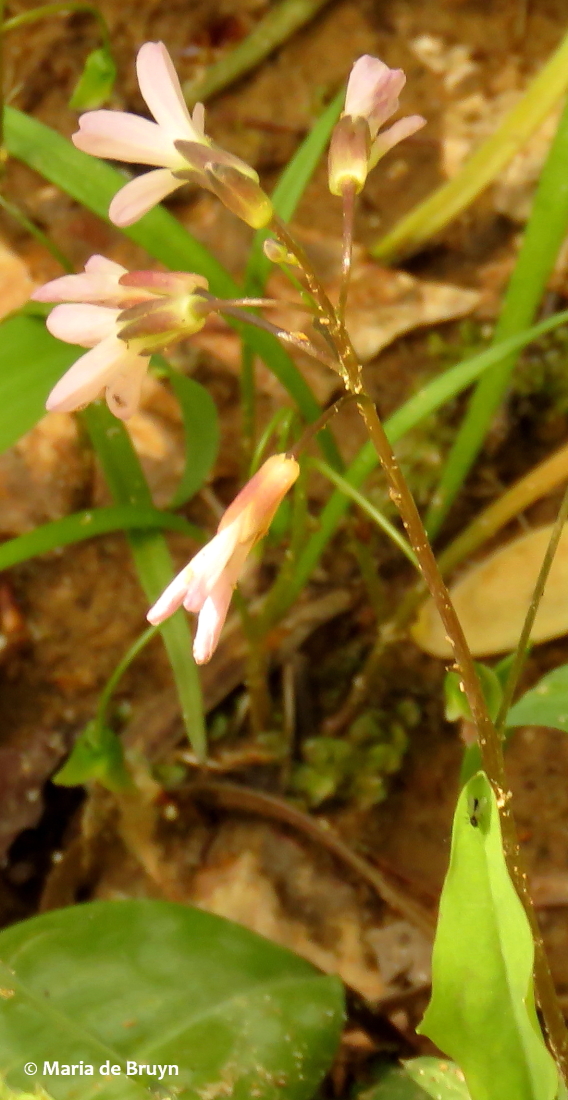
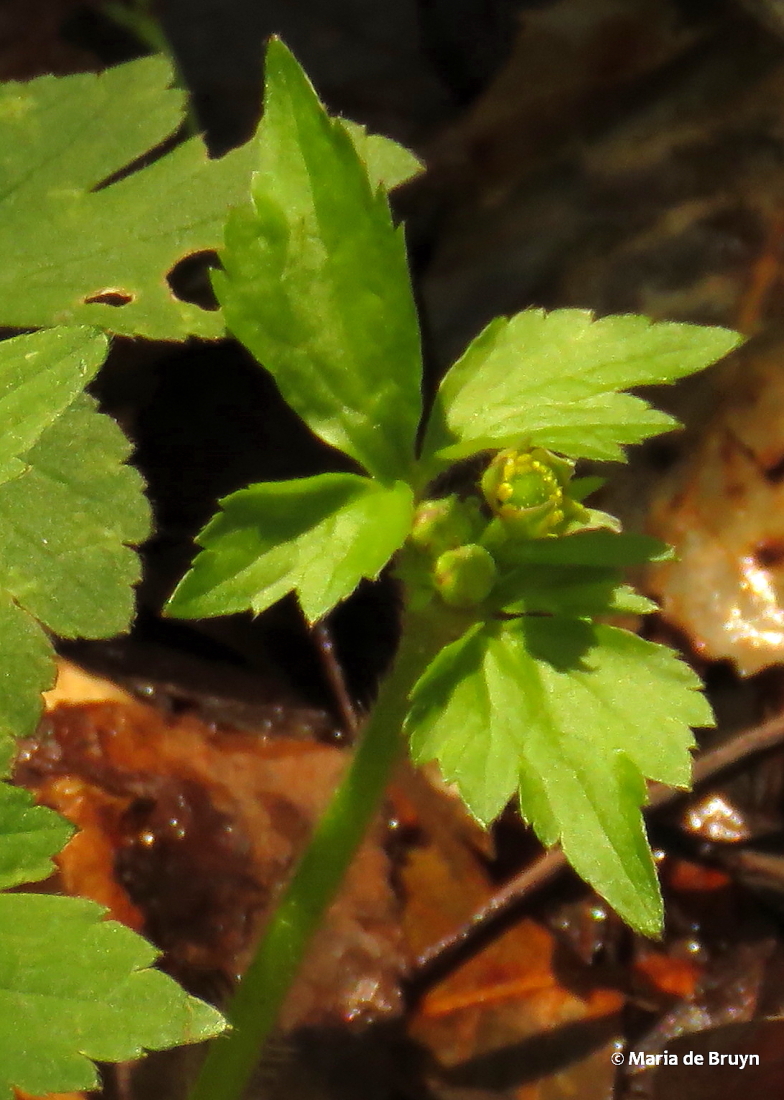
A sighting of a foamflower (Tiarella cordifolia), followed by a cutleaf toothwort (Cardamine concatenata) provided a bit more color, as did the littleleaf buttercup (Ranunculus abortivus), although its blooms were not fully expanded yet.


cutleaf toothwort IMG_3187© Maria de Bruynlittle leaf buttercup IMG_3092© Maria de Bruyn

Only the jigsaw puzzle-like leaves of the bloodroot (Sanguinaria canadensis) were in evidence as that flower had stopped blooming already. A tufted titmouse singing overhead (Baeolophus bicolor) gave us a nice little concert as compensation.

bloodroot IMG_3198© Maria de Bruyn tufted titmouse IMG_3201© Maria de Bruyn

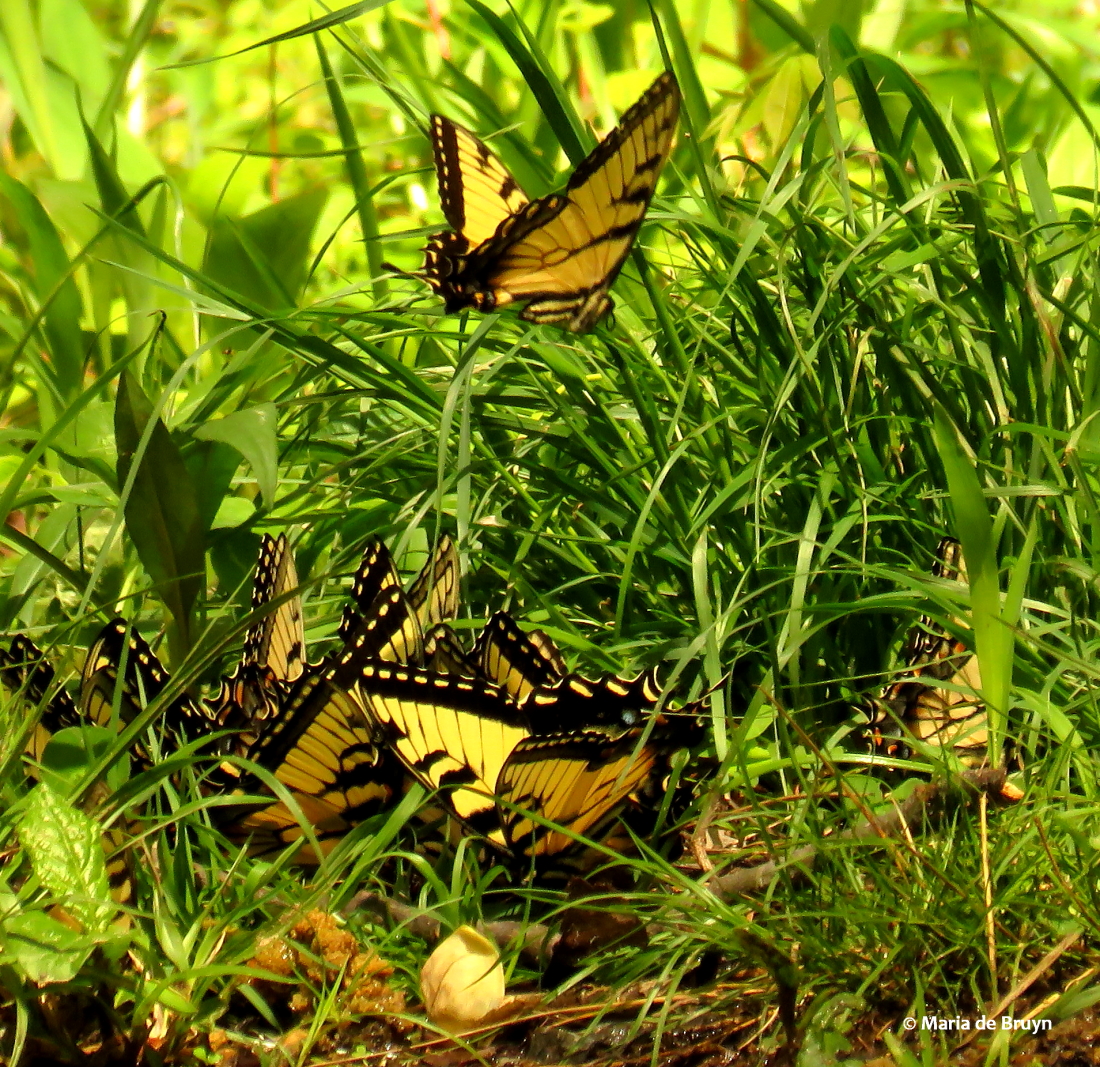
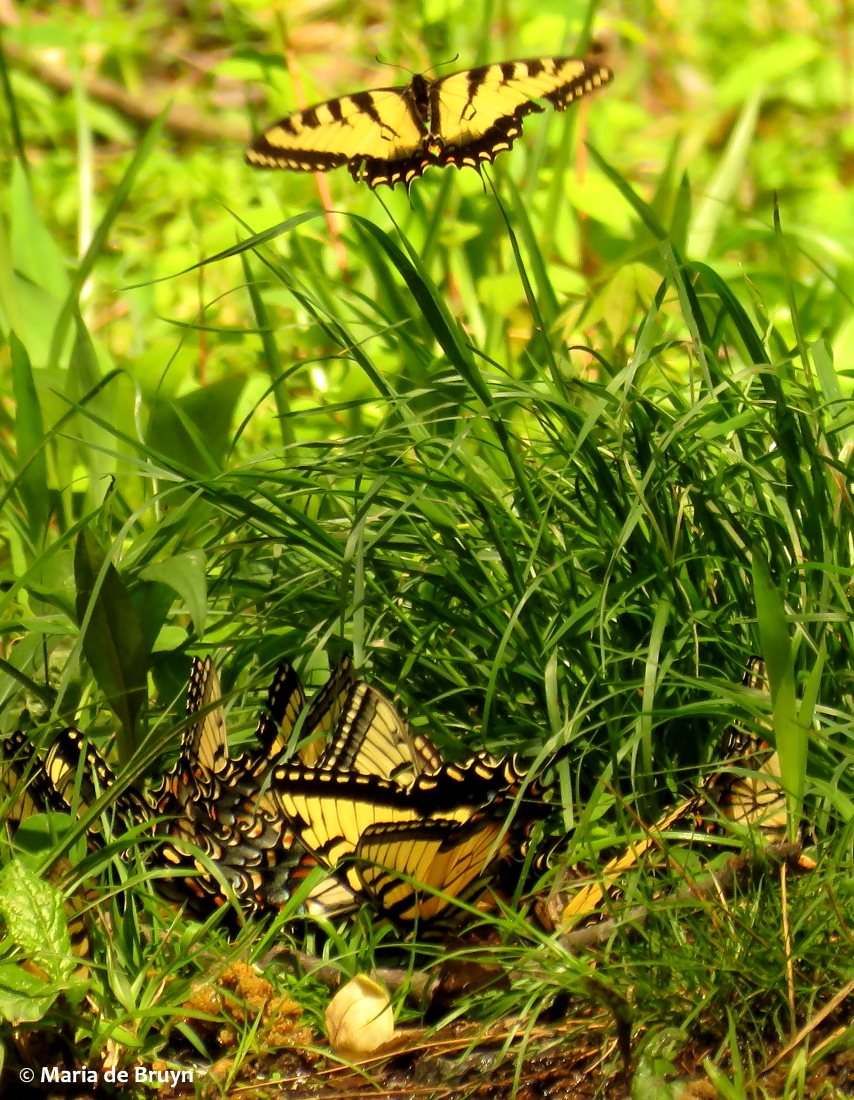
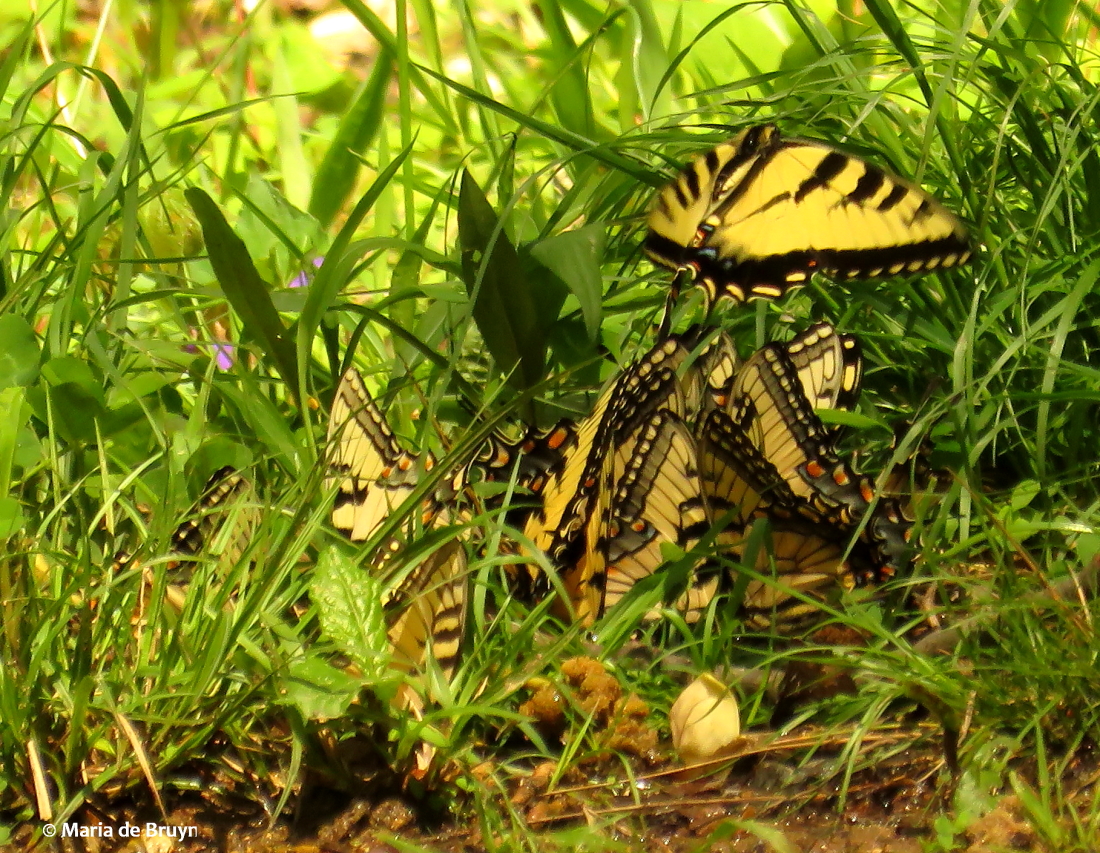
Eastern tiger swallowtail IMG_3428© Maria de Bruyn resAnd then we came across our three surprises of the walk. We had already seen several Eastern tiger swallowtail butterflies (Papilio glaucus) fluttering by in one’s and two’s and we remarked how welcome they were because of the paucity of butterflies we had had the past couple years. But then across another branch of the creek, we spotted some 12-20 butterflies congregating over some delicacy of unknown (to us) origin.

Eastern tiger swallowtail IMG_3259© Maria de Bruyn res Eastern tiger swallowtail IMG_3263© Maria de Bruyn res

The water was fairly deep and flowing fast, so we did not cross but we surmised that someone’s dog had left a pile of poo to provide a mud-puddling butterfly feast.

Eastern tiger swallowtail IMG_3443© Maria de Bruyn res Eastern tiger swallowtail IMG_3447© Maria de Bruyn res

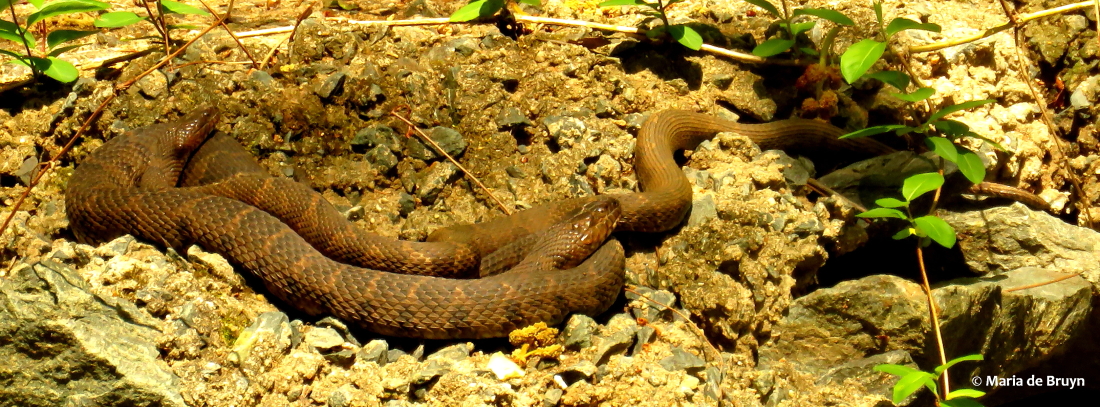
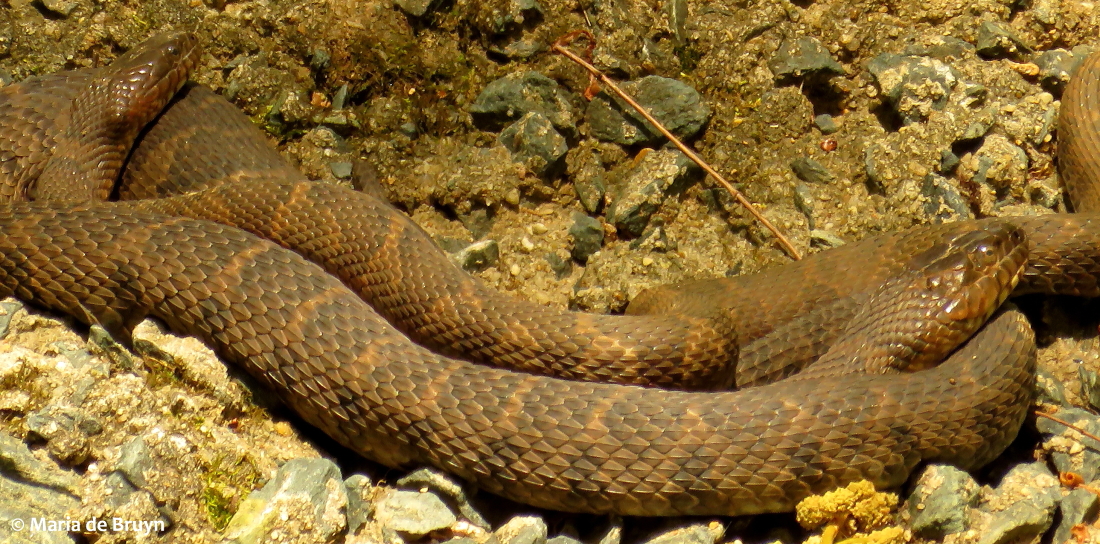
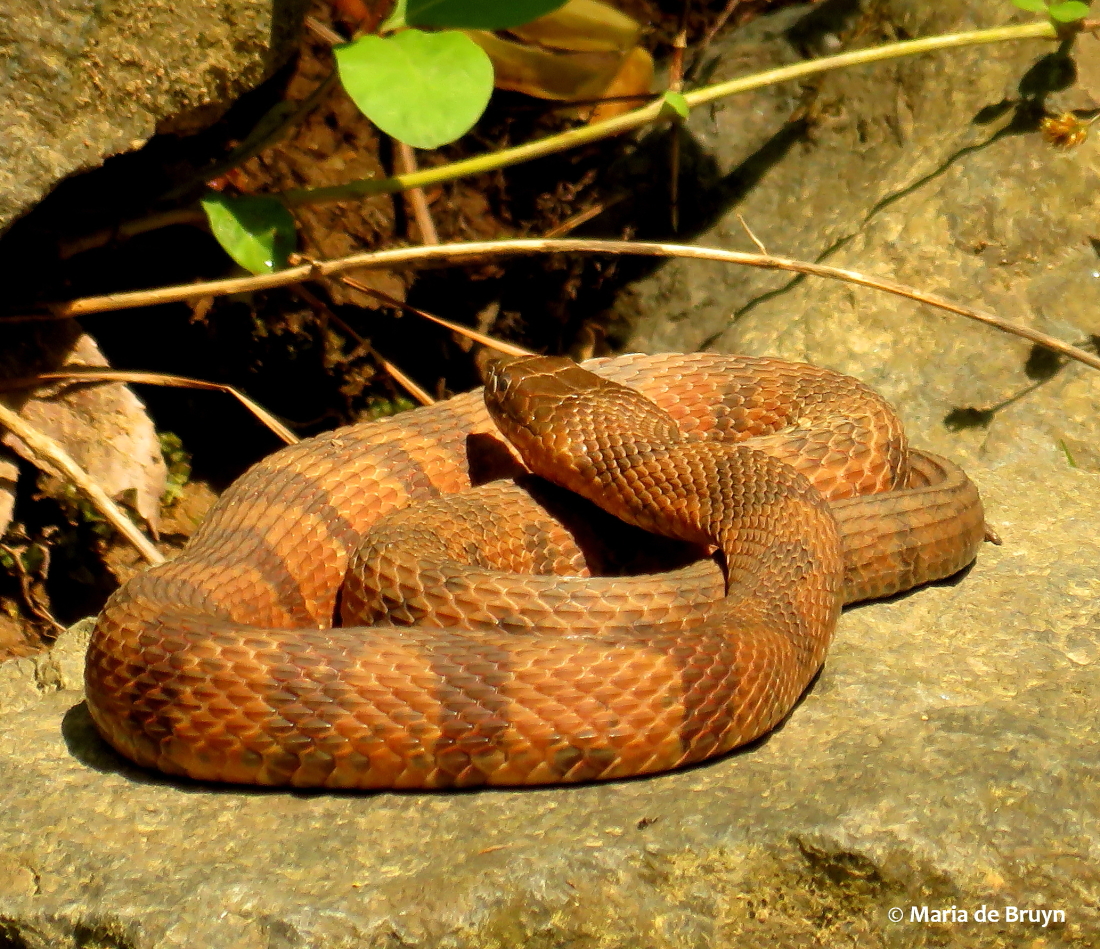
Then we noticed on a rock just below the bank under the butterflies where two Northern watersnakes (Nerodia sipedon) were having a little rest.

northern watersnake IMG_3406© Maria de Bruyn

northern watersnake IMG_3408© Maria de BruynThey were a bit dull in color, which became quite obvious when compared to a third northern watersnake that we spotted on a rock closer to the creek – perhaps a younger individual who had decided that a sunbath was just the thing for a Saturday afternoon.

northern watersnake IMG_3241© Maria de Bruyn northern watersnake IMG_3349© Maria de Bruyn

While we were all enamored with the flowers we’d seen, the butterflies and snakes gave our walk a special feel.

bugleweed IMG_3501© Maria de Bruyn


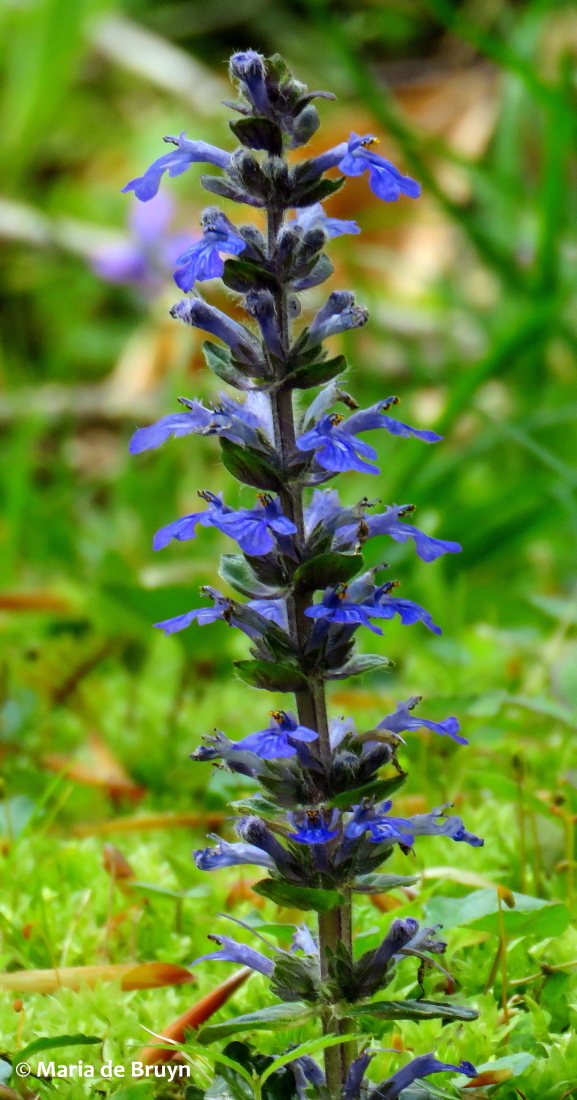
On our return trip through the woods to reach our transportation, we came across an invasive plant, the bugleweed (Ajuga reptans). We had already seen plenty of Japanese wisteria, mahonia, privet and autumn olive and agreed that another volunteer day to weed out some invasives would be a good contribution to the preserve. But that is for the future – right now, we are happy to think back to our surprise spottings!

April’s fool – this is NOT a flower!


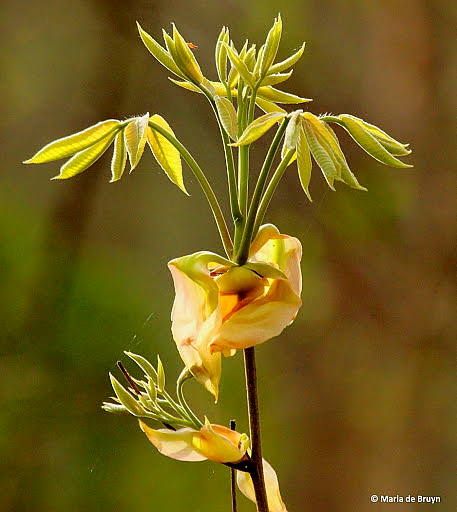
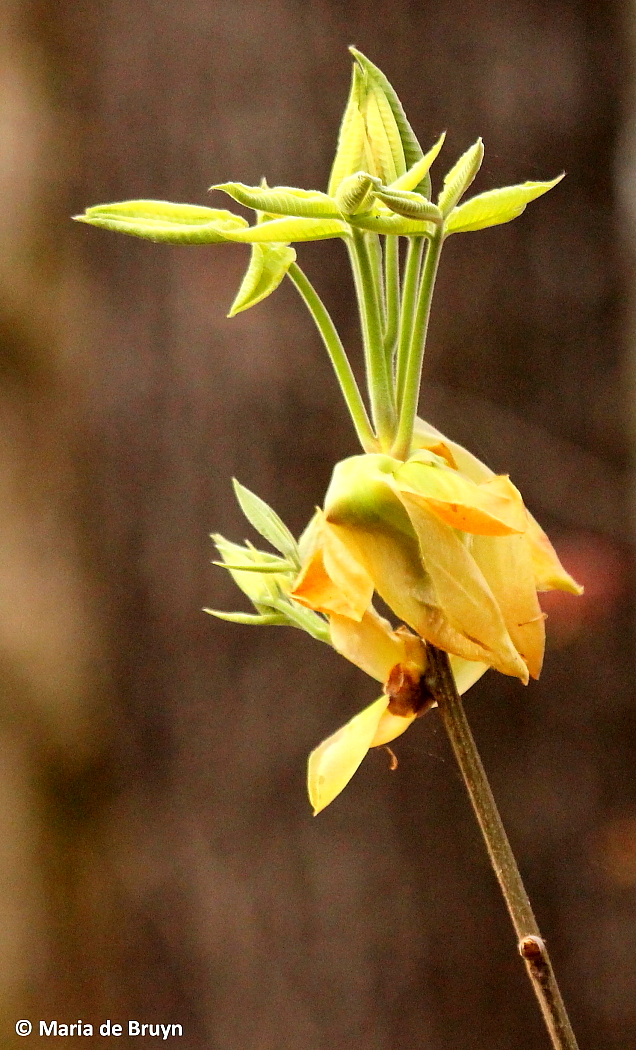
shagbark hickory I77A7704© Maria de Bruyn resDuring North Carolina’s early spring weeks, visitors to wooded areas may be delighted by newly emerging shagbark hickory saplings (Carya ovata).

shagbark hickory I77A7683© Maria de Bruyn

The slender young trees show off their new leaves at the ends of branching twigs, creating lovely patterns against the sky and other foliage. Eventually, they may reach a height of some 100 feet (30 meters) and, if not felled by storms, floods or other means, they may get as old as 350 years.

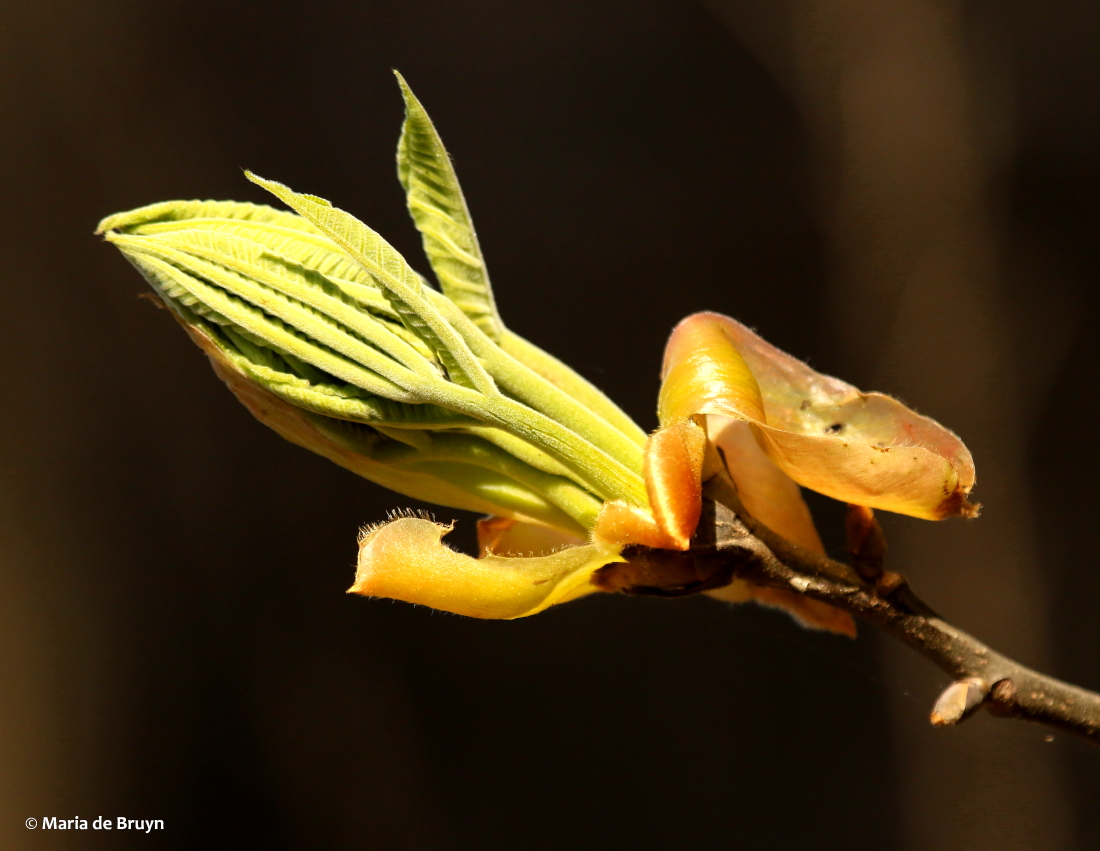
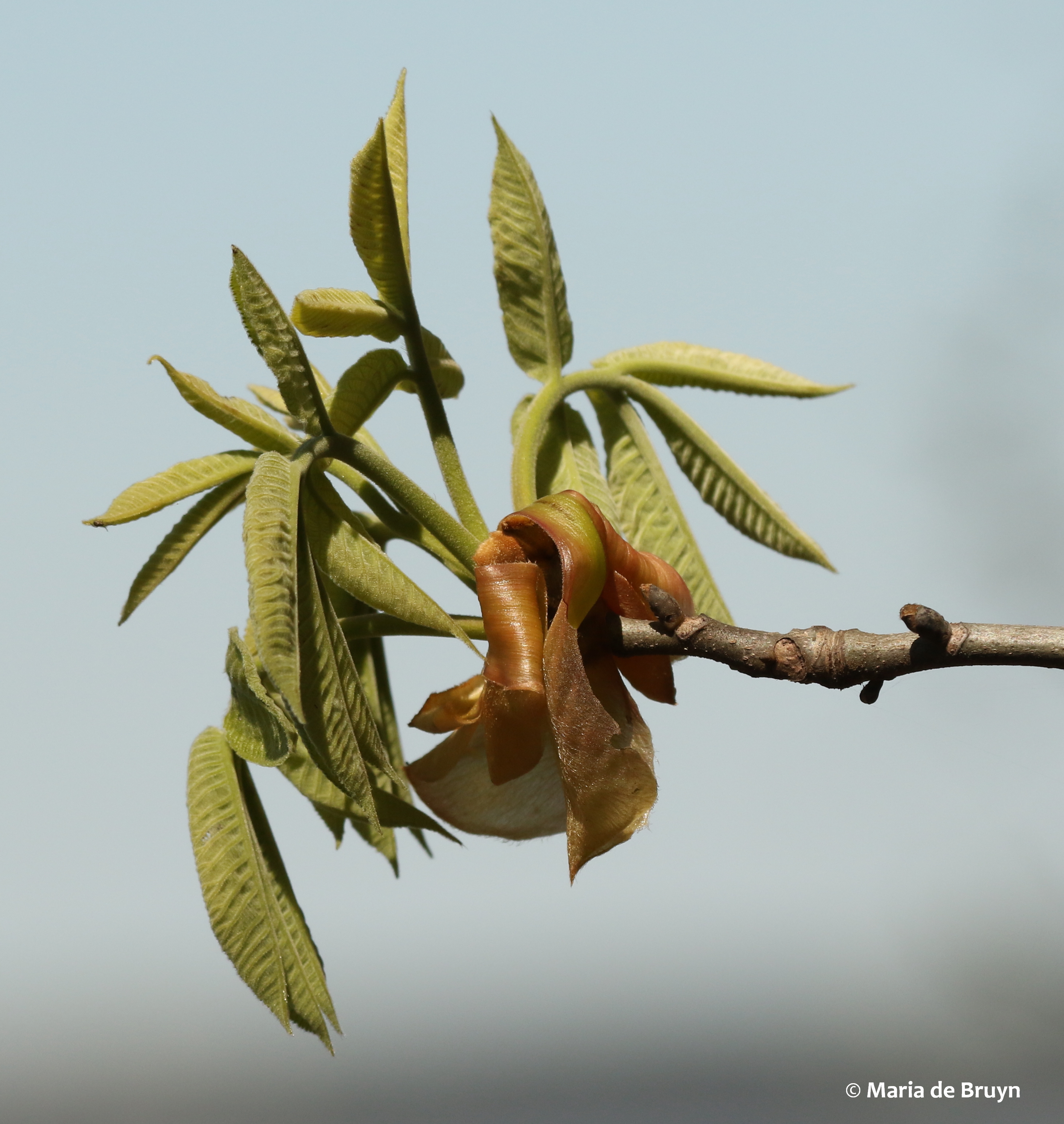
When I first saw these little beauties, I thought that they had wonderful spring flowers in hues of orange, rose and yellow. The “flowers” were at the base of clusters of pinnate leaves and they were often quite lovely.

shagbark Noah Shagbark hickory tree IMG_0185© Maria de Bruyn

It turns out that I had been fooled not only on April 1st, but the whole spring season in past years. Only recently did I find out that the shagbarks don’t have spring flowers at all – the curling petals are actually the scales of the buds from which the leaves emerge! The male and female flowers appear in late summer and early fall.

shagbark hickory I77A7708© Maria de Bruyn res

When the shagbark reaches the age of about 10 years, it begins to produce hickory nuts, reaching its full nut-bearing potential around the age of 40 and continuing to produce until about 100 years. The nuts are eaten by many species, including humans, squirrels, raccoons, chipmunks, black bears, mice, foxes and birds.

shagbark hickory I77A7679© Maria de Bruyn res

The shaggy bark, found in mature but not young trees, is used to help flavor syrups. I must admit that these trees attract my attention much more in the spring than other times of year – those flower-like bud scales are gorgeous!