Nest Watch citizen science – 2016 edition

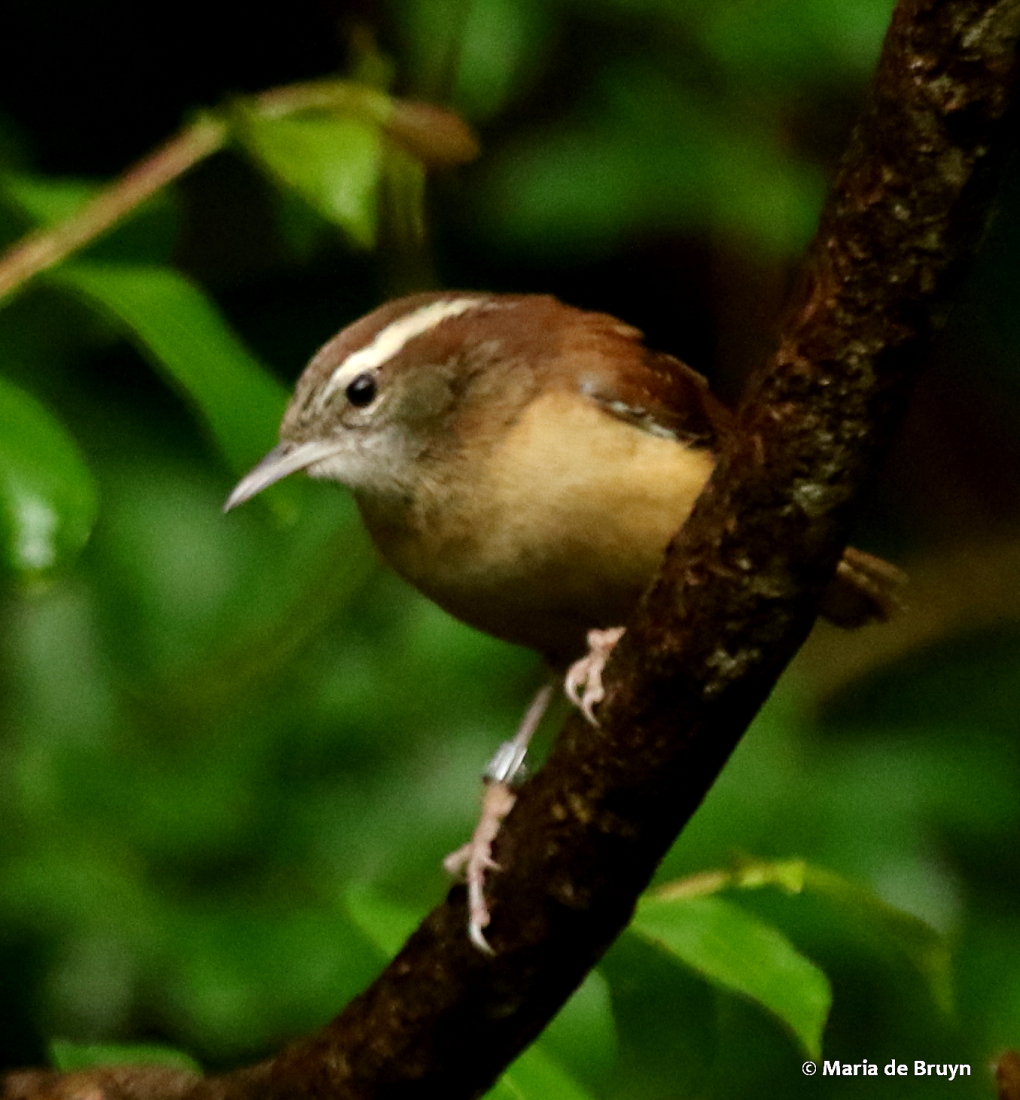
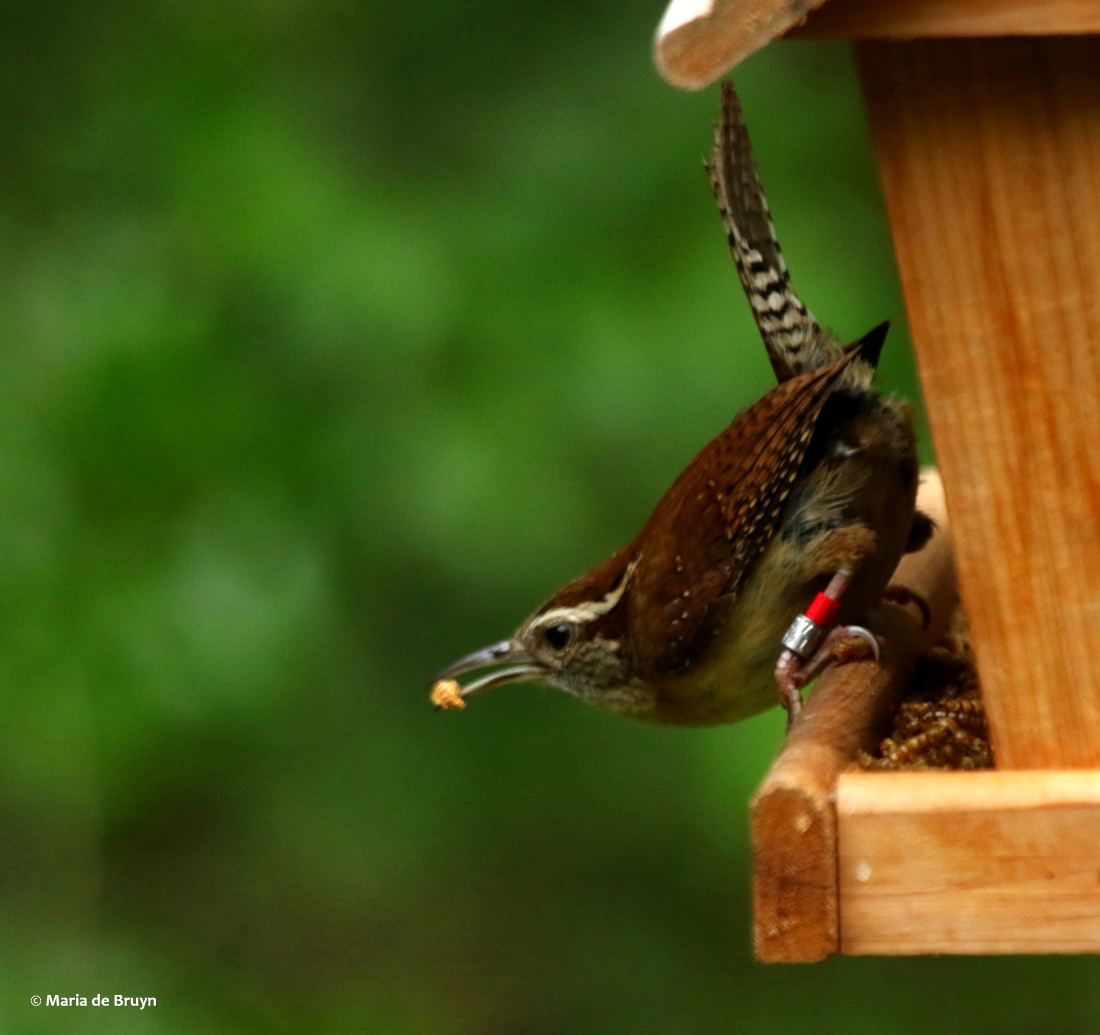
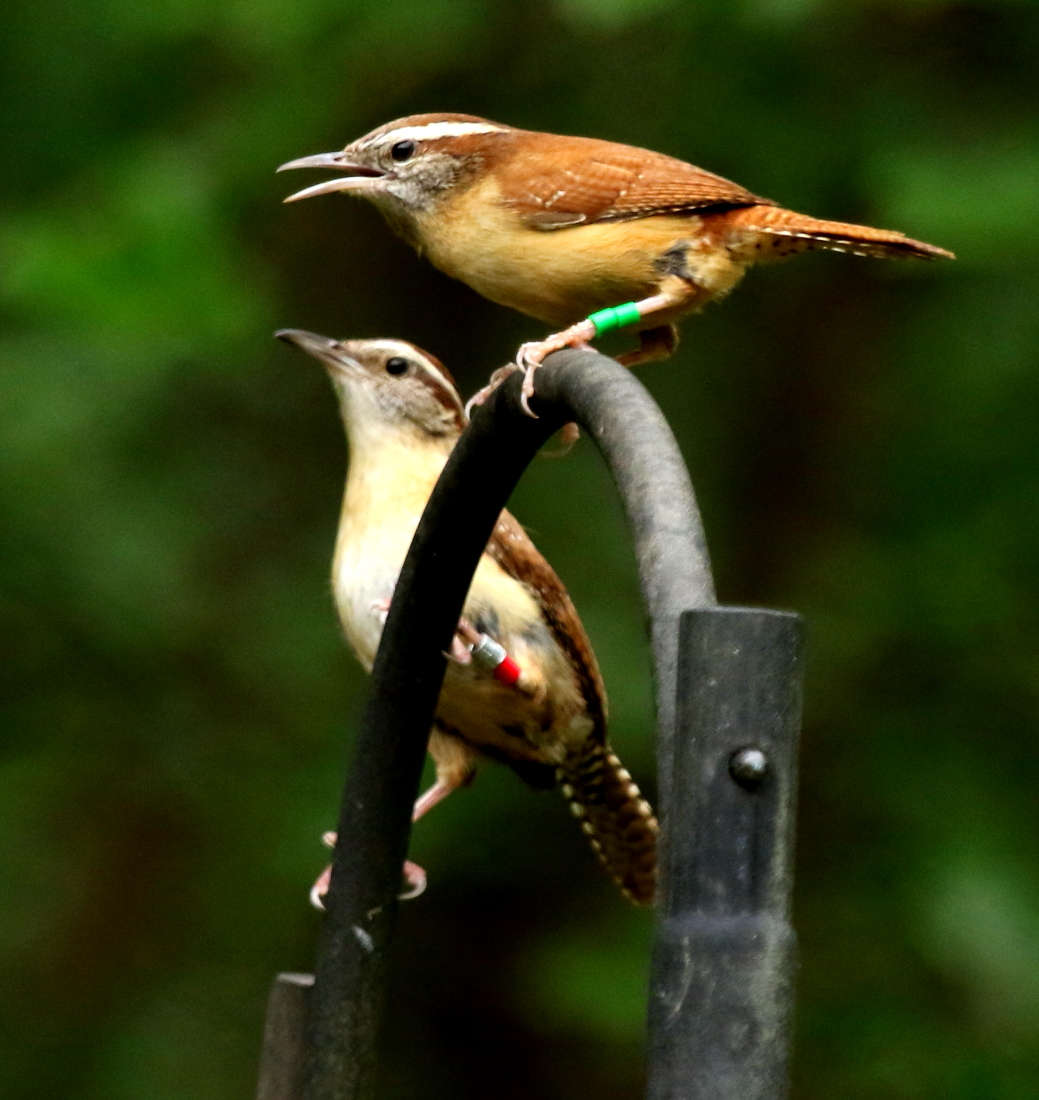
Carolina wren Renee and Riley I77A9074© Maria de Bruyn resLast year, I became a Nest Watch volunteer, which involves having birds banded in your yard so that you can follow and report to researchers the birds’ presence over time as they visit and leave your yard.

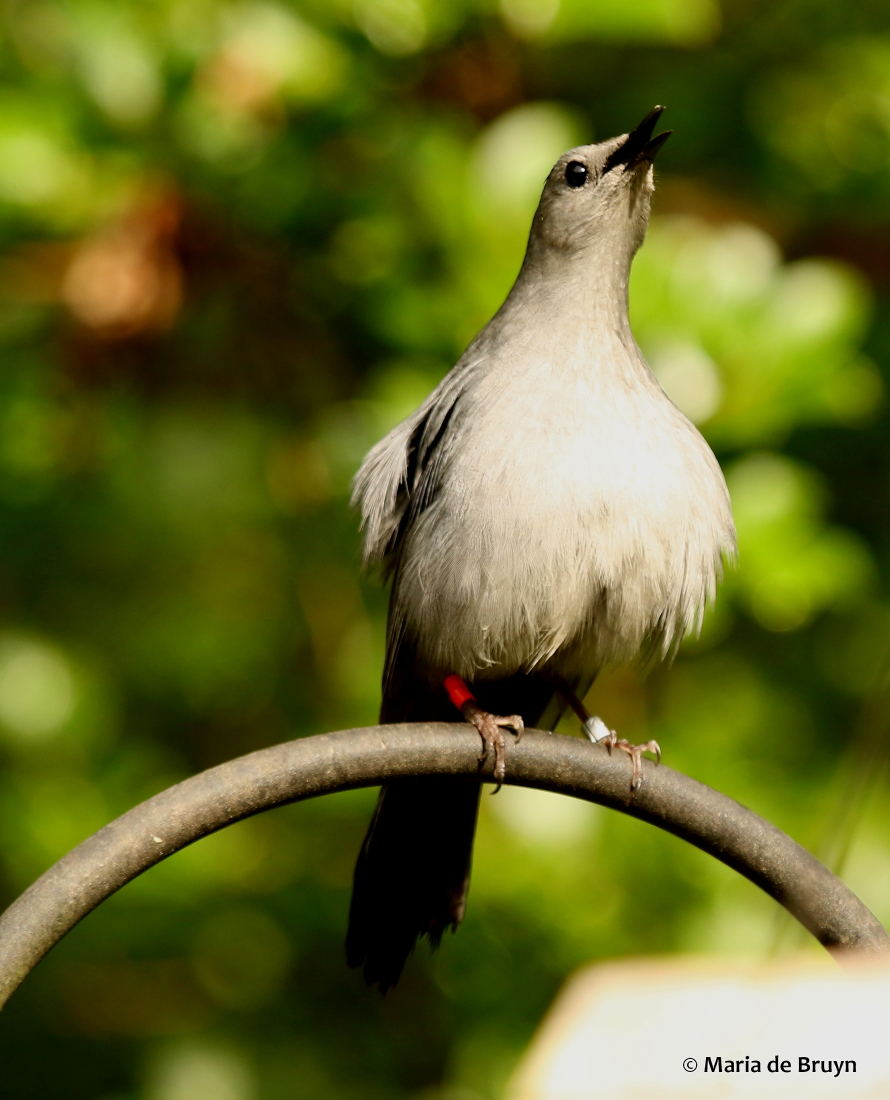
In 2015, we banded six birds. If a bird is only a temporary visitor or if it died outside the yard due to disease, old age or predation, you just won’t see it again and have no idea what became of it. The American robin (Turdus migratorius) that was banded last year never returned. If the birds stick around, however, you have the enjoyment of observing birds you get to know. The three gray-headed catbirds (Dumetella carolinensis) stayed around all summer and fall, and two of them – Camden and Corey – returned to my yard from winter migration a few days ago. They have been accompanied by females whom they appear to be assiduously courting.
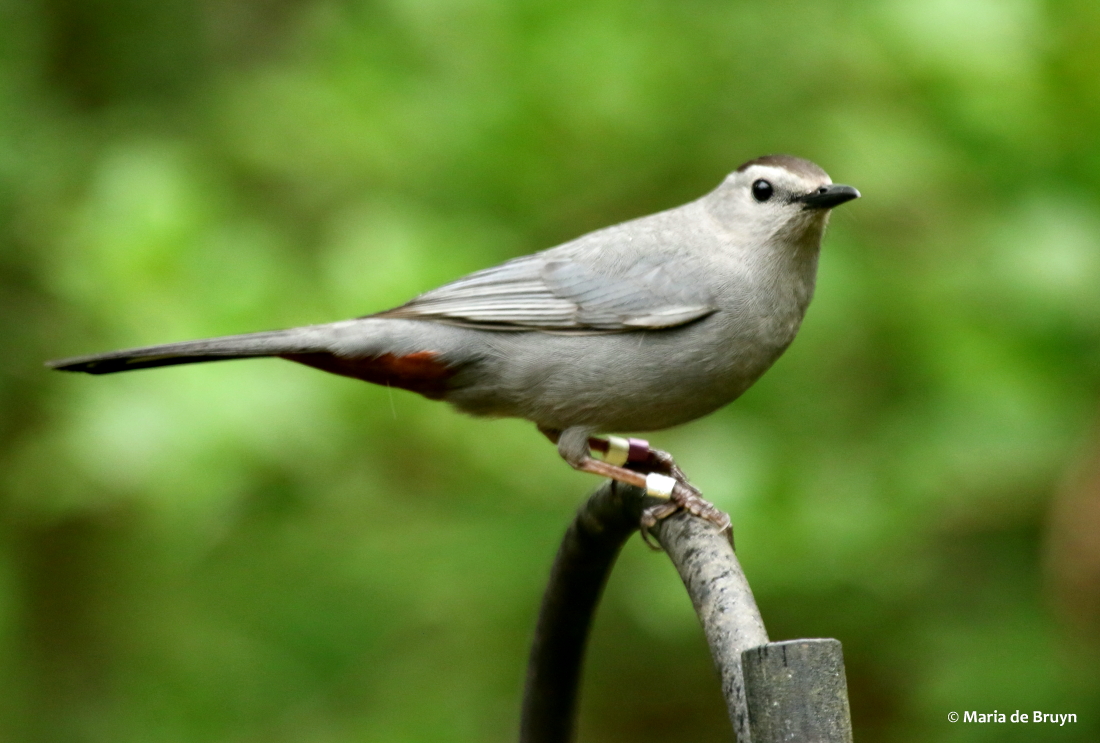
gray-headed catbird Camden I77A8990© Maria de Bruyn res

gray-headed catbird Corey I77A8083© Maria de Bruyn res

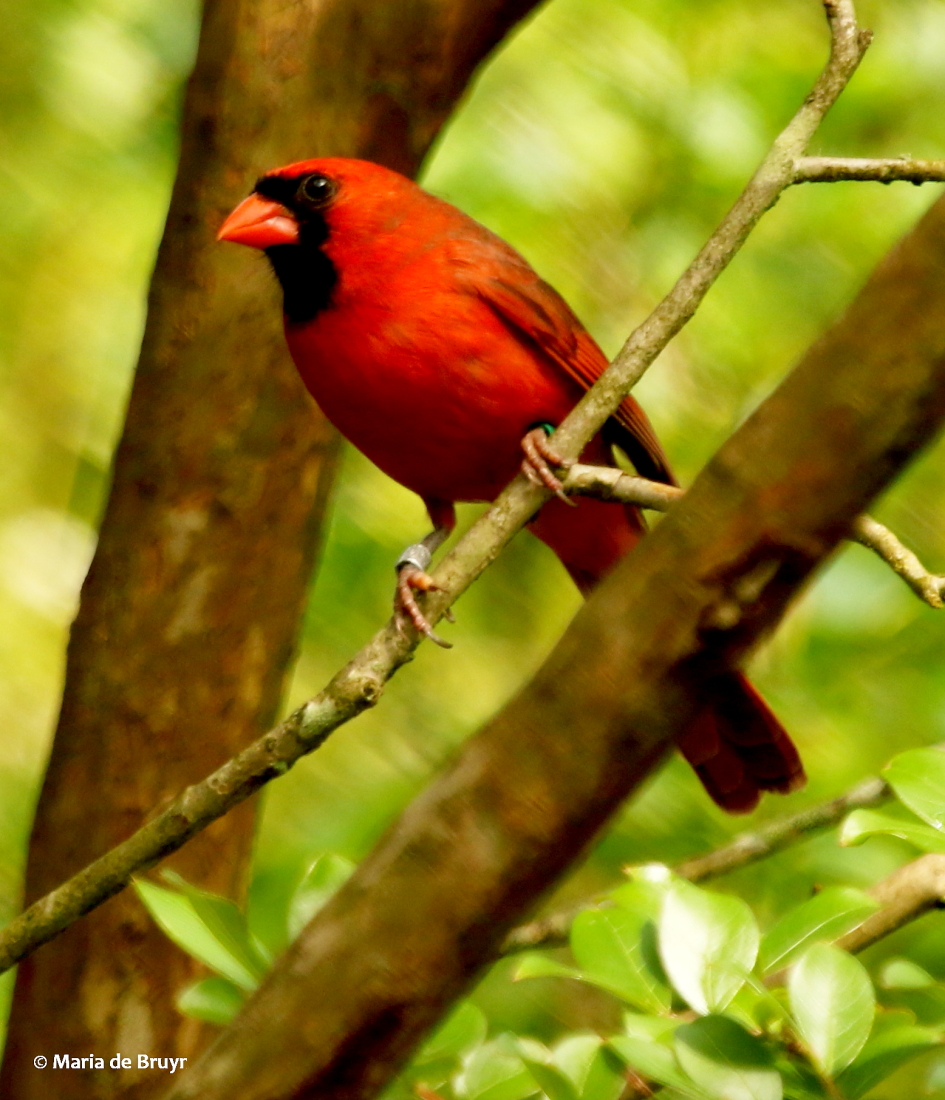
Northern cardinal Clancy I77A8123© Maria de Bruyn resOne Northern cardinal (Cardinalis cardinalis) was banded last year, but Clancy only stayed a few days and then disappeared for the rest of the summer, fall and winter. He suddenly appeared yesterday – perhaps encouraged to spend time at the feeders by the other birds with bracelets.

Three days ago, a second round of banding was done and we put the colorful anklets on a total of 10 birds. They were caught in two mist nets – one near my back garden and one near the backyard feeders.
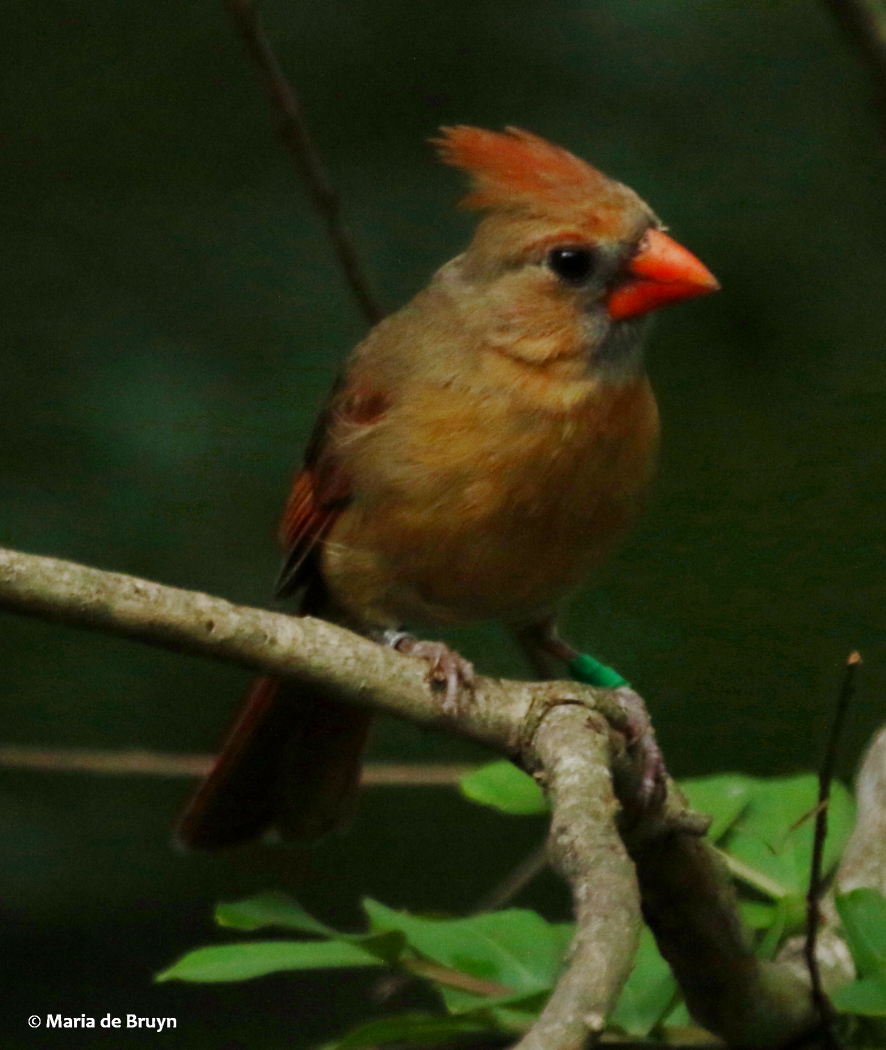
Northern cardinal Camilla I77A9127© Maria de Bruyn resThe nets had just been installed when our first visitor, a female Northern cardinal, was caught. She was not happy and when put in a bag until she could be banded, weighed, examined and measured, she did not remain still and calm. She had a little wait, however, as a female Carolina wren (Thryothorus ludovicianus) flew into the other net at just about the same time, followed by her mate within seconds. As the cardinals can tolerate being in a bag better than the smaller birds, the two wrens were banded first. Alicia let the first one go and then I released the second one, who rested on my palm for a bit. He felt so nice and soft!
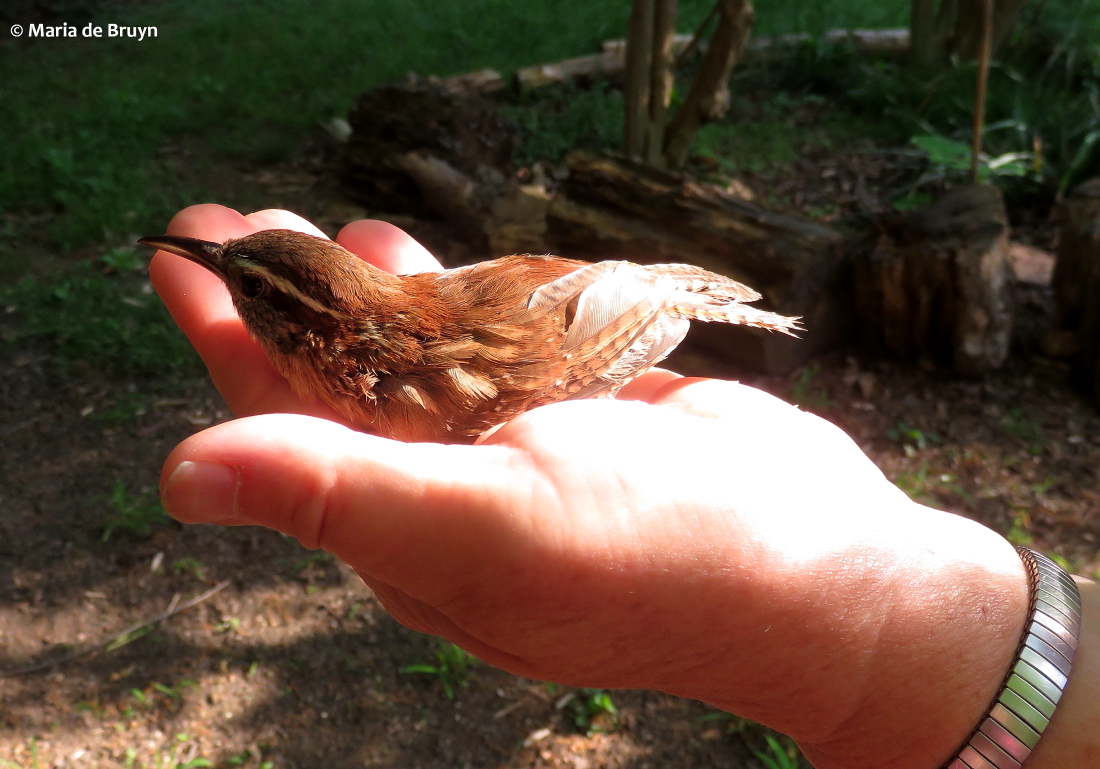
Carolina wren Riley IMG_3832© Maria de Bruyn res

Forty-five minutes later, playback of a house wren’s song (Troglodytes aedon) led to the capture of a male who immediately came to investigate who was invading his territory. His mate, who was busy putting the finishing touches on a nest in a box near the mist net, didn’t go near the net.
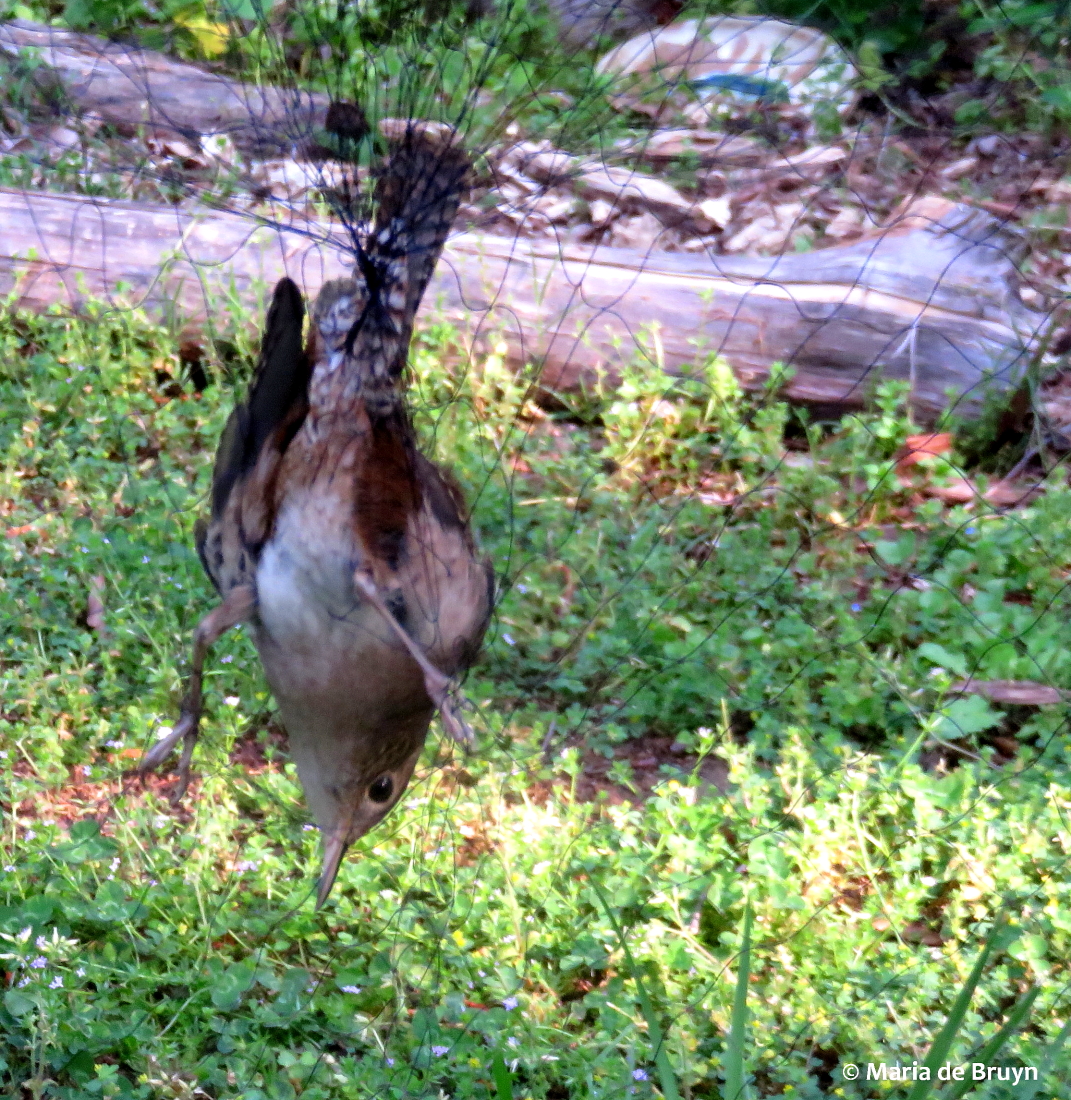
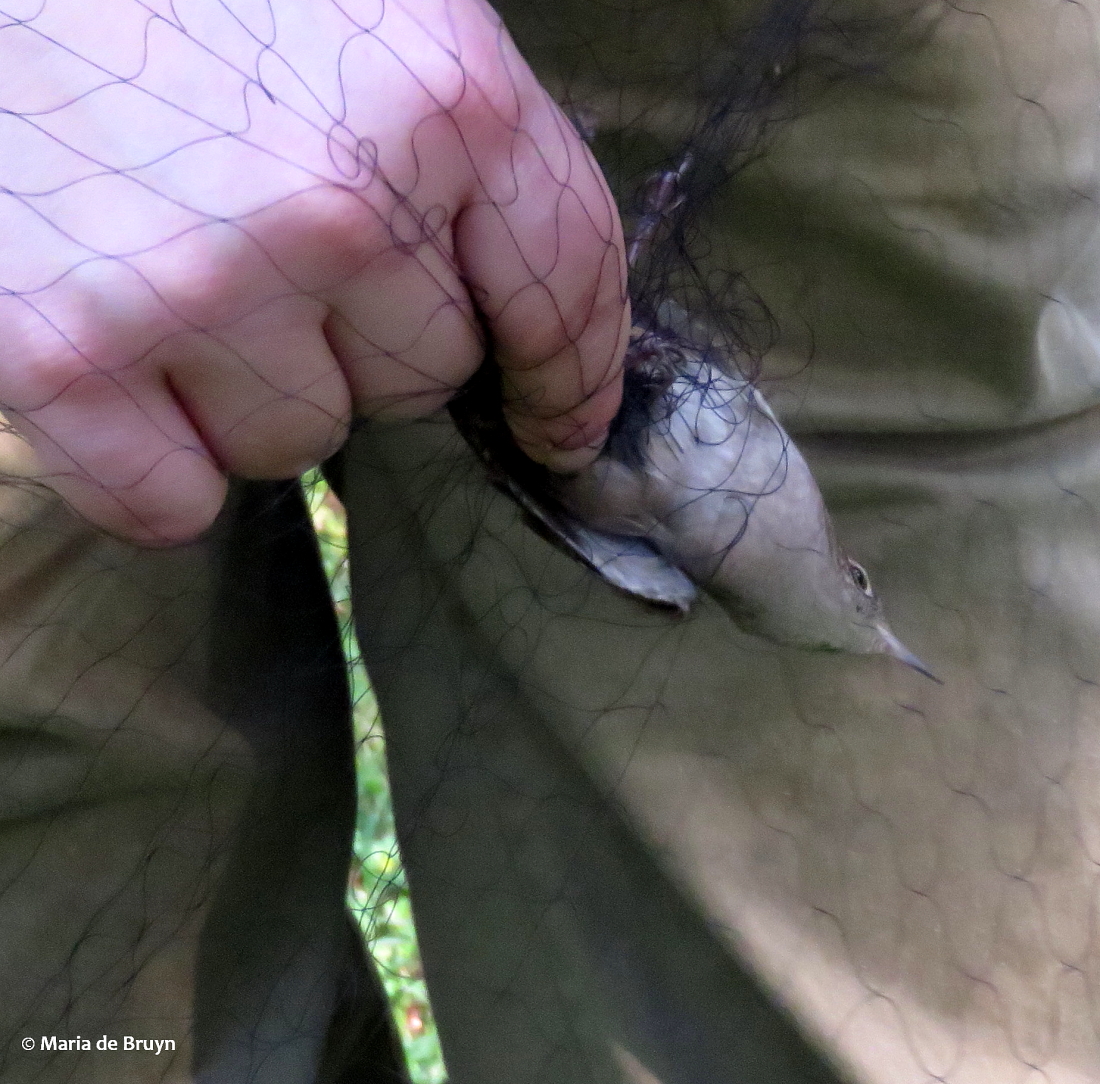
house wren Hans IMG_3842© Maria de Bruyn reshouse wren Hans IMG_3844© Maria de Bruyn res

A few birds not targeted for the study ended up tangled in a net. A white-throated sparrow (Zonotrichia albicollis) had beautiful vivid breeding colors on his head. A red-bellied woodpecker (Melanerpes carolinus) was not calm like the sparrow, fluttering his wings constantly as Alicia, the bird bander, got him loose.
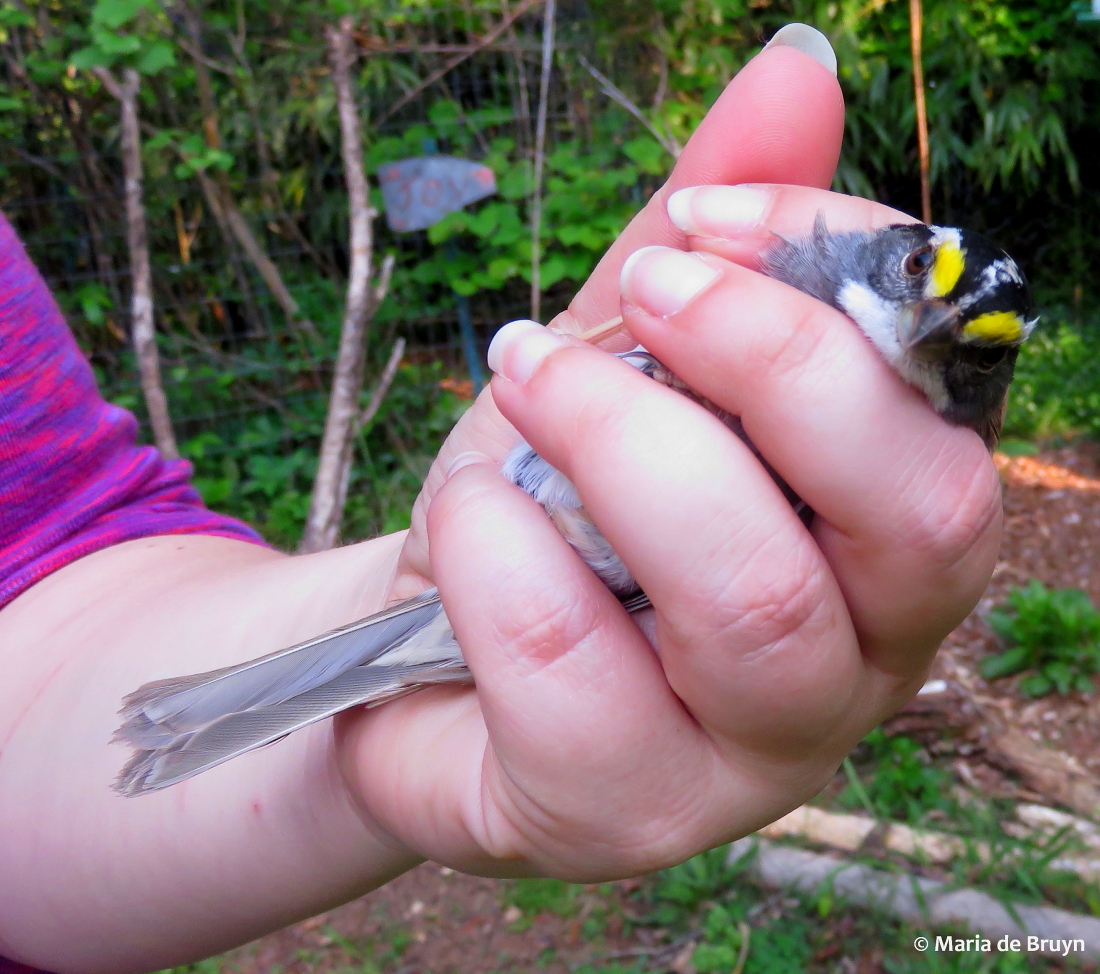
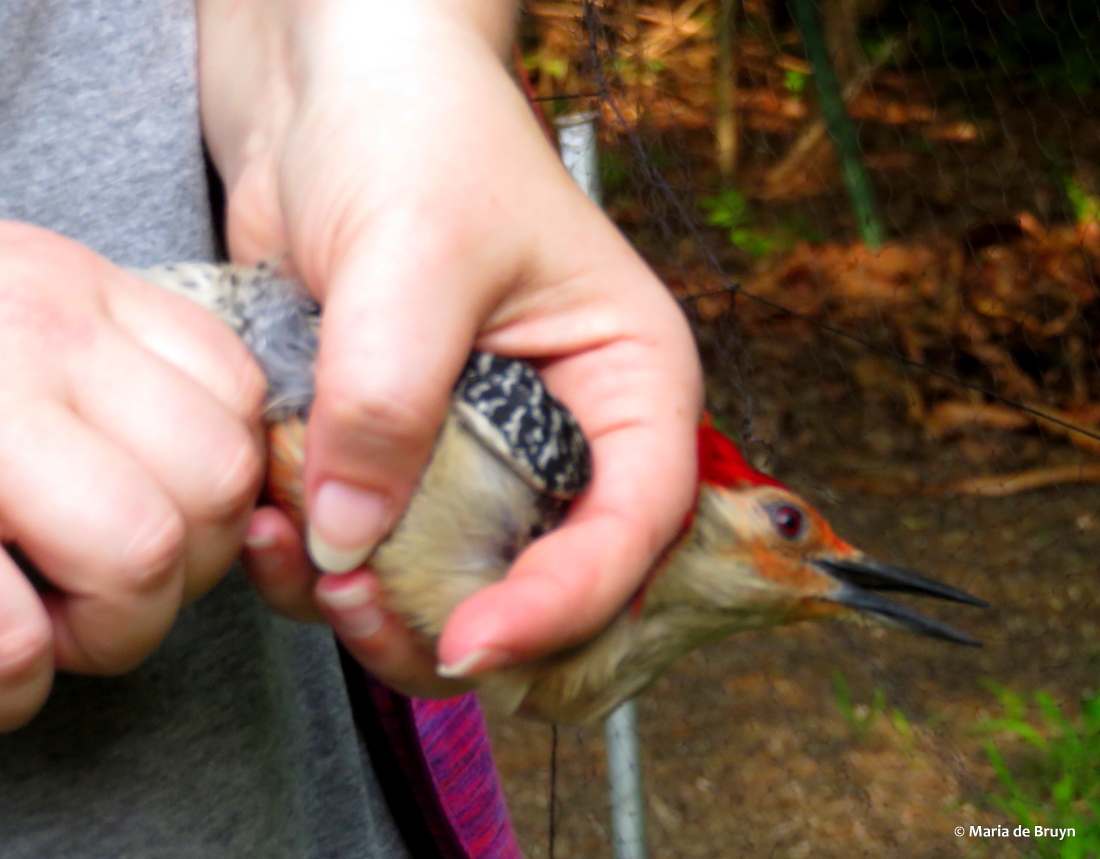
white-throated sparrow IMG_3837© Maria de Bruyn res red-bellied woodpecker IMG_3822© Maria de Bruyn res

Next up were a male cardinal and a female American robin. Like last year, the birds were measured and weighed. Although about the same length, the weight difference between the heaviest Northern cardinal we banded (41.2 oz) and the American robin was striking (79.6oz). The robin’s fondness for worms and other dietary preferences helps account for this. When I let her go, she didn’t feel very heavy in my hand as she rested a second before flying off.
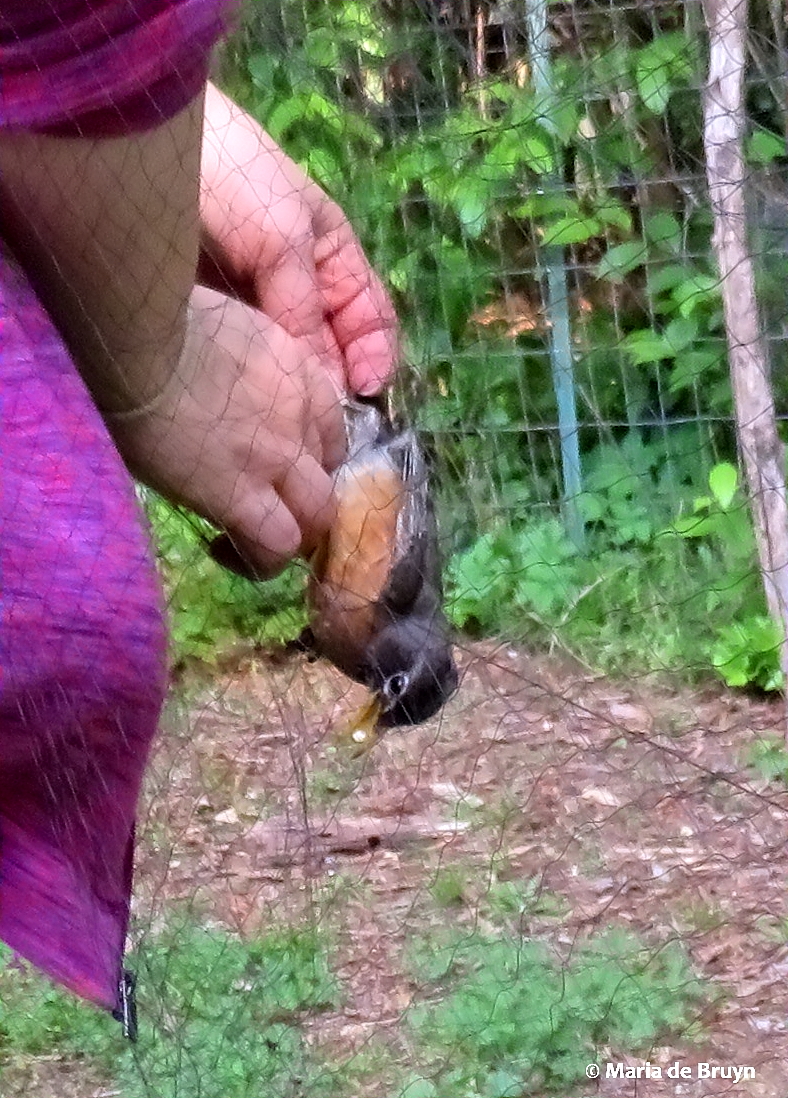
American robin Raisin IMG_3854© Maria de Bruyn

Except for birds that were molting their tail feathers, Alicia also removed the third left tail feather; this is done primarily for stable isotope analysis, which allows a researcher to estimate where the bird was when that feather was grown.
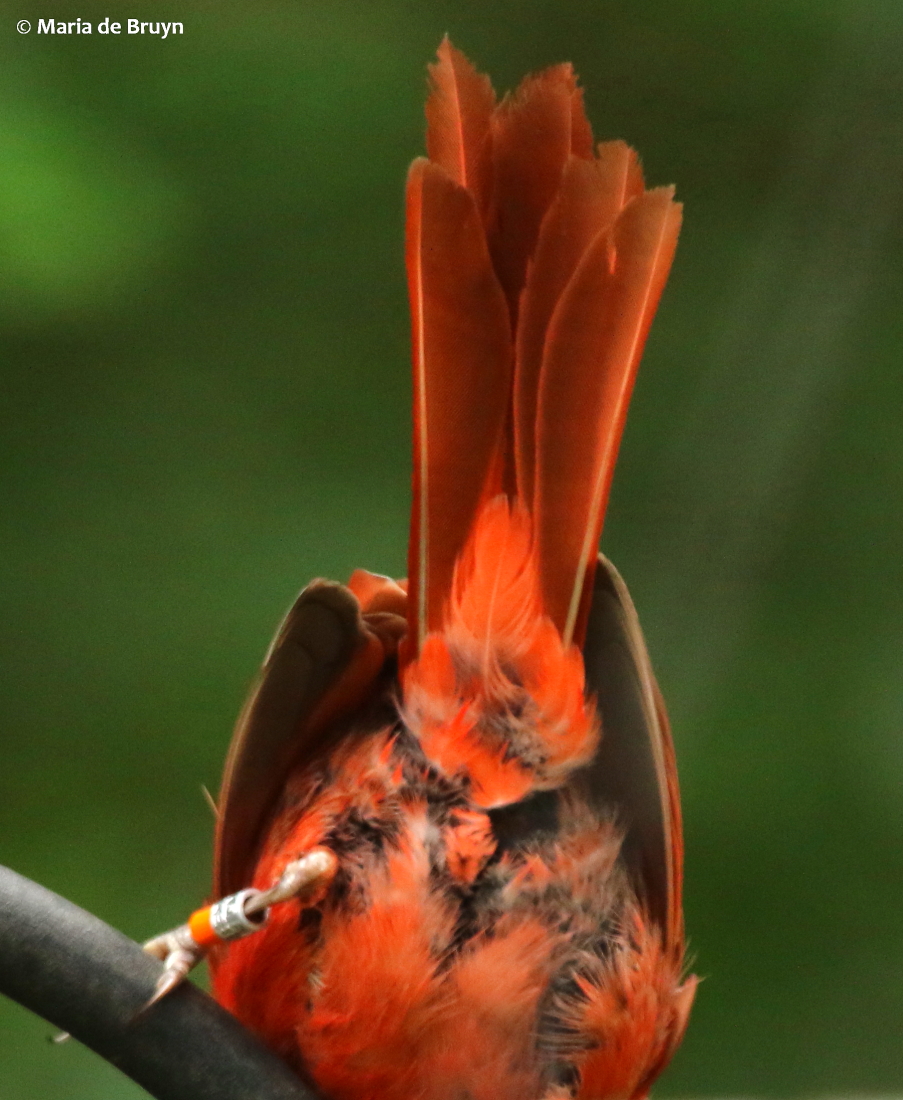
Northern cardinal Crake I77A0559© Maria de Bruyn res

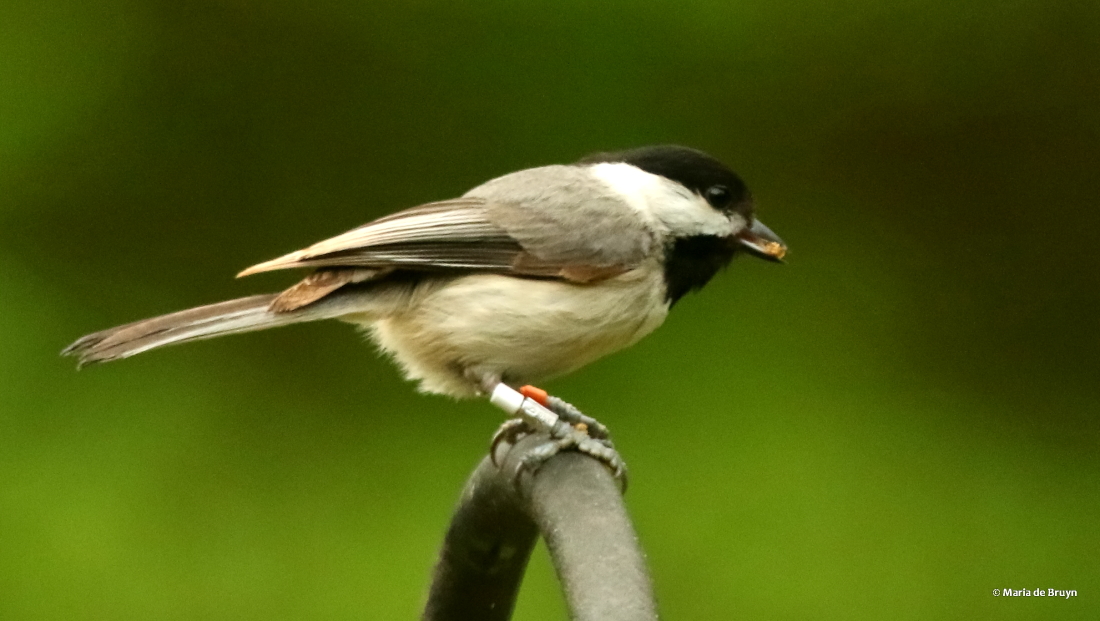
Carolina chickadee Chancey I77A7762© Maria de Bruyn resThe catbirds avoided the mist nets skillfully this year. Playback of their songs drew them to the vicinity but the two pairs visiting the feeders were more interested in chasing each other away from the territory. Alicia hoped that we could get a Carolina chickadee (Poecile carolinensis); with playback we got a male and then, 45 minutes later after banding another cardinal, we got a pair of them.
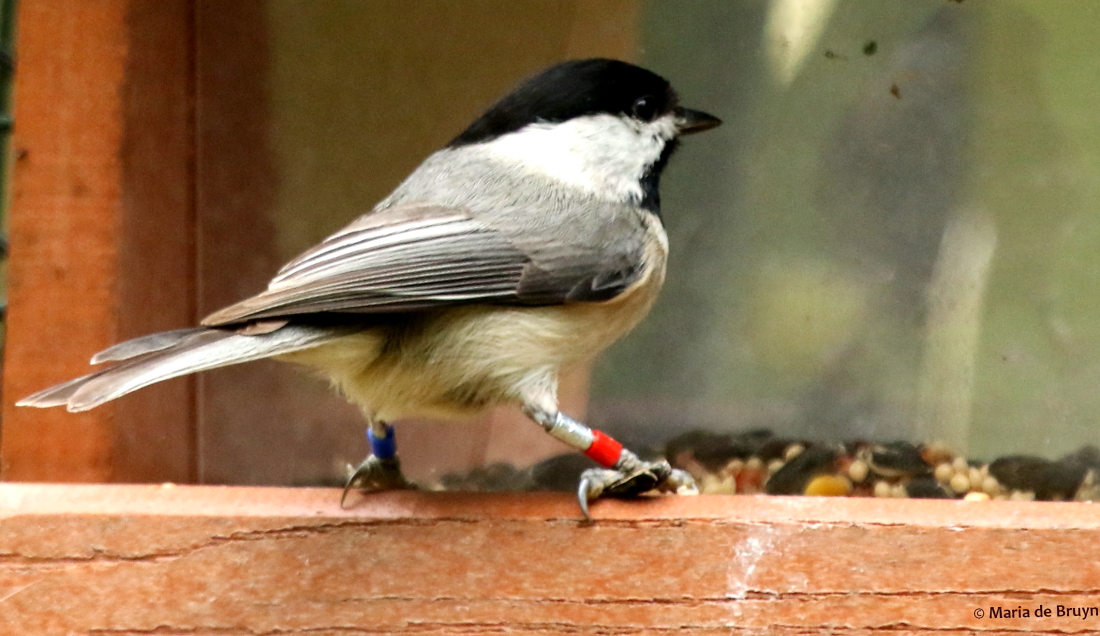
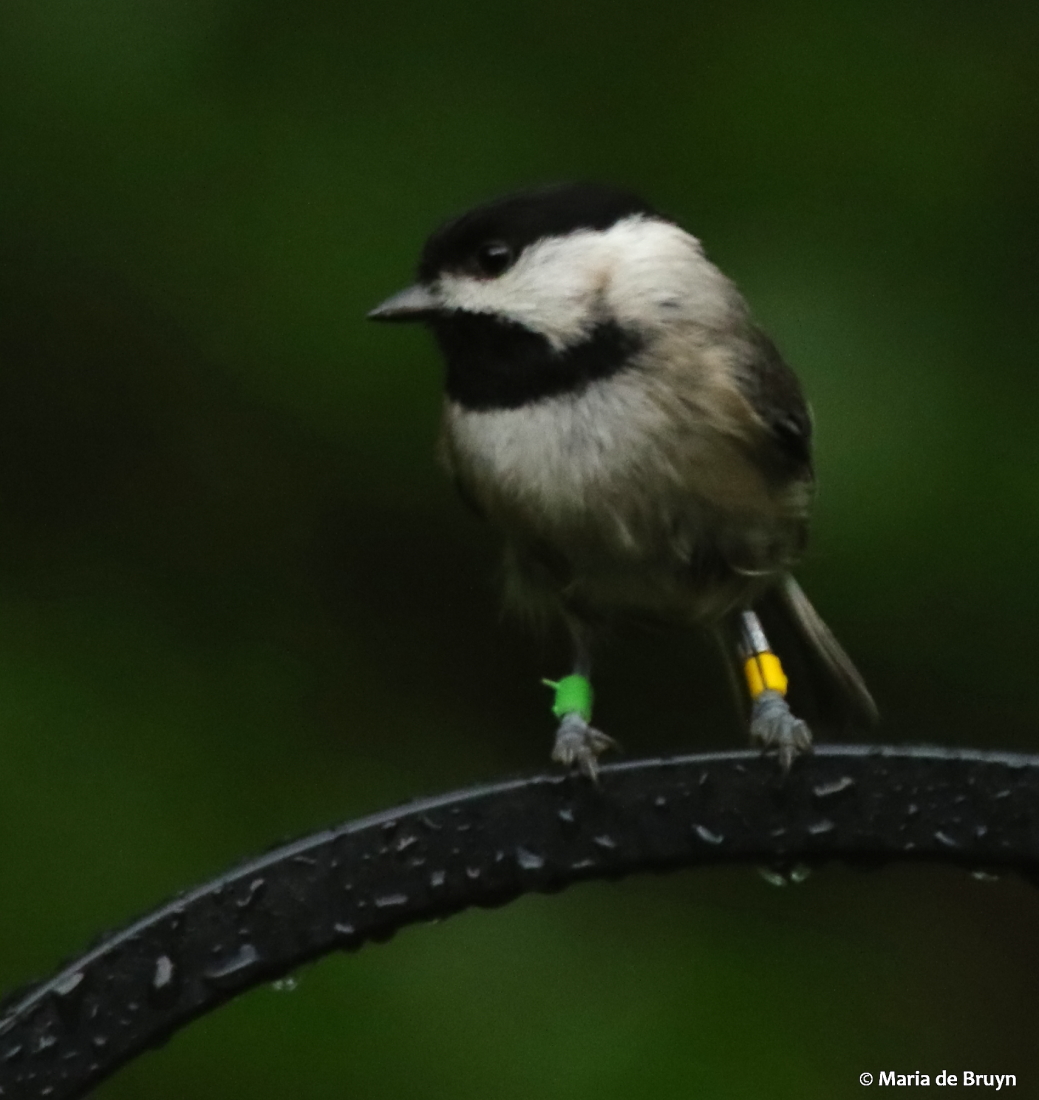
Carolina chickadee Chase I77A0348© Maria de Bruyn res Carolina chickadee Chantal I77A9525© Maria de Bruyn res

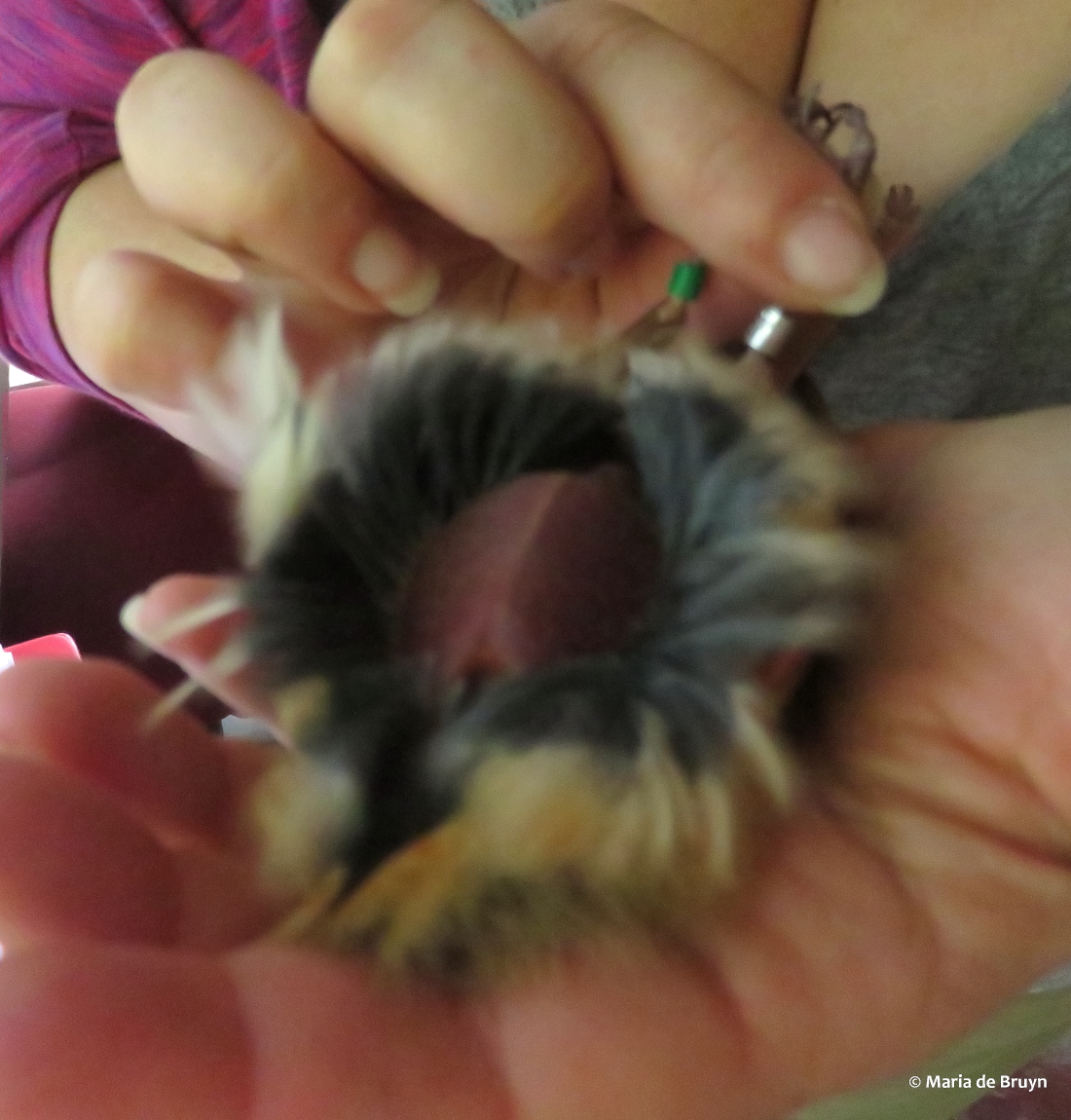
Alicia blew on the birds’ undersides (forgive the blurry photo) to assess fat reserves, which are stored along the flanks and up near the furcula by the collar bone. She could also determine sex that way and thought that one chickadee might be developing an egg – hopefully, one of the females who lost a nest to predators in my yard a week ago. The last male chickadee released was out of sorts after the experience; before leaving my hand to fly off rapidly, he turned and bit me as a parting shot.
Carolina wren Renee IMG_3813© Maria de Bruyn res Carolina chickadee IMG_3856© Maria de Bruyn res

Alicia had remarked that she hoped no tufted titmouse (Baeolophus bicolor) would be caught; they are not part of the study and she said they are so feisty that their bites can be a bit painful like those of the cardinals. Unfortunately, one leaving a feeder did end up in a net and lived up to its reputation as a feisty bird. A chipping sparrow (Spizella passerina), who was the last bird in a net remained fairly calm as the net was removed from its claws.
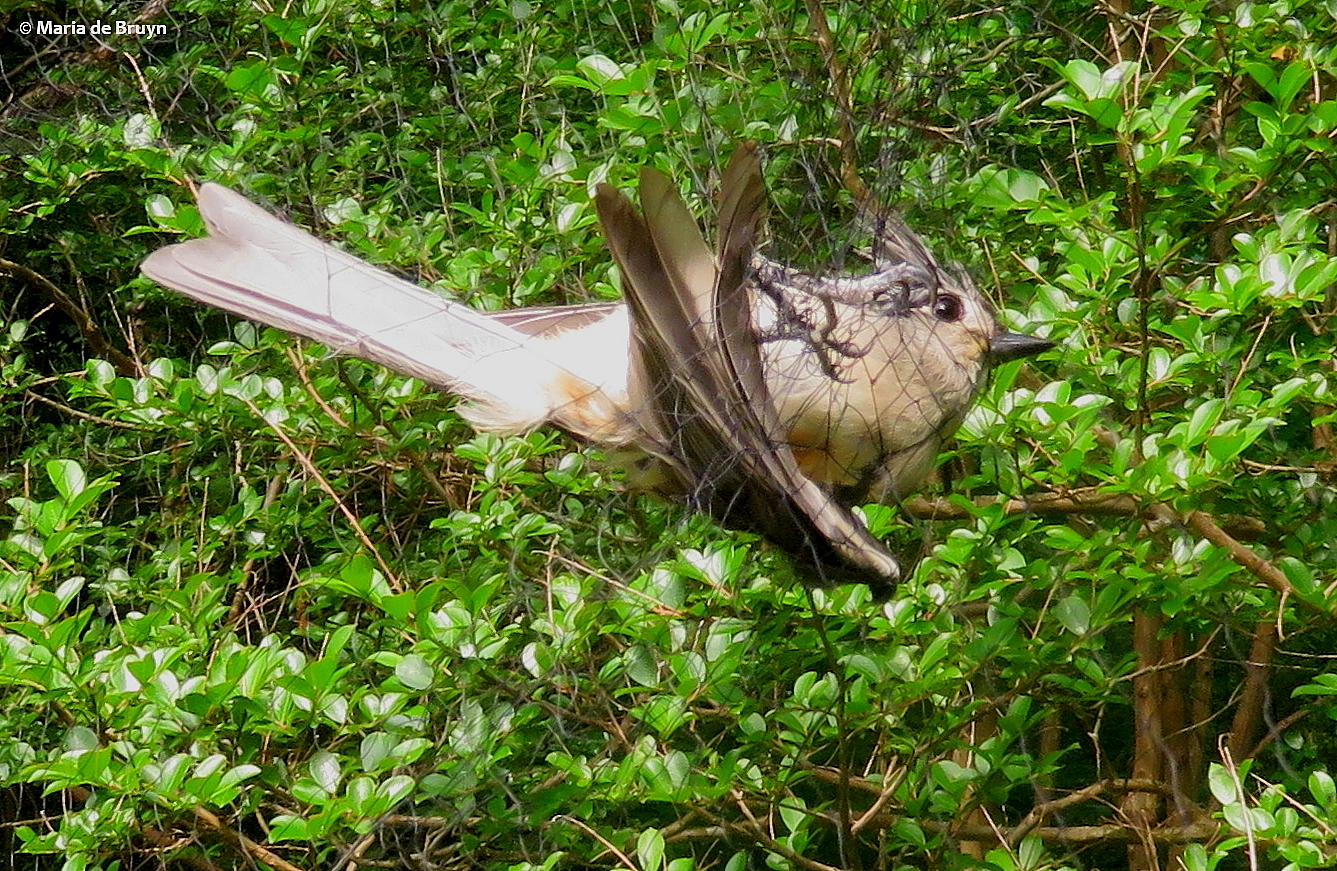
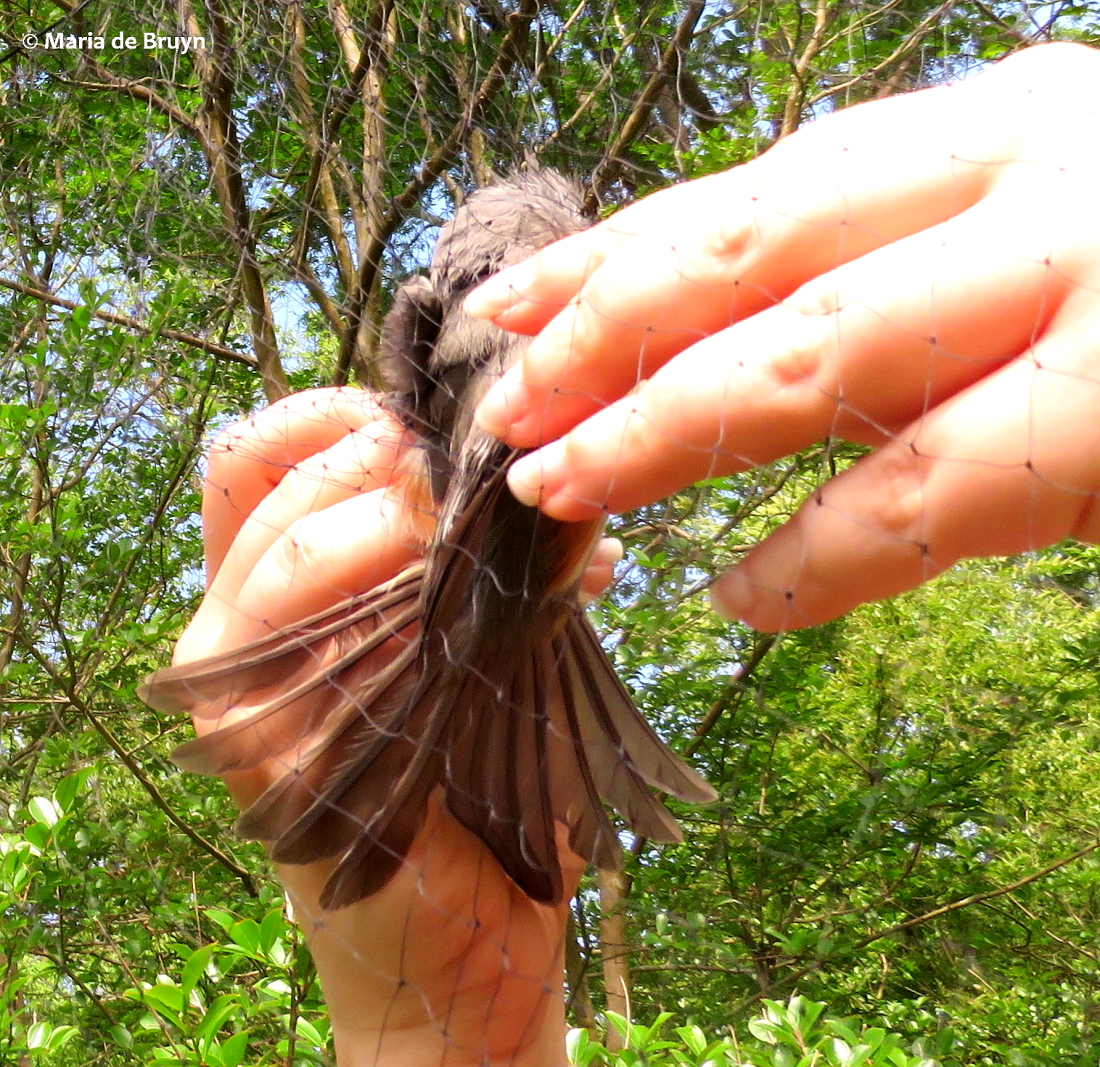
tufted titmouse IMG_3858© Maria de Bruyn res

Tufted titmouse IMG_3861© Maria de Bruyn res

Yesterday, I spent some time watching the feeders and yard to see if all the banded birds had left. Luckily, some of them showed up and were here again today. So here are a few of “my birds” with bling – this is a truly enjoyable citizen science project. 🙂
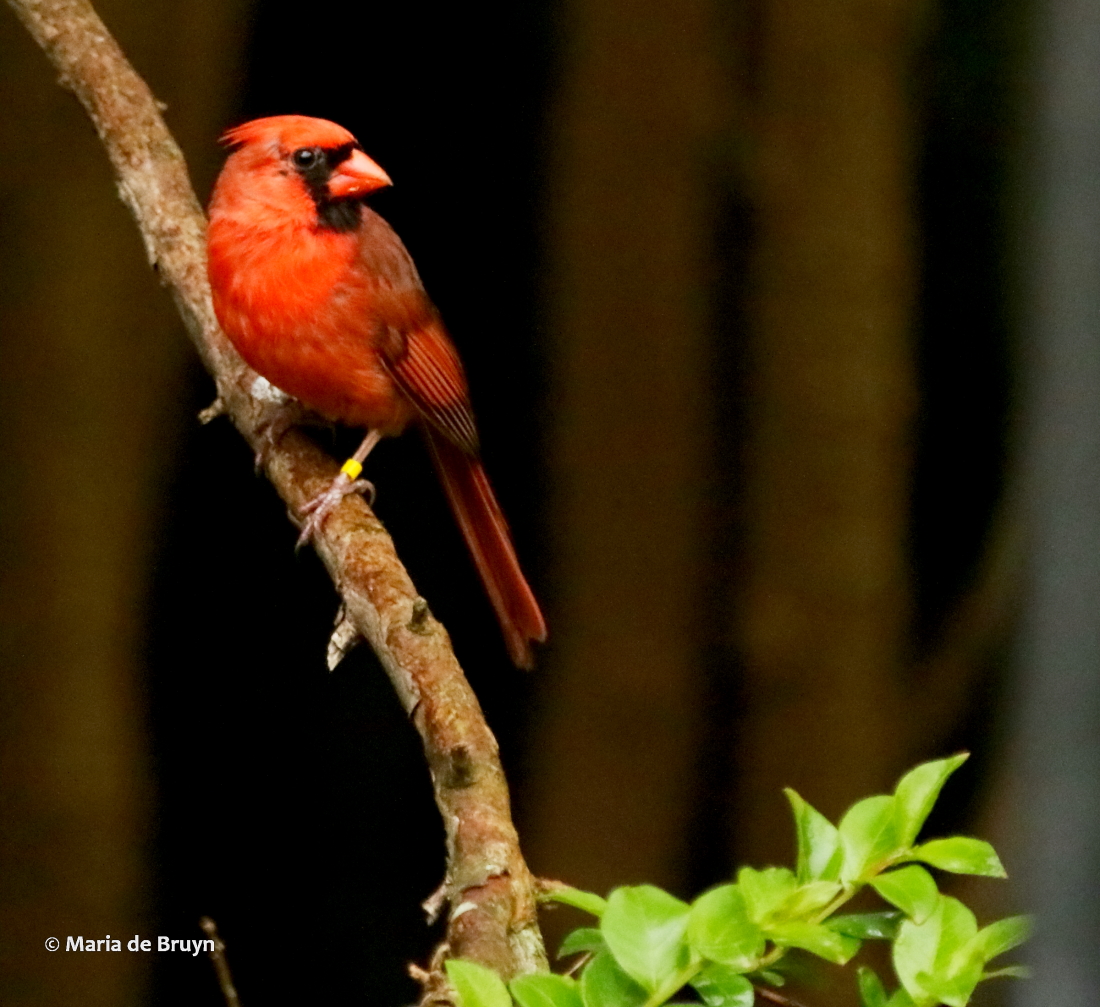
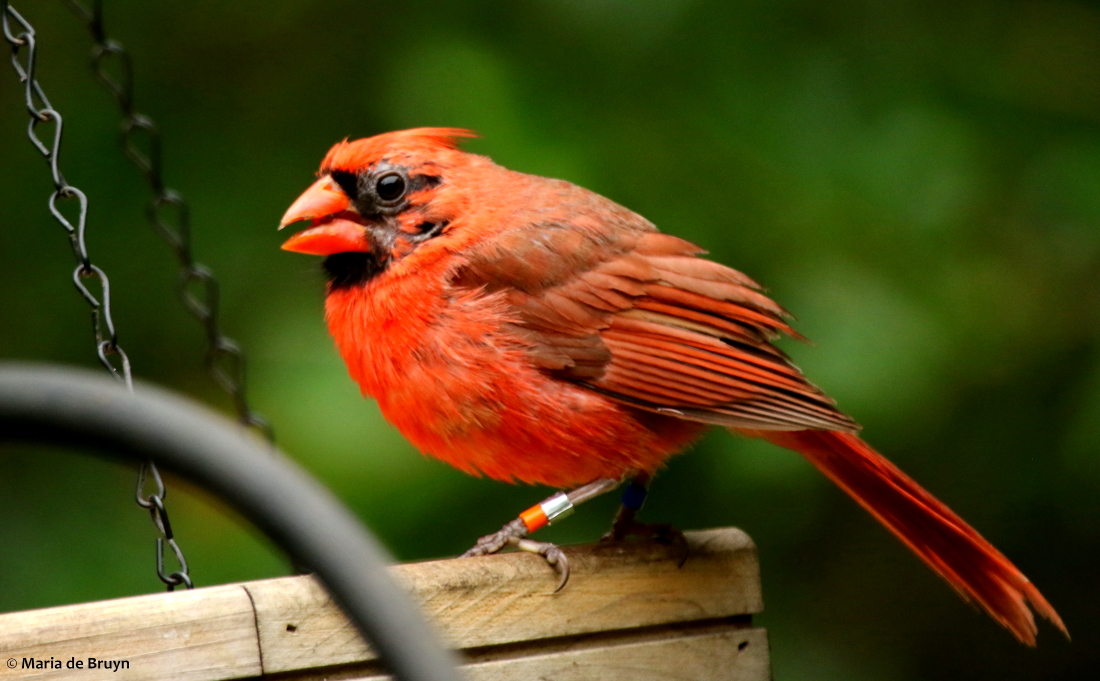
Northern cardinal Clarence I77A0124© Maria de Bruyn res Northern cardinal Crake I77A0593© Maria de Bruyn res

Clarence                                                                       Crake

Carolina wren Renee I77A9354© Maria de Bruyn resCarolina wren Riley I77A0508© Maria de Bruyn res

Renee and Riley Carolina wrens


A varied palate – hummingbirds’ choice of foods

DK7A2925© Maria de Bruyn res

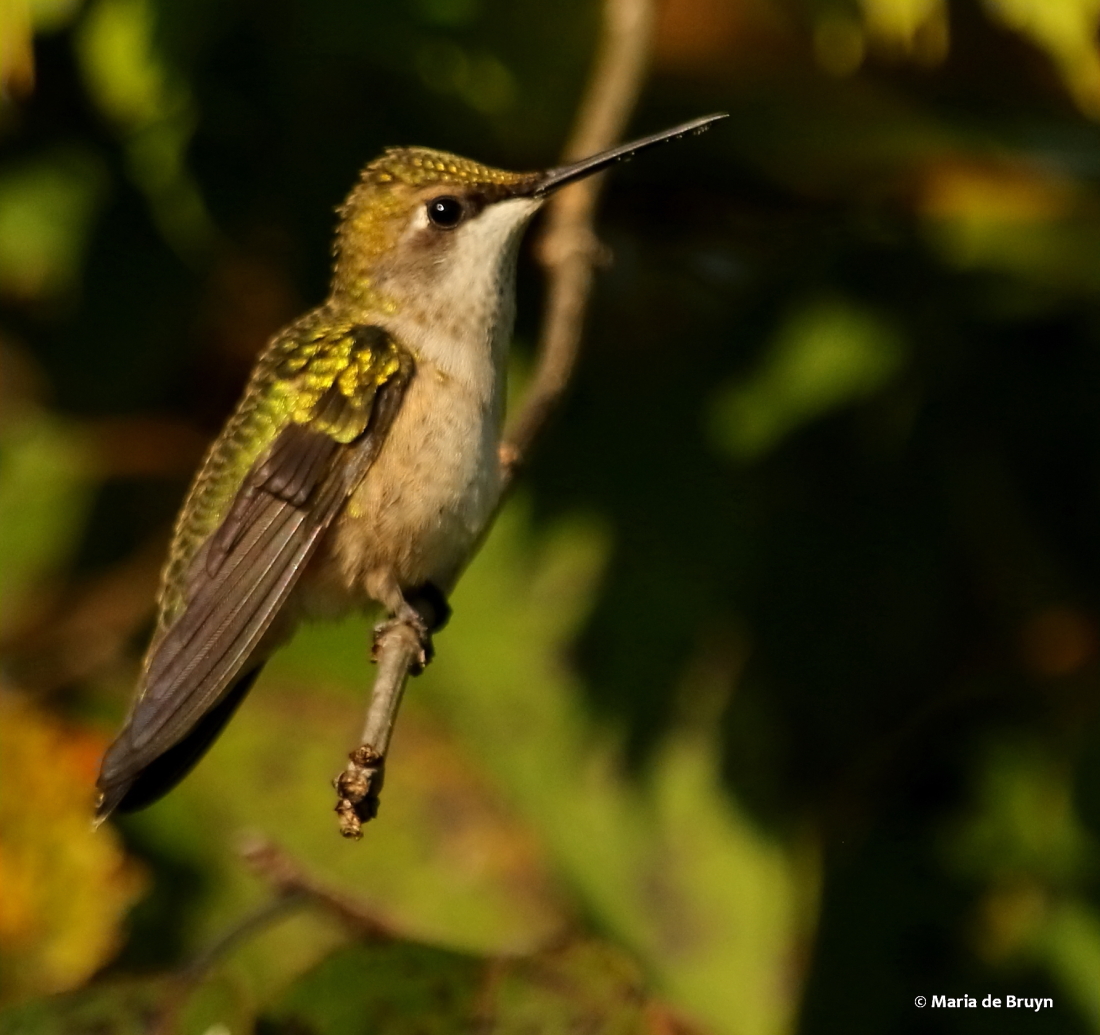
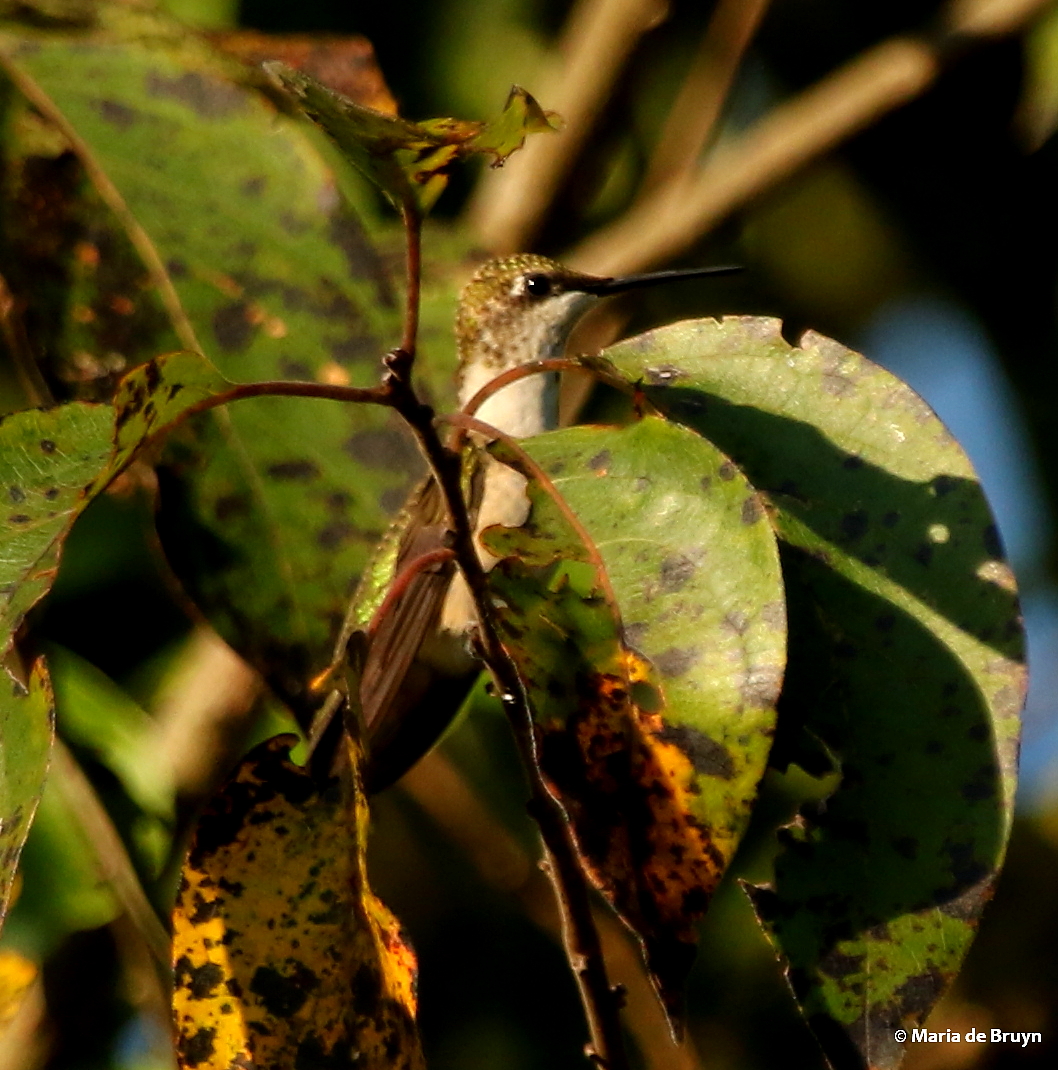
As promised, one more blog on hummingbirds before I move to another topic; their presence always brings me enjoyment and I know other people who are enamored with these tiny birds, too. Also, although autumn has come, I still have a couple ruby-throated hummingbirds (Archilochus colubris) at my feeders. And a couple days ago I had the privilege of seeing a species new to me, the buff-bellied hummingbird (Amazilia yucatanensis), which has only visited the state of North Carolina once before (at least as far as human witnesses are concerned)!

DK7A2528© Maria de Bruyn resThe hummers have a varied diet, including mainly insects (mosquitoes, gnats, fruit flies, small bees), spiders, tree sap and sweet nectar (or sugar water). They tend to feed about 5-10 times per hour during the day and need about 10 calories of nutrition each day.


It is a lot easier to catch them drinking nectar than catching insects (apologies for the blurred photos)!

DK7A0749© Maria de Bruyn (2) res

DK7A7171© Maria de BruynDK7A2814© Maria de Bruyn

DK7A7808© Maria de Bruyn


Hummingbirds use their long tubular tongues as elastic micro-pumps to obtain nectar. This enables them to lick a flower up to 20 times per second as they gather food. And although we can’t see it when just looking at them, they have forked tongues (like snakes)!


DK7A0391© Maria de Bruyn res ruby-throated hummingbird DK7A1076© Maria de Bruyn res

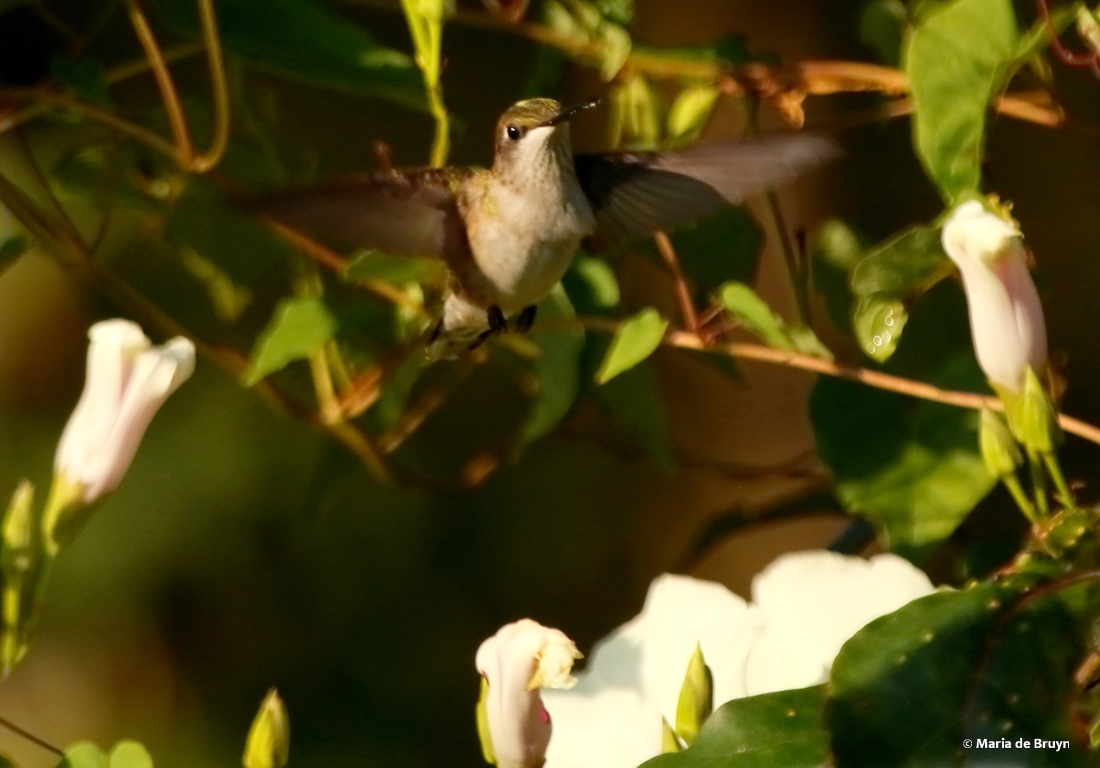
DK7A4497© Maria de Bruyn2The hummers visit a variety of flowers to drink their sweet nectar, often preferring orange or red flowers but certainly not avoiding others.In my garden, this includes cardinal flowers (Lobelia cardinalis), hollyhocks (Alcea), yellow passionflower (Passiflora lutea) and lantana (Lantana).

ruby-throated hummingbird DK7A0820© Maria de BruynDK7A0555© Maria de Bruyn res

In nature reserves, I’ve seen them visiting morning glories (Ipomoea), ironweed (Vernonia) and trumpet vines (Campsis radicans).

DK7A2213© Maria de Bruyn resDK7A3392© Maria de Bruyn res

DK7A2289© Maria de Bruyn res


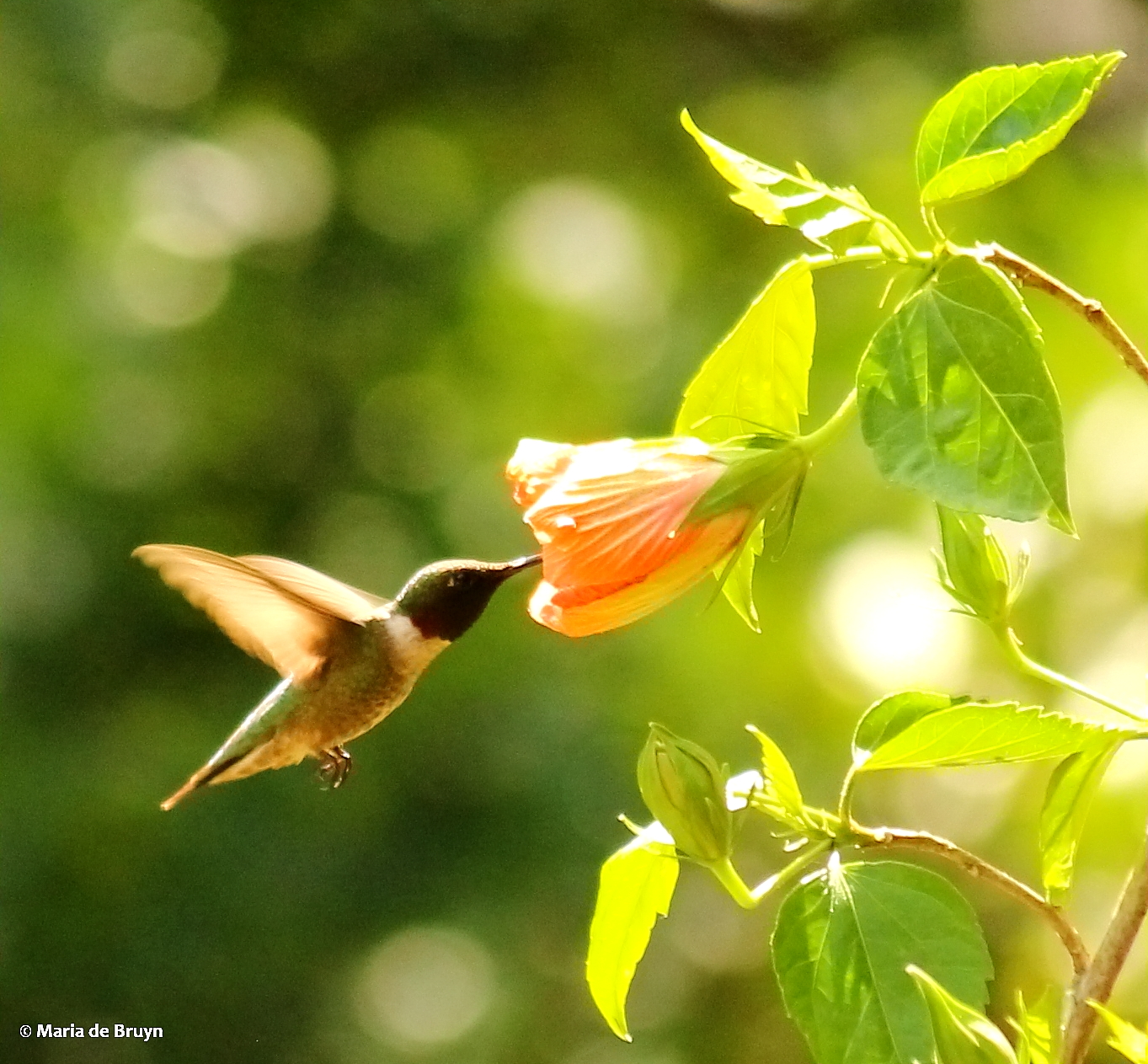
Their long bills, tubular tongues and slim bodies make it easy for them to drink from long flowers, but sometimes they will simply pierce the base of a flower to obtain nectar, or use a hole already made there by an insect.

DK7A2915© Maria de Bruyn resDK7A2428© Maria de Bruyn res

Light-colored flowers are not shunned as food sources, however!

DK7A7178© Maria de Bruyn (2) resDK7A7142© Maria de Bruyn res

DK7A7165© Maria de Bruyn res

Bean plants and gerbera daisies (Gerbera)  were on the menu at the Translating Traditions farm.

DK7A7360© Maria de Bruyn resDK7A7381© Maria de Bruyn res

At my house, the hummers visit the nectar feeders with great regularity, presumably because the food is very easily available there. A little known fact about the hummingbirds is that, compared to all other birds, their brains are the largest in comparison to body size. They remember where feeders are from year to year and also can recognize the people who fill the feeders. When the nectar is low and I appear, a hummer will sometimes hover and chitter in my direction at length; I really do think it is warning me that it’s time to prepare another serving.

ruby-throated hummingbird DK7A8190© Maria de Bruyn res

The buff-bellied hummingbird breeds in Mexico and south Texas. When they migrate, it is in a north-eastern direction, but the only previous recorded visit of one to North Carolina was in 2007. Now there is one hanging out at a couple’s home in the town of Winston-Salem, so I accompanied three fellow birders to go see it. Our 90-minute drive there was rewarded by a view of the bird within about 15 minutes and we stayed for almost two hours watching it come and go along with some ruby-throated hummingbirds.

buff-bellied hummingbird DK7A1131© Maria de Bruynbuff-bellied hummingbird DK7A1171© Maria de Bruyn

These hummingbirds have bellies with a light orange-yellow hue, brighter orange tail feathers and a bright green back and head. In contrast to the ruby-throated hummingbird’s straight dark bill, they have a reddish, curved bill. These lovely little birds appear to be the least studied species among the hummingbirds in the USA.

rufous hummingbird IMG_1789 M de Bruyn


Two years ago, I had a rufous hummingbird (Selasphorus rufus) visit my nectar feeder after he had migrated here in winter from the far North. This year, I’ll leave at least one feeder up again after the ruby-throats take off for warmer climes in case some wintering hummers need food. And I’ll look forward to seeing my regular residents again next summer!


More information:

http://www.livescience.com/51904-hummingbird-tongue-pump.html

http://www.nytimes.com/2015/09/08/science/the-hummingbirds-tongue-how-it-works.html?_r=0

Hummers haranguing – feistiness in small packages!

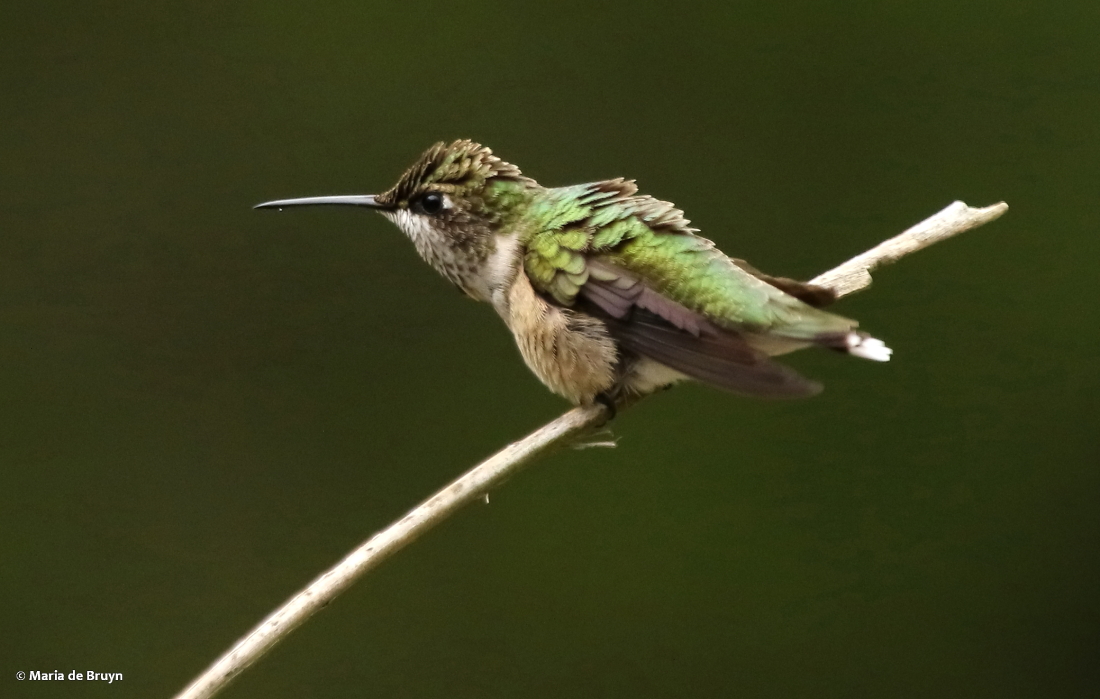
ruby-throated hummingbird DK7A0498© Maria de Bruyn (2) resAt times, we may see on Facebook or the Internet a photo or video of hummingbird nectar feeders surrounded by at least 6 and sometimes dozens of these small birds, sharing space as they take turns at imbibing some of the sweet water. Here in my part of North Carolina, however, it seems that the ruby-throated hummingbirds (Archilochus colubris) are just NOT interested in having their territory host family members or neighbors. This species is known for being territorial and those in my vicinity live up to that reputation for sure.

Both at home and in nature reserves, I’ve watched these tiny birds stake out a claim to a feeder or some choice blooms. They drink a little and then will take up a post on a vantage point where they can keep an eye out for other birds. Occasionally, the waiting spot is out in the open and often it is in a nearby shrub or tree.

ruby-throated hummingbird DK7A2402© Maria de Bruyn res ruby-throated hummingbird DK7A2298© Maria de Bruyn

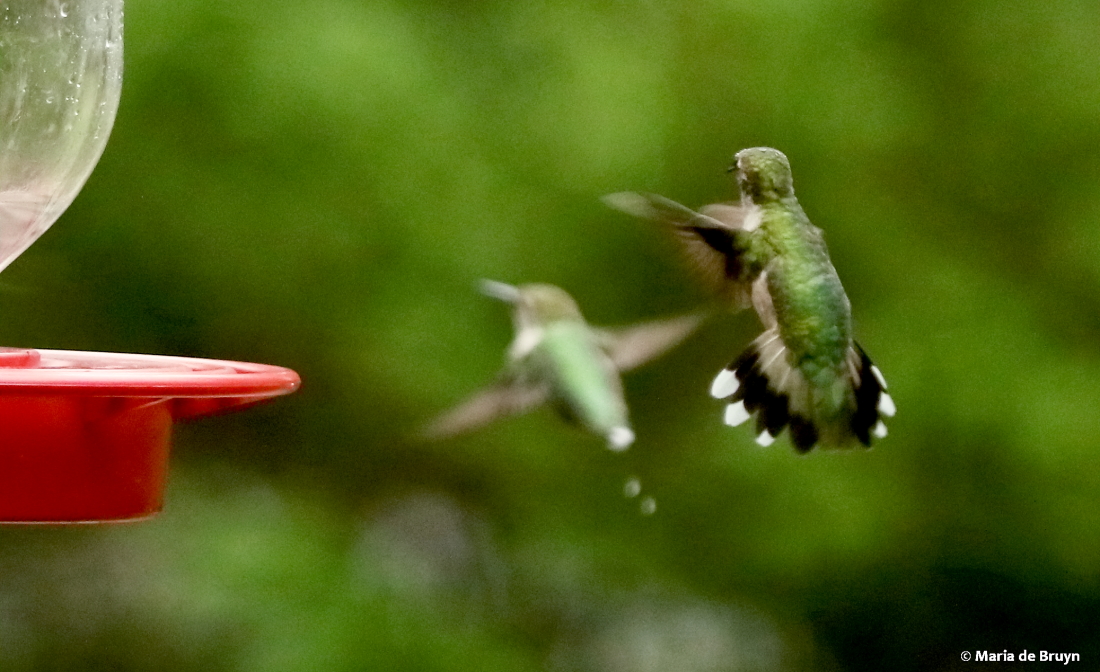
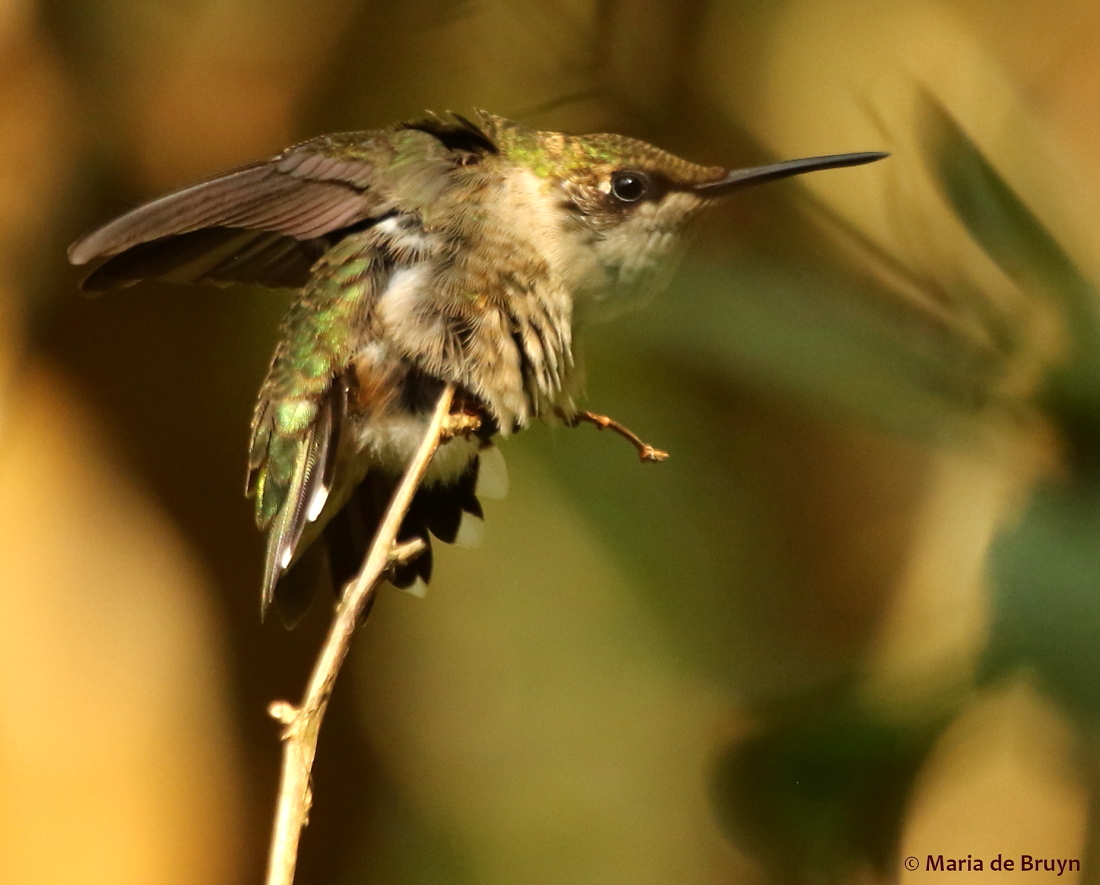
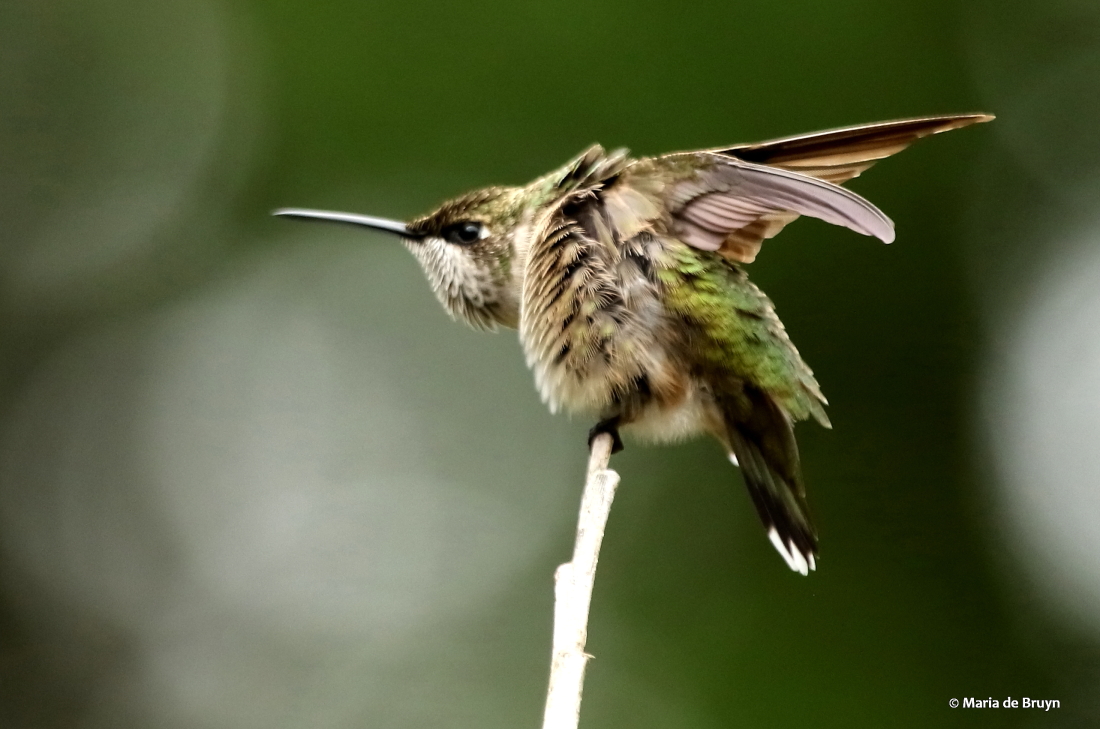
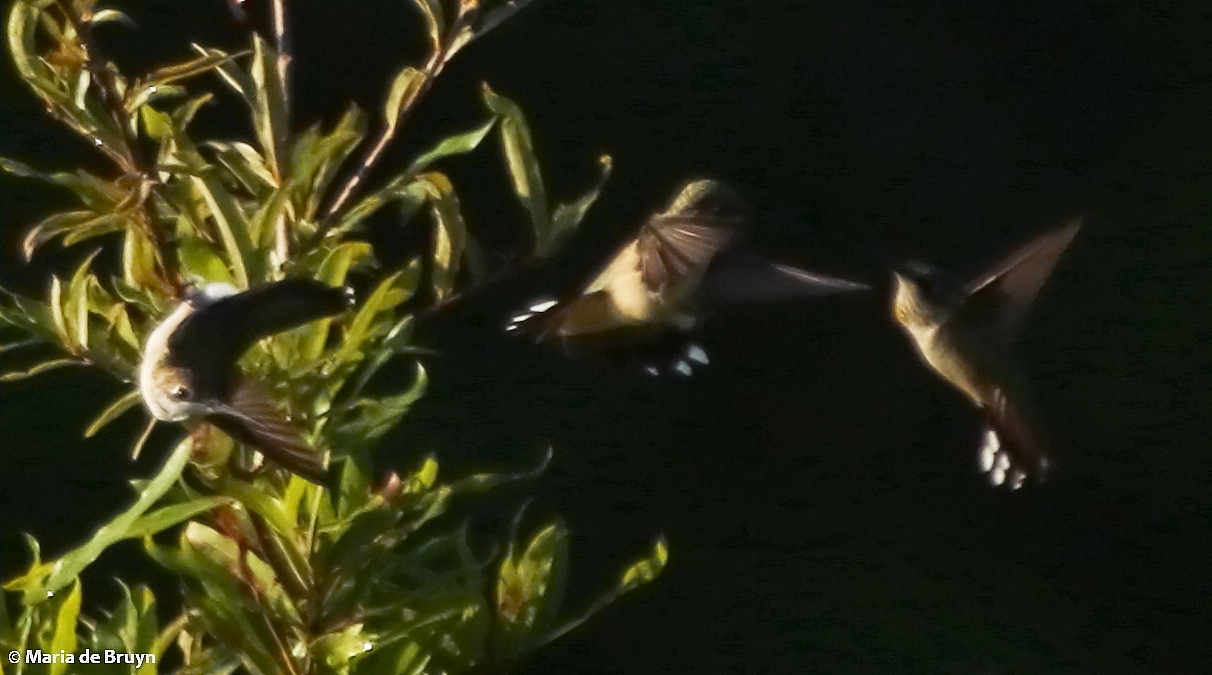
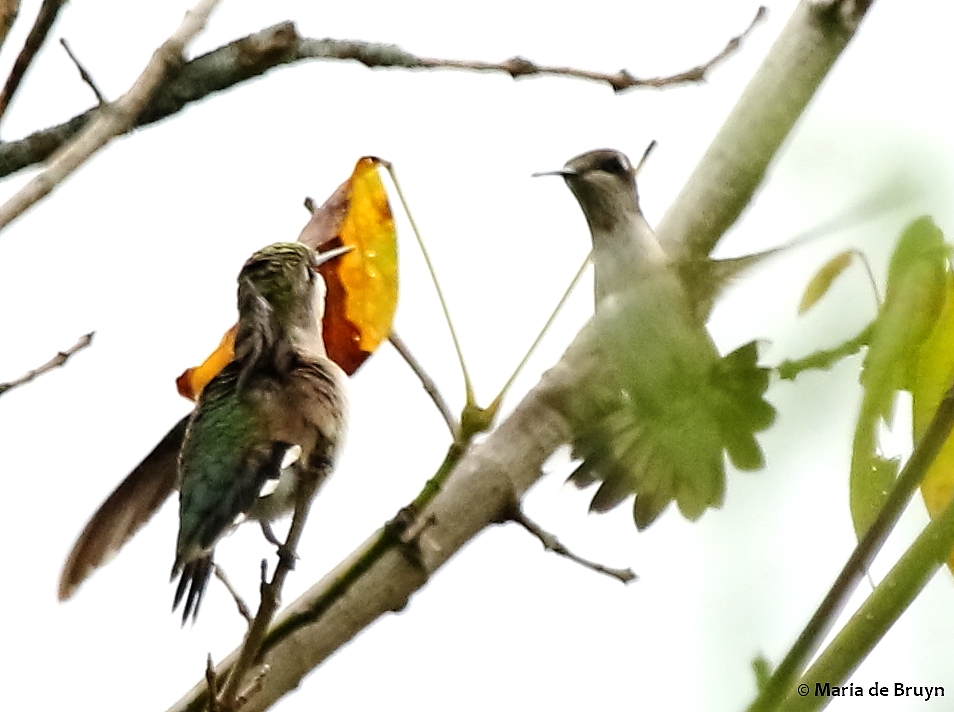
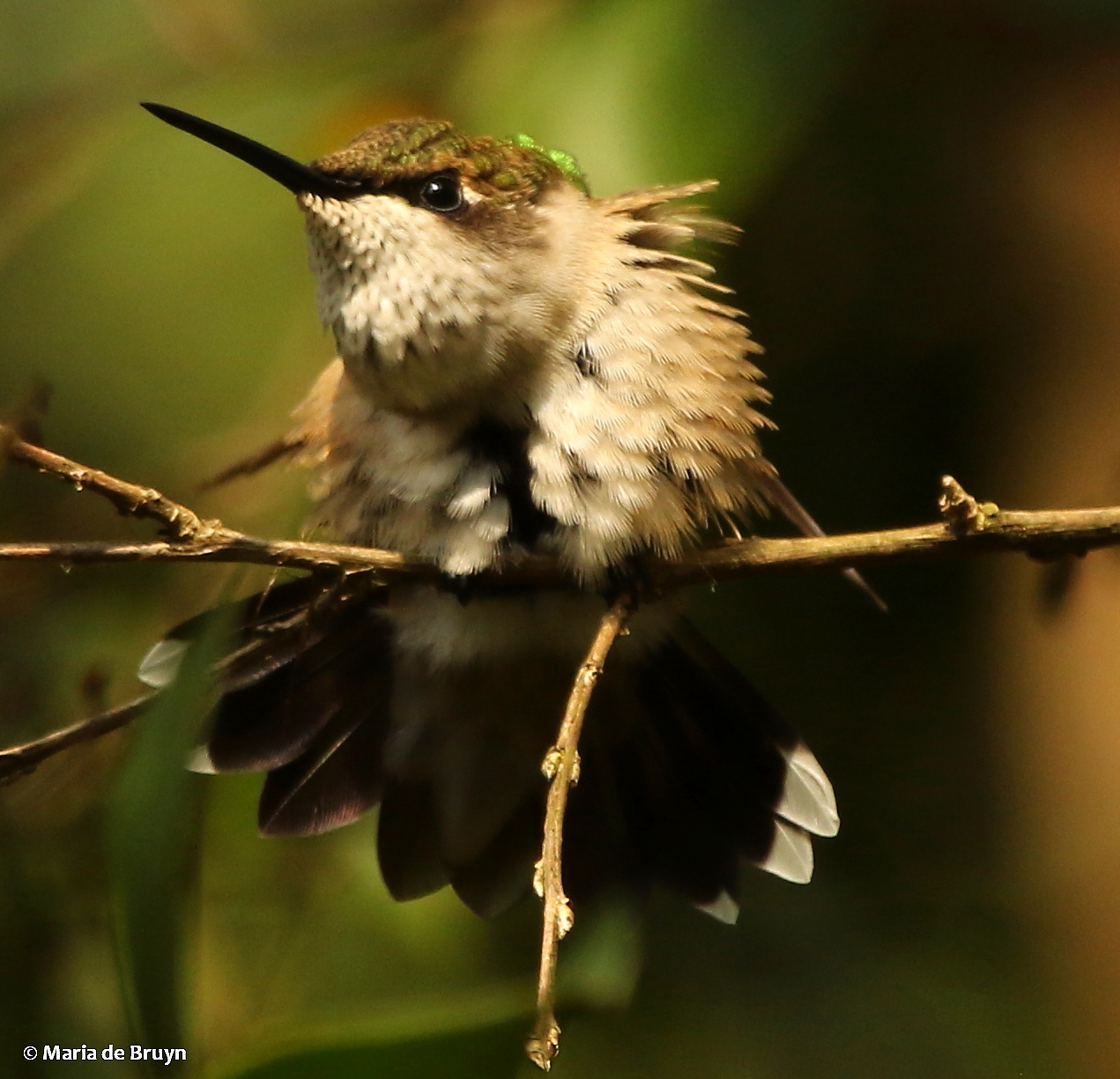
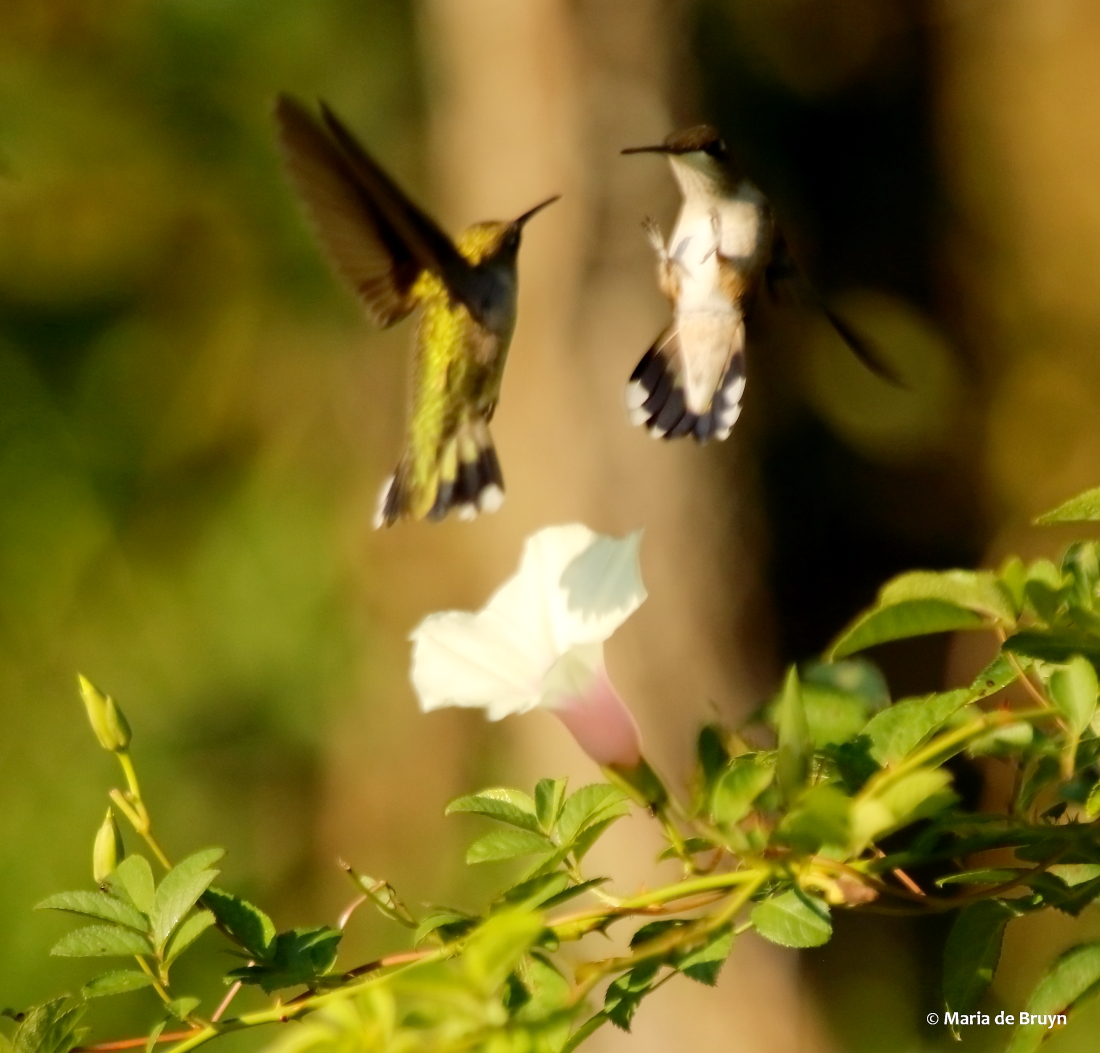
When they spot a rival approaching the food source, they may either immediately give chase or first engage in a threat display.

ruby-throated hummingbird DK7A2376© Maria de Bruyn resruby-throated hummingbird DK7A1568© Maria de Bruyn res

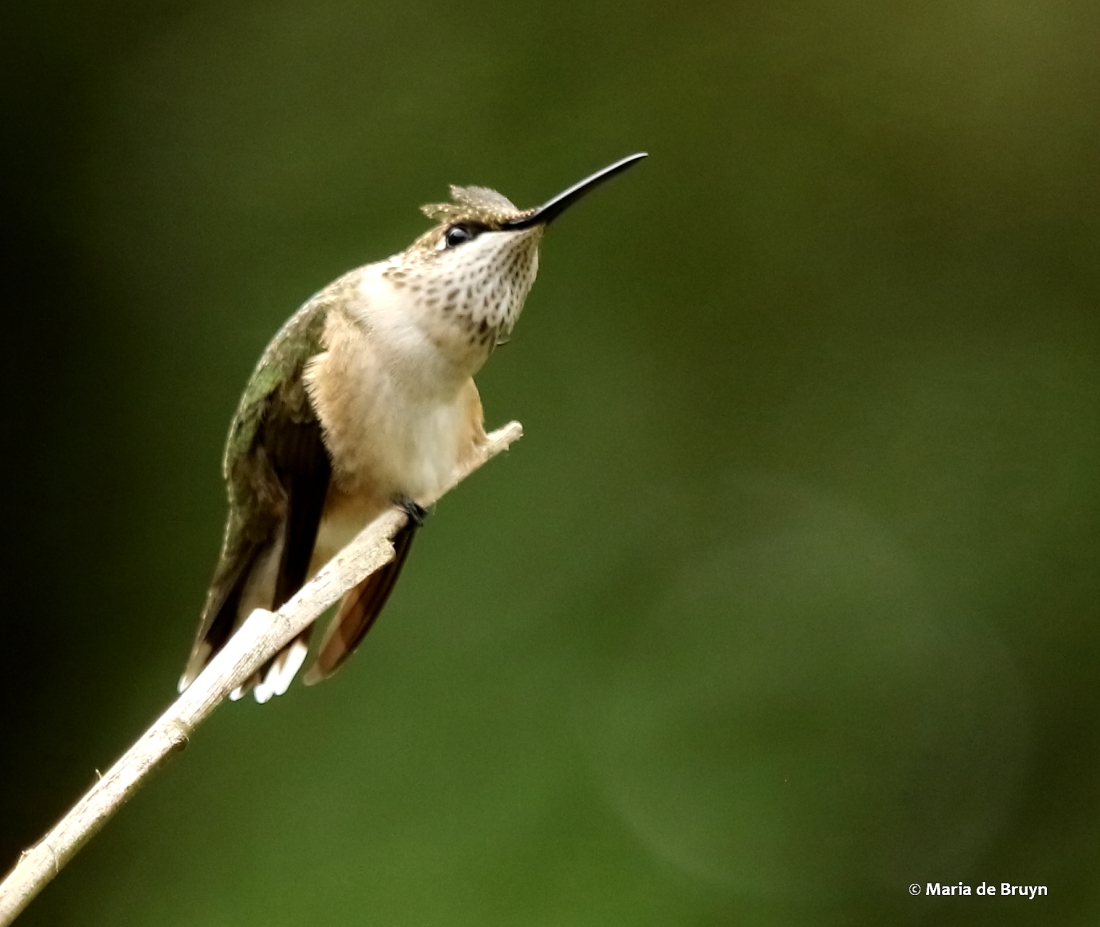
Their displays include both posturing and sound. To warn off other birds, they may chirp both quickly and loudly. Their threat postures aim to frighten away intruders by displaying size and strength and include pointing their long bills at the other bird(s), puffing up their throats, spreading and raising their wings, and flaring their tail feathers, .

ruby-throated hummingbird DK7A0712© Maria de Bruyn resruby-throated hummingbird DK7A0492© Maria de Bruyn res


ruby-throated hummingbird DK7A7307© Maria de Bruyn resruby-throated hummingbird DK7A0499© Maria de Bruyn res

ruby-throated hummingbird DK7A7353© Maria de Bruyn resruby-throated hummingbird DK7A7928© Maria de Bruyn

ruby-throated hummingbird DK7A2247© Maria de Bruyn resThey don’t really use their bills to battle as they need to protect this body part but they can fly into each other. On one occasion, in my front yard, I heard a loud thump when the two birds actually collided during a high-speed chase.

The drive to protect territory is not for lack of food. My yard has three nectar feeders out back and one in the front and three of them have at least four feeding holes. This year, a brightly colored male laid claim to the yard while the female was caring for her brood. When the female and young birds began coming to the feeders, “Red” was not pleased. Later, the young males also vied with one another.

ruby-throated hummingbird DK7A1562© Maria de Bruyn res

Chittering loudly, they sweep in to make the other birds take off; occasionally they do get a chance to have a short drink before another hummer shows up. At my house, the birds can feed because they have to patrol both the front and back yards and can’t be in two places at once.

ruby-throated hummingbird IMG_0379© Maria de Bruynruby-throated hummingbird DK7A0866© Maria de Bruyn res

I witnessed a similar scenario at the Mason Farm Biological Reserve. There was a spot with plenty of blooming trumpet vines (Campsis radicans) and morning glories (Ipomoea pandurata), which were attracting a variety of pollinators. Three hummingbirds were also visiting and, again, chasing one another from the site as soon as they caught sight of their rivals.

ruby-throated hummingbird DK7A2117© Maria de Bruyn

ruby-throated hummingbird DK7A2116© Maria de Bruyn

In an area near the Haw River where many wildflowers bloom, a similar scenario took place.

ruby-throated hummingbird DK7A9401© Maria de Bruynruby-throated hummingbird DK7A9403© Maria de Bruyn

This is the time of year when the ruby-throated hummingbirds undertake their migration to Central America, a distance of at least 1000 miles. They need to store energy for this and may double their body mass while feeding during the preparatory phase. However, it seems to me that chasing away other birds from their preferred feeding sites must take an enormous amount of energy and it seems to be an endless activity. In my yard, it goes on all day long!

ruby-throated hummingbird DK7A1828© Maria de Bruyn resThese birds’ flight muscles take up 25% of their weight; when they rest, their hearts beat at a rate of 250 beats per minute but during flight, their hearts speed up to 1220, so the zipping back and forth and up and down in hot pursuits must use lots of calories and energy. They also may hover mid-air for a while rather than sitting on an outpost twig; the other day, one of Red’s rivals spent a quarter minute suspended about 18 inches from my face, looking me over until Red dive-bombed him.

ruby-throated hummingbird DK7A2213© Maria de Bruyn resThis summer I’ve been lucky to see the hummers in several places, including Sandy Creek Park, near the Haw River and a farm cultivated by refugees from Myanmar. In all cases, the birds appeared unwilling to share their dining areas. Once in a while, though, one would have the space to him- or herself for a while and I could watch them feed, afterwards flicking out their long tongues.


ruby-throated hummingbird DK7A7940© Maria de Bruyn resruby-throated hummingbird DK7A0181© Maria de Bruyn res

When they return next year, I hope to learn more about these wonderful little birds through daily observation in my garden habitat.

ruby-throated hummingbird DK7A1673© Maria de Bruyn (2) res

More interesting information on ruby-throated hummingbirds can be found here:

http://www.rubythroat.org/rthufactsmain.html

http://www.allaboutbirds.org/guide/ruby-throated_hummingbird/lifehistory

http://www.worldofhummingbirds.com/behavior.php

Citizen science in my backyard!

Gray-headed catbird DK7A8986© Maria de Bruyn resIt’s been a while since I’ve blogged – not for lack of ideas and photos but due to a dearth of time and energy that was absorbed by multiple troubles with a few cool happenings in between. But now I’m back with some new observations about the beauty and happenings of interest in my natural world and I hope to share some wildlife sightings on a regular basis again.

One activity that I have managed to fit in amid the other goings-on was enrollment in two new (for me) citizen science projects for the Smithsonian Institute. I’m participating in an eMammal project run by the North Carolina Museum of Natural Science and in a multi-year observational study of some common birds. The mammal project is time-limited, so I will report on that in about a month’s time.

Northern mockingbird DK7A8859©Maria de BruynThe bird project will involve tracking visits to my yard by banded birds for several years to come. The target species include American robins (Turdus migratorius), Carolina chickadees (Poecile carolinensis), Carolina wrens (Thryothorus ludovicianus), house wrens (Troglodytes aedon), gray-headed catbirds (Dumetella carolinensis), Northern cardinals (Cardinalis cardinalis) and Northern mockingbirds (Mimus polyglottos, at the right), all of which come to my yard. Song sparrows are the 8th target species but I haven’t seen them at my house. However, I discovered that there is a great crested flycatcher in my trees, although I’ve never seen him (or her) either, so who knows if one will come in the future? In any case, the target birds can live from about 6-10 years on average, so I’ll have an ongoing activity for as long as my eyesight remains reasonable!

bird banding IMG_3291© Maria de Bruyn resmist net IMG_3290© Maria de Bruyn

So how does the bird banding proceed? We (the bird bander and I) set up one 12-foot and one 6-foot mist net in two parts of the yard, after the bander laid out her equipment for the banding process. Within a very short time, we caught three birds in the large net! The first was a gray-headed catbird that I recognized (photo above), because he had molted all his tail feathers at once and looks a bit odd with no tail. This bird, whom I have named Corey, has been the most vocal catbird at my feeders and he was extremely vocal about having been caught as well.

gray-headed catbird IMG_3294© Maria de Bruyn bird banding IMG_3295© Maria de Bruyn

After being disentangled – very carefully – from the net, he was put in a bag while the bander got the other two birds out of the net. Corey was measured, weighed, and banded with a combination of aluminum and colored bands. Sex was determined (I now know he is a he!) and then he was let go.

gray-headed catbird IMG_3301© Maria de Bruyn bird banding IMG_3304© Maria de Bruyn res

Northern cardinal IMG_3311© Maria de Bruyn resBird 2 was a beautiful male Northern cardinal, who appeared to have good fat reserves. He was a bit vocal and bit the bander to show his displeasure at the treatment he was receiving.

Bird 3 was a male American robin. Sex was determined partly by looking at the cloacal region (outside breeding season, other markers besides brood patches and this area are examined). If a bander is unsure of the sex, this is also marked on the data sheet. The robin was more sedate during handling than his predecessors.


American robin IMG_3314 © Maria de Bruyn resAmerican robin IMG_3315© Maria de Bruyn res

The house wrens had been calling loudly during the banding and flitted about in the trees and to the feeders,but they always flew just above the nets and were not caught. A male Carolina wren with a nice eye stripe did not escape.
house wren DK7A4794© Maria de Bruyn Carolina wren IMG_3316© Maria de Bruyn

American crow IMG_3359© Maria de BruynThe chickadees and Northern mockingbird flew about but did not really come too close to the nets. Non-target species were at or near the feeders, too, such as courting bluejays, an American crow (Corvus brachyrhynchos, right) who came to eat jelly and take some apple to his mate, downy woodpeckers, white-breasted and brown-headed nuthatches, a house finch, Eastern towhees and a male cowbird.

red-bellied woodpecker IMG_3344© Maria de Bruyn resOther non-target birds flew into the large mist net, however, such as a brown thrasher, a tufted titmouse, a red-bellied woodpecker (Melanerpes carolinus, right), a chipping sparrow (Spizella passerina), a female common yellowthroat (Geothlypis trichas, below) and a common grackle. I’d not seen these birds up so close before, so that was really a nice experience.

Common yellowthroat IMG_3339© Maria de Bruyn res


bird banding IMG_3340© Maria de Bruyn resTo get more target species, a loudspeaker that played bird calls and some model birds were placed in the grass by the largest net. Eventually, two more catbirds were caught – with other catbirds in a nearby tree puffing themselves up to show their shared distress. These were the first catbirds banded for the project so far, so that was a nice way to end the exercise.

Cope's tree frog IMG_3293© Maria de Bruyn resA tour of the yard to see if there were any nests that could be followed for the Nest Watch project revealed a couple wren nests in boxes that were built up so high it was not possible to see if they had eggs in them. The bluebirds’ nest has five eggs that I will follow through fledging (hopefully); a catbird nest is too high up for me to see how many eggs she is sitting on but I will watch for her fledglings, too. And a Cope’s tree frog (Hyla chrysoscelis) had taken up residence in the nest box that the downy woodpecker uses to rest at night. The wrens had begun building a nest in that box last night and the frog was gone this afternoon.
The banding took place yesterday in the morning and in the afternoon, the banded birds had not returned. I wonder how long it will take most of these individuals to come again. Corey already returned this afternoon, instantly recognizable not only because of his very short tail feathers growing in but because of the red and silver bands on his little legs. I was so glad to see he was none the worse for wear!

A tiny bundle of yellow-feathered joy

ruby-crowned kinglet IMG_1148©Maria de Bruyn resWhile ospreys are one of my favorite large birds, the gorgeous ruby-crowned kinglet (Regulus calendula) has won my heart among my tinier feathered friends. Today I’m sharing some portraits of kinglets made the past couple months (in my yard and at Bolin Creek greenway in Chapel Hill, Jordan Lake woods, Sandy Creek Park in Durham).

One of the more active small birds (about 4 incruby-crowned kinglet IMG_5278© Maria de Bruyn reshes or 10-11 cm long), this kinglet is in almost constant motion, which makes getting good portraits a bit of a challenge. Despite this high level of activity, however, research has shown that the ruby-crowned kinglet only uses up to 10 kcal a day in energy. (Sometimes I think this holds true for me as well as the weight I want to lose just stays in place.)


ruby-crowned kinglet IMG_7952© Maria de Bruyn resTheir main diet consists of insects, including spiders, ants, wasps, beetles and aphids. They will also occasionally eat seeds, fruit and sap.

In addition, these kinglets – or at least the one that has been visiting my yard during migration the past couple years – also love suet a lot.

The ruby-crowned kinglet is known for its habit of flicking its wings as it forages for food; this helps it scare up insects (another bird that uses its wings in its hunt for food, like Northern mockingbirds and snowy egrets).


ruby-crowned kinglet IMG_4238© Maria de Bruyn resruby-crowned kinglet IMG_1631© Maria de Bruyn res

Ruby-crowned kinglet IMG_2653©Maria de Bruyn res


Though they don’t look as adept as hummingbirds, they sometimes hover to get at insects on the underside of leaves; they show this hovering behavior at feeders, too, before landing or flying off with a piece of suet snatched in flight..

ruby-crowned kinglet IMG_2760 MdB res2Most of the time, the male’s beautiful little red crest (which gives the species its name) remains hidden unless it gets excited about something.
ruby-crowned kinglet IMG_2762 MdB res2
Ruby-crowned kinglet 2 IMG_1149©Maria de Bruyn res


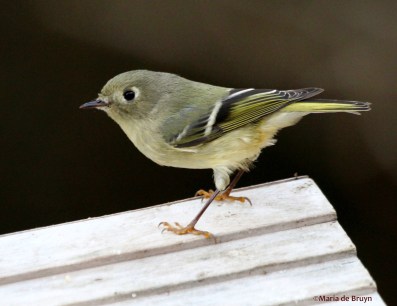
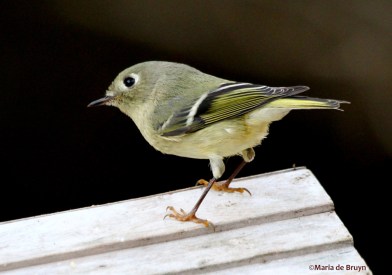
The ruby-crowned kinglet seems to me to have an expression of perpetual wonderment as it flits quickly from one spot to another. Its thin little legs with yellow-red feet help it land securely, on a branch, wire or feeder.

ruby-crowned kinglet IMG_0633©Maria de Bruynruby-crowned kinglet IMG_4076© Maria de Bruyn res

ruby-crowned kinglet IMG_0617©Maria de Bruyn resIn my pursuit of portraits, I’ve found that just as I think I have the bird in focus, it has disappeared from my viewfinder and I need to look up and around to locate it again..Given its diminutive size, one wouldn’t expect that the female lays up to 12 – twelve! – eggs in its nest, which is elastic and can expand as the brood grows. The male and female stay together until the chicks fledge at about 2 months and they will defend the nest against intruders.
ruby-crowned kinglet IMG_4075© Maria de Bruyn resruby-crowned kinglet IMG_4074© Maria de Bruyn res

ruby-crowned kinglet IMG_8928© Maria de Bruyn2 resSometimes, I hear the chittering call before I see the tiny wonder and only very rarely get to enjoy its longer song, which apparently varies according to region.

Ruby-crowned kinglets can live up to at least 4½ years (as shown by a banded bird). I don’t actually know if there is more than one bird visiting me or whether another will take its place in time.

ruby-crowned kinglet IMG_0102©Maria de Bruyn resWhat is very cool for me is that my visitor can become very friendly indeed. Last year, on two occasions, I was carrying a replenished suet feeder outside when the kinglet flew in to perch on it as I held the feeder in my hands – giving me a great close-up view. I look forward to seeing if the kinglet will favor me with an up-close-and-personal meeting again this coming winter!ruby-crowned kinglet IMG_0639©Maria de Bruyn res