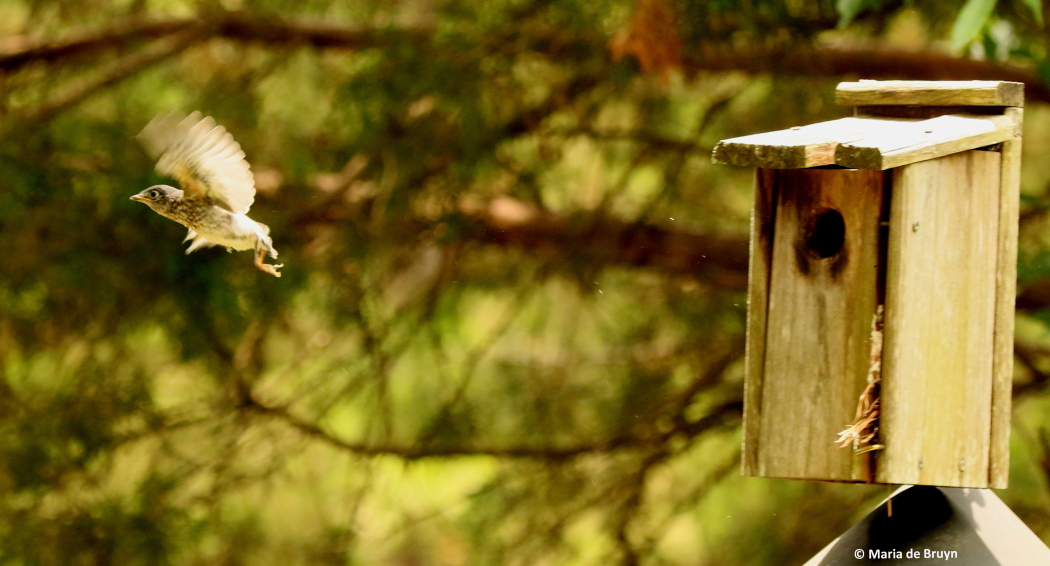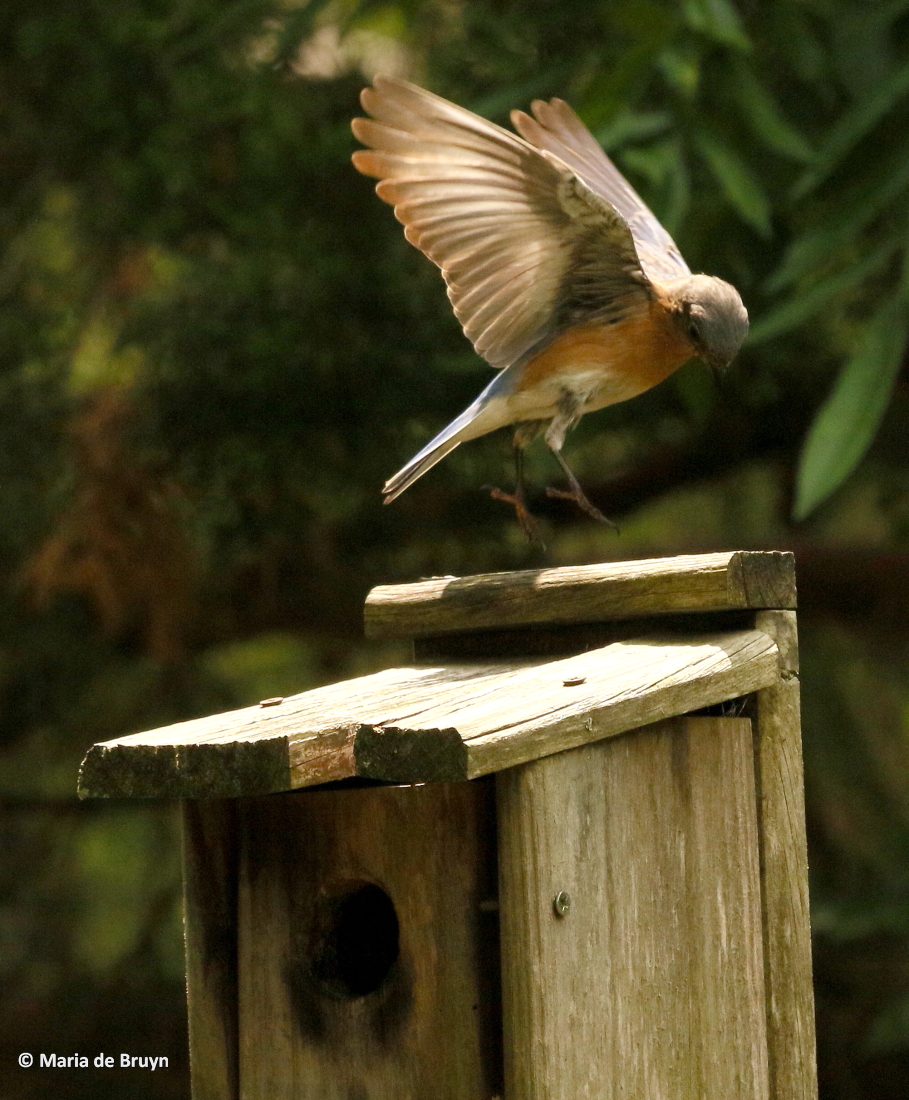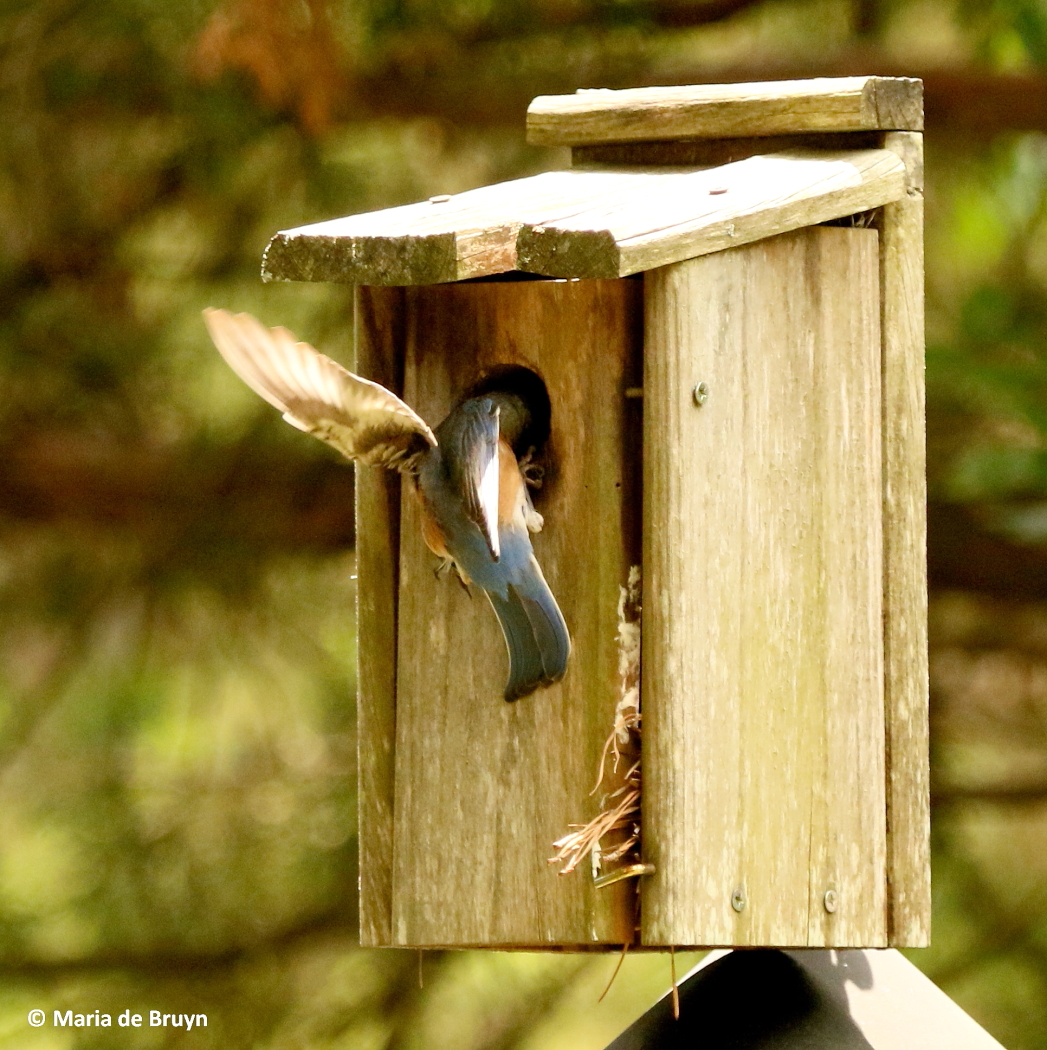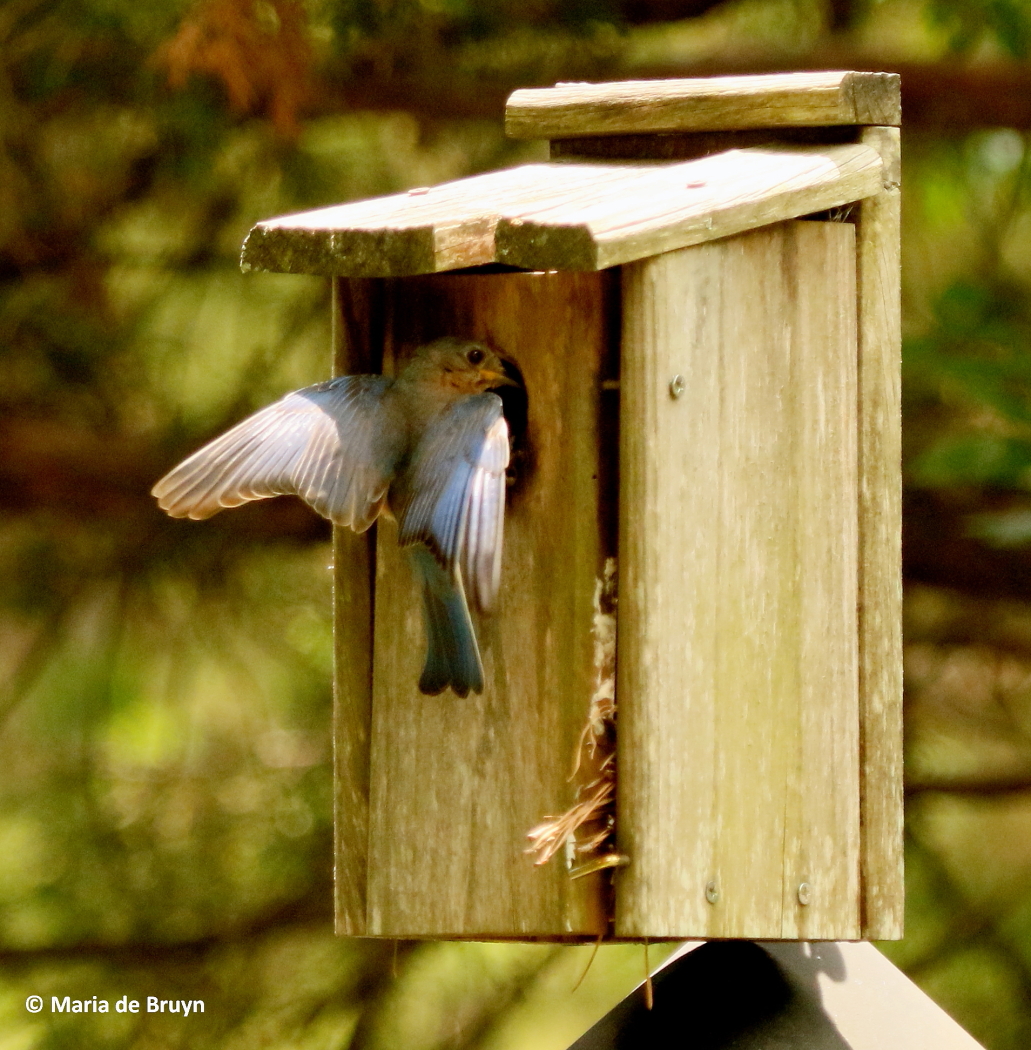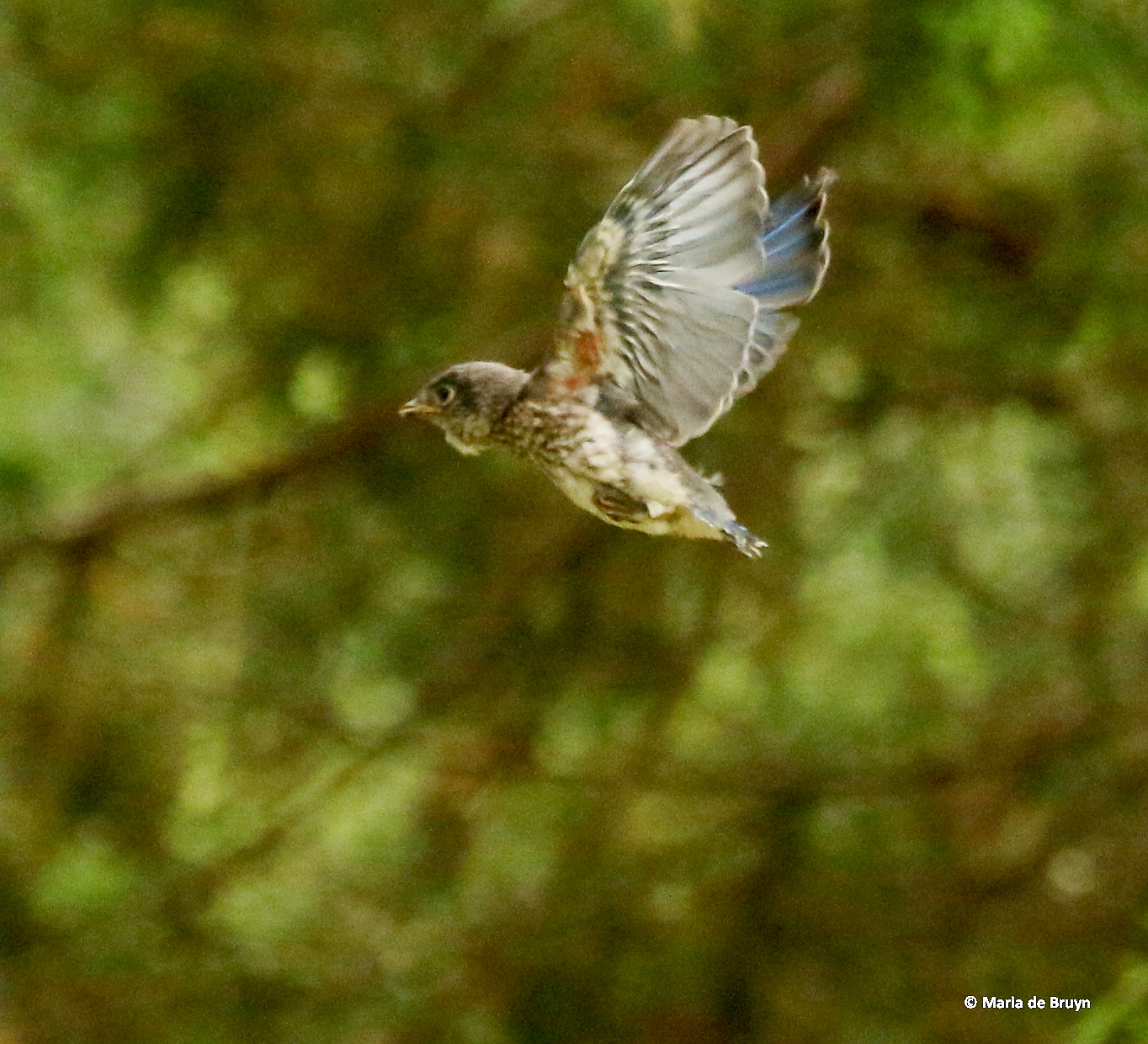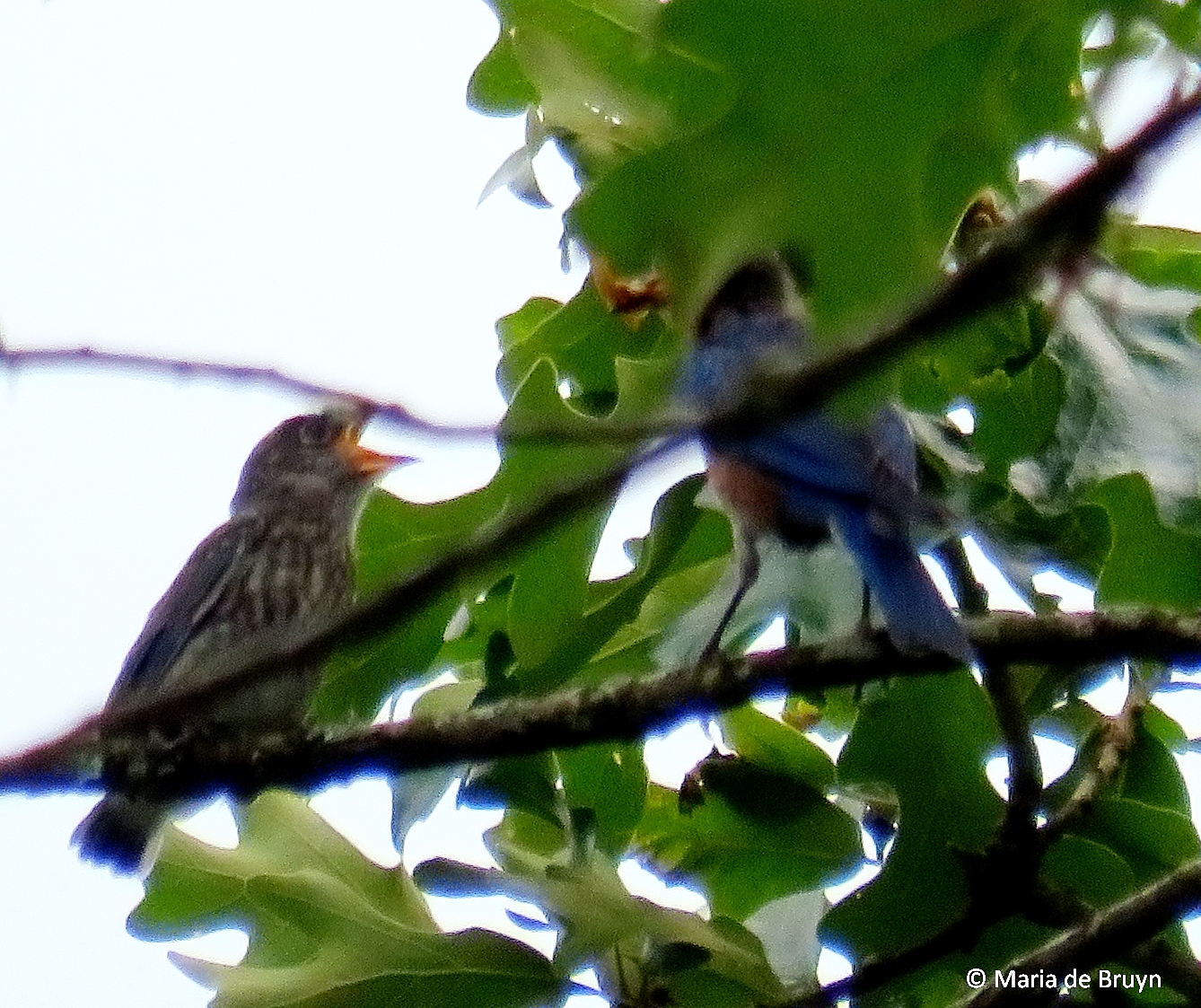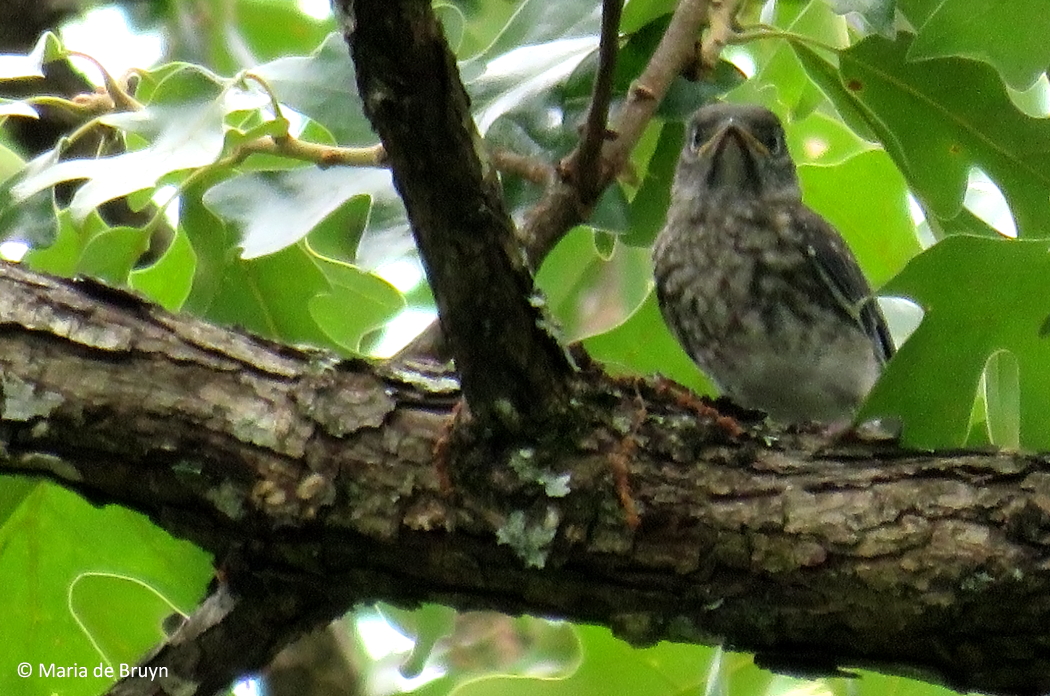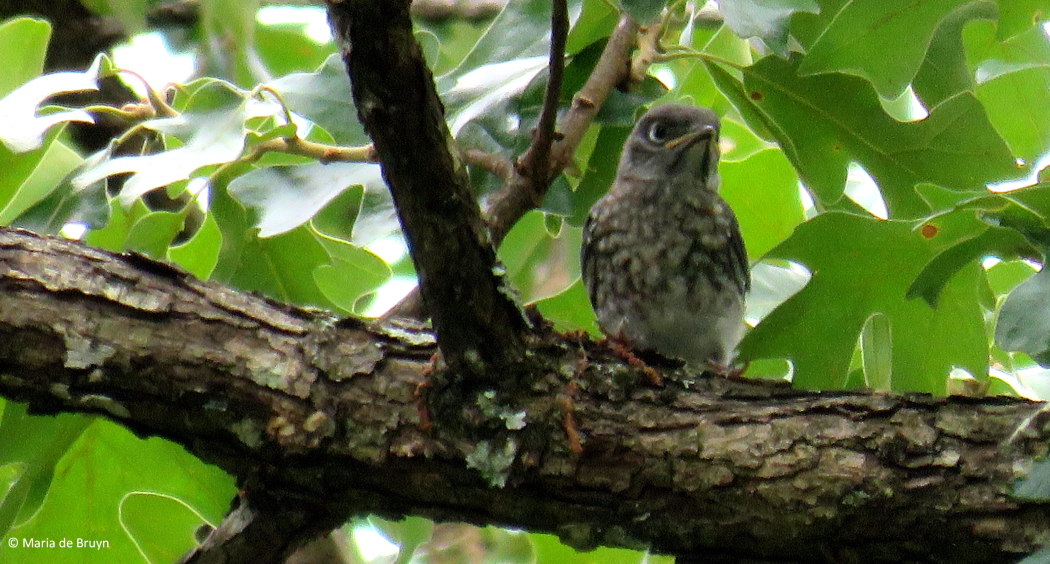
Braeburn Farm is for the birds!

I don’t often get the chance to visit a farm (other than organized farm tours, which are a bit pricey and then might be crowded). Last year, I was invited to one during an annual llama shearing, which was educational. This year, however, I’ve had the chance to visit Braeburn Farm four times so far because the owner and manager have decided to make it a nature reserve as well as a cattle farm. Nick, the land manager, is a birder who is more than willing to share his knowledge with the visitors.

pond I77A6227© Maria de Bruyn res

My first visit to this farmland/nature reserve was in the early spring to see Wilson’s snipes at one of the five ponds. By late June, these birds had moved on but the ponds were now harboring mallards (Anas platyrhynchos), red-winged blackbirds (Agelaius phoeniceus), belted kingfishers (Megaceryle alcyon) and killdeer (Charadrius vociferous).

mallard duck I77A7320© Maria de Bruyn res     red-winged blackbird I77A6920© Maria de Bruyn res

belted kingfisher I77A6936© Maria de Bruyn (2)   killdeer I77A6934© Maria de Bruyn res

My quest to see green herons at one pond was unsuccessful, but my 20-minute walk there was accompanied by the non-stop screaming of a red-tailed hawk (Buteo jamaicensis), who called both from tree tops and the air as she circled overhead.

red-tailed hawk I77A6030© Maria de Bruyn res   red-tailed hawk I77A6044© Maria de Bruyn res

A non-native bird who might greet you as you come down the road near the farm manager’s home is a helmeted guineafowl (Numida meleagris), the sole survivor of a neighbor’s flock. This bird now comes to visit the domestic chickens (Gallus gallus domesticus) at Braeburn, perhaps seeking some companionship in addition to the easily available chicken feed.

helmeted guineafowl I77A5648© Maria de Bruyn res    chicken I77A6958© Maria de Bruyn (2)

chicken I77A6949© Maria de Bruyn resThe farm chickens are in a large pen while other chickens run free, including one with a wild hairdo.

A trio of wild turkeys left the woods and entered a field during one of my visits but they were at a considerable distance; still, I could say I had seen them that day! The Eastern meadowlarks (Sturnella magna) have often been visible at a distance in the fields, but on my last visit I saw one a bit closer on a fence post, giving me the chance to enjoy its beautiful plumage.


Eastern meadowlark I77A8597© Maria de Bruyn    Eastern meadowlark I77A5898© Maria de Bruyn

Eastern kingbird I77A5683© Maria de Bruyn res


Eastern kingbirds (Tyrannus tyrannus) can be seen in many of the fields and on wires. They take advantage of the ponds to snag dragonfly meals and the dry grasses provide materials for nests.


Eastern kingbird I77A7653© Maria de Bruyn        Eastern kingbird I77A7099© Maria de Bruyn res

They also pose very prettily on the shrubbery!

Eastern kingbird I77A7007© Maria de Bruyn   Eastern kingbird I77A6380© Maria de Bruyn res

grasshopper sparrow I77A7118© Maria de Bruyn res


The grasshopper sparrows (Ammodramus savannarum) are numerous, which was lovely for me as this species was a lifer for me. If you approach on foot, they fly off, but Nick said they are so used to his motorized cart, they stay put as he chugs on by!


grasshopper sparrow I77A6976© Maria de Bruyn res      grasshopper sparrow I77A5738© Maria de Bruyn res

Savannah sparrow I77A8690© Maria de Bruyn res


In the spring, when we had gone to see the snipes, we were lucky to see savannah sparrows (Passerculus sandwichensis) running about in the grass (I had at first thought we were seeing field mice scurrying about).


orchard oriole I77A7271© Maria de Bruyn resIn June, a pair of orchard orioles (Icterus scpurius) had built a nest in a tree bordering one pond and I was excited to see two babies just days before they fledged. The father was feeding them and brought one baby a large cricket, which seemed to be too large for it swallow easily. Dad tried to help by pushing it down but when I left, the insect was still sticking out of baby’s mouth and its sibling was still hungry, too.

orchard oriole I77A7475© Maria de Bruyn res

orchard oriole I77A7510© Maria de Bruyn    orchard oriole I77A7500© Maria de Bruyn

barn swallow I77A7161© Maria de Bruyn resThe barn swallows (Hirundo rustica) adopted an abandoned barn as their hotel of choice. When I visited in June, the young had just been fledging; they and their parents were circling the barn and resting on fences nearby, showing off their beautiful colors.

In July, a few stragglers remained in nests. Some that had taken the great leap were hanging around outside, even clutching the barn wall.

barn swallow I77A7062© Maria de Bruyn res        barn swallow IMG_4527© Maria de Bruyn

barn swallow I77A7145© Maria de Bruyn res

barn swallow I77A7139© Maria de Bruyn res

Others were enjoying the view on a wire line, together with some purple martins.

barn swallow I77A6990© Maria de Bruyn res

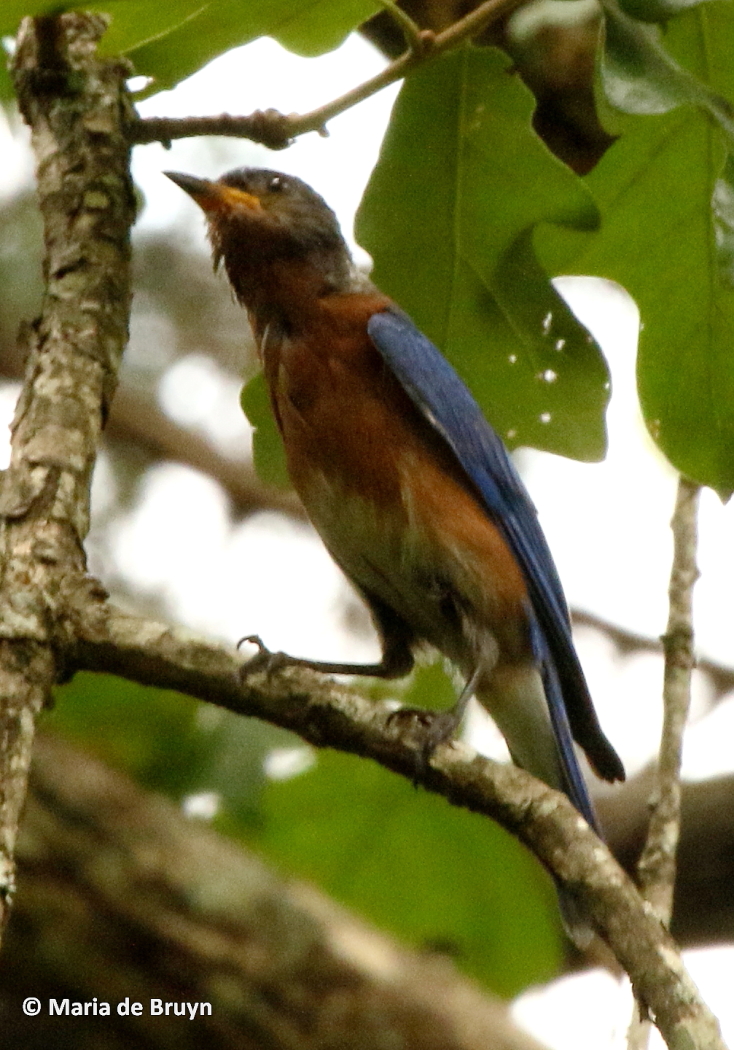
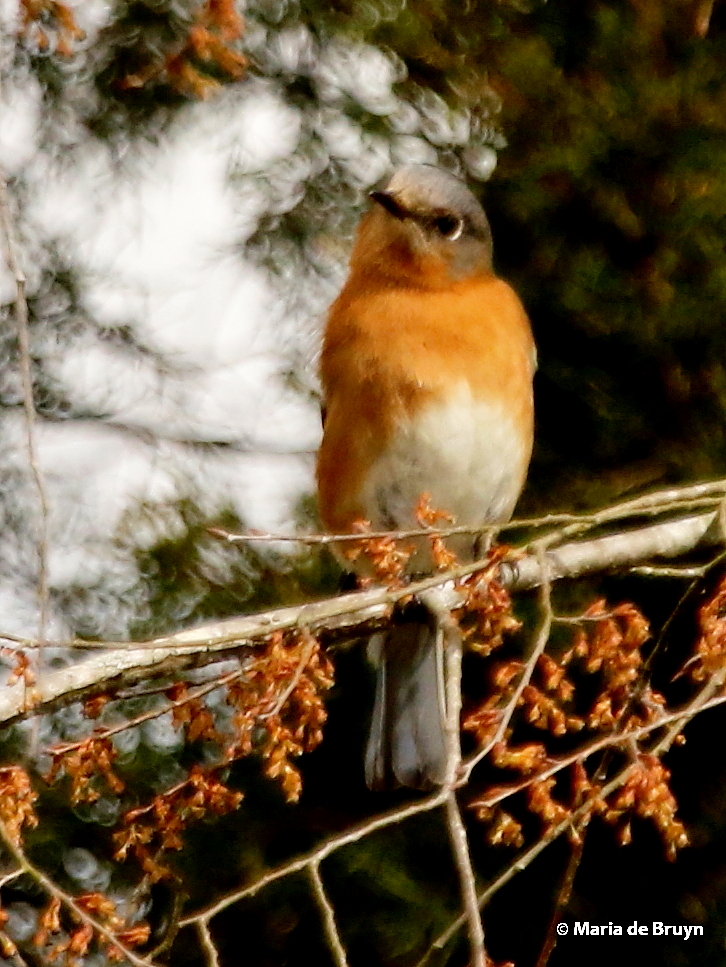
The fence posts and other farm structures offer resting places for various birds, like the Eastern wood peewee (Contopus virens), chipping sparrow (Spizella passerina), house finches (Haemorhous mexicanus) and Eastern bluebirds (Sialia sialis).

Eastern wood-peewee I77A6694© Maria de Bruyn res    Eastern wood peewee I77A6675© Maria de Bruyn res

chipping sparrow I77A6665© Maria de Bruyn res   house finch I77A6529© Maria de Bruyn res

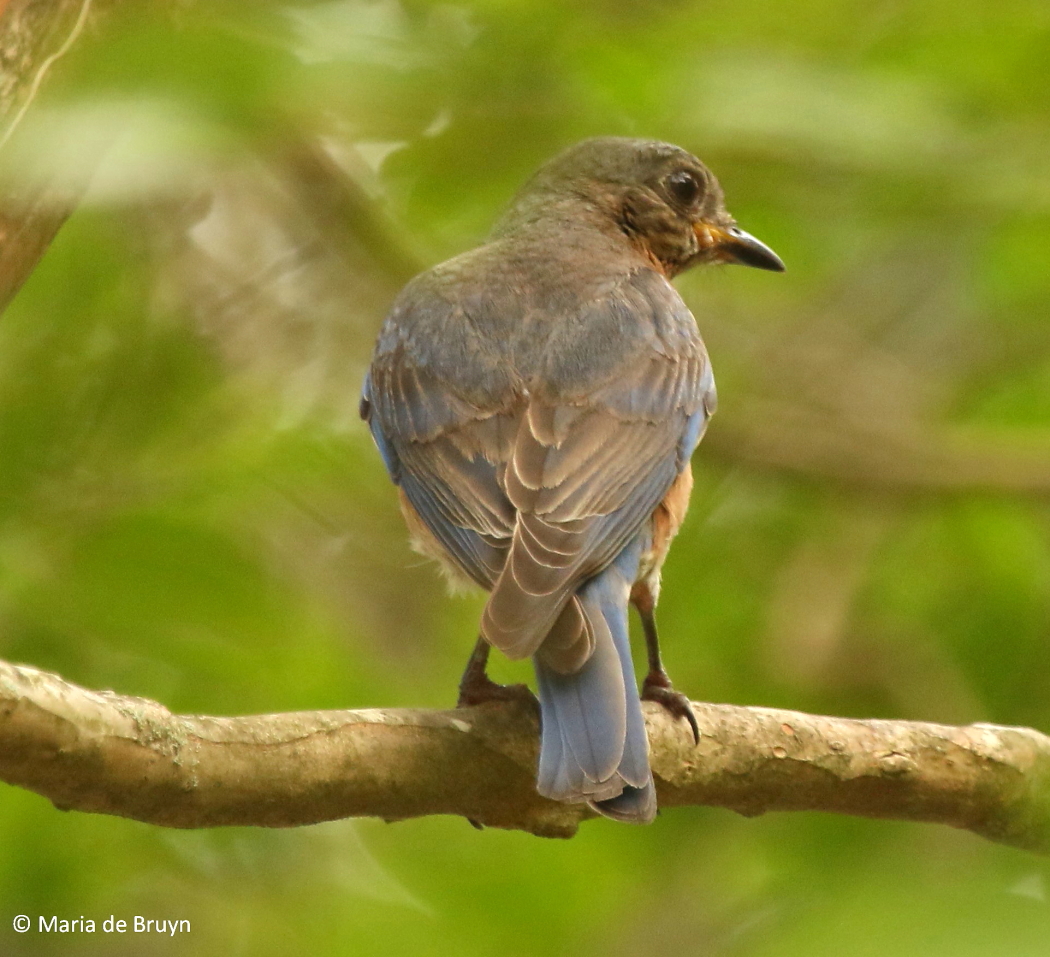
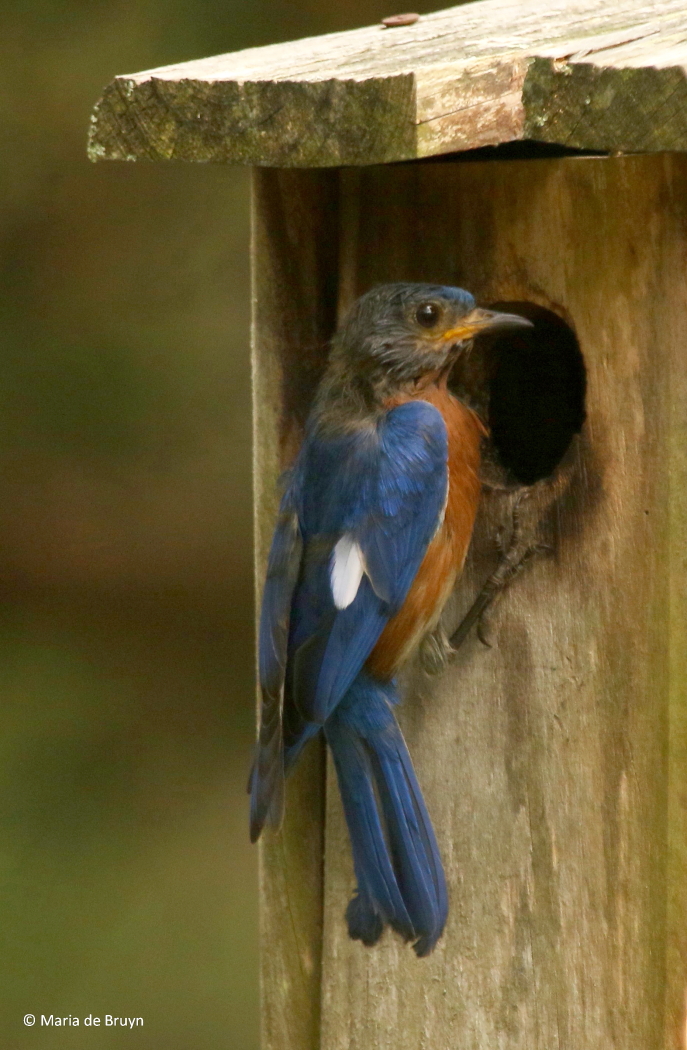
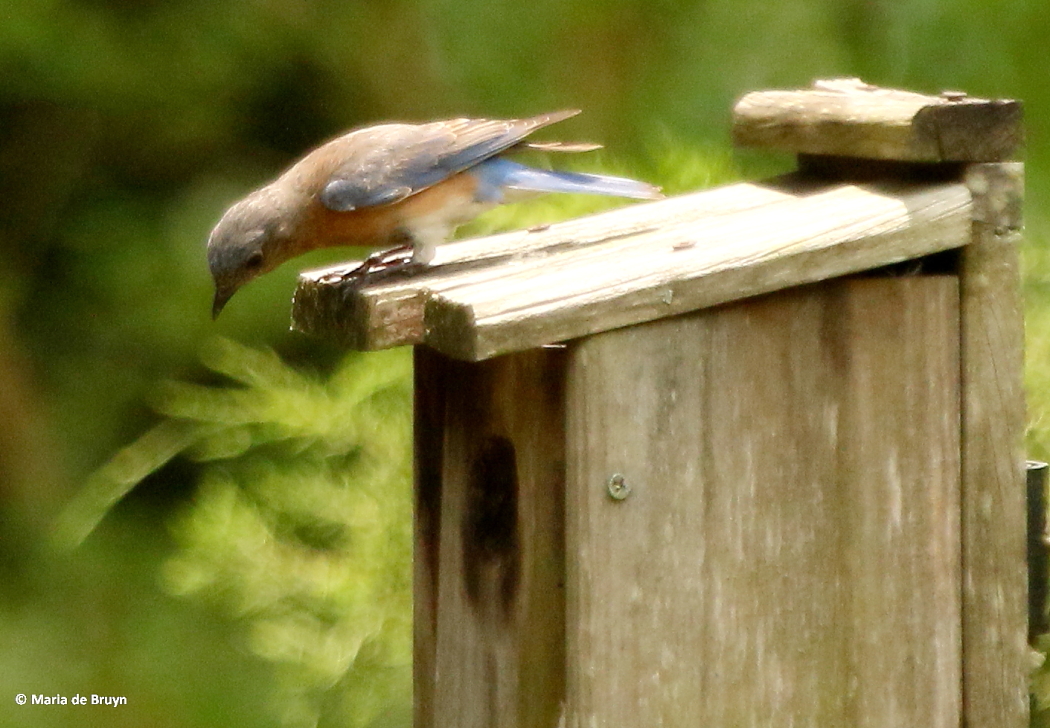
Eastern bluebird I77A5859© Maria de Bruyn res  Eastern bluebird I77A5847© Maria de Bruyn res

turkey vulture I77A7105© Maria de Bruyn res


The turkey vultures (Cathartes aura) take advantage of the cattle’s well-water stations to get a drink, but then may retire to a tree branch for a bit of sunning. Nick likes them better than the black vultures, who had killed a newborn calf when its mother wasn’t taking care of it.


turkey vulture I77A7107© Maria de Bruyn res    turkey vulture IMG_4469© Maria de Bruyn res

Northern mockingbird I77A7669© Maria de Bruyn res


Other birds, like the Northern mockingbirds (Mimus polyglottos) and great-crested flycatchers (Myiarchus crinitus) enjoy the view from the vantage of high branches in trees.


great-crested flycatcher I77A7199© Maria de Bruyn res     great-crested flycatcher I77A7193© Maria de Bruyn res

While the 500-acre farm is mostly advertised in relation to its beef and opportunities to hold events such as receptions there, the farm management is now increasingly promoting it as a place for wildlife observation as well. The biodiversity in birds, mammals, insects, reptiles and plants is wonderful and my next blog will focus on examples of the non-avian wildlife to be seen there. If you’d like to visit the farm, do contact them!

Birds and blooms at Sandy Creek Park – more of the “good ones”

moon I77A9993© Maria de Bruyn res

Birds are a favorite photographic subject of mine, even though catching them in late spring and summer is challenging when the lush foliage offers them many places to hide. Their songs and calls and warbles tell me that they are there, but often I need to wait quite a while until I finally catch a flutter of movement out of the corner of my eye to locate them.


white-eyed vireo I77A0007©Maria de Bruyn

One early morning, when the moon was still in the sky, I was fortunate enough to see a lot of fluttering in trees near the park’s parking lot – and I discovered an immature white-eyed vireo (Vireo griseus) with a parent who looked as if she or he was really practicing forbearance.

white-eyed vireo I77A0010©Maria de Bruyn      white-eyed vireo I77A0006©Maria de Bruyn

Carolina wren I77A0188©Maria de Bruyn res

Nearby, a Carolina wren (Thryothorus ludovicianus) was singing loudly; these little avians have an outsized voice so that you can hardly miss them even when they are hidden behind leaves.

A handsome male goldfinch (Spinus tristis) was in a field, while a female was visiting the coneflowers (Echinacea), of which there were various species in the cultivated butterfly garden.


American goldfinch I77A0382©Maria de Bruyn res American goldfinch I77A0177©Maria de Bruyn res

coneflower I77A7325© Maria de Bruyn res      coneflower I77A6365© Maria de Bruyn res   coneflower I77A6250© Maria de Bruyn res

Eastern bluebird I77A6188© Maria de Bruyn res


Other birds were busy finding insect meals, like the male, female and immature Eastern bluebirds (Sialia sialis).


Eastern bluebird I77A6022© Maria de Bruyn res    Eastern bluebird I77A5558© Maria de Bruyn res

Common grackle I77A6377© Maria de Bruyn res


The common grackle (Quiscalus quiscula) scored a meal, while the pine warbler (Setophaga pinus) and blue-gray gnatcatcher (Polioptila caerulea) were busy in the trees searching for caterpillars and insects.

Other birds (and mammals, I think) had been getting crayfish from the ponds but I guess there were so many that they only ate the tastiest parts.

Pine warbler I77A5605© Maria de Bruyn res   Pine warbler I77A5598© Maria de Bruyn


blue-gray gnatcatcher I77A0302©Maria de Bruyn res     crayfish IMG_4926©Maria de Bruyn res

The American robins (Turdus migratorius) were looking for earthworms on the ground, and the song sparrows (Melospiza melodia) alternated between the ground and shrubs in their search for food.

American robin IMG_0550© Maria de Bruyn res     song sparrow I77A6195© Maria de Bruyn

The male red-winged blackbirds (Agelaius phoeniceus) were calling and flying from shrub to shrub, showing off their handsome black plumage with a red highlight.

red-winged blackbird I77A6090© Maria de Bruyn res  red-winged blackbird I77A6126© Maria de Bruyn res

Over at a nearby pond, the Northern rough-winged swallows (Stelgidopteryx serripennis) were swooping over the water and then sharing space on a snag; meanwhile, a mother wood duck (Aix sponsa) led her brood along the shoreline.

rough-winged swallow I77A0234© Maria de Bruyn res    wood duck I77A7225© Maria de Bruyn

In a tree beside another pond, the immature great blue herons (Ardea herodias) were still at their nest at the start of June; later in the month, they were no longer hanging out there.

great blue heron IMG_0430© Maria de Bruyn res   great blue heron IMG_0402© Maria de Bruyn res

milkweed I77A0079©Maria de Bruyn res


Botanists can have a great time at Sandy Creek, too. The milkweed plants in the butterfly garden attract both butterflies and bees.

Carolina horsenettles (Solanum carolinense) are common but pretty little plants, while the orange jewelweed (Impatiens capensis) enjoys a good reputation as having stem juice that relieves the pain caused by poison ivy for many people.

Carolina horsenettle I77A5581© Maria de Bruyn res      orange jewelweed I77A0511© Maria de Bruyn res

The fairywand (Chamaelirium luteum) grows profusely on the edges of Sandy Creek ponds and the swamp rose (Rosa palustris) sprouts near them as well.

fairywand I77A7293© Maria de Bruyn res      swamp rose Rosa palustris I77A5621© Maria de Bruyn res

Japanese honeysuckle I77A5711© Maria de Bruyn res


Japanese honeysuckle (Lonicera japonica), an invasive plant, attracts pollinators but so does the more vibrant and native coral honeysuckle (Lonicera sempervirens L.).


coral honeysuckle I77A0159© Maria de Bruyn res      coral honeysuckle I77A0127© Maria de Bruyn 2 res

In the fields, you can see lovely brown-eyed Susans (Rudbeckia) and coreopsis.

Brown-eyed Susan IMG_0504© Maria de Bruyn res  brown-eyed Susan IMG_0497© Maria de Bruyn res


coreopsis flower IMG_0494© Maria de Bruyn res   coreopsis flower IMG_0486© Maria de Bruyn res

Stoke's aster I77A6353© Maria de Bruyn resThe cultivated garden in the park gets plenty of color from the Stoke’s asters (Stokesia laevis) and red bee balm (Monarda didyma), which is a real magnet for hummingbirds. I recently bought a couple for my home garden and was rewarded with seeing the hummers visit them within 2 days.


red bee balm I77A7307© Maria de Bruyn res    red bee balm I77A6390© Maria de Bruyn res

What makes my walks so interesting is discovering new species. A native grass (Bromus) was lovely; helpful facebook group members gave me suggestions for possible species but we couldn’t narrow it down. The group also helped me identify a plant that I hadn’t seen before, a Germander (Teucrium canadense).

grass Bromus IMG_4811© Maria de Bruyn res   Germander Teucrium canadense I77A0544© Maria de Bruyn res

I managed to find an ID myself for a common flower that seems to grow all over the place – the Asiatic dayflower (Commelina communis). It is considered an invasive plant and is on the watch list for North Carolina, but I have to say that I find it quite attractive. Each flower blooms for only one day and to me they look like little faces and make me smile. And so I continue learning as each new walk invariably ends up teaching me something new. Enjoy your day!

Asiatic dayflower Commelina communis I77A0667© Maria de Bruyn res    Asiatic dayflower I77A0677© Maria de Bruyn res

Leaping into the wide – and sometimes wet – world!

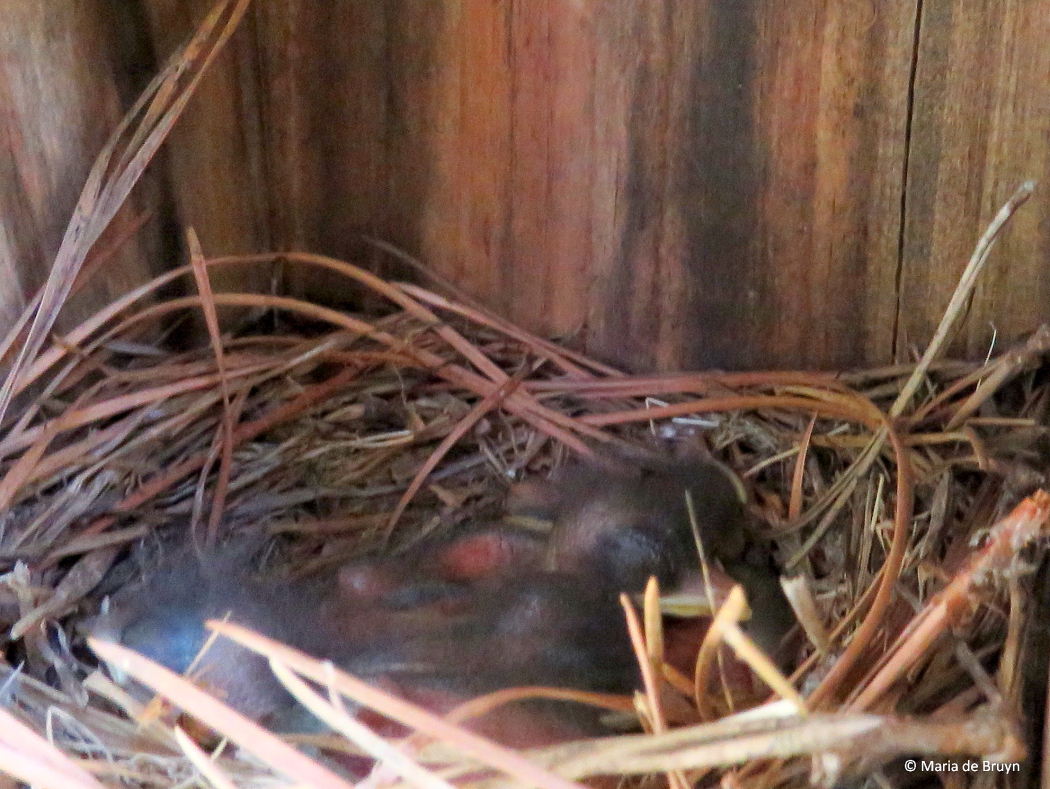
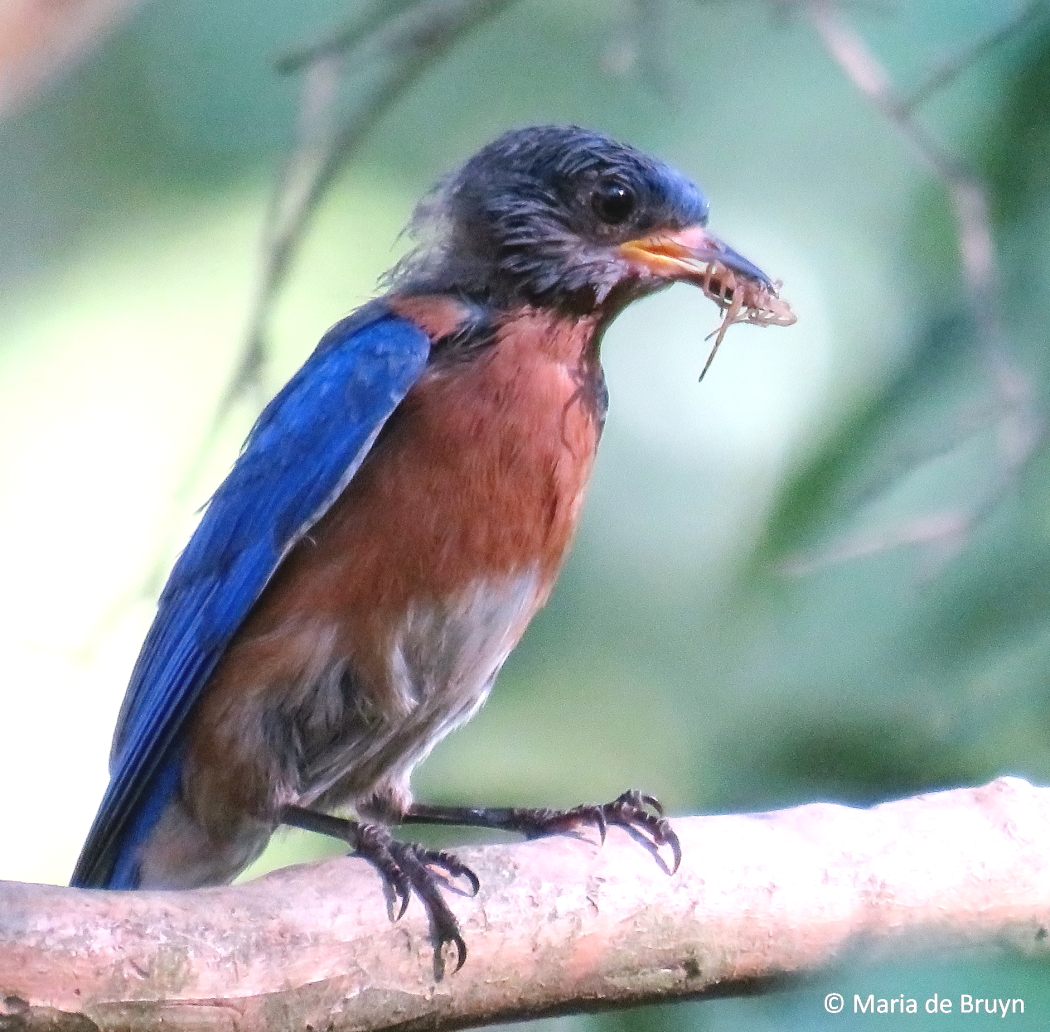
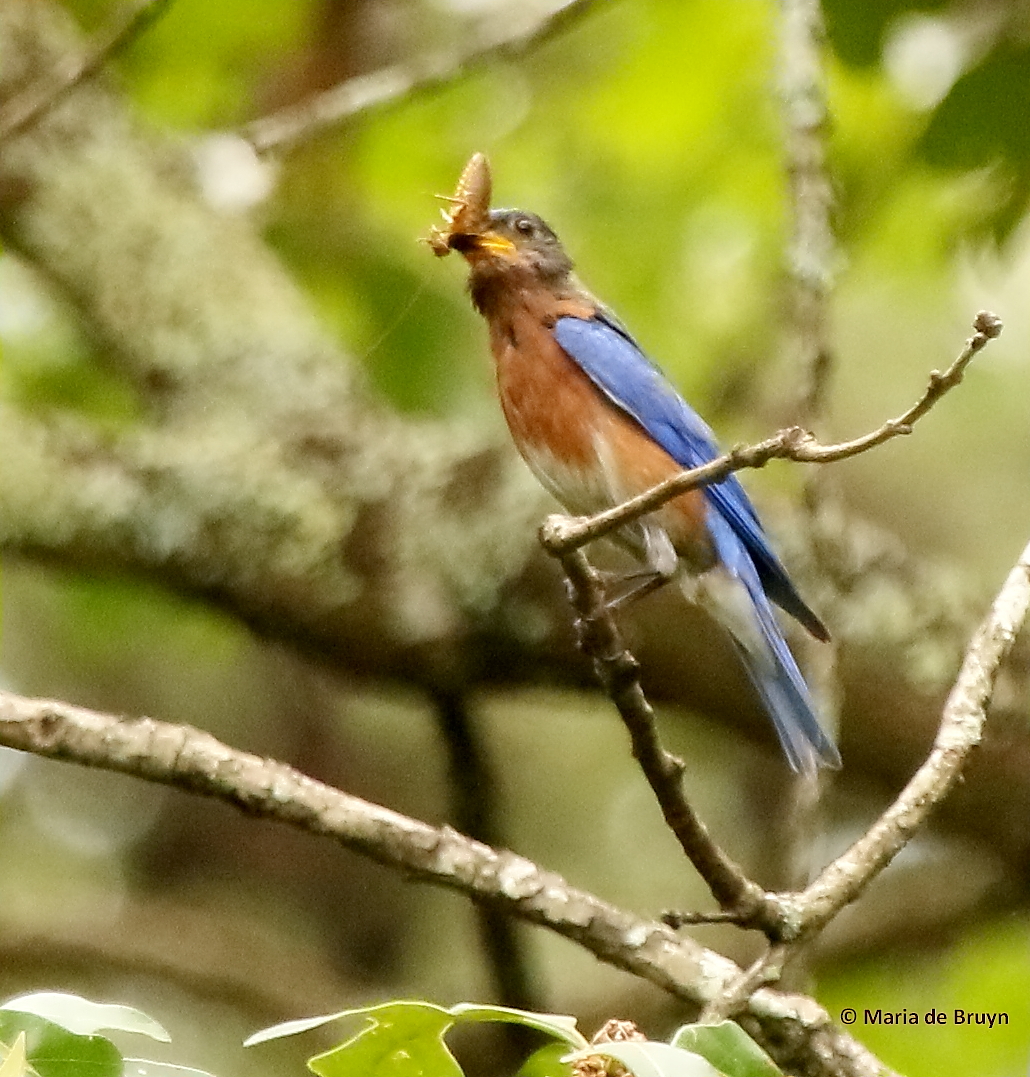
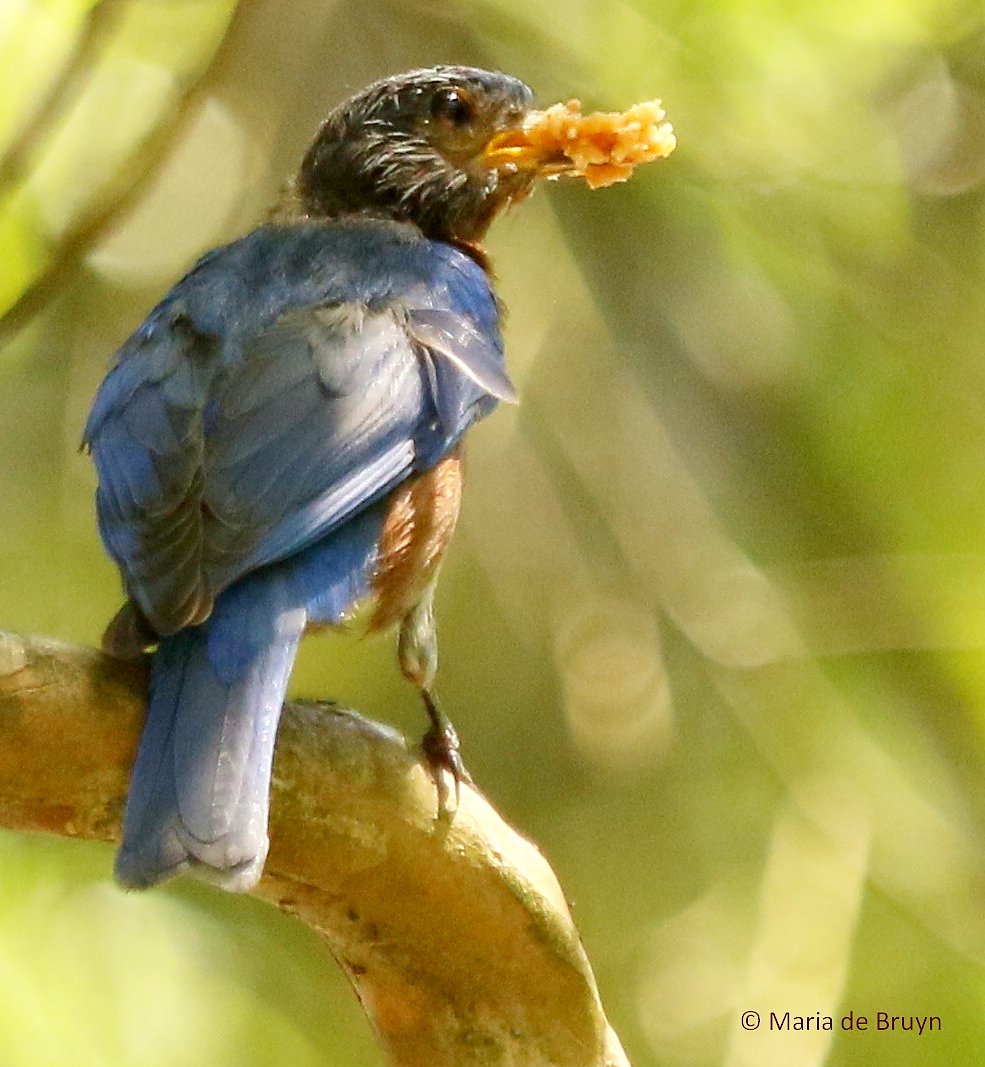
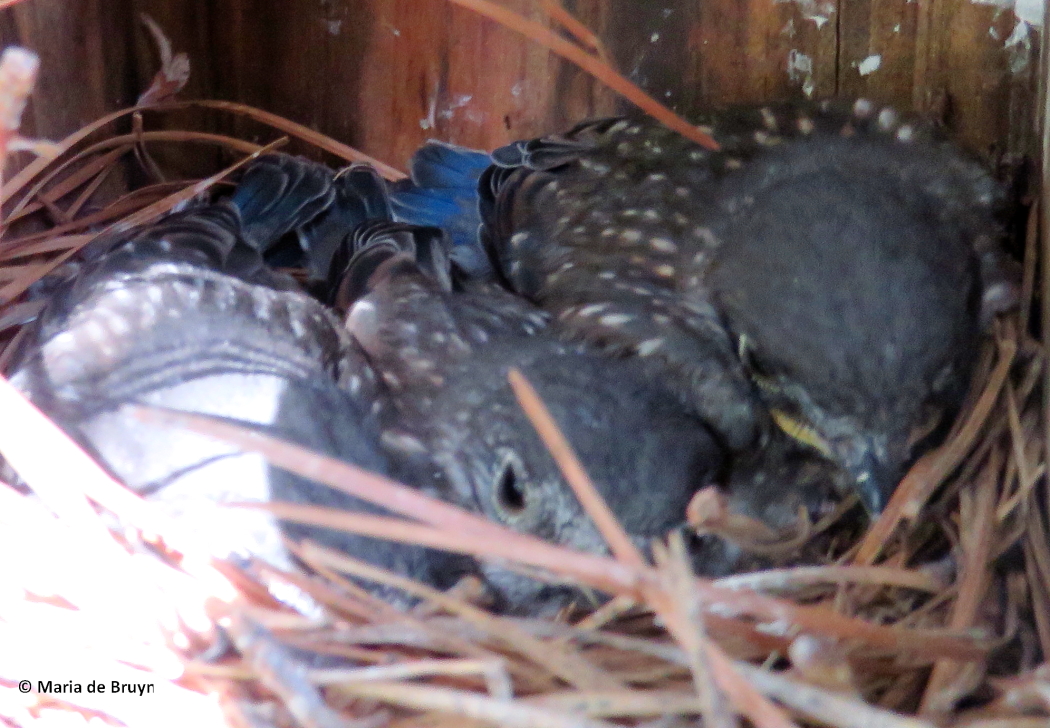
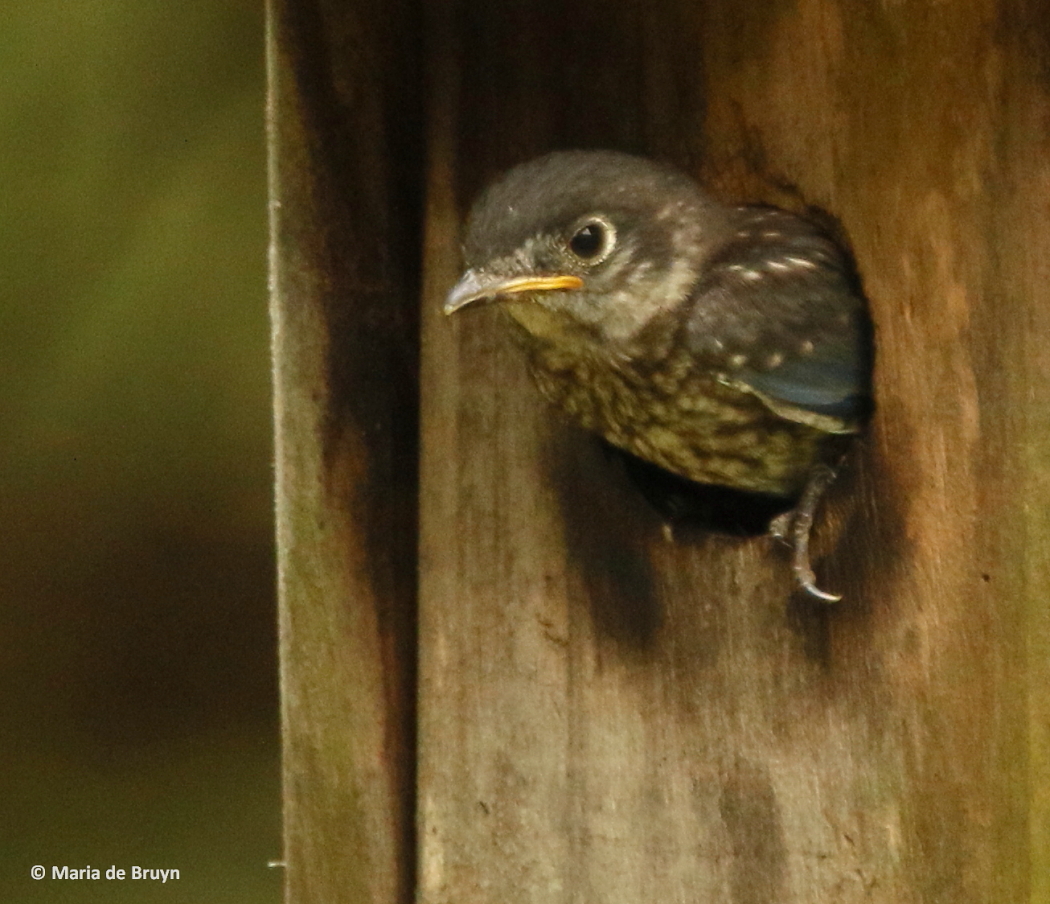
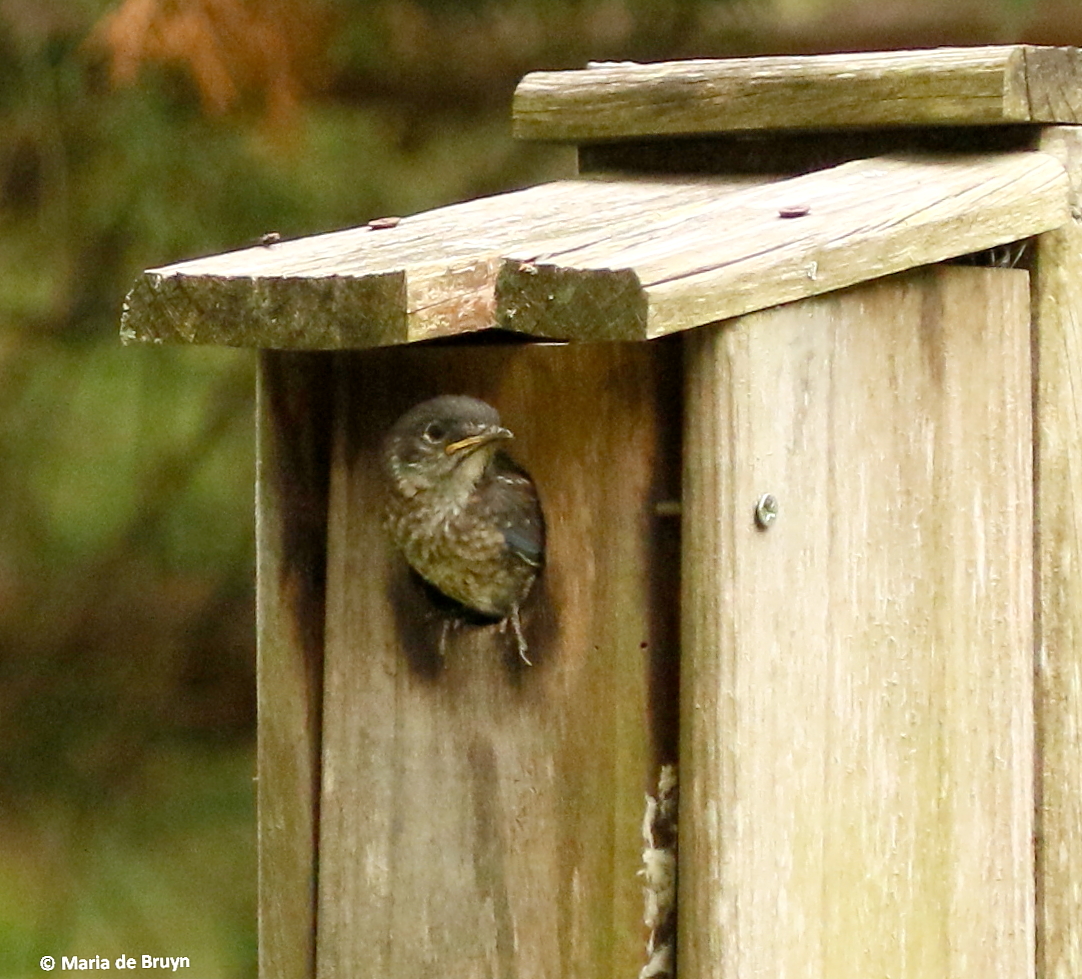
Eastern bluebird IMG_2991© Maria de Bruyn resEarlier this past week, I calculated that the Eastern bluebird (Sialia sialis) babies in my front-yard nest box were close to fledging. I knew approximately when mom had finished laying her eggs (four in total), so that I could guess when they reached normal fledging age (16-18 days after hatching). When I looked at the nest on 10 June, I saw that there were only three babies; I have no clue what happened to egg No. 4.  But the three survivors were progressing well as mom and dad made frequent forays to gather caterpillars and insects for them.

Eastern bluebird IMG_2819© Maria de Bruyn res Eastern bluebird I77A5733© Maria de Bruyn res

Eastern bluebird I77A8417© Maria de Bruyn

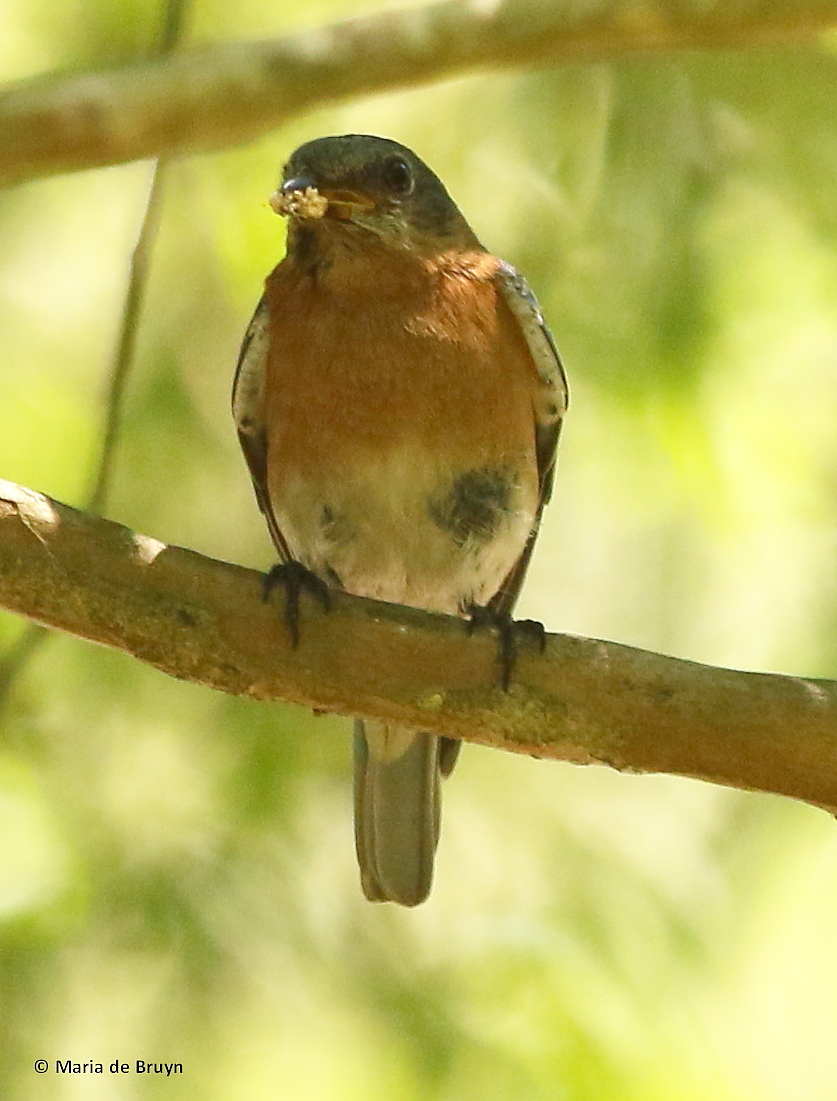
Occasionally, the male and also the female bluebird, identifiable by her subtler coloring and her brood patch, would visit the suet and meal worm feeders for a fast food repast for themselves. It was hard work keeping their growing offspring fed!

Eastern bluebird I77A6411 © Maria de Bruyn         Eastern bluebird I77A5769© Maria de Bruyn

They also had to let one of their older offspring from a previous brood know that they were no longer going to feed him, even when he begged.

Eastern bluebird IMG_1509© Maria de Bruyn res

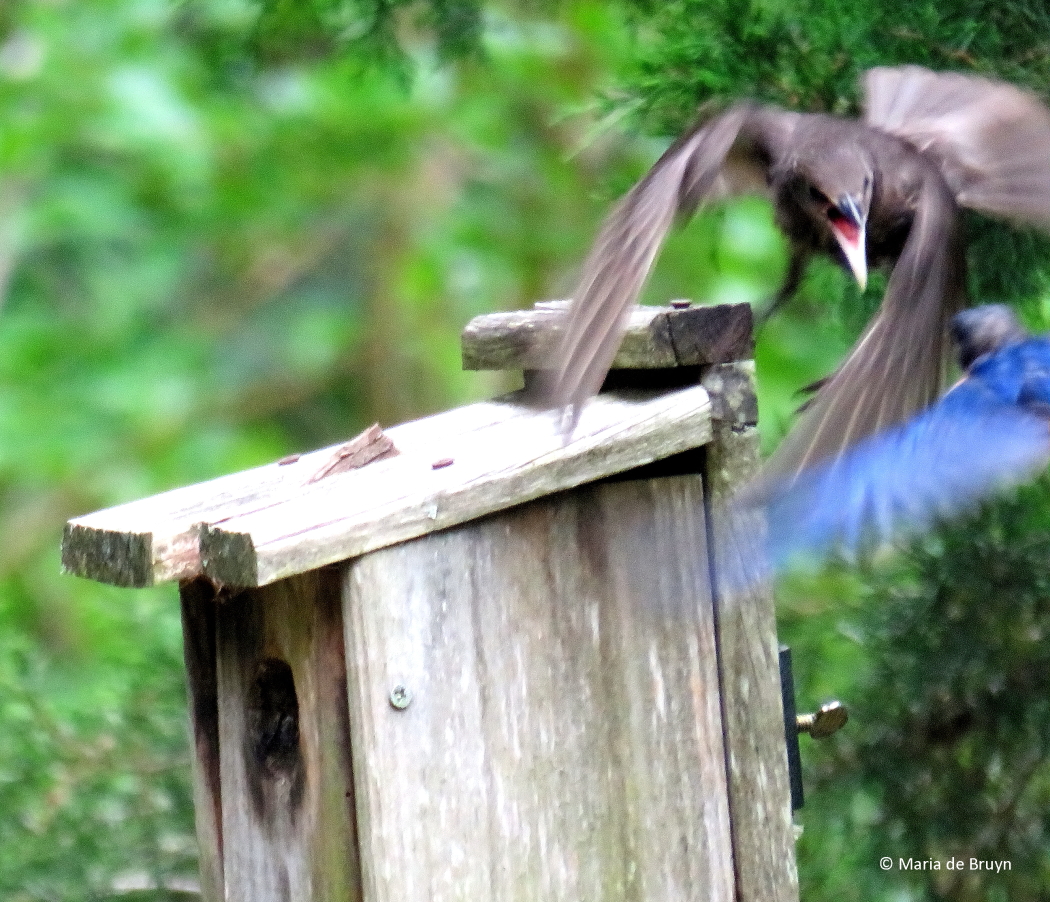
As fledging time neared, mom and dad had to contend with other birds coming near the box. Dad was especially angry with a young starling (Sturnus vulgaris) who wanted to settle on top of the box. Starlings have been known to eat young birds and papa bluebird was obviously taking no chances! (I just caught the action out of the corner of my eye so the photos aren’t great but do give an idea of the argument!). The parents also chased away squirrels from the tree in front of the box, which alerted me to the fact that fledging was probably imminent since the parents become especially protective at this time. I started using a smaller camera with a very long zoom (but somewhat lesser photo quality) as they weren’t excited by me being too close either.

Eastern bluebird IMG_3841© Maria de Bruyn res     Eastern bluebird IMG_3840© Maria de Bruyn res

Eastern bluebird IMG_4618© Maria de Bruyn res

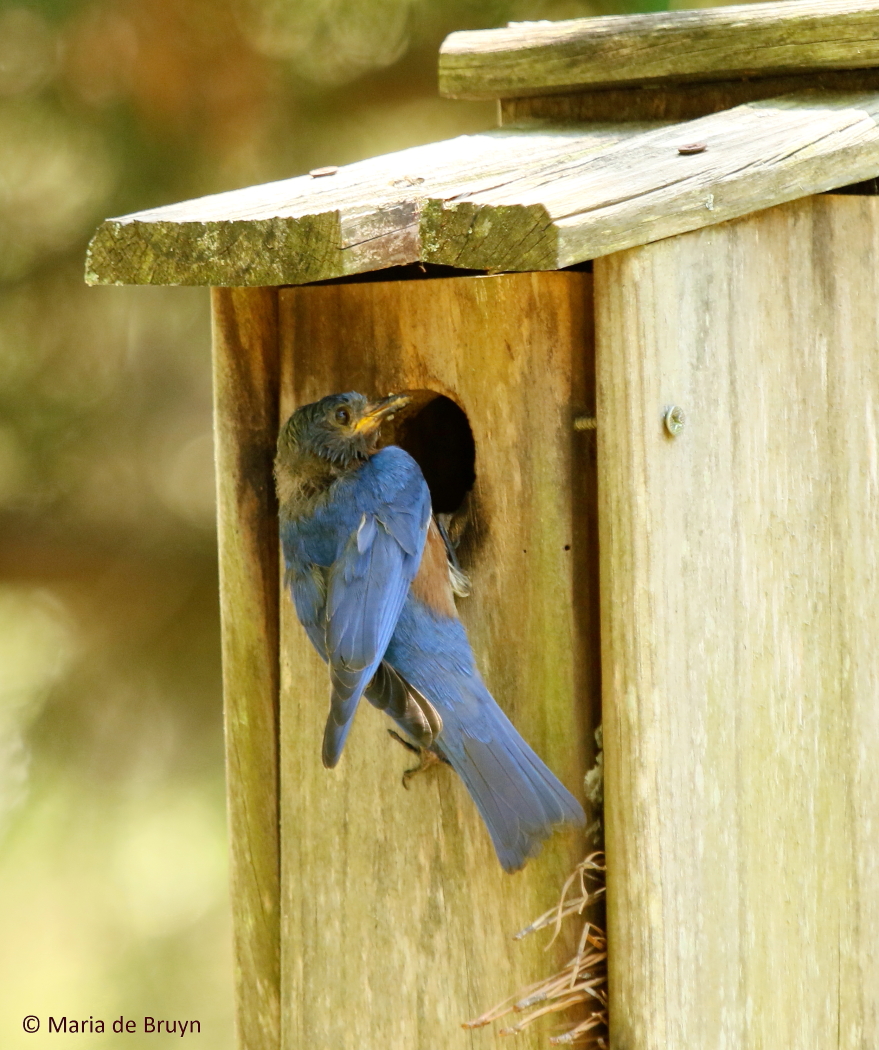
On Wednesday, I checked the box before going out for the morning and there were still three babies there. When I came home a few hours later, mama and papa were sitting on branches, with or without food, calling to their little ones to come on out. They would also fly to the box for a quick look inside.

Eastern bluebird I77A7702© Maria de Bruyn res           Eastern bluebird I77A7729 © Maria de Bruyn res

Mama also repeated behavior I had seen last year – flying to the box, standing on top and then hovering in front of the hole as a form of encouragement.  When she and dad left, I approached to take a look and discovered bluebird baby No. 1 had already flown away. This meant that the parents had to watch the first baby out in the trees somewhere, as well as their two lagging offspring in the box.

Eastern bluebird I77A8584© Maria de Bruyn res        Eastern bluebird I77A8791© Maria de Bruyn res

Eastern bluebird I77A8592© Maria de BruynAt one point, mother bluebird seemed a bit fed up – she flew over to the box (without food) and finally entered, staying inside for a good 60-90 seconds at least. I imagined her giving the babies a lecture about how they had to be courageous and willing to jump.

Her admonishments seemed to have had an effect; the babies began calling loudly from inside their birth home. Finally, after about 30 minutes, one poked its head out to take a look at the big wide world. Mom and dad seemed glad, waiting together in the tree to see how long it would take baby No. 2 to join them.

Eastern bluebird I77A8685© Maria de Bruyn    Eastern bluebird I77A8648© Maria de Bruyn

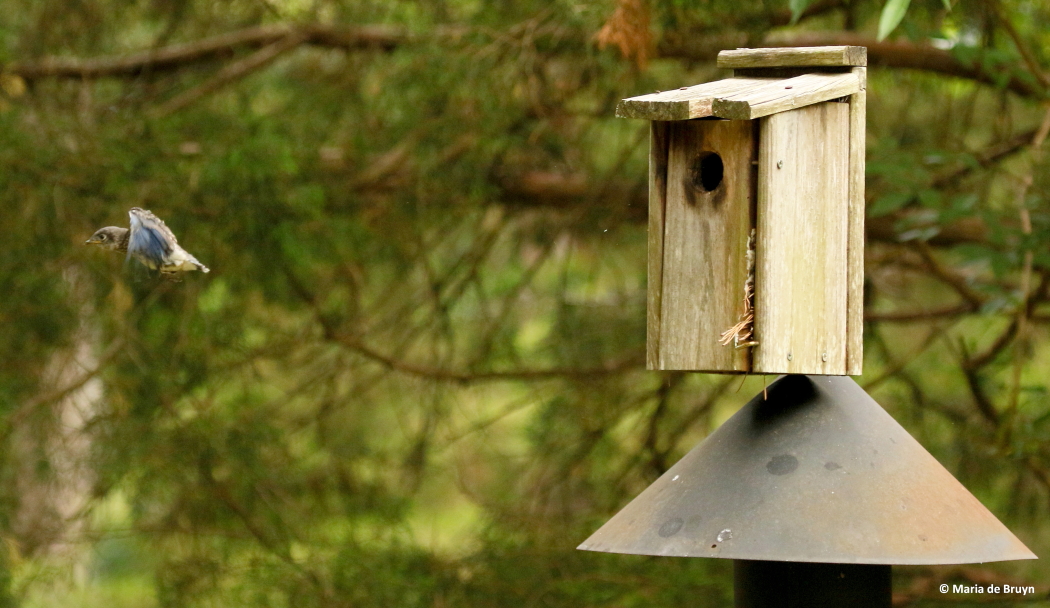
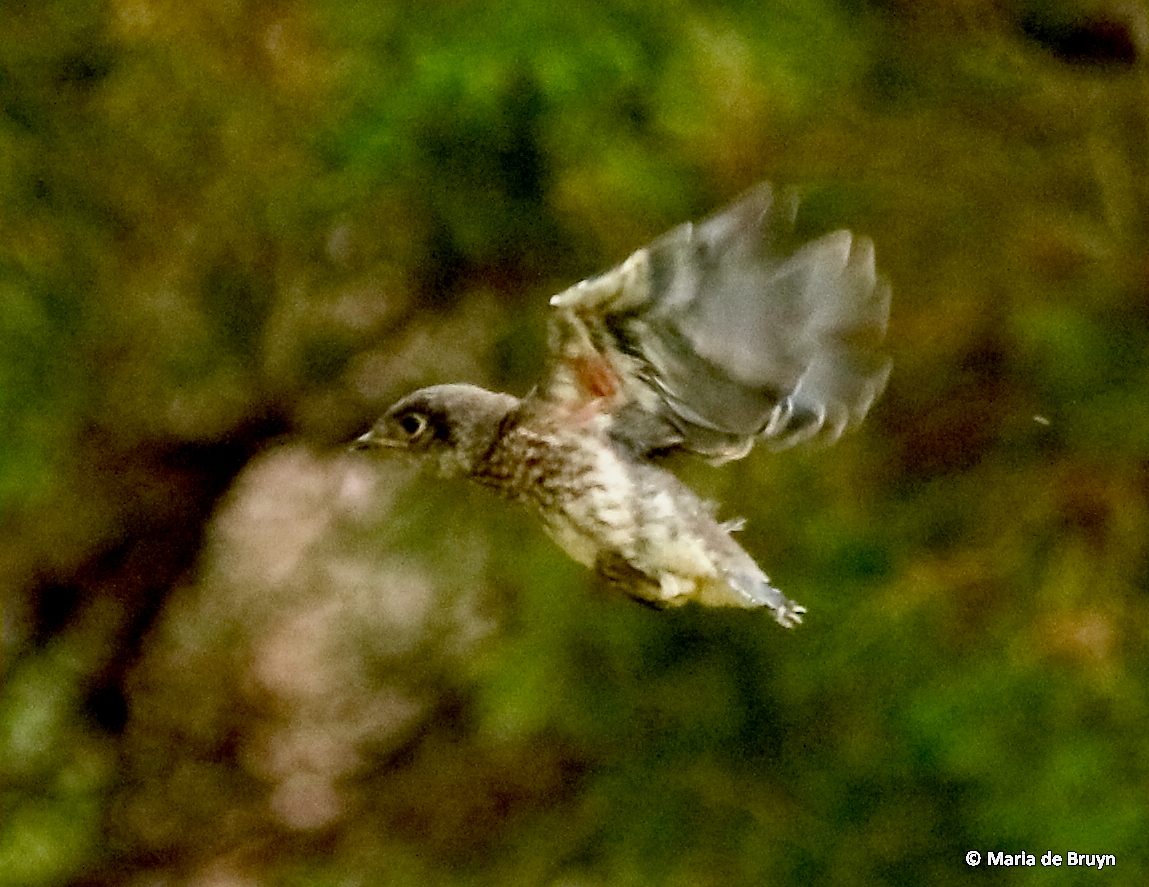
The baby looked around a lot, also staring at me; s/he went back inside and then looked out a few more times, finally taking the great leap into the outside world. Baby 2 was a very strong flier – not even alighting in the tree in front of the box but circling around to land high in a juniper and then in a tall oak tree behind the box.

Eastern bluebird I77A8746© Maria de Bruyn res

Eastern bluebird I77A8877© Maria de Bruyn res


Sibling No. 3 took a little while longer and mama bluebird again went to the box to give encouragement. The baby then spent a little more time observing the new environment and also made a strong flight out.

Eastern bluebird I77A8899© Maria de Bruyn res Eastern bluebird I77A8891© Maria de Bruyn res

Eastern bluebird I77A8861© Maria de Bruyn res  Eastern bluebird I77A8925© Maria de Bruyn

Eastern bluebird I77A8930© Maria de Bruyn res Eastern bluebird I77A8931© Maria de Bruyn     Eastern bluebird I77A8932© Maria de Bruyn res

It rained that night and I hoped that the bluebird babies were ok; between the thunderstorms and a neighbor’s cat who comes to hunt birds in my yard, their environment seemed precarious for their first days of life. In the afternoon, I was happy to see papa bluebird feeding one of the three babies at the top of an oak tree. Mama was also flying around up there, so I assumed they were all hanging out in the high branches.

Eastern bluebird IMG_4723© Maria de Bruyn        Eastern bluebird IMG_4777© Maria de Bruyn res

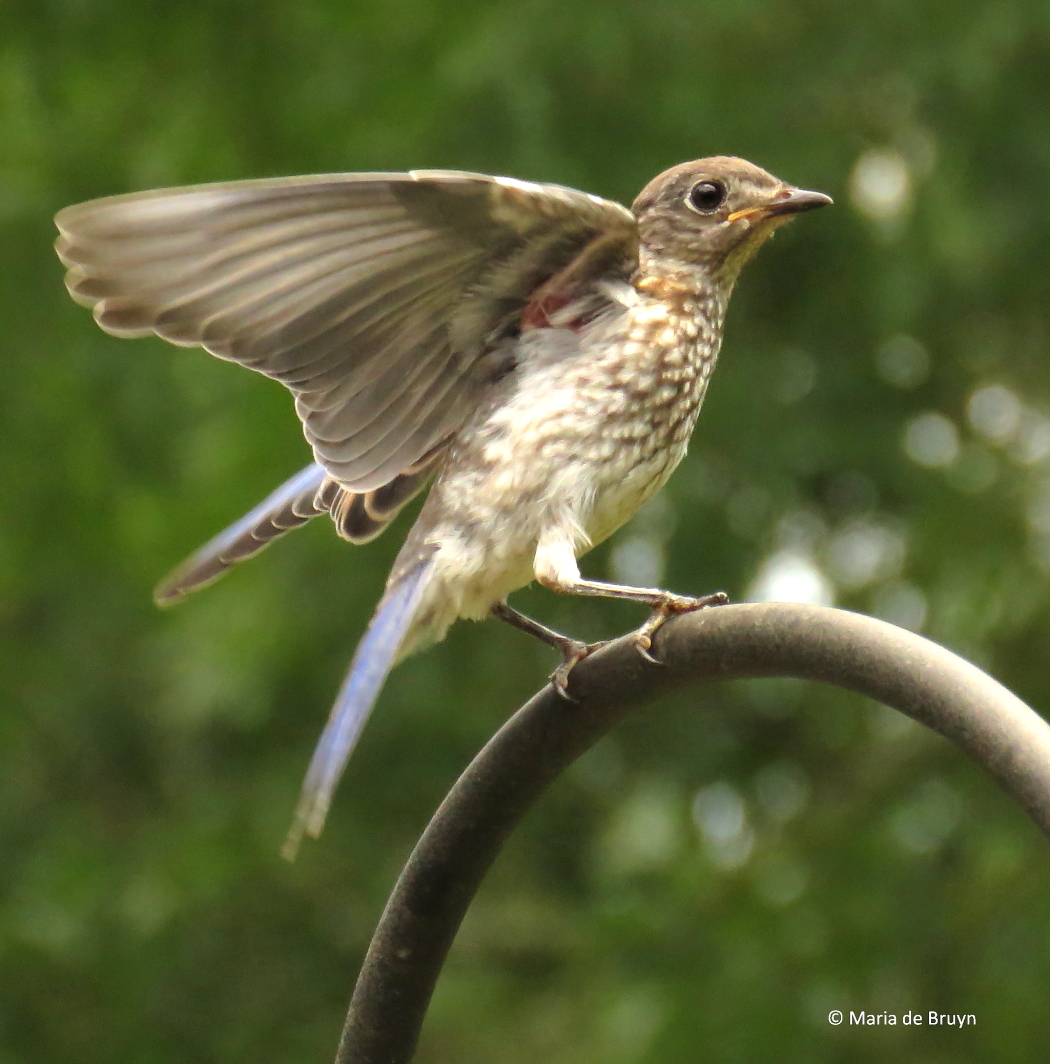
Thursday night, it rained heavily again for many hours; Friday was an easier day and night. I haven’t seen the fledglings again yet but have seen their parents coming for suet and meal worms and flying up to the oak tree, so I assume at least a couple are there. I look forward to seeing their speckled selves at the feeders along with their parents – and will be curious to see if their parents go for a third brood this year.

Eastern bluebird IMG_4779© Maria de Bruyn res


Chasing Joseph – excitement evoked by an effervescent bird!


Calliope hummingbird I77A6799© Maria de Bruyn

Birders can be quite enamored with their pursuit of avian species, some making special trips just to see one bird that they haven’t seen before. Such trips may be within an hour or two of their homes, but there are plenty of birders who travel to other (even distant) regions within their own or another country as well. Some people might say they are a bit crazy, but birding is actually one of the sanest ways to appreciate nature.

Eastern bluebird I77A6750© Maria de Bruyn cardIt generates knowledge, provides rest and relaxation (well, mostly) and many birders contribute to environmental protection and conservation, even if they restrict themselves to observing local species like Eastern bluebirds (Sialia sialis). In addition, while much is made of the money that hunting fees provide for environmental programs, birders also make economic contributions to society – through donations to environmental protection groups and expenditures on birding supplies, ecotourism, etc. The Audubon Society reports that birders and other wildlife observers spend $916 million in the US state of North Carolina alone each year!

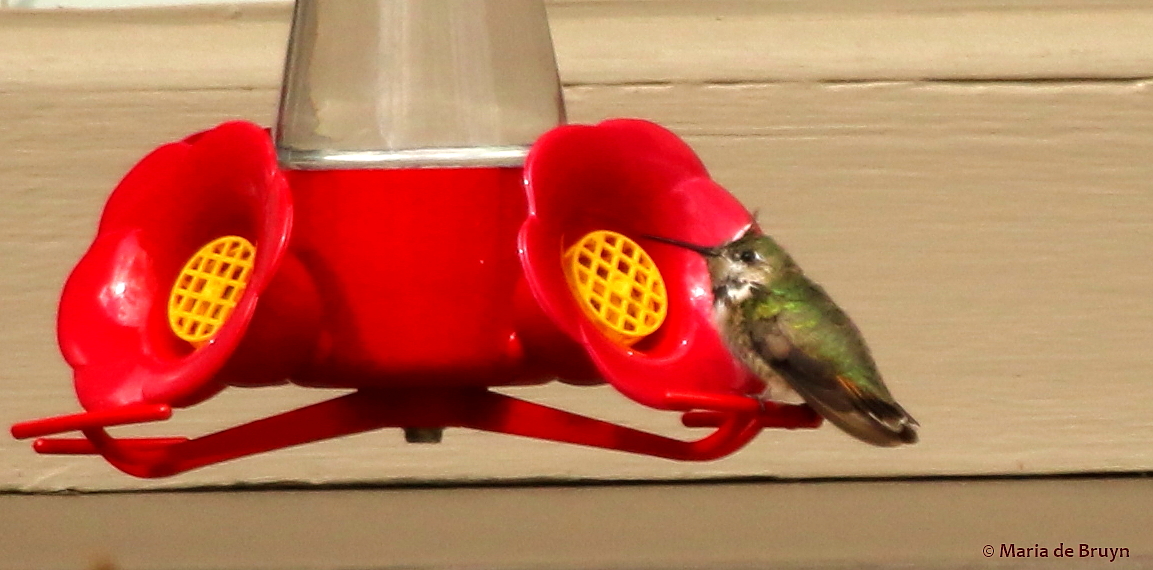
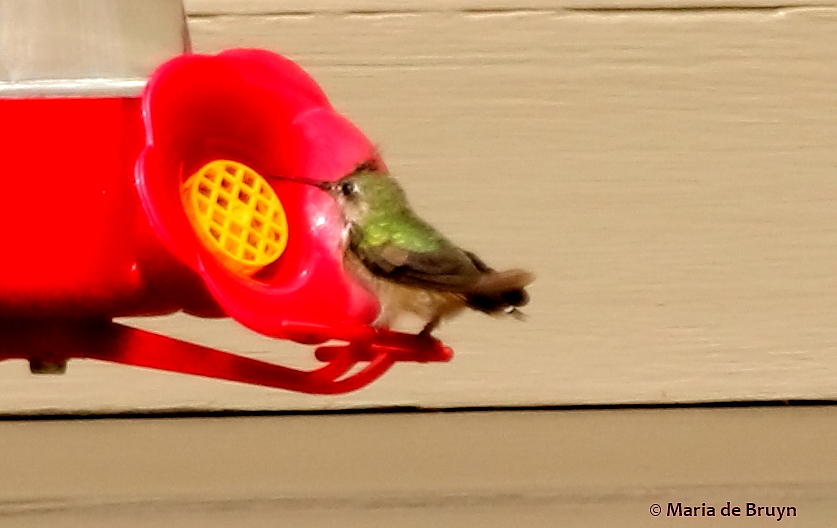
Calliope hummingbird I77A6939© Maria de Bruyn resSo, in the last half year, I’ve become a birder who will make a special trip to see a particular bird. In October last year, I traveled 77 miles with friends to see a buff-bellied hummingbird (Amazilia yucatanensis). This year, a shorter distance (22 miles) led me twice to the calliope hummingbird (left, Selasphorus calliope), which is the smallest bird species in North America outside Mexico.

The first visit was pure serendipity; two other birders (Lucretia and Lorentz) and I met birding guide Jan at a reservoir and he mentioned having seen the calliope the previous day. It was only a 10-minute drive from where we were, he said, and the couple hosting the bird was very nice. So we jumped in Lorentz’s car and headed over to the next county in pursuit of our lifer (a bird that one sees for the first time in one’s life).

Calliope hummingbird I77A6897© Maria de BruynThe calliope hummers are the tiniest long-distance migrants of all the world’s birds, traveling from the mountains of the Northwest USA and Canada to Mexico and a few spots in the southern United States in winter. This year, however, a young male landed in the Malinski’s yard; they named him Joseph.

Some other instances of calliope hummingbirds in the Southeastern USA have been noted but they are still fairly unusual. However, it’s speculated that they may become more frequent winter visitors because of environmental changes associated with human activity.

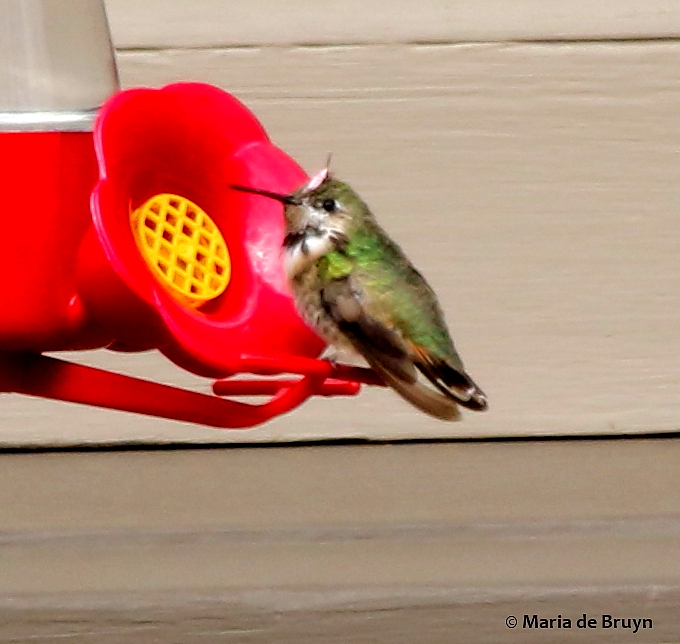
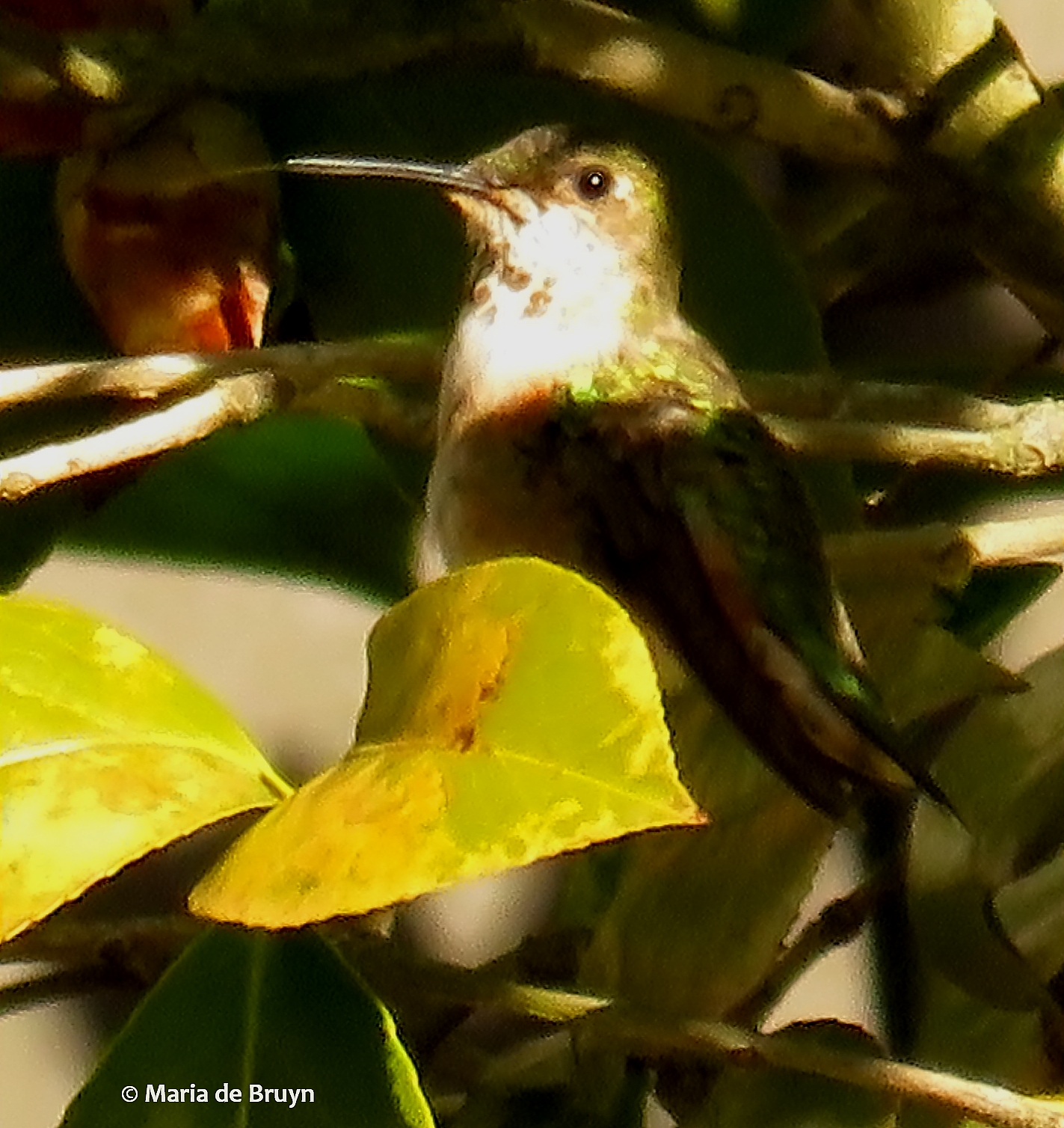
At the Malinski’s home, the calliope is keeping company with another winter migrant, a female rufous hummingbird (below, Selasphorus rufus). Mrs. Malinski has seen the rufous chasing the calliope away from the feeders, living up to that species’ reputation for being feisty. However, the calliope hummers are brave, too, even chasing red-tailed hawks (Buteo jamaicensis) away from their territories during breeding season!

Rufous hummingbird IMG_2657© Maria de Bruyn       Rufous hummingbird IMG_2669© Maria de Bruyn

Calliope hummingbird I77A6756© Maria de BruynJoseph is currently molting and can be identified for the time being with a little topknot atop his head. Susan Campbell, North Carolina’s well-known hummingbird bander, gave him his bracelet at the Malinski home, which should make it possible to identify him if he returns next year.

Calliope banding Campbell IMG_0646


In this photo kindly provided by Susan, you can clearly see that he is developing the bright purple feathers that will grace his throat and give him a beautiful appearance in full maturity. They are just a little visible when he zips in to land at the feeder.


yellow-bellied sapsucker I77A7858© Maria de Bruyn res


Both Joseph and the female rufous enjoy the nectar provided by the Malinski’s. These birds will also eat insects and calliopes are known to drink from yellow-bellied sapsucker (Sphyrapicus varius) sapwells like those shown here.


Many people have traveled to the couple’s home to observe Joseph. During my two visits, I encountered 10 other birders and I know of more who paid a visit. The Malinski’s are most gracious, allowing us to stay in their front yard for hours.

Calliope hummingbird I77A6566© Maria de Bruyn       Calliope hummingbird I77A7075© Maria de Bruyn

loggerhead shrike I77A7328© Maria de Bruyn


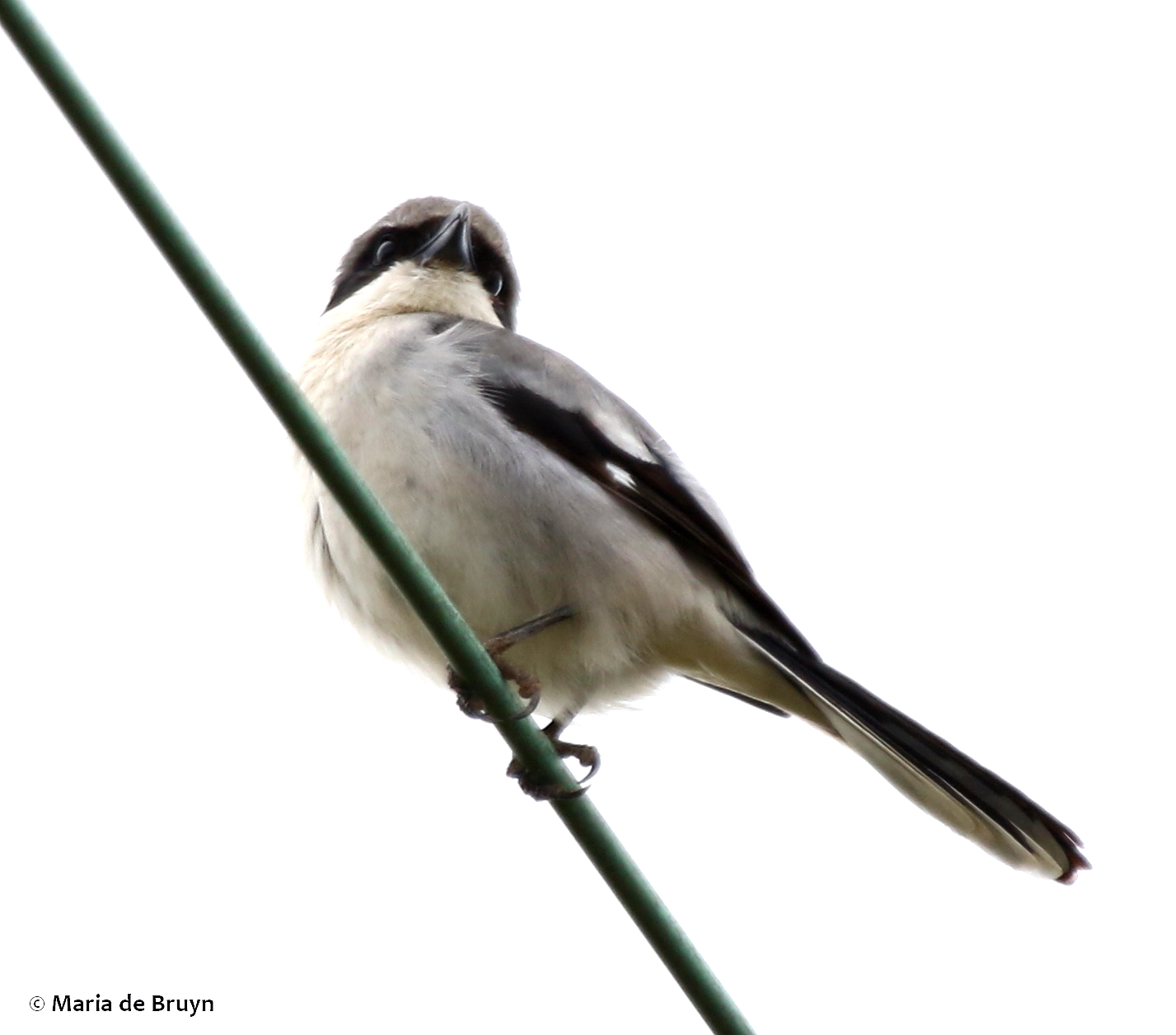
After I left them with Joseph buzzing back and forth between the front and back yards, I stopped at a rural road known as a spot for white-crowned sparrows. I didn’t see them but did get to see a loggerhead shrike (Lanius ludovicianus).


loggerhead shrike I77A7301© Maria de Bruyn            loggerhead shrike I77A7280© Maria de Bruyn

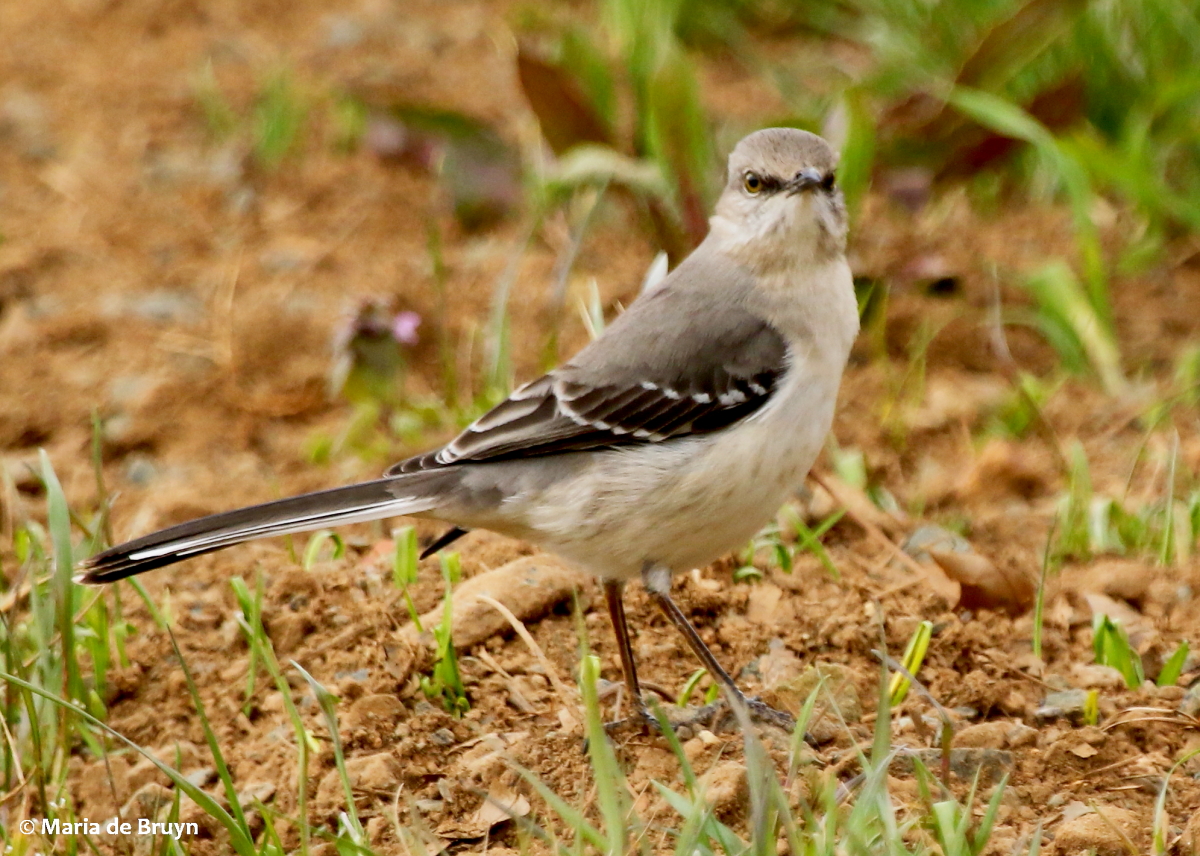
The Northern mockingbirds (Mimus polyglottos) were courting and chasing each other, making a fair bit of noise and flashing their lovely feathers.

Northern mockingbird I77A7172© Maria de Bruyn    Northern mockingbird I77A7425© Maria de Bruyn

Northern mockingbird I77A7118© Maria de Bruyn res

Even though mockingbirds live around my yard, I always enjoy seeing them again. I likely never will become a birder who goes off to exotic lands just to chase down one species I haven’t seen before. But I certainly am paying even more attention to the birds around me wherever I am and making some shorter forays as time permits (just yesterday, I joined friends Beth, Carol and Nan to go see a Wilson’s snipe (Gallinago delicata) at a farm in the next county – another lifer!). But it’s not only birds that will get me to travel – bears are on my list of animals that I am still hoping to see and photograph in the wild. When I get to that point, you’ll read about them here, too!

Water-logged and soggy birds

Carolina wren I77A2794© Maria de Bruyn resMy original intent was to write only one more blog this year, but our current weather has induced me to write two (the other will follow on the last day of 2015). During the past week, our region has had more than our “fair share” of rain. Fortunately, the house is not downstream or downhill of flowing water so that flooding is not a concern (and having helped my parents when their home was flooded with about 5 feet of water, I know that is a real pain to say the least). But the yard is so water-logged that small pools of water are scattered in many places and the ground cover squishes when we walk on it. Combined with very high temperatures for this time of year, it seems that El Niño is really making itself known – and the birds like this Carolina wren (Thryothorus ludovicianus) must be getting tired of being water-logged as well!

Sayings such as “like water off a duck’s back” imply that birds don’t really get bothered by water pouring from the heavens, but that is probably only partly true. During recent downpours, I saw – through the back porch screen – a Carolina wren and Northern cardinal (Cardinalis cardinalis) hanging out on a downspout under the house eaves, while a brown-headed nuthatch (Sitta pusilla) clung to the brick wall under the roof overhang to get out of the rain.

brown-headed nuthatch I77A0090© Maria de BruynNorthern cardinal I77A0101© Maria de Bruyn res

Birds that regularly dive underwater do have denser feathers, which helps prevent water from penetrating through to their skin, as is the case for this Canada goose (Branta canadensis).

Canada goose I77A1169© Maria de Bruyn res

But birds’ feathers are not inherently waterproof – when we see water droplets beading on their backs and tails, as in the case of this brown thrasher (Toxostoma rufum) and blue jay (Cyanocitta cristata), it’s because the birds have made them water-resistant to some extent.

Blue jay I77A3141© Maria de Bruyn resbrown thrasher I77A9881© Maria de Bruyn res

This happens in two ways. On the one hand, birds such as pigeons, herons, hawks and owls have special feathers called “powder downs” or “pulviplumes”, which are covered in a dusty powder containing keratin that disintegrates and becomes a waterproof coating. They spread the powder to other feathers while preening.

Great blue heron I77A1220© Maria de Bruyn res

Great blue heron (Ardea herodias)

brown-headed nuthatch I77A0090© Maria de Bruyn resOther birds have a uropygial (preen) gland located at the base of their tails. It produces a substance containing oil and wax that the birds spread on their feathers when they groom. Often, they will rub their head against the preen gland and then spread the oil by rubbing their head against other feathers, a behavior that this female red-winged blackbird (Agelaius phoeniceus) seemed to be doing when she was grooming. The wax then helps make the feathers more flexible and water-resistant, which explains the water beads we see on their feathers when it rains.

dark-eyed junco I77A4085© Maria de Bruyndark-eyed junco I77A9650© Maria de Bruyn res

Dark-eyed junco (Junco hyemalis)

Eastern towhee I77A9682© Maria de Bruyn res Pine warbler I77A9921© Maria de Bruyn res

Eastern towhee (Pipilo erythrophthalmus)

     Pine warbler (Setophaga pinus)

It may be that some birds are less successful in spreading the powder and wax to their head feathers, or they rub all the oil or powder off their heads onto other feathers. This may account for the “bad hair day” look some of them get when it rains for hours on end. These spiky “Mohawks” often appear in Northern cardinals and Eastern bluebirds (Sialia sialis).

Northern cardinal I77A9734© Maria de Bruyn res Northern cardinal I77A9870© Maria de Bruyn res

Eastern bluebird I77A9717© Maria de Bruyn resEastern bluebird I77A9710© Maria de Bruyn res

Other birds seem to especially get soggy feathers on the crowns of their heads just above their eyes. This may be why we see so many of them shaking their heads vigorously to get rid of the dampness on their pates.

Pine warbler I77A9942© Maria de Bruyn res White-throated sparrow I77A2980© Maria de Bruyn res

Pine warbler                                              White-throated sparrow (Zonotrichia albicollis)

Red-bellied woodpecker I77A9724© Maria de Bruyn res


And some birds just get an overall scruffy look when it rains hard, like this red-bellied woodpecker (Melanerpes carolinus).


Eastern bluebird I77A0155© Maria de Bruyn resThe water-logged look does seem to give some birds an angry or disgruntled appearance; I can certainly sympathize since endless days of rain – even in warmer temperatures – is one of my least favorite types of weather. It seems that overcast days and showers are continuing in our local forecast for some time to come. So the poor birds have to put up with the wet weather a while longer. We’ll all appreciate the sunlight when it comes back in force – hopefully soon!