Pines, habitat loss and endangered woodpeckers

longleaf pine IMG_0016©Maria de Bruyn resLongleaf pine trees (Pinus palustris) grow for 100-150 years before they reach full size and they can live as long as 500 years. Their extremely long needles give the young trees the look of a spike with grass growing out of it. At the tops of trees, the long, fanned out needles paint a pretty picture when silhouetted against the sky, even on overcast and dull days.

longleaf pine IMG_0015©Maria de Bruyn res

RED-COCKADED WOODPECKER IMG_9109©Maria de Bruyn RESUnfortunately, the longleaf pine forests have dwindled in size as a result of logging and this has contributed to the endangerment of a unique bird – the red-cockaded woodpecker (Picoides borealis).


The longleaf pine has a rough bark and plentiful resin, so much so that tree stumps impregnated with the resin will not rot. The heartwood of the old pines also becomes saturated with the resin.

longleaf pine IMG_9042©Maria de Bruyn reslong-leaf pine IMG_9025©Maria de Bruyn res

When the longleaf pine forests were still plentiful, the red-cockaded woodpecker evolved into a very specialized bird species as far as nesting is concerned. They mainly nest in longer-lived longleaf pines, preferring trees that are infected with red heart fungus as this softens the wood and makes it easier for the birds to dig out a nest cavity. They are the only woodpecker species that makes nest cavities in living rather than dead trees.

longleaf pine IMG_9035©Maria de Bruyn resThe nest cavities are constructed by a family of birds and completing one can take as long as two years (or longer). The families work on several cavities at a time and you will find clusters of trees with nest holes in given areas. The cavities are pecked out in such a way that the tree releases resin around the nest hole and you will see trees that are covered with long thick strands of resin coming down from nests.

The woodpeckers employ this tactic because the heavy flow of resin helps to keep tree-climbing snakes away from their nests, eggs and chicks. A breeding male will scout various nest cavities and then roost in the most recent cavity with the heaviest flow of pitch. The female lays the eggs and then the male incubates them during the night-time hours.

red-cockaded woodpecker IMG_9103©Maria de Bruyn resRaising the young becomes a cooperative effort as older sons remain with the parents and help incubate, brood and feed the babies. Family groups can range from three to nine or more members. The female offspring only rarely stay with their breeding parents as they move off in search of their own mates.

These woodpeckers mainly eat insects, including ants, beetles, roaches, and wood-boring insects as well as caterpillars and spiders. The family will forage as a group and sometimes also eat fruit and berries. Their abandoned nest cavities are used by other birds and small mammals.

red-cockaded woodpecker IMG_9152 ©Maria de BruynThe species is now considered vulnerable to extinction, with only about 12,500 of these birds remaining in the Southern United States. This is equivalent to about one per cent of the original population of this woodpecker. In response, there are now conservation efforts being undertaken to preserve the longleaf pine forests as habitat for the red-cockaded woodpeckers.


long-leaf pine IMG_0013©Maria de Bruyn resAt the Santee Coastal Reserve Wildlife Management Area in South Carolina, as well as in the Sandhills areas of South and North Carolina, forest rangers and others are working to enhance the longleaf pine forests for the birds. Controlled burns are clearing out dense undergrowth as the woodpeckers prefer sites with less deciduous growth; you can see them foraging quite low on trees.

In some areas, wildlife management projects are trying to help out the birds by creating artificial cavities, into which man-made nests are inserted. Restrictor plates around the holes also serve to stop other species from enlarging the holes or shape of the nest hole so that the red-cockaded woodpeckers will keep using them.

longleaf pine IMG_9040©Maria de Bruyn res longleaf pine IMG_9030©Maria de Bruyn res

At the Santee Coastal Reserve, several such nest holes can be observed alongside other trees where the birds are making their own nest cavities. Trees with nest holes are banded with white tape so that rangers can keep an eye on the woodpeckers’ activity.

longleaf pine IMG_9046©Maria de Bruyn resRED-COCKADED WOODPECKER IMG_9229©Maria de Bruyn RES

It is heartwarming to see the efforts being made to restore the longleaf pine forests and the habitat for the woodpeckers – perhaps this will prevent this species from going extinct. And the National Wildlife Federation has stated that research shows that long-leaf pine forests will be especially well adapted to coping with environmental changes caused by global warming.

RED-COCKADED WOODPECKER IMG_9214©Maria de Bruynred-cockaded woodpecker IMG_9165 ©Maria de Bruyn

Growing up to be a redhead

Red-headed woodpecker IMG_9062© Maria de Bruyn (2)In the past month or so, I’ve been seeing red-headed woodpeckers (Melanerpes erythrocephalus) almost everywhere I go — except my own neighborhood! Jordan Lake’s woods in two different areas and various sections of the Mason Farm Biological Reserve have all provided me with multiple spottings of, and concerts by, these lovely birds.

I’m not very good at recognizing birds by their calls. Having listened to loud rock music as a teenager left me with some hearing problems. But the red-heads have a loud, unique, warbling territorial call that they emit frequently, regardless of whether another of their species is close by or not. I’ve become quite good at recognizing that call!

The juveniles begin life looking quite different from their parents. They have mostly gray-brown heads and backs and the part of their feathers that will later be entirely white are marked by black splotches and dots.

Red-headed woodpecker IMG_0654© Maria de BruynRed-headed woodpecker IMG_0700© Maria de Bruyn


Red-headed woodpecker IMG_0742© Maria de Bruyn res


Like their parents, they show a variety of prey-hunting and food-gathering behaviors. You will hear them pecking at trees in their quest for insects but they also look for insects on the ground and can catch them during flight in mid-air.


Red-headed woodpecker IMG_0612© Maria de BruynThey also eat fruit, seeds and nuts like acorns and beechnuts, with plant materials making up about two-thirds of their diet. They will store food in caches so that they can find it again later during times of more nutritional scarcity. And in places far apart, they appear to be good at finding the same orangey cubes that are not nuts but some other, obviously delicious, substance.


Red-headed woodpecker IMG_8082© Maria de BruynRed-headed woodpecker IMG_8096© Maria de BruynRed-headed woodpecker IMG_8788© Maria de Bruyn resred-headed woodpecker IMG_1880© Maria de Bruyn


Red-headed woodpecker IMG_9470© Maria de BruynTheir food storage habits help birders find them more easily. Both at Jordan Lake and Mason Farm, I’ve discovered a couple trees where certain birds have their food stash and if I wait long enough, a red-head is more than likely going to appear.


Unfortunately, due to habitat loss and changes to its usual food supply, this species has declined considerably in numbers. That is why it is so nice to see the juveniles among these various groups.

Red-headed woodpecker IMG_0574© Maria de BruynRed-headed woodpecker IMG_0576© Maria de Bruyn

Red-headed woodpecker IMG_8625© Maria de Bruyn


As they age, the brown feathers begin giving way to red ones, first around the nape and back of the neck. The black markings on the tail feathers begin to fade as well as they grow older.


Red-headed woodpecker IMG_9202© Maria de Bruyn resRed-headed woodpecker IMG_8734© Maria de Bruyn res

When they reach maturity, the birds have brilliant red heads, glossy black and pure white flight and tail feathers.

Red-headed woodpecker IMG_8345© Maria de Bruyn resRed-headed woodpecker IMG_9104© Maria de Bruyn

Red-headed woodpecker IMG_1587© Maria de Bruyn resRed-headed woodpecker IMG_8332© Maria de Bruyn res

As these birds need dead trees for their nesting and storage cavities, it’s great that our area has some preserved forests where they currently appear to be thriving. And I can continue going out in the hopes of one descending from treetops to a lower and nearer perch so that I can finally get the stunning shots I’ve been wishing for!
Red-headed woodpecker IMG_0605© Maria de BruynRed-headed woodpecker IMG_0707© Maria de Bruyn


We are NOT spiders!

Harvestman 2 IMG_4346© Maria de BruynWhen I was about 13 years old, my girl scout troop went to a somewhat “primitive” camp for our summer adventure. We slept in tents and had toilet paper, but we had to construct what we would use such as a table, a toilet (a hole in the ground with a seat of branches lashed together), and a shower (with a tarp but held up with branches bound by ropes and a pail with a pull rope). The shower was fine except for one thing – some daddy longlegs decided to take up residence on the tarp and for me – and others – sharing the space with what we thought were long-legged spiders was not really our idea of fun.

It was many decades later that I discovered that daddy longlegs are acHarvestman 2 MdB signedtually called harvestmen (scientific name, Opiliones) and they are actually not spiders at all! In fact, they are interesting insects that do not really look like spiders except for the fact that most species share the trait of having those extremely long legs.

Many Opiliones species can detach a leg, which continues to twitch for some time after leaving the body – this is thought to serve as a distraction that enables the harvestman to escape from a predator.

Harvestman 1 IMG_4324© Maria de BruynSpiders and harvestmen are both arthropods but differ in various ways. Spiders have segmented bodies, while harvestmen have a body of only one segment, with their single pair of eyes sitting atop the oval structure, like the black eyes you can see on the orange harvestman here. Spiders, on the other hand, have 3 or 4 pairs of eyes, as well as silk glands that are lacking in harvestmen.

Harvestmen’s legs protrude from structures that look a little bit like mechanical nuts; they are actually called the coxa and trochanters. These may be the same color as the arachnid’s body or be of a different color.

IMG_3212 ©Maria de Bruyn blogHarvestman IMG_7970©Maria de Bruyn

harvestman IMG_4882©Maria de BruynSimilar to spiders, harvestmen do have a pair of pedipalps – specialized appendages – and these form the arachnids’ feeding apparatus together with the first pair of legs. This feeding organ is called the stomotheca.

The two harvestmen below were seen in early December at Mason Farm Biological Reserve. They were approaching one another, separating and then coming together again. I have no idea what they were up to. Mating came to mind but in winter?

Harvestman 2 IMG_1897© Maria de Bruynharvestman 2 IMG_1967© Maria de BruynMore than 6,400 species of harvestmen have been discovered on all continents except Antarctica, but it is speculated that there may be as many as 10,000 species. I have seen them in varied habitats such as a forest, on beach sand, clinging to plants and wandering about on manmade structures. They vary in color and appearance as seen below. Some are mainly one color, some are two-toned and others have patterns on their bodies.

Harvestman IMG_0072©Maria de Bruyn blogHarvestman IMG_8238© Maria de Bruyn blog

Harvestman IMG_8590©Maria de Bruyn blogHarvestman IMG_9271©Maria de Bruyn blog

Harvestman IMG_9238©Maria de Bruyn blogHarvestman IMG_9238©Maria de Bruyn blog 2

harvestman mites IMG_2021©Maria de Bruyn bg

Some harvestman end up being parasitized by smaller insects such as the red mites seen catching a ride on this individual. If they don’t die, though, they can go on to mate, lay eggs and have offspring.

I used to avoid harvestmen if possible, but now I take an extra look at them hoping to find one with coloring and/or a body pattern that I haven’t seen before. Nature continues to be intriguing!

harvestman IMG_2090© Maria de Bruyn res

Patient fishers of the bird world

great blue heron IMG_8830© Maria de Bruyn resIt’s not uncommon for visitors to our ponds, lakes and rivers to see what look like tall, statuesque bird sculptures on shorelines. The great blue herons (Ardea herodias) – North America’s largest heron species – can stand for long periods without moving or only slightly tilting their heads as they exercise extreme patience in their quest for a morning, midday or evening meal.

If they have a chance for easy pickings, these herons will certainly take advantage of it, as I discovered when the koi and goldfish in my pond were disappearing. But in their natural habitat they will scan the water intently to find their prey.

great blue heron IMG_4336©Maria de Bruyn resgreat blue heron IMG_8910© Maria de Bruyn rea

If you have the time and inclination to watch them for a lengthier period of time, you will note how they hunch down and stretch up as they position themselves to get good views of the water around them.

great blue heron IMG_4174©Maria de Bruyn (2) resgreat blue heron IMG_4242©Maria de Bruyn

great blue heron IMG_8791© Maria de Bruyn resThey stare downwards and to the side, following the movements of fish, frogs and crayfish. When the wind blows, their plumed neck and tail feathers sway gently and beautifully in the breeze.

great blue heron IMG_4343©Maria de Bruyn resIf nothing seems nearby, they will move with quiet and slow deliberation to another spot, often quite nearby. Unlike the snowy egrets, they don’t stir up the mud with their feet or flap their wings to create movement in the water.

When a fish does swim by, they burst into very fast motion, plunging their long beaks and whole heads down to grab what they have spotted.


great blue heron and egret IMG_8470© Maria de Bruyn resgreat blue heron IMG_8811© Maria de Bruyn res

They are not always successful, sometimes coming up empty beaked!

great blue heron IMG_8878© Maria de Bruyn resgreat blue heron IMG_8879© Maria de Bruyn resBut their patience obviously does pay off, too.

Great blue heron IMG_9578©Maria de BruynGreat blue heron IMG_9530©Maria de Bruyn

Once caught, they need to work the fish or other prey around so that they can swallow it down smoothly. As they swallow their meal whole, this is important. (And they can eat a very large meal; there is a film on the Internet showing a heron swallowing a groundhog!!)

great blue heron IMG_8813© Maria de Bruyn resgreat blue heron IMG_8816© Maria de Bruyngreat blue heron IMG_8477© Maria de Bruyn res

great blue heron IMG_8483© Maria de Bruyn  resgreat blue heron IMG_8482© Maria de Bruyn

great blue heron IMG_8818© Maria de Bruyn great blue heron IMG_8825© Maria de Bruyn res

If you look carefully, you can see the meal slide down their long necks.

great blue heron IMG_8826© Maria de Bruyn resgreat blue heron IMG_8484© Maria de Bruyn

Great blue heron IMG_0554©Maria de Bruyn resThis fishing strategy works well for the great blues as they can continue to hunt even when injured. This bird had a very badly damaged wing and apparently couldn’t fly anymore but it could stalk slowly in the lake as it looked for food.

The bird below had had some kind of encounter – either with a man-made obstacle or some form of wildlife that left it with an injured wing and broken leg. Bald eagles are one of the few predators of adult herons and this great blue lives at Jordan Lake which has a group of such eagles in residence. Despite the handicap, the heron could fly from spot to spot and then stand in wait for meals to swim by.

great blue heron IMG_9244© Maria de Bruyn resgreat blue heron IMG_9247© Maria de Bruyn res

If disturbed, these birds emit a very loud and harsh squawk or croaking sound and then often take off. They certainly wouldn’t win any singing contests with their definitively non-melodious calls.

great blue heron IMG_8516© Maria de Bruyn resgreat blue heron IMG_8940© Maria de Bruyn resgreat blue heron and egret IMG_5083© Maria de BruynThey prefer to fish in solitude and don’t care for other birds invading their territory. This great blue and great egret wanted the same spot and the great blue made some efforts to chase off its white competitor. However, the egret refused to leave and eventually they shared the spot with some meters of space between them.

Watching the herons fish has not only given me an appreciation for their innate patience but has also enhanced my own patience as well as I stand and wait with them until it’s finally mealtime.


A tiny bundle of yellow-feathered joy

ruby-crowned kinglet IMG_1148©Maria de Bruyn resWhile ospreys are one of my favorite large birds, the gorgeous ruby-crowned kinglet (Regulus calendula) has won my heart among my tinier feathered friends. Today I’m sharing some portraits of kinglets made the past couple months (in my yard and at Bolin Creek greenway in Chapel Hill, Jordan Lake woods, Sandy Creek Park in Durham).

One of the more active small birds (about 4 incruby-crowned kinglet IMG_5278© Maria de Bruyn reshes or 10-11 cm long), this kinglet is in almost constant motion, which makes getting good portraits a bit of a challenge. Despite this high level of activity, however, research has shown that the ruby-crowned kinglet only uses up to 10 kcal a day in energy. (Sometimes I think this holds true for me as well as the weight I want to lose just stays in place.)


ruby-crowned kinglet IMG_7952© Maria de Bruyn resTheir main diet consists of insects, including spiders, ants, wasps, beetles and aphids. They will also occasionally eat seeds, fruit and sap.

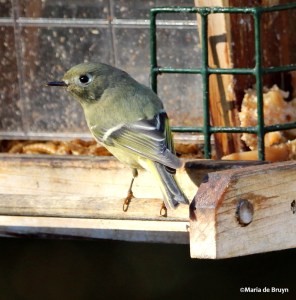
In addition, these kinglets – or at least the one that has been visiting my yard during migration the past couple years – also love suet a lot.

The ruby-crowned kinglet is known for its habit of flicking its wings as it forages for food; this helps it scare up insects (another bird that uses its wings in its hunt for food, like Northern mockingbirds and snowy egrets).


ruby-crowned kinglet IMG_4238© Maria de Bruyn resruby-crowned kinglet IMG_1631© Maria de Bruyn res

Ruby-crowned kinglet IMG_2653©Maria de Bruyn res


Though they don’t look as adept as hummingbirds, they sometimes hover to get at insects on the underside of leaves; they show this hovering behavior at feeders, too, before landing or flying off with a piece of suet snatched in flight..

ruby-crowned kinglet IMG_2760 MdB res2Most of the time, the male’s beautiful little red crest (which gives the species its name) remains hidden unless it gets excited about something.

ruby-crowned kinglet IMG_2762 MdB res2
Ruby-crowned kinglet 2 IMG_1149©Maria de Bruyn res


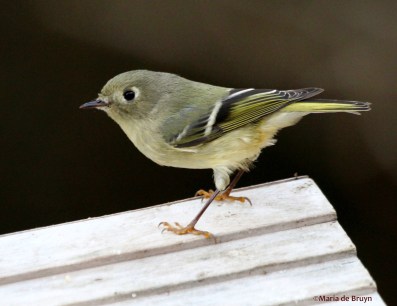
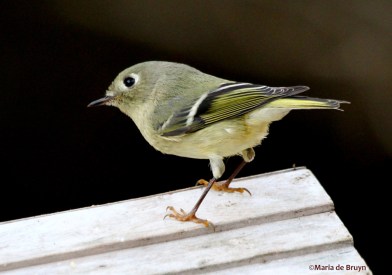
The ruby-crowned kinglet seems to me to have an expression of perpetual wonderment as it flits quickly from one spot to another. Its thin little legs with yellow-red feet help it land securely, on a branch, wire or feeder.

ruby-crowned kinglet IMG_0633©Maria de Bruynruby-crowned kinglet IMG_4076© Maria de Bruyn res

ruby-crowned kinglet IMG_0617©Maria de Bruyn resIn my pursuit of portraits, I’ve found that just as I think I have the bird in focus, it has disappeared from my viewfinder and I need to look up and around to locate it again..Given its diminutive size, one wouldn’t expect that the female lays up to 12 – twelve! – eggs in its nest, which is elastic and can expand as the brood grows. The male and female stay together until the chicks fledge at about 2 months and they will defend the nest against intruders.
ruby-crowned kinglet IMG_4075© Maria de Bruyn resruby-crowned kinglet IMG_4074© Maria de Bruyn res

ruby-crowned kinglet IMG_8928© Maria de Bruyn2 resSometimes, I hear the chittering call before I see the tiny wonder and only very rarely get to enjoy its longer song, which apparently varies according to region.

Ruby-crowned kinglets can live up to at least 4½ years (as shown by a banded bird). I don’t actually know if there is more than one bird visiting me or whether another will take its place in time.

ruby-crowned kinglet IMG_0102©Maria de Bruyn resWhat is very cool for me is that my visitor can become very friendly indeed. Last year, on two occasions, I was carrying a replenished suet feeder outside when the kinglet flew in to perch on it as I held the feeder in my hands – giving me a great close-up view. I look forward to seeing if the kinglet will favor me with an up-close-and-personal meeting again this coming winter!ruby-crowned kinglet IMG_0639©Maria de Bruyn res