Learning to love an over-protective bird

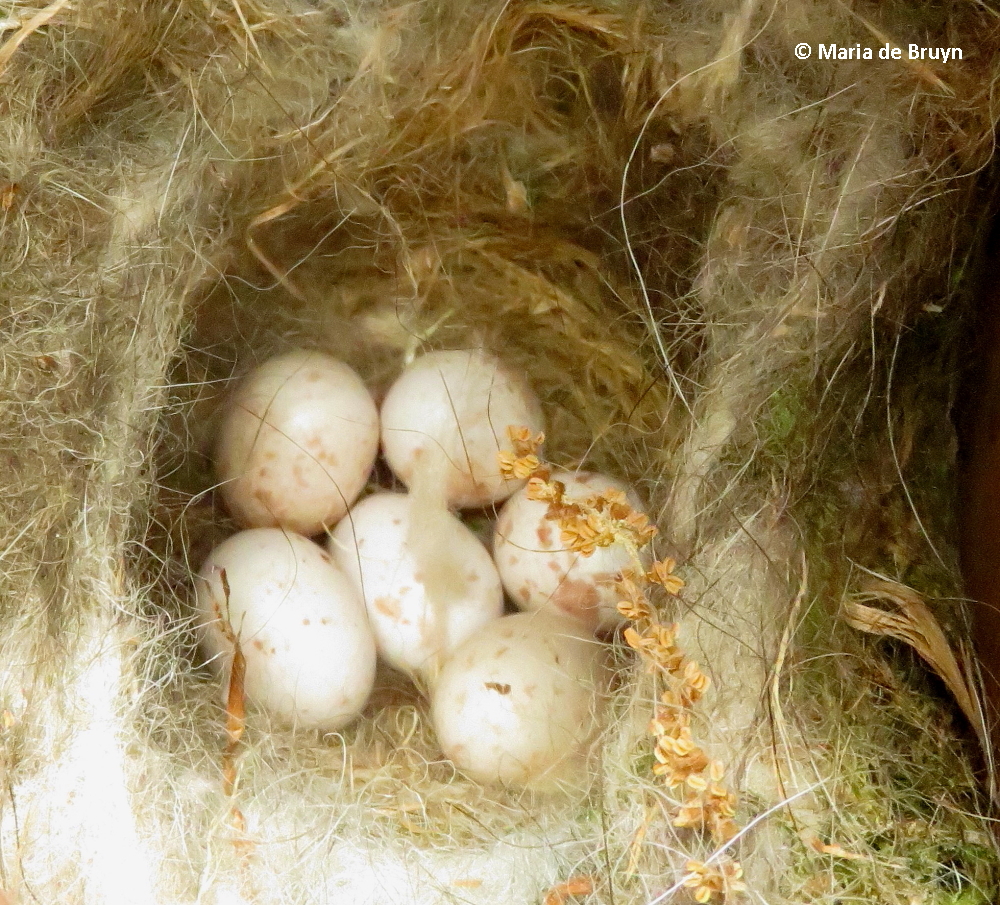
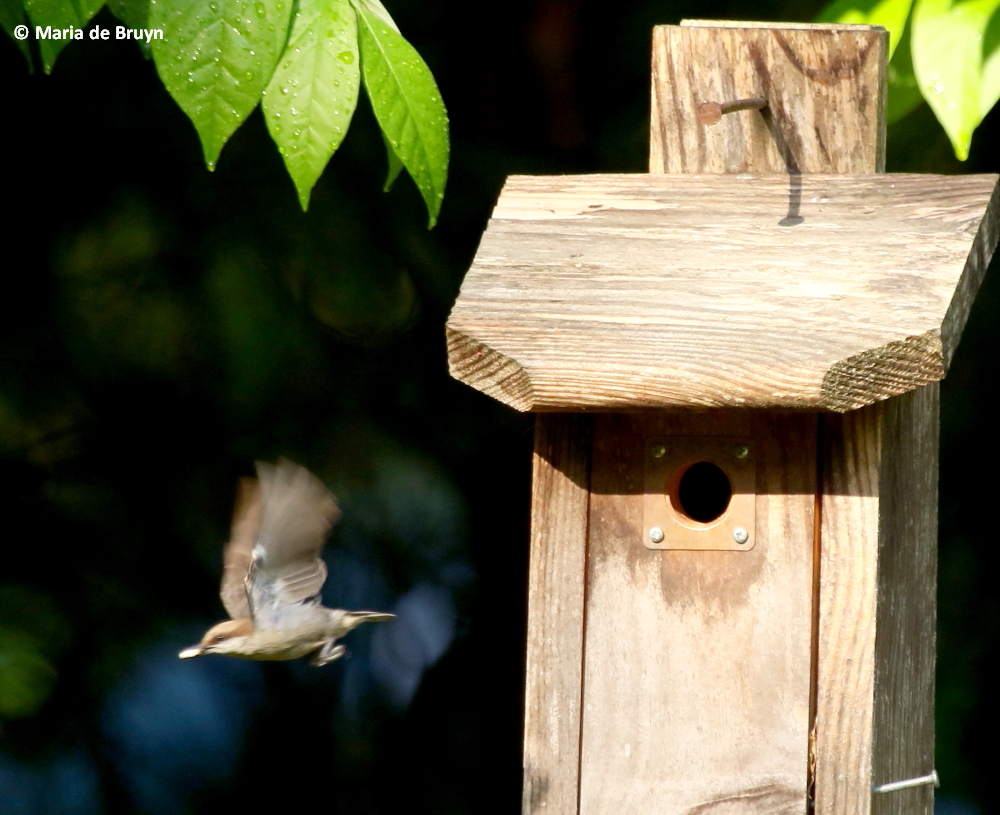
When house wrens (Troglodytes aedon) first began visiting my yard some years ago, I was not aware that they are extremely protective parents. I didn’t see them as often as birds of other species since they don’t come to my feeders and were not using nest boxes.


The past couple years, however, they have become more comfortable in my yard and began building their nests in boxes after all. This became problematic for me and especially the other species who use the boxes — Eastern bluebirds, Carolina chickadees and brown-headed nuthatches. The reason?

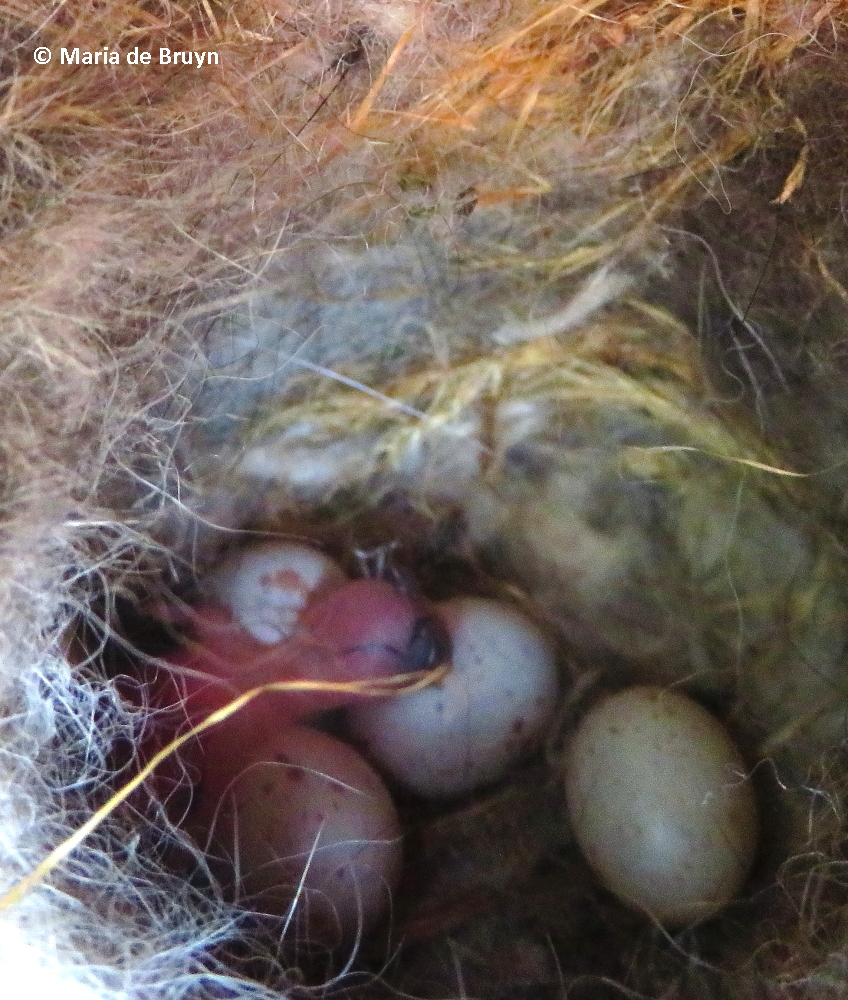
House wrens do their utmost to drive other birds out of their territory so that there is no competition for food needed by their nestlings and fledglings. This protectiveness makes them go so far as to peck other birds’ eggs, which they have done with chickadees and bluebirds in my yard.

Very unfortunately (and upsetting to me), they even killed two nestling nuthatches one year. The other two nuthatch babies managed to fledge. This behavior led a birder, Althea Sherman, to launch a crusade against house wrens in scientific journals in the early 1900s. Now, there are instructions online on how the wrens can be discouraged, for example, on a website devoted to bluebirds.

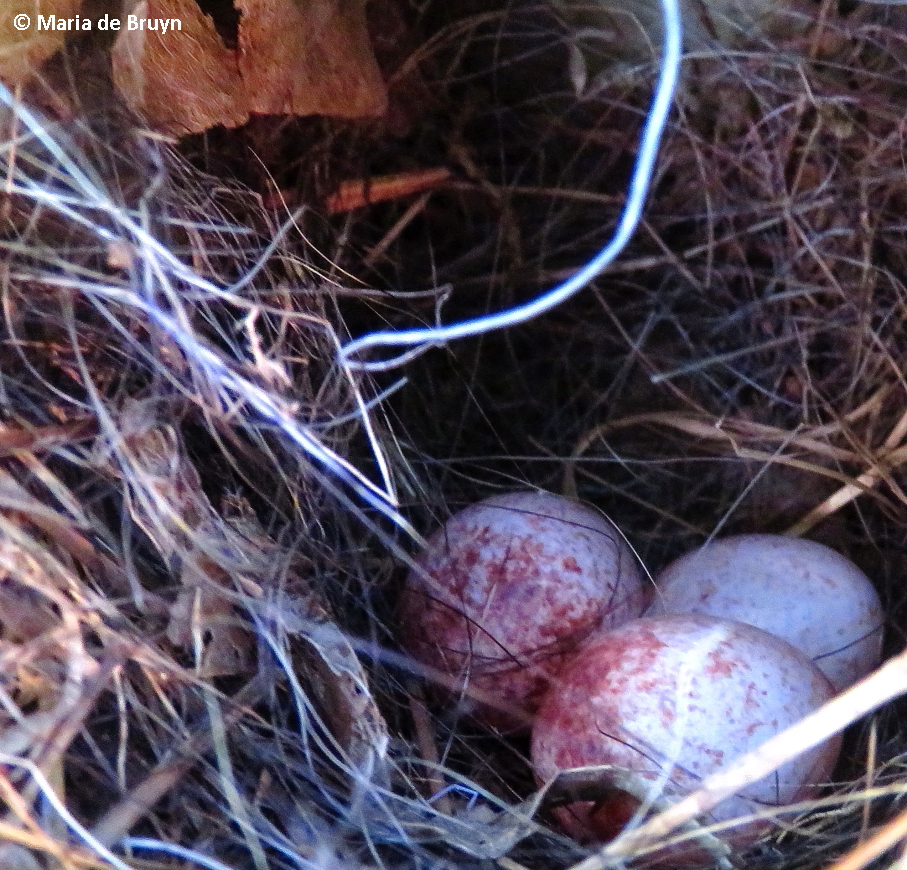
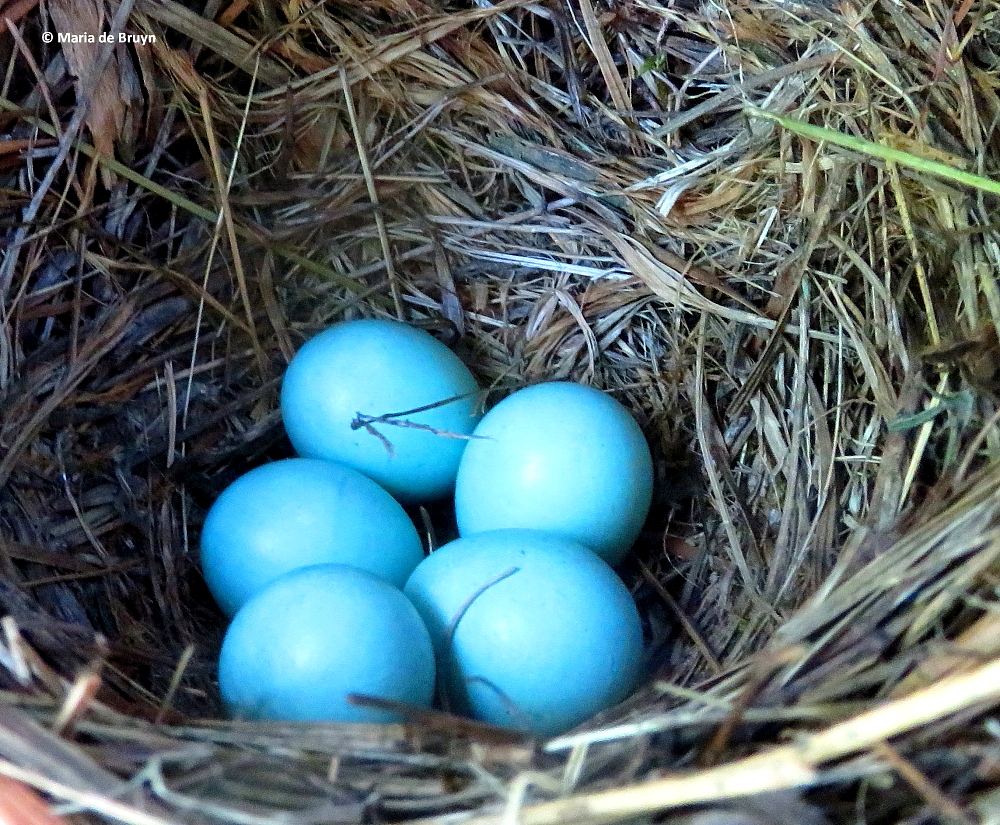
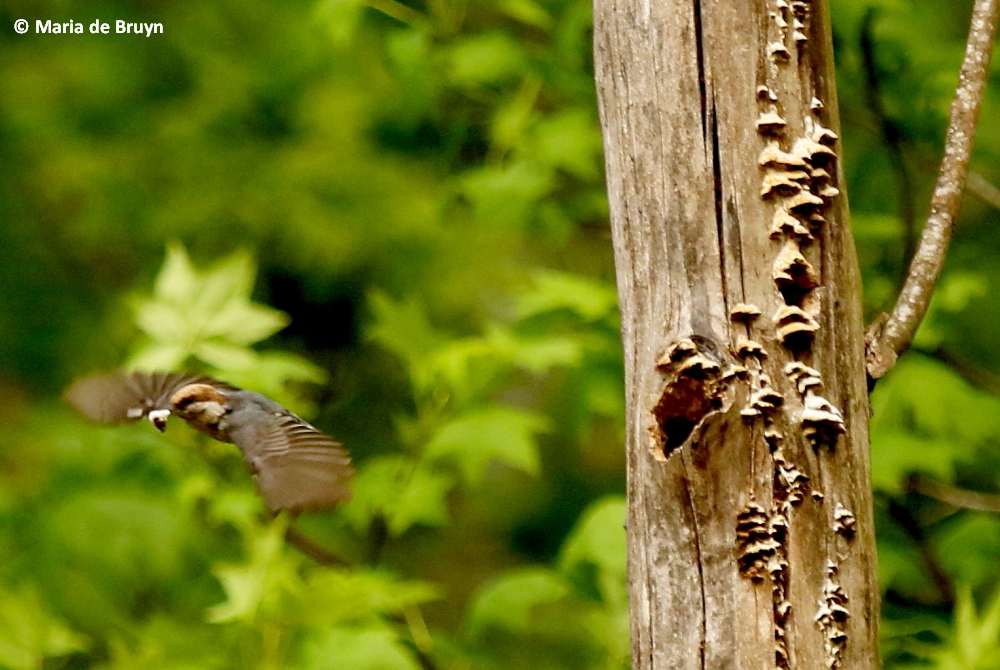
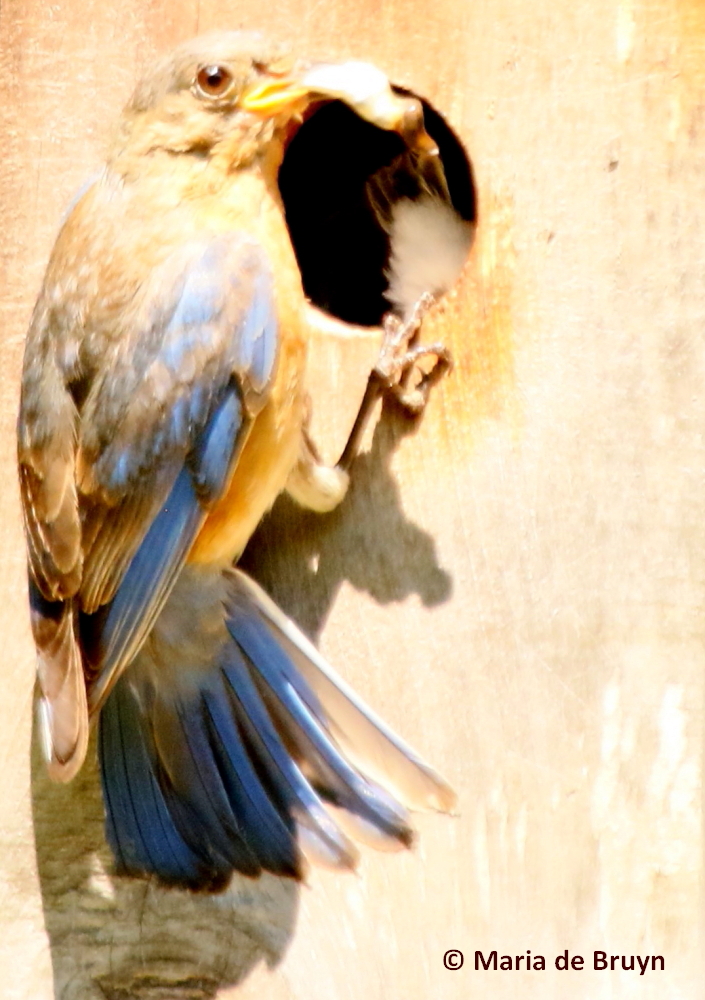
This year, Eastern bluebirds (Sialia sialis) were tending four eggs in one box and a house wren tried to invade. The parents were very protective and successfully drove the wren away (photo below). Another pair of bluebirds had nested early and managed to guide their young to fledging. They then abandoned my backyard for nesting and the house wrens had no rivals for nest boxes in that area for the rest of breeding season.

House wrens are one of the bird species banded in my yard each year for the Smithsonian Institution’s Neighborhood Nestwatch program. This year the bird bander noticed their nest with babies in a backyard nest box, so she upped the chances of catching one by counting on their extremely protective nature.

A net was put up not far from the box and the bird bander played the call of another house wren. This resulted in both mama and papa wren getting inadvertently caught up in the net while trying to drive away the intruder. They were both banded and then immediately let go so they could resume feeding their babies.

The four woodpiles in my backyard were like a larder for them because they host a plethora of insects.


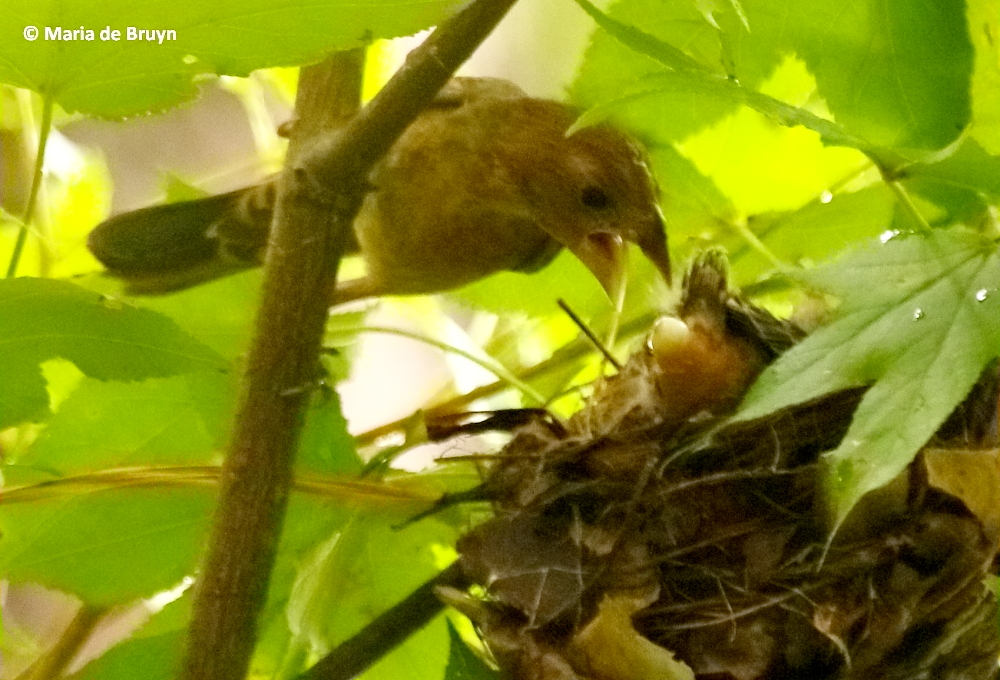
And the house wrens are obviously not that choosy about which insects they eat. Mama and Papa brought a large variety to their ever-hungry nestlings.


The parents were also very good at keeping the nest clean.

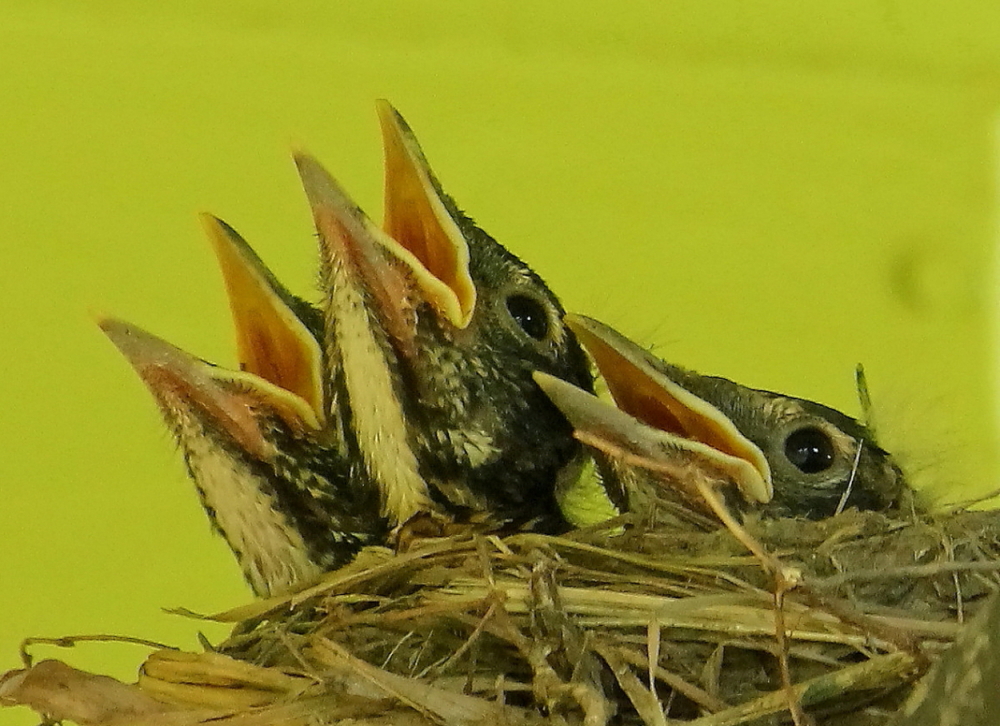
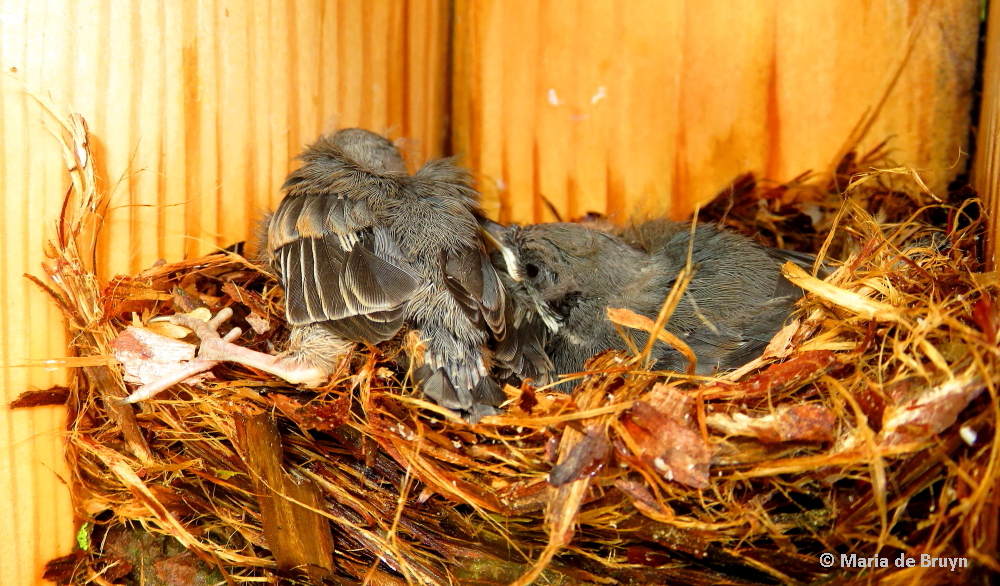
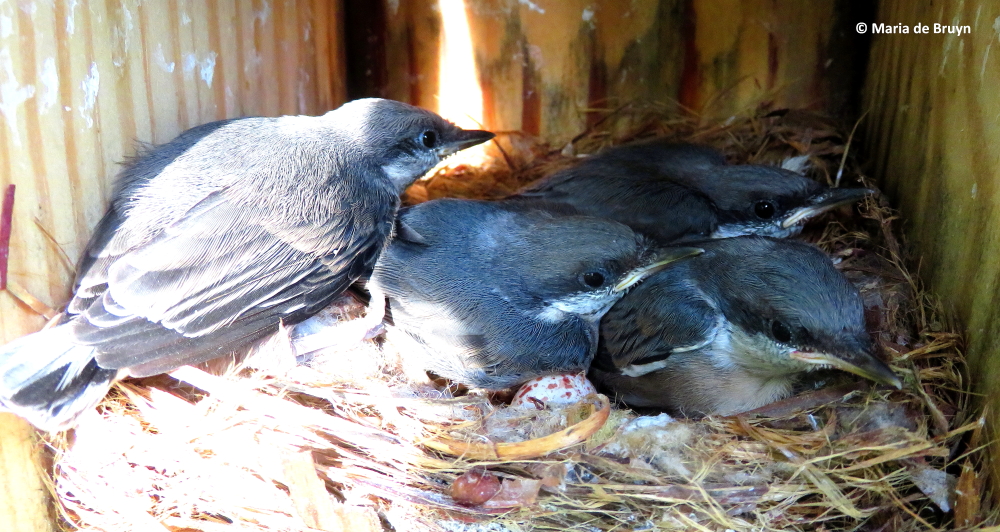
The three nestlings appeared to be producing numerous fecal sacs so that mom and dad were constantly checking the nest for them and flying them away.


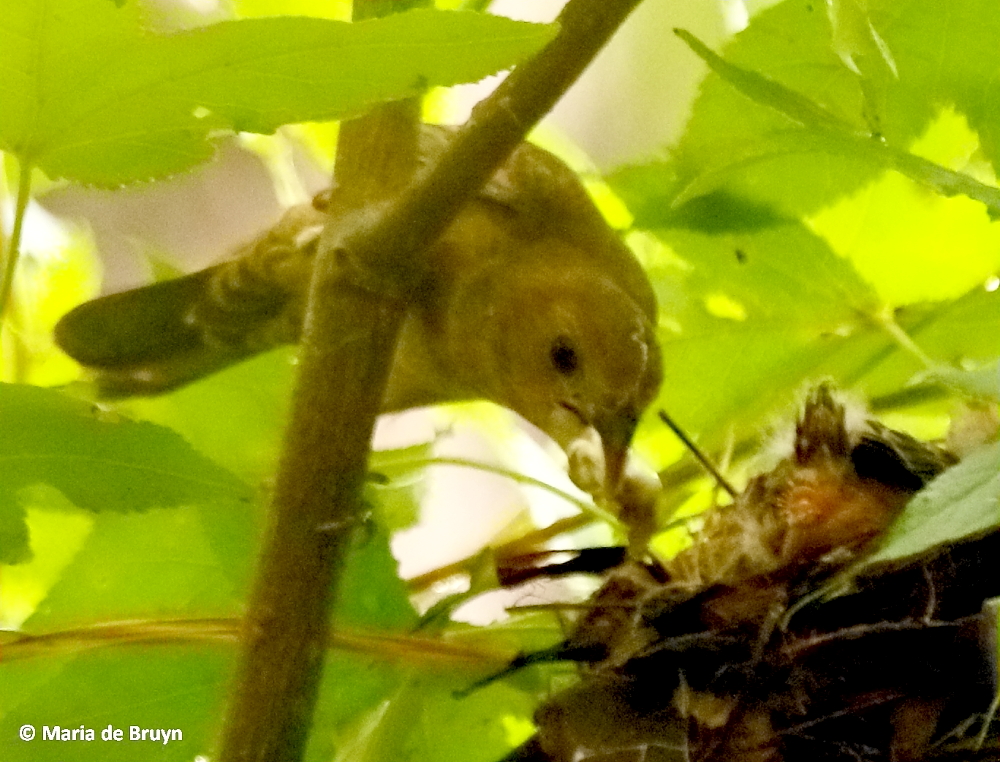
At one point, it was interesting that when the male wren brought a large insect to the nest, he handed it over to the female, who was waiting a bit after having just given the babies food.


Eventually, the large meal was delivered to the nestlings.


As the days went by, the nestlings became louder and more insistent on being fed and the parents scarcely paused in their efforts to keep the meals coming and the nest clean. It must have been a relief for the parents when the babies finally left the nest box because they could now take a breather now and then.


Right after fledging, the parents were still busy. The fledglings had not yet flown far so I could see the first post-fledging feeding session for one young wren.

I had learned that house wrens sometimes incorporate spider egg sacs into the nests they build because the hatched spiders eat nest parasites and thereby help protect the developing nestlings! The parents also fed mother spiders and egg sacs to their young. Just after fledging I caught a circle-of-life moment when a parental wren fed a mother spider with her attached egg sac to a fledgling – the death of the poor insect furthered the life of the new bird.

I could see and hear the parent house wrens continuing to feed the fledglings that afternoon. But after a while they appear to have moved to another yard, where they likely weren’t dealing with humans closely watching.


The Eastern bluebirds have a new nest in my front yard now with four eggs, so my nest watching can continue for a while. And the juvenile birds of other species coming to the feeders are entertaining, too.

Costa Rican rambles 5B: the Talari Mountain Lodge and environs


After fully experiencing the “honey dew” (another name for cicada urine), we set off for the next university site, an area where students learn about planting. A statue of the Virgin Mary welcomed visitors and we admired some of the beautiful plantings and their seeds that were attracting plenty of insects.


We then left to make a quick stop at a park called Los Cusingos, that we would visit at length later; this was just a quick bathroom break before we took to the road again. My photo of the gray-headed tanager was not that great but you can see how beautiful the red passionflower (Passiflora vitifolia) at the entrance was.

As we drove to a place called Las Nubes, we passed private homes with their filled metal framework trash bins in front, a cemetery and plenty of banana plants.


One of our group members stepped in an anthill when trying to avoid puddles and traffic, which led to some stinging bites. In the meantime, others were trying to see various species of birds that were staying low in the vegetation along the road. I spotted a rather large wasp nest in a nearby tree, likely of the Synoeca septentrionalis species.


At some distance, there was a yellow-headed caracara (Milvago chimachima) sitting on a branch. These raptors are about 16-18 inches in length (41-46 cm) and part of their diet is carrion. They also eat reptiles, amphibians and other small birds, while avoiding birds as food. They take ticks off cattle as well, which gives them a thumbs up from me – any bird that eats ticks is a friend.


A gorgeous smooth-billed ani (Crotophaga ani) was sitting calmly as we milled around in the road. Some people might find this bird homely, but I think it is quite handsome despite a somewhat bulbous beak. They, too, are on my “good birds” list as they sometimes eat ticks and other parasites off of grazing animals. Another nice characteristic is their communal child-raising strategy – several pairs cooperate to build a nest together, in which several females than lay their eggs. They share the incubation and feeding of nestlings – hippies of the bird world!


We traveled on and the views along the road were beautiful, with the mountains and valleys in the distance and then we caught sight of some swallow-tailed kites (Elanoides forficatus) soaring over the nearest valley. We saw one land in a tree and it turned out that they were building a nest there. In the photo, you can see a small white patch on the right-hand side of the tree, which is the female kite on the nest.

As we waited patiently, a few kites began flying overhead; one with nesting material clutched in its claws.


They soared and swooped, giving us delightful views of their flight and then one came by with a meal that it had caught – a poor little chameleon or lizard.


We admired the Talamanca mountain range called La Amistad (Friendship), which separates Costa Rica from Panama. Starting in 1979, these two countries’ governments began a process to conserve the entire range, which is home to four indigenous groups of humans, 600 avian species, 215 mammal species, 250 species of amphibians and reptiles, 115 species of fish and some 10,000 flowering plants! As UNESCO has noted, this is: “one of the very few transboundary World Heritage properties, an excellent intergovernmental framework for coordinated and cooperative management and conservation.”


After a nice lunch, we continued visiting other sites, including one near a Canadian project. That afternoon, I saw my first trogon species – the gartered trogon (Trogon caligatus), another handsome bird to be sure.


While the rest of the group followed Steve’s instructions for sighting some birds hiding in underbrush on a slope, fellow traveler Janet and I watched some leaf-cutter ants (Atta cephalotes) at their labors. Sometimes, I was just not tall enough to see over shrubs to locate a bird and I love all wildlife anyway, so watching the ants in their industrious endeavor was fun.

On our way back to the lodge for supper, we passed small roadside stores and Steve spotted a fork-tailed flycatcher (Tyrannus savanna) for us.


Back at Talari, I did some sightseeing from the balcony of my room, spotting a lengthy and messy-looking flycatcher nest, a variegated squirrel (Sciurus variegatoides) traversing the tree canopy and a pair of palm tanagers (Thraupis palmarum), who were tending an offspring.


At first, I thought the fledged bird was a different species as it sat under a leafy canopy, but later I saw the parents with it. Then it surprised Janet, who was staying next door – she called me over to see the fledgling who had flown into her room and was sitting in the middle of the floor.


She also had two nests under the roof of her balcony, one of which definitely belonged to a clay-colored thrush (Turdus grayi).


After admiring one of the neighbors’ cows and social flycatcher (Myiozetetes similis), I caught sight of a quiet beauty sitting on a branch in front of my room.


The Lesson’s motmot (Momotus lessonii), also known as the blue-diademed motmot, has a bright red eye and beautiful tail with what some birding sites call a “raquet tip”.


As we set off for the dining area, we were treated to a visit from a streaked flycatcher (Myiodynastes maculatus), quite a good-looking bird with its heavily streaked back, breast and face.


As we passed through some vegetation before dinner, I saw a gorgeous flowering banana as a blue-feathered and red-legged honeycreeper (Cyanerpes cyaneus) flew high overhead.


Even though we often were looking for birds in dark and leafy/shady areas, I avoided using a flash but when I saw the lemur anole (Norops lemurinus) on a tree, I gave in so that I coul d get a photo.


As dusk came on and we looked out from the dining area, we got to see some fiery-billed aracaris (Pteroglossus frantzii) in the distance.


While some others in our group got to see one close up, that was not my fate, but the next morning, the aracaris were in a little better light though still far away, allowing me to get a bit better photos.


We ended our second night at Talari Lodge with an owling outing – Steve managed to draw in a tropical screech owl (Megascops choliba) by playing its call on his phone. The owl who came had had an injury to one eye, with a pupil that would no longer dilate but s/he seemed to be flying fine and looked healthy. That bird gave us a nice long look at its beautiful self so that we retired for the night with a feeling of birding satisfaction!


Avian generations in the making – part 3B: fledgling and post-fledgling care

The number of days after hatching when young altricial birds leave the nest is fairly predictable for many species; knowing those approximate dates is helpful if you want to plan a day to watch fledging happen. I can often arrange to sit and watch a nest box on the appointed day for several hours.This has enabled me to see several broods of Eastern bluebirds and brown-headed nuthatches make their leaps to freedom on the path to adulthood.

When it is time for fledging, parent birds encourage their babies to leave the nest. They may entice them by perching nearby with some food but not bringing it to them. Or they fly to the box with food and then go to a branch instead of feeding. The Eastern bluebirds (Sialia sialis) in my yard will hover in front of the nest box like a hummingbird, sometimes with food in their mouths; perhaps they are showing the young ones that flight involves flapping wings.

While in some species, parents appreciate help from older children in caring for a current brood, Eastern bluebirds apparently do not. This may be because they see the previously fledged young as competitors for food. In my yard, father bluebird especially was chasing the young of earlier nests away from the feeders, not only when they begged but also when they fed themselves.


When fledging day arrived for the bluebirds’ third brood, one of the older siblings (I’m not sure if it was a female or male) was very interested in seeing the third brood fledge. He imitated his parents, hovering in front of the nest box so the young ones could see him.


Again, however, the parent bluebirds chased him away.

This did not deter the immature bird, however. He waited for the parents to go get food and again took on encouraging the young siblings. It was fascinating to watch!


The parents returned and drove him off with a show of bad temper.

Eventually, the babies did fly out of the nest box into a nearby crepe myrtle. There, they continued to call for food with a wide-open mouth.


This gaping behavior stimulates the parents to feed their offspring and the offspring can be very insistent and persistent in begging for food.


Eastern starling (Sturnus vulgaris)


Carolina wrens (Thryothorus ludovicianus)


Common grackle (Quiscalus quiscula)     Royal tern   (Thalasseus maximus)

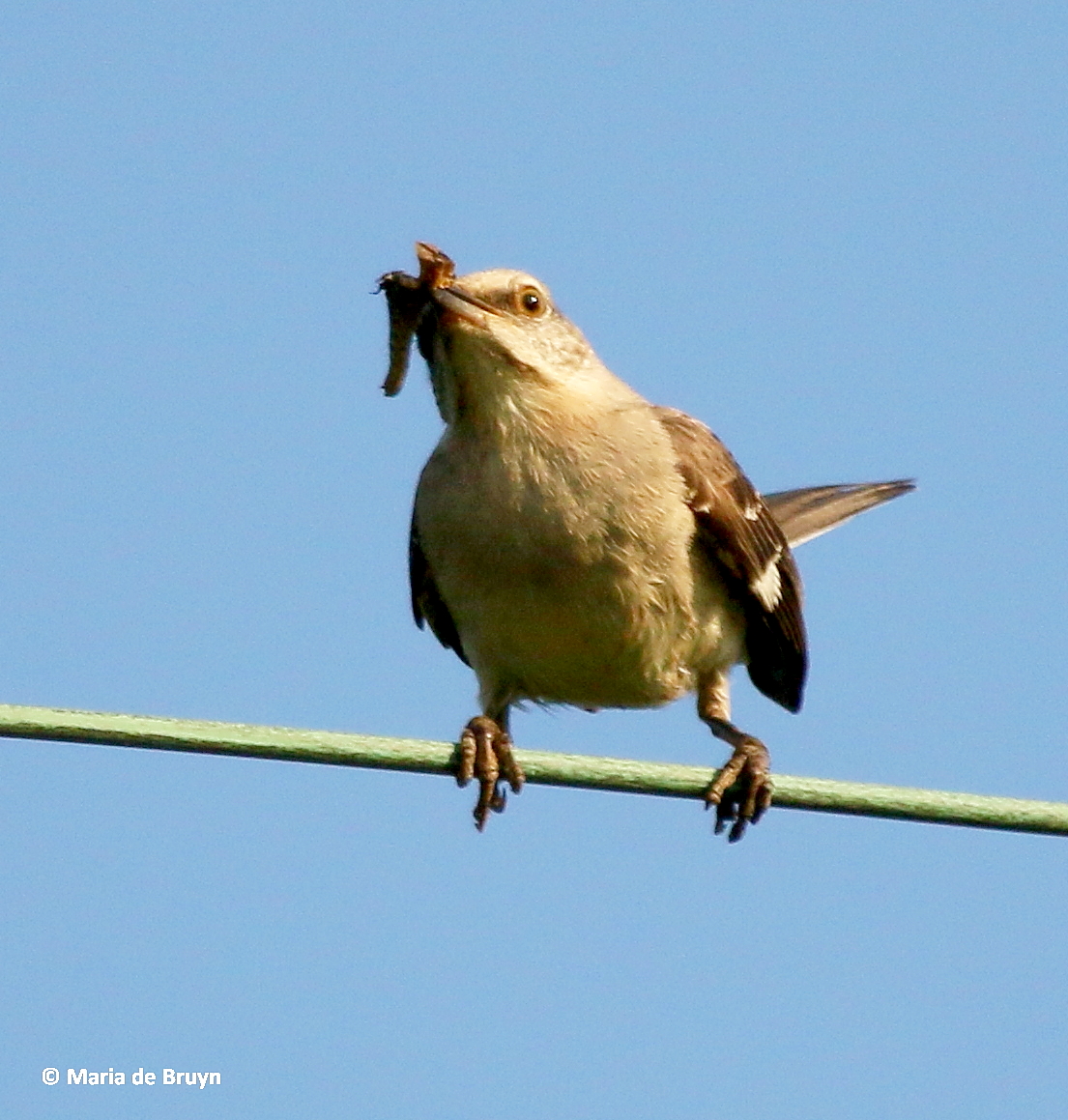
This behavior can go on for days, especially when the young ones cannot yet fly, like this recently fledged Northern mockingbird (Mimus polyglottos).


The birds that feed their young ones on the ground, like the American robins (Turdus migratorius) have it a bit easier than those that feed juveniles perched on wires, like these barn swallows (Hirundo rustica).


I can imagine that the mother and father get to a point of thinking, “Enough already!” as those large fledglings continue to beg for food; this parent Northern cardinal (Cardinalis cardinalis) did not seem willing to go out for yet another bug for the young one.

But some young birds can be very insistent, even when it is obvious that they are now fully capable of finding some food on their own. This parent chipping sparrow (Spizella passerina) seemed willing to be a feeder for a while longer.


The parent-child feeding routine that often catches people’s eye is when a young brown-headed cowbird is being fed by a (non-voluntary) adoptive parent. For example, here we see a male hooded warbler (Setophaga citrina) bringing food to a brown-headed cowbird baby (Molothrus ater) after the youngster spent quite a while loudly crying out for a meal and hopping around on branches after the parent to convince him that he needed to be fed.


Of course, at a certain point the parents do stop feeding and the young set off on their own. They may check out nearby nest boxes, either scouting homes for next season or looking for roosting boxes for the cold winter nights, like these Eastern bluebirds. They may groom a bit to remove the last bits of fluffy feathers, like this red-shouldered hawk (Buteo lineatus). And then they are ready to spend an autumn and winter getting ready to repeat the cycle, this time as the parent birds. And we can look forward to watching the process again. 😊


Avian generations in the making – part 3A: raising and feeding babies

So here in North America, it’s approaching winter and it may seem a bit weird to have another blog at this time on birds raising their young. But I wanted to complete the series even though it has been delayed because of my volunteer activities and commitments the past month. Also, it is now late spring in the Southern hemisphere so for some people this is seasonal and there are other birds around them that are getting ready for babies, though different species than these American robins (Turdus migratorius). Because this part kept growing longer as I worked on it, I’ve divided it into two parts – this one on raising the babies until fledging and the next one on fledging and post-fledgling care. I hope all of you who read this will enjoy it no matter where you live.

It’s fascinating to me to watch the birds during their reproductive cycle; I always learn something new. Once parent birds have completed a nest to their liking, the female lays her eggs and proceeds to brood them, with some species sitting on the eggs almost full time right away and others taking breaks.


Carolina wren (Thryothorus ludovicianus)              Eastern bluebird (Sialia sialis)

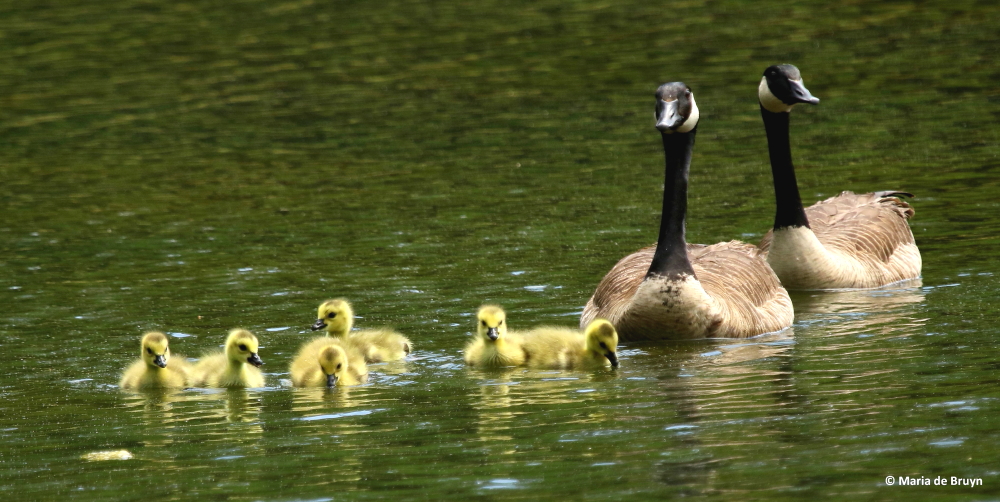
An acquaintance recently told me about a friend of hers who commented that she had seen a very pregnant goose that was so fat, she was waddling. The acquaintance proceeded to give an avian reproduction lesson to her friend – a woman in her 80s – who apparently did not know all birds lay eggs! Even after babies hatch, the Canada goose (Branta canadensis) may still look well-fed!

Some bird species have young who are “precocial”, that is, they are covered with downy feathers and have open eyes when they hatch and are soon able to feed themselves. These species include turkeys and ducks, like these mallards (Anas platyrhynchos), and the young often leave the nest soon after birth (which makes them “nidifugous” – good Scrabble word!). The newborns may look fuzzy but it’s not long before they start to take after their parents’ looks.

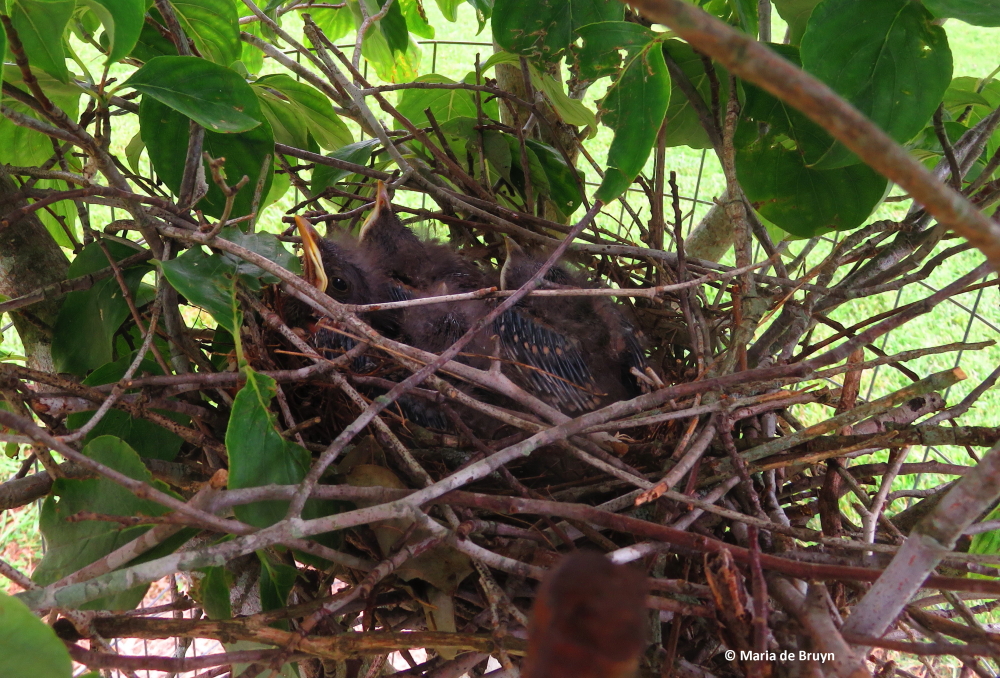
Other birds, such as songbirds, are altricial (as are human beings) – they are naked and helpless at birth and require considerable care before they can walk, fly and feed themselves. If you have some in a nest that is easily observable (and you can take photos when parents are not there so you don’t distress them), it’s interesting to see how the babies develop.


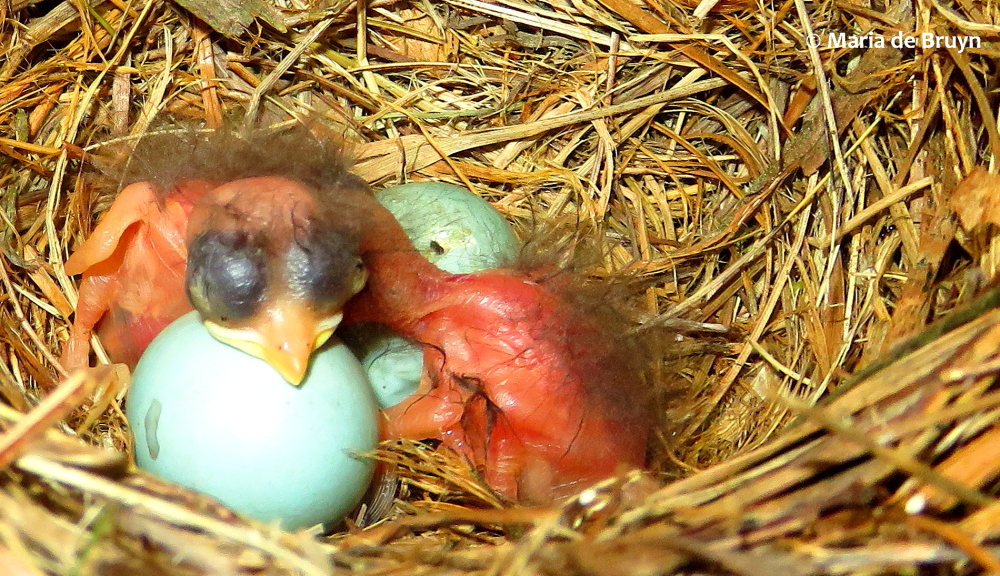
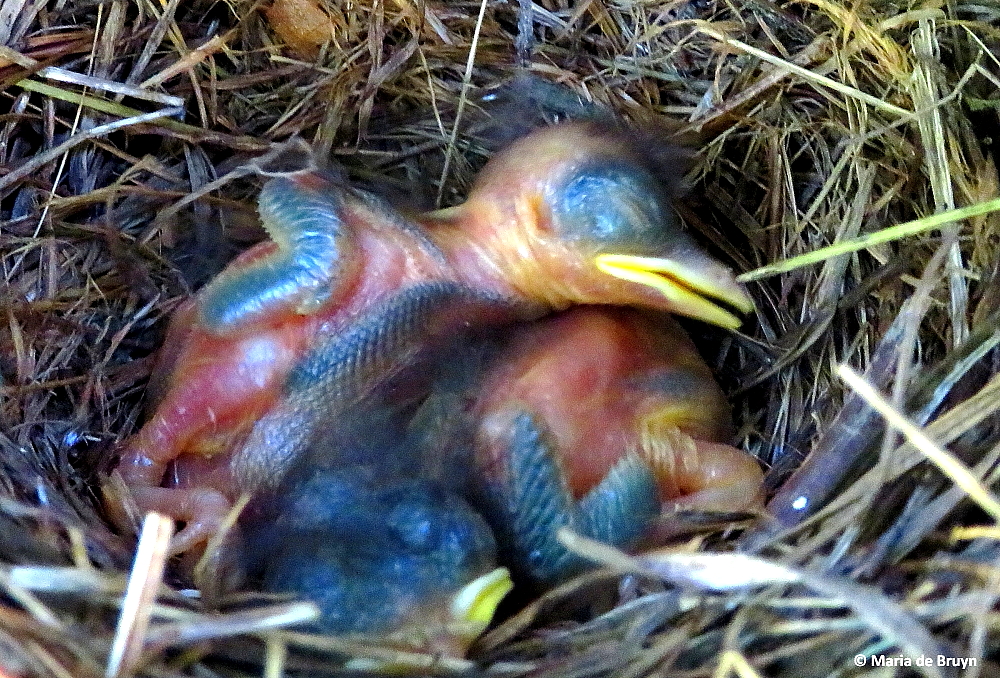
Carolina chickadees (Poecile carolinensis) on 18 and 22 April           

Brown-headed nuthatches (Sitta pusilla) on 13, 25 and 29 April


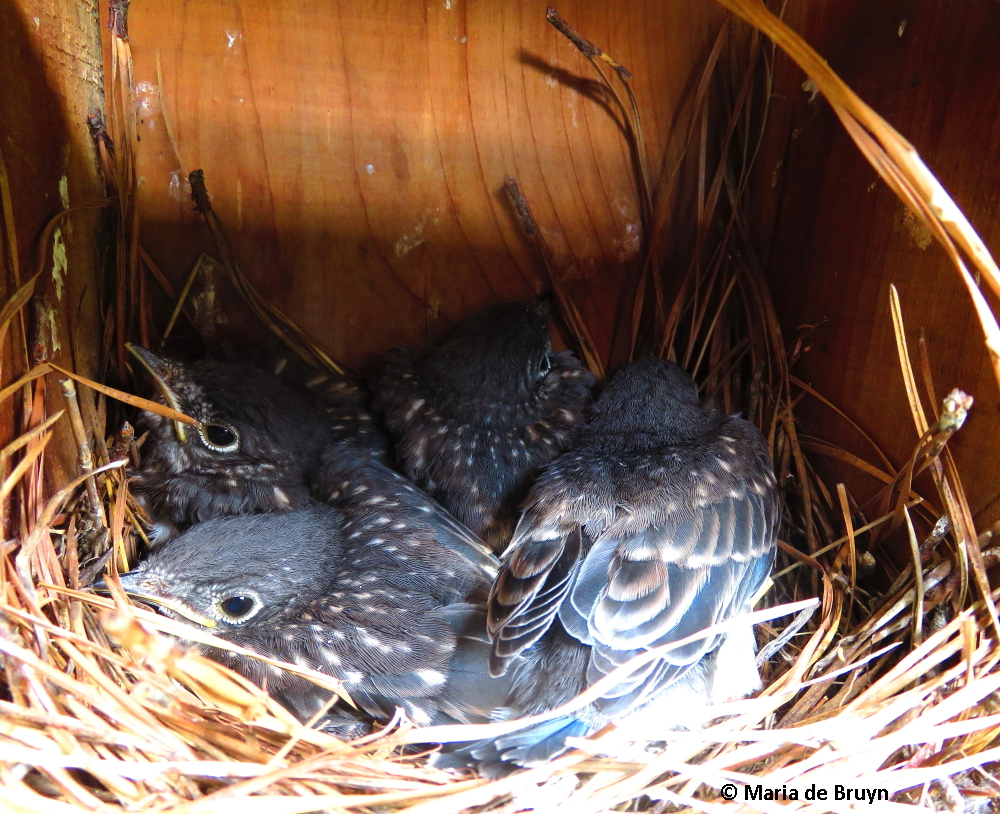
Eastern bluebirds (below)


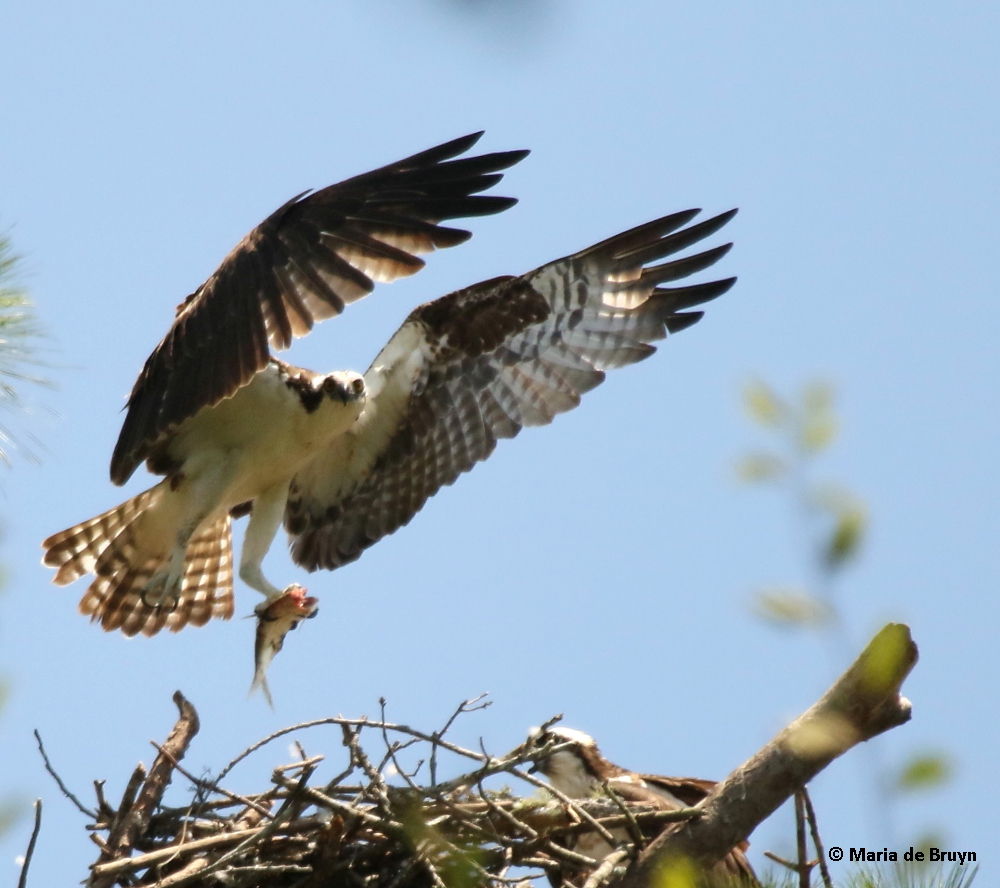
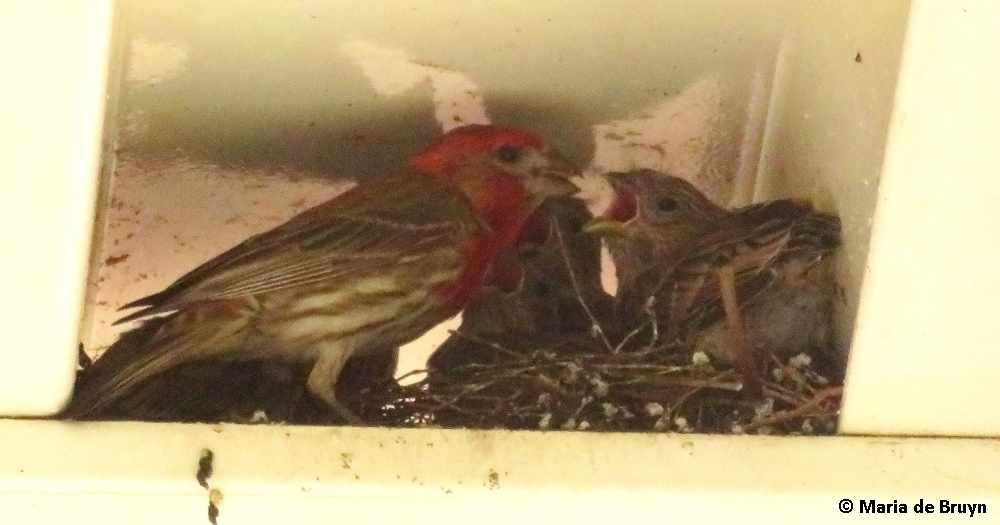
As the mother incubates the eggs, her mate will often feed her so she doesn’t have to leave the nest. This young osprey (Pandion haliaetus) was assiduous in bringing his female life companion fish. Then as the babies hatch, in many species both the male and female parents get busy bringing the young frequent meals.  It’s estimated that Carolina chickadees, for example, will bring over 5000 insects to their brood before fledging!

Northern mockingbird (Mimus polyglottos)


House finch (Haemorhous mexicanus)  and Red-headed woodpecker                (Melanerpes erythrocephalus)


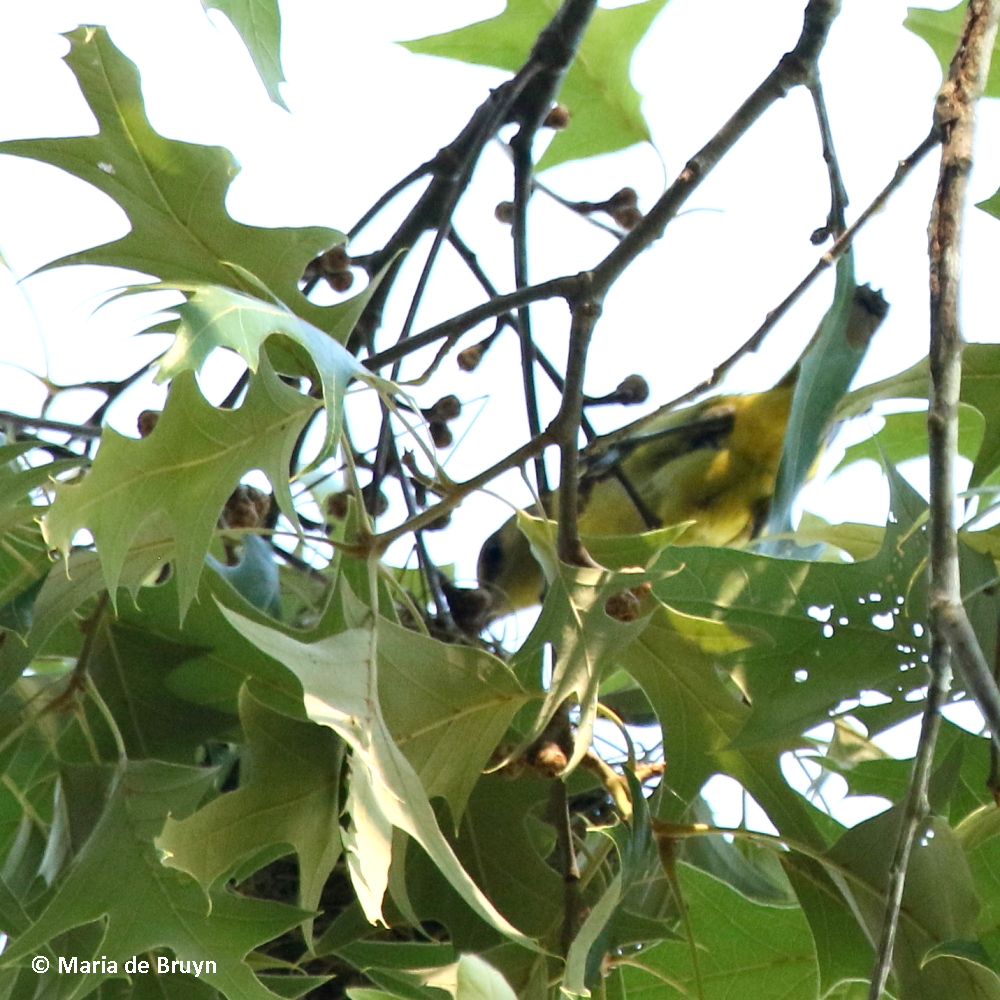
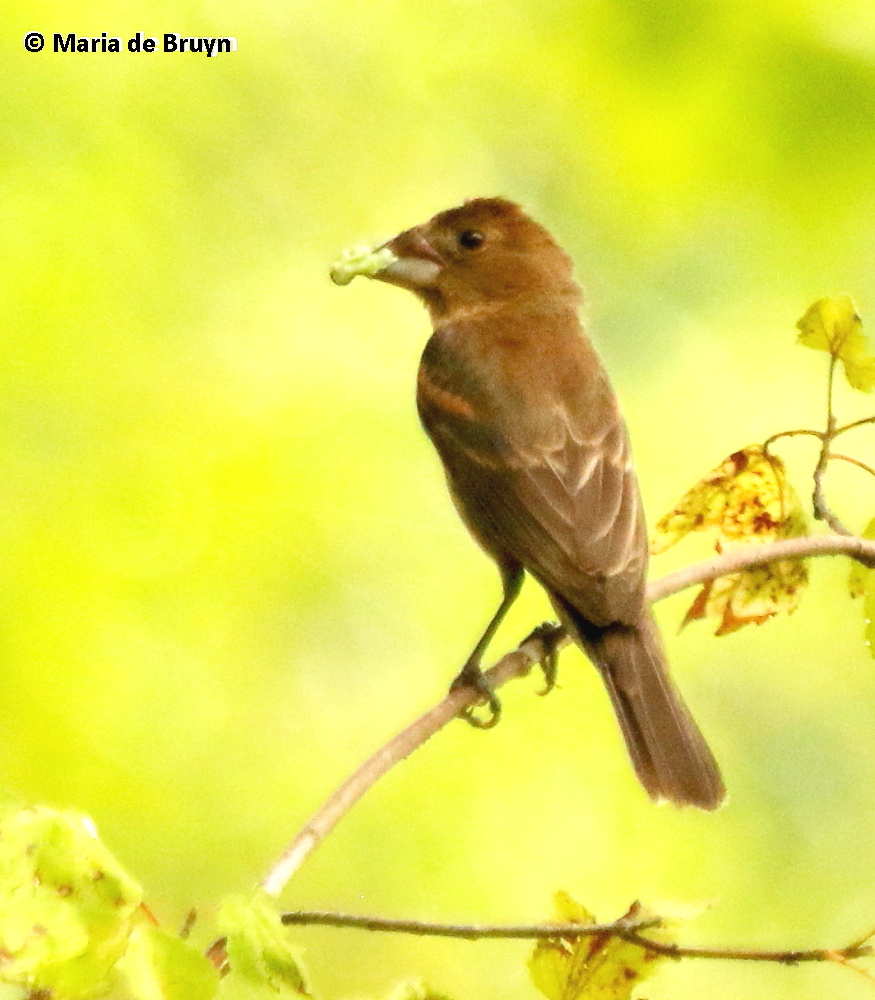
Orchard oriole (Icterus spurius)                  Blue grosbeak (Passerina caerulea


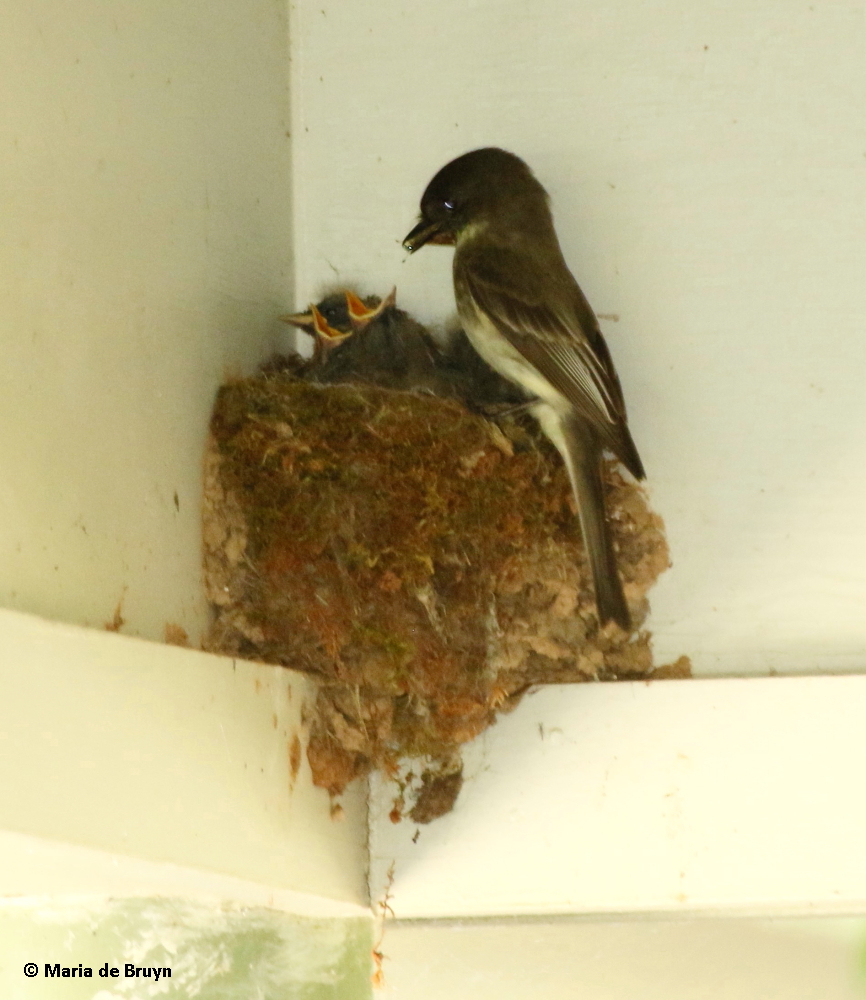
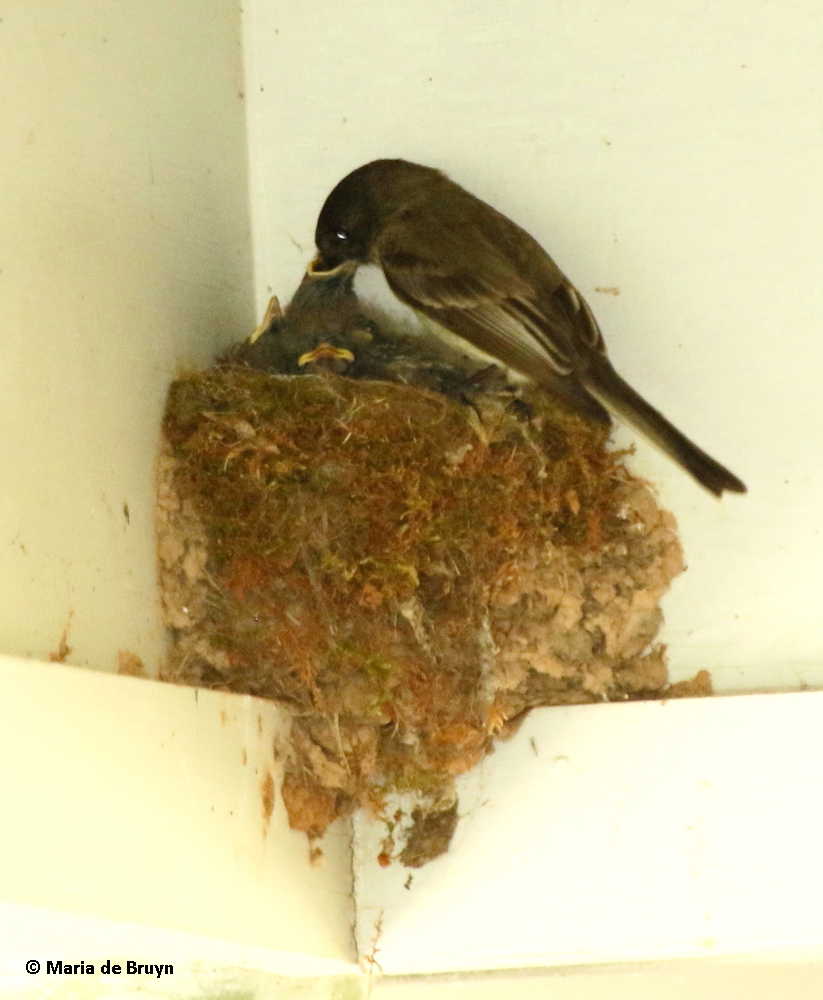
Eastern phoebe (Sayornis phoebe)

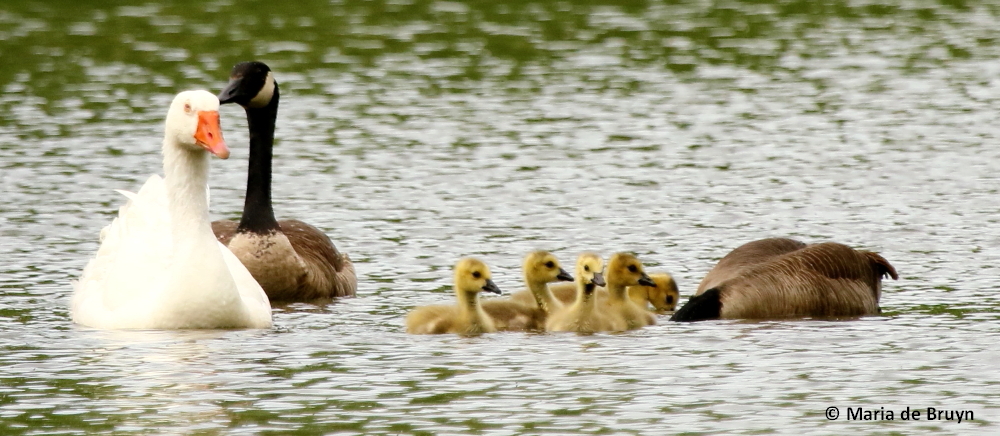
In some species, the previous year’s young will help their parents with the new brood. Brown-headed nuthatches and American crows are examples of this. A pair of Canada geese that I observed this past spring seemed to have a domestic goose helping them out.

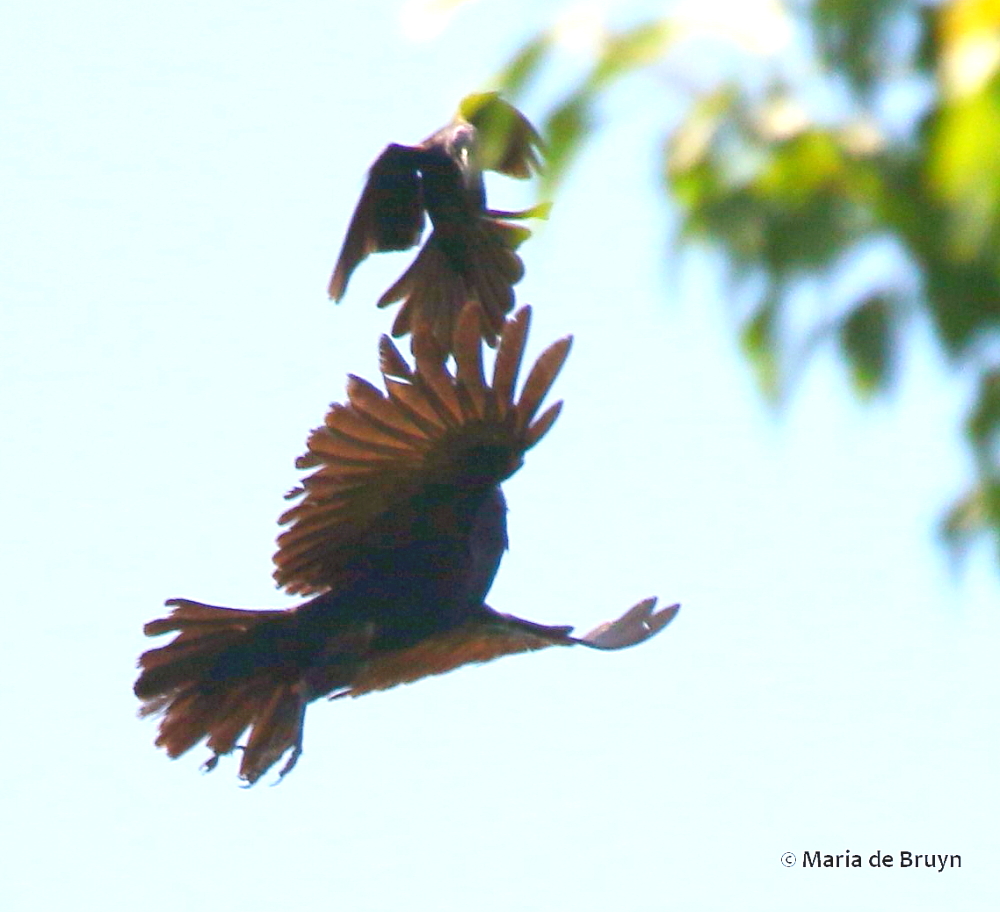
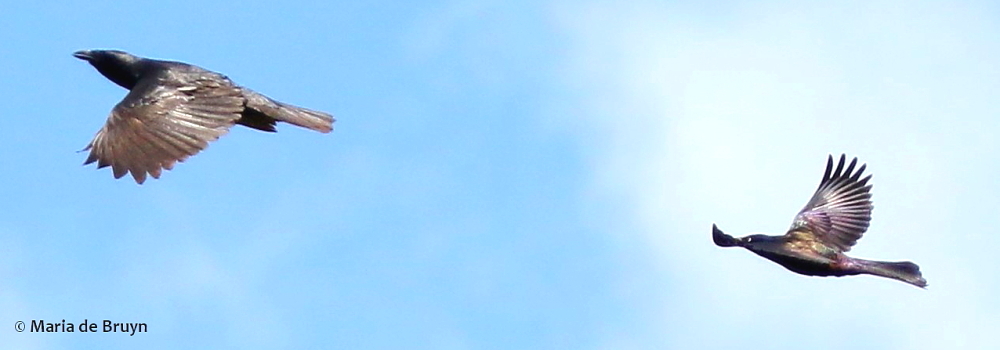
The parents have other chores, too. They must keep the babies safe from predators – Both American crows (Corvus brachyrhynchos) and common grackles (Quiscalus quiscula) will be chased away by songbirds, for example, because these birds will raid nests to eat eggs and babies. But the grackles must also protect their own young against the crows, pursuing them non-stop to drive them away.
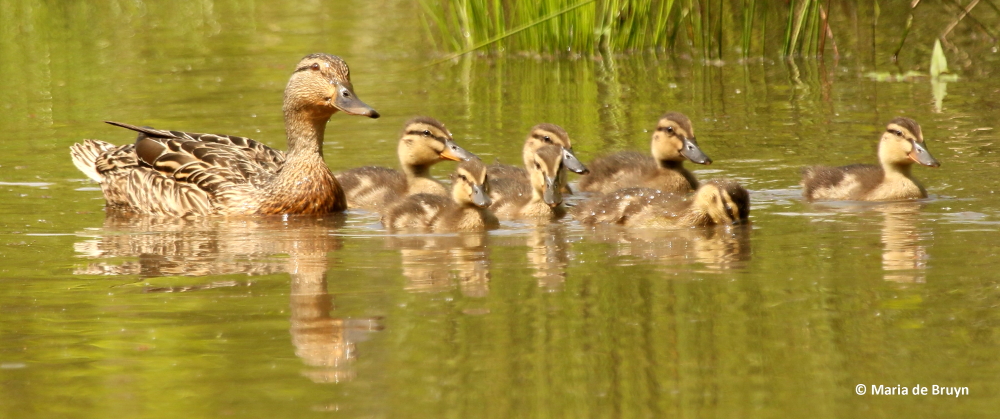
 

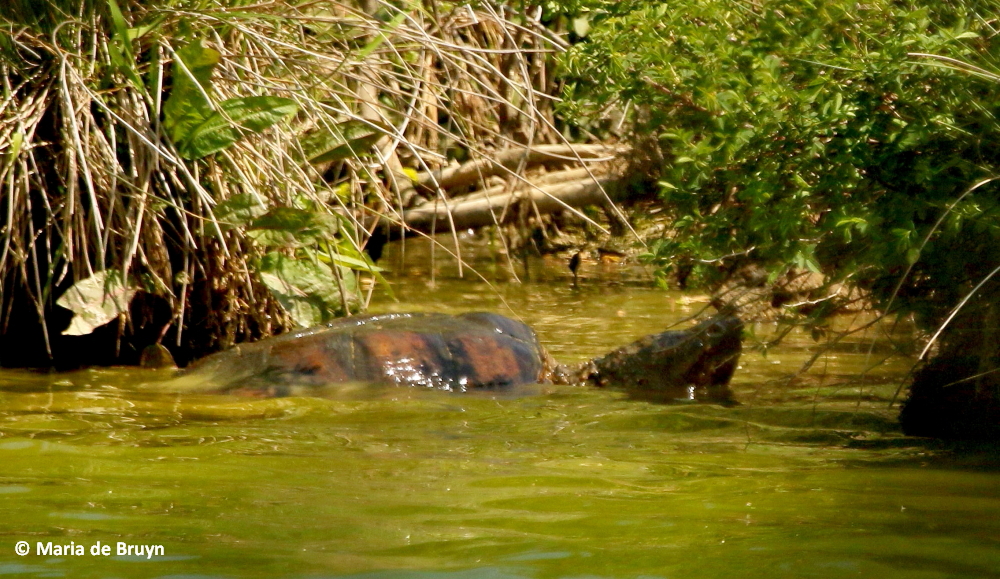
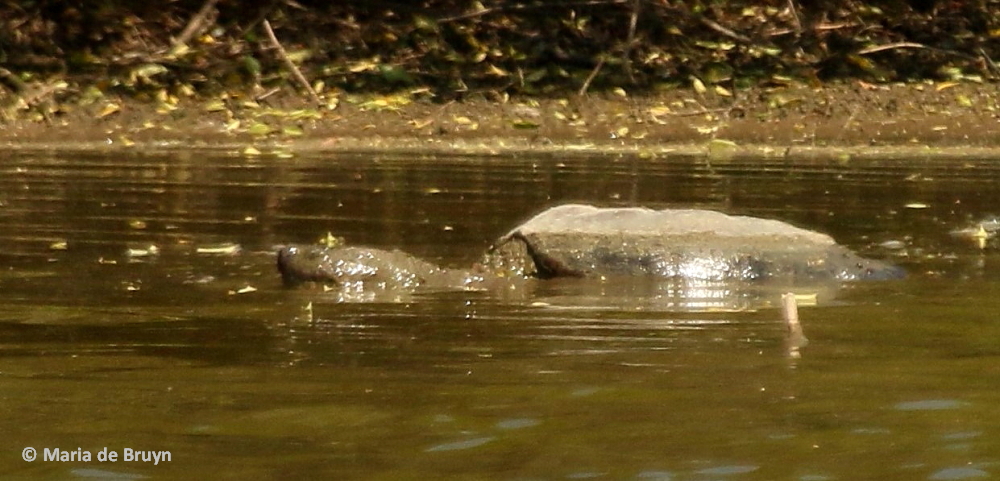
For other birds, protecting the young can be more difficult. This mother wood duck (Aix sponsa) was raising her brood in a pond that was home to at least three large snapping turtles (Chelydra serpentina). Ultimately, another birder and I thought she only had two ducklings survive.   

Keeping the nest reasonably clean is another chore. The babies make this task a little easier than you might think because they defecate into a mucous membrane that forms a sac. When you watch a nest box, especially when it gets closer to fledging time, you can periodically see the parents flying out of the box with a white blob in their mouth, which turns out to be a fecal sac. They either discard it elsewhere or sometimes eat it for some nutritional benefit.


Brown-headed nuthatches

This year, I was surprised to have caught a female blue grosbeak during the cleaning – it appeared that she was actually pulling the fecal sac from the baby! Later, I read that some species stimulate defecation by prodding the babies’ cloaca so they can get on with the chore. I also caught a photo in which a baby bluebird had just presented its rear end to the parent for removal of a sac. I could imagine that some human parents might think a fecal sac would be a cool avian adaptation for their babies to have – no more dirty diapers and expense for diapers either! (An idea for an SF short story?)


After all their efforts, the parents are usually ready for those babies to fledge – the subject of the upcoming last blog in the series.


* Not all the photos in this blog are of great quality, I know, but my intention was first to show behaviors and secondarily to have some nice shots in the blog.


A cuckoo causing confusion and consternation, delight and distress….

In the spring this year, I and another birder had the uncommon pleasure of seeing yellow-billed cuckoos (Coccyzus americanus) courting at Mason Farm Biological Reserve. These birds often stay high in trees, hidden by leaves, so it is always a treat to see one of them out in the open. Seeing two together, as the male tenderly offered his lady love a gift, was an unexpected pleasure.


Also unexpected have been my more frequent sightings of cuckoos in my yard. Last year, I had caught a glimpse of one in a crepe myrtle tree; I thought it was a lucky fluke. This year, I began to see cuckoos in the large trees of my front yard more often, though frequently they were half hidden behind the leaves of the willow oak, red cedar and persimmon. I did hear their identifying calls so I knew when they were around but not in sight.

Then, this past Sunday afternoon as I sat on my front porch photographing birds and insects visiting my flower garden, I suddenly caught sight of a cuckoo flapping about on a makeshift trellis I had arranged around an oak stump where I hope Carolina jasmine and other climbing vines will create a pleasing area.

The spot is popular with chipmunks and Eastern gray squirrels (Sciurus carolinensis), as well as many smaller birds like Renee, one of the banded Carolina wrens (Thryothorus ludovicianus) living in my yard.


But to see a large cuckoo sprawled on the branches was unexpected and I feared that it had an injured wing after escaping from a hawk attack. I took a few quick photos. Then I approached to get a better look — the bird tried to flutter away but didn’t get far.

I ran inside to get a box and the phone number of a local wildlife rehabilitator. I left a message and managed to get the bird in the box, to which it protested vigorously. When I closed the top, it calmed down and then the rehabilitator returned my call stating that perhaps it was a fledgling – I said it looked like the wing was injured so she asked me to take a photo of it.

When she saw my point-and-shoot camera photo, she said it wasn’t clear whether it was a juvenile or not and asked me to photograph the beak. Young birds have a yellow or bright “lining” where the beak meets the face. This area is called the gape flange and in most birds, the color disappears as they age and the beak becomes firmer.


With a slightly better photo of the bird’s head and beak, the rehabilitator informed me that this was indeed a young bird. She also told me that the bird probably was feigning a wing injury to get the parents to come back more quickly with food! On her recommendation, I put the bird back on a stump by the makeshift lattice.

I knew about killdeer adults pretending to have a broken wing and dragging it on the ground to lead predators away from a nesting area. The yellow-billed cuckoo adults will also do this distraction display.

But I had not heard of fledglings engaging in this ruse. The rehabilitator said she had known of crow fledglings that kept this up a couple days, although she didn’t realize cuckoos would do this as she doesn’t get many calls about this species. But, she commented, “birds aren’t stupid; a free meal is a free meal.”

I kept checking on the bird and it stayed on the stump quite a while. Then it hopped down into the leaf litter and made its way over to some large rocks under a cedar tree with low-hanging branches. First, the cuckoo just hung out on the rock. And all this time, it kept that wing stretched out.

Then the bird lunged upward to get onto the branch. At this point, I seriously wondered whether it wasn’t injured after all, perhaps having fallen out of the nest and hurting its wing when it landed. It got a purchase on the limb and continued to keep its wing out. Then it fell off the branch.


After a short rest on the rock, the fledgling jumped up on to the branch again and stayed there. I went inside and returned periodically to check on him/her. About 3.5 hours from time I first saw him/her, the bird was still resting on the branch with the wing out. S/he was no longer wary when I came to look but viewed me calmly.

About 30 minutes later, I went back outside for another check and found the bird on the branch, but now with its wings both folded in towards its body. I was really glad that it appeared to be ok and hoped the parents would come for it. I had heard them calling earlier in the afternoon but never saw them approach the offspring, though this may have happened when I went inside for brief periods. And when I finally looked at the first photos I had shot in quick succession, I saw a couple where the bird had drawn in both wings to hop about, only to stretch out its wing later again.


When it was almost time for me to leave for a theater engagement with a friend, I went back out to check one more time and discovered my cuckoo friend was gone. I examined the cedar tree to see if it was further up, as well as the trees and ground all around, and could find no sign of him/her. I hoped that s/he finally decided to give up the display and just flew to a better place. I did check the area the next two days but did not see the bird again.

Then, this morning, a distressing finding started off my day. When I went outside, a neighbor boy was staring at the ground in front of my street-side willow oak. When I got there, the cuckoo lay dead at the street edge. He said he had seen the bird yesterday sitting on the road “with a broken wing”. I wish I had seen it – I don’t know if the bird had really been injured after all, was feigning an injury and then fell prey to a neighbor’s cat (which is what I think happened as its underside looked like it might have been in a cat’s mouth), or if something else occurred. In any event, it was such a sad discovery.

I buried the cuckoo while regretting how short its life was. I’m glad I don’t let my cats roam about anymore and I wish neighbors would also keep their felines inside, even though I know that birds might fall prey to a hawk or die because of a disease. But I wish I’d been able to help this beautiful young bird. My emotions tell me the cuckoos won’t return but my mind says they won’t avoid the yard because they lost an offspring. Time will tell.