Warbler watching and migration – a shared pleasure for birders!

black-and-white-warbler-i77a3458-maria-de-bruynAutumn migration in North America has been underway for some weeks and our bird populations in North Carolina are changing in composition. Some birds stay year-round – for example, I see robins, blue jays, Carolina wrens, Carolina chickadees and tufted titmice in all seasons to my great delight. However, other birds who have been here since spring are now getting ready to leave for a southerly jaunt to a place that will be warmer for them in winter – most of the ruby-throated hummingbirds and some gray catbirds have departed already. (I have had a catbird stay year-round but others leave.) Many black and white warblers (Mniotilta varia) will be leaving, too.

american-redstart-i77a4367maria-de-bruyn-resThe Nature Conservancy has noted that the autumn songbird migration is one of the top four migrations in this state. The Audubon Society has even published a guide to this migration and when certain species usually begin their travels. (Left: American redstart male)


This seasonal event means that dedicated birders make special efforts to visit places where it’s likely we’ll see warblers. Many of North America’s 50 species don’t eat seed or suet, so you won’t find them visiting your feeders often. I have found, however, that pine warblers (Setophaga pinus) and yellow-rumped warblers (Setophaga coronata) are pretty social and those who are here for the winter are already joining my “regular” birds at feeding stations. The pine warblers especially like suet (female left, male right below).

pine-warbler-i77a0184-maria-de-bruyn-res        pine-warbler-i77a0409-maria-de-bruyn-8-x-10

The yellow rumps are still looking around a lot for insects; this one snagged a skipper butterfly.

yellow-rumped-warbler-i77a5552-maria-de-bruyn-res

In the autumn, many of these songbirds no longer have their beautiful breeding plumage, which is often so distinctive that you can identify them easily, especially the males. I was lucky enough to see some of those beauties during spring migration as well as in the summer for the ones that spend the warmer months here.

prothonotary-warbler-i77a2854-maria-de-bruyn-res   prothonotary-warbler-i77a9933-maria-de-bruyn-res

Prothonotary warbler male (Protonotaria citrea)

yellow-throated-warbler-img_0418-maria-de-bruyn        prairie-warbler-i77a1622-maria-de-bruyn-res

Yellow-throated (Setophaga dominica) & prairie warblers (Setophaga discolor)

american-redstart-i77a7811-maria-de-bruyn-res


The warblers’ non-breeding coloration is frequently duller and drabber than their breeding plumage. Often only experienced birders can tell some species apart on first sight. Added to that is the fact that young birds don’t yet have their adult plumage and the immature males often look just like adult females. So it is a challenging time for identification, especially for me, but an exciting time for discoveries.


blackpoll-warbler-i77a1289-maria-de-bruyn-resGetting photos of these lovely birds can be tricky since they move about a lot in search of their insect meals. It is ultimately the pursuit of those culinary delights that leads the warblers to migrate South, since the insect population declines dramatically in areas with cold weather.

Nature photographer Mary had discovered a spot where the warblers could bathe in a relatively protected fashion; she kindly shared the location with some of us and a number of avid birders sat with her for hours waiting for the birds to appear. Some of our more “common” avian friends used the site, too, including a gray catbird (Dumetella carolinensis) and a brown thrasher (Toxostoma rufum).

gray-catbird-i77a4922maria-de-bruyn-res    brown-thrasher-i77a4880maria-de-bruyn-res

northern-waterthrush-i77a5013maria-de-bruyn-res


A Northern waterthrush (also a warbler, Parkesia noveboracensis) found the spot enticing.

The trees around the water hosted birds as they looked for insects, like the black-throated blue warblers below (Setophaga caerulescens), seen a few weeks apart.


black-throated-blue-warbler-i77a8117-maria-de-bruyn-res  black-throated-blue-i77a4426maria-de-bruyn-res

A female American redstart (Setophaga ruticilla) spent time working the shrubs surrounding the creek with some success.

american-redstart-i77a4981maria-de-bruyn-res    american-redstart-i77a4996maria-de-bruyn-res

The male redstarts hopped about the branches and rocks hanging over the creek for a while before venturing below to bathe.

american-redstart-i77a7628-maria-de-bruyn-res american-redstart-i77a4217-maria-de-bruyn-res

american-redstart-i77a4477maria-de-bruyn-res  american-redstart-i77a4480maria-de-bruyn-res

The birds appeared to enjoy their bathing spot immensely, sometimes dipping under water over and over again.

american-redstart-i77a4685-maria-de-bruyn-res  american-redstart-i77a4693-maria-de-bruyn-res

american-redstart-i77a4658-maria-de-bruyn   american-redstart-i77a4629-maria-de-bruyn-res

american-redstart-i77a4710-maria-de-bruyn-res


They also didn’t mind sharing the space with each other (or sometimes other species)..

magnolia-warbler-i77a2250-maria-de-bruyn-res


The Magnolia warblers (Setophaga magnolia) did the same, giving me some good looks and making my first in-person sighting of this species (lifer!) quite special.


magnolia-warbler-i77a5161-maria-de-bruyn-res    magnolia-warbler-i77a5184-maria-de-bruyn-res

chestnut-sided-warbler-i77a5210-maria-de-bruyn-res


The chestnut-sided warbler (Setophaga pensylvanica)was a very vigorous bather!

chestnut-sided-warbler-i77a5230-maria-de-bruyn-res

chestnut-sided-warbler-i77a5207-maria-de-bruyn-res    chestnut-sided-warbler-i77a5203-maria-de-bruyn-res

hooded-warbler-i77a4728-maria-de-bruyn-res


A male hooded warbler (Setophaga citrina) made a brief appearance one day, followed by some female and male common yellowthroats (Geothlypis trichas).


common-yellowthroat-i77a4431maria-de-bruyn-2common-yellowthroat-i77a4316maria-de-bruyn-res

Another water body that provided me with some excellent views of warblers was the Haw River. In the small town of Bynum, a bridge crosses the river and gives birders a great vantage point to see birds in the tree canopy close to eye level. There I was able to see two more lifers a couple weeks ago – the first was a bay-breasted warbler (Setophaga castanea).

bay-breasted-warbler-i77a1004-maria-de-bruyn-res    bay-breasted-warbler-i77a1003-maria-de-bruyn-res

blackpoll-warbler-i77a1315-maria-de-bruyn-resThis beauty was followed by another that had me confused. At first, I thought I was seeing a kinglet but this bird was a bit large and then as I got closer looks, I realized it looked like a bay-breasted warbler but had yellow feet. A search on the Internet showed I had seen a blackpoll warbler (Setophaga striata), likely a non-breeding male. Experts on an American Birding Association Internet site confirmed the ID for me.

blackpoll-warbler-i77a1320-maria-de-bruyn-res    blackpoll-warbler-i77a1329-maria-de-bruyn-res

black-and-white-warbler-i77a7204-maria-de-bruyn-resMy migration warbler watching culminated with some exciting finds in my own yard. I was surprised by several I hadn’t seen at home before, including common yellowthroats, a black and white warbler looking for insects in my willow oak and a gorgeous Northern parula (Setophaga americana), who even came to my feeders before pursuing a caterpillar in a Rose of Sharon nearby.

northern-parula-i77a7131-maria-de-bruyn-res   northern-parula-i77a7117-maria-de-bruyn-res

northern-parula-i77a7076-maria-de-bruyn-res


I’m now hoping to see some birds that breed further North during the summer arrive here for their late fall/winter/early spring sojourn, such as a ruby-crowned kinglet who has spent time with me each winter for the last three years. Next time I’ll share some of my pollinator sightings with you, in the hope you find them as fascinating as me. Have a nice day!

Birds and blooms at Sandy Creek Park – more of the “good ones”

moon I77A9993© Maria de Bruyn res

Birds are a favorite photographic subject of mine, even though catching them in late spring and summer is challenging when the lush foliage offers them many places to hide. Their songs and calls and warbles tell me that they are there, but often I need to wait quite a while until I finally catch a flutter of movement out of the corner of my eye to locate them.


white-eyed vireo I77A0007©Maria de Bruyn

One early morning, when the moon was still in the sky, I was fortunate enough to see a lot of fluttering in trees near the park’s parking lot – and I discovered an immature white-eyed vireo (Vireo griseus) with a parent who looked as if she or he was really practicing forbearance.

white-eyed vireo I77A0010©Maria de Bruyn      white-eyed vireo I77A0006©Maria de Bruyn

Carolina wren I77A0188©Maria de Bruyn res

Nearby, a Carolina wren (Thryothorus ludovicianus) was singing loudly; these little avians have an outsized voice so that you can hardly miss them even when they are hidden behind leaves.

A handsome male goldfinch (Spinus tristis) was in a field, while a female was visiting the coneflowers (Echinacea), of which there were various species in the cultivated butterfly garden.


American goldfinch I77A0382©Maria de Bruyn res American goldfinch I77A0177©Maria de Bruyn res

coneflower I77A7325© Maria de Bruyn res      coneflower I77A6365© Maria de Bruyn res   coneflower I77A6250© Maria de Bruyn res

Eastern bluebird I77A6188© Maria de Bruyn res


Other birds were busy finding insect meals, like the male, female and immature Eastern bluebirds (Sialia sialis).


Eastern bluebird I77A6022© Maria de Bruyn res    Eastern bluebird I77A5558© Maria de Bruyn res

Common grackle I77A6377© Maria de Bruyn res


The common grackle (Quiscalus quiscula) scored a meal, while the pine warbler (Setophaga pinus) and blue-gray gnatcatcher (Polioptila caerulea) were busy in the trees searching for caterpillars and insects.

Other birds (and mammals, I think) had been getting crayfish from the ponds but I guess there were so many that they only ate the tastiest parts.

Pine warbler I77A5605© Maria de Bruyn res   Pine warbler I77A5598© Maria de Bruyn


blue-gray gnatcatcher I77A0302©Maria de Bruyn res     crayfish IMG_4926©Maria de Bruyn res

The American robins (Turdus migratorius) were looking for earthworms on the ground, and the song sparrows (Melospiza melodia) alternated between the ground and shrubs in their search for food.

American robin IMG_0550© Maria de Bruyn res     song sparrow I77A6195© Maria de Bruyn

The male red-winged blackbirds (Agelaius phoeniceus) were calling and flying from shrub to shrub, showing off their handsome black plumage with a red highlight.

red-winged blackbird I77A6090© Maria de Bruyn res  red-winged blackbird I77A6126© Maria de Bruyn res

Over at a nearby pond, the Northern rough-winged swallows (Stelgidopteryx serripennis) were swooping over the water and then sharing space on a snag; meanwhile, a mother wood duck (Aix sponsa) led her brood along the shoreline.

rough-winged swallow I77A0234© Maria de Bruyn res    wood duck I77A7225© Maria de Bruyn

In a tree beside another pond, the immature great blue herons (Ardea herodias) were still at their nest at the start of June; later in the month, they were no longer hanging out there.

great blue heron IMG_0430© Maria de Bruyn res   great blue heron IMG_0402© Maria de Bruyn res

milkweed I77A0079©Maria de Bruyn res


Botanists can have a great time at Sandy Creek, too. The milkweed plants in the butterfly garden attract both butterflies and bees.

Carolina horsenettles (Solanum carolinense) are common but pretty little plants, while the orange jewelweed (Impatiens capensis) enjoys a good reputation as having stem juice that relieves the pain caused by poison ivy for many people.

Carolina horsenettle I77A5581© Maria de Bruyn res      orange jewelweed I77A0511© Maria de Bruyn res

The fairywand (Chamaelirium luteum) grows profusely on the edges of Sandy Creek ponds and the swamp rose (Rosa palustris) sprouts near them as well.

fairywand I77A7293© Maria de Bruyn res      swamp rose Rosa palustris I77A5621© Maria de Bruyn res

Japanese honeysuckle I77A5711© Maria de Bruyn res


Japanese honeysuckle (Lonicera japonica), an invasive plant, attracts pollinators but so does the more vibrant and native coral honeysuckle (Lonicera sempervirens L.).


coral honeysuckle I77A0159© Maria de Bruyn res      coral honeysuckle I77A0127© Maria de Bruyn 2 res

In the fields, you can see lovely brown-eyed Susans (Rudbeckia) and coreopsis.

Brown-eyed Susan IMG_0504© Maria de Bruyn res  brown-eyed Susan IMG_0497© Maria de Bruyn res


coreopsis flower IMG_0494© Maria de Bruyn res   coreopsis flower IMG_0486© Maria de Bruyn res

Stoke's aster I77A6353© Maria de Bruyn resThe cultivated garden in the park gets plenty of color from the Stoke’s asters (Stokesia laevis) and red bee balm (Monarda didyma), which is a real magnet for hummingbirds. I recently bought a couple for my home garden and was rewarded with seeing the hummers visit them within 2 days.


red bee balm I77A7307© Maria de Bruyn res    red bee balm I77A6390© Maria de Bruyn res

What makes my walks so interesting is discovering new species. A native grass (Bromus) was lovely; helpful facebook group members gave me suggestions for possible species but we couldn’t narrow it down. The group also helped me identify a plant that I hadn’t seen before, a Germander (Teucrium canadense).

grass Bromus IMG_4811© Maria de Bruyn res   Germander Teucrium canadense I77A0544© Maria de Bruyn res

I managed to find an ID myself for a common flower that seems to grow all over the place – the Asiatic dayflower (Commelina communis). It is considered an invasive plant and is on the watch list for North Carolina, but I have to say that I find it quite attractive. Each flower blooms for only one day and to me they look like little faces and make me smile. And so I continue learning as each new walk invariably ends up teaching me something new. Enjoy your day!

Asiatic dayflower Commelina communis I77A0667© Maria de Bruyn res    Asiatic dayflower I77A0677© Maria de Bruyn res

Water-logged and soggy birds

Carolina wren I77A2794© Maria de Bruyn resMy original intent was to write only one more blog this year, but our current weather has induced me to write two (the other will follow on the last day of 2015). During the past week, our region has had more than our “fair share” of rain. Fortunately, the house is not downstream or downhill of flowing water so that flooding is not a concern (and having helped my parents when their home was flooded with about 5 feet of water, I know that is a real pain to say the least). But the yard is so water-logged that small pools of water are scattered in many places and the ground cover squishes when we walk on it. Combined with very high temperatures for this time of year, it seems that El Niño is really making itself known – and the birds like this Carolina wren (Thryothorus ludovicianus) must be getting tired of being water-logged as well!

Sayings such as “like water off a duck’s back” imply that birds don’t really get bothered by water pouring from the heavens, but that is probably only partly true. During recent downpours, I saw – through the back porch screen – a Carolina wren and Northern cardinal (Cardinalis cardinalis) hanging out on a downspout under the house eaves, while a brown-headed nuthatch (Sitta pusilla) clung to the brick wall under the roof overhang to get out of the rain.

brown-headed nuthatch I77A0090© Maria de BruynNorthern cardinal I77A0101© Maria de Bruyn res

Birds that regularly dive underwater do have denser feathers, which helps prevent water from penetrating through to their skin, as is the case for this Canada goose (Branta canadensis).

Canada goose I77A1169© Maria de Bruyn res

But birds’ feathers are not inherently waterproof – when we see water droplets beading on their backs and tails, as in the case of this brown thrasher (Toxostoma rufum) and blue jay (Cyanocitta cristata), it’s because the birds have made them water-resistant to some extent.

Blue jay I77A3141© Maria de Bruyn resbrown thrasher I77A9881© Maria de Bruyn res

This happens in two ways. On the one hand, birds such as pigeons, herons, hawks and owls have special feathers called “powder downs” or “pulviplumes”, which are covered in a dusty powder containing keratin that disintegrates and becomes a waterproof coating. They spread the powder to other feathers while preening.

Great blue heron I77A1220© Maria de Bruyn res

Great blue heron (Ardea herodias)

brown-headed nuthatch I77A0090© Maria de Bruyn resOther birds have a uropygial (preen) gland located at the base of their tails. It produces a substance containing oil and wax that the birds spread on their feathers when they groom. Often, they will rub their head against the preen gland and then spread the oil by rubbing their head against other feathers, a behavior that this female red-winged blackbird (Agelaius phoeniceus) seemed to be doing when she was grooming. The wax then helps make the feathers more flexible and water-resistant, which explains the water beads we see on their feathers when it rains.

dark-eyed junco I77A4085© Maria de Bruyndark-eyed junco I77A9650© Maria de Bruyn res

Dark-eyed junco (Junco hyemalis)

Eastern towhee I77A9682© Maria de Bruyn res Pine warbler I77A9921© Maria de Bruyn res

Eastern towhee (Pipilo erythrophthalmus)

     Pine warbler (Setophaga pinus)

It may be that some birds are less successful in spreading the powder and wax to their head feathers, or they rub all the oil or powder off their heads onto other feathers. This may account for the “bad hair day” look some of them get when it rains for hours on end. These spiky “Mohawks” often appear in Northern cardinals and Eastern bluebirds (Sialia sialis).

Northern cardinal I77A9734© Maria de Bruyn res Northern cardinal I77A9870© Maria de Bruyn res

Eastern bluebird I77A9717© Maria de Bruyn resEastern bluebird I77A9710© Maria de Bruyn res

Other birds seem to especially get soggy feathers on the crowns of their heads just above their eyes. This may be why we see so many of them shaking their heads vigorously to get rid of the dampness on their pates.

Pine warbler I77A9942© Maria de Bruyn res White-throated sparrow I77A2980© Maria de Bruyn res

Pine warbler                                              White-throated sparrow (Zonotrichia albicollis)

Red-bellied woodpecker I77A9724© Maria de Bruyn res


And some birds just get an overall scruffy look when it rains hard, like this red-bellied woodpecker (Melanerpes carolinus).


Eastern bluebird I77A0155© Maria de Bruyn resThe water-logged look does seem to give some birds an angry or disgruntled appearance; I can certainly sympathize since endless days of rain – even in warmer temperatures – is one of my least favorite types of weather. It seems that overcast days and showers are continuing in our local forecast for some time to come. So the poor birds have to put up with the wet weather a while longer. We’ll all appreciate the sunlight when it comes back in force – hopefully soon!

A morning at Cane Creek Reservoir

The Orange County water authority maintains two recreational areas where it manages water supplies for our area’s drinking and sewage water. One is the Cane Creek Reservoir, where people can boat, fish, bird and relax. When my morning began yesterday with a distressing family situation, for which I would need to wait for news, I decided to visit the reservoir since getting out into nature always helps me handle stress. My foray was rewarding, both in terms of handling the emotional tension and appreciating the marvelous diversity that nature offers for our appreciation.

marbled orbweaver DK7A5291© Maria de Bruyn resMy walk began with a need to wipe spider webs from my face as our arachnid brethren were busy spinning their webs across walking paths. The marbled orbweaver (Araneus marmoreus) was in the process of building a web, climbing up and down and leaving new silken strands behind as they emerged from the spinneret.

marbled orbweaver DK7A5288© Maria de Bruyn

The walking path also held evidence of the passing of a young white-tailed fawn (Odocoileus virginianus). A Carolina satyr butterfly (Hermeuptychia sosybius) was moving from grass blade to grass stem as I proceeded up a hill.

white-tailed deer DK7A5276© Maria de Bruyn resCarolina Satyr DK7A5279 © Maria de Bruyn res

Eastern bluebird DK7A5392© Maria de BruynFirst birds of the day as I left the woods — a pair of Eastern bluebirds (Sialia sialis) that were roosting on a wire. When a pine warbler (Setophaga pinus) wanted to join them, he was given to understand that his proximity was not appreciated.


pine warbler DK7A5383© Maria de Bruyn res

Next, I caught sight of a Northern mockingbird (Mimus polyglottos polyglottos), very busy grooming near the top of a small tree.

Northern mockingbird DK7A5449© Maria de Bruyn res Northern mockingbird DK7A5443© Maria de Bruyn

Southern magnolia DK7A5439© Maria de Bruyn resA nearby Southern magnolia (Magnolia grandiflora) was mostly laden with rose-colored fruit but one large bloom was still vibrant and visited by smaller and larger bees.

A number of birds were singing but I didn’t recognize their calls and I saw some birds flit from one tree to another but then I caught sight of one that was dipping into the grass to pick up insects and then sitting still on a branch for a while. It was a lovely Eastern phoebe (Sayornis phoebe), a type of flycatcher with a yellow hue.

Eastern phoebe DK7A5586© Maria de BruynEastern phoebe DK7A5722© Maria de Bruyn

This bird flew around a bit, perching in trees, on ropes and barbed wire, providing some nice views of its lovely self.

Eastern phoebe DK7A5670© Maria de Bruyn resEastern phoebe DK7A5825© Maria de Bruyn res

A blue-gray gnatcatcher (Polioptila caerulea), busy as these small birds always seem to be, was gleaning insects from twigs and branches.

blue-gray gnatcatcher DK7A5924© Maria de Bruyn Blue-gray gnatcatcher DK7A5920© Maria de Bruyn blue-gray gnatcatcher 1-de Bruyn, Maria DK7A5944 Supported on the balance beam

Coming up on the shoreline of the reservoir, I first spotted some least sandpipers (Calidris minutilla) foraging at the water’s edge. This is the smallest species of sandpiper and they are also the smallest shorebirds in North America. They looked very pretty in flight.

least sandpiper DK7A6073© Maria de Bruynleast sandpiper DK7A6081© Maria de Bruyn

The sandpipers landed near some killdeer (Charadrius vociferous), who looked very large next to them.

killdeer DK7A6103© Maria de Bruyn res

red-spotted purple DK7A6143© Maria de Bruyn resA red-spotted purple butterfly (Limenitis arthemis astyanax) was mud-puddling on the shore, as was a Sachem skipper butterfly (Atalopedes campestris). A trio of American goldfinches (Spinus tristis) also dropped onto the wet mud for a brief time.


sachem skipper DK7A6355© Maria de Bruynsachem skipper DK7A6368© Maria de Bruyn

american goldfinch DK7A6323© Maria de Bruyn res

Several flocks of Canada geese (Branta canadensis) came in to the little lake. One group surprised me by suddenly veering in my direction and flying right in front of me, so close that they more than filled the screen of my zoom lens.

Canada goose DK7A6472© Maria de Bruyn res Canada goose DK7A6195© Maria de Bruyn res

Canada goose DK7A6205© Maria de Bruyn resCanada goose DK7A6207© Maria de Bruyn res

Near the end of my visit, a fellow birder kindly pointed out two green herons (Butorides virescens) to me. (Having binoculars is a definite advantage for this pursuit!). One was rather far away but another within walking distance so I snuck up on it in stages.

green heron DK7A6717© Maria de Bruyngreen heron DK7A6575© Maria de Bruyn

In the left-hand photo, you can imagine the dinosaur ancestor of this stalker.

At one point, the bird stretched and stared at the sky, moving its head from side to side obviously watching something – it turned out to be a juvenile red-tailed hawk (Buteo jamaicensis).

red-tailed hawk DK7A6633© Maria de Bruyn red-tailed hawk DK7A6631© Maria de Bruyn

My sneaking ever closer to the heron was rewarded when I saw the short bird catch and eat a rather large frog for its brunch. It was sad for the frog, but that is the cycle of life.

green heron DK7A6826© Maria de Bruyn resgreen heron DK7A6850© Maria de Bruyn res

And when I returned home a short while later, I learned that the family emergency had been handled for the time being. Like the fauna, our own cycles of life are also unpredictable.

A bedraggled sort of day

Carolina wren IMG_4876© Maria de Bruyn resFirst, let this lovely Carolina wren (Thryothorus ludovicianus) and me wish you – fellow nature lovers and blog readers – all the best as we look to the future in this year of 2015! May your minor disappointments (life is not always rosy) be compensated by love, laughter, health and happiness in abundance!


Yesterday may have been a minor disappointment for the wildlife here.Hermit thrush IMG_3106© Maria de Bruyn res On Sunday, it was very cold for North Carolina standards. Together with two other Audubon Society volunteers, I was standing at a local lake in 15°F (-9.4°C) weather waiting to see if any bald eagles flew by for inclusion in the quarterly Eagle Count. We didn’t see any, although this lovely hermit thrush (Catharus guttatus) was nearby eating berries.

Monday was warmer but EXTREMELY wet! Two of my cats awakened me at 5 a.m. and I could hear the rain coming down in a veritable deluge. I wondered if I would be able to see the road to drive for an appointment later that morning (it did let up, thank goodness) and also wondered how the birds and animals were keeping in this unpleasant weather.

Northern cardinal IMG_4462© Maria de Bruyn res

Northern cardinal IMG_4049© Maria de Bruyn res


When it’s cold, the birds fluff up their feathers to trap air pockets by their bodies; this helps they retain body heat and stay warmer. Heavier wet feathers don’t seem to fluff well, though. On the other hand, birds’ feathers are covered with an oily or waxy substance that helps water run off, thereby keeping their bodies drier. Those feathers don’t necessarily look pretty though. Many of the birds were indeed looking bedraggled, some to a greater degree and others just a bit like these Northern cardinals (Cardinalis cardinalis).

red-bellied woodpecker IMG_5005© Maria de Bruyn resIt didn’t seem that many birds were hiding in vegetation to get out from under the downpour. Nope – they all appeared to be very hungry and anxious red-bellied woodpecker IMG_4948© Maria de Bruyn resfor a meal like this red-bellied woodpecker (Melanerpes carolinus), who was scolding me for being so close to the feeders!

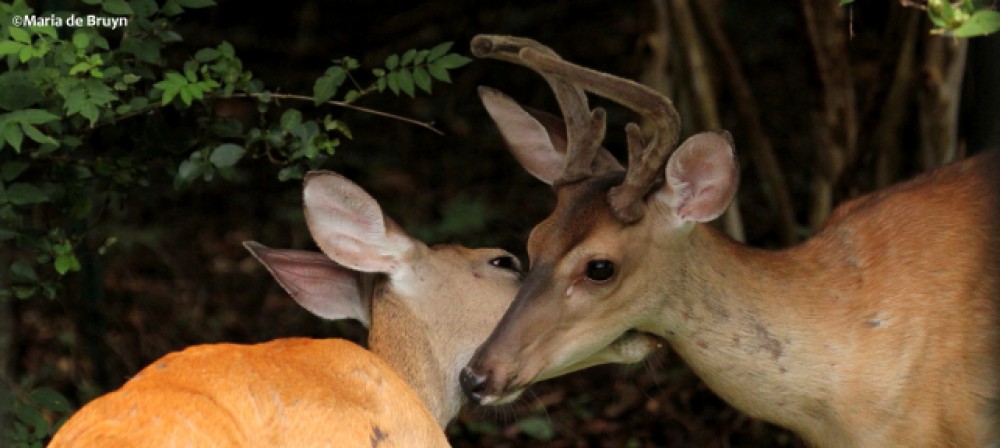
white-tailed deer IMG_4092© Maria de Bruyn resA few white-tailed deer (Odocoileus virginianus) were also wet and hungry, including two visitors to my yard that I had not seen before. They were two bucks, one of whom must have been hit by a car. One of his antlers was broken off and he was hopping along holding up his left hind leg, which had obviously been injured.


white-tailed deer IMG_4063© Maria de Bruyn res white-tailed deer IMG_4001© Maria de Bruyn res

white-tailed deer IMG_4055© Maria de Bruyn resA young doe, who visits regularly, stopped for some bird seed, as did the other buck whose antlers had been shed. Their thick hair was coated in raindrops.

The Eastern gray squirrels (Sciurus carolinensis) can curl their tails up over their backs as a kind of natural umbrella, both on the ground and in trees. This individual, who may have been injured by a predator and escaped, enjoyed some apple – first on the ground and then later in the tree away from the blue jays that were hopping around it.

Eastern gray squirrel IMG_4325© Maria de Bruyn res Eastern gray squirrel IMG_4334© Maria de Bruyn res

Some of the birds definitely looked more presentable than other. The three visiting mockingbirds (Mimus polyglottos) were sleek and beautiful, one using its long tail tobalance as it plucked meal worms from a feeder designed for somewhat smaller birds.

Northern mockingbird IMG_4503© Maria de Bruyn res Northern mockingbird IMG_4467© Maria de Bruyn res

The dark-eyed juncos (Junco hyemalis), Eastern towhees (Pipilo erythrophthalmus) and chipping sparrows (Spizella passerina) looked in fine shape, too.

dark-eyed junco IMG_4802© Maria de Bruyn res dark-eyed junco IMG_4729© Maria de Bruyn res

Eastern towhee IMG_4924© Maria de Bruyn res chipping sparrow IMG_4817© Maria de Bruyn res

The bluebirds (Sialia sialis) varied in appearance; a couple looked groomed but wet, while a couple others looked a bit disheveled.

Eastern bluebird IMG_4587© Maria de Bruyn res Eastern bluebird IMG_4588© Maria de Bruyn res

pine warbler IMG_4569© Maria de Bruyn resThe pine warbler (Setophaga pinus) – usually among the more handsome garden birds – unfortunately looked a sorry sight. Fortunately, when the rain ends, he’ll be able to shake that water off and get back to looking like one of the handsome fellas of the avian neighborhood!

pine warbler IMG_4618© Maria de Bruyn


pine warbler IMG_4842© Maria de Bruyn res

ruby-crowned kinglet IMG_4777© Maria de BruynThe ruby-crowned kinglet’s (Regulus calendulabrown-headed nuthatch IMG_4409© Maria de Bruyn res) oily feather covering seemed to do well in keeping the rainwater at bay, while the brown-headed nuthatch (Sitta pusilla) looked a bit more water-logged.ruby-crowned kinglet IMG_4741© Maria de Bruyn res

The tufted titmouse (Baeolophus bicolor) and Carolina chickadee (Poecile carolinensis) join me in looking forward to dryer and sunnier weather in a few days’ time!

tufted titmouse IMG_4350© Maria de Bruyn resCarolina chickadee IMG_4386© Maria de Bruyn res