Water-logged and soggy birds

Carolina wren I77A2794© Maria de Bruyn resMy original intent was to write only one more blog this year, but our current weather has induced me to write two (the other will follow on the last day of 2015). During the past week, our region has had more than our “fair share” of rain. Fortunately, the house is not downstream or downhill of flowing water so that flooding is not a concern (and having helped my parents when their home was flooded with about 5 feet of water, I know that is a real pain to say the least). But the yard is so water-logged that small pools of water are scattered in many places and the ground cover squishes when we walk on it. Combined with very high temperatures for this time of year, it seems that El Niño is really making itself known – and the birds like this Carolina wren (Thryothorus ludovicianus) must be getting tired of being water-logged as well!

Sayings such as “like water off a duck’s back” imply that birds don’t really get bothered by water pouring from the heavens, but that is probably only partly true. During recent downpours, I saw – through the back porch screen – a Carolina wren and Northern cardinal (Cardinalis cardinalis) hanging out on a downspout under the house eaves, while a brown-headed nuthatch (Sitta pusilla) clung to the brick wall under the roof overhang to get out of the rain.

brown-headed nuthatch I77A0090© Maria de BruynNorthern cardinal I77A0101© Maria de Bruyn res

Birds that regularly dive underwater do have denser feathers, which helps prevent water from penetrating through to their skin, as is the case for this Canada goose (Branta canadensis).

Canada goose I77A1169© Maria de Bruyn res

But birds’ feathers are not inherently waterproof – when we see water droplets beading on their backs and tails, as in the case of this brown thrasher (Toxostoma rufum) and blue jay (Cyanocitta cristata), it’s because the birds have made them water-resistant to some extent.

Blue jay I77A3141© Maria de Bruyn resbrown thrasher I77A9881© Maria de Bruyn res

This happens in two ways. On the one hand, birds such as pigeons, herons, hawks and owls have special feathers called “powder downs” or “pulviplumes”, which are covered in a dusty powder containing keratin that disintegrates and becomes a waterproof coating. They spread the powder to other feathers while preening.

Great blue heron I77A1220© Maria de Bruyn res

Great blue heron (Ardea herodias)

brown-headed nuthatch I77A0090© Maria de Bruyn resOther birds have a uropygial (preen) gland located at the base of their tails. It produces a substance containing oil and wax that the birds spread on their feathers when they groom. Often, they will rub their head against the preen gland and then spread the oil by rubbing their head against other feathers, a behavior that this female red-winged blackbird (Agelaius phoeniceus) seemed to be doing when she was grooming. The wax then helps make the feathers more flexible and water-resistant, which explains the water beads we see on their feathers when it rains.

dark-eyed junco I77A4085© Maria de Bruyndark-eyed junco I77A9650© Maria de Bruyn res

Dark-eyed junco (Junco hyemalis)

Eastern towhee I77A9682© Maria de Bruyn res Pine warbler I77A9921© Maria de Bruyn res

Eastern towhee (Pipilo erythrophthalmus)

     Pine warbler (Setophaga pinus)

It may be that some birds are less successful in spreading the powder and wax to their head feathers, or they rub all the oil or powder off their heads onto other feathers. This may account for the “bad hair day” look some of them get when it rains for hours on end. These spiky “Mohawks” often appear in Northern cardinals and Eastern bluebirds (Sialia sialis).

Northern cardinal I77A9734© Maria de Bruyn res Northern cardinal I77A9870© Maria de Bruyn res

Eastern bluebird I77A9717© Maria de Bruyn resEastern bluebird I77A9710© Maria de Bruyn res

Other birds seem to especially get soggy feathers on the crowns of their heads just above their eyes. This may be why we see so many of them shaking their heads vigorously to get rid of the dampness on their pates.

Pine warbler I77A9942© Maria de Bruyn res White-throated sparrow I77A2980© Maria de Bruyn res

Pine warbler                                              White-throated sparrow (Zonotrichia albicollis)

Red-bellied woodpecker I77A9724© Maria de Bruyn res


And some birds just get an overall scruffy look when it rains hard, like this red-bellied woodpecker (Melanerpes carolinus).


Eastern bluebird I77A0155© Maria de Bruyn resThe water-logged look does seem to give some birds an angry or disgruntled appearance; I can certainly sympathize since endless days of rain – even in warmer temperatures – is one of my least favorite types of weather. It seems that overcast days and showers are continuing in our local forecast for some time to come. So the poor birds have to put up with the wet weather a while longer. We’ll all appreciate the sunlight when it comes back in force – hopefully soon!

New bird generations emerge in my yard!

This spring and summer, I’ve had the pleasure of watching various species of birds in my yard care for new offspring until they have fledged (left the nest). My most recent observations came today as I watched three hatchlings jump bravely into their wide new world. This blog will introduce you to some of my new neighbors; two blogs to follow will go back in time to spring and early summer to describe some nesting I witnessed in local parks and reserves.

gray catbird IMG_3888© Maria de BruynA dense privet tree next to my carport offered a pair of gray catbirds (Dumetella carolinensis) space to construct a well-hidden nest. I discovered it was there because the parents suddenly began yelling at me loudly whenever I left the carport to walk into the yard and then a bird bander who was visiting managed to locate the nest, which was about 8 feet up so I couldn’t see the eggs in it.

I kept an eye on the shrub and saw the parents were flying in with insects and emerging empty-beaked, so I knew the eggs had hatched. One day, I ventured close and peered through the privet branches and saw a couple little heads sticking up above the nest.

gray catbird IMG_3933© Maria de Bruyn res gray catbird IMG_3903© Maria de Bruyn res

A short time later, the baby birds hopped out of the nest and they stayed in the large shrub for several days as their parents continued bringing them a variety of insects.  As I mentioned in a previous blog, the parents were good providers, sometimes bringing more than one type of insect home in their beaks.

gray catbird DK7A2939© Maria de Bruyn res gray catbird DK7A2937© Maria de Bruyn res

Eastern bluebird IMG_3881© Maria de Bruyn resA pair of Eastern bluebirds (Sialia sialis) laid five eggs in a nest box in my front yard and I was able to record when all the eggs had been laid. Information provided online about time to hatching (12 to 14 days) alerted me as to when I might see newborns.  Only four of the five eggs hatched; the fifth one was broken. I also checked how long it takes for hatchlings to develop until they leave the nest – that can take 16-21 days but usually 17-18 days.

Eastern bluebird DK7A3842© Maria de Bruyn res


The bluebird parents were diligent about bringing food, mostly caterpillars and insects but supplemented by wild raspberries and dried meal worms that I had made available. It turned out this brood wasn’t too interested in the meal worms; I found a layer of them in the nest when the babies fledged.


Eastern bluebird DK7A3411© Maria de Bruyn resEastern bluebird DK7A8706© Maria de Bruyn res


Eastern bluebird DK7A3210© Maria de Bruyn resEastern bluebird DK7A8685© Maria de Bruyn res

Eastern bluebird DK7A3137© Maria de Bruyn RESClose to fledging, the parents began showing protective behavior – chasing squirrels out of the large tree in front of the nest box, flying at other birds that came too close, keeping an eye on me as I sat near the box. Mama and papa removed fecal sacs frequently, flying off with them to a considerable distance from the nest. Only once did I see a parent actually swallow the fecal sac.


Eastern bluebird DK7A3081© Maria de Bruyn resMama investigated something odd at the edge of the box one day, flying down to look closely at the gap between the box wall and door. When I looked, I didn’t see anything. She also would occasionally hover in front of the nest box opening, as if she was demonstrating to the babies what they had to do.

Eastern bluebird DK7A3149© Maria de Bruyn res Eastern bluebird DK7A3174© Maria de Bruyn res

I was lucky enough to see all four babies leave the nest. Two of them were definitely stronger than the other two, who couldn’t fly as well and who didn’t seem to have feathers that were so well developed. When I moved close to take photos, the cautious parents dive-bombed me and the young eventually moved across the street. I never saw the young ones at my feeders.

Eastern bluebird DK7A4306© Maria de Bruyn resEastern bluebird DK7A4281© Maria de Bruyn res

Eastern bluebird DK7A4489© Maria de Bruyn res Eastern bluebird DK7A4386© Maria de Bruyn res

These past few weeks, some bluebirds raised a second brood in my backyard. This nest had some history. First, three eggs were laid, with a pair of bluebirds visiting the nest occasionally. Unfortunately, one day I saw a Cooper’s hawk (Accipiter cooperii) swoop in and it looked like the raptor had caught one of the bluebirds. In any event, the eggs were abandoned. After a few weeks, I had just decided to clean out the nest with eggs when I suddenly saw another pair of bluebirds building a new nest on top of the old one. They, Eastern bluebird DK7A7145© Maria de Bruyn restoo, laid three eggs.

Using the guidance given to me by the Smithsonian Institute’s Backyard Nestwatch Project, I checked the box every three days until the eggs hatched and then every two days to check on the nestlings’ well-being.

I was surprised that the mother was not sitting on the eggs much of the time, but the local Audubon chapter president told me that when the weather is very hot, the parent will not brood because it could become too warm inside the box.

The parents were quite diligent in bringing food to the hungry babies. They occasionally visited my mealworm and suet feeders but mostly just to feed themselves. They appeared to be feeding their babies an exclusive diet of caterpillars and insects and a little bit of suet – no mealworms though.

Eastern bluebird DK7A7038© Maria de Bruyn resEastern bluebird DK7A8265© Maria de Bruyn res

Eastern bluebird DK7A8265© Maria de Bruyn res Eastern bluebird DK7A8041© Maria de Bruyn res

They were busy removing fecal sacs as well and I discovered that the baby birds actually present the sac to the parent by sticking up their behinds so the parent can pull out the sac. That made for a couple unusual photos!

Eastern bluebird DK7A8089© Maria de BruynEastern bluebird DK7A8106© Maria de Bruyn res


Eastern bluebird DK7A8351© Maria de Bruyn res

Eastern bluebird DK7A8316© Maria de Bruyn resI had calculated that today or tomorrow would likely be fledging day so after a doctor’s appointment and grocery shopping, I settled into a canopy chair to observe the box. The parents were very busy bringing food but also taking time to sit in the crepe myrtle tree across from the box to call to their little ones. The nestlings were now sticking their heads out of the box so I figured that fledging was imminent.

As I watched the parents and nestlings for an hour, I also looked around at the other bird activity in the yard. Suddenly, I saw an immature red-bellied woodpecker (Melanerpes carolinus) take interest in the nestlings and it swooped over to the box. I feared for the little ones but one of the parents descended on the larger bird to drive it away from their temporary home.

red-bellied woodpecker DK7A8468© Maria de Bruyn resred-bellied woodpecker DK7A8472© Maria de Bruyn res

Eastern bluebird DK7A8532© Maria de BruynAfter a while, I thought bird No. 1 was going to jump but at the last minute s/he crawled back inside. I was occasionally turning my head to observe other birds at feeders and just as I turned my head again, action erupted.

Eastern bluebird DK7A8660© Maria de Bruyn resI was warned because the bluebird parents swooped down from the crepe myrtle tree to fly straight at my head under the canopy of my chair – they were not taking any chances! It turned out that bird No. 1 had flown by me and landed on the side of my screened-in porch, which was where I had been looking.

Eastern bluebird DK7A8714© Maria de BruynEastern bluebird DK7A8715© Maria de Bruyn res

The parents continued to fly at me, perhaps 6 or 7 times coming very close to my face, so I went on the porch so that they could calm down. Then they began chasing other birds as their young one had flown from the porch to a tree. While they were occupied, I went back to the chair and was able to see babies 2 and 3 jump from the nest box.

Eastern bluebird DK7A8864© Maria de Bruyn resEastern bluebird DK7A8865© Maria de Bruyn res

Eastern bluebird DK7A9056© Maria de Bruyn resEastern bluebird DK7A9058© Maria de Bruyn res

Eastern bluebird DK7A9059© Maria de Bruyn res

It was a partly cloudy, partly sunny morning for the fledging today and then a few hours after the bluebird young flew, the rain began. There has only been a little thunder and no lightning so perhaps this will just be a nice steady rain that we can use and not severe weather. I do feel a little sorry for the new members of our local bluebird society, however, as they have to face getting sodden on their first day outdoors. The parents are visiting the mealworm feeder now; I hope I get to see the babies at my feeders the coming days. In any event, they made my morning very enjoyable indeed and I have a third nesting report to add to Backyard Nestwatch!


P.S. I have higher-resolution photos for sale as prints or photo cards; let me know if you ever want a particular one!


Citizen science in my backyard!

Gray-headed catbird DK7A8986© Maria de Bruyn resIt’s been a while since I’ve blogged – not for lack of ideas and photos but due to a dearth of time and energy that was absorbed by multiple troubles with a few cool happenings in between. But now I’m back with some new observations about the beauty and happenings of interest in my natural world and I hope to share some wildlife sightings on a regular basis again.

One activity that I have managed to fit in amid the other goings-on was enrollment in two new (for me) citizen science projects for the Smithsonian Institute. I’m participating in an eMammal project run by the North Carolina Museum of Natural Science and in a multi-year observational study of some common birds. The mammal project is time-limited, so I will report on that in about a month’s time.

Northern mockingbird DK7A8859©Maria de BruynThe bird project will involve tracking visits to my yard by banded birds for several years to come. The target species include American robins (Turdus migratorius), Carolina chickadees (Poecile carolinensis), Carolina wrens (Thryothorus ludovicianus), house wrens (Troglodytes aedon), gray-headed catbirds (Dumetella carolinensis), Northern cardinals (Cardinalis cardinalis) and Northern mockingbirds (Mimus polyglottos, at the right), all of which come to my yard. Song sparrows are the 8th target species but I haven’t seen them at my house. However, I discovered that there is a great crested flycatcher in my trees, although I’ve never seen him (or her) either, so who knows if one will come in the future? In any case, the target birds can live from about 6-10 years on average, so I’ll have an ongoing activity for as long as my eyesight remains reasonable!

bird banding IMG_3291© Maria de Bruyn resmist net IMG_3290© Maria de Bruyn

So how does the bird banding proceed? We (the bird bander and I) set up one 12-foot and one 6-foot mist net in two parts of the yard, after the bander laid out her equipment for the banding process. Within a very short time, we caught three birds in the large net! The first was a gray-headed catbird that I recognized (photo above), because he had molted all his tail feathers at once and looks a bit odd with no tail. This bird, whom I have named Corey, has been the most vocal catbird at my feeders and he was extremely vocal about having been caught as well.

gray-headed catbird IMG_3294© Maria de Bruyn bird banding IMG_3295© Maria de Bruyn

After being disentangled – very carefully – from the net, he was put in a bag while the bander got the other two birds out of the net. Corey was measured, weighed, and banded with a combination of aluminum and colored bands. Sex was determined (I now know he is a he!) and then he was let go.

gray-headed catbird IMG_3301© Maria de Bruyn bird banding IMG_3304© Maria de Bruyn res

Northern cardinal IMG_3311© Maria de Bruyn resBird 2 was a beautiful male Northern cardinal, who appeared to have good fat reserves. He was a bit vocal and bit the bander to show his displeasure at the treatment he was receiving.

Bird 3 was a male American robin. Sex was determined partly by looking at the cloacal region (outside breeding season, other markers besides brood patches and this area are examined). If a bander is unsure of the sex, this is also marked on the data sheet. The robin was more sedate during handling than his predecessors.


American robin IMG_3314 © Maria de Bruyn resAmerican robin IMG_3315© Maria de Bruyn res

The house wrens had been calling loudly during the banding and flitted about in the trees and to the feeders,but they always flew just above the nets and were not caught. A male Carolina wren with a nice eye stripe did not escape.

house wren DK7A4794© Maria de Bruyn Carolina wren IMG_3316© Maria de Bruyn

American crow IMG_3359© Maria de BruynThe chickadees and Northern mockingbird flew about but did not really come too close to the nets. Non-target species were at or near the feeders, too, such as courting bluejays, an American crow (Corvus brachyrhynchos, right) who came to eat jelly and take some apple to his mate, downy woodpeckers, white-breasted and brown-headed nuthatches, a house finch, Eastern towhees and a male cowbird.

red-bellied woodpecker IMG_3344© Maria de Bruyn resOther non-target birds flew into the large mist net, however, such as a brown thrasher, a tufted titmouse, a red-bellied woodpecker (Melanerpes carolinus, right), a chipping sparrow (Spizella passerina), a female common yellowthroat (Geothlypis trichas, below) and a common grackle. I’d not seen these birds up so close before, so that was really a nice experience.

Common yellowthroat IMG_3339© Maria de Bruyn res


bird banding IMG_3340© Maria de Bruyn resTo get more target species, a loudspeaker that played bird calls and some model birds were placed in the grass by the largest net. Eventually, two more catbirds were caught – with other catbirds in a nearby tree puffing themselves up to show their shared distress. These were the first catbirds banded for the project so far, so that was a nice way to end the exercise.

Cope's tree frog IMG_3293© Maria de Bruyn resA tour of the yard to see if there were any nests that could be followed for the Nest Watch project revealed a couple wren nests in boxes that were built up so high it was not possible to see if they had eggs in them. The bluebirds’ nest has five eggs that I will follow through fledging (hopefully); a catbird nest is too high up for me to see how many eggs she is sitting on but I will watch for her fledglings, too. And a Cope’s tree frog (Hyla chrysoscelis) had taken up residence in the nest box that the downy woodpecker uses to rest at night. The wrens had begun building a nest in that box last night and the frog was gone this afternoon.

The banding took place yesterday in the morning and in the afternoon, the banded birds had not returned. I wonder how long it will take most of these individuals to come again. Corey already returned this afternoon, instantly recognizable not only because of his very short tail feathers growing in but because of the red and silver bands on his little legs. I was so glad to see he was none the worse for wear!

A bedraggled sort of day

Carolina wren IMG_4876© Maria de Bruyn resFirst, let this lovely Carolina wren (Thryothorus ludovicianus) and me wish you – fellow nature lovers and blog readers – all the best as we look to the future in this year of 2015! May your minor disappointments (life is not always rosy) be compensated by love, laughter, health and happiness in abundance!


Yesterday may have been a minor disappointment for the wildlife here.Hermit thrush IMG_3106© Maria de Bruyn res On Sunday, it was very cold for North Carolina standards. Together with two other Audubon Society volunteers, I was standing at a local lake in 15°F (-9.4°C) weather waiting to see if any bald eagles flew by for inclusion in the quarterly Eagle Count. We didn’t see any, although this lovely hermit thrush (Catharus guttatus) was nearby eating berries.

Monday was warmer but EXTREMELY wet! Two of my cats awakened me at 5 a.m. and I could hear the rain coming down in a veritable deluge. I wondered if I would be able to see the road to drive for an appointment later that morning (it did let up, thank goodness) and also wondered how the birds and animals were keeping in this unpleasant weather.

Northern cardinal IMG_4462© Maria de Bruyn res

Northern cardinal IMG_4049© Maria de Bruyn res


When it’s cold, the birds fluff up their feathers to trap air pockets by their bodies; this helps they retain body heat and stay warmer. Heavier wet feathers don’t seem to fluff well, though. On the other hand, birds’ feathers are covered with an oily or waxy substance that helps water run off, thereby keeping their bodies drier. Those feathers don’t necessarily look pretty though. Many of the birds were indeed looking bedraggled, some to a greater degree and others just a bit like these Northern cardinals (Cardinalis cardinalis).

red-bellied woodpecker IMG_5005© Maria de Bruyn resIt didn’t seem that many birds were hiding in vegetation to get out from under the downpour. Nope – they all appeared to be very hungry and anxious red-bellied woodpecker IMG_4948© Maria de Bruyn resfor a meal like this red-bellied woodpecker (Melanerpes carolinus), who was scolding me for being so close to the feeders!

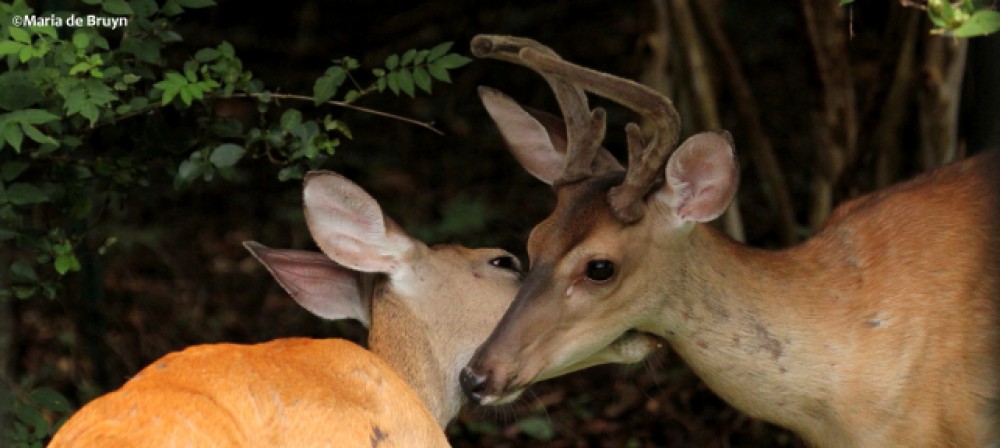
white-tailed deer IMG_4092© Maria de Bruyn resA few white-tailed deer (Odocoileus virginianus) were also wet and hungry, including two visitors to my yard that I had not seen before. They were two bucks, one of whom must have been hit by a car. One of his antlers was broken off and he was hopping along holding up his left hind leg, which had obviously been injured.


white-tailed deer IMG_4063© Maria de Bruyn res white-tailed deer IMG_4001© Maria de Bruyn res

white-tailed deer IMG_4055© Maria de Bruyn resA young doe, who visits regularly, stopped for some bird seed, as did the other buck whose antlers had been shed. Their thick hair was coated in raindrops.

The Eastern gray squirrels (Sciurus carolinensis) can curl their tails up over their backs as a kind of natural umbrella, both on the ground and in trees. This individual, who may have been injured by a predator and escaped, enjoyed some apple – first on the ground and then later in the tree away from the blue jays that were hopping around it.

Eastern gray squirrel IMG_4325© Maria de Bruyn res Eastern gray squirrel IMG_4334© Maria de Bruyn res

Some of the birds definitely looked more presentable than other. The three visiting mockingbirds (Mimus polyglottos) were sleek and beautiful, one using its long tail tobalance as it plucked meal worms from a feeder designed for somewhat smaller birds.

Northern mockingbird IMG_4503© Maria de Bruyn res Northern mockingbird IMG_4467© Maria de Bruyn res

The dark-eyed juncos (Junco hyemalis), Eastern towhees (Pipilo erythrophthalmus) and chipping sparrows (Spizella passerina) looked in fine shape, too.

dark-eyed junco IMG_4802© Maria de Bruyn res dark-eyed junco IMG_4729© Maria de Bruyn res

Eastern towhee IMG_4924© Maria de Bruyn res chipping sparrow IMG_4817© Maria de Bruyn res

The bluebirds (Sialia sialis) varied in appearance; a couple looked groomed but wet, while a couple others looked a bit disheveled.

Eastern bluebird IMG_4587© Maria de Bruyn res Eastern bluebird IMG_4588© Maria de Bruyn res

pine warbler IMG_4569© Maria de Bruyn resThe pine warbler (Setophaga pinus) – usually among the more handsome garden birds – unfortunately looked a sorry sight. Fortunately, when the rain ends, he’ll be able to shake that water off and get back to looking like one of the handsome fellas of the avian neighborhood!

pine warbler IMG_4618© Maria de Bruyn


pine warbler IMG_4842© Maria de Bruyn res

ruby-crowned kinglet IMG_4777© Maria de BruynThe ruby-crowned kinglet’s (Regulus calendulabrown-headed nuthatch IMG_4409© Maria de Bruyn res) oily feather covering seemed to do well in keeping the rainwater at bay, while the brown-headed nuthatch (Sitta pusilla) looked a bit more water-logged.ruby-crowned kinglet IMG_4741© Maria de Bruyn res

The tufted titmouse (Baeolophus bicolor) and Carolina chickadee (Poecile carolinensis) join me in looking forward to dryer and sunnier weather in a few days’ time!

tufted titmouse IMG_4350© Maria de Bruyn resCarolina chickadee IMG_4386© Maria de Bruyn res

A fruity buffet for the birds!

summer tanager profile IMG_4040©Maria de BruynIn front of a dog park in the small town of Carrboro, NC, there stands a small serviceberry tree, also known as a shadbush or sarvisberry (Amelanchier). This particular specimen has several trunks and was heavily laden with pretty white flowers in the early spring. These turned into bright red berries in late spring, forming a very bountiful buffet for the resident birds and some other wildlife, too!

The variety of species visiting this tree was delightful and led me to go back on several mornings and evenings to observe.

cedar waxwing IMG_1675©Maria de Bruyn2 rescedar waxwing IMG_2159©Maria de Bruyn res

The cedar waxwings (Bombycilla cedrorum) were there in pairs and groups, some of them sweetly feeding one another!

Northern cardinal IMG_4073©Maria de Bruyn2 resNorthern cardinal IMG_2078©Maria de Bruyn2 res

The male and female Northern cardinals (Cardinalis cardinalis) were also huge fans of this tree, returning over and over to have their fill.

Eastern bluebird IMG_4543©Maria de Bruyn reschipping sparrow IMG_2268©Maria de Bruyn2 res

A couple birds seemed only to alight in the tree, not really partaking, like the Eastern bluebirds (Sialia sialis) and chipping sparrows (Spizella passerina). However, those sparrows, like the American robin (Turdus migratorius), might have been just checking out the wares before they dropped to the ground under the tree to enjoy a few berries. That surprised me – especially, the robins whom I have considered to be mainly insectivores and worm-eaters.

chipping sparrow IMG_1626©Maria de Bruyn2 res American robin IMG_4531©Maria de Bruyn res

One day, a trio of Eastern gray squirrels (Sciurus carolinensis) arrived. I thought for sure that they would be stripping the branches clean but they hopped around the tree, sampling here and there. During several visits to the serviceberry, that was the only time I saw them climb into the tree for a snack.

Eastern gray squirrel IMG_2191©Maria de Bruyn2 resEastern gray squirrel IMG_2116©Maria de Bruyn2 res

Other birds seemed to visit only briefly, like the Northern mockingbird (Mimus polyglottos) and the tufted titmouse (Baeolophus bicolor).

Northern mockingbird IMG_4164©Maria de Bruyn2 res tufted titnouse IMG_2122©Maria de Bruyn res

red-bellied woodpecker IMG_1633©Maria de Bruyn2 resThe red-bellied woodpecker (Melanerpes carolinus), on the other hand, was a very frequent visitor – coloring oh so nicely with the host tree! This bird seemed to be also storing some berries for later consumption in the bark of a tree?

red-bellied woodpecker IMG_2094©Maria de Bruyn2 res

red-bellied woodpecker IMG_2007©Maria de Bruyn2 res

Serviceberries are promoted for gardens as a source of delicious fruit for human beings. They are said to be wonderful in jam, pies, ice cream, syrup for pancakes and or in alcoholic drinks. Raw, they taste a little like blueberries with a nice sweet tang.


They were obviously a great hit with a pair of summer tanagers (Piranga rubra). The male colored nicely with the fruit he was eating; he is an example of the only bird in North America that is entirely red!

Summer tanager IMG_1643©Maria de Bruyn res summer tanager IMG_4112©Maria de Bruyn res

The yellow female stood out as she ate berry after berry.

Summer tanager IMG_1955©Maria de Bruyn res summer tanager IMG_4041©Maria de Bruyn res


Cedar apple rust IMG_9380© Maria de BruynAfter watching this spectacle, I have now decided to find one of these shrubs for my own yard. They are unfortunately susceptible to cedar apple rust (Gymnosporangium juniperi-virginianae) which I have in neighboring cedar trees; it doesn’t seem to hurt the cedars but may account for the fact that the apples in my apple tree stay very small even if I haven’t seen signs of the rust on the apple tree leaves. Hopefully, it won’t be a problem as it would be really nice to see the birds at a serviceberry buffet here at home in years to come!