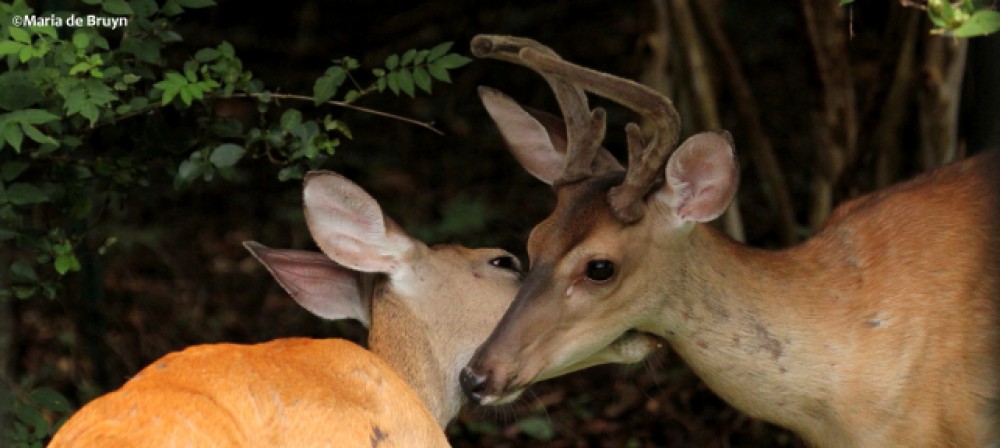
Hungry hairy herons and their caring parents

A little over a week ago, fellow photographer Mary posted a wonderful photo of young green herons (Butorides virescens) perched in a row awaiting their parents. They still had very fuzzy hairdos, reminding me a bit of a row of Albert Einsteins. About 4 days later, I drove to the pond in a senior citizen residential community to see them and they had already lost most of – but not all – the fuzz atop their heads. That didn’t matter though because it was a real pleasure watching them for a while.


Friend Lucretia had accompanied me and we were lucky enough to park right near the end of the pond where the sibling group was parked. Only one was out on a limb when we arrived; the three brothers/sisters were in hiding in the thick shrubs bordering the pond.

The bold juvenile may have been the eldest of the quartet as s/he seemed to have lost the most fuzzy feathers.


S/he groomed, looked around and then yawned hugely – making me think of how I often want to react to much of the news that is shown in the media these days. This was followed by what looked like a smile and happy reaction, which is how I often feel when out taking one of my nature walks!


After a while, a couple of No. 1’s siblings began moving around in the brush, eventually coming out into the open.

In the meantime, No. 1 took the time to defecate; gotta take care of those body functions! (It’s interesting that birds all have white poop. The fecal sacs that songbirds take out of nests are white; this bird’s stream of feces was white. Why? Here’s a tidbit of information you might not know: Birds’ bodies do not produce urine as mammals do. Rather, they excrete nitrogen wastes as uric acid in the form of a white paste.)

Another sibling did some preening.


As we walked around the end of the pond, it turned out that Mama was taking a rest there. (I really can’t tell the male from the female adult but for convenience’s sake just identified her as the mother since she was close by.)


After a time, Mama took off and ended up in a perch on the underside of a small dock. It made me wonder if that was a good place to fish because the water might be a bit cooler and perhaps fish were schooling there. A good number of turtles were also swimming about there – perhaps the shady area was just a nice break from the sun-warmed water.


While Mama scanned the deeps, a nice song sparrow (Melospiza melodia) and a beautiful Eastern bluebird (Sialia sialis) entertained us with song.

Brown-headed nuthatches, a brown thrasher, and a downy woodpecker (Picoides pubescens) were among the other birds flitting about the trees and shrubs bordering the pond.

While adult green herons sometimes use tools to fish – using twigs or insects as bait – Papa heron was just standing patiently at the other end of the pond, watching the water intently. He suddenly plunged and ingested a small fish, using what one ornithologist called a “bill lunge”, in which the bird keeps it feet in place but stretches its body forward to spear prey with its long bill. Apparently, green herons can also catch prey by hanging upside down from their perches over water.


We wondered if he was eating the fish himself or collecting a gullet-full of food for his offspring. Herons namely feed their young by regurgitating previously-swallowed food.

As we continued our walk around the pond, we came upon a great blue heron (Ardea herodias) who had some good luck in getting a meal.

When we arrived back at the spot where the young herons were hanging out, we saw a beautiful gray catbird (Dumetella carolinensis) snag a meal of its own.

One of the young herons was in the water, apparently practicing fishing behavior. S/he caught something but then let it go.

Then Mama suddenly flew in; the foursome greeted her excitedly and Lucretia saw her regurgitate a meal onto the grass. (Unfortunately, this happened behind a shrub that I could not see around so I missed that behavior.) When I had moved over to see the young ones, they had already gulped down whatever food there was and were engaged in vigorous behavior to convince Mama to repeat what she had just done.


This gave a fairly good view of the group. One still had a very pink bill while others were getting more yellowish bills on the way to getting dark beaks.

Mama flew off to a tree and apparently settled in for another food-gathering exercise, while one of her young ones called piteously.


After a couple hours, we decided it was time to drive back to our own areas of residence, but it was bittersweet having to leave the group of four behind. But they certainly provided us with an entertaining morning, even if that was not their intention! We hope they will grow up with no threats from predators and be able to repeat the process with broods of their own one day. 😊

Diving in for a meal


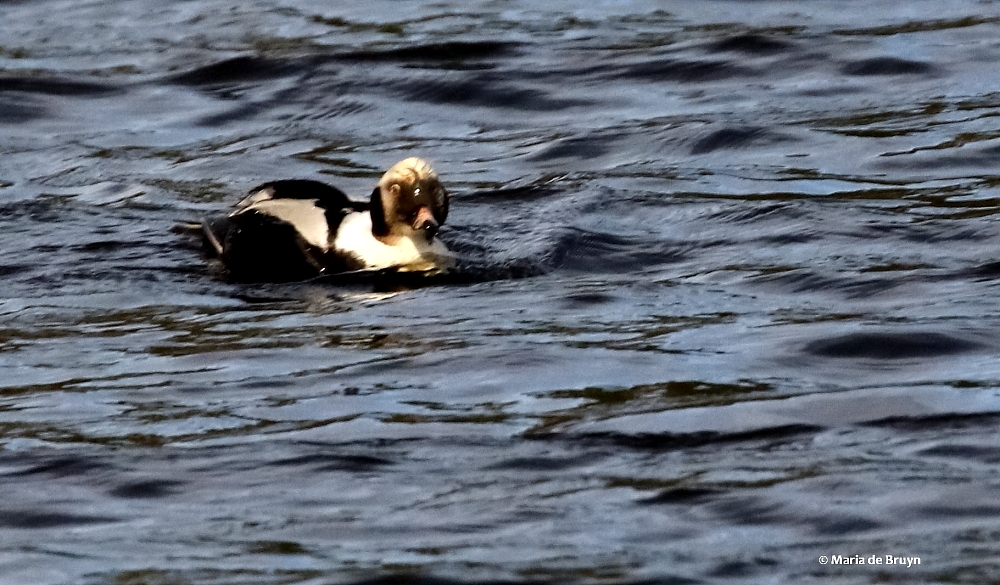
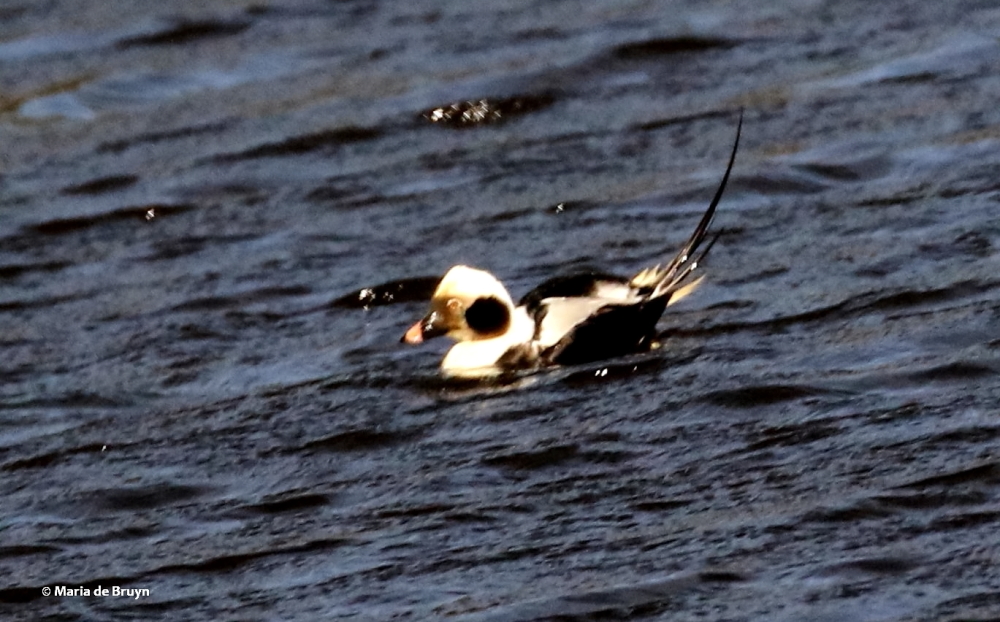
Recently, I had the good fortune to see a sea duck because it had veered away from its usual habitat to land on a pond near the middle of North Carolina. The male long-tailed duck (Clangula hyemalis) is a real looker in his winter plumage. His dark grey bill is tipped by bright pink color and he has large black circles on his white cheeks, which some people think look a bit like ear-muffs.

According to the Audubon Society, these ducks dine on mollusks and crustaceans when they are at sea during the winter. Since this duck had apparently gotten off-course during his winter migration, he seemed to be satisfied now with pondweeds and grasses, which is what they tend to eat in the summer when they are at their breeding grounds.

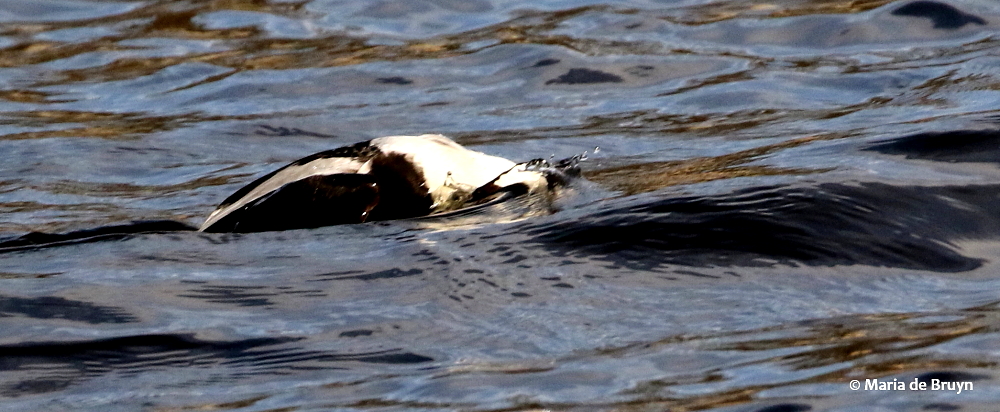
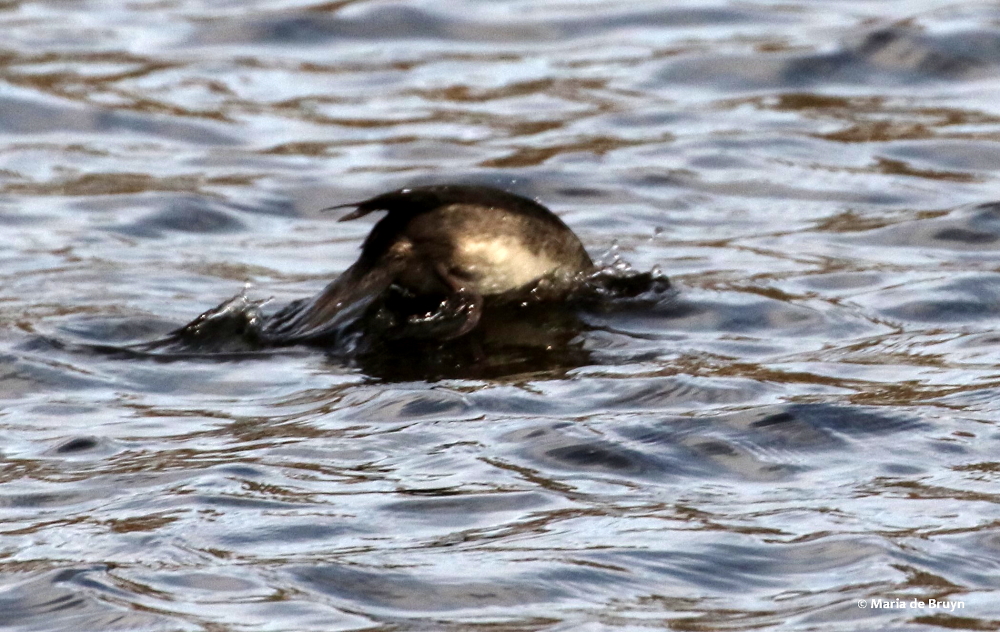
It is his beautiful long tail (3.9 to 5.9 in, 10-15 cm) that really catches your eye, especially when he dives under to gather up some of his food. His dive appeared to comprise a very slight spreading of wing feathers and then a quick forward and downward movement, ending with his rear end sticking up with the long-tailed plume waving a bit before he straightened out just below the water’s surface.

It was when I watched this duck dive under again and again that I actually stopped to think a bit about how ducks dive for their meals. This bird seemed to stay under water for what seemed a very long time (probably 15-30 seconds). It turns out that they can remain submerged up to a minute. In comparison to other diving ducks, the long-tailed duck spends more time under water than at the surface; in fact, when looking for food, this duck will be under water 3-4 times longer than it stays above water!

When reviewing my photos, I realized that this bird was not diving deep but rather staying submerged just under the surface. My friend Lucretia pointed out that the duck would extend his wings a bit away from his body before he went under and the photos showed his wings spread out.

This must be the species’ diving technique when they are foraging for plant material because it turns out that they are likely the deepest diving ducks in the world, able to go down as much as 200 feet (60 meters) in search of food! So it turned out that we were really seeing quite a special bird.

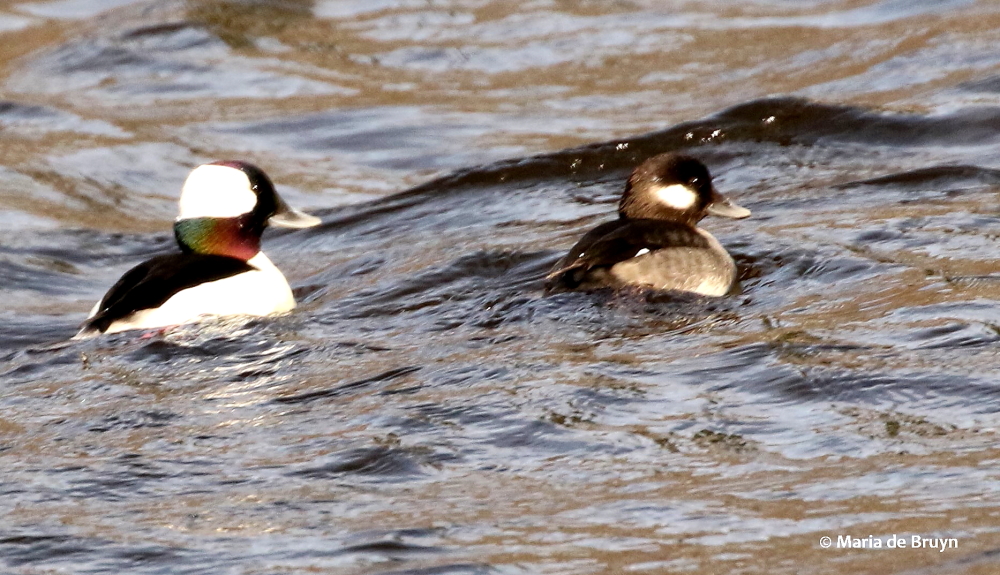
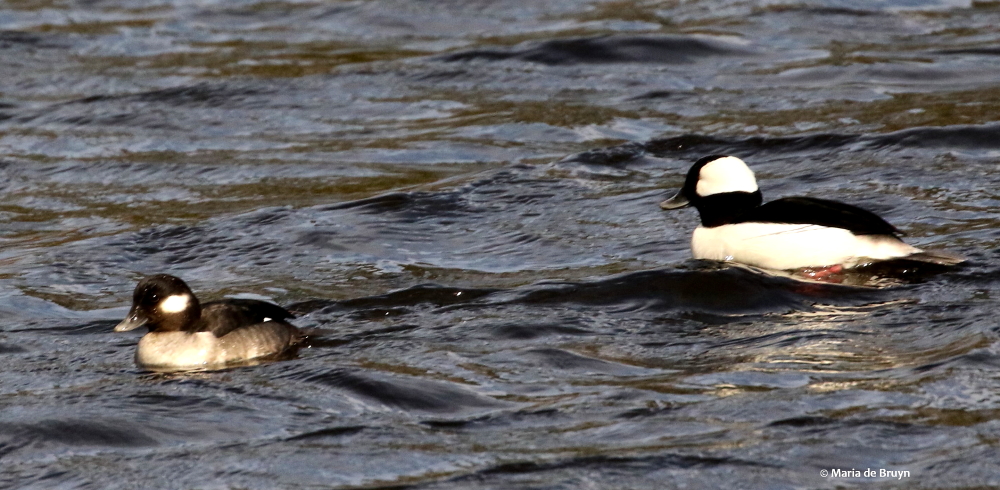
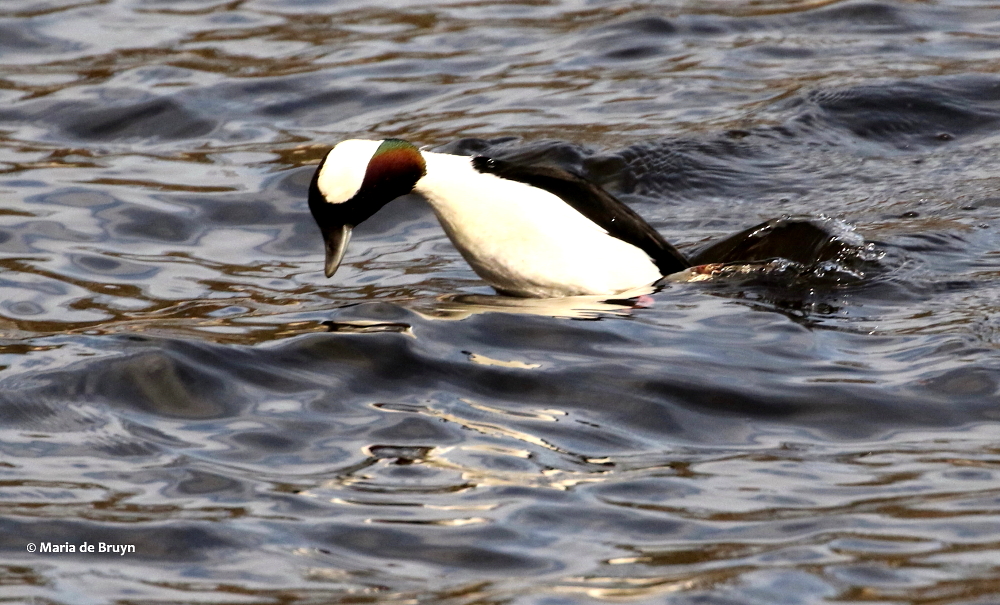
A pair of bufflehead ducks (Bucephala albeola) were at the same pond and give a nice demonstration of their different diving technique. Their winter and summer diets are similar to those of the long-tailed duck; they, too, seemed to be eating plants during our visit. Their dives were of much shorter duration; they appear to stay under water “only” 12-25 seconds at most.

In contrast to the long-tailed duck, however, they would rear up a bit over the water and then arch their bodies in a graceful dive, popping up again quickly after swallowing their food.


It’s interesting to note that their Greek genus name comes from a term meaning bull-headed, while their common name came from a combination of the words buffalo and head. The male duck can puff out his head feathers, making his head look even larger.

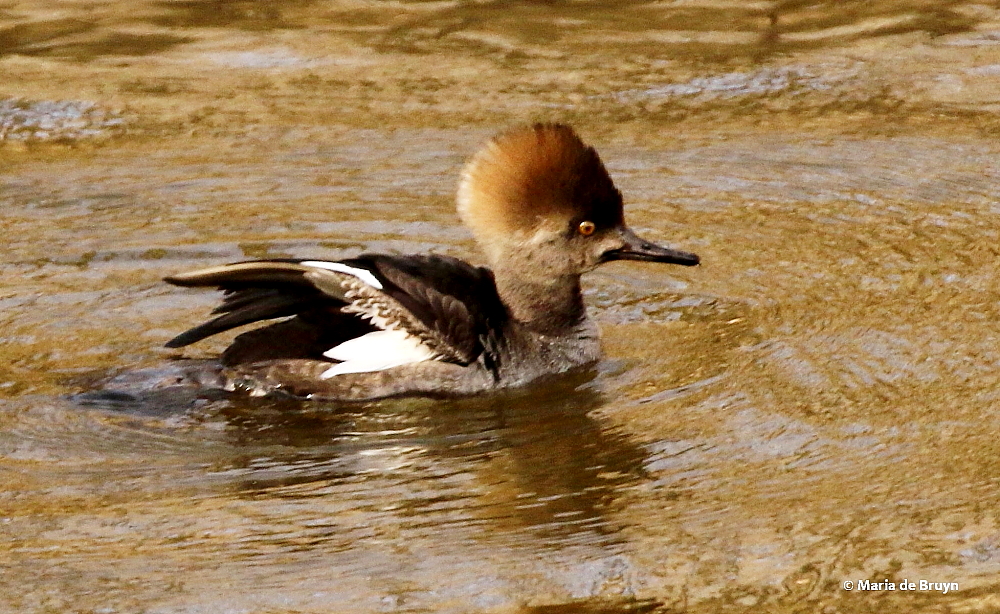
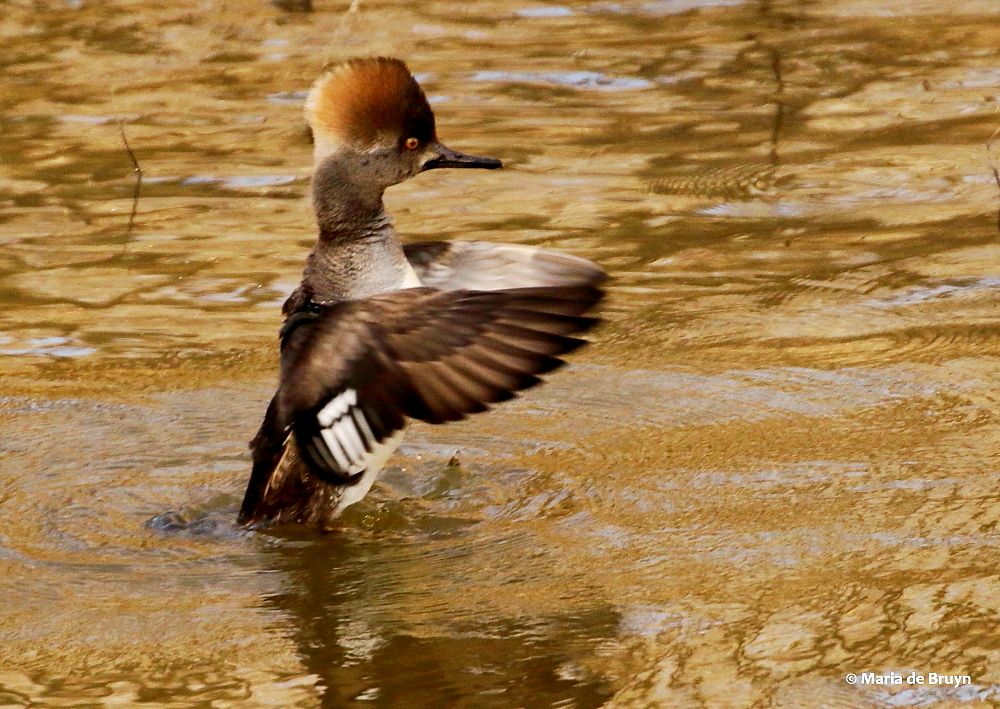
Another duck that can do this is the male hooded merganser (Lophodytes cucullatus); the female can also extend her head feathers, giving herself a crested appearance.

The male and female are quite different in appearance, but both are attractive. Their diet appears to be mostly crustaceans and mollusks.

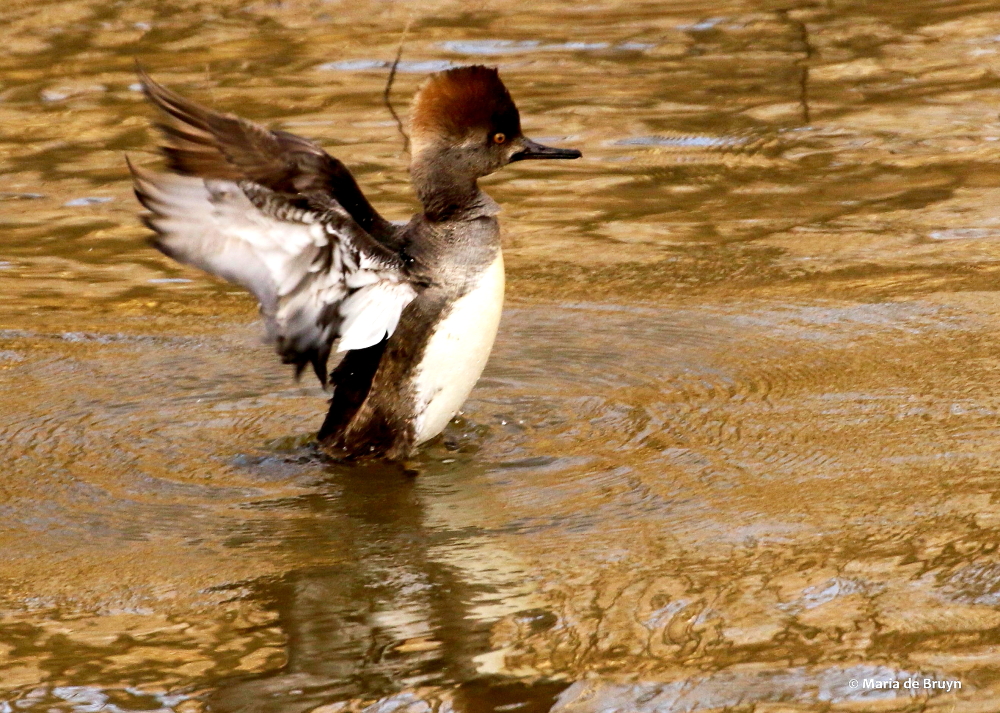
A female merganser at nearby lake gave a short diving demo the same day as the long-tailed and bufflehead ducks. She, too, tended to perform a shallow dive like the former duck.

Duck watching had not been one of my preferred birding activities but now I’ve become curious as to how other species are executing their underwater forays. Perhaps the arcing-body plunge is a bufflehead specialty – I’ll have to pay more attention to diving techniques from now on!

Oh, those ravishing raptors!

Numerous people who attract birds with feeders feel regret and sadness when one of their avian visitors is captured to serve as a meal for a raptor in the neighborhood. I, too, feel that pity and discomfort when I see one of the hawks or owls capture a bird or animal because my thoughts go to the pain and fear that the prey must feel. But of course all wildlife has to eat and I want members of the predator species to survive as well. And the beautiful predators can be really interesting to observe.


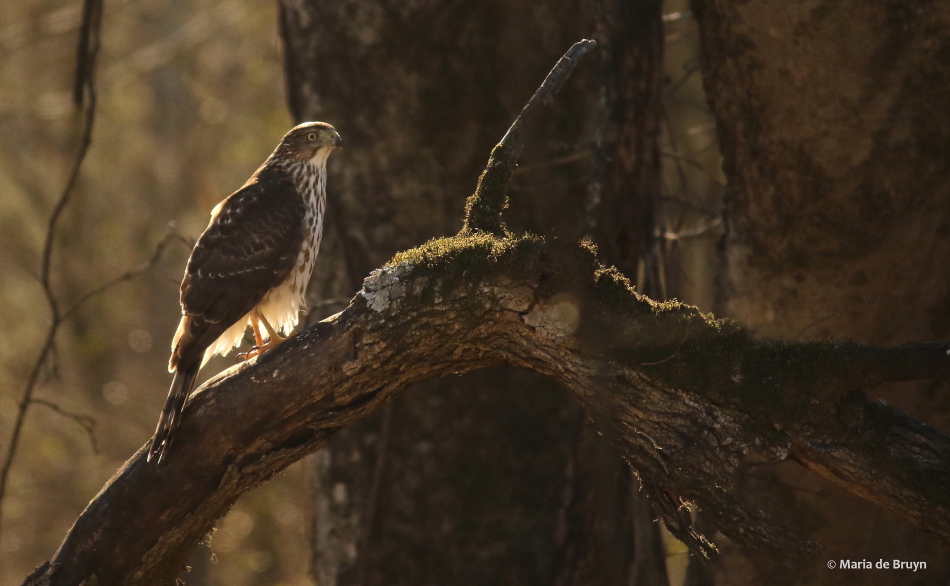
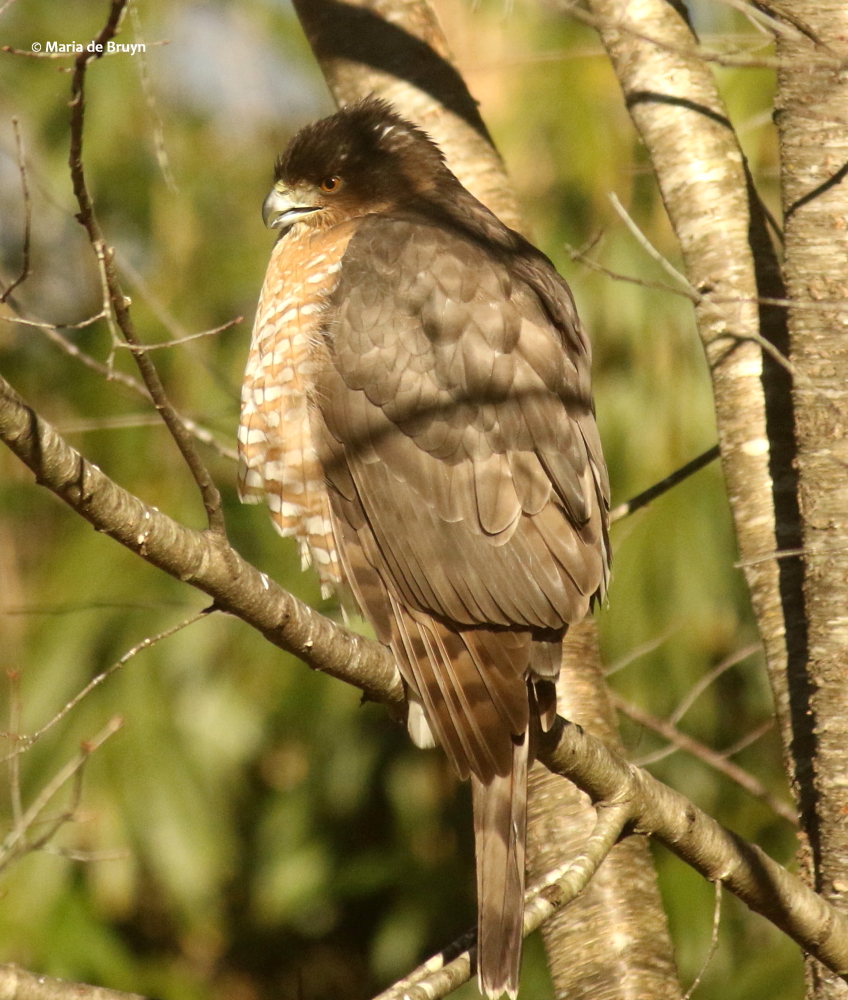
A Cooper’s hawk (Accipiter cooperii, left) sometimes frequents my yard looking for a bird to take. This particular day in November last year, the hawk flew to the front-yard feeders but came up empty-taloned. Raptors, also known as birds of prey, are not the only birds that eat something other than seed. Some smaller birds, like the shrike, do so and many songbirds eat insects. The raptors, however, often go after prey that is fairly large in comparison to their own body size. In January this year, I came across another Cooper’s hawk at a nature reserve. The bird flew soundlessly past me to land in a tree downslope and paused for a bit before flying on, providing time for me to get a gorgeous portrait.

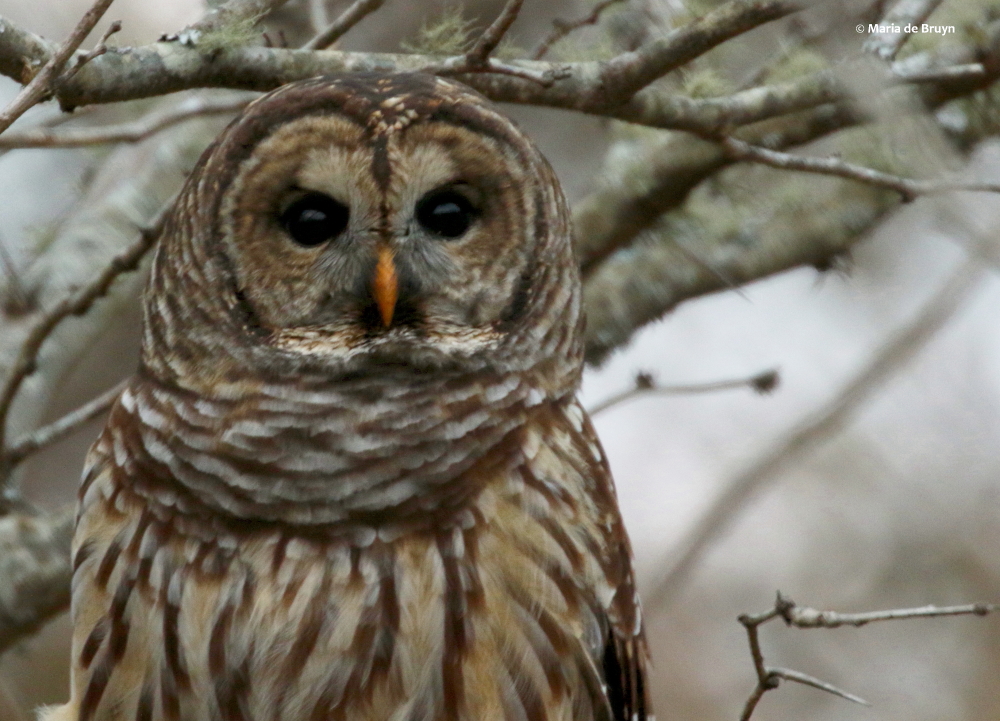
I’ve been lucky lately in seeing barred owls (Strix varia) at the Brumley Nature Preserve North. This owl was sitting silently next to a walking path, looking out over the adjacent field.

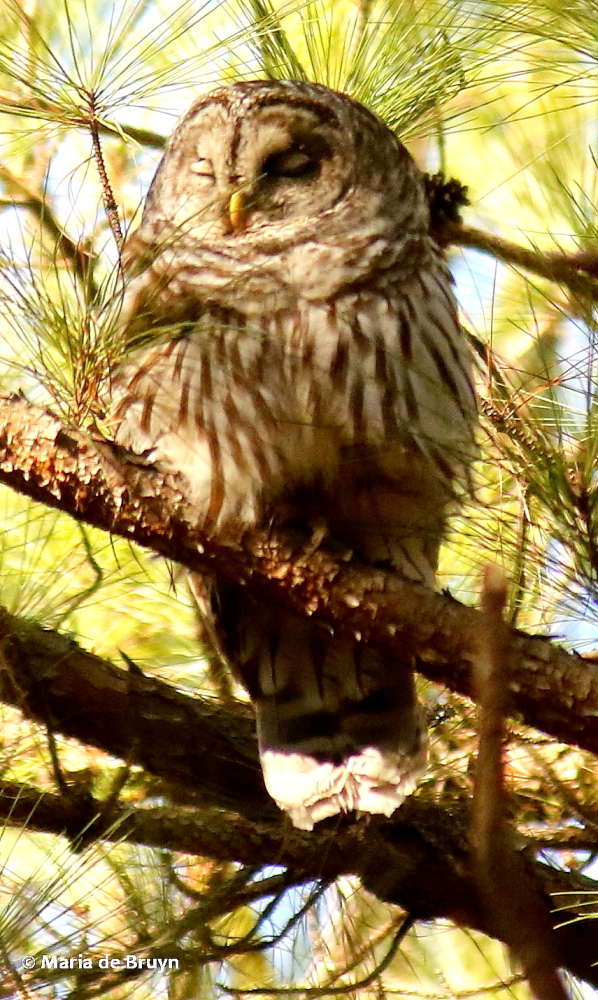
A couple weeks ago, I was startled by this barred owl who suddenly flew in front of me from behind my right shoulder. I hadn’t noticed him/her in a tree behind me. I tried to follow its flight but lost it. I thanked the owl for letting me glimpse it and said it would be nice if s/he came back so I could get another look. Sure enough, after I had turned back to the vicinity where I originally was surprised by the silent predator, it flew in and perched on a branch. The bird had a snooze, keeping one eye partially open to keep me in view.


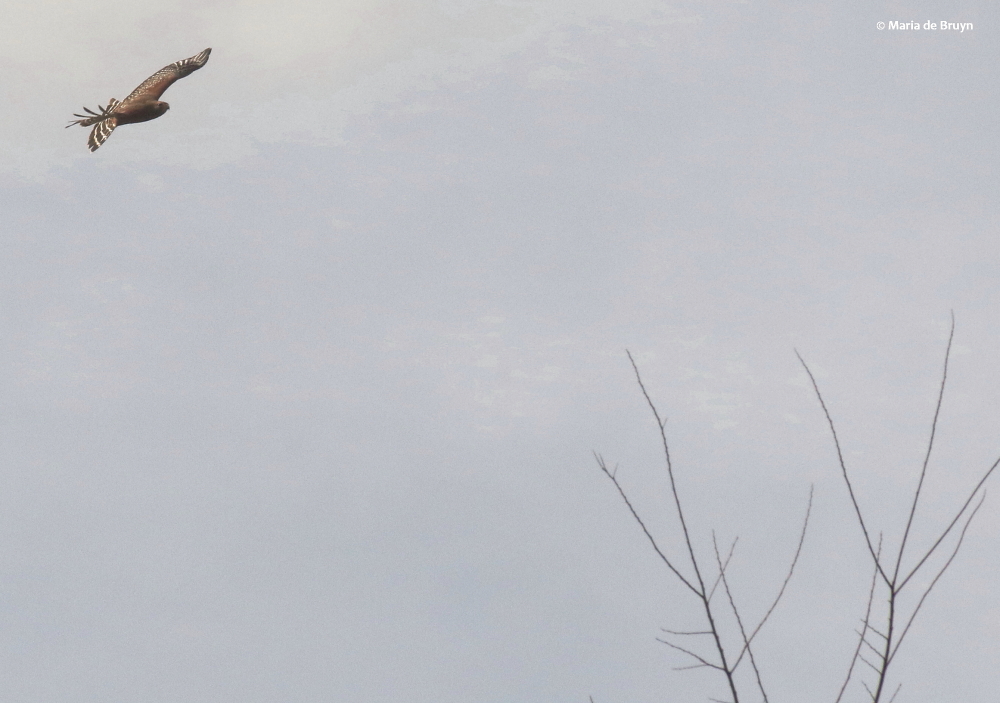
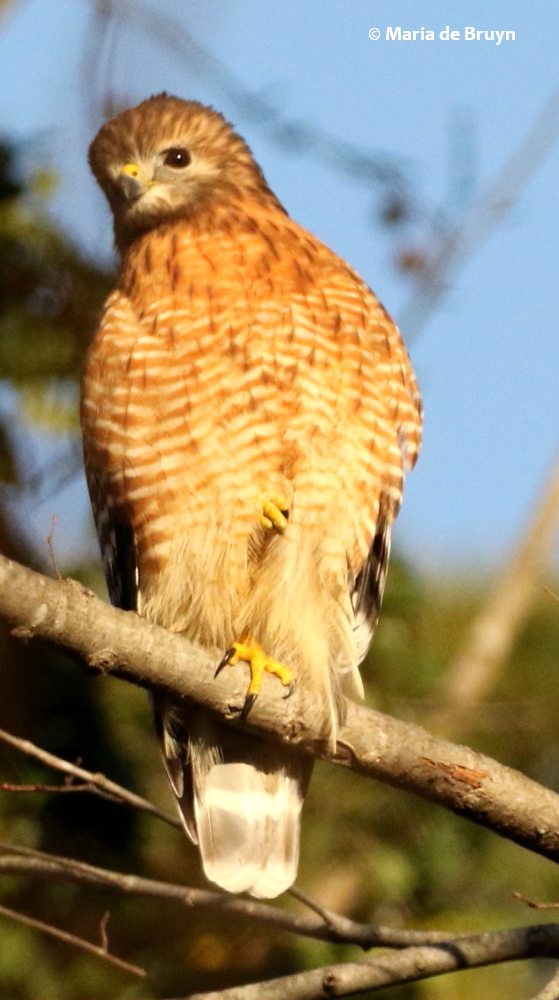
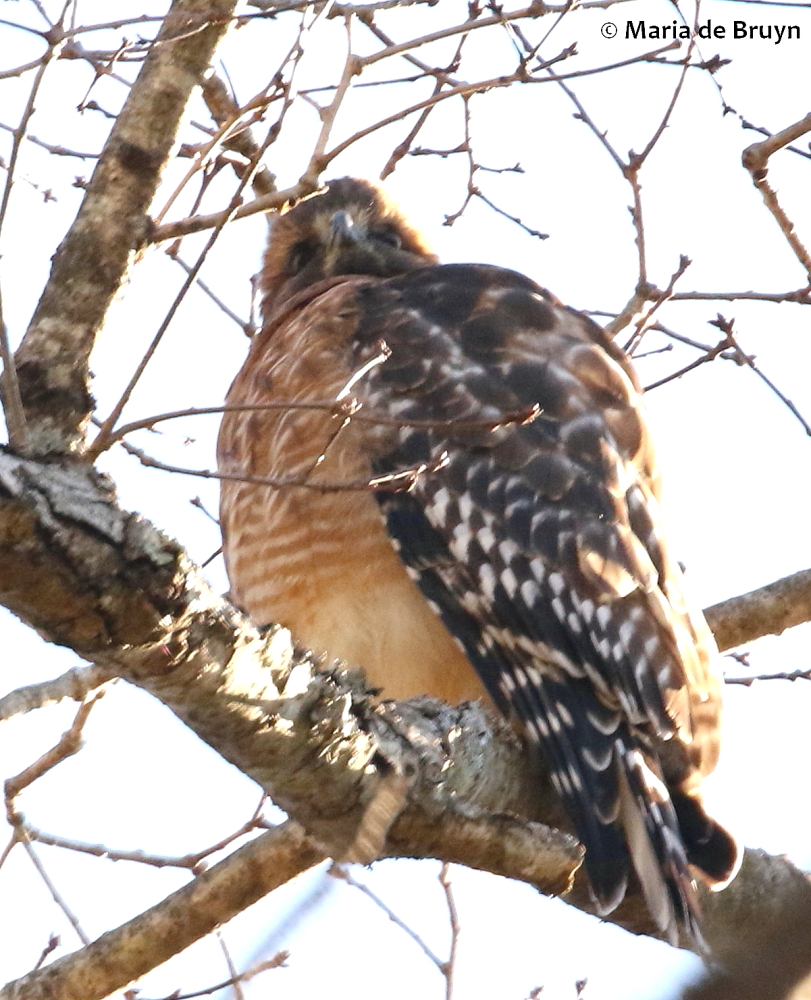
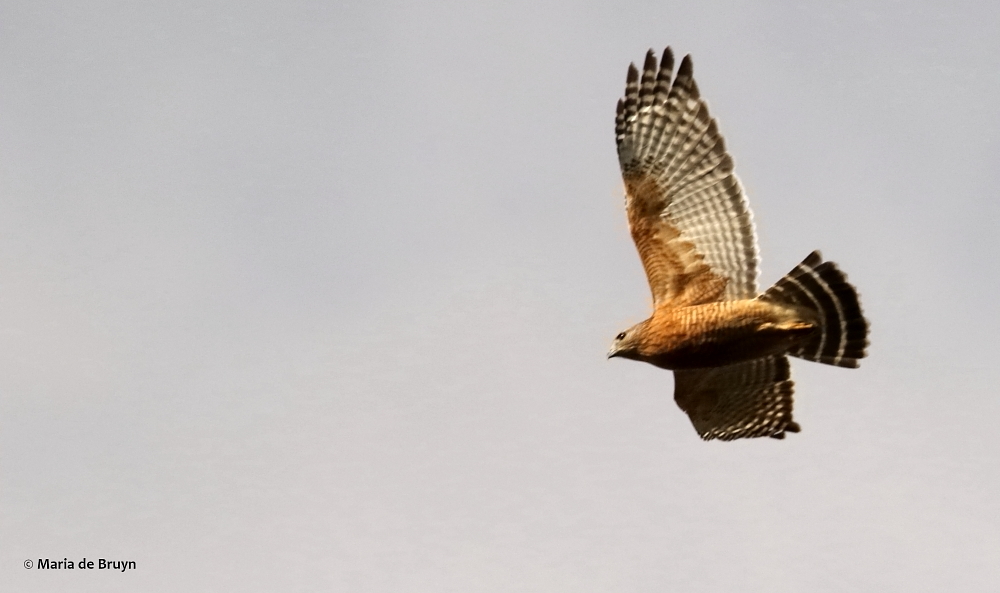
Lately, I’ve been seeing many red-shouldered hawks (Buteo lineatus). They have been flying overhead at the nature reserves. The other day, two flew by calling raucously and then they alighted at the top of a far distant tree. I couldn’t get a photo but did see them mating in silhouette against the late afternoon sky.


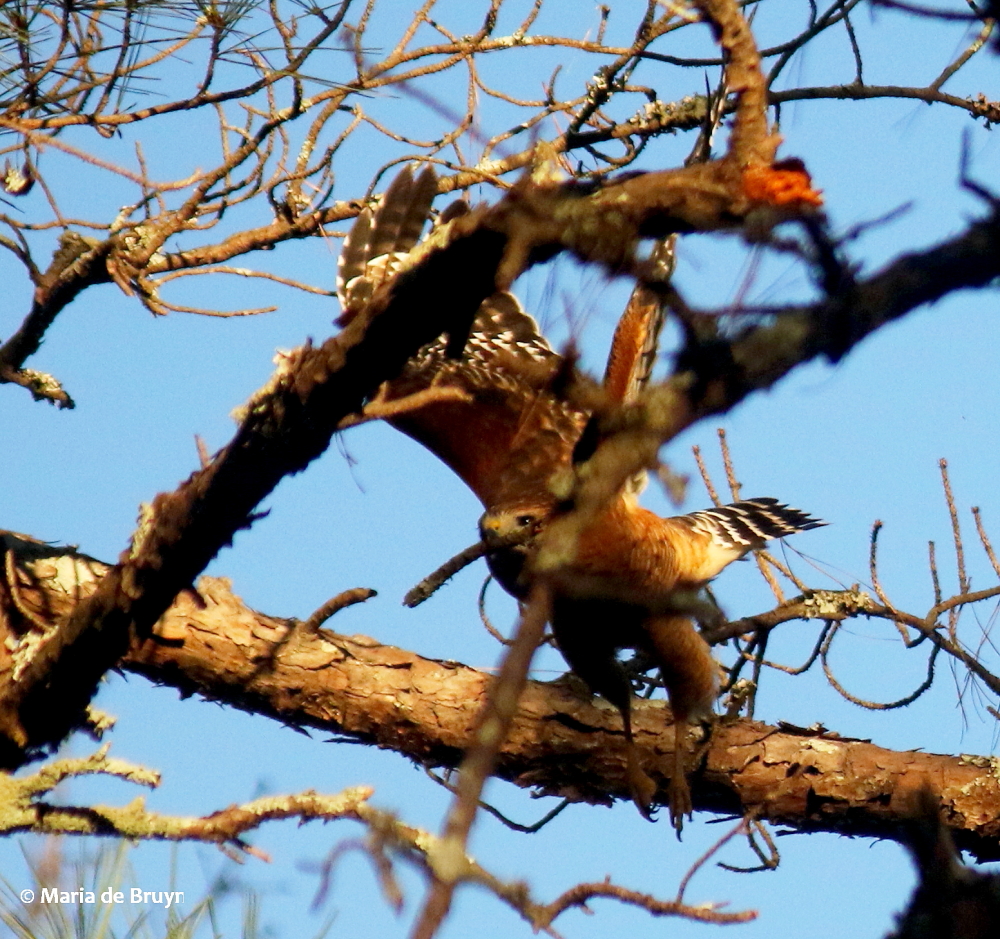
A few weeks ago, a pair of red-shouldered hawks began constructing a nest just down the street from where I live. One afternoon, I happened to see them and one was collecting twigs to build or refurbish a nest.


This pair roams our neighborhood looking for prey; sometimes, one or both will perch in my back-yard tree for a little rest.


When one of the red-shouldered or Cooper’s hawks pauses for some time in the tree over the small pond, I figure it is watching for frogs or one of the chipmunks that live in the rocks surrounding the pond. The chipmunks appear to be very good at eluding capture.


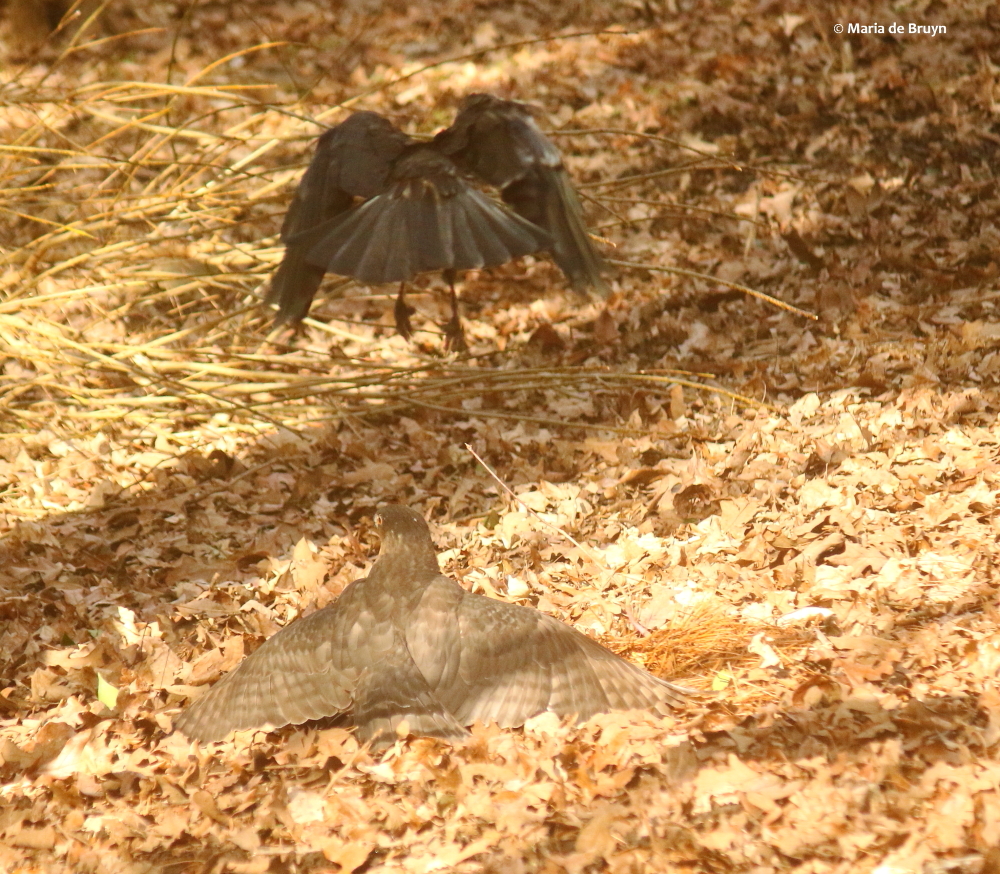
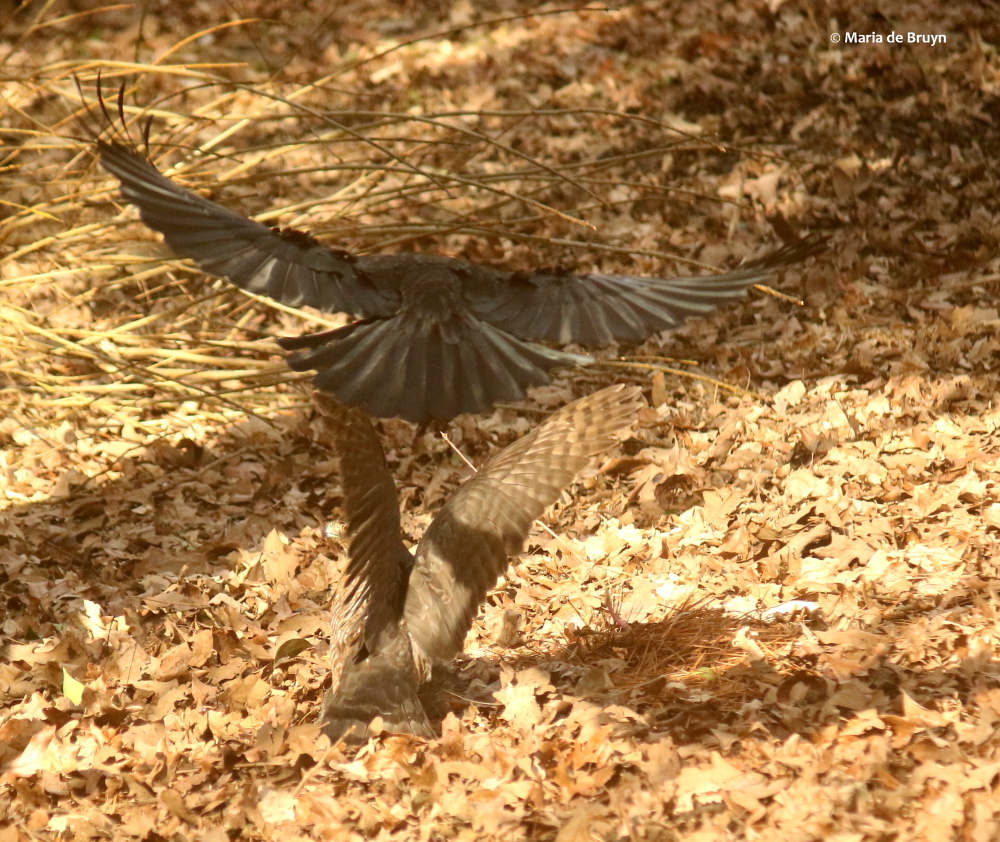
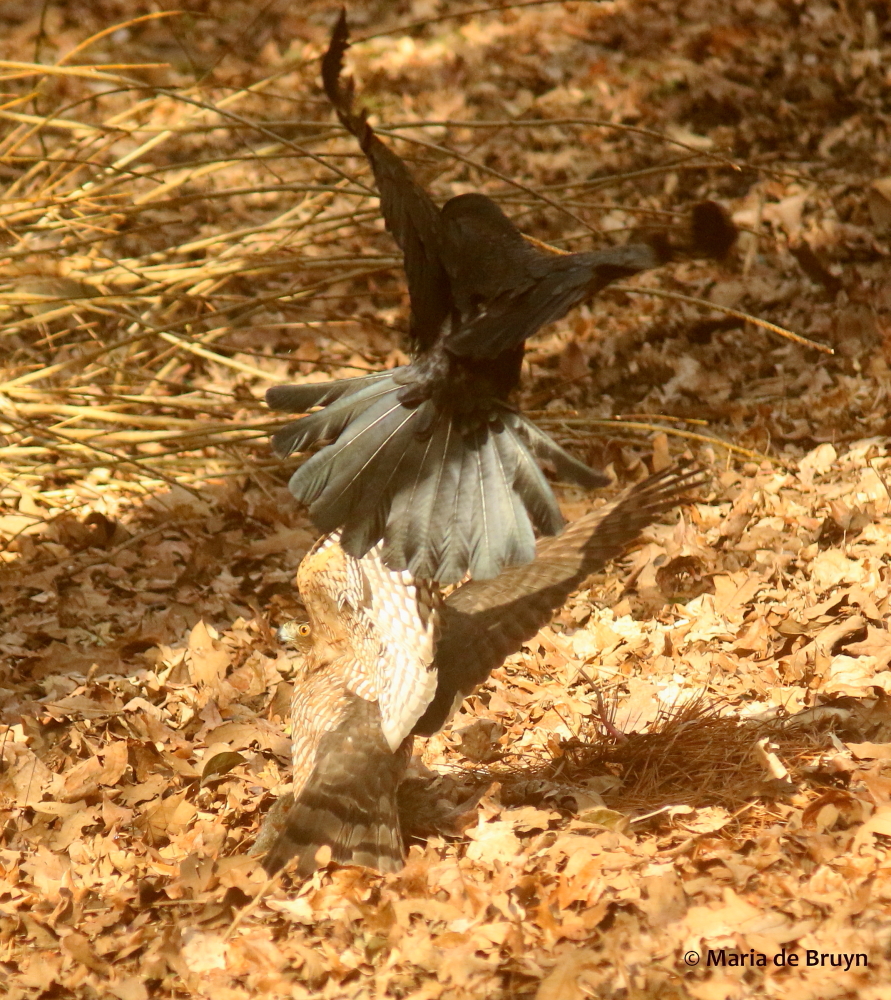
A couple weeks ago, our neighborhood family of American crows (Corvus brachyrhynchos) was making a racket in my yard and when I looked out the window, I could see them harassing a hawk. I couldn’t make out why they were so angry but grabbed my camera for some shots through the window.


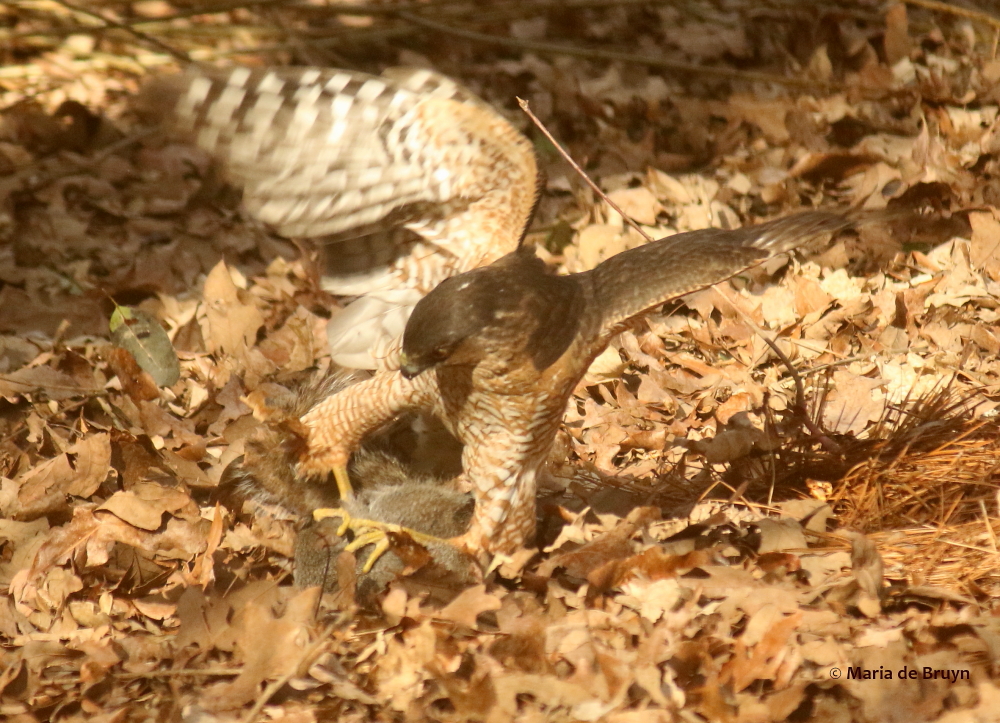
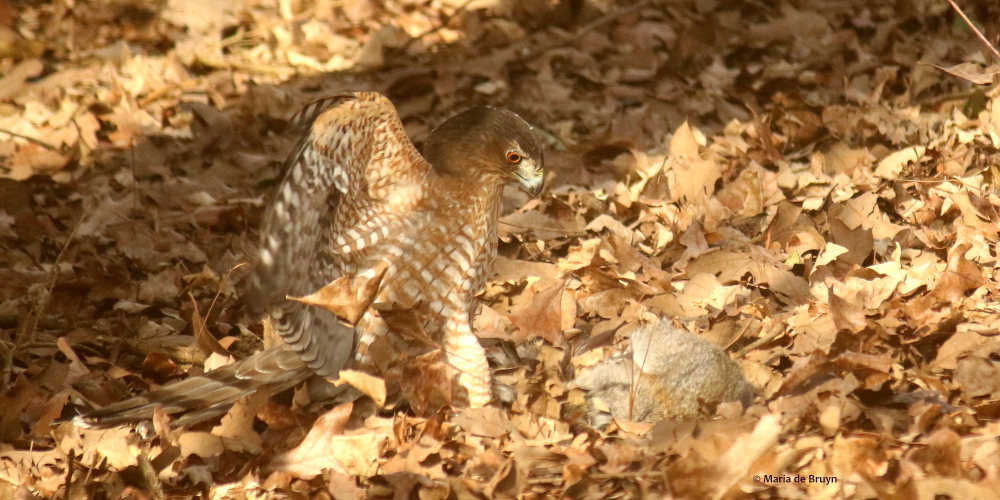
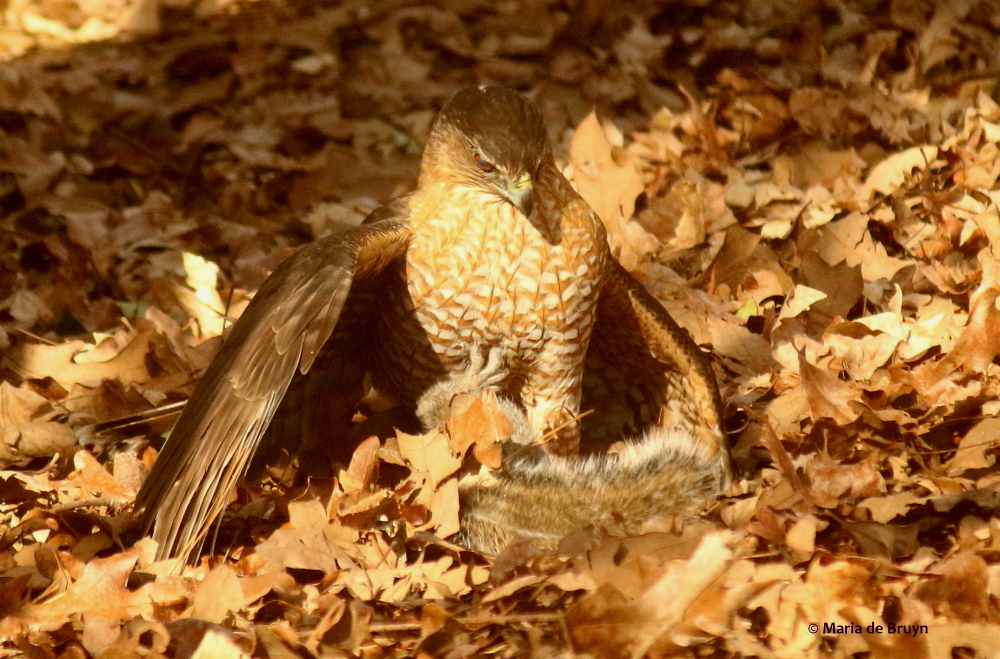
It turned out that the Cooper’s hawk had caught one of the numerous Eastern gray squirrels that live here. The squirrels sometimes annoy me but on the whole, I enjoy watching their antics, so I felt badly for this squirrel, who obviously was not going down without some struggle.

What made it easier for me to watch was that I didn’t really see the squirrel’s head and it was not making a sound. I think the hawk had silenced it early on when it had its claws around its neck and chest.

The hawk was determined and kept hold of the rodent, eventually subduing it.

The hawk as not unscathed, however, as you can see from the wound on its leg.

When the raptor flew off suddenly with the squirrel hanging from its talons, the three crows chased it in hot pursuit. I don’t know if they were just upset that the hawk was present or if they wanted to steal the squirrel away. On walks through the neighborhood, I am now regularly seeing the hawks in trees and on power lines. They are not too shy and seem to be adapted to the human presence in their territory.


While I may be feeling a bit wary for the other animals and birds when the stunning raptors appear, it still is a thrill to see one up close. Only about half of the red-shouldered chicks make it through their first year of life, so I hope the hawks keep coming by. And who knows, maybe we will have some of the long-lived birds who can reach an age of 15-19 years!


Surprise gifts from Mother Nature in 2018 – part 1: birds

On the last day of January 2019, I thought it would still be ok to post a couple blogs on some surprises I encountered the past year. Almost always when I go out on nature walks, I encounter something new – a species of wildlife or plant that I have not seen before or an interaction between species not previously observed. So, I wanted to share a few of those delightful surprises from 2018. In this blog, I focus on birds; in the next part, other kinds of wildlife will be featured.

As I mentioned in a previous blog, my own front yard was the scene of my biggest surprise last year when a snowstorm brought feeder visitors whom I had never seen before and who rarely come to the state where I live. The evening grosbeaks were just stunning.


They were not the only grosbeaks who treated me with their beauty, however. I’ve had rose-breasted grosbeaks (Pheucticus ludovicianus) visit the feeders before, but they still always elicit my appreciation with their bright colors.


In late October, an osprey (Pandion haliaetus) made me stop for a photo as the other birds of its species had already gone south for the winter. The bird was perched on a branch extended over a pond and had to unfortunately contend with a persistent crow that was harassing it. After some time, the sea eagle finally took off with the crow in pursuit – it seemed that the osprey might have injured its wing and perhaps that accounted for a delayed departure to warmer climes.


Although the pursuit photos are not high-quality, you can see a gap in the osprey’s wing and perhaps it was waiting for healing before it undertook a very long journey.


On another day, I was near a wetland when an unexpected visitor flew onto a branch above me. Green herons (Butorides virescens) usually keep their distance from me; I regretted that it was overcast and the lighting was not wonderful for my close-up portrait of this colorful immature bird.


A more muted bird, but lovely nonetheless, is the Northern mockingbird (Mimus polyglottus). When I saw this individual in late December, I was thinking that it must be difficult for them to find food as the vegetation shrivels and insects are in hiding. At that moment, the bird dropped to the ground and was foraging – coming up with a bug to prove that they still could find sustenance in the cold temperatures!


The mockingbirds are often solitary except for breeding season. Some people complain that they are aggressive towards other birds at their feeders but those in my yard are not that way at all. They share space at feeders and don’t chase anyone else away. When it is mating and nesting time, however, they can become quite territorial and are very protective of their nests. This seasonal “grumpiness” was brought home to me one day along a country road when I witnessed a pair of mockingbirds driving a third bird – rival? Intruder? – away from their roosting spot.

When large flocks of gulls and double-crested cormorants (Phalacrocorax auratus) visited a small local lake because of a shad die-off, I had the chance to watch them for a while. One day, it was interesting to observe how one cormorant wanted to jump up on a floating platform, but another bird didn’t want him/her there. They faced off with open beaks – the bird wanting to get out of the water won.


It’s always interesting to me to watch birds as they forage for sustenance. When I think of woodpeckers, my thoughts immediately turn to nuts and insects, which I think of as their staple diets. So it was a surprise to me to see this red-bellied woodpecker (Melanerpes carolinus) dining at length one day on nice ripe persimmons – a bird with a sweet tooth!


Well, I probably shouldn’t say “sweet tooth” but “sweet tongue”. Woodpeckers don’t have teeth but they have exceptionally long tongues that can be wrapped around their brains inside their skulls when not being used to extract insects and other food morsels from crevices.

Another bird that has a long tongue is the great blue heron (Ardea herodius). One day, I came across this bird on its favorite roosting log obviously trying to dislodge something that had gotten stuck – or perhaps something that tasted foul. I hadn’t really seen the species’ tongue before, so the bird gave me some good views.


The effort of shaking its head also led it to protect its eye with the nictating membrane.

Because tufted titmice (Baeolophus bicolor) visit my bird feeders daily to get nuts and, to a lesser extent, seeds, I associate them completely with that type of diet. It was that assumption that made me do a double-take when I spotted a titmouse on a walk with a long spaghetti-like object dangling from its beak. It didn’t seem like a grass stalk so when I lifted my camera to look through the zoom lens, I discovered it had a worm snake (Carphophis amoenus amoenus) in its beak – a finding that really did astound me.


As I took photos, the bird finally flew further away and unfortunately dropped the reptile when it came close to a creek. I felt a bit guilty, thinking I might have disturbed its meal but after waiting about 5 minutes, the bird suddenly flew up with the snake back in its beak! It obviously really wanted to hang on to that prize!


And now on to part 2 of my 2018 surprises – some more reptiles and amphibians, bugs and mammals!

A bountiful year for seeing Castor canadensis

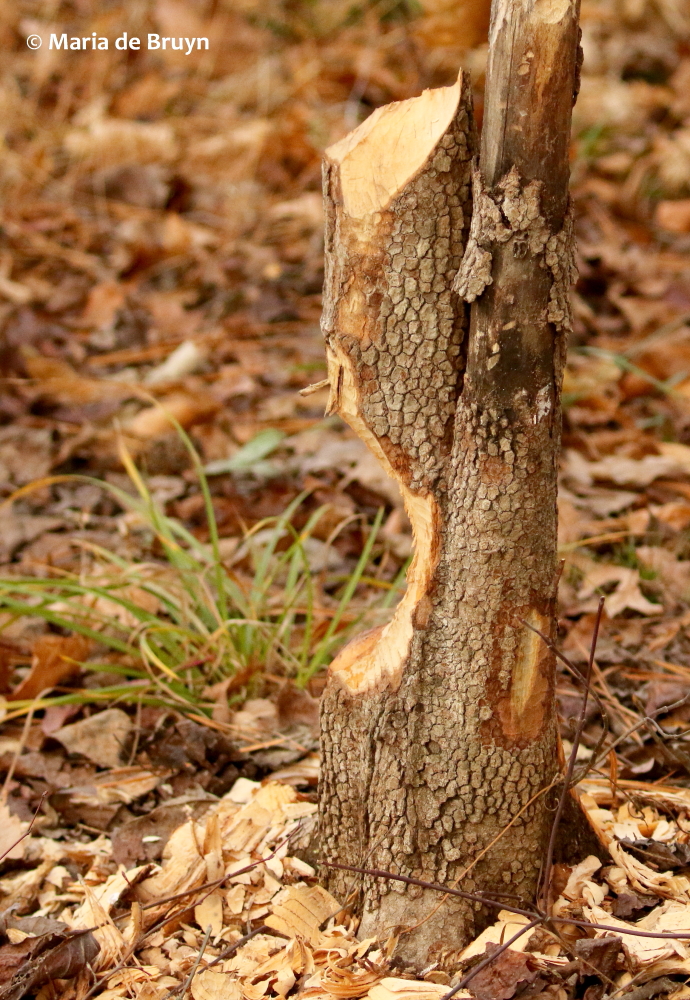
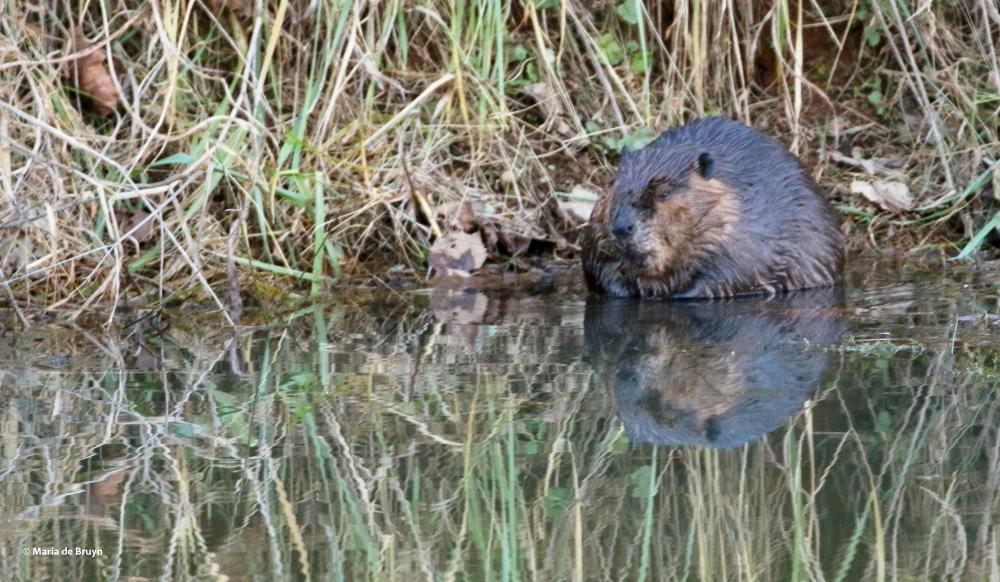
It has been my privilege to go on safaris in Africa and my outings in nature there resulted in sightings of multiple mammalian species each time. Where I live now, there are also a variety of mammals but I don’t see them often, other than squirrels, chipmunks, deer, opossums and raccoons. I was lucky to see chewed trees as evidence of American beavers’ (past) presence, but I was not seeing members of the Castor canadensis species. Some of the chewing patterns on the trees were interesting though.

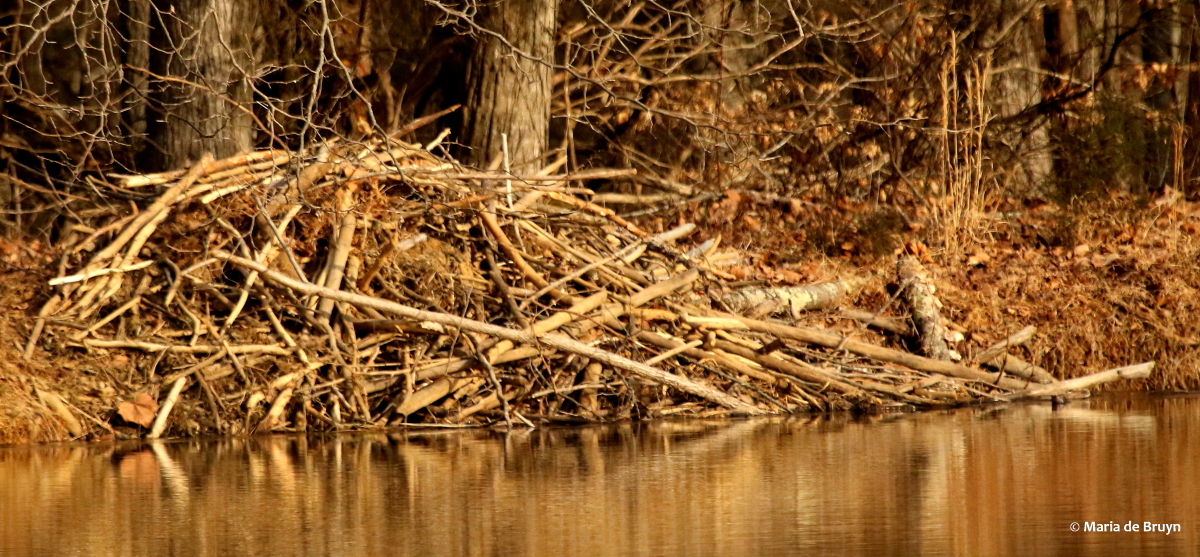
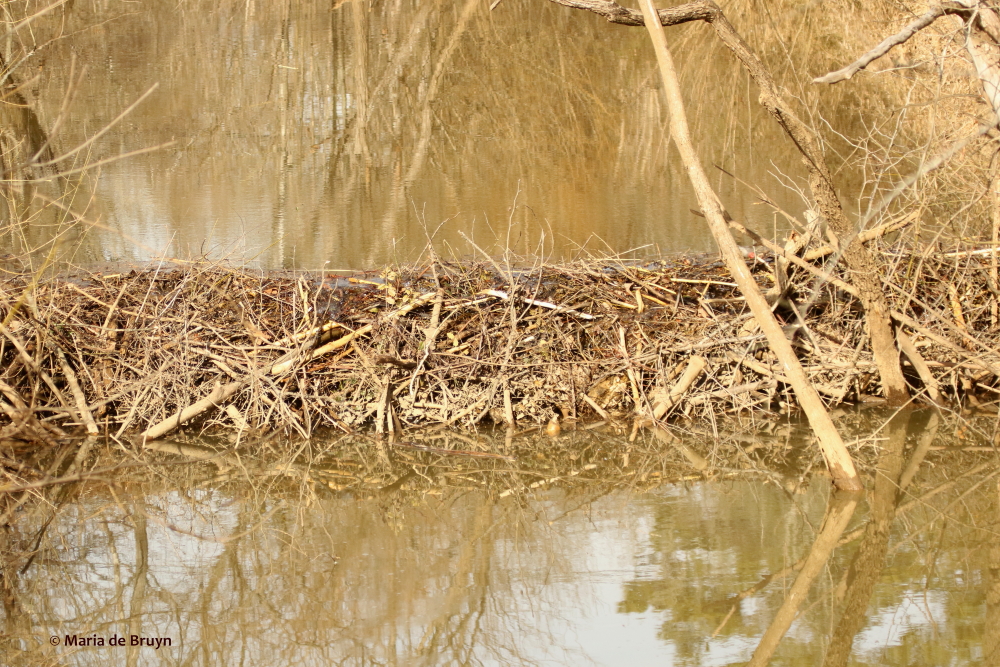
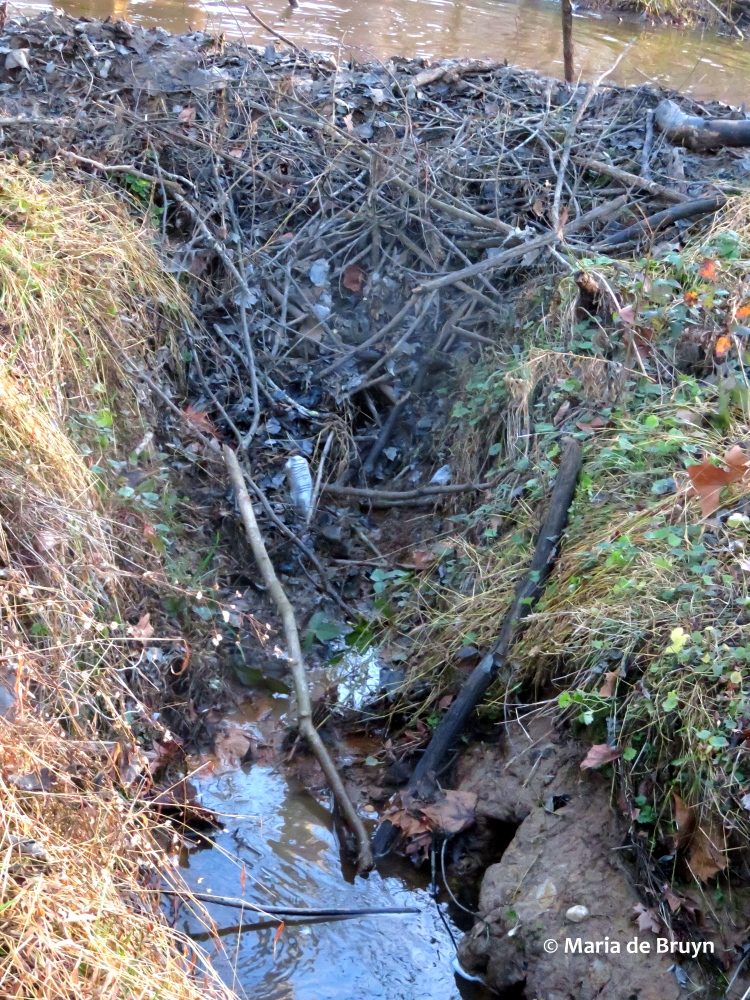
I saw my first beaver lodge at Brumley Nature Preserve South in early 2016 and had the good fortune to get a quick glimpse of a beaver there. (Before that, I had seen them in zoos.) Then I began noticing beaver dams more often on walks, like the one below near the Haw River. So for my first long blog of 2019, I’d like to share with you how 2018 became my bountiful beaver year.

In the spring, a friend told me about a creek where beavers’ dams had resulted in marvelous wetlands along some nature trails. Their handiwork at Pokeberry Creek was appreciated by a considerable number of nearby residents, who were pleased with an increasing number of waterfowl and other birds at the wetlands, as well as otters.


They spoke about the benefits of beavers’ presence, such as the increased biodiversity, improved water quality and more opportunities for wildlife viewing, and celebrated their arrival. Some birding groups began leading walks there to view the numerous songbird and other avian species.

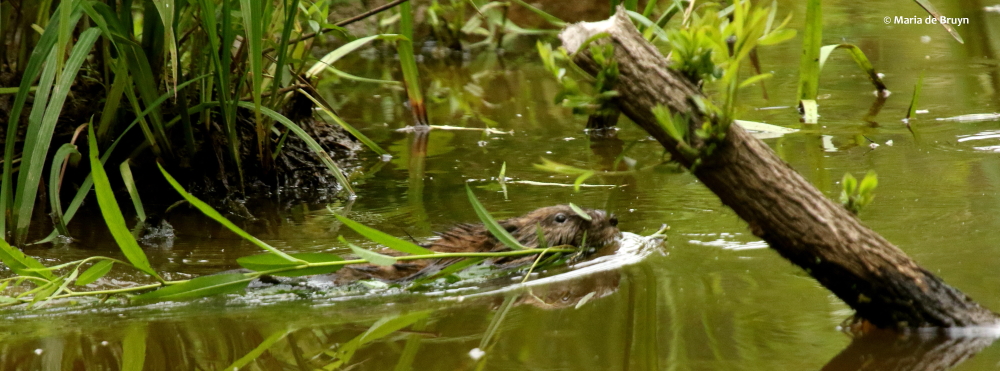
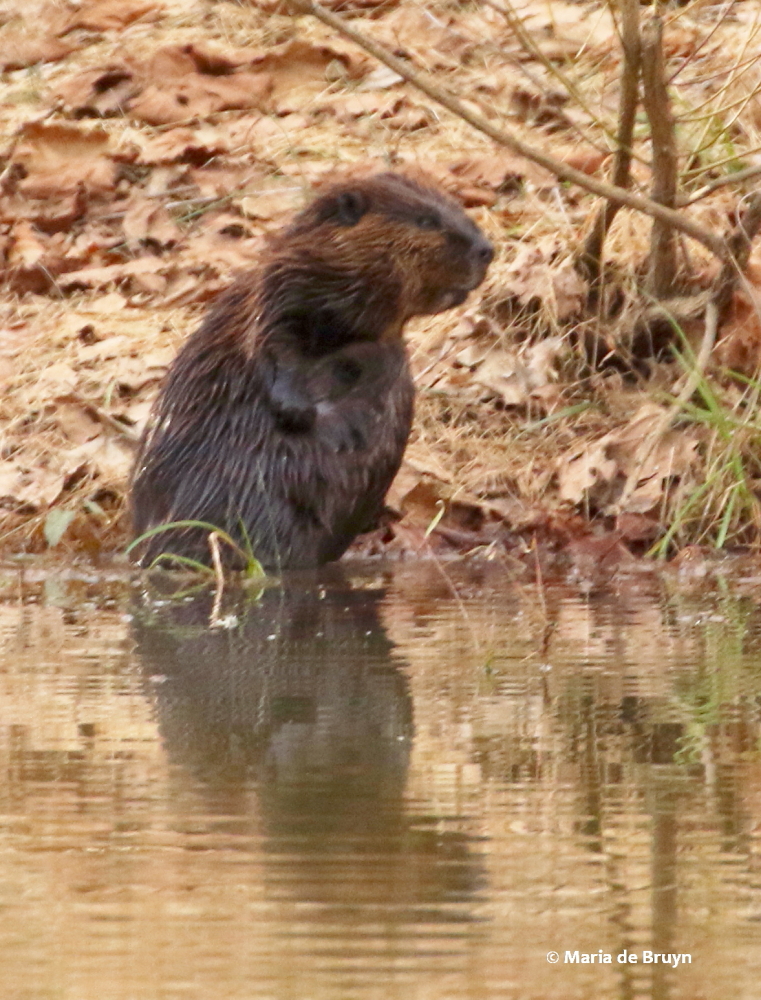
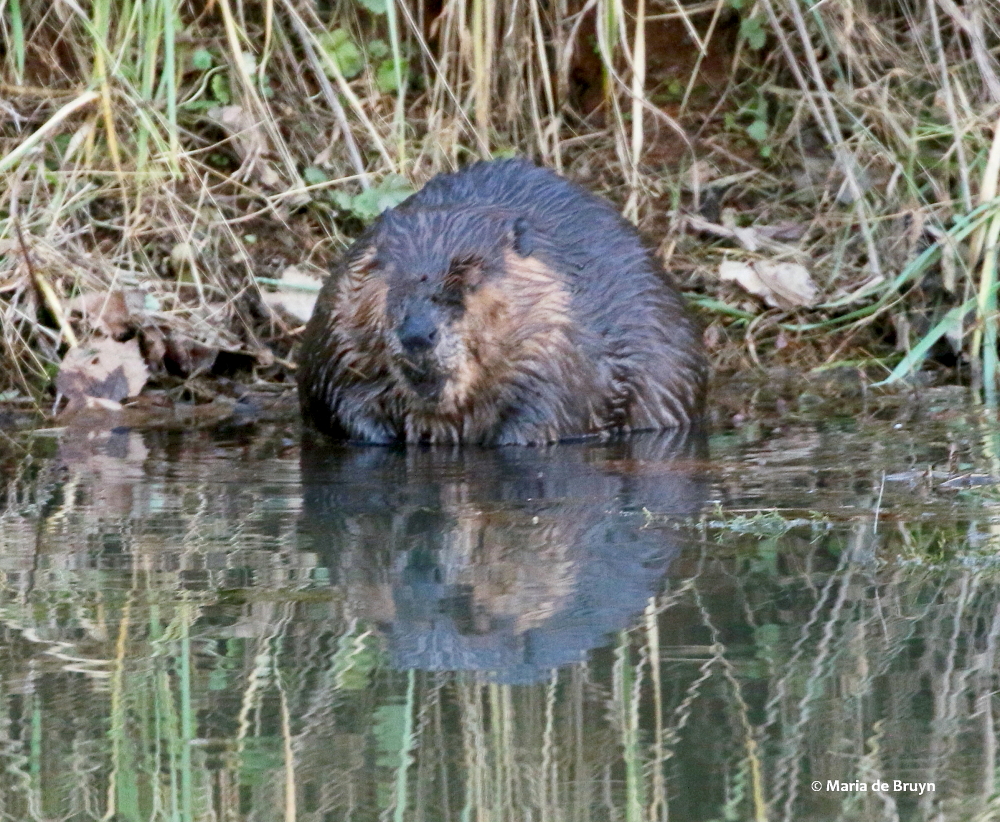
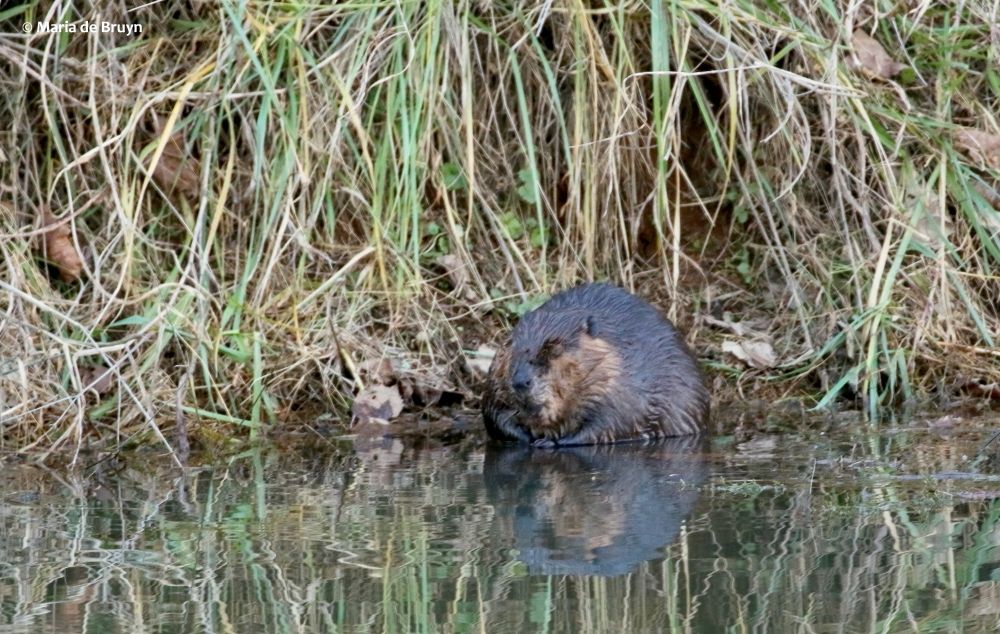
For me, the chance to see the beavers in action was wonderful. One day, I saw an adult chewing branches as part of its meal; it was quiet and didn’t seem disturbed to have me nearby watching.

On other occasions, I saw individuals bringing reeds back to a lodge, presumably to feed young ones left at home. (The offspring may stay with their parents up to two years.)

As beavers are mostly crepuscular, visiting at dusk offered a good chance to see them at work felling trees for their dams and lodges. It struck me that when I had observed them eating, they were very quiet. When they were working to cut trees down, however, I could hear them chewing very loudly.

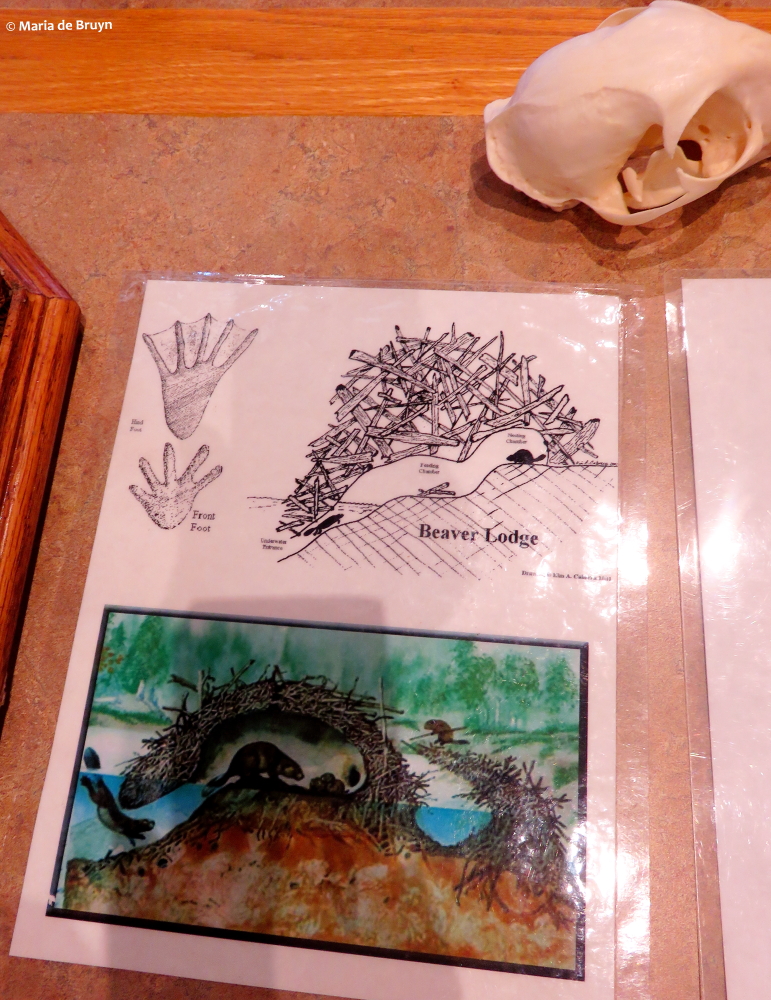
Some people living near Pokeberry Creek brought chairs and drinks to watch the animals at work in the evenings and everyone present seemed to be learning a lot about them. Apparently, many people are interested in beavers – the ranger station at the Jordan Lake Dam has a taxidermied beaver and information about their lodges on display.

Nature’s aquatic engineers are certainly interesting mammals. North America’s largest rodents can swim underwater without coming up for a breath for some 15 minutes; this is because they slow their heart rate. Their transparent eyelids function as goggles so that they can see underwater.

They build dams to ensure that the ponds in which they construct lodges are deep enough so that the entrance remains under water. When the water is at least 2-3 feet, they will be safe from predators and the entrance to their home will stay ice-free in the winter. If they are in a spot where the water remains high enough all the time, they may forego building dams. At Pokeberry, the animals felt a need to build dams in two places. Research has shown that the noise made by water flowing away contributes to their decisions to shore up dams; they apparently cannot tolerate the sound of running water above a certain number of decibels.

The beavers’ environmental engineering irritated some members of the Home Owners Association (HOA) of a nearby community which is still under development. Some people complained that the water was encroaching onto properties (other property owners were ok with it). The rising waters also sometimes flooded a long walking bridge and a cul de sac. Numerous repairs were needed for the bridge and “opposing” parties emerged.

After the HOA announced a plan to have 35 beavers killed, a petition to save the mammals was begun. Within a few days, more than 3700 signatures had been gathered and the HOA undertook a consultation process with different agencies to explore other options. The Friends of Pokeberry Creek Beavers and Wetlands, in the meantime, put up small barriers so that the waters would not encroach so easily onto the cul-de-sac. They also installed a “beaver deceiver” (a pond leveling device, comprising large tubes inserted through a dam so that water would continue to flow through).

It appears that the beavers found the water flow too noisy, so each evening they would mud up the fencing around the deceiver intake so that no water could enter there. The humans would take away the mud; the beavers would put it back. The humans moved the pond leveling devices to deeper areas, but with heavy rainfall, the waters would rise very high.

Finally, in early autumn, the HOA had much of the wetlands drained. This was done to avoid killing the beavers by driving them further downstream to find another area where they could build dams to establish a new pond territory.

The beavers in a large pond that remains rather full have not moved; they are still felling trees, presumably to reinforce their lodge and to have some food supplies in stock for the winter. They also need to keep chewing as their teeth never stop growing. When they remove trees, they leave stumps of about 6-12 inches behind. I’ve seen some of these tree stumps, such as a tulip poplar, sprouting branches again. So the beavers’ tree clearing does not have the same effect as clear-cutting done by humans.


I thought that the drained wetlands at Pokeberry Creek might be the end of my beaver observation opportunities, but then I discovered that another wildlife and recreational park was facing challenges from beaver dams. Sandy Creek Park had had beavers some 5-6 years ago and at that time the mammals were removed (killed). The park manager wants to avoid that now if possible, but the dams need to be controlled since they are causing flooding onto paved pathways which help make the park accessible to persons living with disabilities.

A wildlife biologist visited the park to assess the potential success of a pond leveler there; because the pond in question is rather deep, they may have more success with a beaver deceiver. I’m guessing it will also depend on how the noise levels evolve with the new flow of water into the nearby creek. If they can install a silent outflow pipe, the intervention may be successful.

In November, I found that beavers were also busy at a third natural area that I visit often, the Brumley Nature Preserve North. The rodents are busy in two of three ponds there. The volunteer trail steward periodically breaches the dam at one pond so that the water can continue flowing downstream. When the pond water level remains high enough, the beavers seem to be more lax in repairing the dam.


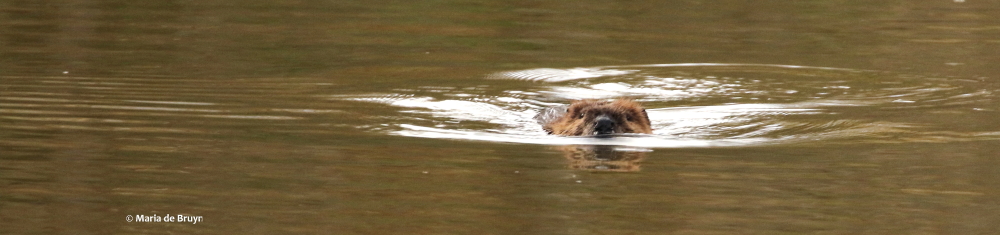
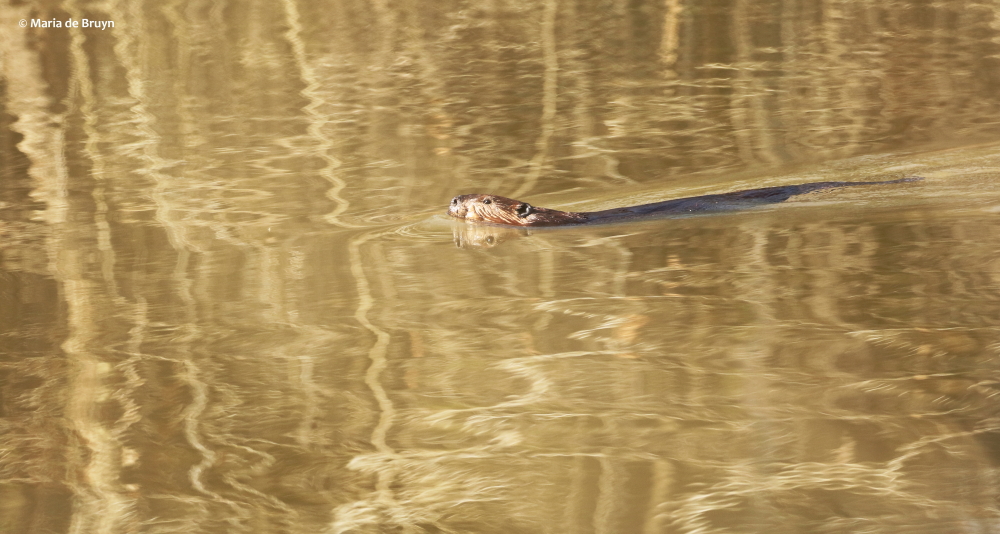
At the other pond, the water level has stayed fairly consistent with all the rainfall our area has had in the past months and no beaver engineering seems to be happening there. As there is no obvious stream flowing into that pond, if we have a dry summer, the beavers may have to abandon that home as the pond could dry up as happened during a drought period last year. There was an interesting development at this pond, however. It involved one particular beaver who recently spent afternoons for a couple weeks swimming laps for hours.

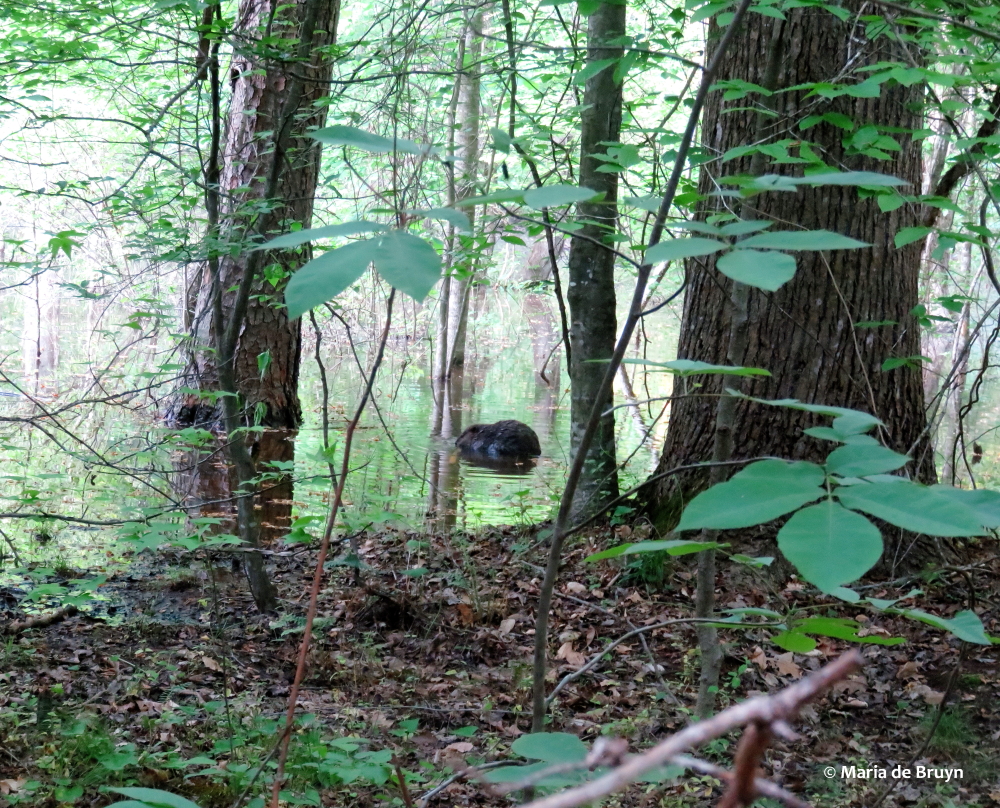
I was quite surprised to see him (it could be female but somehow I thought of this individual as a male who was hoping to attract a mate), since beavers often prefer not to be out in the open during the day. He even emerged from the water from time to time, but always on the other side of the pond.


It didn’t matter whether the day was sunny or colder, gray and overcast. Sometimes, it seemed that he was taking a quick power nap.


The beaver would make small circles, large circles, go to the shore for a quick rest and then resume laps.

One day, I saw him swim toward the lodge and I was able to see inside above the underwater entrance. He didn’t stay there long though and soon came out again to exercise.

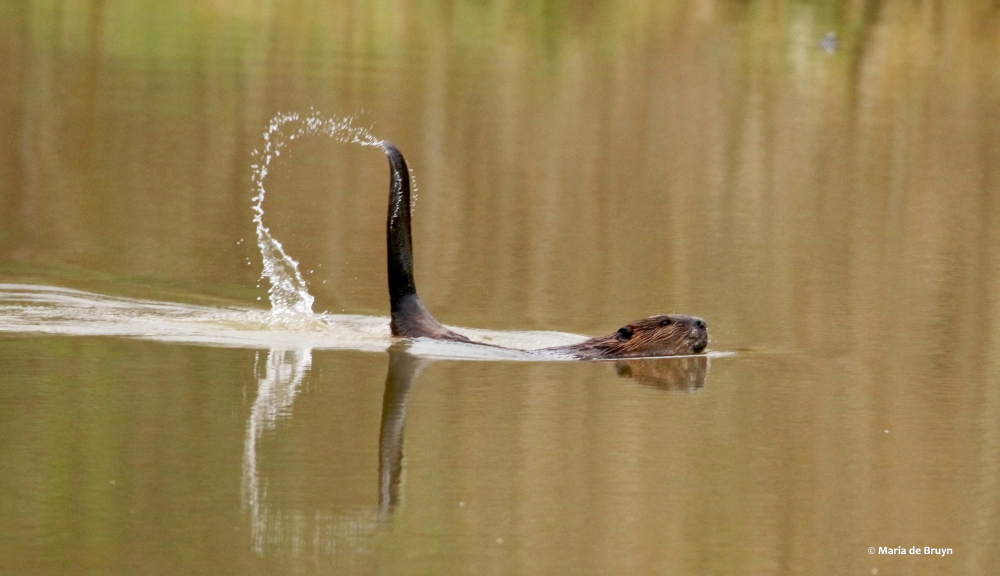
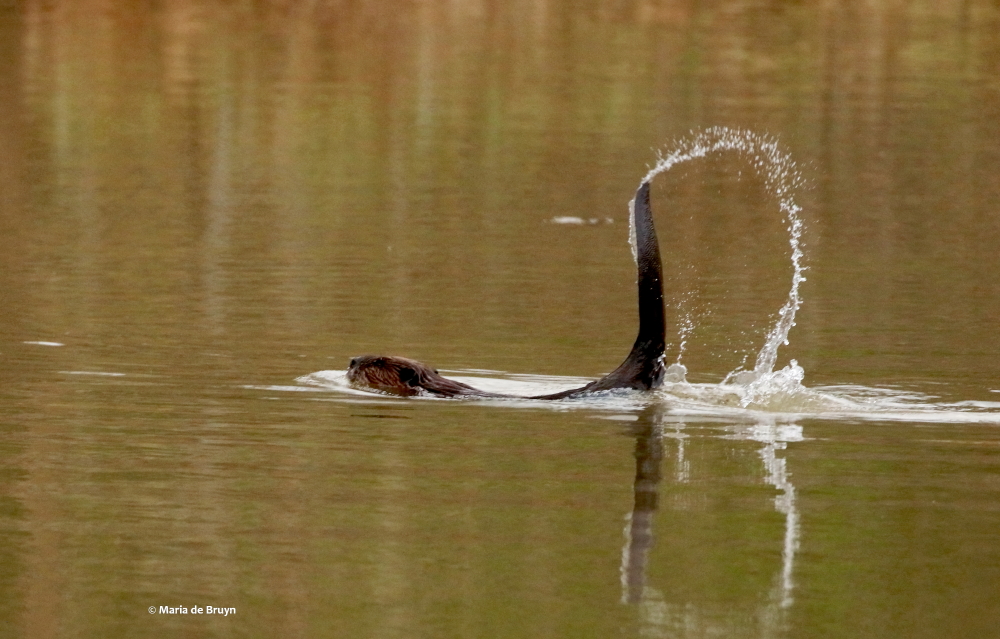
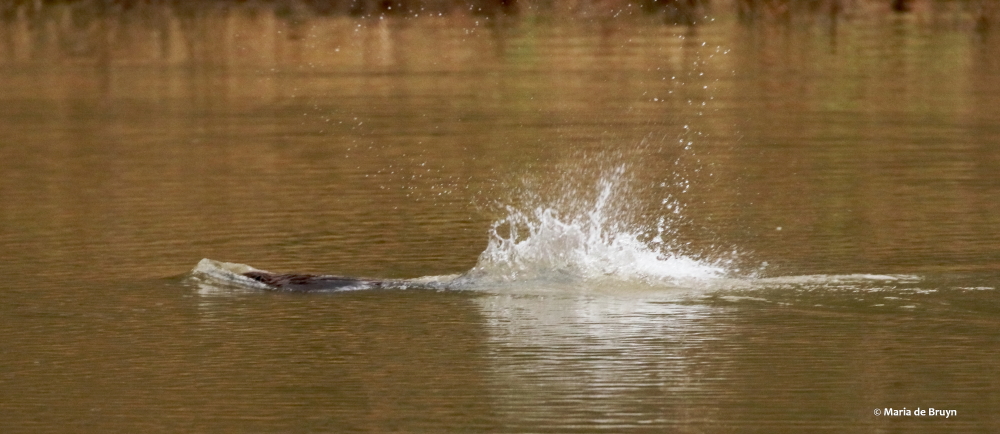
This beaver seemed to be quite relaxed, swimming around and around, except for when walkers came by with dogs. He definitely did not care for the canines; when they appeared, he often would begin slapping his large, flat tail on the water and then diving noisily under water before emerging again nearby.

These tail slap warnings and dives showed off his webbed hind paws.

It was interesting to hear how very loud the tail slaps can be. The beaver will also vocalize its distress.

At one point, some visitors to the reserve allowed their dog to jump into the pond and the canine swam close to the beaver lodge. (Dogs are supposed to be kept on leash but a number of pet owners ignore the sign stating this. When I mentioned that dogs running loose also disturb ground-feeding birds, the response was: “Too bad for the ground birds!”) That very much disturbed the beaver, who slapped his tail again and again.

After that incident, I only saw the beaver having afternoon lap sessions a couple more times. He seems to have given up the practice or is now restricting his swims to very quiet times. I can understand if the animal is trying to avoid stress and distress; that’s one reason I go out for nature walks, too. But I was glad he ventured out for a while so I could see him fairly close on several occasions.

Happy New Year to you all – hope your 2019 is happy, healthy and filled with nature’s beauty!