Birds and blooms at Sandy Creek Park – more of the “good ones”

moon I77A9993© Maria de Bruyn res

Birds are a favorite photographic subject of mine, even though catching them in late spring and summer is challenging when the lush foliage offers them many places to hide. Their songs and calls and warbles tell me that they are there, but often I need to wait quite a while until I finally catch a flutter of movement out of the corner of my eye to locate them.


white-eyed vireo I77A0007©Maria de Bruyn

One early morning, when the moon was still in the sky, I was fortunate enough to see a lot of fluttering in trees near the park’s parking lot – and I discovered an immature white-eyed vireo (Vireo griseus) with a parent who looked as if she or he was really practicing forbearance.

white-eyed vireo I77A0010©Maria de Bruyn      white-eyed vireo I77A0006©Maria de Bruyn

Carolina wren I77A0188©Maria de Bruyn res

Nearby, a Carolina wren (Thryothorus ludovicianus) was singing loudly; these little avians have an outsized voice so that you can hardly miss them even when they are hidden behind leaves.

A handsome male goldfinch (Spinus tristis) was in a field, while a female was visiting the coneflowers (Echinacea), of which there were various species in the cultivated butterfly garden.


American goldfinch I77A0382©Maria de Bruyn res American goldfinch I77A0177©Maria de Bruyn res

coneflower I77A7325© Maria de Bruyn res      coneflower I77A6365© Maria de Bruyn res   coneflower I77A6250© Maria de Bruyn res

Eastern bluebird I77A6188© Maria de Bruyn res


Other birds were busy finding insect meals, like the male, female and immature Eastern bluebirds (Sialia sialis).


Eastern bluebird I77A6022© Maria de Bruyn res    Eastern bluebird I77A5558© Maria de Bruyn res

Common grackle I77A6377© Maria de Bruyn res


The common grackle (Quiscalus quiscula) scored a meal, while the pine warbler (Setophaga pinus) and blue-gray gnatcatcher (Polioptila caerulea) were busy in the trees searching for caterpillars and insects.

Other birds (and mammals, I think) had been getting crayfish from the ponds but I guess there were so many that they only ate the tastiest parts.

Pine warbler I77A5605© Maria de Bruyn res   Pine warbler I77A5598© Maria de Bruyn


blue-gray gnatcatcher I77A0302©Maria de Bruyn res     crayfish IMG_4926©Maria de Bruyn res

The American robins (Turdus migratorius) were looking for earthworms on the ground, and the song sparrows (Melospiza melodia) alternated between the ground and shrubs in their search for food.

American robin IMG_0550© Maria de Bruyn res     song sparrow I77A6195© Maria de Bruyn

The male red-winged blackbirds (Agelaius phoeniceus) were calling and flying from shrub to shrub, showing off their handsome black plumage with a red highlight.

red-winged blackbird I77A6090© Maria de Bruyn res  red-winged blackbird I77A6126© Maria de Bruyn res

Over at a nearby pond, the Northern rough-winged swallows (Stelgidopteryx serripennis) were swooping over the water and then sharing space on a snag; meanwhile, a mother wood duck (Aix sponsa) led her brood along the shoreline.

rough-winged swallow I77A0234© Maria de Bruyn res    wood duck I77A7225© Maria de Bruyn

In a tree beside another pond, the immature great blue herons (Ardea herodias) were still at their nest at the start of June; later in the month, they were no longer hanging out there.

great blue heron IMG_0430© Maria de Bruyn res   great blue heron IMG_0402© Maria de Bruyn res

milkweed I77A0079©Maria de Bruyn res


Botanists can have a great time at Sandy Creek, too. The milkweed plants in the butterfly garden attract both butterflies and bees.

Carolina horsenettles (Solanum carolinense) are common but pretty little plants, while the orange jewelweed (Impatiens capensis) enjoys a good reputation as having stem juice that relieves the pain caused by poison ivy for many people.

Carolina horsenettle I77A5581© Maria de Bruyn res      orange jewelweed I77A0511© Maria de Bruyn res

The fairywand (Chamaelirium luteum) grows profusely on the edges of Sandy Creek ponds and the swamp rose (Rosa palustris) sprouts near them as well.

fairywand I77A7293© Maria de Bruyn res      swamp rose Rosa palustris I77A5621© Maria de Bruyn res

Japanese honeysuckle I77A5711© Maria de Bruyn res


Japanese honeysuckle (Lonicera japonica), an invasive plant, attracts pollinators but so does the more vibrant and native coral honeysuckle (Lonicera sempervirens L.).


coral honeysuckle I77A0159© Maria de Bruyn res      coral honeysuckle I77A0127© Maria de Bruyn 2 res

In the fields, you can see lovely brown-eyed Susans (Rudbeckia) and coreopsis.

Brown-eyed Susan IMG_0504© Maria de Bruyn res  brown-eyed Susan IMG_0497© Maria de Bruyn res


coreopsis flower IMG_0494© Maria de Bruyn res   coreopsis flower IMG_0486© Maria de Bruyn res

Stoke's aster I77A6353© Maria de Bruyn resThe cultivated garden in the park gets plenty of color from the Stoke’s asters (Stokesia laevis) and red bee balm (Monarda didyma), which is a real magnet for hummingbirds. I recently bought a couple for my home garden and was rewarded with seeing the hummers visit them within 2 days.


red bee balm I77A7307© Maria de Bruyn res    red bee balm I77A6390© Maria de Bruyn res

What makes my walks so interesting is discovering new species. A native grass (Bromus) was lovely; helpful facebook group members gave me suggestions for possible species but we couldn’t narrow it down. The group also helped me identify a plant that I hadn’t seen before, a Germander (Teucrium canadense).

grass Bromus IMG_4811© Maria de Bruyn res   Germander Teucrium canadense I77A0544© Maria de Bruyn res

I managed to find an ID myself for a common flower that seems to grow all over the place – the Asiatic dayflower (Commelina communis). It is considered an invasive plant and is on the watch list for North Carolina, but I have to say that I find it quite attractive. Each flower blooms for only one day and to me they look like little faces and make me smile. And so I continue learning as each new walk invariably ends up teaching me something new. Enjoy your day!

Asiatic dayflower Commelina communis I77A0667© Maria de Bruyn res    Asiatic dayflower I77A0677© Maria de Bruyn res

See anything good?

Sandy Creek path IMG_4981© Maria de Bruyn resThat’s a common question I get when I am out on one of my nature walks. Since I carry a camera with a large zoom lens and often a smaller camera, too, it’s obvious to passersby that I’m out observing nature. And I realize that when they ask the question, what they really want to know is whether I saw anything unusual or spectacular.

A recent walk at Sandy Creek Park in Durham, NC, was a case in point. I told one couple who posed the question that my most memorable sighting so far had been a male ebony jewelwing damselfly (Calopteryx maculata) – the iridescence of its body and wings in the sunlight was wonderful. They smiled a bit uncertainly and the lady of the pair admitted that she didn’t know anything about damselflies as they walked on.

ebony jewelwing I77A0417© Maria de Bruyn res   ebony jewelwing I77A0469© Maria de Bruyn res

Fragile Forktail damselfly I77A0648© Maria de Bruyn resAn hour or so later, another couple asked if I had “seen any good ones?” I repeated my delight in seeing the male damselfly, adding that the female is not as striking with her brown color and white spots. “Yes,” said the man, “that is often the case with other species. In our species, though, it’s the females who shine.” That may be the case some of the time, but my day was made by seeing a female damselfly that was a member of a new species for me – the fragile forktail (Ischnura posita).


My experience is that I find some beauty in almost all the wildlife I see (ticks and chiggers are an exception). So I want to share a few of those “good things” I saw at Sandy Creek Park last month in a two-part blog “tour”. In this first part, I’ll continue on with the insects.

Identifying dragonflies is not easy since the females and males can look quite different. The great blue skimmer (Libellula vibrans) provides an example – the male lives up to his name with a blue hue and large size, but the female shows off her beauty with a brown and yellow abdomen.

great blue skimmer dragonfly I77A0715© Maria de Bruyn res    great blue skimmer dragonfly I77A0741© Maria de Bruyn res

The Eastern pondhawk (Erythemis simplicicollis) has distinctively different appearances as a male and female. The adult male is a blue individual, sometimes with a bit of greenish tint; the female – and the immature males! – is brilliant with different shades of green. I remember being excited when I first spotted a female as their green color is so striking.

Eastern pondhawk I77A0721© Maria de Bruyn res  Eastern pondhawk I77A0749© Maria de Bruyn res

blue dasher I77A0172©Maria de Bruyn resThe blue dasher dragonfly (Pachydiplax longipennis) has some stripes, as do some of the bumble bees. The brown-belted bumble bee (Bombus griseocollis) lives up to its name with a brown stripe, while this American bumble bee (Bombus pensylvanicus) feeding on a trumpet vine (Campsis radicans) has white bands. Like honey bees, the latter bee has pollen baskets (corbicula) on its hind legs in which it stores pollen. I enjoyed watching this individual – s/he would dip down into the flower, back up a bit, and then plunge forward again, almost always keeping the pollen basket above the tip of the flower.

Brown-belted bumble bee I77A0218©Maria de Bruyn res   American bumble bee I77A0763© Maria de Bruyn2 res

Bumble bee I77A6297© Maria de Bruyn res


The pollen gatherers were numerous during both visits and willing to share the sources of their bounty – here you see a bumble bee (Bombus), syrphid fly (Toxomerus marginatus) and sweat bee (Halictus) feeding peacefully together on a coneflower (Echinacea).


Eastern carpenter bee IMG_0768© Maria de Bruyn res


The milkweed plants were attracting many species of pollinators; here an Eastern carpenter bee (Xylocopa virginica) was enjoying a meal.


common buckeye I77A0237© Maria de Bruyn res


While there were many, many bees the days of my visits, there were fewer butterflies but the common buckeye (Junonia coenia) was stunning!


The little wood satyr (Megisto cymela) and dun skipper (Euphyes vestris, to the lower right on the milkweed) were not as colorful, and some people might even call them dull, but they are still nice to see and the Eusarca moth (Eusarca confusaria) was also an evenly colored beauty. I had grown up thinking moths usually fly at night, attracted by lights so it still draws my attention when I see them in the daytime.

Little wood satyr I77A0584© Maria de Bruyn res         Eastern carpenter bee IMG_0804© Maria de Bruyn 2 res

Confused Eusarca moth Eusarca confusaria I77A5701© Maria de Bruyn

Even a somewhat tattered American lady (Vanessa virginiensis) offered a pretty view.

American lady I77A6238© Maria de Bruyn res

The broad-headed sharpshooter (Oncometopia orbona), a leaf hopper, and the spotted pink lady beetle (Coleomegilla maculata) are tiny but such colorful insects that close perusal of the vegetation helps you spot them (and presumably makes it easier for birds to see them, too?).

broad-headed sharpshooter Oncometopia orbona I77A0592© Maria de Bruyn      Spotted pink lady beetle I77A0081©Maria de Bruyn bg

Emerald ash borer trap I77A0719© Maria de Bruyn res


One beetle that we don’t really want to see is the emerald ash borer (Agrilus planipennis), an invasive species that came to the USA from Asia. The larvae of these beetles kill ash trees and the park administrators have hung a trap box for them to determine whether this species has reached the park.


Spotting mammals is not always easy at the park but one day fellow birder Jim was kind enough to alert me to an opossum (Didelphis virginiana) in a tree when we met on a walking path. He told me approximately where it was and I spotted that one and another in a nearby tree; I thought it might be a mother and grown offspring but that was a guess and I certainly couldn’t confirm it. As these are nocturnal animals, it was pretty cool for me to see two in broad daylight. The only marsupial found in the United States and Canada is a beneficial animal for us humans (and other wildlife) as they could eat up to 4000 ticks in a week! 

opossum IMG_0605© Maria de Bruyn res     opossum I77A5788© Maria de Bruyn res

One of the pair demonstrated that they can open their jaws widely – watching him/her slowly stretch that mouth offered me a surprise; I would think it couldn’t go any further and the animal continued to show that s/he could really please a dentist who would like lots of space to investigate those teeth.

opossum I77A5897© Maria de Bruyn res

Eastern cottontail rabbitI77A5578© Maria de Bruyn res


The Eastern cottontail rabbit (Sylvilagus floridanus) was not so lucky, carrying a fat tick in its ear. Too bad the opossums couldn’t come by and groom him/her and remove that pesky arachnid!


The park is not only attractive for the entomologists. Reptile enthusiasts can spot turtles fairly easily, especially in the spring when they are looking for places to lay their eggs. A large painted turtle was crossing a field looking for a spot, while an Eastern mud turtle (Kinosternon subrubrum) was trundling down a paved path one morning, not far from a pond which often has many painted turtles and red-eared sliders (Trachemys scripta elegans), like this one – who must have been a bit bothered by a bird feather caught in its shell.

Eastern mud turtle IMG_0741© Maria de Bruyn res    Red-eared slider I77A5941© Maria de Bruyn2

Which bird could it have been? I’m thinking a swallow – see part 2 of the tour for a view of the species and more of the wonderful biodiversity that can be seen in the park.


Youthful exuberance in Yellowstone

bison IMG_8457© Maria de Bruyn resOne of the frequent wildlife sightings during a visit to Yellowstone National Park are the bison, also known as American buffalo (Bison bison). Sometimes you see a single individual, sometimes a group of 3-5 animals and often larger groups or even huge herds. Females and their calves and males usually hang out in separate groups except when it is breeding season. The males can be distinguished by their somewhat longer horns, larger size (up to 2000 lbs) and heavier beards.  The babies are reddish-brown for their first 2.5 months of life, whereafter they begin to develop the dark brown coloring of their species.

bison I77A7891© Maria de Bruyn res

bison IMG_4583© Maria de BruynDuring my recent visit, I learned that you should not get out of your car near a buffalo – they may look placid but they will attack if they feel provoked and can run over 30 mph. From 1980-1999, triple the number of people were injured by bison as by bears in Yellowstone! In 2015, five people were gored by buffalo.Unfortunately, some people still will approach, as shown in this 1992 video showing some frightening consequences. You may then have to photograph them through (dirty) unopened car windows, which doesn’t make for excellent photos, but you can record what you see as memory reminders.

bison IMG_4562© Maria de Bruyn resIn the wintertime, the bison have thick shaggy coats and these are shed in the spring, so that you see individuals with bare patches of skin alternating with woolly areas.

A park ranger told me that they rub on trees to help remove their winter coats; there are whole areas of forest where many trees have bare spots devoid of bark as a result. The bison also “horn” trees, mostly in the autumn, rubbing their horns on cedars and pines by preference; the trees then emit a fragrance which is thought to be an insect deterrent.

bison IMG_4573© Maria de Bruyn res bison IMG_4569© Maria de Bruyn res

Another sign that buffalo are nearby are the bison wallows – these shallow depressions in the ground are used year after year, both during dry and rainy weather. The wallows have multiple functions, including offering dust and mud covering to protect against insects, a place for resting, grooming and play.

I77A6602© Maria de Bruyn resbison I77A6605© Maria de Bruyn res

bison IMG_4578© Maria de Bruyn res

When walking in meadows, along roads and on hillsides, you can often come across bison dung, popularly known as meadow muffins and buffalo chips. These large deposits used to be used as a fire source as they burn well and could be easily gathered.

Given the bison’s size and their habituation to people in the Park, human beings will find that they not infrequently have to share the road with these mammals. They will cross the road from one side to another and sometimes spend some time ambling down the road, so that you can have one pass within about a foot of your car window.

bison IMG_4563© Maria de Bruyn resbison I77A7869© Maria de Bruyn res

bison I77A7490© Maria de Bruyn res

During these “bison jams”, cars are supposed to stop and give them right of way – we are the intruders in their home after all. You then may see an individual through the car window who has been collared or tagged, presumably for research.

bison I77A1714© Maria de Bruyn resbison I77A1739© Maria de Bruyn res

The bison can have very expressive faces, even if at first sight it seems they always have the same expression. This mother demonstrated when she was nursing her calf.

bison I77A1679© Maria de Bruyn res bison I77A1667© Maria de Bruyn res

bison I77A1624© Maria de Bruyn res

bison I77A1473© Maria de Bruyn res

If you had asked me a month ago which adjectives I might associate with bison, my answer likely would have been something like: massive, placid when undisturbed, woolly, furry, huge, plodding. Playful would not have been on the list, but I discovered that American buffalo babies can be very exuberant and know how to have a good time!

A group of three spent quite some time chasing one another, jumping and leaping – one in particular seemed to be the instigator of the play session.

bison I77A1539© Maria de Bruyn res bison I77A1519© Maria de Bruyn res

bison I77A1441© Maria de Bruyn res  bison I77A1453© Maria de Bruyn res

bison I77A1525© Maria de Bruyn res

bison I77A9171© Maria de Bruyn resAt one point, I was in a car where I could observe a group of bison fording a river very near to the road. It was shallow where they entered but grew deeper toward the middle and other side and it turned out there was a strong current. It posed a challenge to the pregnant bison and the babies were really having a tough go. We watched them struggle across, keeping their chins above water as they slowly progressed while being swept downstream from the adults.

bison I77A9113© Maria de Bruyn res bison I77A9103© Maria de Bruyn res

bison I77A9135© Maria de Bruyn res

Luckily, all of the babies made it to the other side, including one who thought s/he was going after her/his mother when s/he got to the top of the riverbank. s/he trotted after a smaller bison, then was followed by a much larger female who began butting her/him – turned out the baby may have been confused after the strenuous river crossing because the smaller bison was not going to nurse. The mother kept after the baby until finally the young one turned and realized who mom really was!

bison I77A9283© Maria de Bruyn resbison I77A9293© Maria de Bruyn res

bison I77A9321© Maria de Bruyn res

bison I77A1450© Maria de Bruyn resBefore Europeans came to the United States, these magnificent mammals ranged as far as the Atlantic seaboard, meaning they could have been in my neighborhood at one time! Now the wild bison are largely confined to some national parks after almost going extinct in the 19th century and the most genetically pure ones are in Yellowstone. So I’m lucky that I had the chance to observe them several times during my recent trip out West and I’d love to see them there again. 🙂

Living above a restaurant

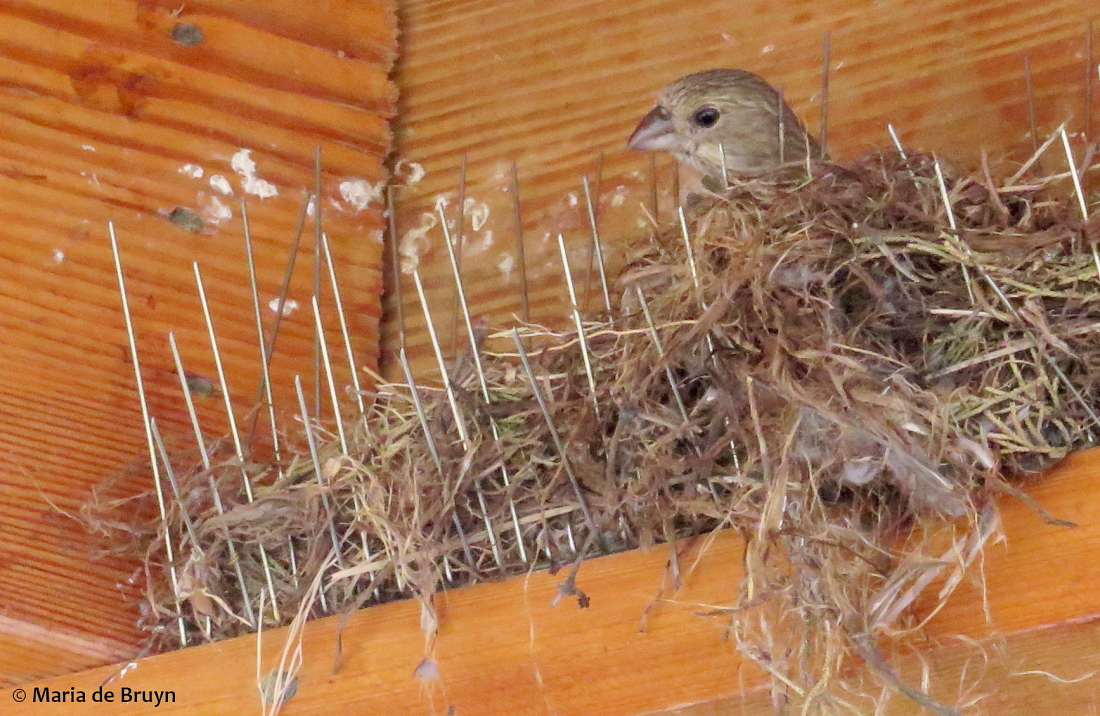
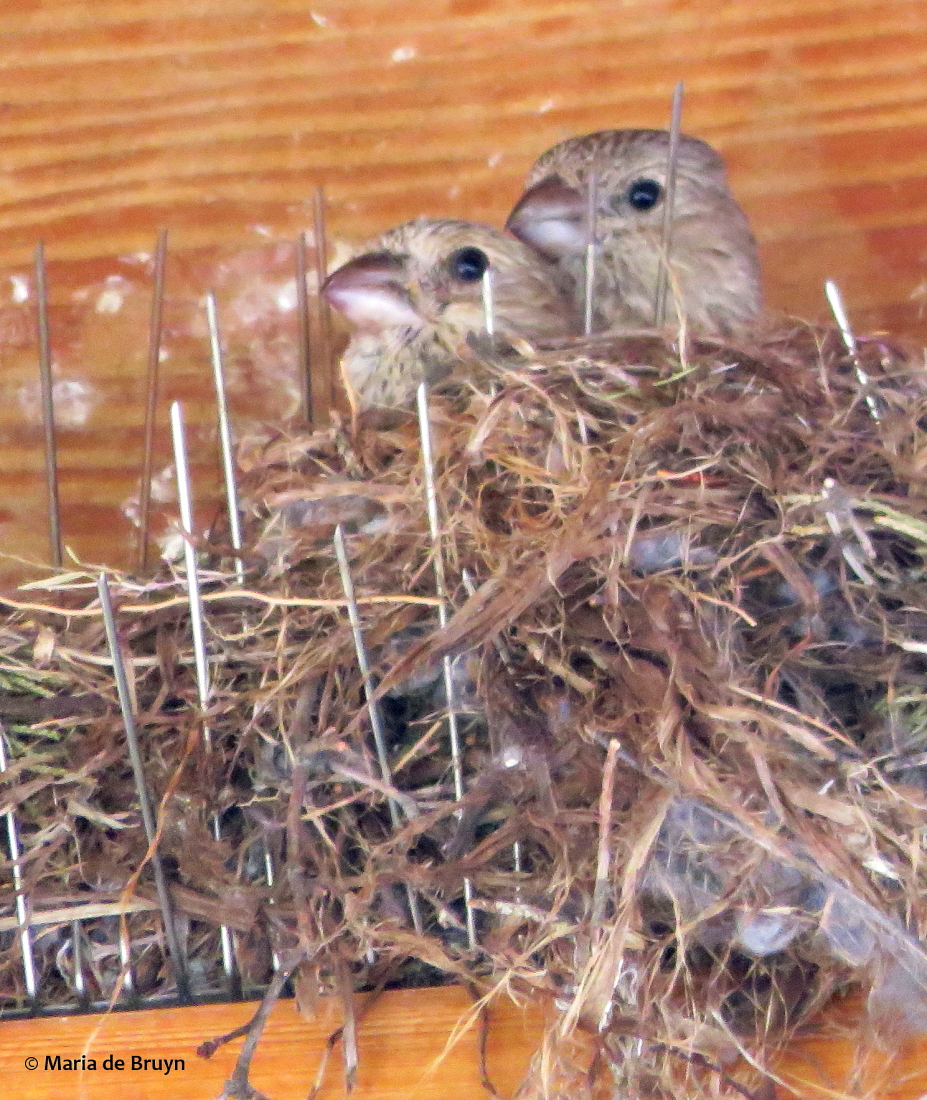
house finch nest 1 IMG_4358© Maria de Bruyn resAt one point in Amsterdam, I lived in a room with a shared kitchen and toilet above a butcher shop. It was a cramped space but I made some nice friends there. Eventually, I painted the hallway with flowers and snails to bring a bit of nature inside. Today, on my way to a prompt writing session, I saw that some birds also choose to live above commercial establishments, including those who established homes above one of my favorite restaurants, El Tigre.

House finch nest 1IMG_4373© Maria de Bruyn res


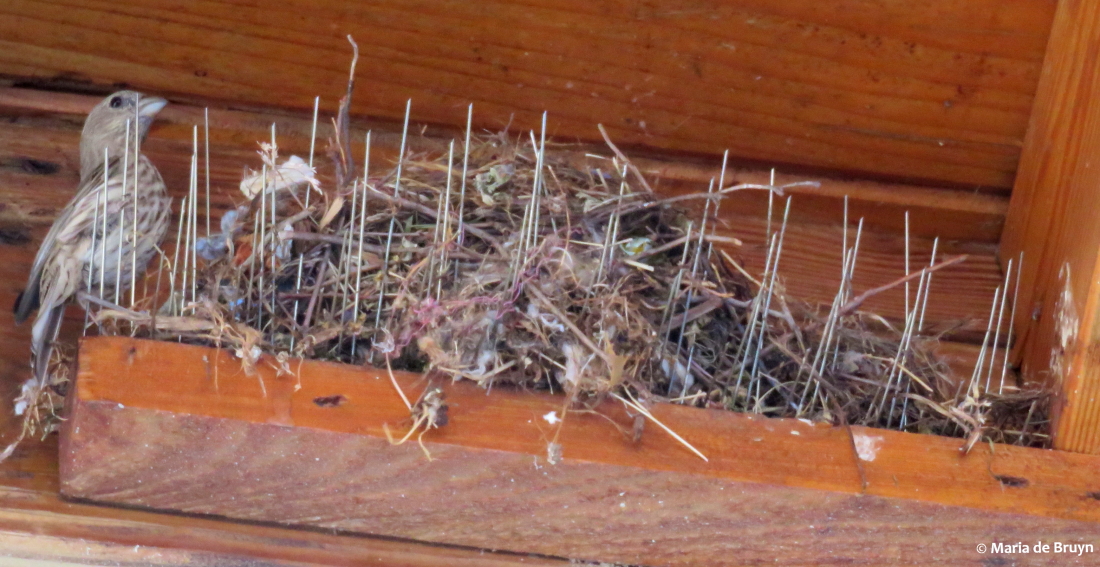
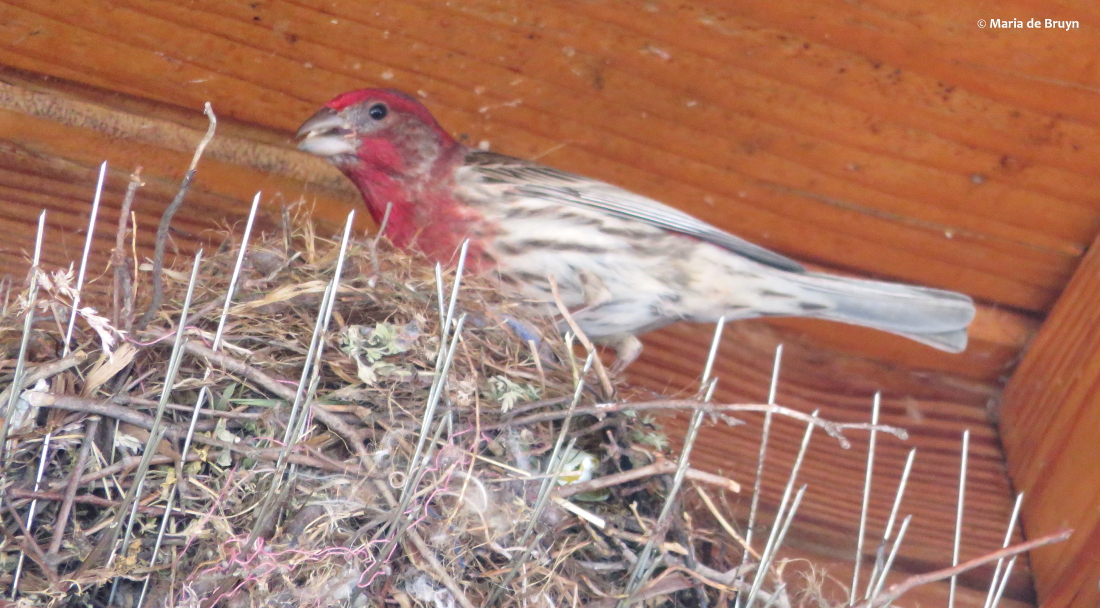
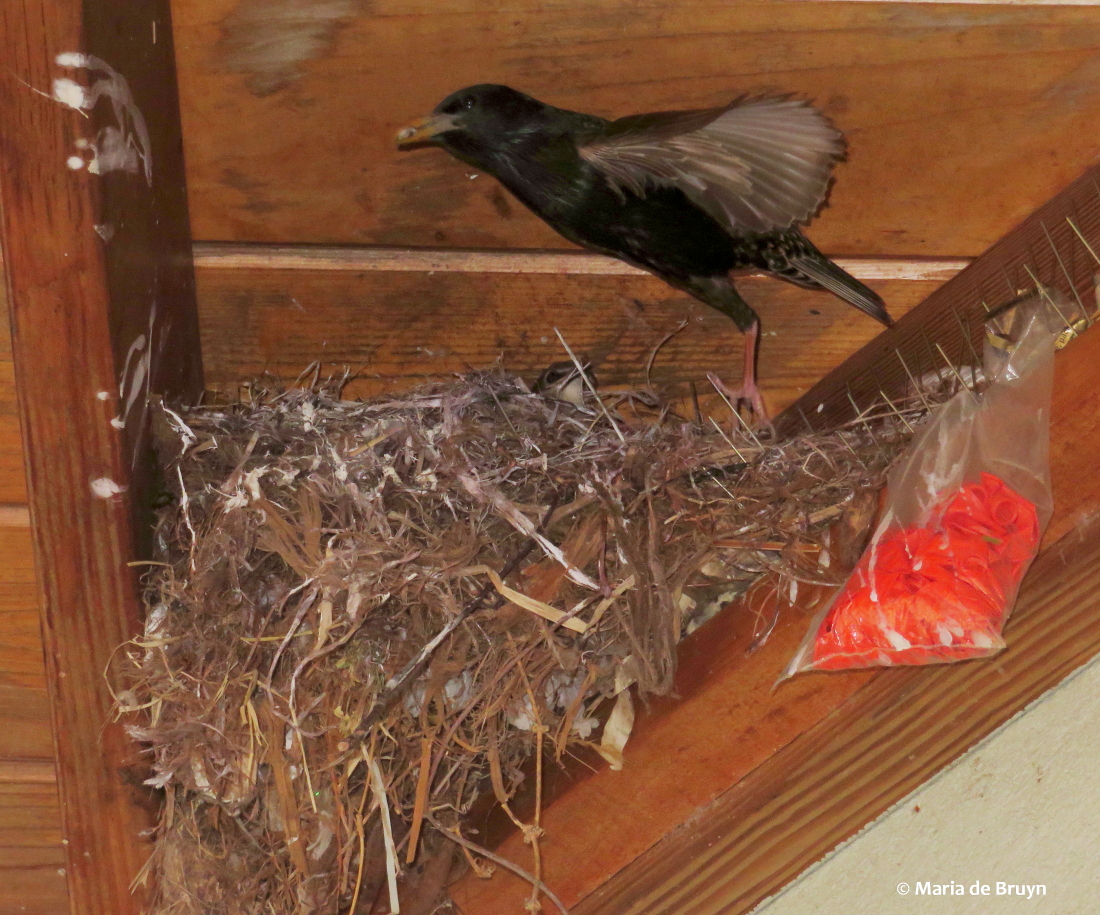
There were three nests (at least – I didn’t look around to the other wall), with house finches (Haemorhous mexicanus) on either side of a European starling (Sturnus vulgaris) home in the middle. Nest 1 had a female bird visiting while a couple stayed inside.


The other finch nest was attended by both mother and father.

house finch nest 3 IMG_4375© Maria de Bruyn res house finch nest 3 IMG_4351© Maria de Bruyn res

house finch nest 3 IMG_4396© Maria de Bruyn res

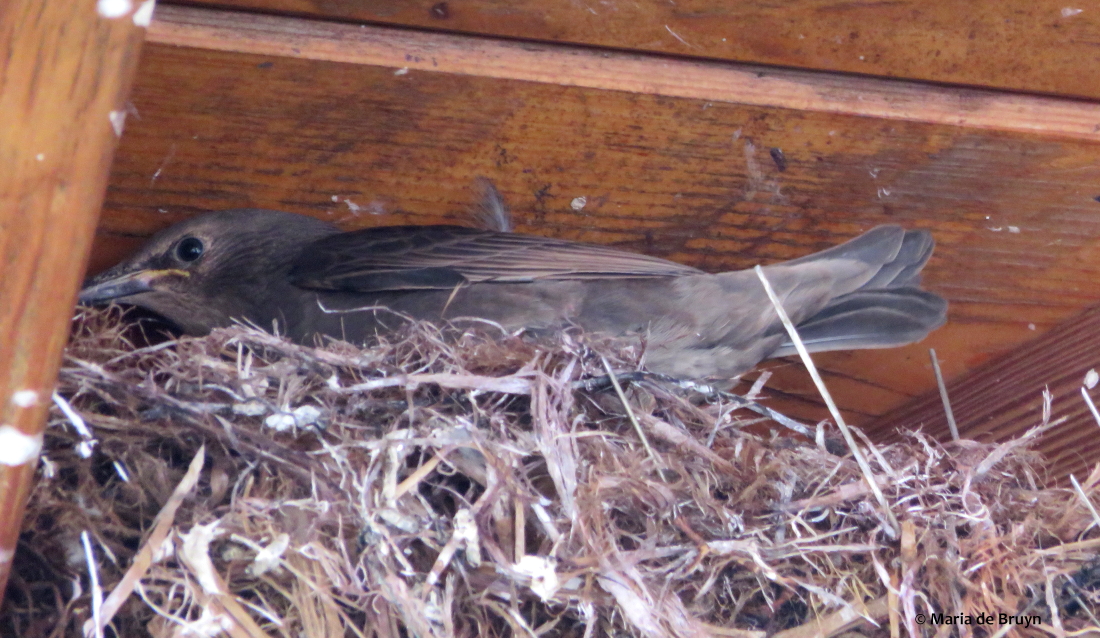
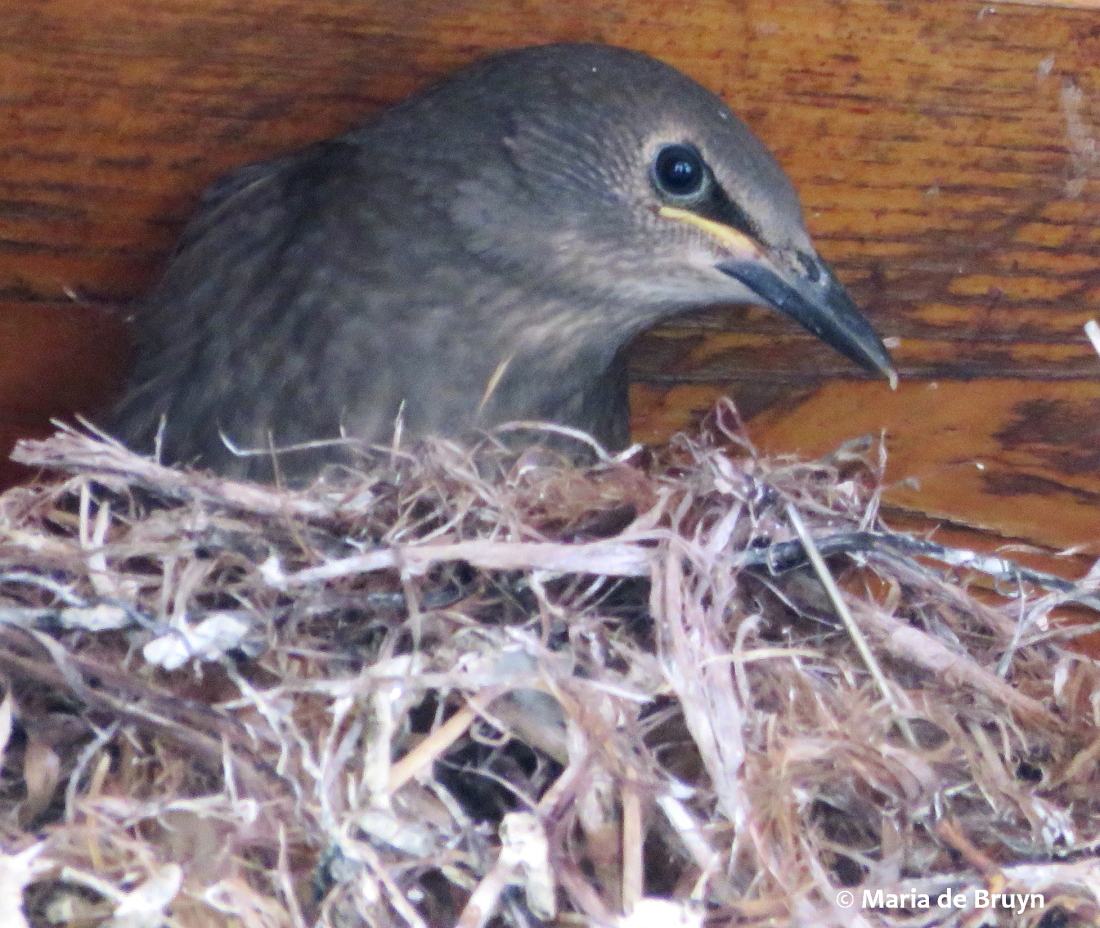
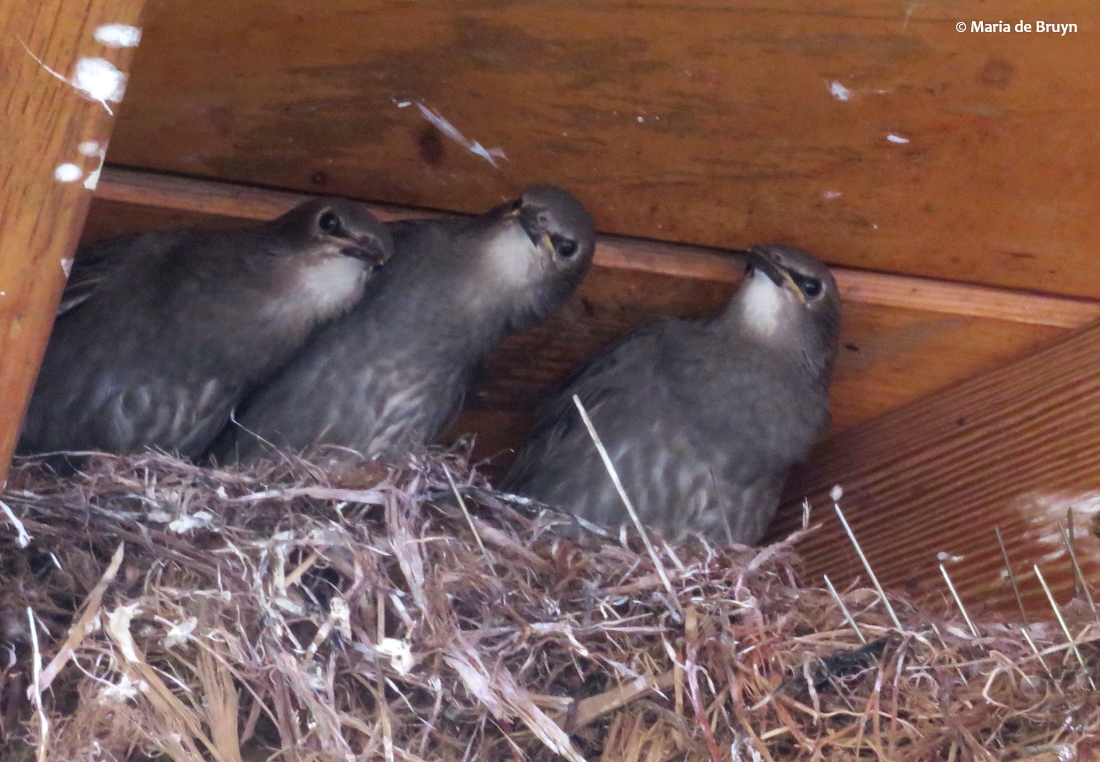
European starling IMG_4390© Maria de Bruyn resThe nest with starlings had rather large babies in it. At one point, an adult bird flew in with a worm or insect but then took off before feeding anyone – perhaps alarmed when it saw me watching the nest. The babies didn’t say much, in contrast to the somewhat older baby starlings in my yard who make quite a racket asking to be fed.

European starling IMG_4387© Maria de Bruyn resEuropean starling IMG_4347© Maria de Bruyn res


European starling IMG_4397© Maria de Bruyn res

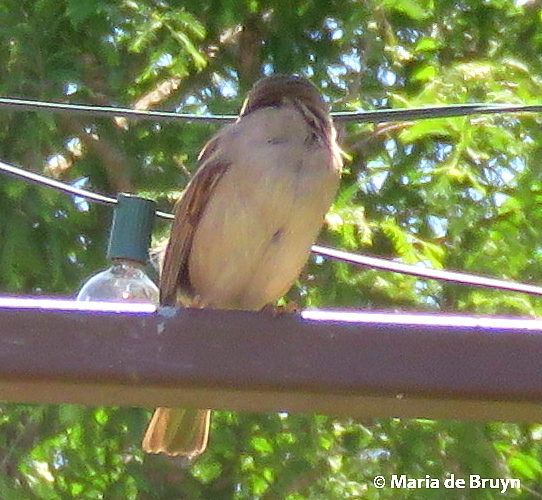
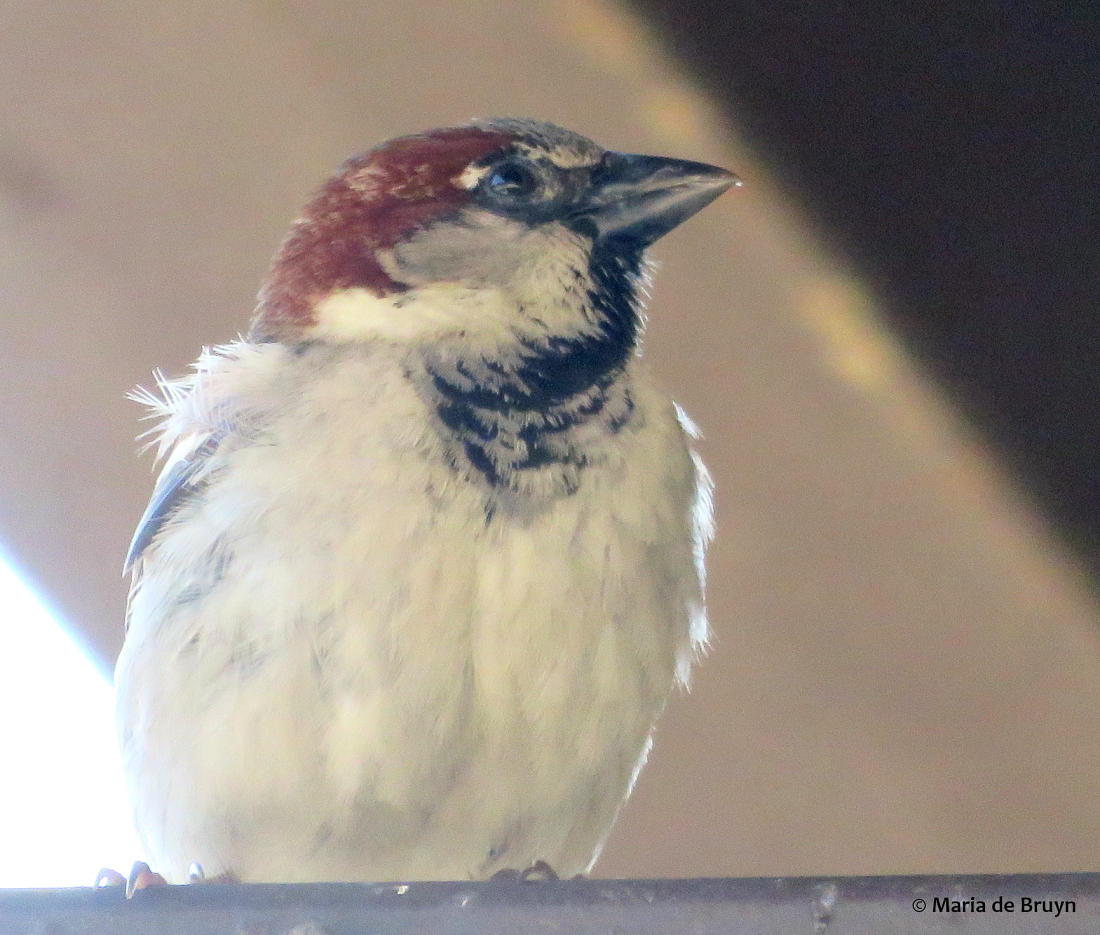
I wasn’t the only observer, however; a couple house sparrows (Passer domesticus) were also observing the comings and goings to and from the nests.

house sparrow IMG_4412© Maria de Bruyn res house sparrow IMG_4355© Maria de Bruyn res

I had a busy day and didn’t think I’d get to do much nature observation – but then those adaptable birds showed me that even in an urban environment, I can grab a few moments to see what other species are doing on a lovely spring day!


Nest Watch citizen science – 2016 edition

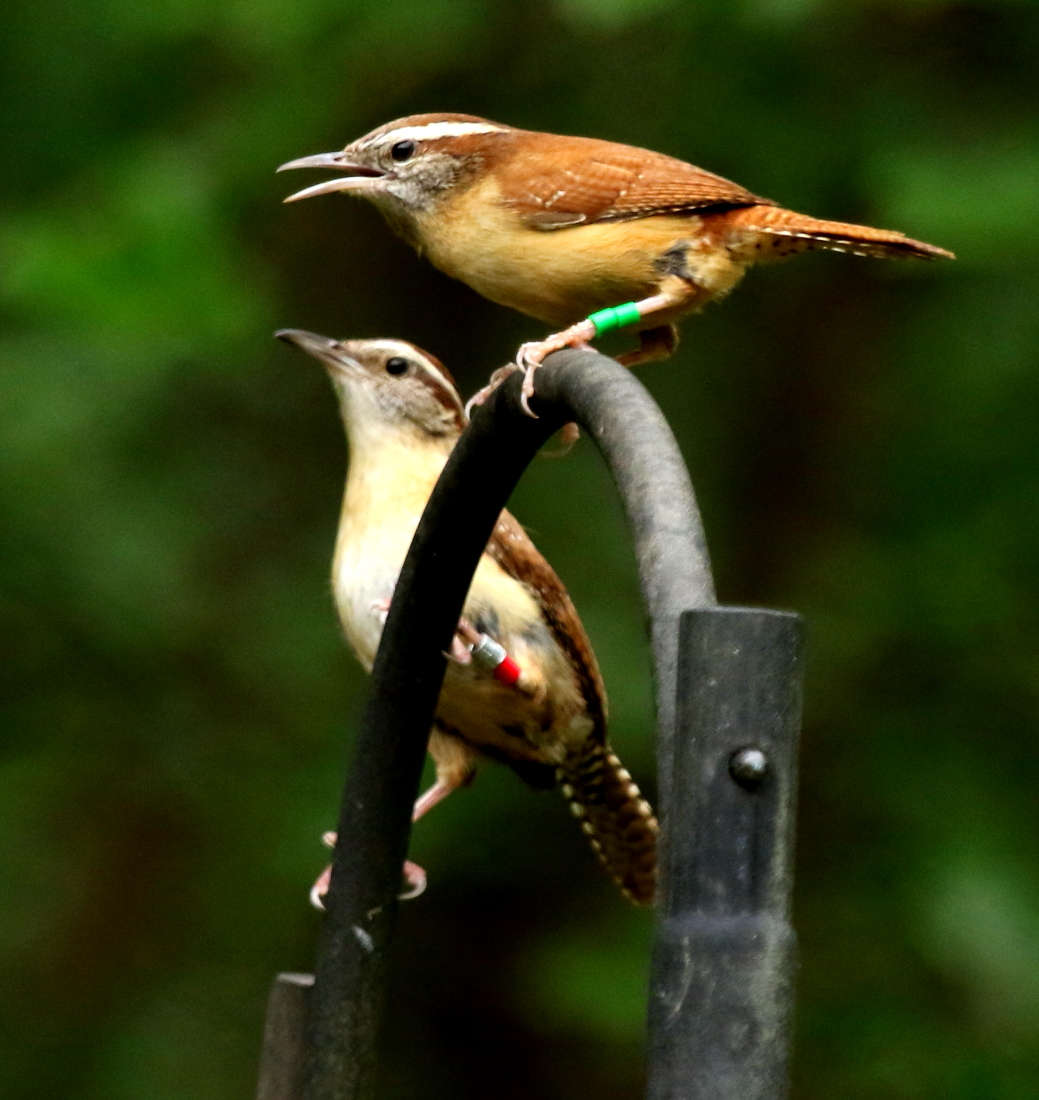
Carolina wren Renee and Riley I77A9074© Maria de Bruyn resLast year, I became a Nest Watch volunteer, which involves having birds banded in your yard so that you can follow and report to researchers the birds’ presence over time as they visit and leave your yard.

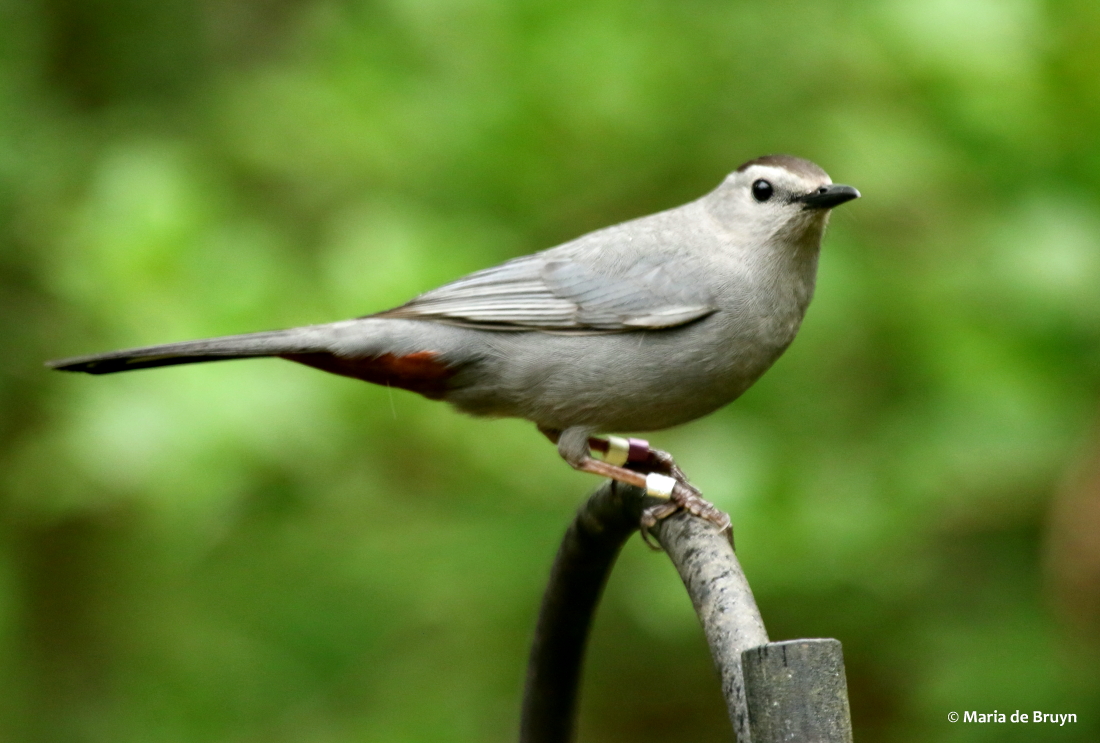
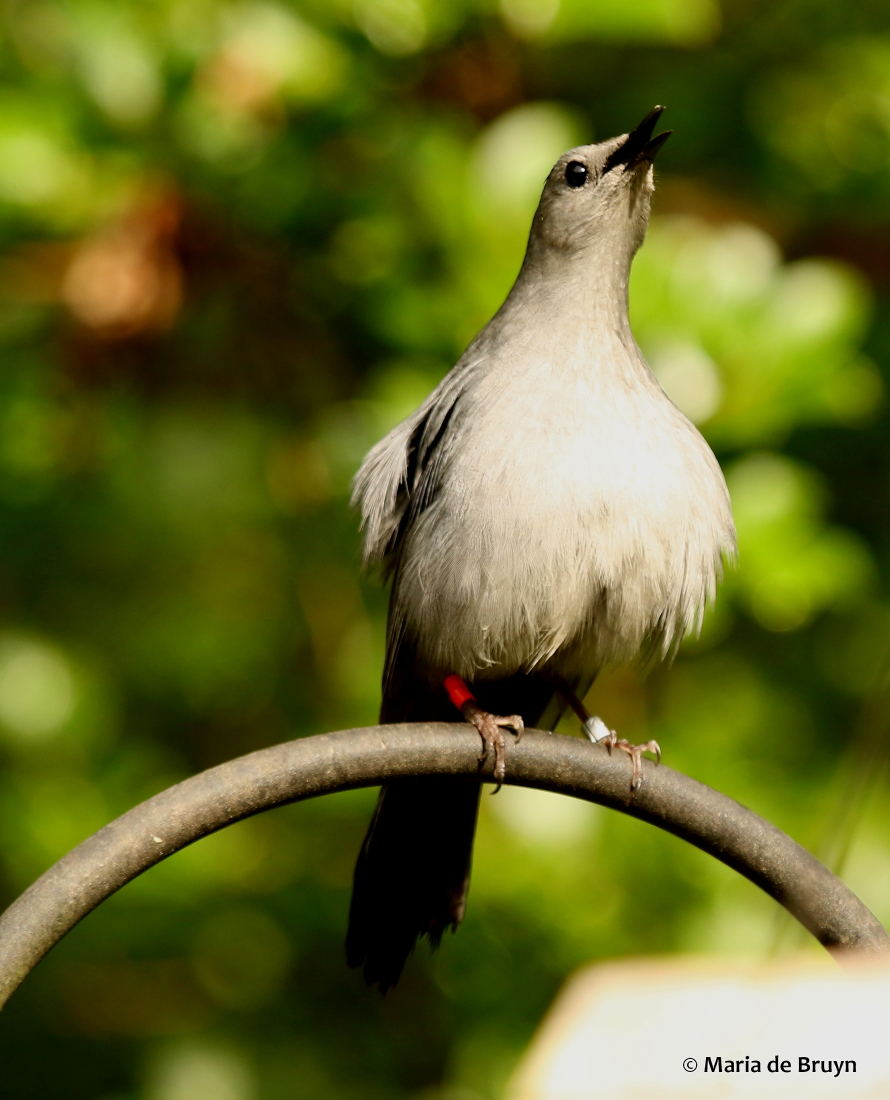
In 2015, we banded six birds. If a bird is only a temporary visitor or if it died outside the yard due to disease, old age or predation, you just won’t see it again and have no idea what became of it. The American robin (Turdus migratorius) that was banded last year never returned. If the birds stick around, however, you have the enjoyment of observing birds you get to know. The three gray-headed catbirds (Dumetella carolinensis) stayed around all summer and fall, and two of them – Camden and Corey – returned to my yard from winter migration a few days ago. They have been accompanied by females whom they appear to be assiduously courting.
gray-headed catbird Camden I77A8990© Maria de Bruyn res

gray-headed catbird Corey I77A8083© Maria de Bruyn res

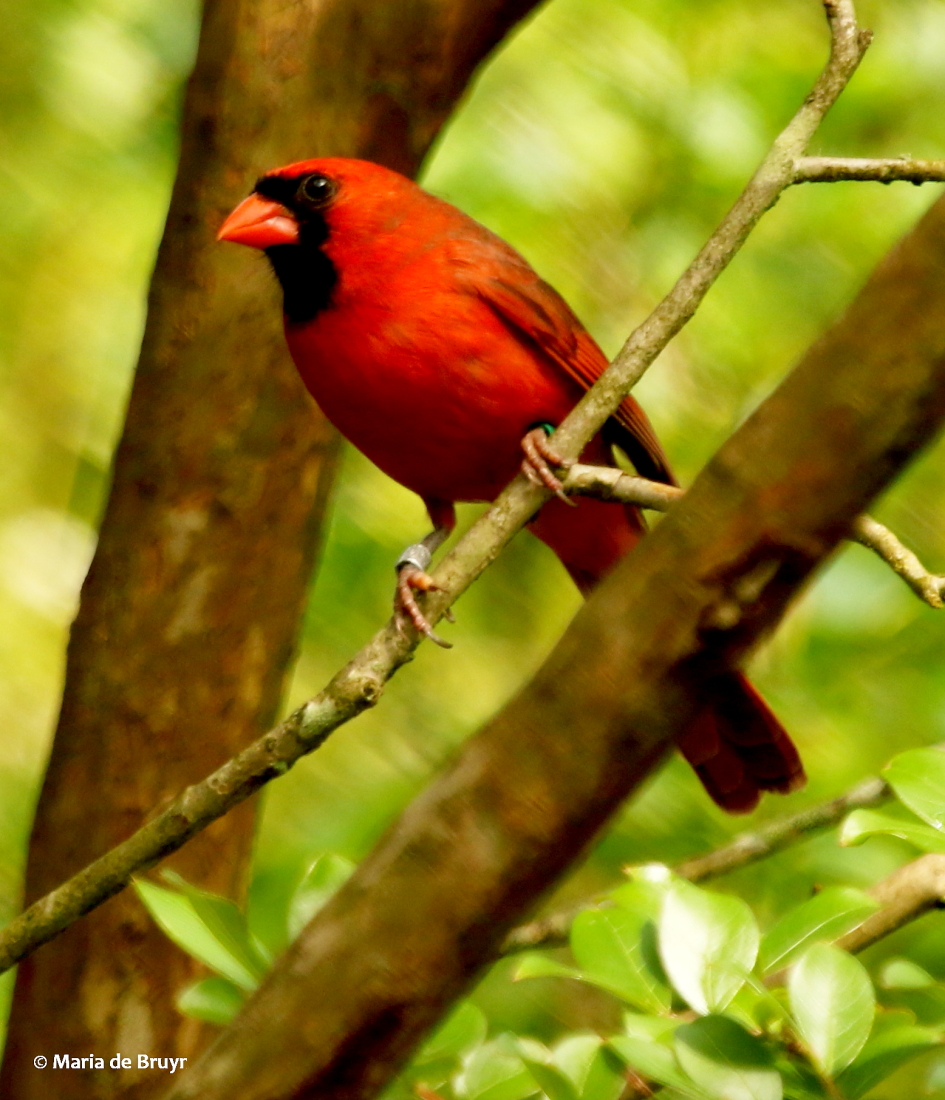
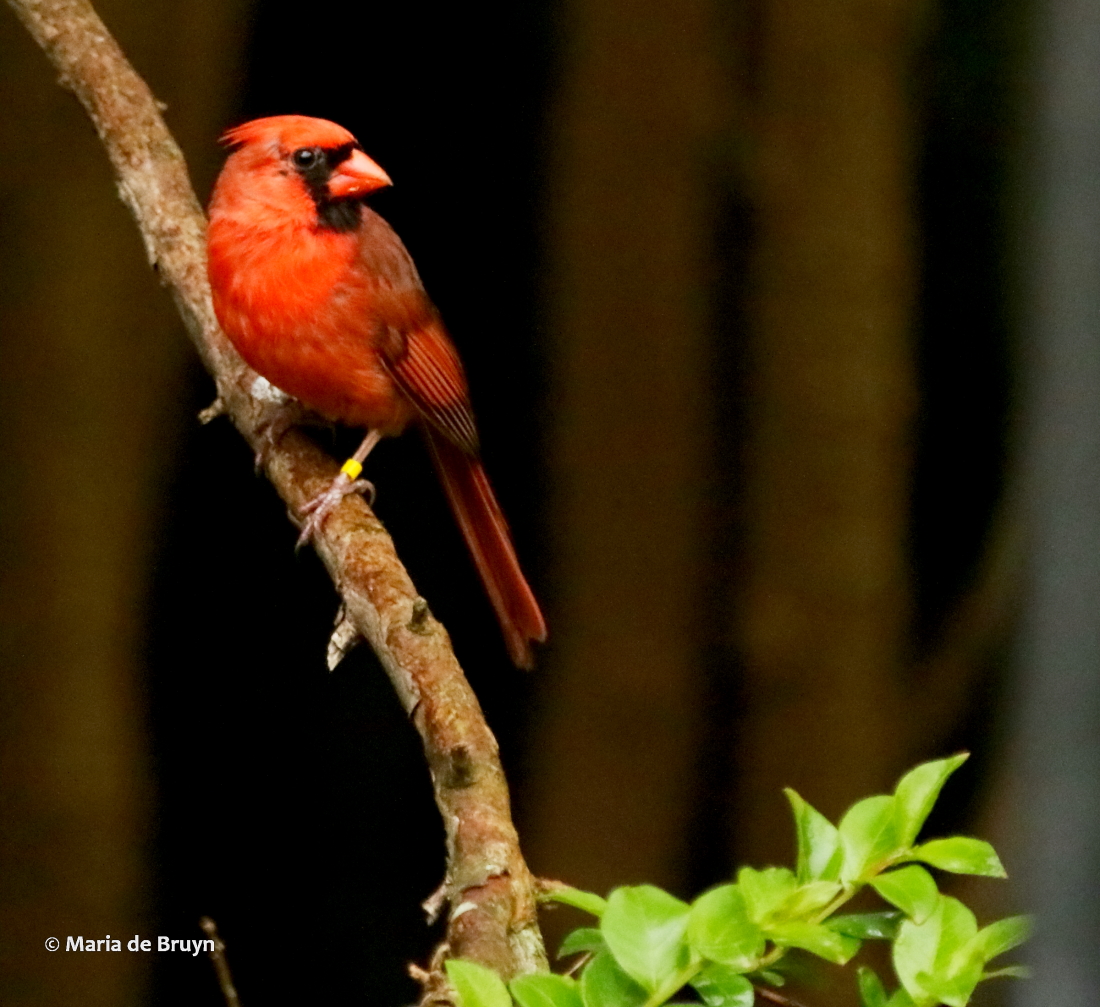
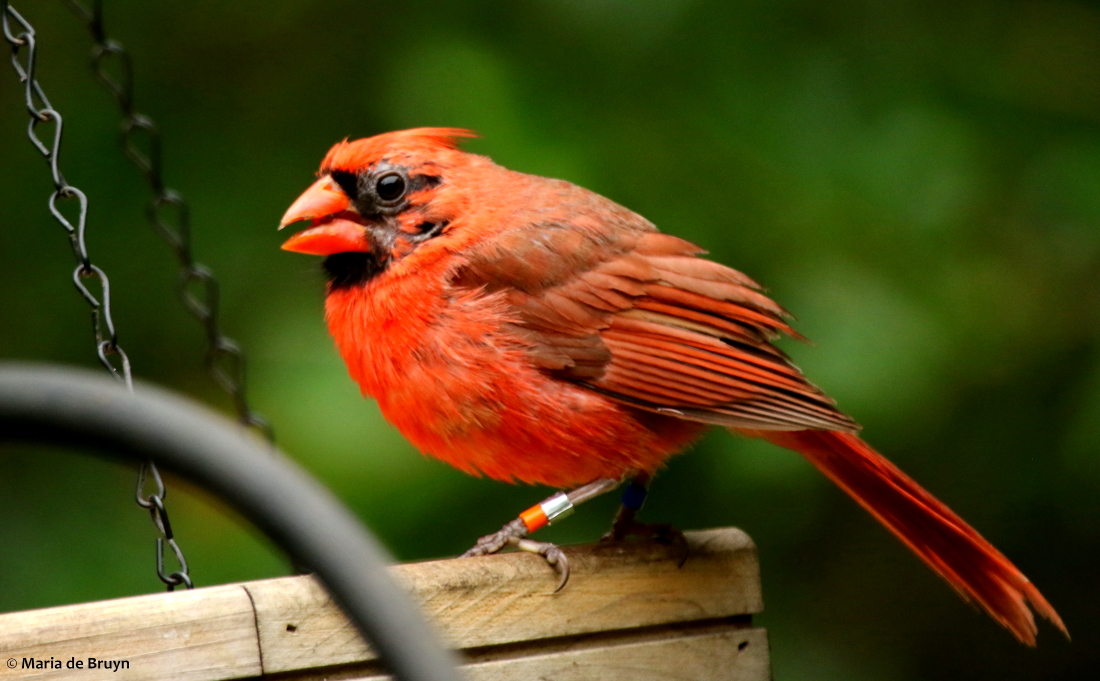
Northern cardinal Clancy I77A8123© Maria de Bruyn resOne Northern cardinal (Cardinalis cardinalis) was banded last year, but Clancy only stayed a few days and then disappeared for the rest of the summer, fall and winter. He suddenly appeared yesterday – perhaps encouraged to spend time at the feeders by the other birds with bracelets.

Three days ago, a second round of banding was done and we put the colorful anklets on a total of 10 birds. They were caught in two mist nets – one near my back garden and one near the backyard feeders.

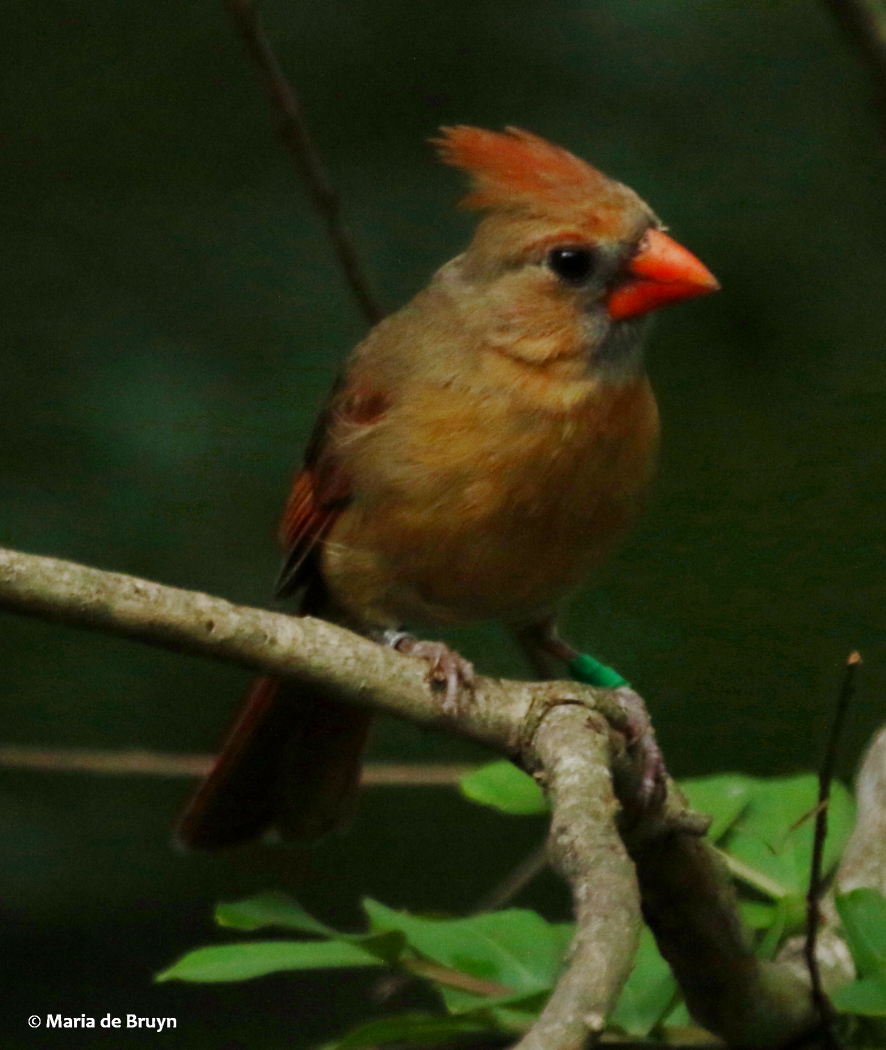
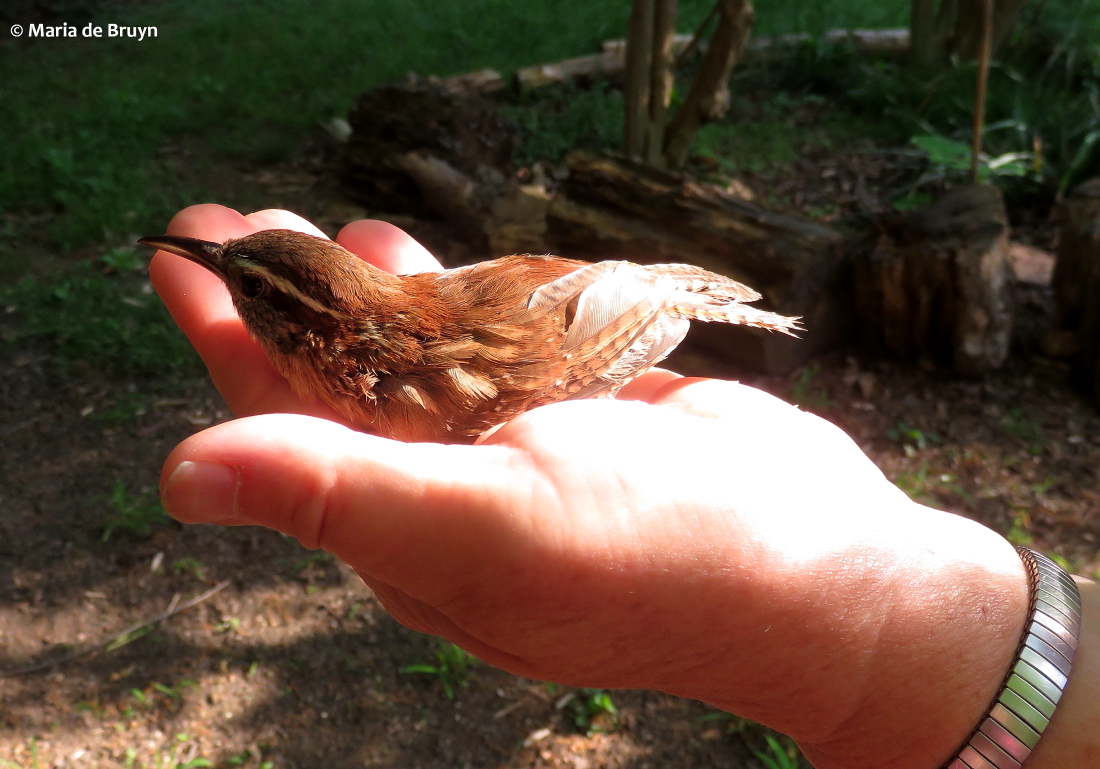
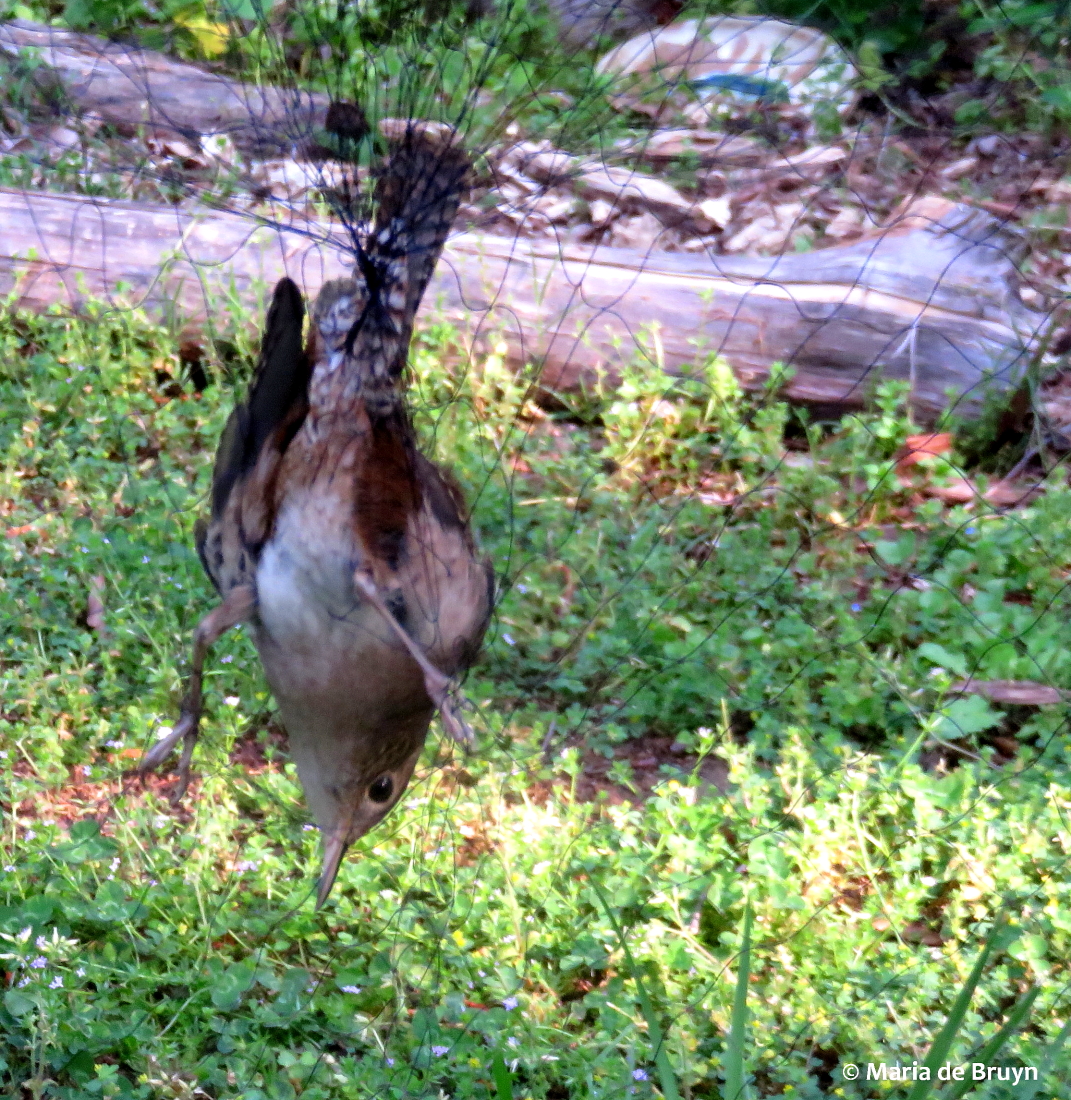
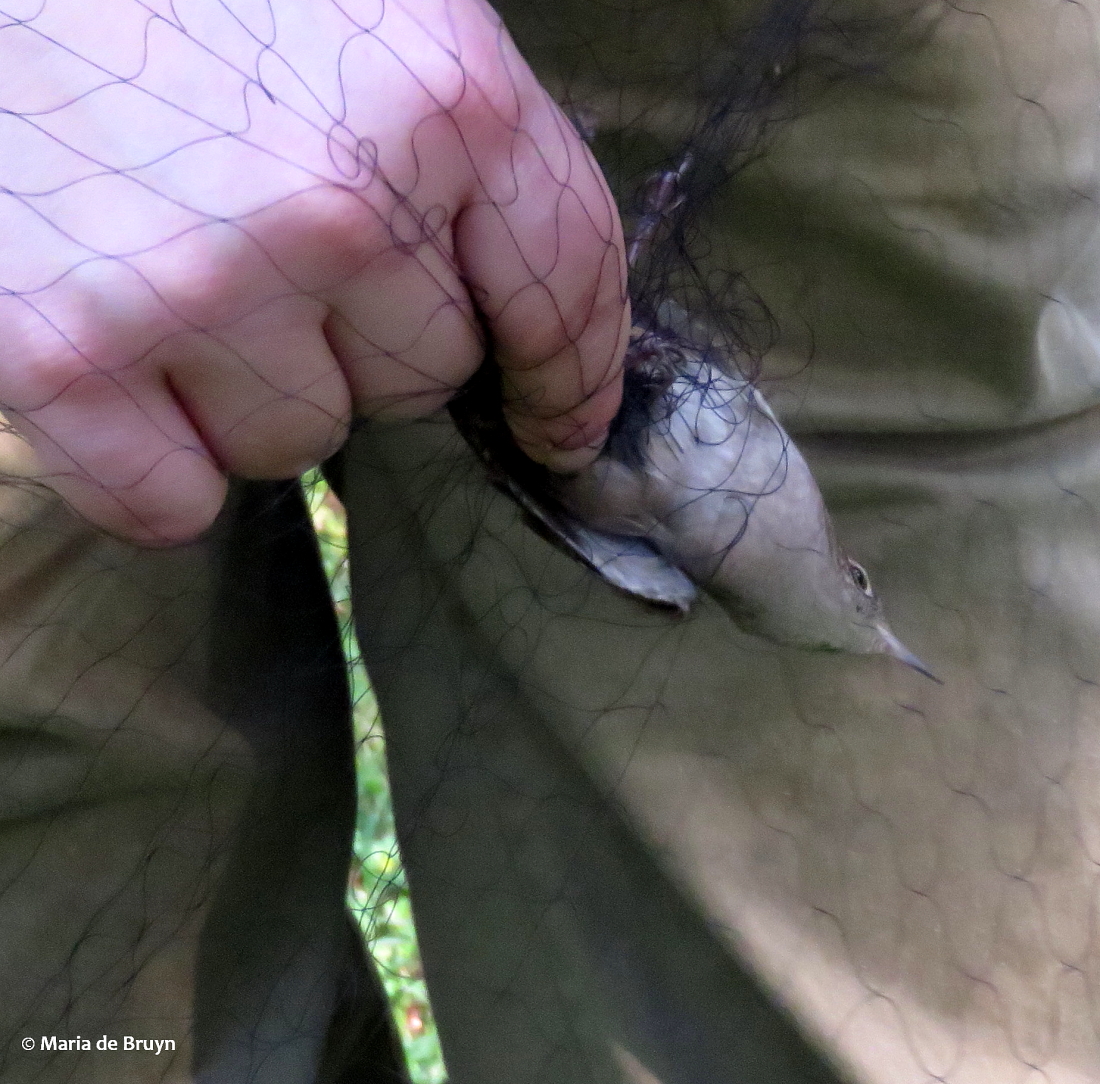
Northern cardinal Camilla I77A9127© Maria de Bruyn resThe nets had just been installed when our first visitor, a female Northern cardinal, was caught. She was not happy and when put in a bag until she could be banded, weighed, examined and measured, she did not remain still and calm. She had a little wait, however, as a female Carolina wren (Thryothorus ludovicianus) flew into the other net at just about the same time, followed by her mate within seconds. As the cardinals can tolerate being in a bag better than the smaller birds, the two wrens were banded first. Alicia let the first one go and then I released the second one, who rested on my palm for a bit. He felt so nice and soft!

Carolina wren Riley IMG_3832© Maria de Bruyn res

Forty-five minutes later, playback of a house wren’s song (Troglodytes aedon) led to the capture of a male who immediately came to investigate who was invading his territory. His mate, who was busy putting the finishing touches on a nest in a box near the mist net, didn’t go near the net.

house wren Hans IMG_3842© Maria de Bruyn reshouse wren Hans IMG_3844© Maria de Bruyn res

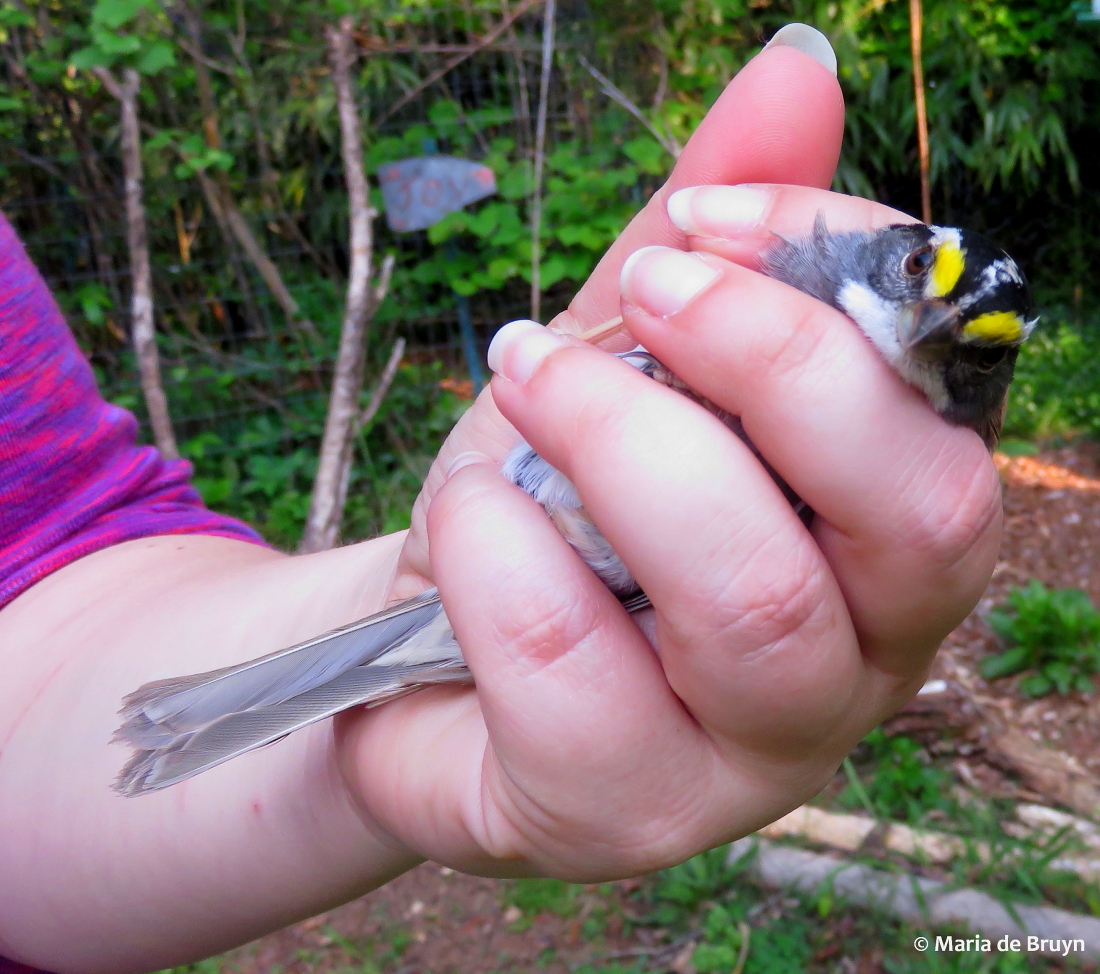
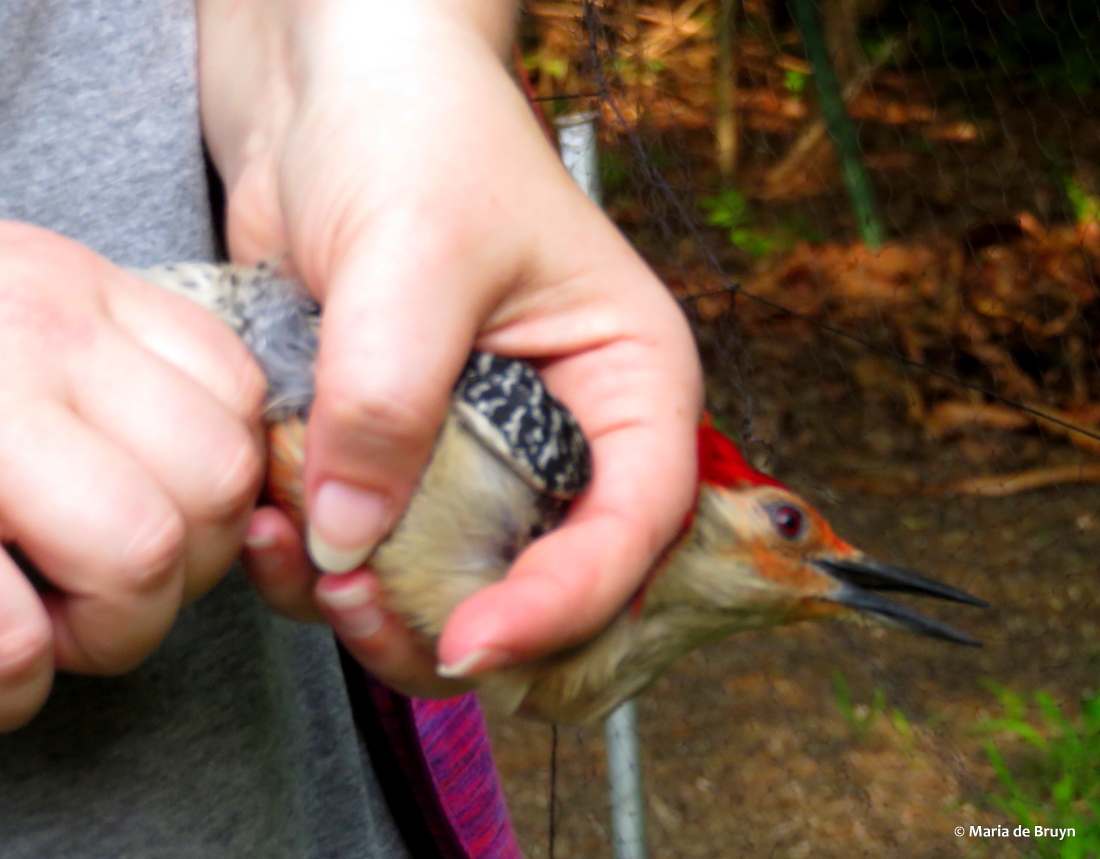
A few birds not targeted for the study ended up tangled in a net. A white-throated sparrow (Zonotrichia albicollis) had beautiful vivid breeding colors on his head. A red-bellied woodpecker (Melanerpes carolinus) was not calm like the sparrow, fluttering his wings constantly as Alicia, the bird bander, got him loose.

white-throated sparrow IMG_3837© Maria de Bruyn res red-bellied woodpecker IMG_3822© Maria de Bruyn res

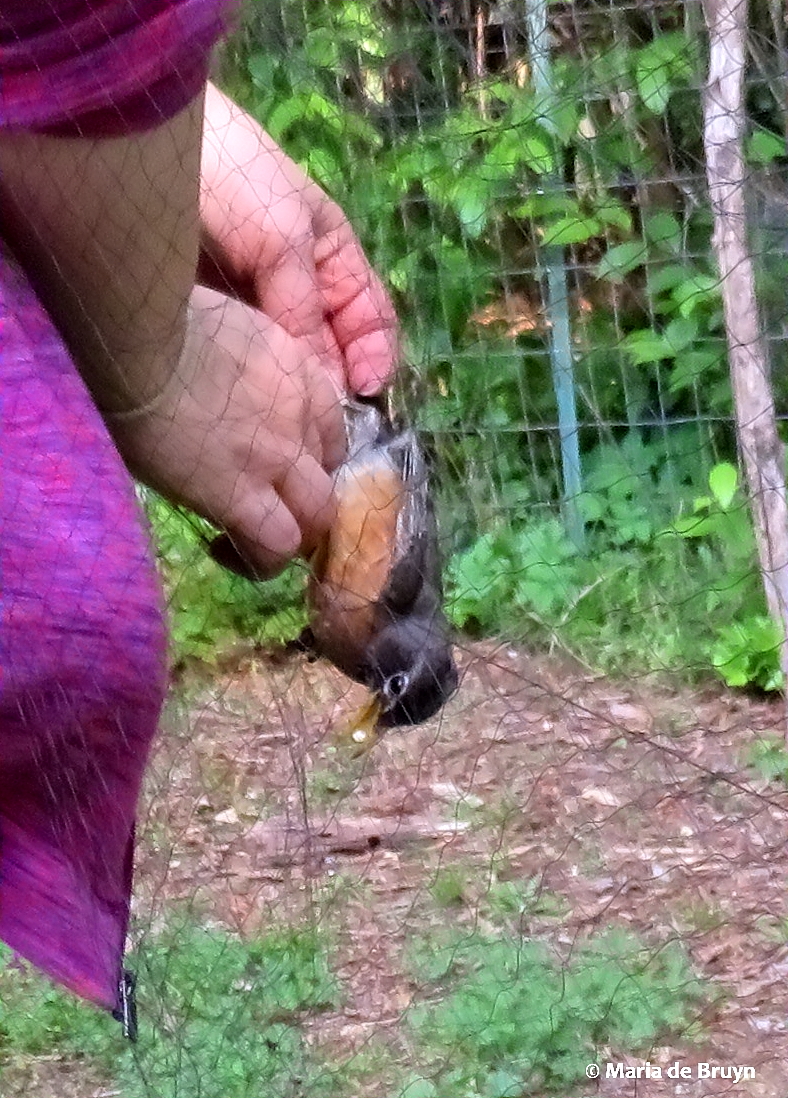
Next up were a male cardinal and a female American robin. Like last year, the birds were measured and weighed. Although about the same length, the weight difference between the heaviest Northern cardinal we banded (41.2 oz) and the American robin was striking (79.6oz). The robin’s fondness for worms and other dietary preferences helps account for this. When I let her go, she didn’t feel very heavy in my hand as she rested a second before flying off.

American robin Raisin IMG_3854© Maria de Bruyn

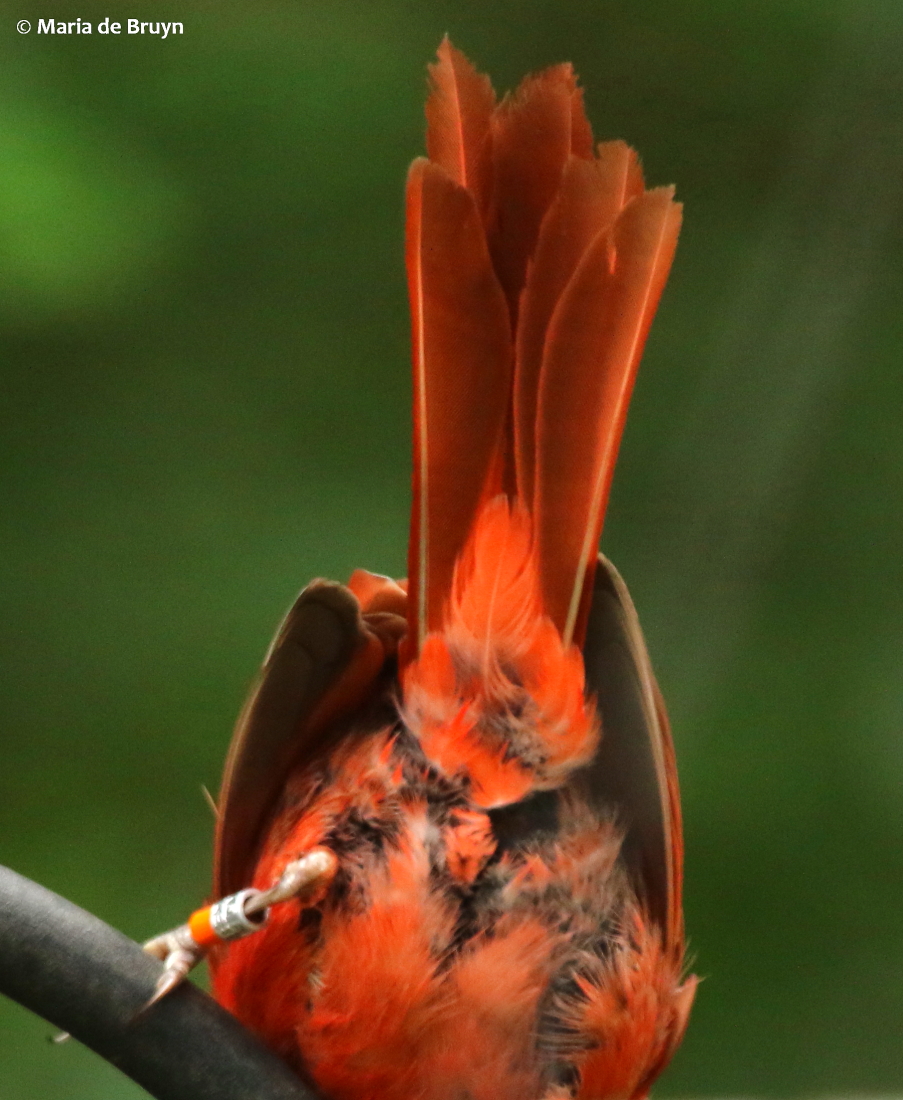
Except for birds that were molting their tail feathers, Alicia also removed the third left tail feather; this is done primarily for stable isotope analysis, which allows a researcher to estimate where the bird was when that feather was grown.

Northern cardinal Crake I77A0559© Maria de Bruyn res

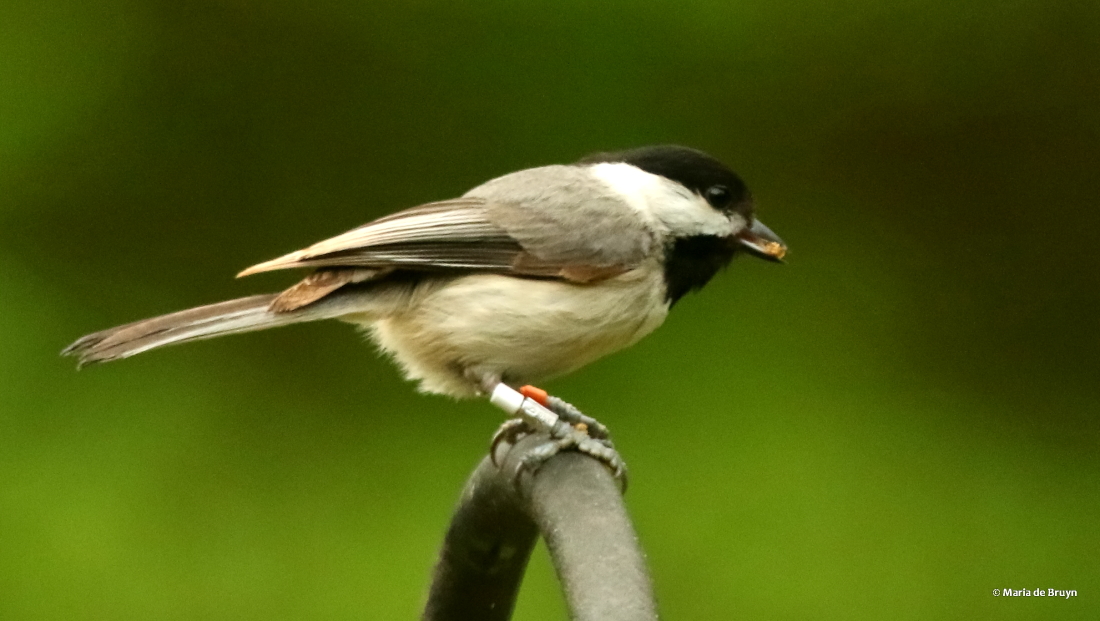
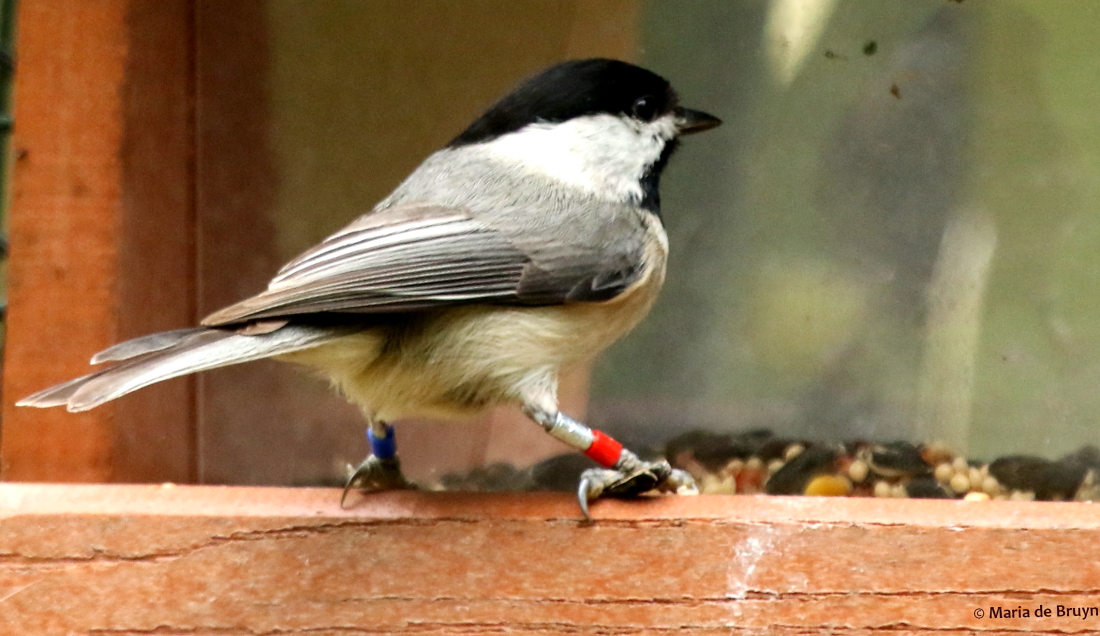
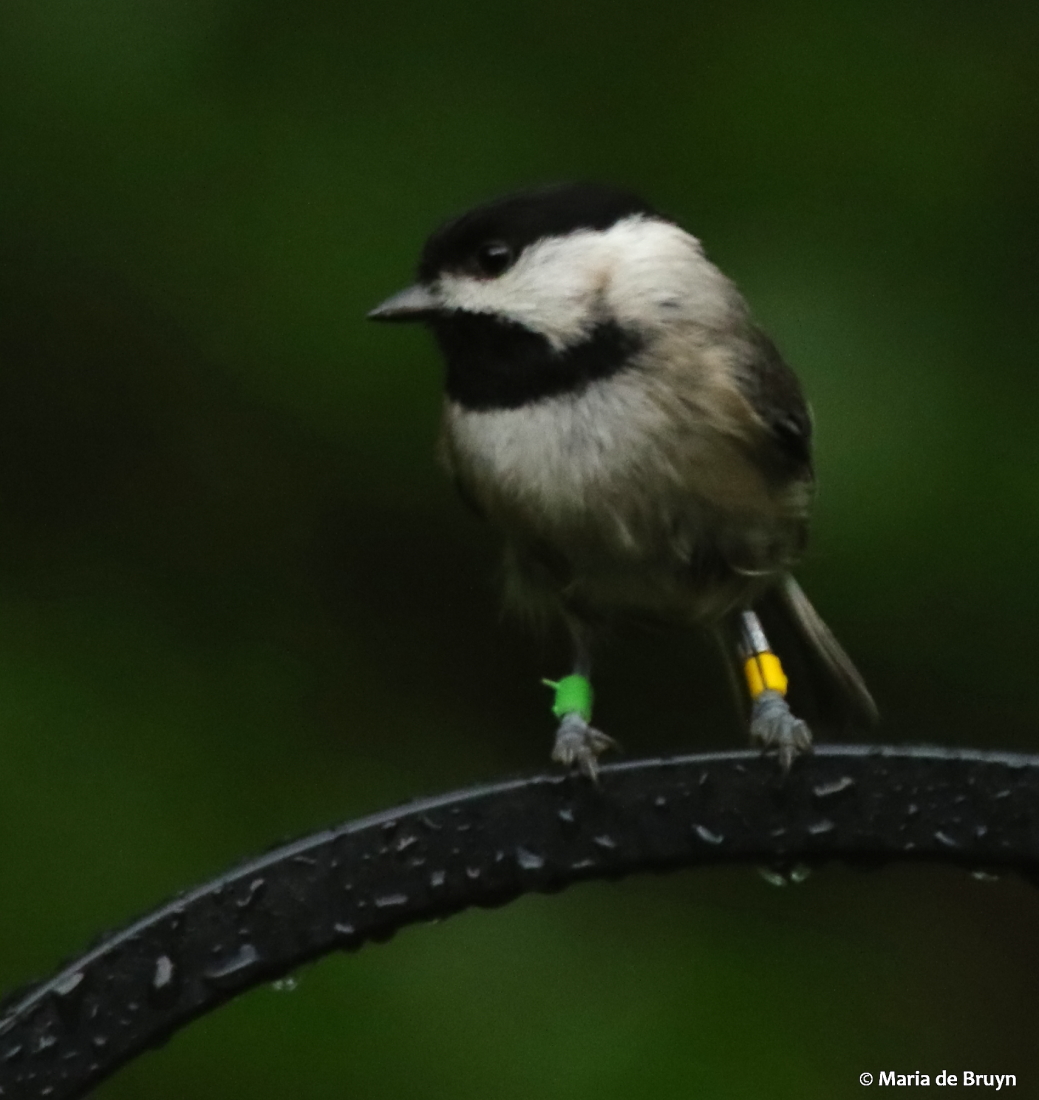
Carolina chickadee Chancey I77A7762© Maria de Bruyn resThe catbirds avoided the mist nets skillfully this year. Playback of their songs drew them to the vicinity but the two pairs visiting the feeders were more interested in chasing each other away from the territory. Alicia hoped that we could get a Carolina chickadee (Poecile carolinensis); with playback we got a male and then, 45 minutes later after banding another cardinal, we got a pair of them.

Carolina chickadee Chase I77A0348© Maria de Bruyn res Carolina chickadee Chantal I77A9525© Maria de Bruyn res

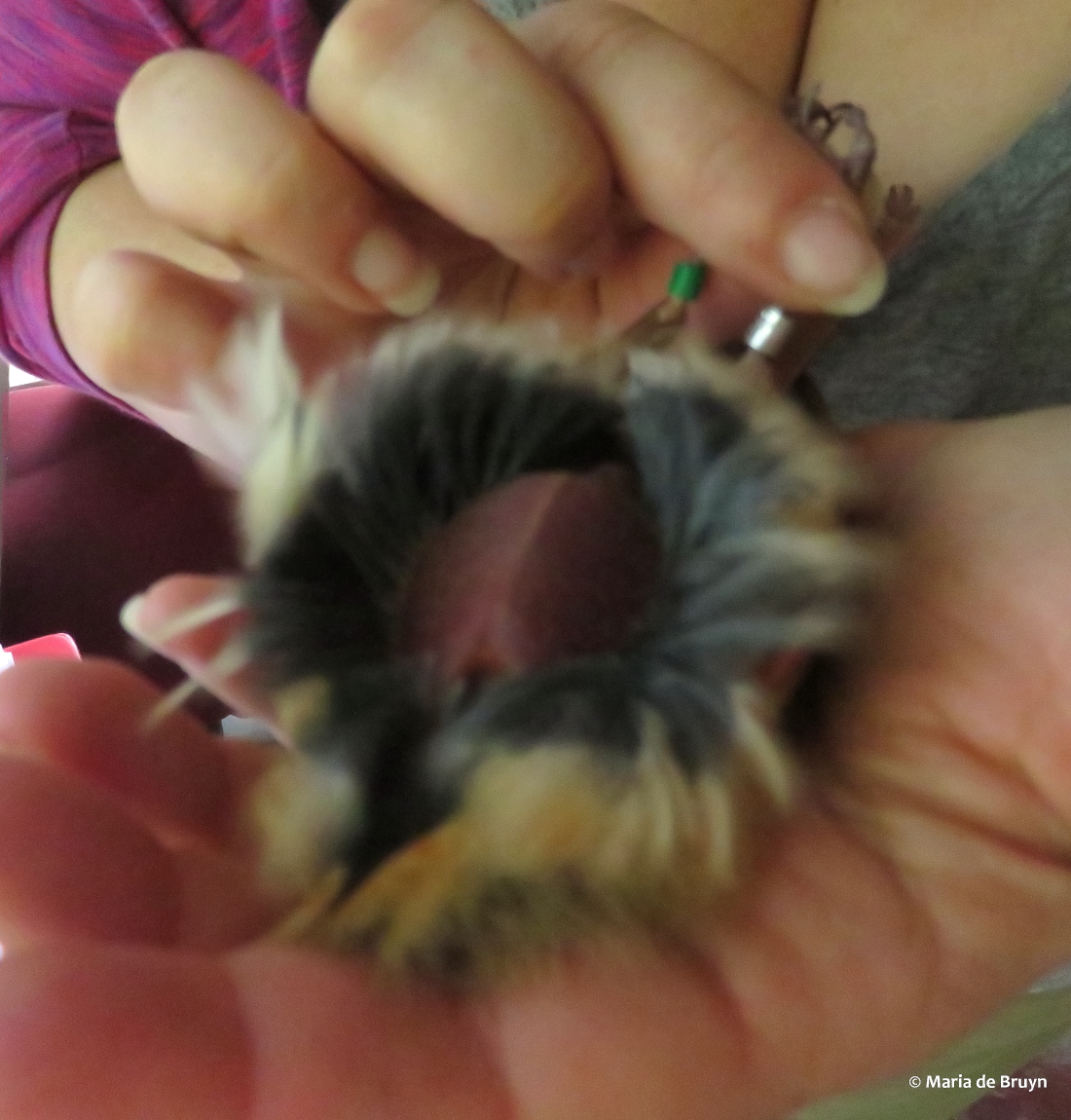
Alicia blew on the birds’ undersides (forgive the blurry photo) to assess fat reserves, which are stored along the flanks and up near the furcula by the collar bone. She could also determine sex that way and thought that one chickadee might be developing an egg – hopefully, one of the females who lost a nest to predators in my yard a week ago. The last male chickadee released was out of sorts after the experience; before leaving my hand to fly off rapidly, he turned and bit me as a parting shot.

Carolina wren Renee IMG_3813© Maria de Bruyn res Carolina chickadee IMG_3856© Maria de Bruyn res

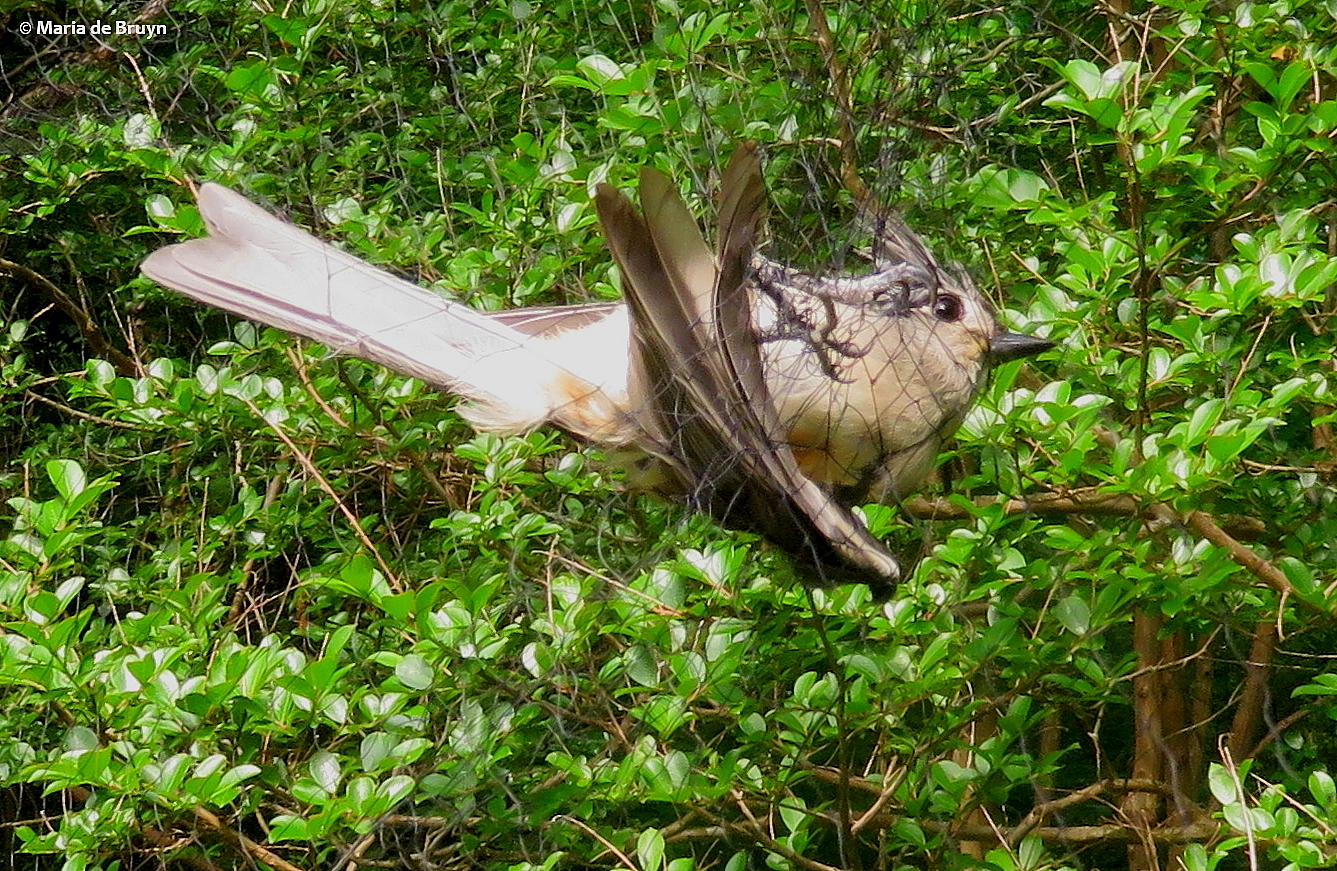
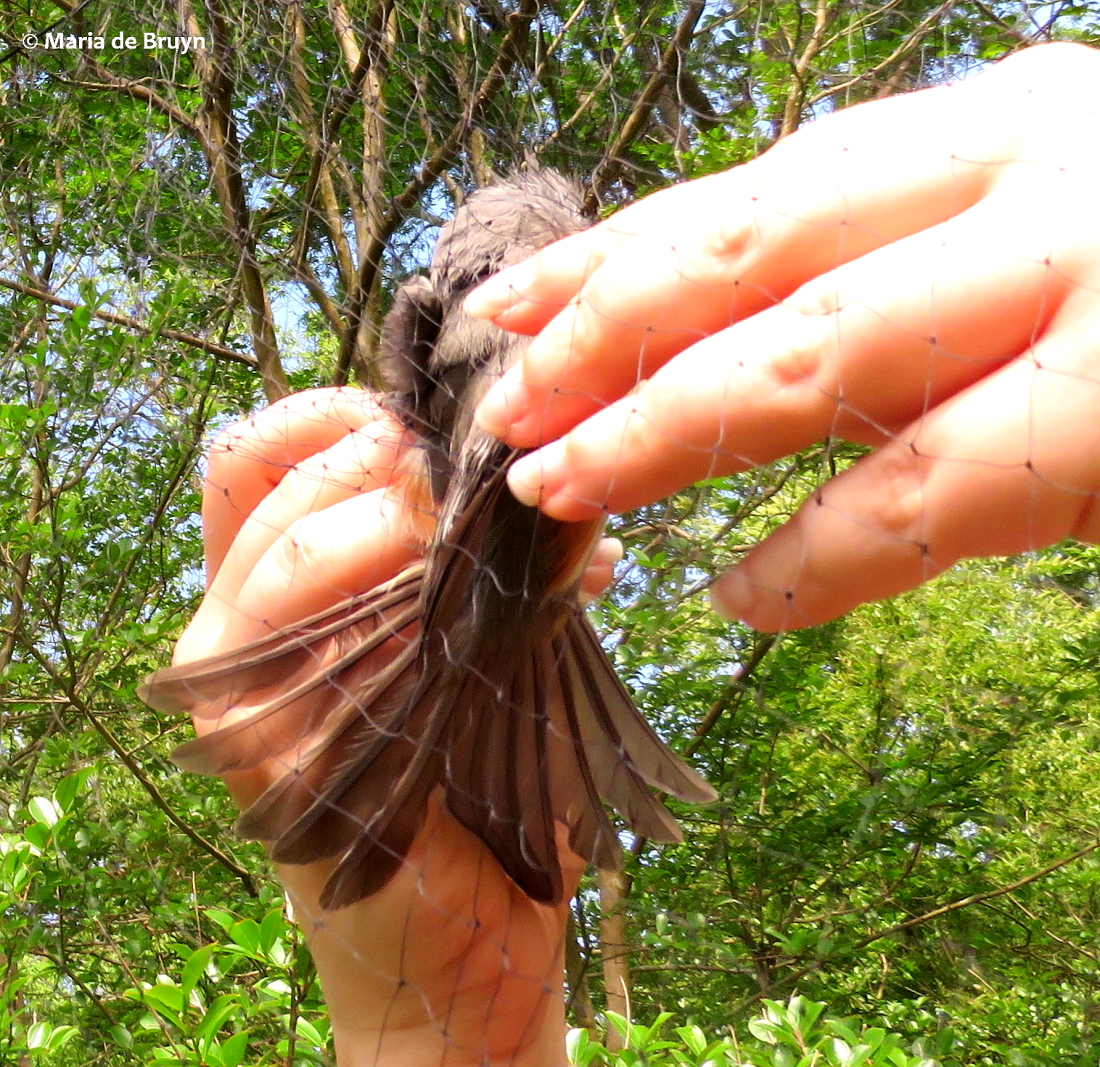
Alicia had remarked that she hoped no tufted titmouse (Baeolophus bicolor) would be caught; they are not part of the study and she said they are so feisty that their bites can be a bit painful like those of the cardinals. Unfortunately, one leaving a feeder did end up in a net and lived up to its reputation as a feisty bird. A chipping sparrow (Spizella passerina), who was the last bird in a net remained fairly calm as the net was removed from its claws.

tufted titmouse IMG_3858© Maria de Bruyn res

Tufted titmouse IMG_3861© Maria de Bruyn res

Yesterday, I spent some time watching the feeders and yard to see if all the banded birds had left. Luckily, some of them showed up and were here again today. So here are a few of “my birds” with bling – this is a truly enjoyable citizen science project. 🙂

Northern cardinal Clarence I77A0124© Maria de Bruyn res Northern cardinal Crake I77A0593© Maria de Bruyn res

Clarence                                                                       Crake

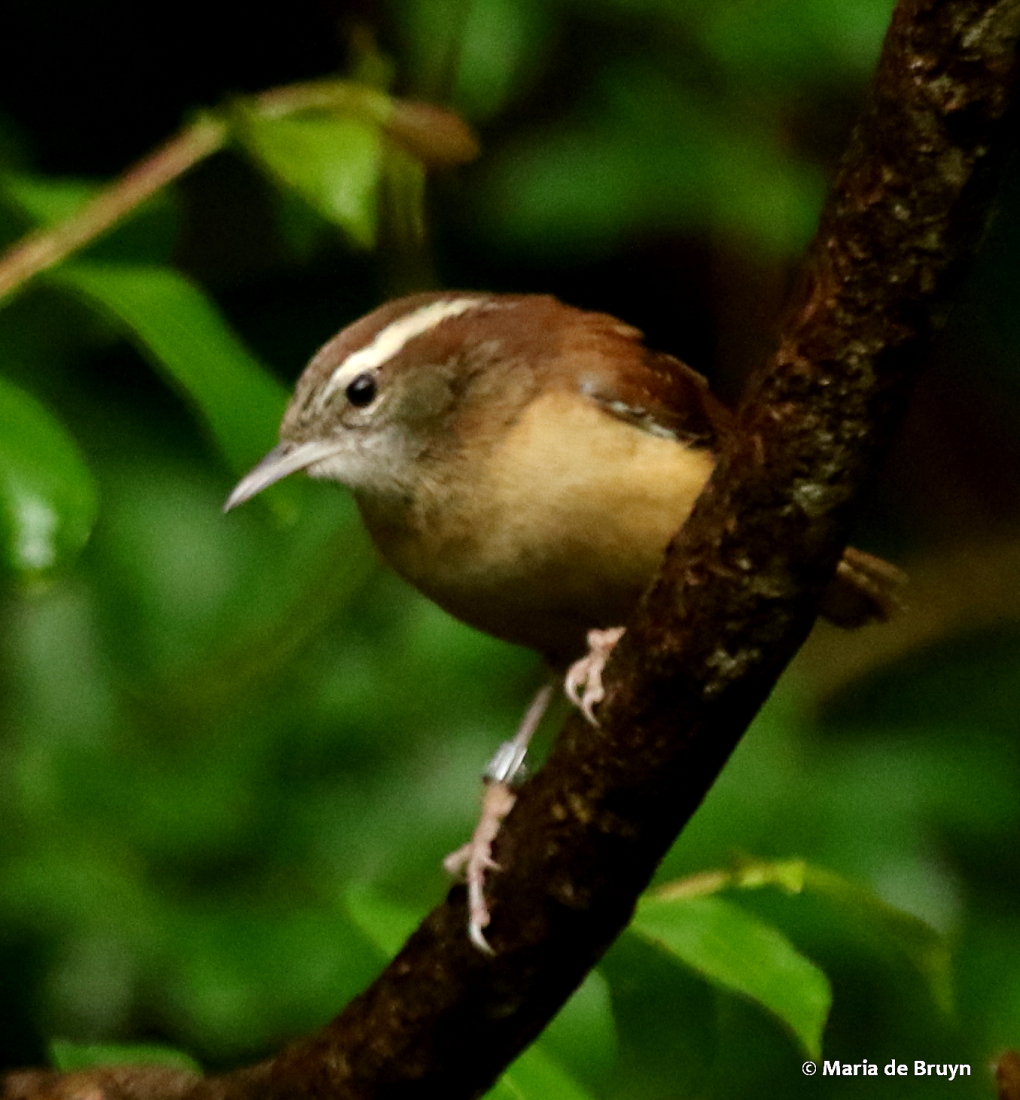
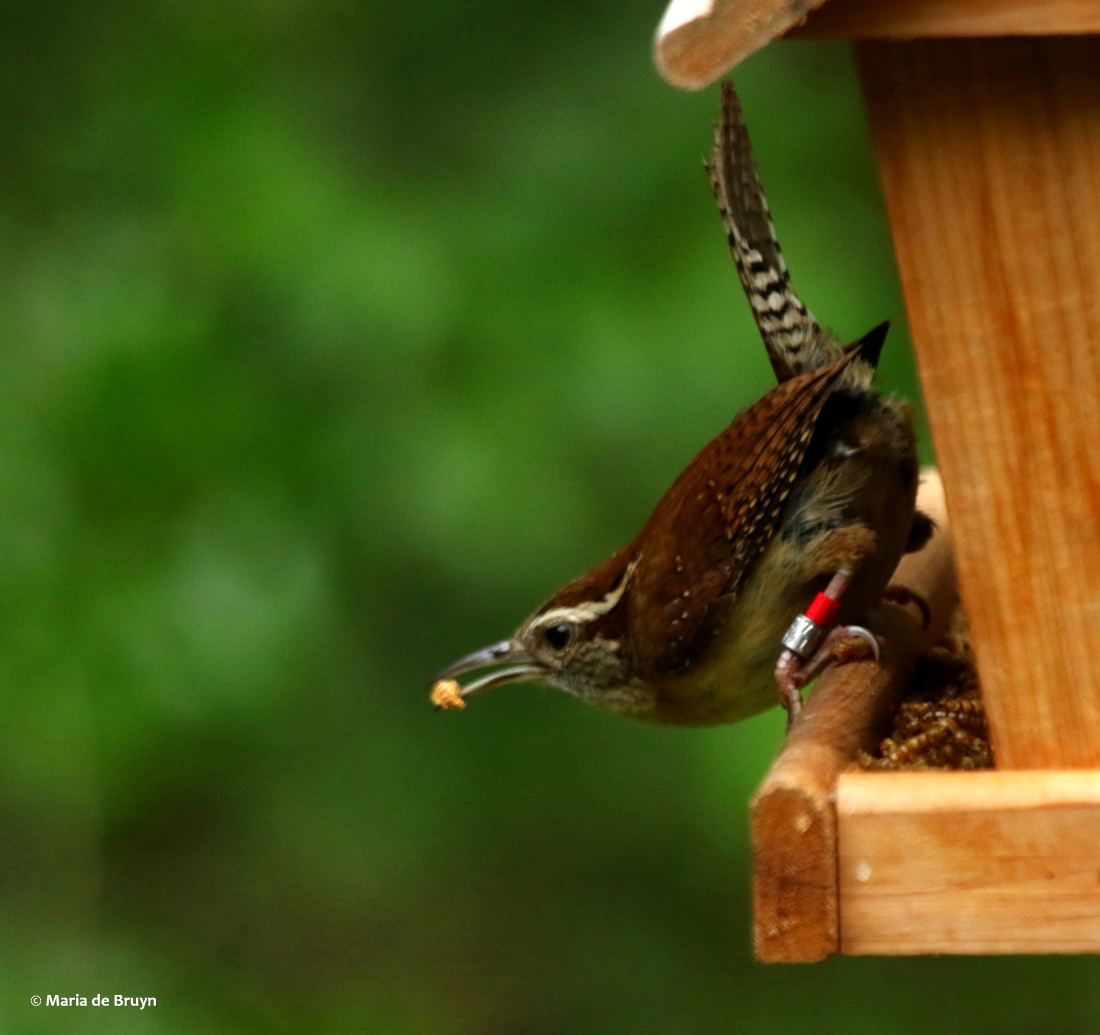
Carolina wren Renee I77A9354© Maria de Bruyn resCarolina wren Riley I77A0508© Maria de Bruyn res

Renee and Riley Carolina wrens