The banded birds are back!

gray catbird DK7A2255© Maria de Bruyn resIn a previous blog, I described how six birds were banded in my backyard so I could track them over time. Bird banding has been done for decades, indicating that it is a practice that truly works for monitoring lifespans and locations of individual birds. But it still seemed to me that being caught in a net, having someone hold you as they extricated your legs and wings from the clinging threads, then putting rings on your legs and sticking you into a container (for weighing) would be a traumatic enough experience for you to decide that this geographical area was not where you wanted to be. Anthropomorphizing the banded birds’ reactions meant that I wouldn’t have been surprised (albeit very disappointed) if I had not seen the six birds again.

gray catbird DK7A2210© Maria de Bruyn resMy expectation was almost immediately proved wrong, however, confirming that birds do not stay away from sites where they were given their ankle bracelets. Corey, my tail-less gray catbird (Dumetella carolinensis) was the first one I spotted again, the very next day after the banding. He has an aluminum band on one leg and 2 red bands on the other.

Since the bands are such different colors, I decided to name the birds as that is easier to note down for sightings. The gray catbird with an aluminum band (they all have this color as it contains their registration number) and white and purple bands became Camden. The catbird with the lovely yellow and green bands was dubbed Clarissa. All three have been very regular visitors to the feeders, proving that a little discomfort was not enough to dissuade them from visiting the always available buffet of mealworms and other delights.

gray catbird Camden DK7A2085© Maria de Bruyn res gray catbird Clarissa DK7A2091© Maria de Bruyn res

The catbirds have a fondness for sweets and like both apples and blueberries. Grape jelly is a real treat, for which they will return again and again.

gray catbird Clarissa DK7A2647© Maria de Bruyn resgray catbird Camden DK7A2198© Maria de Bruy resn gray catbird Camden DK7A1965© Maria de Bruyn resCorey’s return visits have shown how his tail feathers grew in again nicely over time. gray catbird Corey DK7A2472© Maria de Bruyn resI named the Northern cardinal (Cardinalis cardinalis) Clancy and I first spotted him again 2 days after the banding. He has not been a regular visitor, however – or I just haven’t caught sight of him among the bevy of other male cardinals that flit around the trees. However, a few days ago he turned up among the apples!

Northern cardinal Clancy  DK7A7771© Maria de Bruyn res northern cardinal Clancy  DK7A7753© Maria de Bruyn res

Carolina wren Willow DK7A2608© Maria de Bruyn resWillow, the Carolina wren (Thryothorus ludovicianus), has been a very infrequent returnee. When he comes, he tries to stay out of sight, choosing the side of the feeder away from me and only lingering a short while in plain sight. At least I know he is ok.

The one bird I have not yet seen is Rusty, the American robin (Turdus migratorius). I’ve been staring at the legs of every robin that hops around the yard but have yet to see one with leg jewelry. Perhaps he was just a stray visitor the day of the banding? I will certainly keep a look-out for him.

My first re-sighting data were entered into the Nestwatch site on 1 June 2015; it will be interesting to see how long I can maintain this input. Clarissa is a very frequent visitor so I think she will be in many entries. Or perhaps she is just busy right now feeding young ones.

gray catbird Clarissa DK7A2504© Maria de Bruyn res gray catbird Clarissa DK7A2503© Maria de Bruyn res gray catbird Clarissa DK7A2498© Maria de BruynEastern bluebird IMG_3881© Maria de Bruyn resIn the meantime, I am monitoring two nests for data entry; one for Eastern bluebirds (Sialia sialis), who have babies in a nest box, and one for gray catbirds, who have a nest in the middle of a shrub next to my carport.

The catbird parents are ever so vigilant and call out warnings to me whenever I approach the shrub. They hesitate to go into the shrub with food when I am near, even though those babies must be hungry. I finally got a view of them through the twigs when they were close to fledging. They are now hopping around on twigs in the shrub near the nest. Yesterday, when I came too close, Mama catbird dive-bombed, actually grazing my head!

Gray catbird IMG_3887© Maria de Bruyn res gray catbird IMG_3873© Maria de Bruyn

The parents in both pairs are very diligent about bringing the babies meals, working as a team. One catbird parent seems to be good at collecting a variety of foods, in one case bringing three different insects at once (presumably one for each baby). I will look forward to seeing the young ones out and about and sincerely hope my neighbor’s cat doesn’t get them.

gray catbird DK7A2939© Maria de Bruyn res gray catbird DK7A2937© Maria de Bruyn res

Bird watching is an enjoyable way to spend time; doing it and contributing to scientific data collection is even cooler!

Citizen science in my backyard!

Gray-headed catbird DK7A8986© Maria de Bruyn resIt’s been a while since I’ve blogged – not for lack of ideas and photos but due to a dearth of time and energy that was absorbed by multiple troubles with a few cool happenings in between. But now I’m back with some new observations about the beauty and happenings of interest in my natural world and I hope to share some wildlife sightings on a regular basis again.

One activity that I have managed to fit in amid the other goings-on was enrollment in two new (for me) citizen science projects for the Smithsonian Institute. I’m participating in an eMammal project run by the North Carolina Museum of Natural Science and in a multi-year observational study of some common birds. The mammal project is time-limited, so I will report on that in about a month’s time.

Northern mockingbird DK7A8859©Maria de BruynThe bird project will involve tracking visits to my yard by banded birds for several years to come. The target species include American robins (Turdus migratorius), Carolina chickadees (Poecile carolinensis), Carolina wrens (Thryothorus ludovicianus), house wrens (Troglodytes aedon), gray-headed catbirds (Dumetella carolinensis), Northern cardinals (Cardinalis cardinalis) and Northern mockingbirds (Mimus polyglottos, at the right), all of which come to my yard. Song sparrows are the 8th target species but I haven’t seen them at my house. However, I discovered that there is a great crested flycatcher in my trees, although I’ve never seen him (or her) either, so who knows if one will come in the future? In any case, the target birds can live from about 6-10 years on average, so I’ll have an ongoing activity for as long as my eyesight remains reasonable!

bird banding IMG_3291© Maria de Bruyn resmist net IMG_3290© Maria de Bruyn

So how does the bird banding proceed? We (the bird bander and I) set up one 12-foot and one 6-foot mist net in two parts of the yard, after the bander laid out her equipment for the banding process. Within a very short time, we caught three birds in the large net! The first was a gray-headed catbird that I recognized (photo above), because he had molted all his tail feathers at once and looks a bit odd with no tail. This bird, whom I have named Corey, has been the most vocal catbird at my feeders and he was extremely vocal about having been caught as well.

gray-headed catbird IMG_3294© Maria de Bruyn bird banding IMG_3295© Maria de Bruyn

After being disentangled – very carefully – from the net, he was put in a bag while the bander got the other two birds out of the net. Corey was measured, weighed, and banded with a combination of aluminum and colored bands. Sex was determined (I now know he is a he!) and then he was let go.

gray-headed catbird IMG_3301© Maria de Bruyn bird banding IMG_3304© Maria de Bruyn res

Northern cardinal IMG_3311© Maria de Bruyn resBird 2 was a beautiful male Northern cardinal, who appeared to have good fat reserves. He was a bit vocal and bit the bander to show his displeasure at the treatment he was receiving.

Bird 3 was a male American robin. Sex was determined partly by looking at the cloacal region (outside breeding season, other markers besides brood patches and this area are examined). If a bander is unsure of the sex, this is also marked on the data sheet. The robin was more sedate during handling than his predecessors.


American robin IMG_3314 © Maria de Bruyn resAmerican robin IMG_3315© Maria de Bruyn res

The house wrens had been calling loudly during the banding and flitted about in the trees and to the feeders,but they always flew just above the nets and were not caught. A male Carolina wren with a nice eye stripe did not escape.

house wren DK7A4794© Maria de Bruyn Carolina wren IMG_3316© Maria de Bruyn

American crow IMG_3359© Maria de BruynThe chickadees and Northern mockingbird flew about but did not really come too close to the nets. Non-target species were at or near the feeders, too, such as courting bluejays, an American crow (Corvus brachyrhynchos, right) who came to eat jelly and take some apple to his mate, downy woodpeckers, white-breasted and brown-headed nuthatches, a house finch, Eastern towhees and a male cowbird.

red-bellied woodpecker IMG_3344© Maria de Bruyn resOther non-target birds flew into the large mist net, however, such as a brown thrasher, a tufted titmouse, a red-bellied woodpecker (Melanerpes carolinus, right), a chipping sparrow (Spizella passerina), a female common yellowthroat (Geothlypis trichas, below) and a common grackle. I’d not seen these birds up so close before, so that was really a nice experience.

Common yellowthroat IMG_3339© Maria de Bruyn res


bird banding IMG_3340© Maria de Bruyn resTo get more target species, a loudspeaker that played bird calls and some model birds were placed in the grass by the largest net. Eventually, two more catbirds were caught – with other catbirds in a nearby tree puffing themselves up to show their shared distress. These were the first catbirds banded for the project so far, so that was a nice way to end the exercise.

Cope's tree frog IMG_3293© Maria de Bruyn resA tour of the yard to see if there were any nests that could be followed for the Nest Watch project revealed a couple wren nests in boxes that were built up so high it was not possible to see if they had eggs in them. The bluebirds’ nest has five eggs that I will follow through fledging (hopefully); a catbird nest is too high up for me to see how many eggs she is sitting on but I will watch for her fledglings, too. And a Cope’s tree frog (Hyla chrysoscelis) had taken up residence in the nest box that the downy woodpecker uses to rest at night. The wrens had begun building a nest in that box last night and the frog was gone this afternoon.

The banding took place yesterday in the morning and in the afternoon, the banded birds had not returned. I wonder how long it will take most of these individuals to come again. Corey already returned this afternoon, instantly recognizable not only because of his very short tail feathers growing in but because of the red and silver bands on his little legs. I was so glad to see he was none the worse for wear!

A life and death drama on a nature walk

ice DK7A6116©Maria de BruynFrost was sparkling on the grass, dried shrubs and grasses as our small group set out on a birding walk in the local nature preserve. Water in the creeks and bog was frozen in pretty patterns and the air felt crisp (and cold).


ice DK7A6094©Maria de Bruyn

Eastern towhee DK7A5990©Maria de BruynAt first, not many birds seemed to be aroblue jay DK7A5949©Maria de Bruynund but soon we spotted Eastern towhees (Pipilo erythrophthalmus) and numerous sparrow species in the meadows — none really close by but still visible to those with binoculars and a zoom lens. Blue jays (Cyanocitta cristata) were flying from very high treetop to treetop.

After seeing my familiar red-headed woodpecker (Melanerpes erythrocephalus), to whom I’ve given the name “young’un” as I’ve been following her/his progress since s/he was a brown and white juvenile, we saw some Eastern phoebes (Sayornis phoebe) and more sparrows.

Eastern phoebe DK7A6061©Maria de Bruynred-headed woodpecker DK7A6013©Maria de Bruyn

hairy woodpecker DK7A6163©Maria de BruynIn the woods, we saw a ruby-crowned kinglet and a yellow-bellied sapsucker (Sphyrapicus varius). It was when we emerged from the woods into another meadow that we had our most spectacular encounter, however. I spotted a young red-tailed hawk (Buteo jamaicensis) perched in a tree at the meadow’s edge gazing ahead.


red-tailed hawk DK7A6229©Maria de Bruyn red-tailed hawk DK7A6245©Maria de Bruyn

red-tailed hawk DK7A6246©Maria de BruynSuddenly, the bird flew across the field (perhaps 150 feet in a fellow birder’s estimate) to land on a branch in a tree right next to our walking path.

red-tailed hawk DK7A6397©Maria de Bruyn res

After alighting, the bird began staring downwards very intently. We walked a little closer and stopped. The bird didn’t even look in our direction but continued to stare down with great concentration, occasionally looking out ahead.

red-tailed hawk DK7A6380©Maria de Bruyn res red-tailed hawk DK7A6370©Maria de Bruyn res

We came closer and stopped again. Finally, we got right up even with the bird and looked directly at it from about 6-10 feet. It acknowledged our presence but continued to stare down and we couldn’t figure out what it was tracking. Other birds fluttered in nearby branches but it paid them no mind.

red-tailed hawk DK7A6411©Maria de Bruyn red-tailed hawk DK7A6414©Maria de Bruyn

red-tailed hawk DK7A6425©Maria de Bruyn red-tailed hawk DK7A6432©Maria de Bruyn res

When our group began to walk on after taking many photos and admiring the bird’s sharp eyes and even sharper looking talons, I looked intently under the tree, too. And then I spotted the prey — a hispid cotton rat (Sigmodon hispidus), holding still as a statue on a log.

hispid cotton rat DK7A6463©Maria de Bruyn res hispid cotton rat DK7A6449©Maria de Bruyn res

The hawk looked at us, yet kept the rodent in sight. On looking at the photos afterwards, I’m glad that the hawk didn’t decide to fly at us with those talons extended in order to drive us away. After looking at the rat, our group walked on as it looked to be quite a standoff; the rat had several smaller branches between it and the hawk which might make capture difficult.

red-tailed hawk DK7A6509©Maria de Bruyn resred-tailed hawk DK7A6488©Maria de Bruyn res

As my fellow birders tried to spot winter wrens and purple finches, which they had heard, I couldn’t get the hawk and rat out of my mind. So as they went on, I returned to the dramatic scene. As I arrived, the hawk had risen on the branch and was crouching as it looked at me and the rat. It turned on the branch and I just knew that it was getting ready for an attack. Part of me wanted the rat to make it out of there and part of me felt the hawk deserved a meal after such stellar spotting from a distance and patience in watching the prey.

red-tailed hawk DK7A6496©Maria de Bruyn resThe hawk looked at me, crouched again and then dropped down with great fluttering of wings.

red-tailed hawk DK7A6525©Maria de Bruyn red-tailed hawk DK7A6531©Maria de Bruyn res

red-tailed hawk DK7A6532©Maria de Bruyn res red--tailed hawk DK7A6548©Maria de Bruyn res

Those large wings were somewhat caught up in the small branches but it got the rat. It flapped about, perhaps securing a tighter hold on its meal-to-be and then flew up to a nearby branch (behind lots of vegetation so that I couldn’t get a good photo). It sat for a minute or so and then flew back over the meadow into the woods, leaving me with a few blurry photos as testaments of the final act in the drama.

red-tailed hawk DK7A6574©Maria de Bruyn res red-tailed hawk DK7A6585©Maria de Bruyn res

red-tailed hawk DK7A6599©Maria de Bruyn resMy sympathy was certainly with the rat, whose last 30 minutes of life must have been filled with terror as it froze in the hope of escaping the predator. I had to admire the hawk’s concentration and focus, though — that bird was not going to let anything deter it from getting a meal, not even four humans standing a few feet away aiming cameras and phones at it as it perched on that branch. The hawk certainly gave us an unforgettable experience as we may never come so closely eye-to-eye with a wild raptor again.

If you liked this post and/or the photos, could you please “like” it so that I know people enjoyed this posting? Thanks in advance!

Dining out in winter

cardinal and crowd DK7A9445© Maria de Bruyn resIn the spring, summer and fall, when birds have insects and other favorite foods available, many of us see moderate numbers of avian visitors at our feeders — although there are always exceptions, such as parents looking for easy meals to satisfy the voracious appetites of their offspring. Come wintertime, though, we may have whole flocks of different species flying busily to and fro to take food from our feeders.


tufted titmouse IMG_0635© Maria de BruynOur avian friends need to eat more, and more often, in autumn and winter to ensure that they can gain sufficient fat reserves to see them through the cold weather. Some of the smallest birds will consume up to 30% of their body weight. Nuts are a favored food for tufted titmice (Baeolophus bicolor).

cedar waxwing IMG_7967 ©Maria de Bruyn 2

In the autumn, there are still many berries available and these are a popular food. Birds that tend to eat insects much of the year will switch to berries in winter since their prey has died, is dormant and awaiting rebirth in larval form, or otherwise scarce. The berries of honeysuckle (Lonicera), privet (Ligustrum, an invasive plant) and other plants are popular foods for species such as cedar waxwings (Bombycilla cedrorum).

 Holly berries (Ilex opaca) are a favorite for American robins (Turdus migratorius).

American robin IMG_3302 © Maria de Bruyn American robin IMG_0326©Maria de Bruyn res

Pine siskin IMG_6226©Maria de Bruyn resEven when much of the vegetation has dried up, seeds and seed pods remain. Pine siskins (Spinus pinus), downy woodpeckers (Dryobates pubescens) and American goldfinches (Spinus tristis) will feast on the seeds found in the pods of honeysuckles and trumpet vines (Campsis radicans).


American goldfinch IMG_6251 ©Maria de Bruyn res Downy woodpecker IMG_9184M de Bruyn

In some cases, dried leaves and the remains of caterpillar tents form clumps that attract tufted titmice and white-throated sparrows (Zonotrichia albicollis) as they search for sustenance.

tufted titmouse IMG_9714© Maria de Bruyn res white-throated sparrow DK7A6171© Maria de Bruyn res

Pine siskins will eat moss growing on tree trunks. Other birds search the vegetation alongside ponds, like this song sparrow (Melospiza melodia).

pine siskin IMG_7546©Maria de Bruyn ressong sparrow IMG_6959© Maria de Bruyn (2) res

The seed pods of my crepe myrtle trees (Lagerstroemia) are a magnet in winter for various avian species such as pine siskins, white-throated sparrows, red-winged blackbirds (Agelaius phoeniceus) and Northern cardinals (Cardinalis cardinalis), as well as Eastern gray squirrels (Sciurus carolinensis).

white-throated sparrow IMG_2653©Maria de Bruyn respine siskin IMG_8177 ©Maria de Bruyn

Northern cardinal IMG_4887©Maria de Bruyn resred-winged blackbird DK7A7754© Maria de Bruyn res

Eastern gray squirrel IMG_3547© Maria de Bruyn res Eastern gray squirrel IMG_3528© Maria de Bruyn res (2)

Various species of smaller birds will flock together in winter, both for purposes of safety and help in finding food. As the season progresses, the supply of seeds, pods and berries diminishes. In addition, the variety of natural plants has often decreased in urban areas as homeowners remove “weeds” from their yards. Wildlife organizations therefore encourage bird lovers to add native plants to their property, especially those that attract birds, and to provide extra food through feeders.

white-throated sparrow IMG_1608© Maria de Bruyn ruby-crowned kinglet IMG_1635© Maria de Bruyn res

Northern mockingbird DK7A4279© Maria de Bruyn resMaking available mixed seeds, oil-rich sunflower seeds and suet (traditional or vegetarian made with vegetable shortening) will help the birds like this Northern mockingbird (Mimus polyglottos) keep up their energy. And it’s a good idea to keep those feeders filled — did you know that many songbirds are able to collect food in a special storage pouch within their esophagus so that they can then digest it after dark and overnight? This may help account for the fact that certain birds come back to the feeders over and over again within a short span of time.


The area where I live has had a long winter, with alternating days of relatively high temperatures and then very cold days and nights. Crocuses, daffodils and tulips are beginning to emerge in my gardens despite snow and ice and trees and shrubs are beginning to bud, giving the Eastern gray squirrels and house finches (Haemorhous mexicanus) a new source of food. I think that both the birds and I will be happy when spring arrives and stays! In the meantime, I’ll keep the feeders filled.

Eastern gray squirrel DK7A7410© Maria de Bruyn res House finch DK7A0286© Maria de Bruyn res

My friends, the ruby-crowned kinglets!

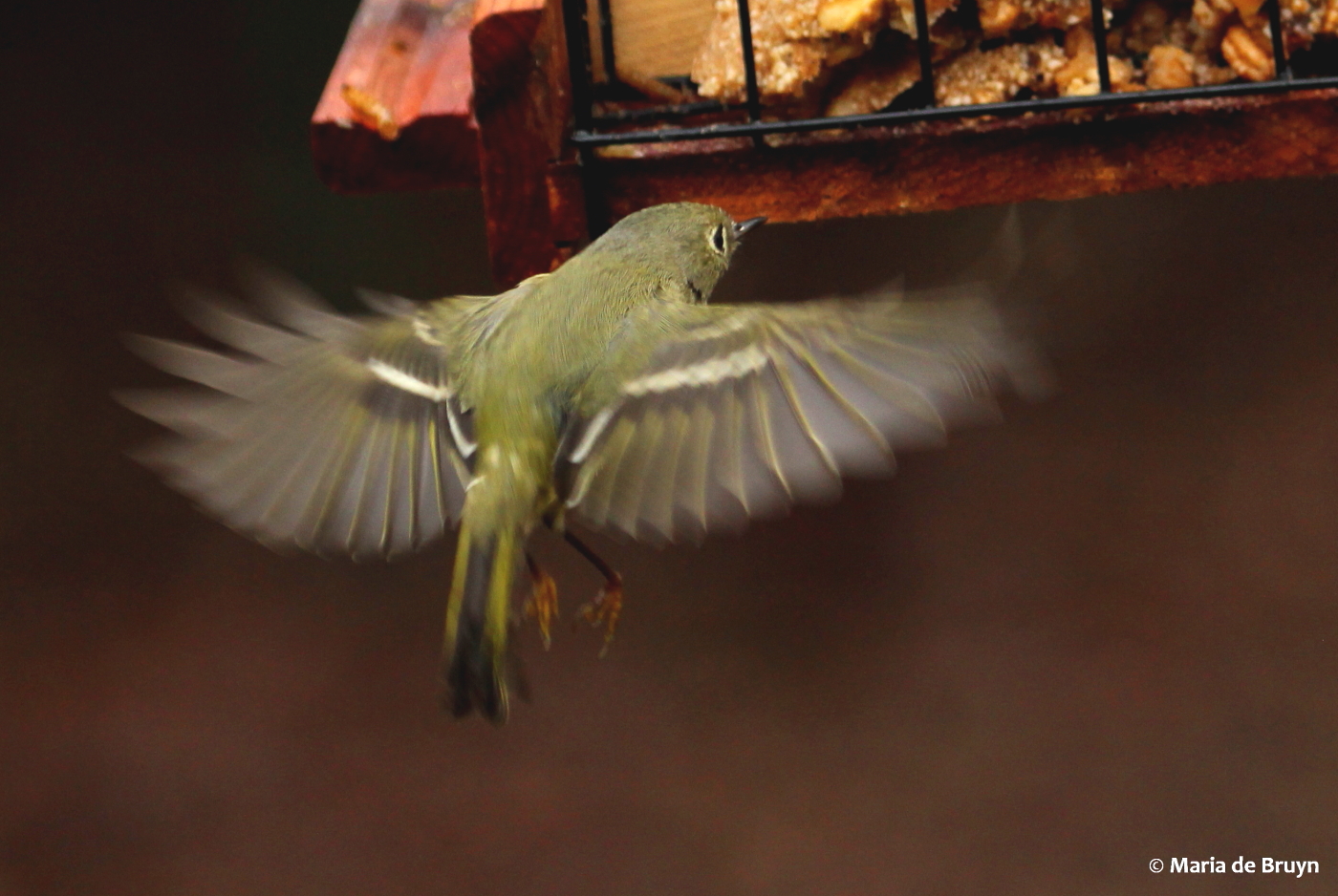
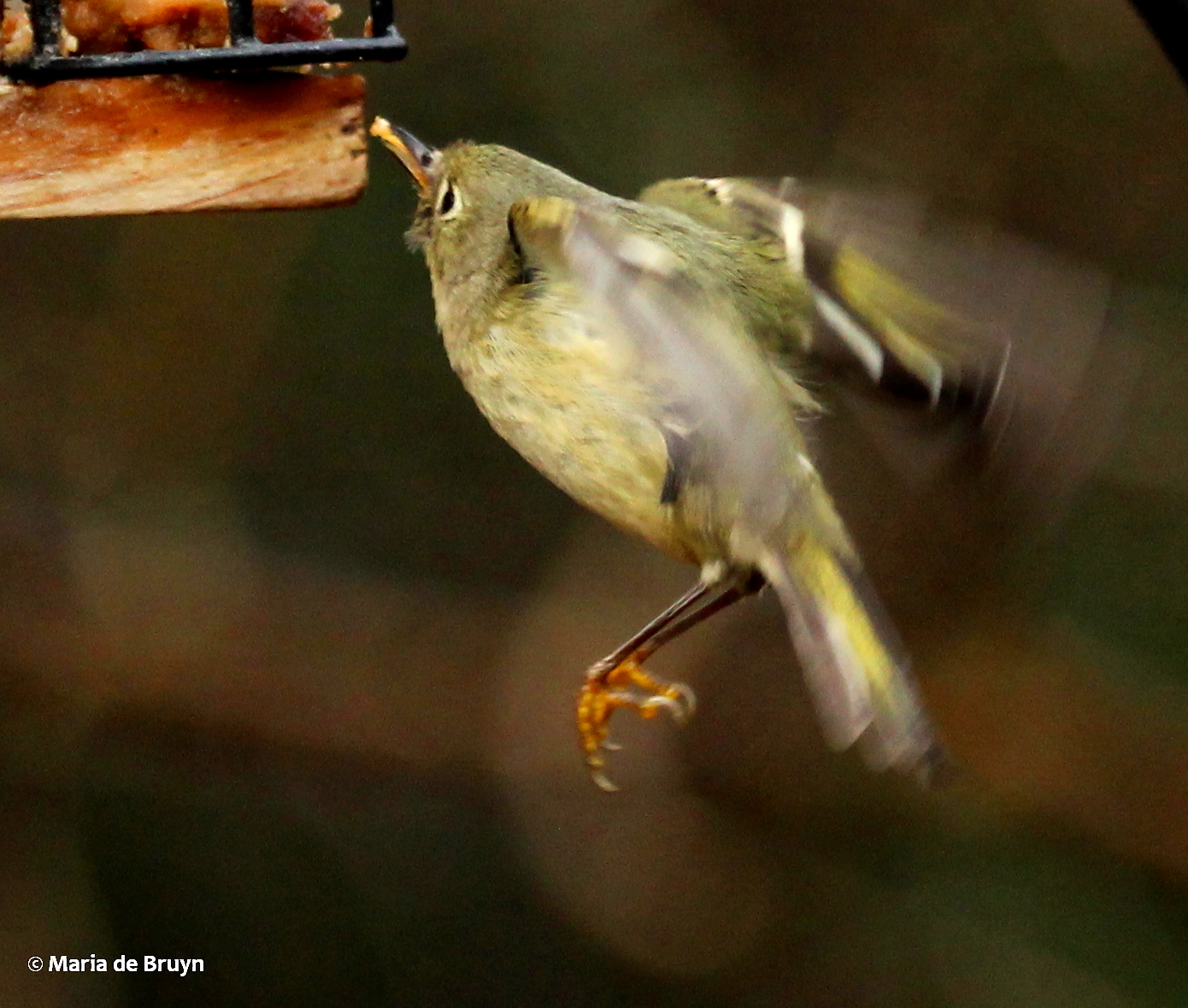
ruby-crowned kinglet IMG_8776© Maria de Bruyn resAs I mentioned in November, ruby-crowned kinglets (Regulus calendula) are one of my favorite bird species. These tiny, yellowish bundles of energy are fascinating to watch as they perch on twigs, hover in mid-air by feeders and branches, and generally look delightful when they stop to catch a breath for a minute.

Adjusting your camera to be able to photograph them with the best speed and lighting can be quite challenging as their constant motion leads them in and out of the sun and above and below branches.

ruby-crowned kinglet IMG_9428© Maria de Bruyn ruby-crowned kinglet IMG_9419© Maria de Bruyn  ruby-crowned kinglet IMG_9377© Maria de Bruyn resruby-crowned kinglet IMG_9406© Maria de Bruyn res

ruby-crowned kinglet IMG_4734© Maria de Bruyn resOn a rainy day, they may sit still for a tiny bit longer but their flight is not impeded though they may look waterlogged.

This has been a good autumn and winter for my being able to photograph these adorable avians, not only in my yard at the feeders but also in venues such as the Jordan Lake woods, Mason Farm Biological Reserve and Sandy Creek Park. This blog will focus on some of the portraits I’ve been able to capture.


ruby-crowned kinglet IMG_0378© Maria de Bruyn resWhen they are flying around rapidly, you could mistake them for first-year, less brightly hued blue-winged warblers (Vermivora cyanoptera). That happened to me in South Carolina where I thought I had gotten a shot of a blue-winged warbler and instead saw a kinglet in the photo.

ruby-crowned kinglet IMG_0271© Maria de Bruyn res

ruby-crowned kinglet IMG_0272© Maria de Bruyn

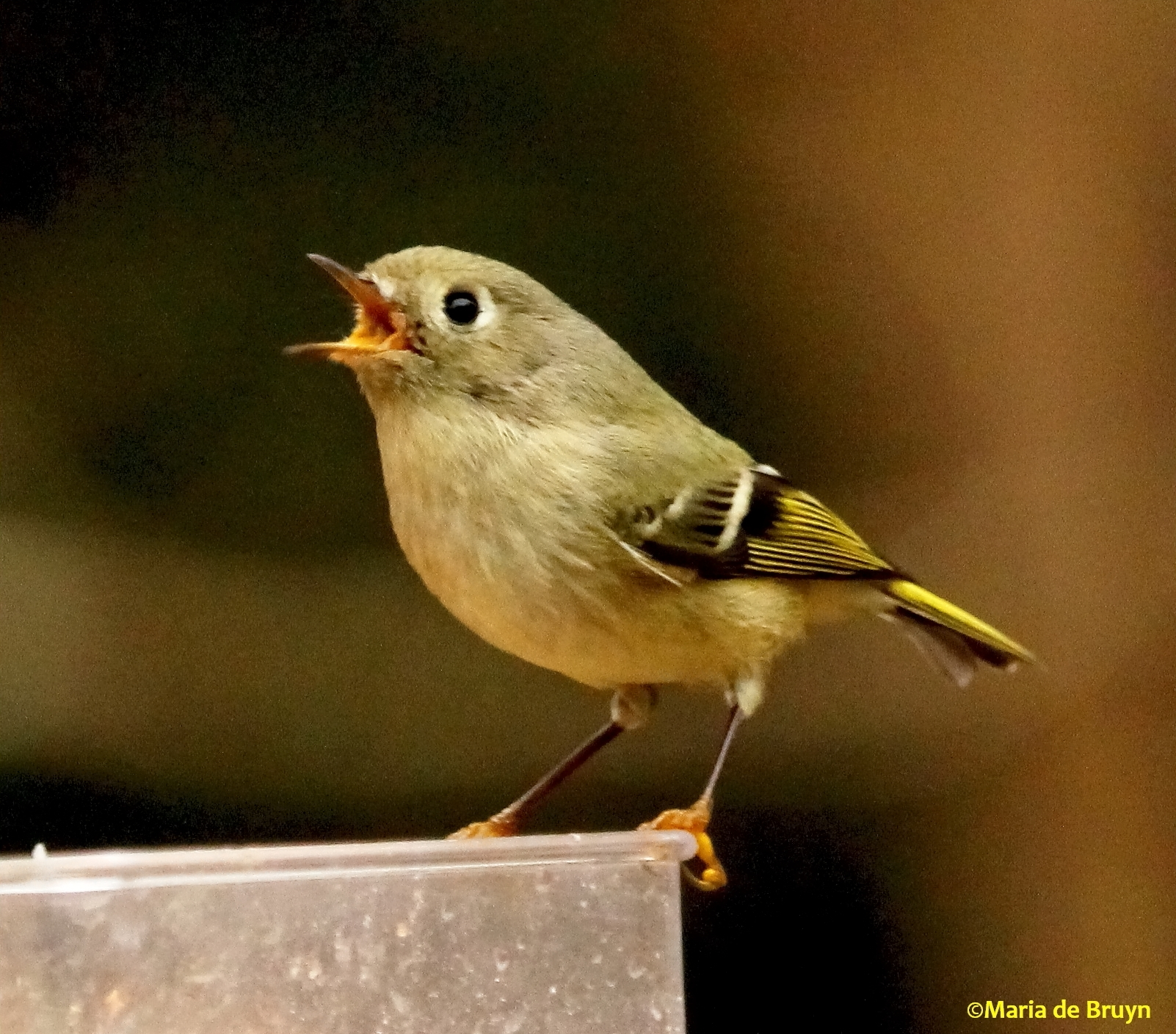
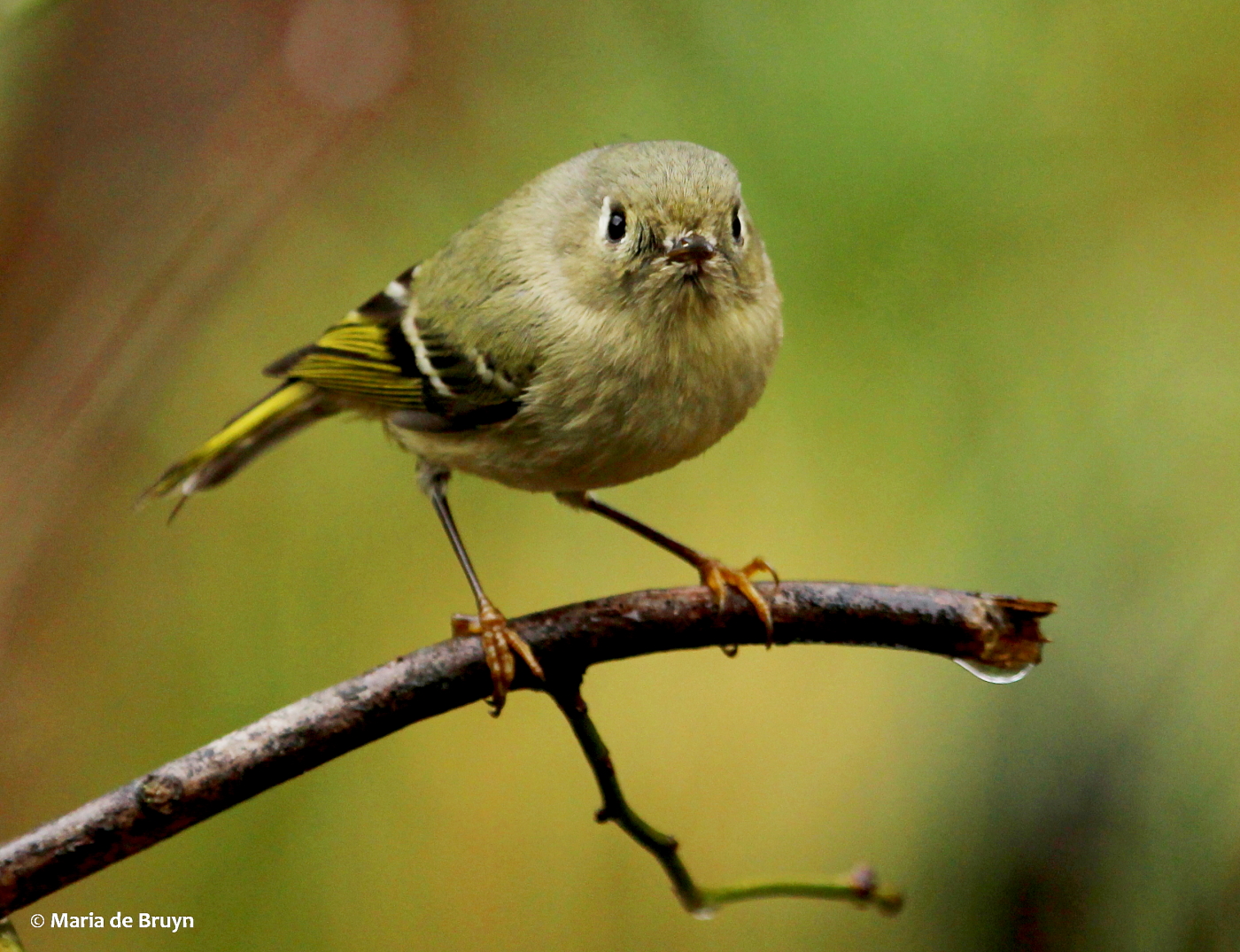
The kinglets’ yellow-olive color, white wing bars, broken white ring around their eyes and fluttering flight help identify them. Very occasionally, you catch sight of the red crown or get a peek at a couple of the normally hidden red feathers.

ruby-crowned kinglet IMG_8791© Maria de Bruyn 2ruby-crowned kinglet IMG_4174 ©Maria de Bruyn res signed

The Latin species name, which means little king, has led to a number of “royal” terms for a group of kinglets: a castle, a court, and a princedom. My favorite, however, is a dynasty – a grand description for a collection of these tiny fliers.

ruby-crowned kinglet IMG_8747© Maria de BruynI think I might have a particular fondness for birds with black or dark legs and yellow feet. I love snowy egrets (Egretta thula) with their large feet resembling yellow rubber gloves and melt at the sight of those dainty kinglet feet.


It’s amazing to think of these small birds migrating to North Carolina from as far North as Canada and Alaska. Just think about how many wing-beats and how much energy this demands of these birds! I’m glad they make the trip though!

ruby-crowned kinglet IMG_0409© Maria de Bruyn res2 ruby-crowned kinglet IMG_3539©Maria de Bruyna”?

ruby-crowned kinglet IMG_5641©Maria de Bruyn resI hope you have found these photos as cute as I did – have a great day!