Delight in small packages

ruby-throated hummingbird M de Bruyn signed (2) res

Ruby-throated hummingbird IMG_6085©Maria de BruynOne bird that seems to almost universally delight people and bring smiles to their days are the hummingbirds. These wonderful little fliers now only live in the Western hemisphere of our earth, but two 30-million-year-old hummingbird fossils were discovered in Germany so they did live elsewhere.

There are more than 300 species – some very, very colorful and some with gorgeous long tails or long curved beaks. Central and South America have spectacular species and one of the Nazca line drawings in Peru depicts a hummingbird. Only eight species breed in the United States.

Here in Chapel Hill, I’ve had the pleasure to see two species – the ruby-throated hummingbird (Archilochus colubris) and the rufous hummingbird (Selasphorus rufus). The ruby-throated (named for the male’s brilliant neck feathers) are here in spring, summer and fall and then they migrate further south, crossing the 500 miles (800 km) of the Gulf of Mexico in one non-stop flight!

Ruby-throated hummingbird IMG_8991©Maria de Bruyn resRuby-throated hummingbird IMG_4837©Maria de Bruyn

The rufous species migrates here from further up north in the wintertime; they will go as far as Alaska to spend the winter and can tolerate below freezing temperatures.rufous hummingbird IMG_1789 M de Bruynrufous hummingbird IMG_2022 MdB

Ruby-throated hummingbird IMG_7541©Maria de BruynRESThe smallest bird species is the Bee hummingbird, which weighs less than a cent coin. On average, the ruby-throated hummingbird weighs less than a US five-cent coin.

They flap their little wings about 50 times per second but increase this to as much as 200 wing beats per second. This rapid motion makes a humming sound, which varies according to the species. Their quick flight allows them to hover as well as fly backwards and upside down.


ruby-throated hummingbird IMG_3498Ruby-throated hummingbird male IMG_5433©Maria de Bruyn res


ruby-throated hummingbird IMG_3293 MdBTheir little feet help them perch but they cannot hop or walk on them.

These little birds need to eat about half their weight in sugar every day, which is why you see them returning to feeders quite often. When there is not enough food, they can go into a hibernation-like state, slowing their metabolism to 1/15th of its normal rate.

Their hearts can beat as quickly as 1260 beats per minute and they take 250 breaths per minute, even when they are sitting still!

Ruby-throated hummingbird IMG_1482©Maria de Bruynres


Hummingbirds do not suck up nectar but quickly lap it up with tIMG_5526©Maria de Bruynheir tongues, which have tubes running down their lengths.

To ensure they have enough food, they can sometimes defend their feeding areas vigorously against other hummers that they consider intruders. This happens a lot at my feeders but they are so fast that it’s very difficult to get good shots of it.


ruby-throated hummingbirds IMG_0729 MdB resRuby-throated hummingbird IMG_2379©Maria de Bruynres2

ruby-throated hummingbirds IMG_0728 MdB res

They eventually will tolerate others in their vicinity (sometimes). They live 3-12 years and perhaps the ones they don’t mind having around are related.

Ruby-throated hummingbird IMG_2742©Maria de Bruynres

It is better not to put food dyes into nectar and brown or raw sugar should not be used to prepare it as these types of sugar contain iron, which can kill hummingbirds if they get too much over a certain period of time. They like sugar water with 25% sugar, although apparently nectar with 35% sugar is even more to their liking.

Ruby-throated hummingbird IMG_7711©Maria de Bruyn resRuby-throated hummingbird IMG_5921©Maria de Bruyn res2

I have yet to find a hummingbird nest made with spider silk and lichens in my yard but hope to see one in the future so that I can say I’ve not only seen the biggest bird egg (ostrich) but also the smallest!

Ruby-throated hummingbird IMG_5925©Maria de Bruyn (2) res

Bluebird young’uns – take 2!

Eastern bluebird IMG_1285©Maria de Bruyn resThe first week after they fledged, I didn’t see the baby Eastern bluebirds (Sialia sialis), although their parents were frequent visitors to the suet/meal worm feeders. I hoped that they had made it and not fallen prey to a neighborhood cat or other predator. When I decided to take photos at the time of the summer solstice, however, I discovered they are all doing quite well and keeping mama and papa quite busy!

Eastern bluebird IMG_1248©Maria de Bruyn res


Sometimes they perched nearby and waited for a parent to come to them with a meal. Other times they waited in nearby trees.
They also followed their parents to the feeder, perching on a bamboo stem or feeder pole, waiting and calling to make their hungry desires known.


Eastern bluebirds IMG_1123©Maria de Bruyn res

They could be quite demanding, which may account for the parents stuffing their mouths quite full of meal worms.

Eastern bluebirds IMG_1243©Maria de Bruyn res

Eastern bluebird IMG_1662©Maria de Bruyn res
I guess those wide open mouths make it quite obvious what they are after.

Eastern bluebird IMG_1254©Maria de Bruyn res

I don’t know whether there was some rivalry in play here or one baby misjudging its landing coordinates on the pole very badly. Good thing those claws missed its sibling’s eye!

Eastern bluebird IMG_1696©Maria de Bruyn resEastern bluebird IMG_1696©Maria de Bruyn close-up
Not every juvenile was just expecting waiter service from dad or mom, though. One young’un (“Southern” for young one) began practicing meal worm gleaning from the feeder him (or her)self, successfully I might add.

Eastern bluebird IMG_1275©Maria de Bruyn res

As his or her siblings learn this, it will be nice for their parents, who probably will want to distance themselves from the constant nagging for food. It will be interesting to see if they decide to nurture a second brood this year!

Eastern bluebird IMG_1262©Maria de Bruyn res

Eastern bluebird IMG_1697©Maria de Bruyn res


Casey Crow adopts a home

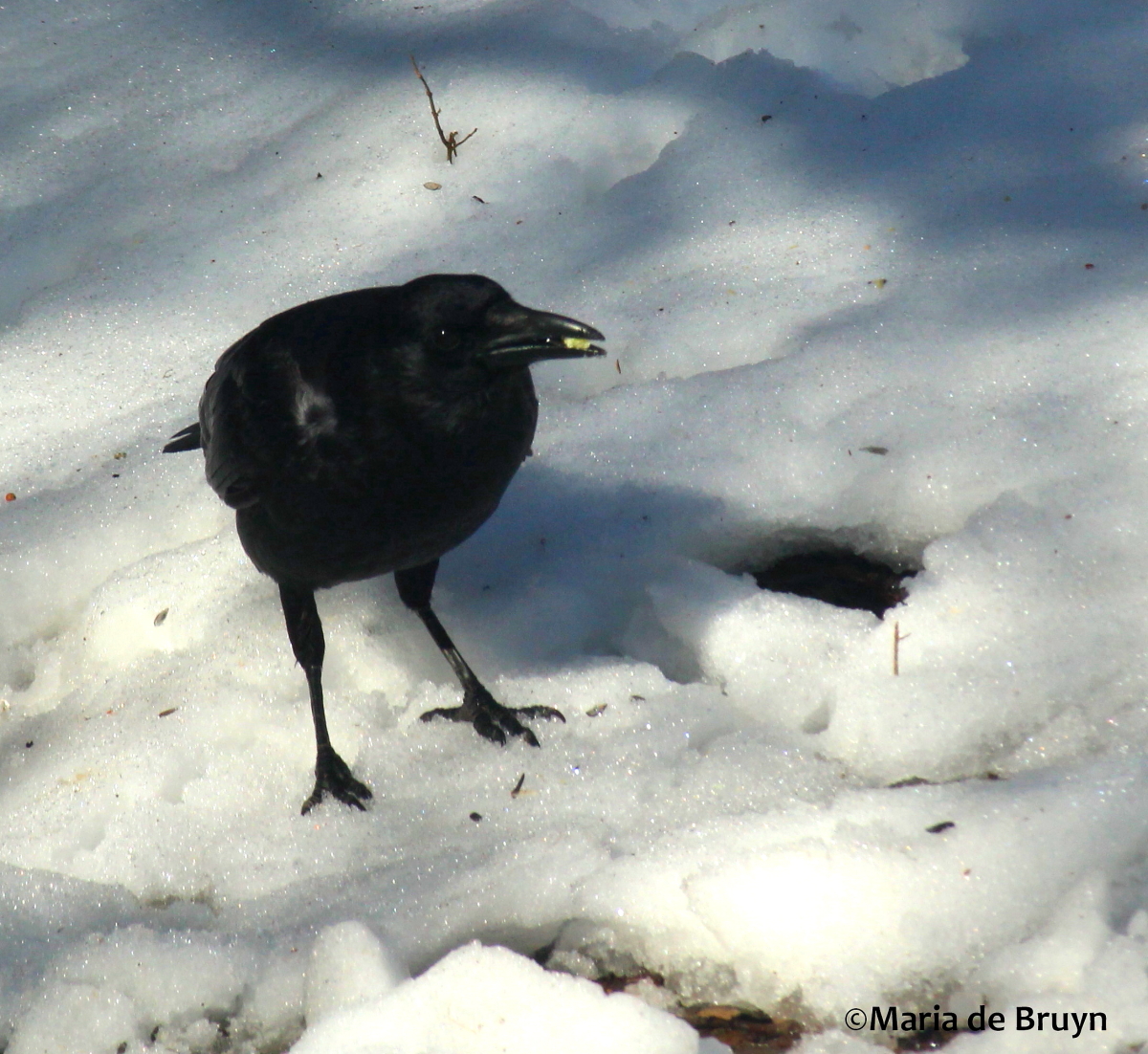
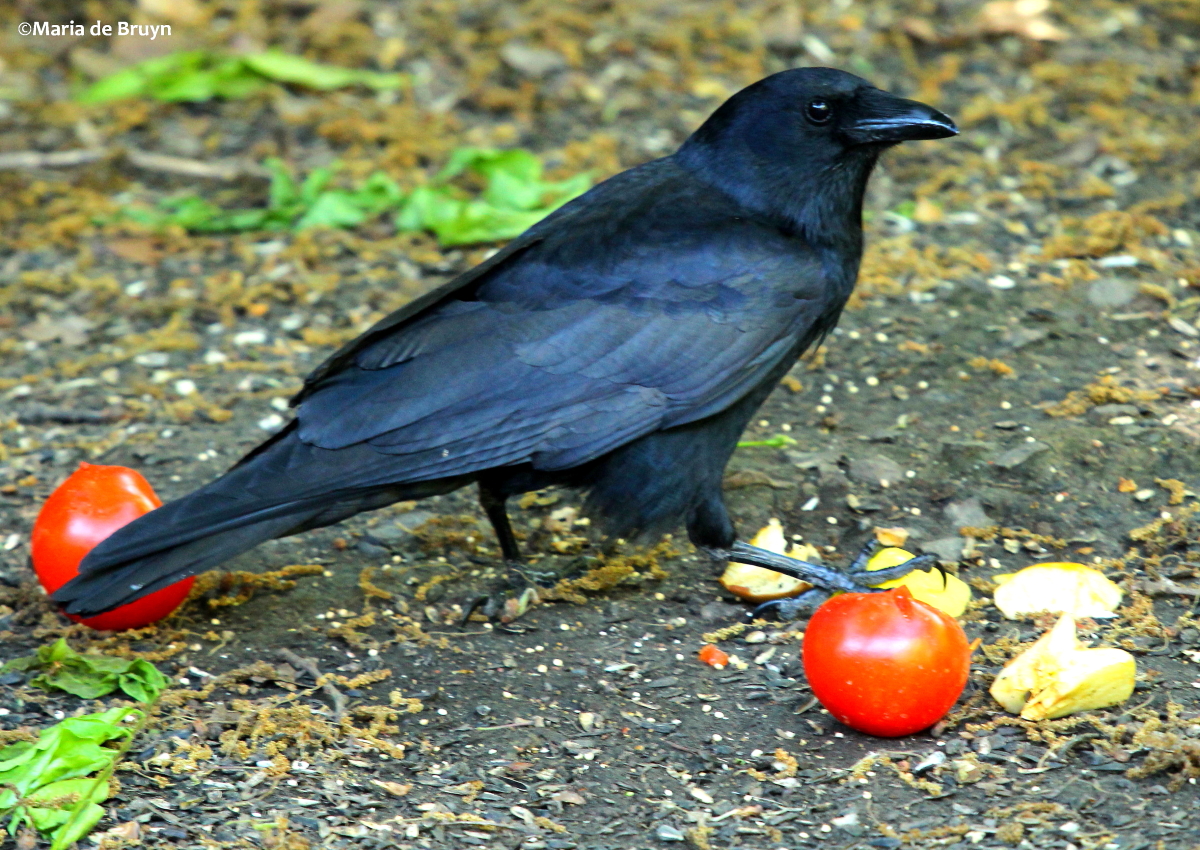
American crow IMG_3544©Maria de BruynresIn years past, I have had the occasional American crow (Corvus brachyrhynchos) visit my yard. For example, this past spring when it was snowing, a few came to eat fruit but they never really hung around – except for one that flew in with a half-eaten squirrel (or rabbit) that it was reluctant to leave behind.American crow IMG_9437© Maria de Bruyn res


Now, however, it seems that the one of these fine-feathered friends has decided to adopt my residence as a temporary home – or at least as a spot for some occasional R & R.

american crow IMG_3459©Maria de Bruyn res

Since I don’t know if this crow is female or male, I’ve named “it” Casey, a nice gender-neutral name. Casey is quite large and has grown bolder as time progresses. At first, Casey would alight on a branch and observe for quite a while before venturing toward a feeder; if I appeared, Casey would leave.

american crow IMG_3466©Maria de Bruynres

Now Casey flies in to perch on the roof, a nearby tree or a feeder not far from the back door, balancing as well as possible. S/he often announces his/her arrival with a few loud caws and sometimes what seems to be irritation when grackles decide to carry out a little harassment.

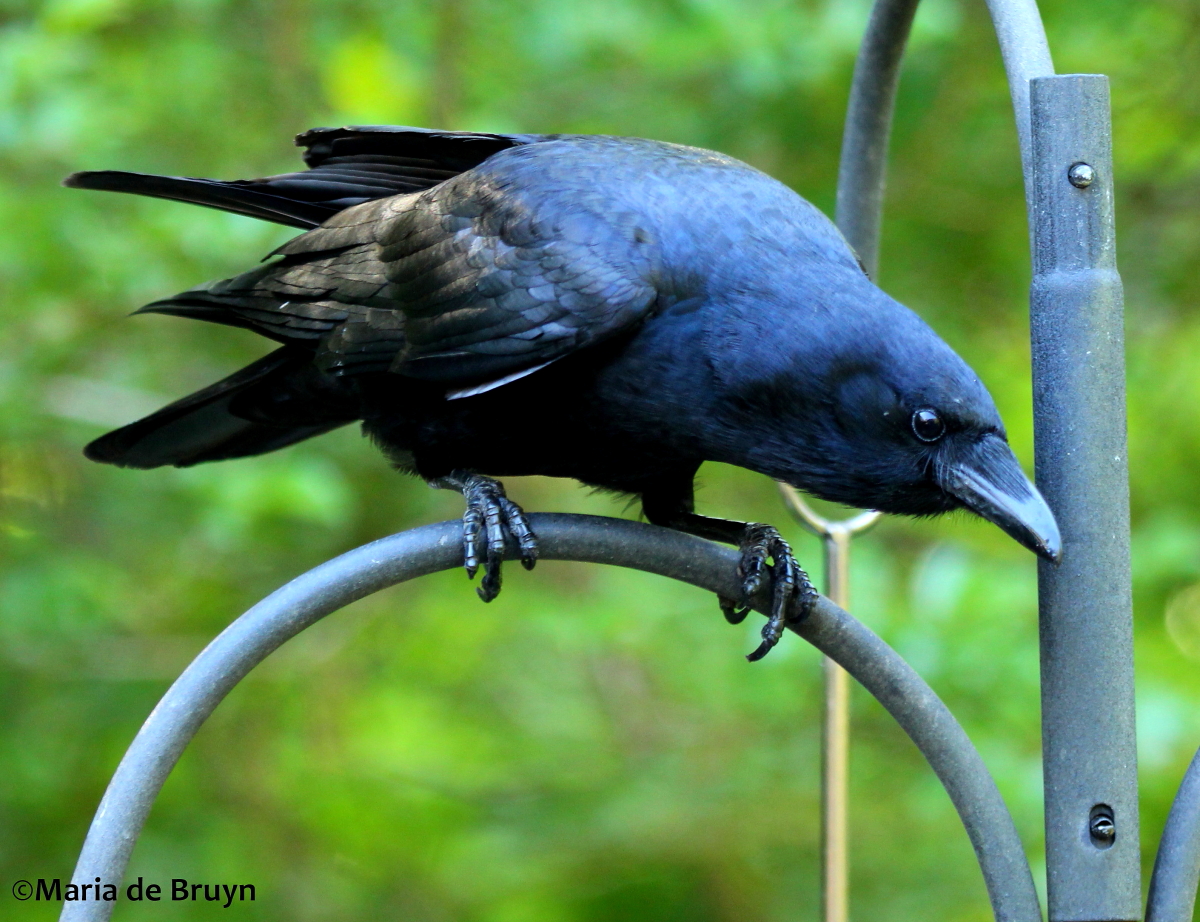
American crow IMG_8668©Maria de Bruyn resOne of my old plastic seed feeders broke, leaving only a bit of skeletal structure. Rather than toss it out, however, I’ve recycled it to become a grape jelly holder. No orioles have visited but it appears that grape jelly has become quite the treat for Casey, who balances in odd and sometimes contorted ways to be able to snag some.

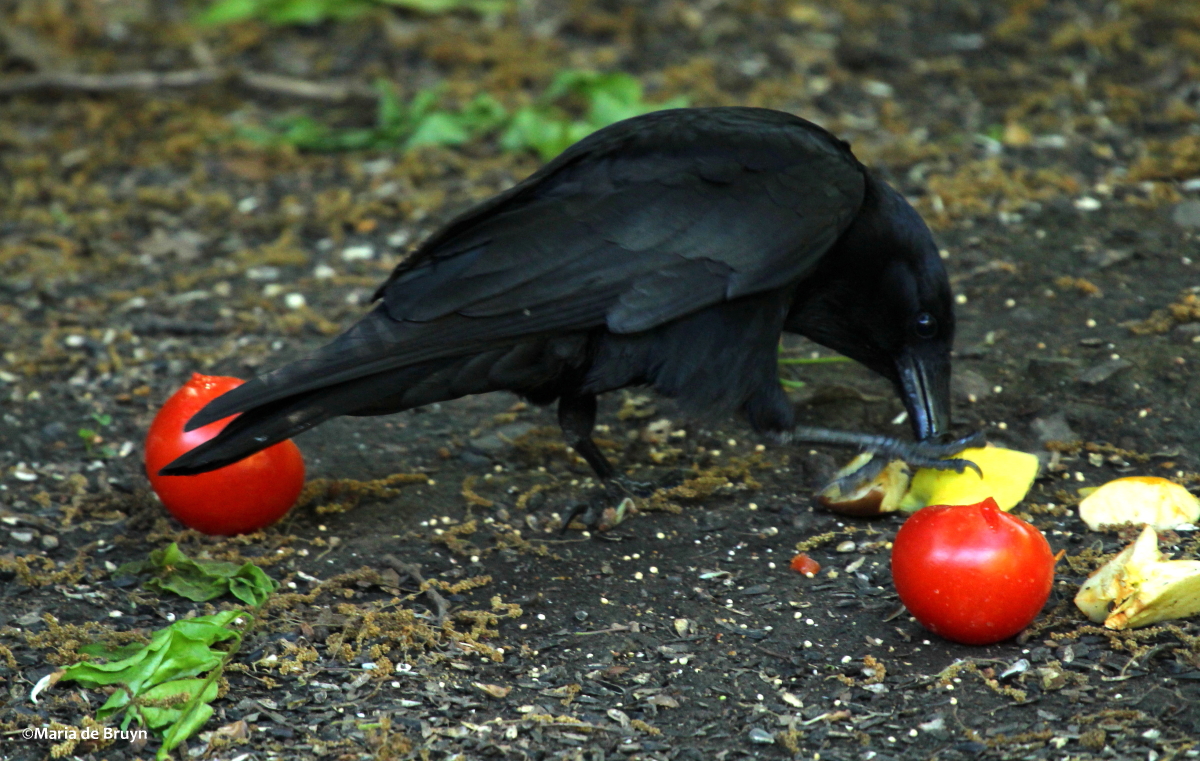
Casey is much too large to balance at other feeders but has obviously been searching for some additional food. A short while ago, I learned that Casey can be quite fond of apples.

american crow IMG_3425©Maria de Bruynresamerican crow IMG_3421©Maria de Bruyn res

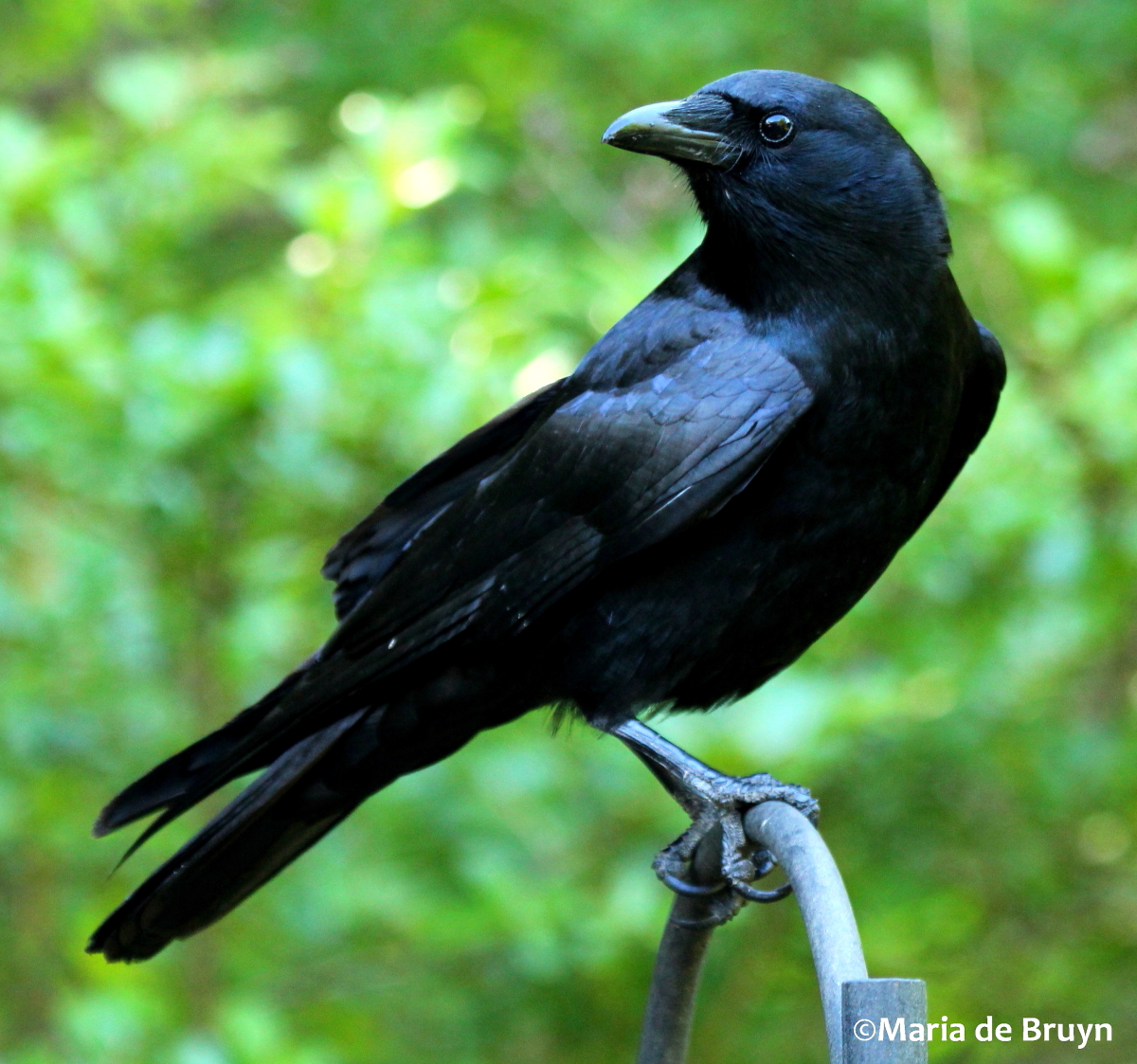
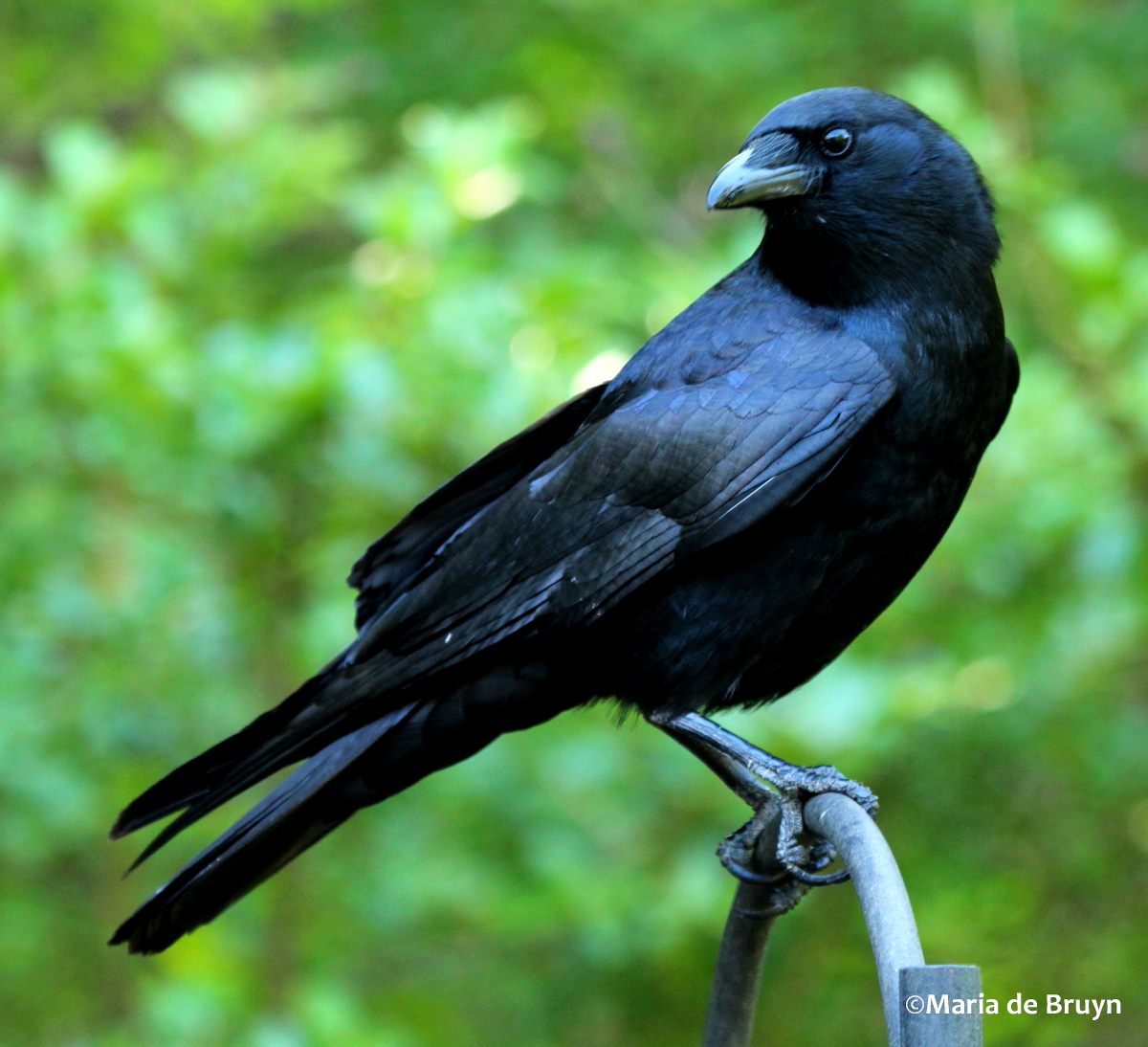
Casey is quite the handsome bird and sometimes seems to be posing for portraits. I assume that it is the same crow that is visiting from day to day, but haven’t been able to figure out any real distinguishing marks yet to be sure. No other crows appear willing to remain near feeders if I go outside, though, so I guess it is always Casey who remains.

american crow IMG_3456©Maria de Bruyn res

I enjoy Casey’s visits but am glad now that the robin pair decided not to re-use their nest on the downspout from last year. Though there wasn’t much room for Casey to perch, I did see her/him fly to that nest and examine it, obviously investigating if there were some nestlings there to serve as a meal. I was quite happy there weren’t any in residence!

I don’t know how much longer Casey will be a regular visitor but it will be interesting to learn more about his/her likes and dislikes as time goes by!


Do deer like treats? Of course, they do!

deer bird seed IMG_3127© Maria de BruynAnyone who has lived in proximity to white-tailed deer (Odocoileus virginianus) know that they have a great appetite for all types of vegetation, including garden flowers that people plant in their yards. This has been a cause of strife between humans and the deer (at least, from the humans’ point of view), even though I and other people have found that deer repellants – both home-made and store-bought – work really well to keep deer from eating plants we wish to keep.

I also have a 5-foot fence around my vegetable garden. In theory, the deer could jump this but the trick is to make the garden long and narrow since the deer calculate how much space they have to land on the other side of the fence. If it looks like the space is too small, they won’t try to jump eveIMG_5431© Maria de Bruynn if they see and smell delicious veggies inside – I know this is true as I’ve watched them figuratively “lick their lips” outside my garden but never attempt to get into it.

The deer’s four-chambered stomach enables it to eat a variety of food. In spring and summer, they prefer green plants, including grasses; in the autumn, they go for corn, acorns and other nuts. In the winter-time, deer eat twigs and buds of trees. They also eat fruit, such as the berries on privet trees, lichens and other fungi.

Stip at apple treeStip and privet IMG_1648© Maria de Bruyn

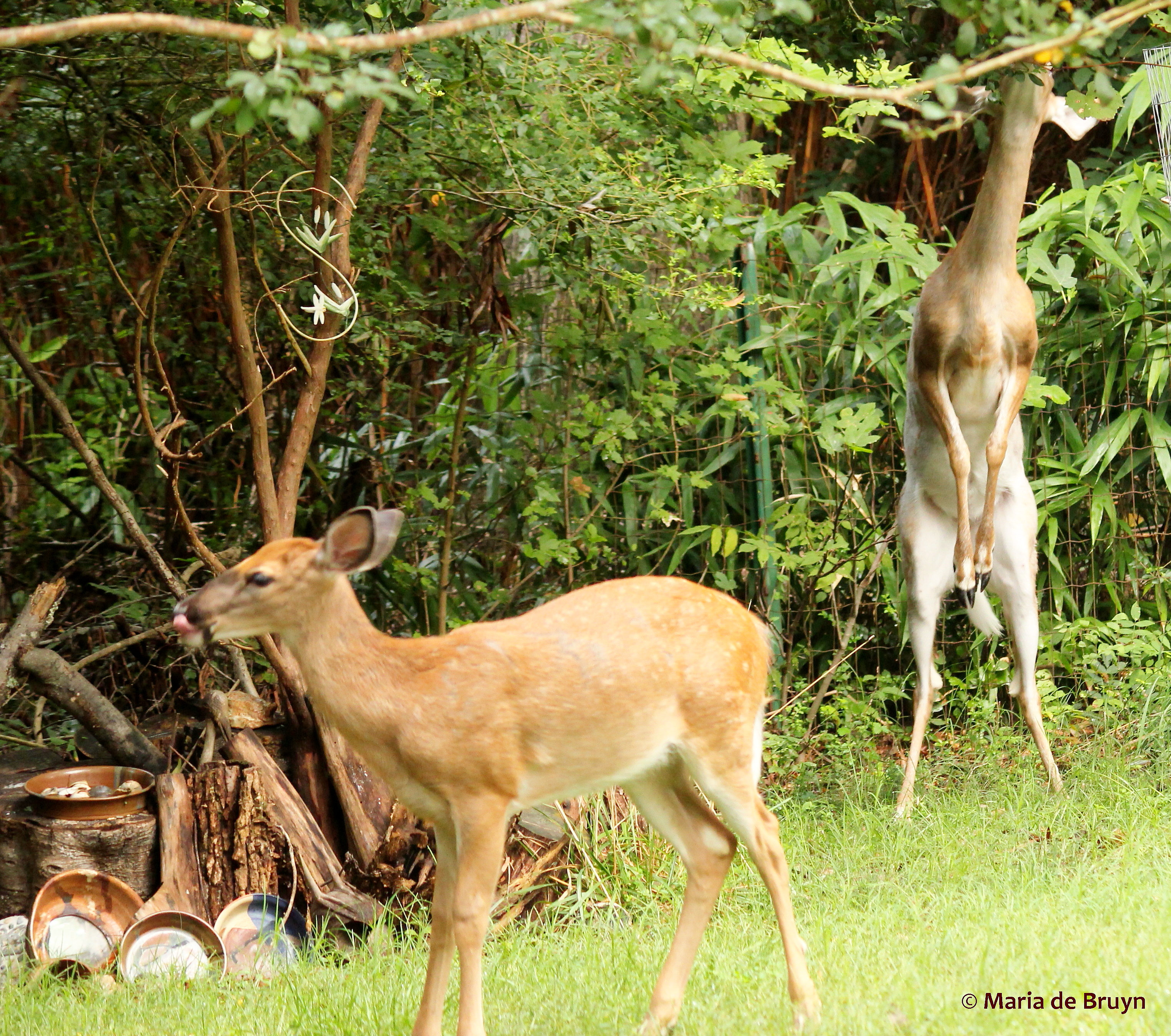
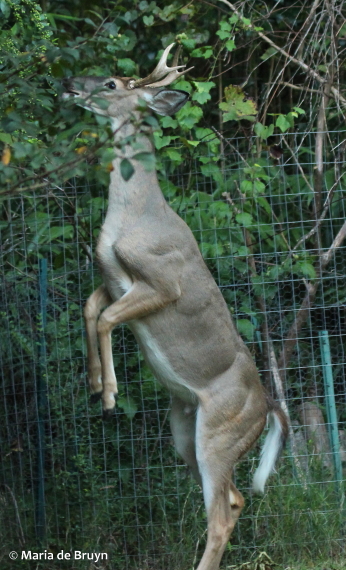
To get to the privet berries, they need to reach the tree branches and their good sense of balance comes in handy. The does do it often in my back yard and the fawns watch them carefully so they can try it, too. Surprisingly, the fawns can stand on their hind legs pretty well when they are only a few months old.

Nezhoni and apple tree 3©Maria de BruynBuck and privet IMG_5243© Maria de Bruyn

Besides privet berries, they like grape leaves (which can be high when the grapevines climb up the privet) and apples. The big bucks will also have a go at it but I don’t see them lifting their bulky bodies up often.

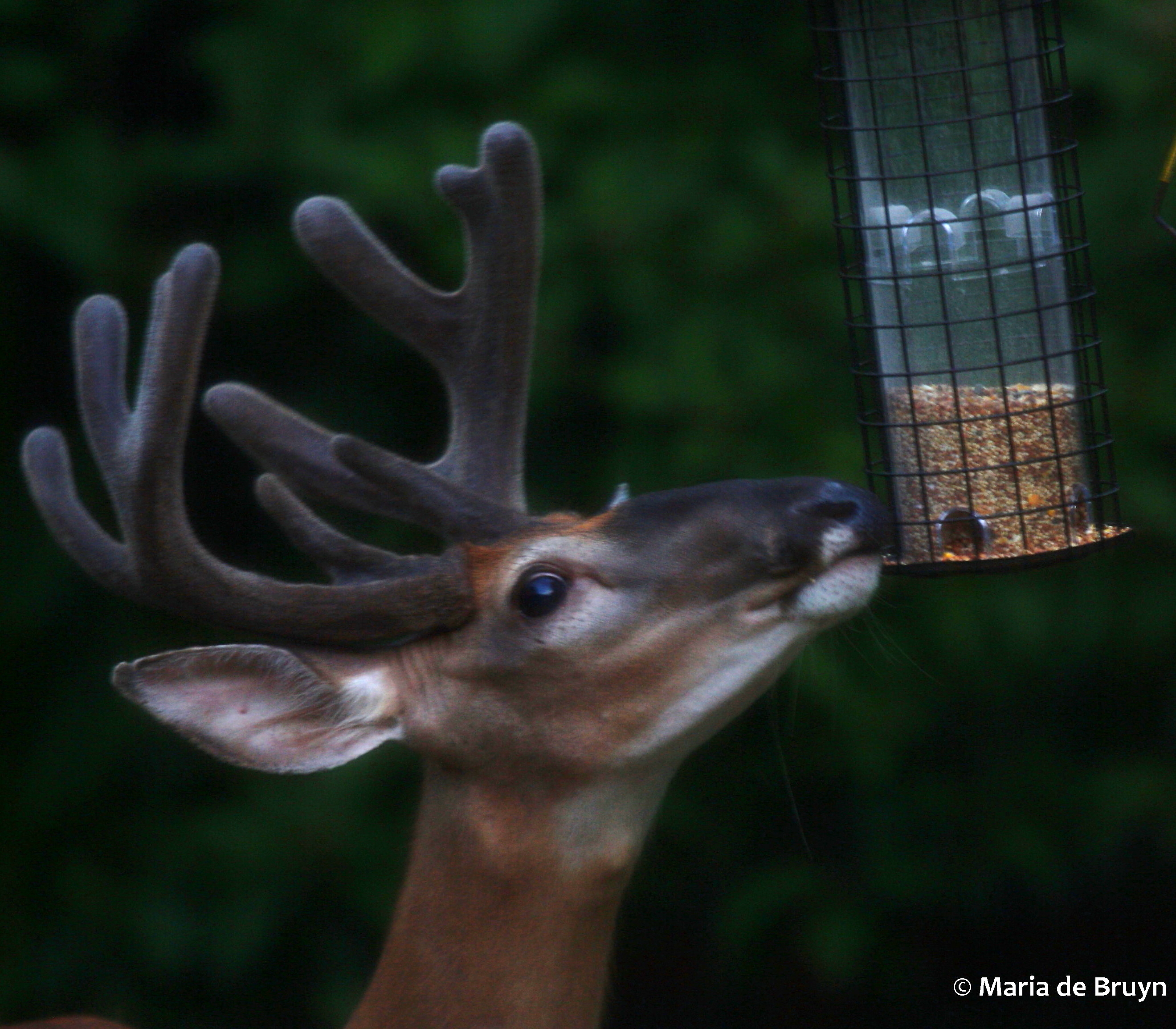
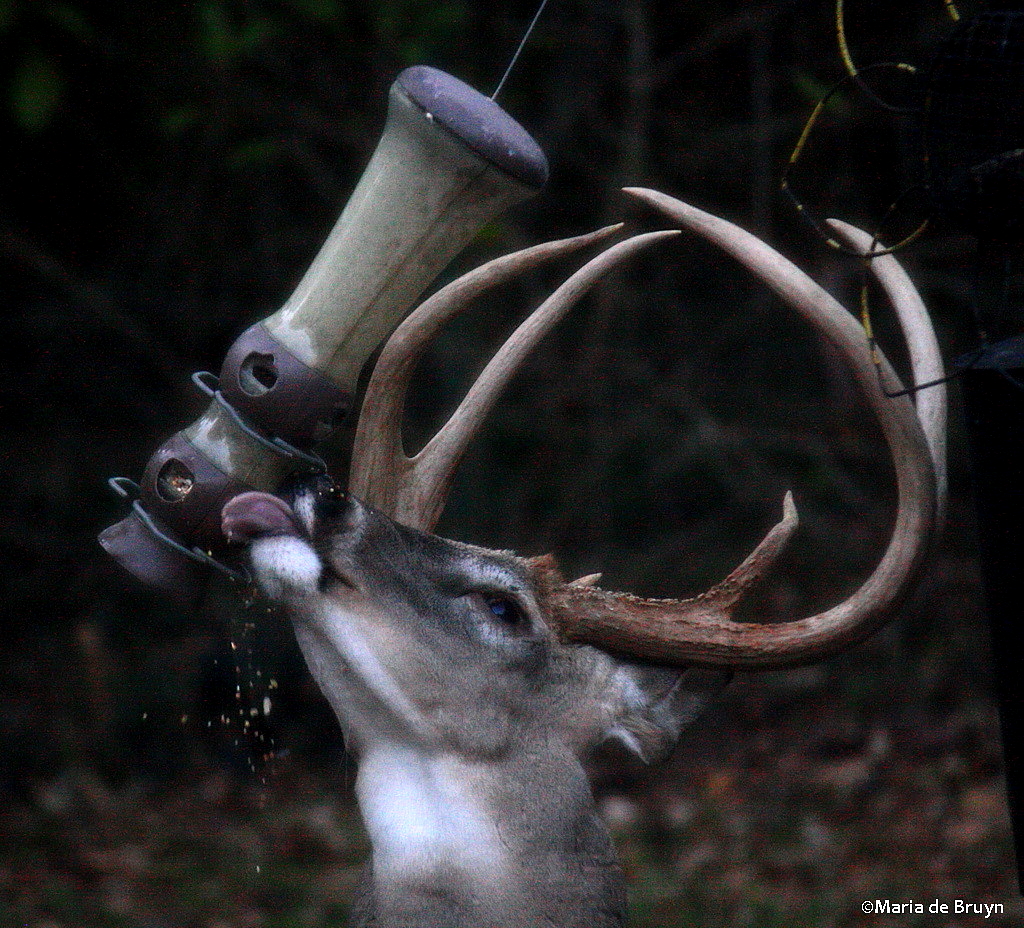
The deer also enjoy treats, just as we may like sweets and birds have a fondness for suet. Bird seed is one treat they like. If the deer are very hungry, they can lick up all the bird seed put out for the ground feeders, but when they are feeling well fed, they will just have a little and leave seed for the birds (and squirrels). The deer’s fondness for bird seed can be strong; if you don’t hang your feeders high enough, they can clean out a feeder in a short time.

emptying bird feeder at night©Maria de Bruynwhite-tailed deer MdB 3 buck

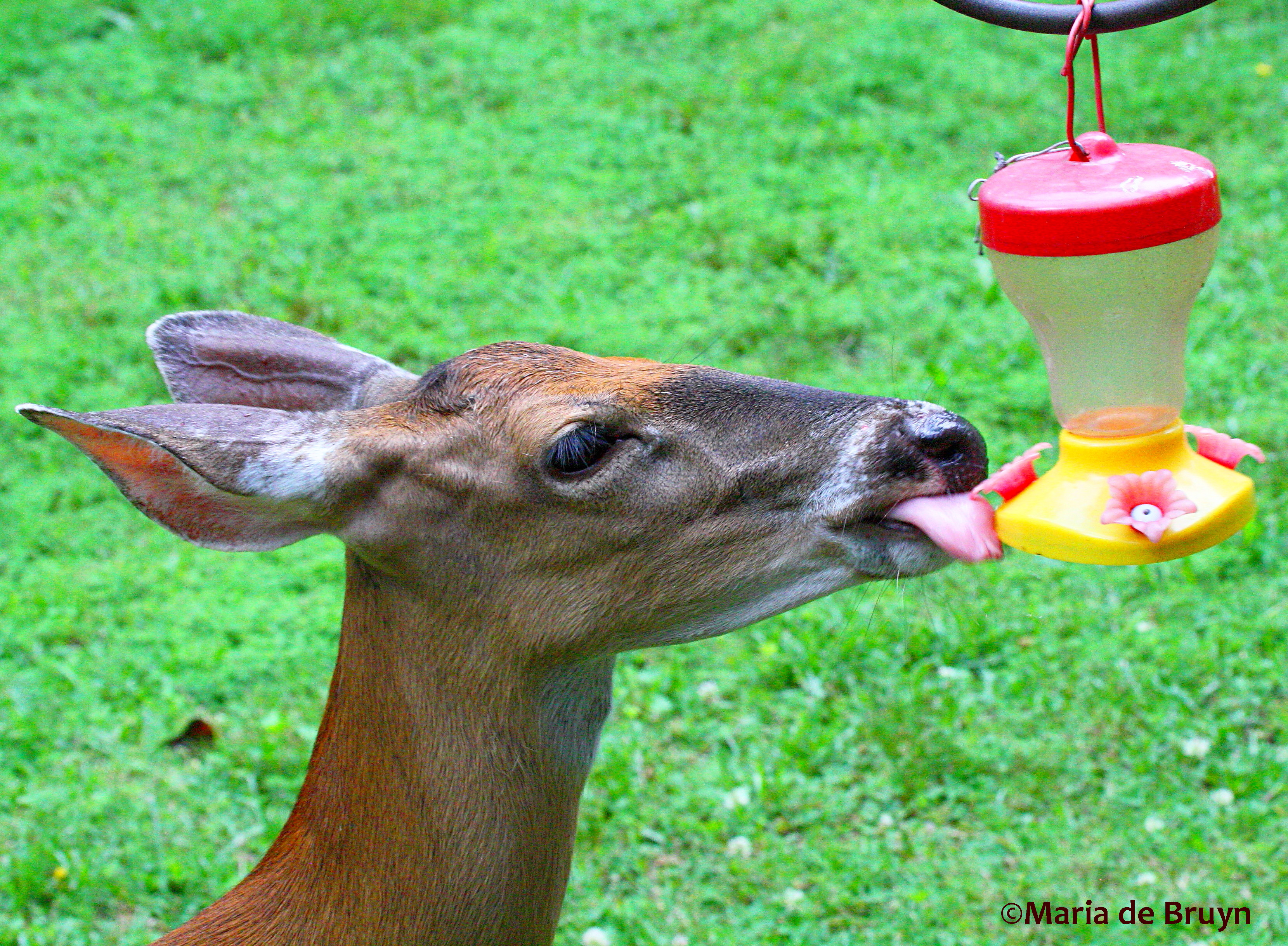
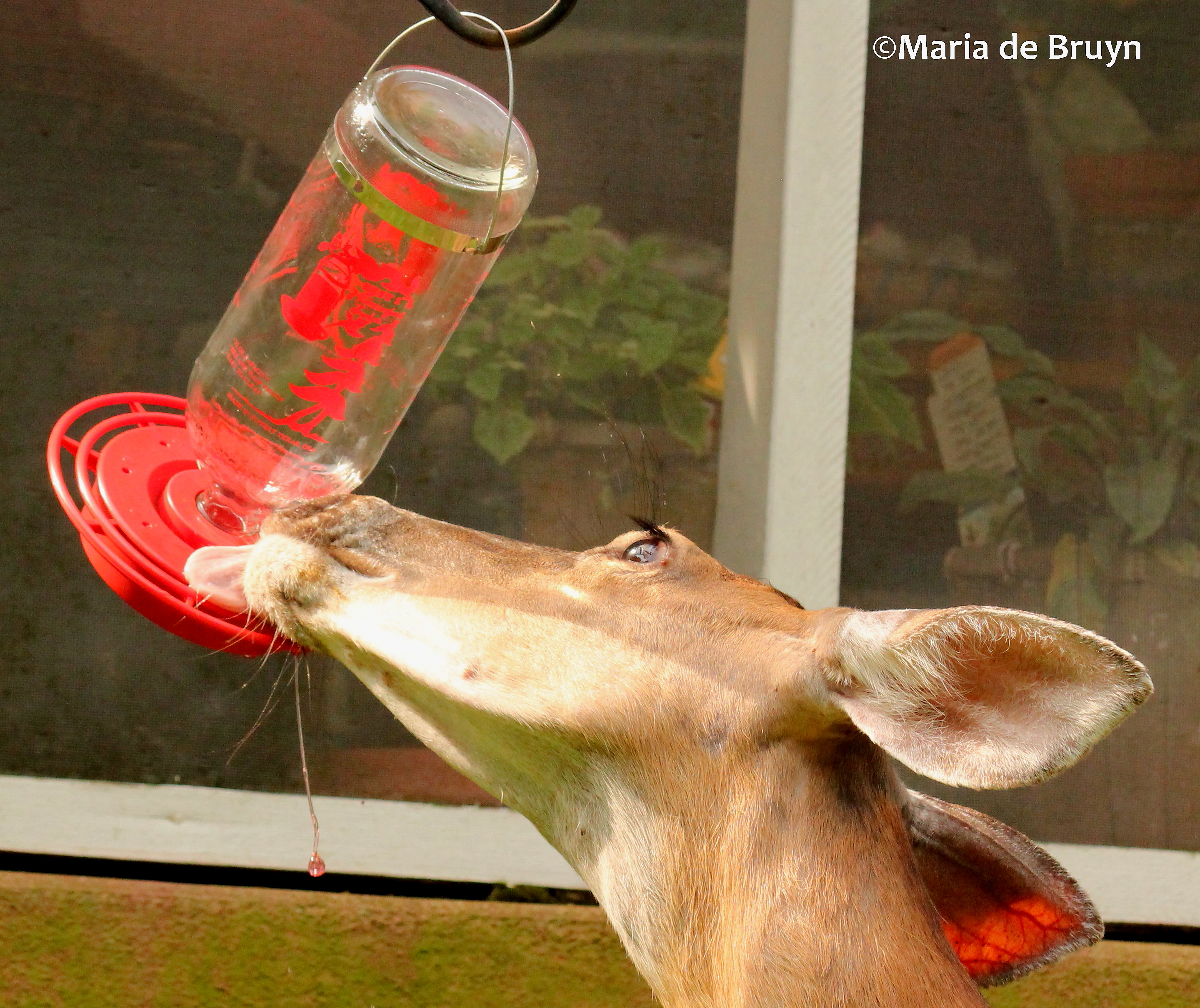
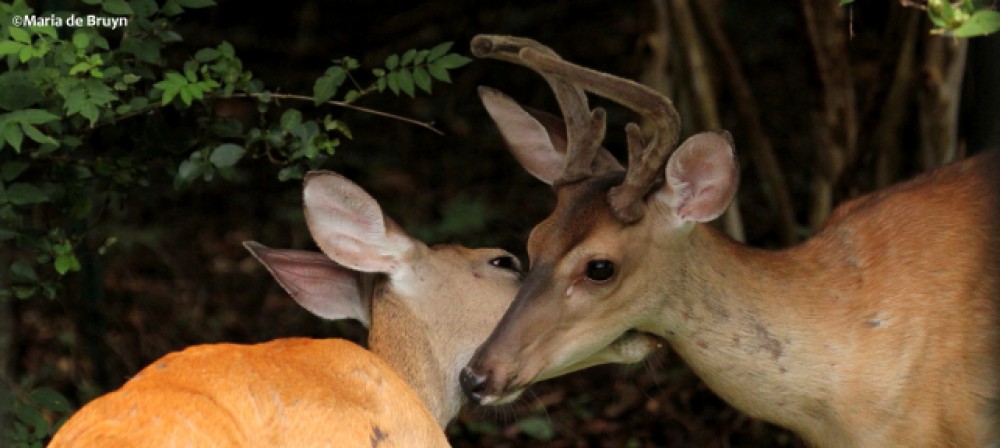
My biggest surprise concerning a deer treat came from Schatje, my “dear deer” friend of five years. One summer, I noted that the hummingbird feeder was emptying quickly and I just thought the hummers were very thirsty. Then one day, I looked outside to see Schatje enjoying a sweet drink. It turned out she was extremely fond of nectar and eventually I had to hang the feeder higher so she wouldn’t drink all the contents a couple times a day!

white-tailed  deer Schatje 1 ©Maria de Bruyn signedSchatje nectar IMG_1727©Maria de Bruyn

This winter has been especially cold and the local deer family have had to rely on their winter diet of fungi, leaves and twigs a lot. Though they likely are not anticipating spring, I’m sure they will be glad when it gets here, just like me!

Next week: squirrel treats

Acrobatic squirrels

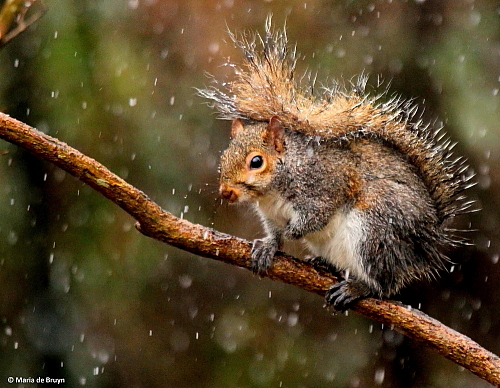
The Eastern gray squirrel (Sciurus carolinensis) is a well-known – and sometimes quite annoying! – visitor to our yards in North Carolina. One way in which they earn themselves a reputation as a pest is when they get into attics, where they could end up chewing on wires. This happened to me, so I had to have a pest control agent come to trap them humanely (rather than poison them). Unfortunately, I found out later that when they are released outside their home territory, it’s tough going for them as other squirrels see them as invaders. I hope they made it.

Squirrel IMG_0820©Maria de Bruynres2 Eastern gray squirrel IMG_2144©Maria de Bruynres2

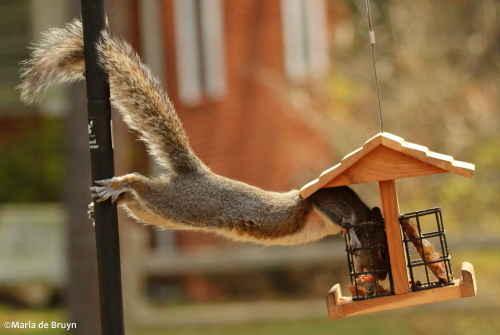
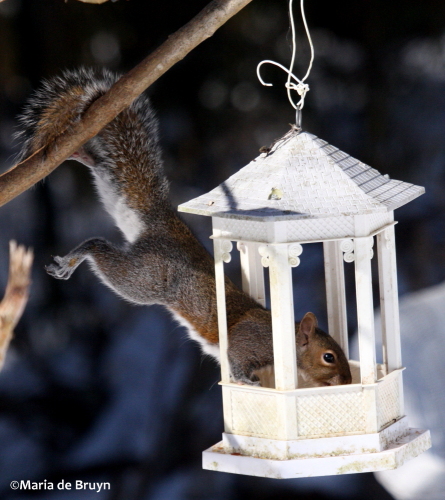
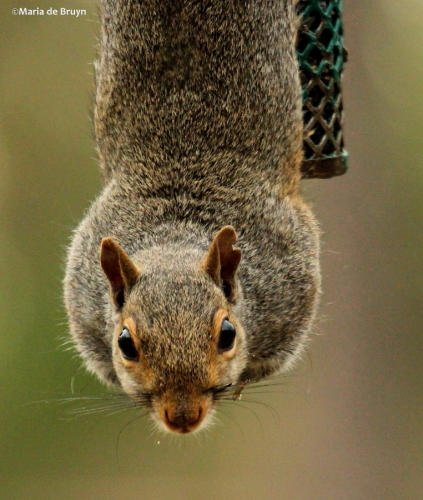
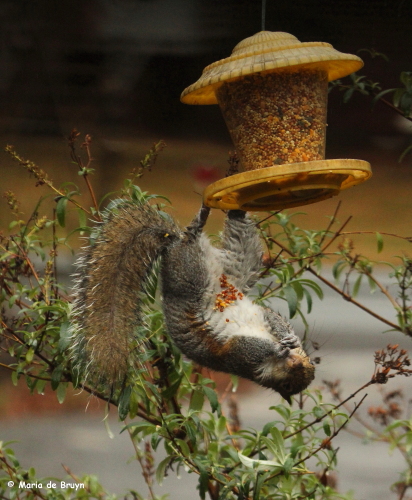
The second way in which they can be a nuisance is when they go to extreme lengths to get at the food in bird feeders. My yard squirrels and I have had an ongoing game of wits over the years, with them doing all they can to get to the feeders and me taking new measures to prevent them from doing so.

Squirrel IMG_8869©Maria de Bruynres2squirrel IMG_1232©Maria de Bruynres2

The gray squirrels mainly eat plants and seeds, including acorns and pine cones, but they also like a variety of other foods, including fruit, seeds and suet. Fortunately, I haven’t had the same experience as my neighbors, who had squirrels chew through the screen on their back porch to get to a bag of seed left there. These agile little mammals have posed a challenge to me, however, in situating my feeders in places that they can’t get to them.

Squirrel IMG_8418©Maria de Bruynres2squirrel IMG_0120© Maria de Bruynres

If the feeder is within a few feet of something they can use as a launching pad (a bush, pole, etc.), they will manage to jump the distance in their ever-present quest for food. Various attempts to prevent this, by moving feeder poles and using combinations of squirrel and raccoon baffles have – sometimes! – proved useful.

squirrel 115©Maria de Bruynres2

However, if the baffles are too low or near a tree, they jump over the baffle to land on top so they can enjoy a meal at their leisure (or until I see them and chase them away).

squirrel IMG_2084©Maria de Bruynres2squirrel IMG_2473©Maria de Bruynres2squirrel IMG_3618 ©Maria de Bruynres2

I must admit, though, that they are a source of entertainment, too; watching their antics and persistence in thinking about how to overcome the barriers can be very amusing. And it’s not like I don’t give them a treat now and then!

Next blog: how ticks get around