My friends, the ruby-crowned kinglets!

ruby-crowned kinglet IMG_8776© Maria de Bruyn resAs I mentioned in November, ruby-crowned kinglets (Regulus calendula) are one of my favorite bird species. These tiny, yellowish bundles of energy are fascinating to watch as they perch on twigs, hover in mid-air by feeders and branches, and generally look delightful when they stop to catch a breath for a minute.

Adjusting your camera to be able to photograph them with the best speed and lighting can be quite challenging as their constant motion leads them in and out of the sun and above and below branches.

ruby-crowned kinglet IMG_9428© Maria de Bruyn ruby-crowned kinglet IMG_9419© Maria de Bruyn  ruby-crowned kinglet IMG_9377© Maria de Bruyn resruby-crowned kinglet IMG_9406© Maria de Bruyn res

ruby-crowned kinglet IMG_4734© Maria de Bruyn resOn a rainy day, they may sit still for a tiny bit longer but their flight is not impeded though they may look waterlogged.

This has been a good autumn and winter for my being able to photograph these adorable avians, not only in my yard at the feeders but also in venues such as the Jordan Lake woods, Mason Farm Biological Reserve and Sandy Creek Park. This blog will focus on some of the portraits I’ve been able to capture.
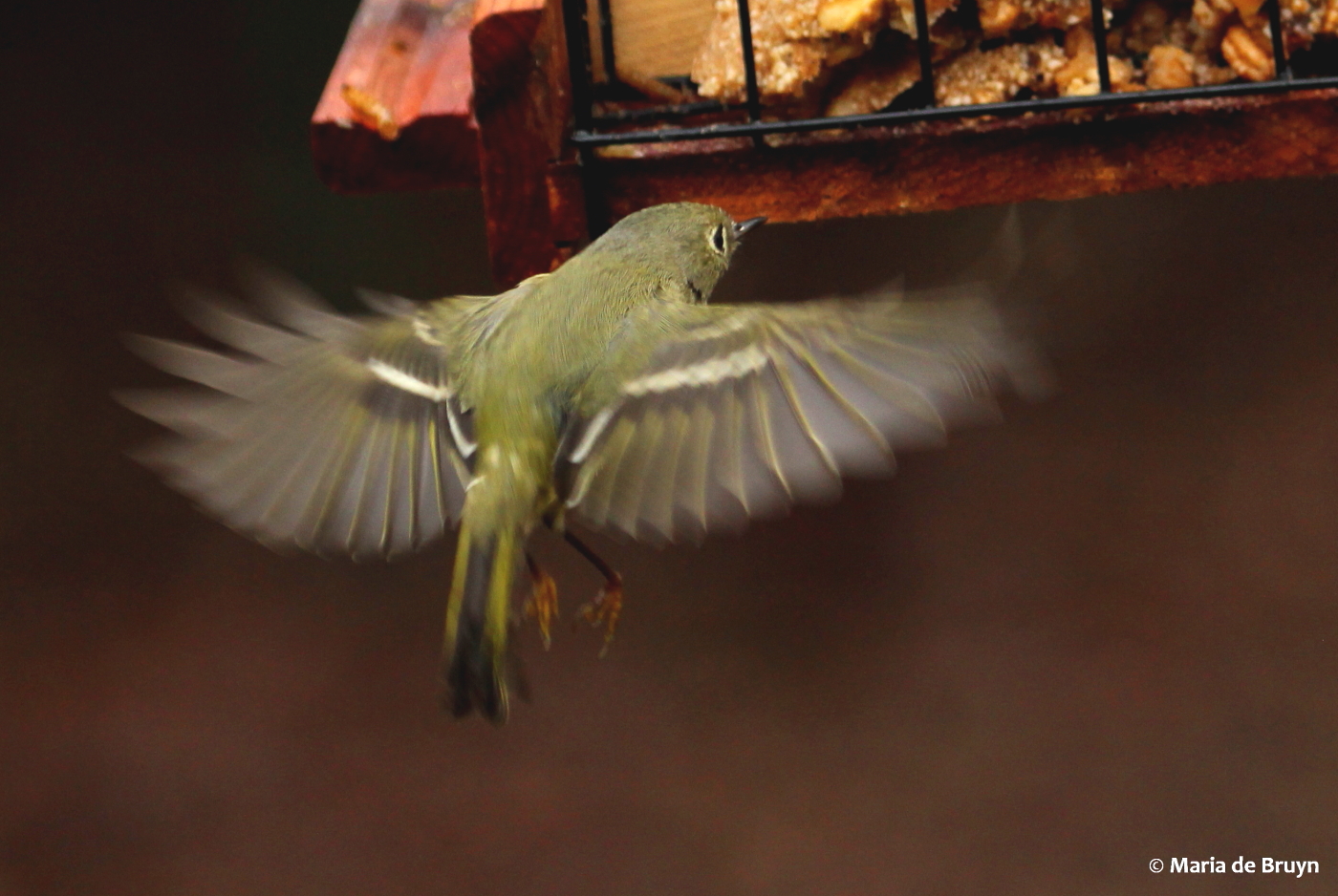


ruby-crowned kinglet IMG_0378© Maria de Bruyn resWhen they are flying around rapidly, you could mistake them for first-year, less brightly hued blue-winged warblers (Vermivora cyanoptera). That happened to me in South Carolina where I thought I had gotten a shot of a blue-winged warbler and instead saw a kinglet in the photo.

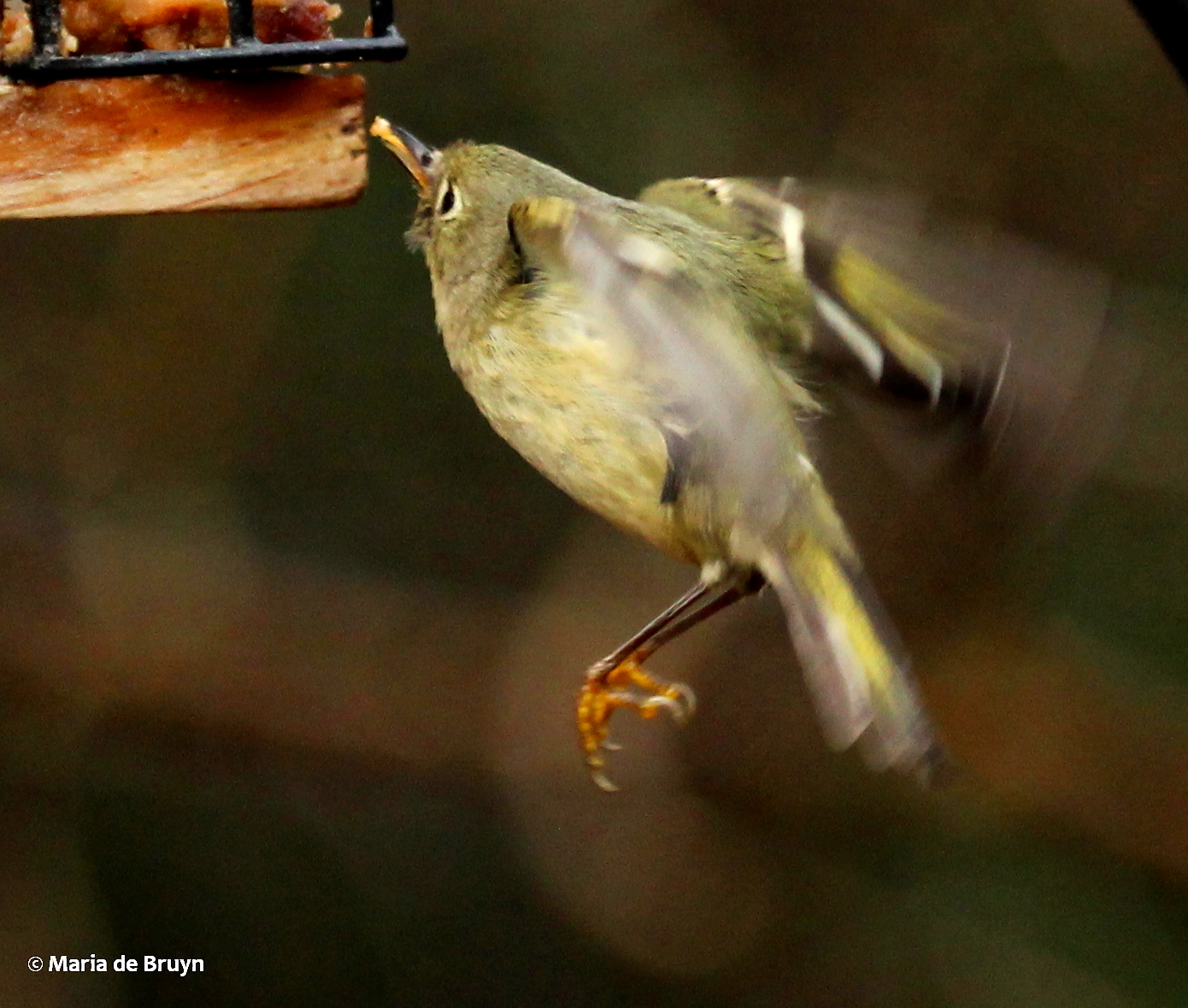
ruby-crowned kinglet IMG_0271© Maria de Bruyn res

ruby-crowned kinglet IMG_0272© Maria de Bruyn

The kinglets’ yellow-olive color, white wing bars, broken white ring around their eyes and fluttering flight help identify them. Very occasionally, you catch sight of the red crown or get a peek at a couple of the normally hidden red feathers.

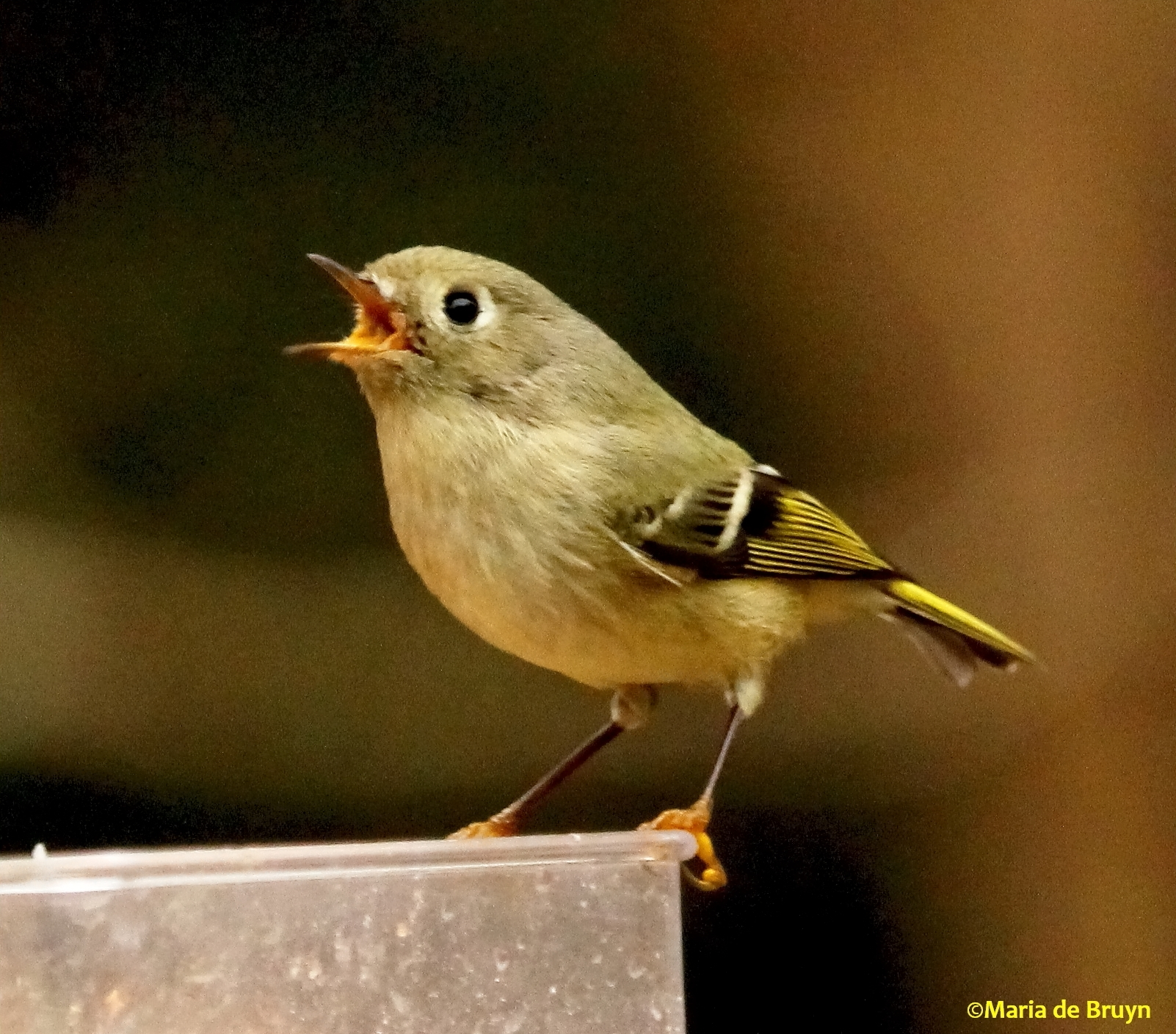
ruby-crowned kinglet IMG_8791© Maria de Bruyn 2ruby-crowned kinglet IMG_4174 ©Maria de Bruyn res signed

The Latin species name, which means little king, has led to a number of “royal” terms for a group of kinglets: a castle, a court, and a princedom. My favorite, however, is a dynasty – a grand description for a collection of these tiny fliers.

ruby-crowned kinglet IMG_8747© Maria de BruynI think I might have a particular fondness for birds with black or dark legs and yellow feet. I love snowy egrets (Egretta thula) with their large feet resembling yellow rubber gloves and melt at the sight of those dainty kinglet feet.


It’s amazing to think of these small birds migrating to North Carolina from as far North as Canada and Alaska. Just think about how many wing-beats and how much energy this demands of these birds! I’m glad they make the trip though!
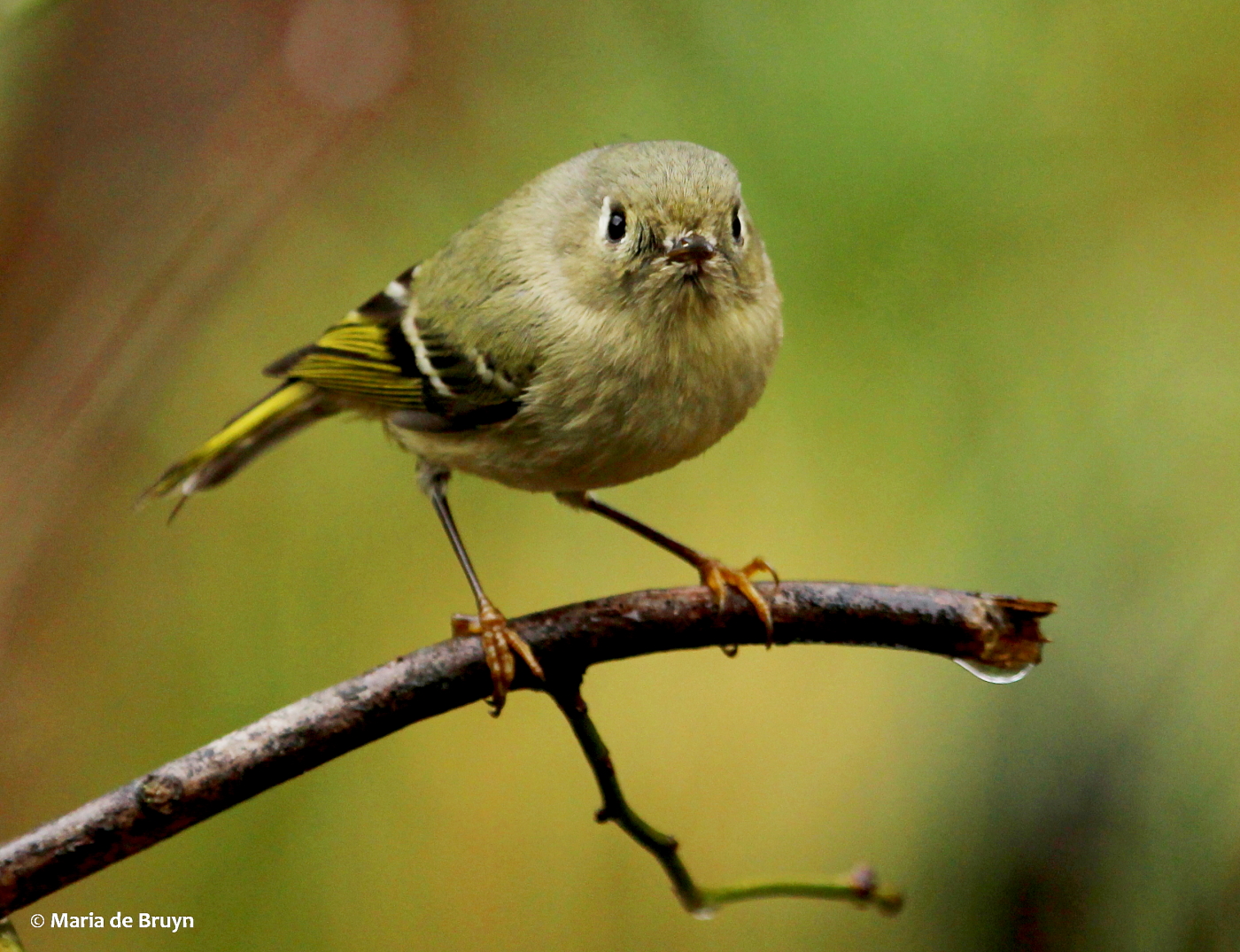
ruby-crowned kinglet IMG_0409© Maria de Bruyn res2 ruby-crowned kinglet IMG_3539©Maria de Bruyna”?

ruby-crowned kinglet IMG_5641©Maria de Bruyn resI hope you have found these photos as cute as I did – have a great day!

Russet-colored shorebird beauties – feminists among the waders!

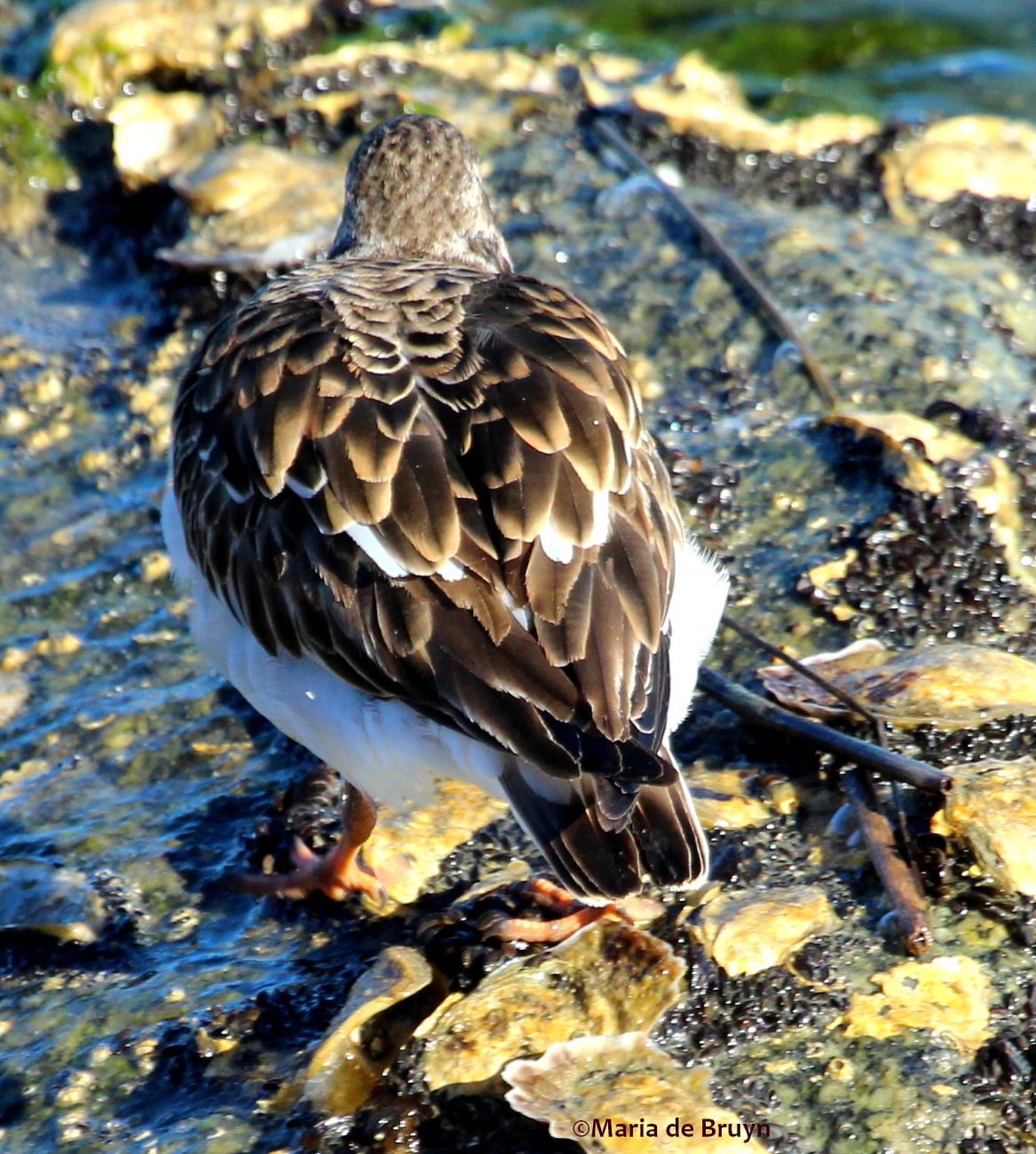
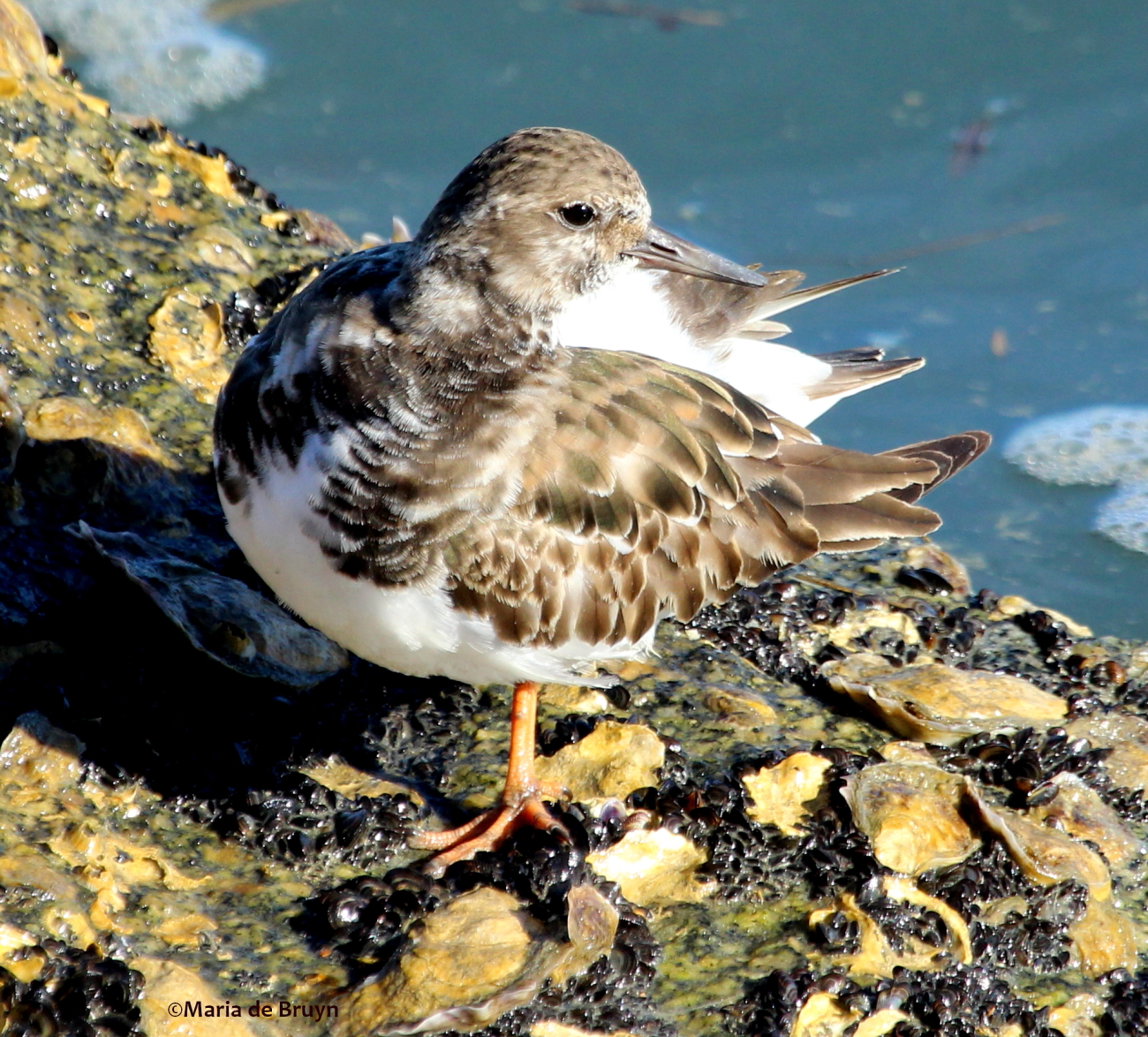
ruddy turnstone IMG_8605©Maria de Bruyn resOne of my favorite shorebirds is the small sandpiper called a ruddy turnstone (Arenaria interpres). Their coloring is a mix of black, white and reddish colors, with adults being more brightly colored when mating and breeding.

These birds are very territorial during the breeding season; they recognize variations in plumage patterns and can identify individuals, which helps them chase away intruders into their territories. Pairs are monogamous when breeding and may mate for several years.

ruddy turnstone IMG_0329©Maria de Bruyn resruddy turnstone IMG_8596©Maria de Bruyn res

ruddy turnstone IMG_8651©Maria de Bruyn resWhen they fly, a stunning pattern is revealed in their spread wings, with striking white patches and bars.

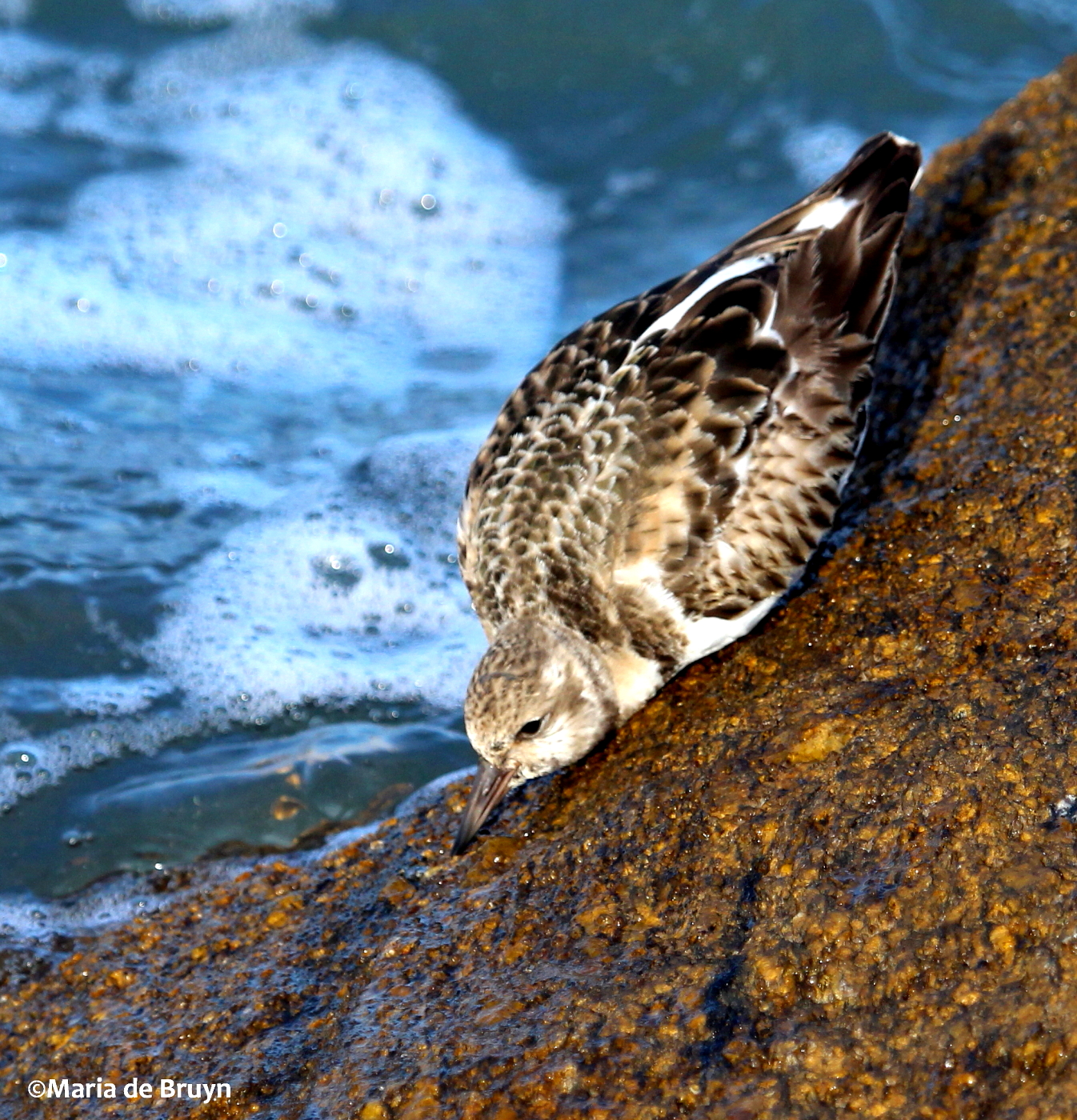
The name turnstone comes from the fact that the birds tend to turn over stones while foraging for insects, crustaceans, worms and mollusks. Several birds may cooperate to overturn larger rocks. This carnivorous diet is supplemented with moss, fruit and berries. Occasionally, the turnstones have also been seen to prey on the eggs of other birds but this behavior appears to be uncommon.

ruddy turnstone IMG_0337©Maria de Bruyn resruddy turnstone IMG_8654©Maria de Bruyn res

They search for their food on rocky outcroppings, among stones, in sand and the ground, inserting their bills into the earth or flipping over seaweed to find meals hidden there.

ruddy turnstone IMG_8629©Maria de Bruyn res ruddy turnstone IMG_8619©Maria de Bruyn res

ruddy turnstone IMG_8782©Maria de BruynThese small birds breed in Northern arctic and tundra regions and then migrate South in the winter, quite often returning to the same wintering grounds each year. Their chicks leave the nest within hours after hatching and abandon the nest within a day. It is the males who take on the major childrearing tasks, guarding the territorial perimeters and warning the female when predators (owls, merlins, gulls, foxes) are near. They also show the young fledglings where to find food after the females have left to pursue other activities.

Outside breeding season and during winter migration, the birds are quite sociable. They have been seen preening and grooming for long periods.

ruddy turnstone IMG_0284©Maria de Bruyn res ruddy turnstone IMG_0305©Maria de Bruyn res

ruddy turnstone IMG_0278©Maria de Bruyn resruddy turnstone IMG_0317©Maria de Bruyn resruddy turnstone IMG_0206©Maria de Bruyn res

The populations of ruddy turnstones are fairly stable and they are not threatened at this time – good news for the bird lovers among us!

Tundra swans, snow geese and Canada geese, too – beauty by the tens of thousands

Tundra swans IMG_8442©Maria de Bruyn

When the tundra swans (Cygnus columbianus) and snow geese (Chen caerulescens) leave the Arctic and sub-Arctic tundras and climes of northern North America to over-winter along the coasts of the United States, those of us who live further south get to enjoy the marvelous spectacle of tens of thousands of these birds gathering together. They appear in huge masses and smaller family groups to feed and then swirl through the skies in an aerial ballet as they settle down to feed again or spend the night in a marsh or on a lake or pond. Witnessing these enormous conglomerations of birds really is an unforgettable experience.

Tundra swans IMG_8440©Maria de BruynThe tundra swan – also known as the whistling swan in North America – is a large, graceful bird. Its diet is varied, ranging from aquatic plants and some molluscs (mostly during the summer) to seeds, grains and tubers like potatoes in the winter. In North Carolina, where they migrate during winter, you can find immense flocks foraging in open agricultural fields before they settle for the night (in winter, these birds sleep mostly on the water; during the breeding season, these monogamous birds sleep mainly on land).

tundra swan IMG_8676©Maria de Bruyn signed res

The adult swans are entirely white except for a black bill, while the immature birds are first a dusty gray color that eventually turns white; the young swans also have a pinkish bill.

Tundra swans IMG_6457©Maria de Bruyn signed res

During a birding trip to the Outer Banks of North Carolina, our Audubon group was privileged to witness the tundra swans returning to a lake in the Pocosin Lakes National Wildlife Refuge one night.

Tundra swans IMG_6446©Maria de Bruyn res

It was like watching a black wave moving back and forth across the orange sky at dusk, while being surrounded by a tremendous volume of honking (not whistling!). Afterwards, I and others regretted that we hadn’t thought to film this so we had a record of the sound. I think we were just so mesmerized that it didn’t occur to us to do that. Here you can hear what their calls are like. For us, it was impressive as we were listening to the sounds of a flock of about 20,000 strong! http://www.allaboutbirds.org/guide/tundra_swan/sounds

Tundra swans IMG_6439©Maria de Bruyn signed res

The snow goose, like the tundra swan, migrates in the winter to North Carolina from the uppermost parts of North America; like the swans, they forage in winter agricultural fields in large groups. There are two color variations: some are almost entirely white, while the “blue morph” variation has a white head but blue-gray body feathers. Our birding group was lucky to see another aerial ballet at Pocosin Lake National Wildlife Refuge put on by the snow geese.

Snow goose IMG_6334©Maria de Bruyn2 res

As a member of our group excitedly called, “They’re rising!” an enormous flock surged up from the lake, flew back and forth just a little and then settled.

Snow goose IMG_6330©Maria de Bruyn signed res

A minute later, they repeated the process and we watched as the swirling cloud rose and fell, just moving side to side a bit. They were very far across the lake from us, so it wasn’t possible to get great shots but at least I had evidence of the sighting!

Snow goose IMG_6341©Maria de Bruyn signed res

The other birds that we saw in some numbers were the more familiar Canadian geese (Branta canadensis). They are commonly seen in our area so it didn’t seem quite so special to spot them at the coast, but they passed by in flocks and beautiful formations that were well worth watching.

Canada goose IMG_5955©Maria de Bruyn signed resCanada goose IMG_6041©Maria de Bruyn res

Canada goose IMG_8306©Maria de Bruyn signed res 2These were the only geese that we were able to see up close a bit; here you see a pair at Lake Mattamuskeet National Wildlife Refuge.

I had seen starling murmurations before and was quite impressed with those. Witnessing the gigantic flocks of tundra swans and snow geese was equally fascinating – if you get a chance to see such large groups, do stop to watch them!