Birds and blooms at Sandy Creek Park – more of the “good ones”

moon I77A9993© Maria de Bruyn res

Birds are a favorite photographic subject of mine, even though catching them in late spring and summer is challenging when the lush foliage offers them many places to hide. Their songs and calls and warbles tell me that they are there, but often I need to wait quite a while until I finally catch a flutter of movement out of the corner of my eye to locate them.


white-eyed vireo I77A0007©Maria de Bruyn

One early morning, when the moon was still in the sky, I was fortunate enough to see a lot of fluttering in trees near the park’s parking lot – and I discovered an immature white-eyed vireo (Vireo griseus) with a parent who looked as if she or he was really practicing forbearance.

white-eyed vireo I77A0010©Maria de Bruyn      white-eyed vireo I77A0006©Maria de Bruyn

Carolina wren I77A0188©Maria de Bruyn res

Nearby, a Carolina wren (Thryothorus ludovicianus) was singing loudly; these little avians have an outsized voice so that you can hardly miss them even when they are hidden behind leaves.

A handsome male goldfinch (Spinus tristis) was in a field, while a female was visiting the coneflowers (Echinacea), of which there were various species in the cultivated butterfly garden.


American goldfinch I77A0382©Maria de Bruyn res American goldfinch I77A0177©Maria de Bruyn res

coneflower I77A7325© Maria de Bruyn res      coneflower I77A6365© Maria de Bruyn res   coneflower I77A6250© Maria de Bruyn res

Eastern bluebird I77A6188© Maria de Bruyn res


Other birds were busy finding insect meals, like the male, female and immature Eastern bluebirds (Sialia sialis).


Eastern bluebird I77A6022© Maria de Bruyn res    Eastern bluebird I77A5558© Maria de Bruyn res

Common grackle I77A6377© Maria de Bruyn res


The common grackle (Quiscalus quiscula) scored a meal, while the pine warbler (Setophaga pinus) and blue-gray gnatcatcher (Polioptila caerulea) were busy in the trees searching for caterpillars and insects.

Other birds (and mammals, I think) had been getting crayfish from the ponds but I guess there were so many that they only ate the tastiest parts.

Pine warbler I77A5605© Maria de Bruyn res   Pine warbler I77A5598© Maria de Bruyn


blue-gray gnatcatcher I77A0302©Maria de Bruyn res     crayfish IMG_4926©Maria de Bruyn res

The American robins (Turdus migratorius) were looking for earthworms on the ground, and the song sparrows (Melospiza melodia) alternated between the ground and shrubs in their search for food.

American robin IMG_0550© Maria de Bruyn res     song sparrow I77A6195© Maria de Bruyn

The male red-winged blackbirds (Agelaius phoeniceus) were calling and flying from shrub to shrub, showing off their handsome black plumage with a red highlight.

red-winged blackbird I77A6090© Maria de Bruyn res  red-winged blackbird I77A6126© Maria de Bruyn res

Over at a nearby pond, the Northern rough-winged swallows (Stelgidopteryx serripennis) were swooping over the water and then sharing space on a snag; meanwhile, a mother wood duck (Aix sponsa) led her brood along the shoreline.

rough-winged swallow I77A0234© Maria de Bruyn res    wood duck I77A7225© Maria de Bruyn

In a tree beside another pond, the immature great blue herons (Ardea herodias) were still at their nest at the start of June; later in the month, they were no longer hanging out there.

great blue heron IMG_0430© Maria de Bruyn res   great blue heron IMG_0402© Maria de Bruyn res

milkweed I77A0079©Maria de Bruyn res


Botanists can have a great time at Sandy Creek, too. The milkweed plants in the butterfly garden attract both butterflies and bees.

Carolina horsenettles (Solanum carolinense) are common but pretty little plants, while the orange jewelweed (Impatiens capensis) enjoys a good reputation as having stem juice that relieves the pain caused by poison ivy for many people.

Carolina horsenettle I77A5581© Maria de Bruyn res      orange jewelweed I77A0511© Maria de Bruyn res

The fairywand (Chamaelirium luteum) grows profusely on the edges of Sandy Creek ponds and the swamp rose (Rosa palustris) sprouts near them as well.

fairywand I77A7293© Maria de Bruyn res      swamp rose Rosa palustris I77A5621© Maria de Bruyn res

Japanese honeysuckle I77A5711© Maria de Bruyn res


Japanese honeysuckle (Lonicera japonica), an invasive plant, attracts pollinators but so does the more vibrant and native coral honeysuckle (Lonicera sempervirens L.).


coral honeysuckle I77A0159© Maria de Bruyn res      coral honeysuckle I77A0127© Maria de Bruyn 2 res

In the fields, you can see lovely brown-eyed Susans (Rudbeckia) and coreopsis.

Brown-eyed Susan IMG_0504© Maria de Bruyn res  brown-eyed Susan IMG_0497© Maria de Bruyn res


coreopsis flower IMG_0494© Maria de Bruyn res   coreopsis flower IMG_0486© Maria de Bruyn res

Stoke's aster I77A6353© Maria de Bruyn resThe cultivated garden in the park gets plenty of color from the Stoke’s asters (Stokesia laevis) and red bee balm (Monarda didyma), which is a real magnet for hummingbirds. I recently bought a couple for my home garden and was rewarded with seeing the hummers visit them within 2 days.


red bee balm I77A7307© Maria de Bruyn res    red bee balm I77A6390© Maria de Bruyn res

What makes my walks so interesting is discovering new species. A native grass (Bromus) was lovely; helpful facebook group members gave me suggestions for possible species but we couldn’t narrow it down. The group also helped me identify a plant that I hadn’t seen before, a Germander (Teucrium canadense).

grass Bromus IMG_4811© Maria de Bruyn res   Germander Teucrium canadense I77A0544© Maria de Bruyn res

I managed to find an ID myself for a common flower that seems to grow all over the place – the Asiatic dayflower (Commelina communis). It is considered an invasive plant and is on the watch list for North Carolina, but I have to say that I find it quite attractive. Each flower blooms for only one day and to me they look like little faces and make me smile. And so I continue learning as each new walk invariably ends up teaching me something new. Enjoy your day!

Asiatic dayflower Commelina communis I77A0667© Maria de Bruyn res    Asiatic dayflower I77A0677© Maria de Bruyn res

See anything good?

Sandy Creek path IMG_4981© Maria de Bruyn resThat’s a common question I get when I am out on one of my nature walks. Since I carry a camera with a large zoom lens and often a smaller camera, too, it’s obvious to passersby that I’m out observing nature. And I realize that when they ask the question, what they really want to know is whether I saw anything unusual or spectacular.

A recent walk at Sandy Creek Park in Durham, NC, was a case in point. I told one couple who posed the question that my most memorable sighting so far had been a male ebony jewelwing damselfly (Calopteryx maculata) – the iridescence of its body and wings in the sunlight was wonderful. They smiled a bit uncertainly and the lady of the pair admitted that she didn’t know anything about damselflies as they walked on.

ebony jewelwing I77A0417© Maria de Bruyn res   ebony jewelwing I77A0469© Maria de Bruyn res

Fragile Forktail damselfly I77A0648© Maria de Bruyn resAn hour or so later, another couple asked if I had “seen any good ones?” I repeated my delight in seeing the male damselfly, adding that the female is not as striking with her brown color and white spots. “Yes,” said the man, “that is often the case with other species. In our species, though, it’s the females who shine.” That may be the case some of the time, but my day was made by seeing a female damselfly that was a member of a new species for me – the fragile forktail (Ischnura posita).


My experience is that I find some beauty in almost all the wildlife I see (ticks and chiggers are an exception). So I want to share a few of those “good things” I saw at Sandy Creek Park last month in a two-part blog “tour”. In this first part, I’ll continue on with the insects.

Identifying dragonflies is not easy since the females and males can look quite different. The great blue skimmer (Libellula vibrans) provides an example – the male lives up to his name with a blue hue and large size, but the female shows off her beauty with a brown and yellow abdomen.

great blue skimmer dragonfly I77A0715© Maria de Bruyn res    great blue skimmer dragonfly I77A0741© Maria de Bruyn res

The Eastern pondhawk (Erythemis simplicicollis) has distinctively different appearances as a male and female. The adult male is a blue individual, sometimes with a bit of greenish tint; the female – and the immature males! – is brilliant with different shades of green. I remember being excited when I first spotted a female as their green color is so striking.

Eastern pondhawk I77A0721© Maria de Bruyn res  Eastern pondhawk I77A0749© Maria de Bruyn res

blue dasher I77A0172©Maria de Bruyn resThe blue dasher dragonfly (Pachydiplax longipennis) has some stripes, as do some of the bumble bees. The brown-belted bumble bee (Bombus griseocollis) lives up to its name with a brown stripe, while this American bumble bee (Bombus pensylvanicus) feeding on a trumpet vine (Campsis radicans) has white bands. Like honey bees, the latter bee has pollen baskets (corbicula) on its hind legs in which it stores pollen. I enjoyed watching this individual – s/he would dip down into the flower, back up a bit, and then plunge forward again, almost always keeping the pollen basket above the tip of the flower.

Brown-belted bumble bee I77A0218©Maria de Bruyn res   American bumble bee I77A0763© Maria de Bruyn2 res

Bumble bee I77A6297© Maria de Bruyn res


The pollen gatherers were numerous during both visits and willing to share the sources of their bounty – here you see a bumble bee (Bombus), syrphid fly (Toxomerus marginatus) and sweat bee (Halictus) feeding peacefully together on a coneflower (Echinacea).


Eastern carpenter bee IMG_0768© Maria de Bruyn res


The milkweed plants were attracting many species of pollinators; here an Eastern carpenter bee (Xylocopa virginica) was enjoying a meal.


common buckeye I77A0237© Maria de Bruyn res


While there were many, many bees the days of my visits, there were fewer butterflies but the common buckeye (Junonia coenia) was stunning!


The little wood satyr (Megisto cymela) and dun skipper (Euphyes vestris, to the lower right on the milkweed) were not as colorful, and some people might even call them dull, but they are still nice to see and the Eusarca moth (Eusarca confusaria) was also an evenly colored beauty. I had grown up thinking moths usually fly at night, attracted by lights so it still draws my attention when I see them in the daytime.

Little wood satyr I77A0584© Maria de Bruyn res         Eastern carpenter bee IMG_0804© Maria de Bruyn 2 res

Confused Eusarca moth Eusarca confusaria I77A5701© Maria de Bruyn

Even a somewhat tattered American lady (Vanessa virginiensis) offered a pretty view.

American lady I77A6238© Maria de Bruyn res

The broad-headed sharpshooter (Oncometopia orbona), a leaf hopper, and the spotted pink lady beetle (Coleomegilla maculata) are tiny but such colorful insects that close perusal of the vegetation helps you spot them (and presumably makes it easier for birds to see them, too?).

broad-headed sharpshooter Oncometopia orbona I77A0592© Maria de Bruyn      Spotted pink lady beetle I77A0081©Maria de Bruyn bg

Emerald ash borer trap I77A0719© Maria de Bruyn res


One beetle that we don’t really want to see is the emerald ash borer (Agrilus planipennis), an invasive species that came to the USA from Asia. The larvae of these beetles kill ash trees and the park administrators have hung a trap box for them to determine whether this species has reached the park.


Spotting mammals is not always easy at the park but one day fellow birder Jim was kind enough to alert me to an opossum (Didelphis virginiana) in a tree when we met on a walking path. He told me approximately where it was and I spotted that one and another in a nearby tree; I thought it might be a mother and grown offspring but that was a guess and I certainly couldn’t confirm it. As these are nocturnal animals, it was pretty cool for me to see two in broad daylight. The only marsupial found in the United States and Canada is a beneficial animal for us humans (and other wildlife) as they could eat up to 4000 ticks in a week! 

opossum IMG_0605© Maria de Bruyn res     opossum I77A5788© Maria de Bruyn res

One of the pair demonstrated that they can open their jaws widely – watching him/her slowly stretch that mouth offered me a surprise; I would think it couldn’t go any further and the animal continued to show that s/he could really please a dentist who would like lots of space to investigate those teeth.

opossum I77A5897© Maria de Bruyn res

Eastern cottontail rabbitI77A5578© Maria de Bruyn res


The Eastern cottontail rabbit (Sylvilagus floridanus) was not so lucky, carrying a fat tick in its ear. Too bad the opossums couldn’t come by and groom him/her and remove that pesky arachnid!


The park is not only attractive for the entomologists. Reptile enthusiasts can spot turtles fairly easily, especially in the spring when they are looking for places to lay their eggs. A large painted turtle was crossing a field looking for a spot, while an Eastern mud turtle (Kinosternon subrubrum) was trundling down a paved path one morning, not far from a pond which often has many painted turtles and red-eared sliders (Trachemys scripta elegans), like this one – who must have been a bit bothered by a bird feather caught in its shell.

Eastern mud turtle IMG_0741© Maria de Bruyn res    Red-eared slider I77A5941© Maria de Bruyn2

Which bird could it have been? I’m thinking a swallow – see part 2 of the tour for a view of the species and more of the wonderful biodiversity that can be seen in the park.


Hummers haranguing – feistiness in small packages!

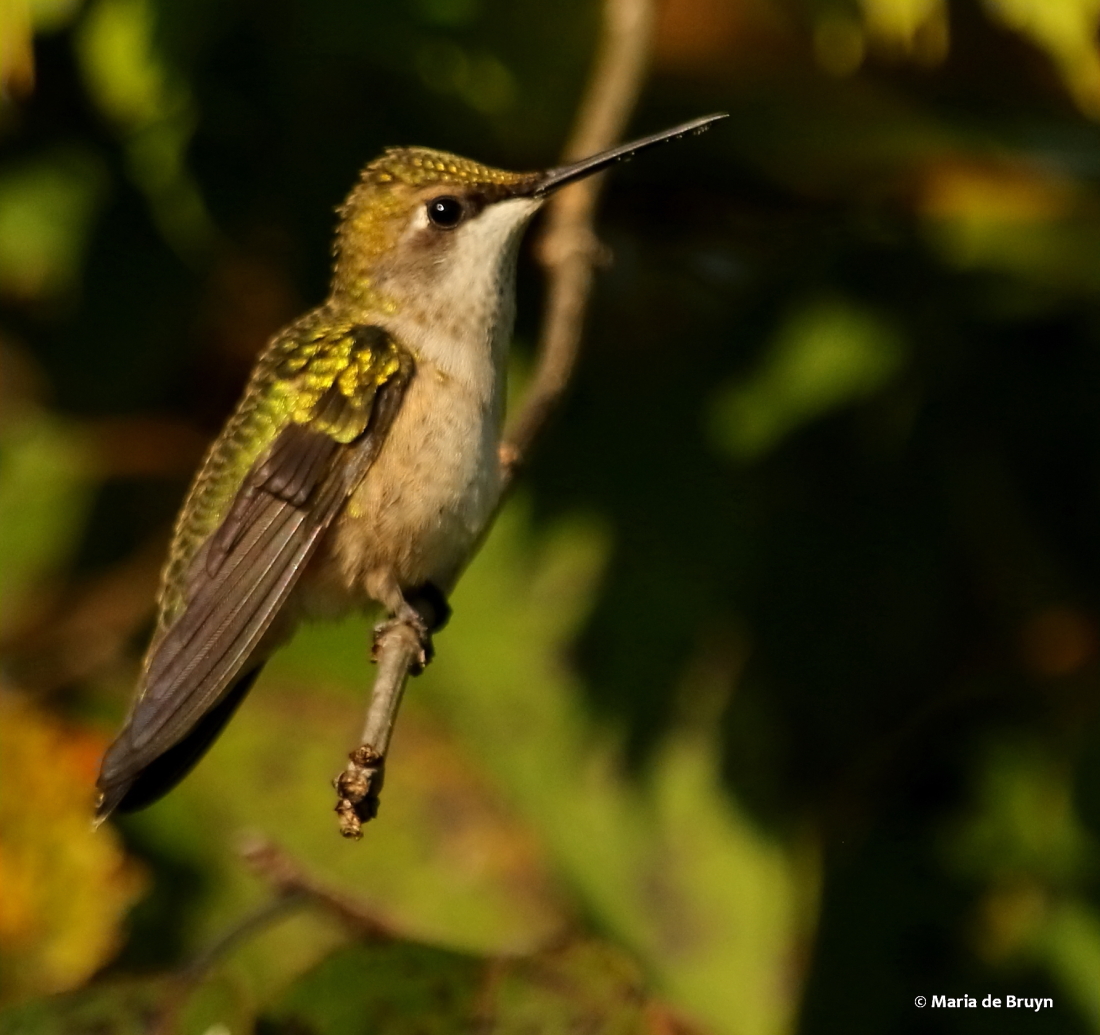
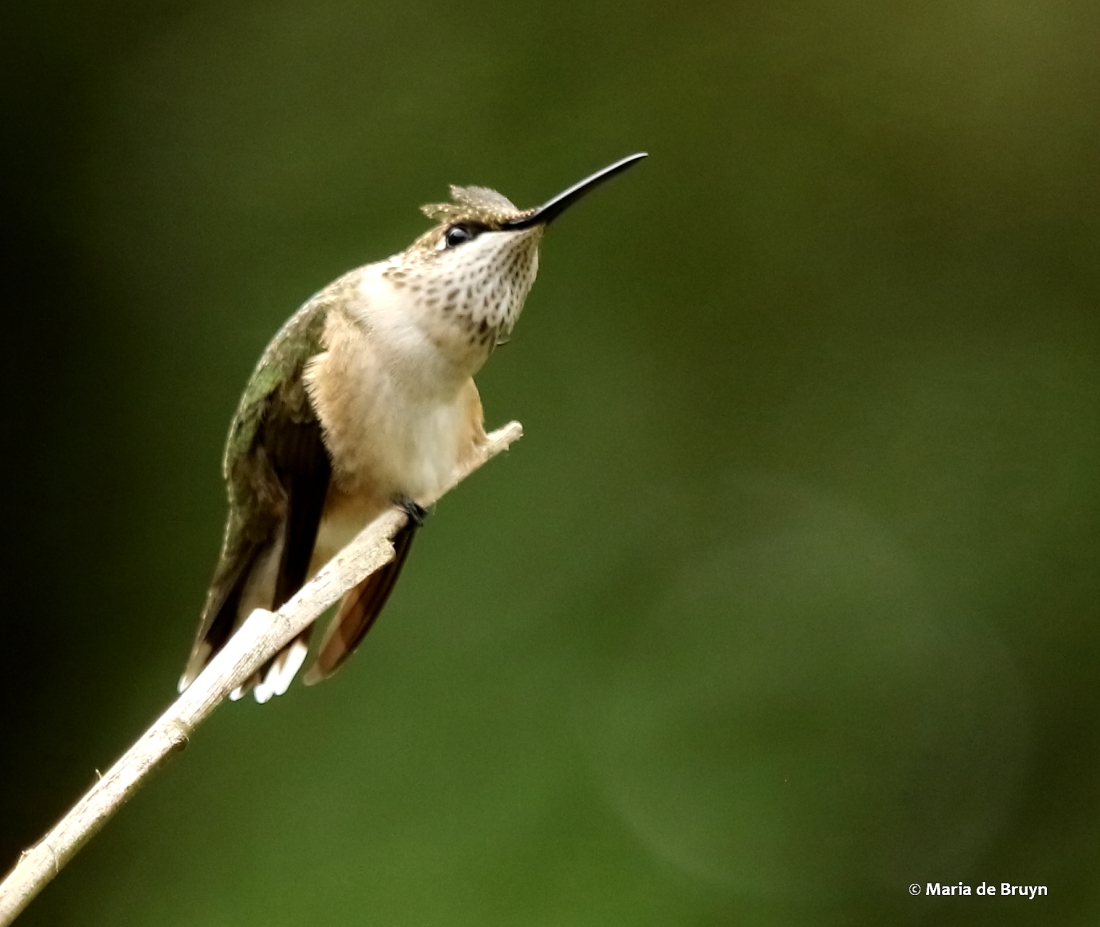
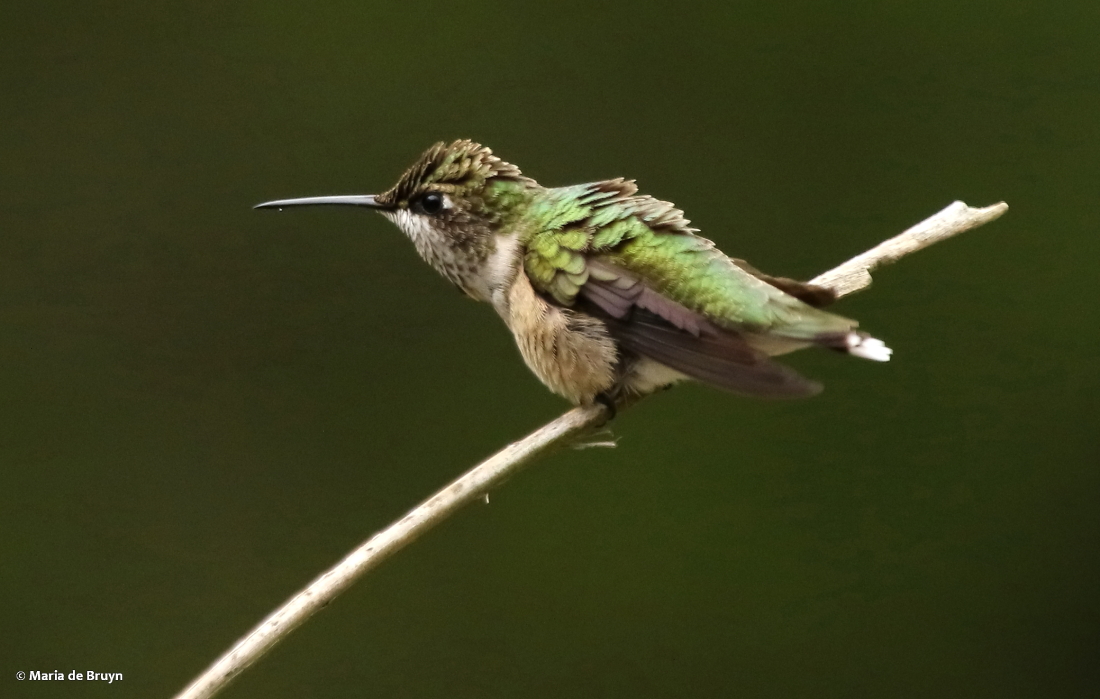
ruby-throated hummingbird DK7A0498© Maria de Bruyn (2) resAt times, we may see on Facebook or the Internet a photo or video of hummingbird nectar feeders surrounded by at least 6 and sometimes dozens of these small birds, sharing space as they take turns at imbibing some of the sweet water. Here in my part of North Carolina, however, it seems that the ruby-throated hummingbirds (Archilochus colubris) are just NOT interested in having their territory host family members or neighbors. This species is known for being territorial and those in my vicinity live up to that reputation for sure.

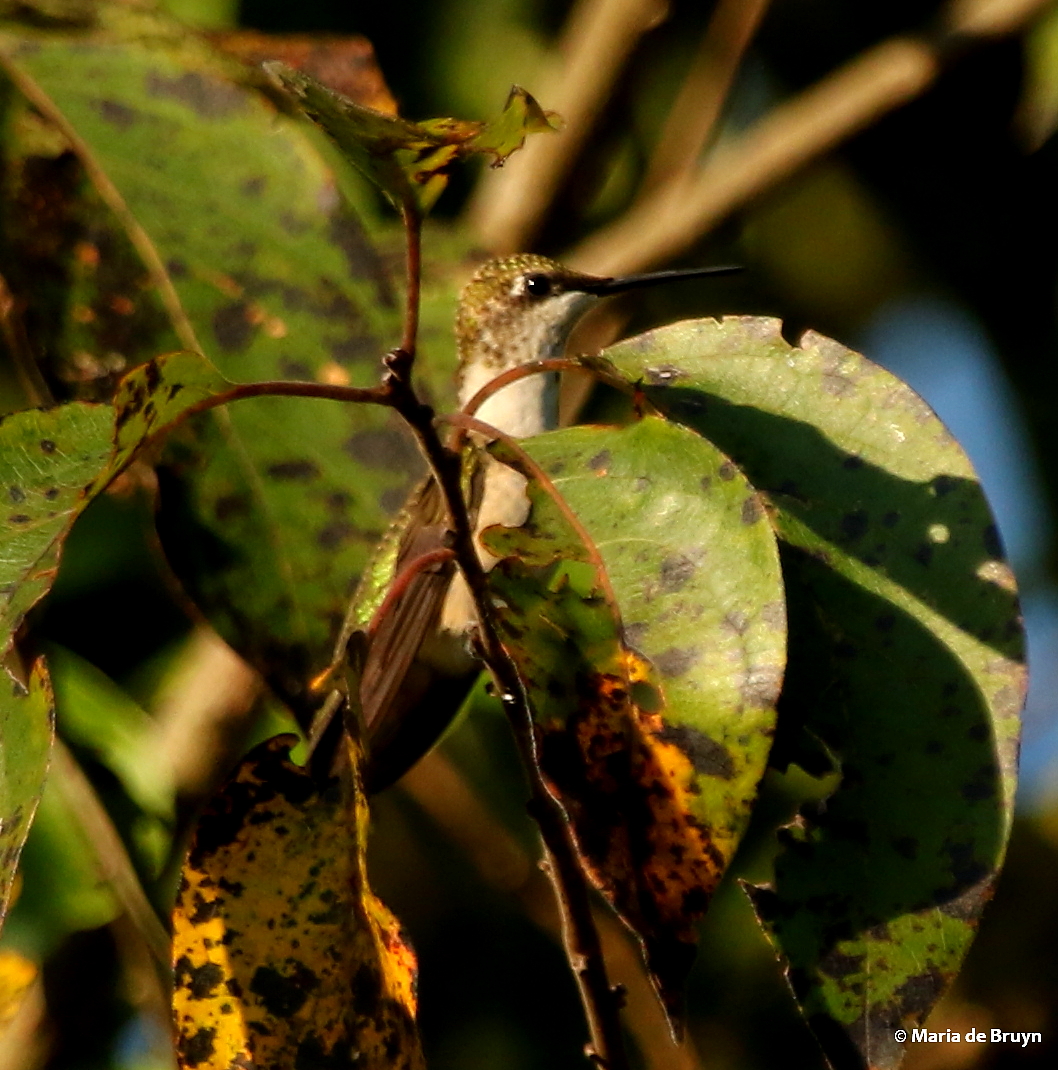
Both at home and in nature reserves, I’ve watched these tiny birds stake out a claim to a feeder or some choice blooms. They drink a little and then will take up a post on a vantage point where they can keep an eye out for other birds. Occasionally, the waiting spot is out in the open and often it is in a nearby shrub or tree.

ruby-throated hummingbird DK7A2402© Maria de Bruyn res ruby-throated hummingbird DK7A2298© Maria de Bruyn

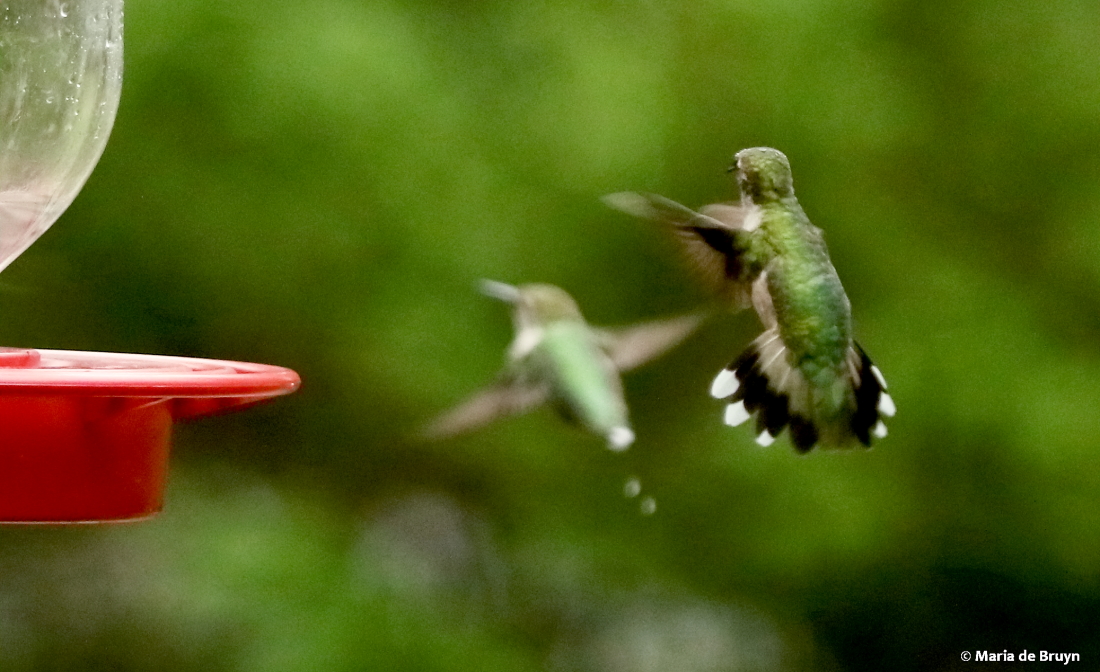
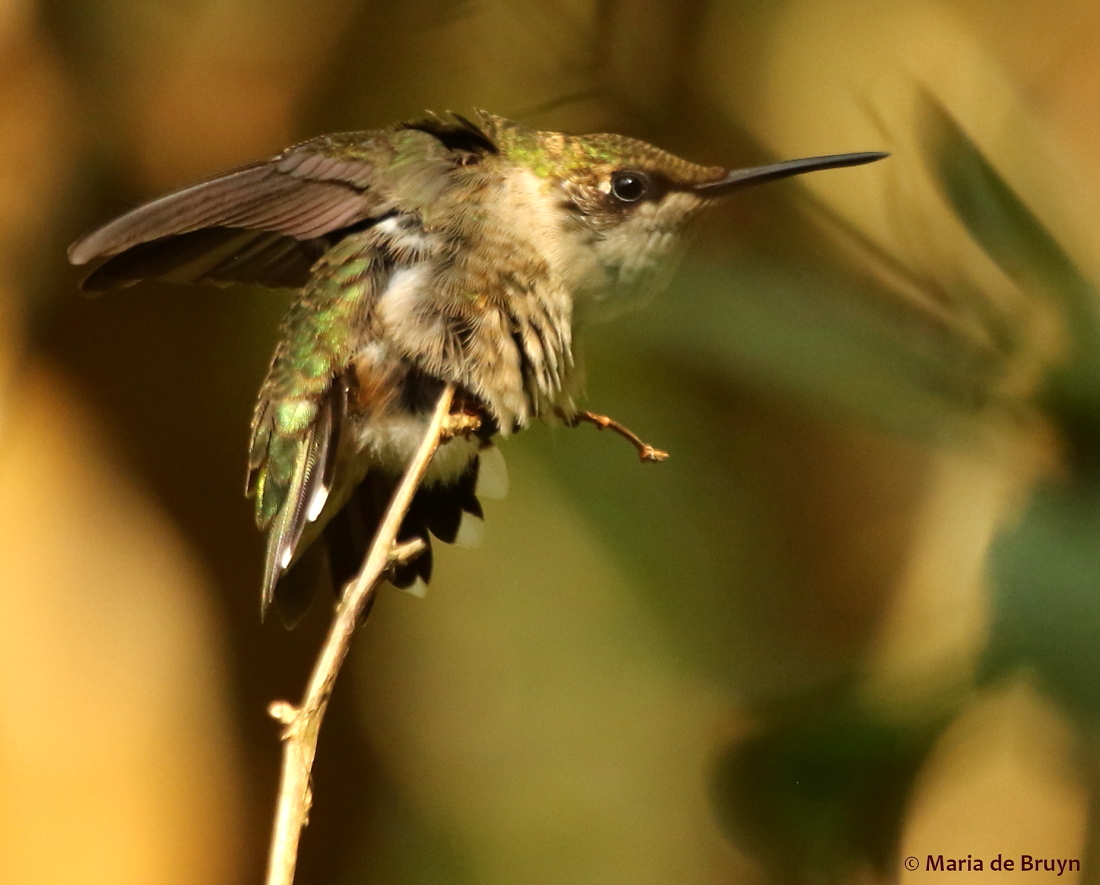
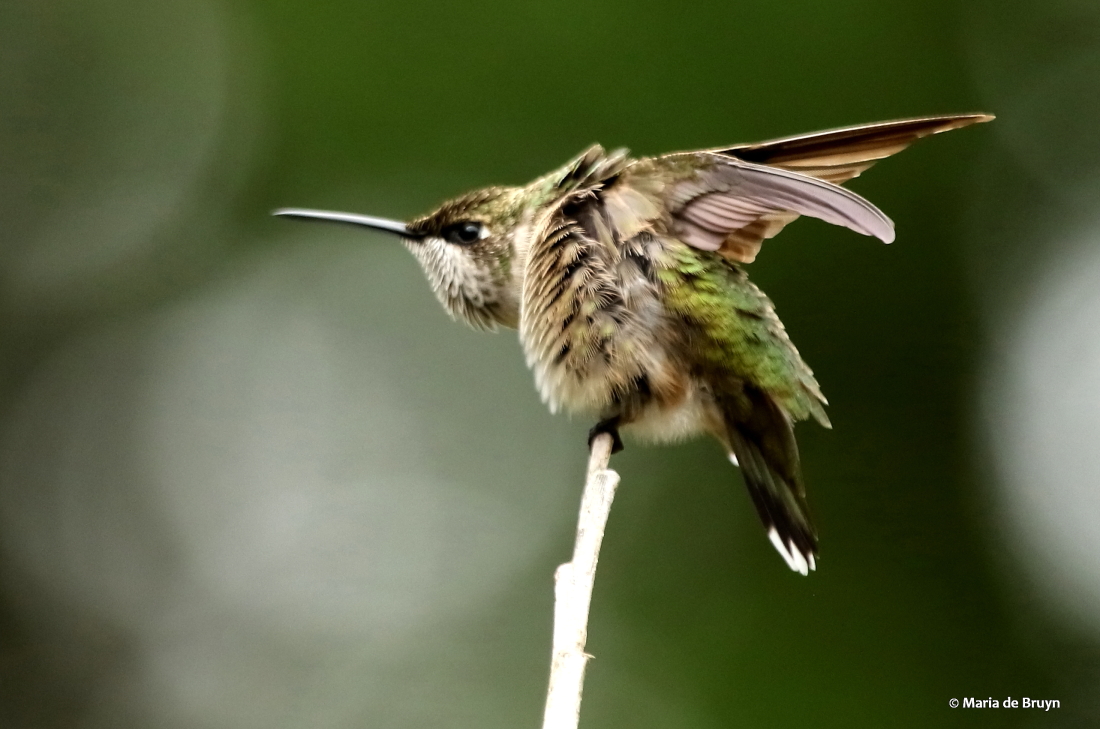
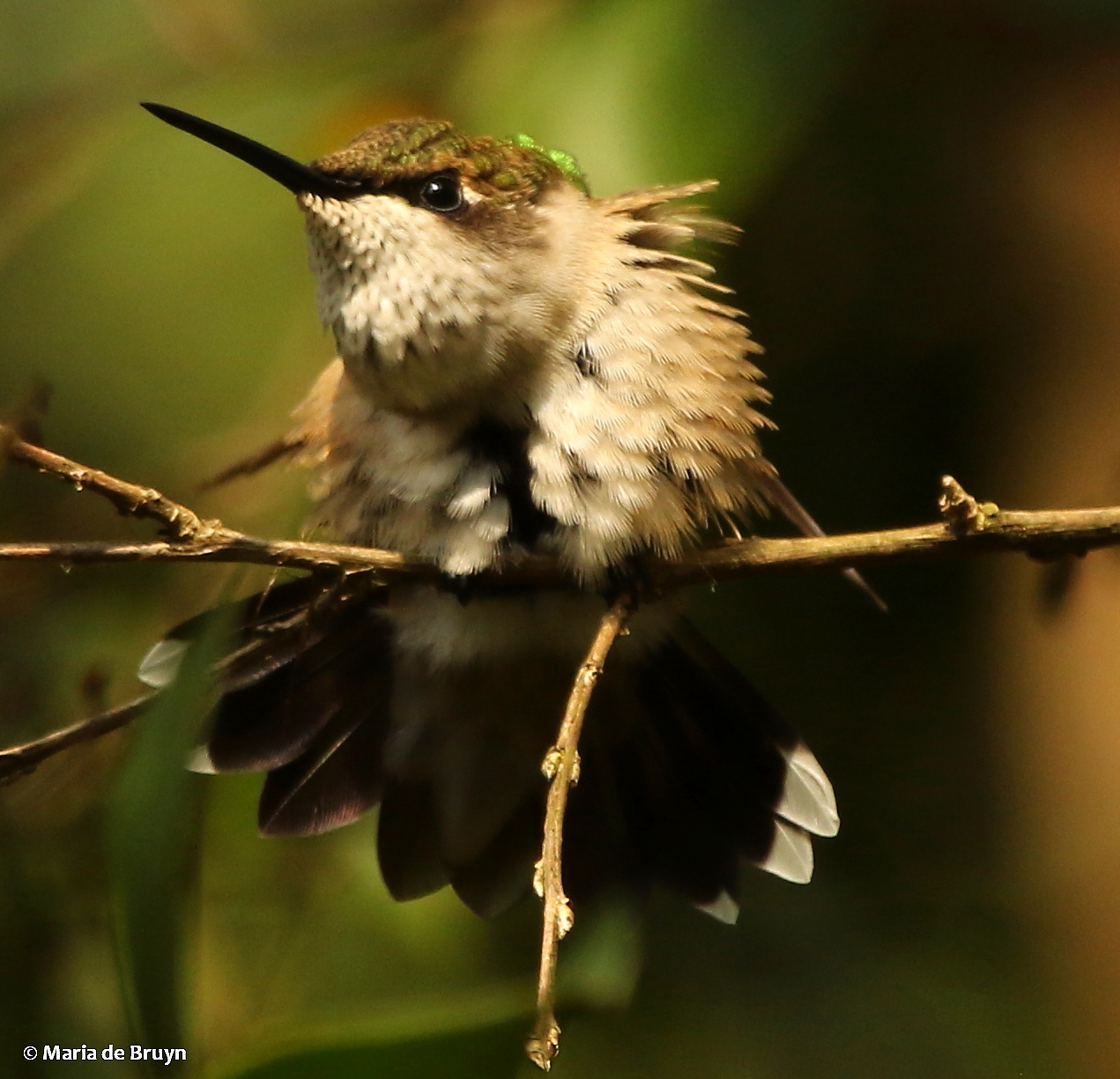
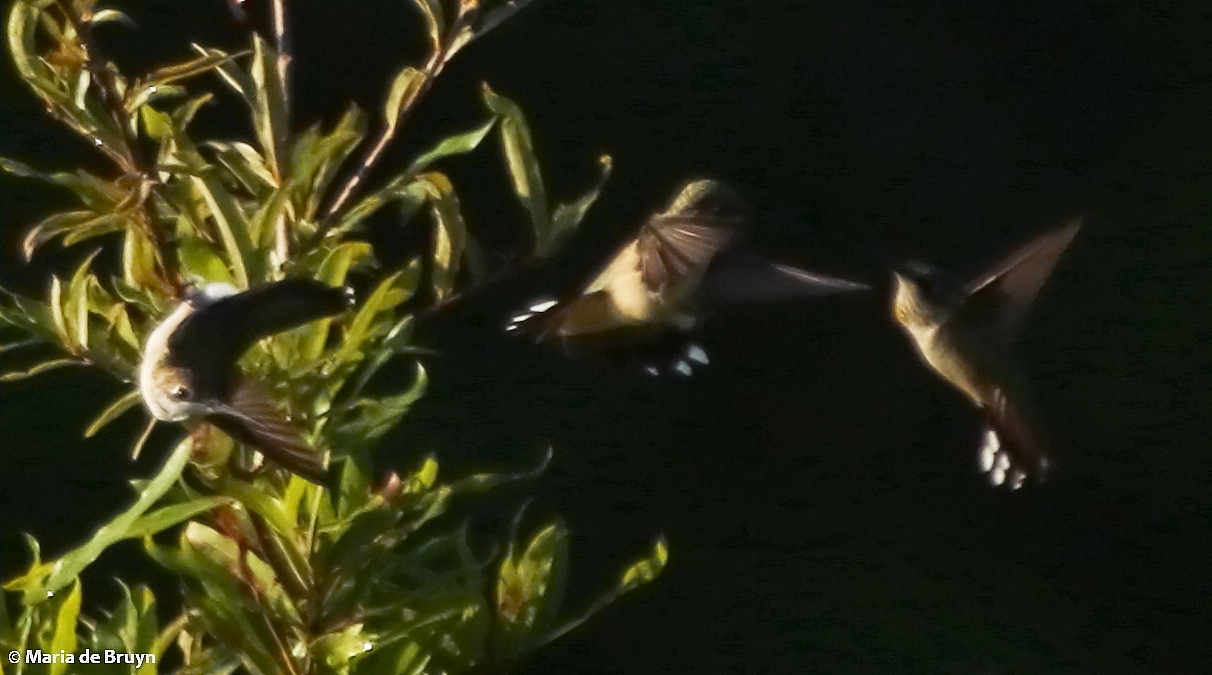
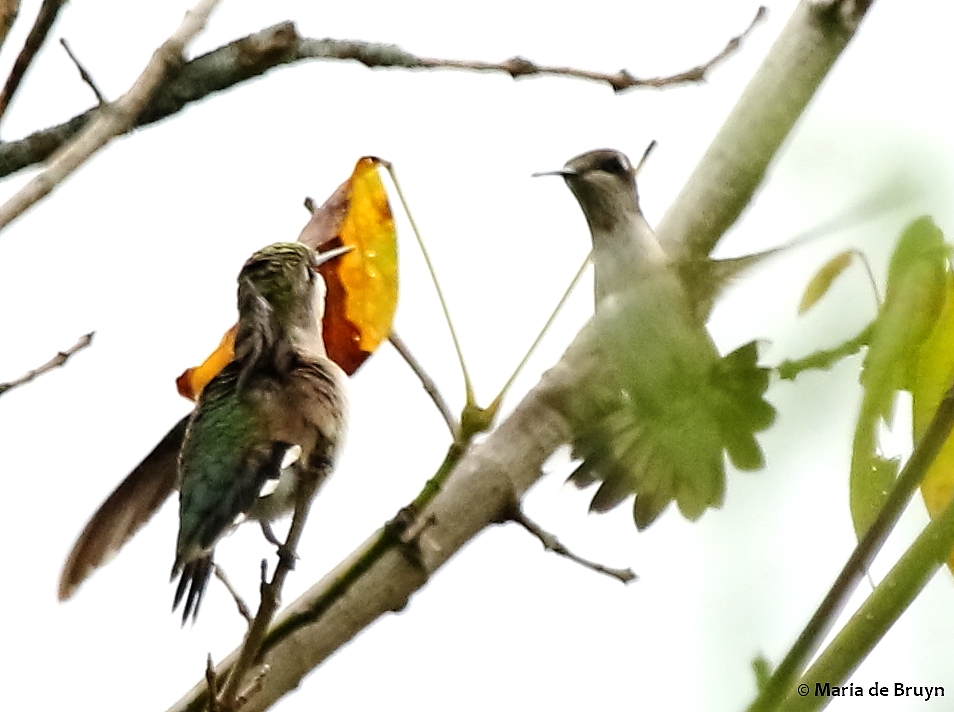
When they spot a rival approaching the food source, they may either immediately give chase or first engage in a threat display.

ruby-throated hummingbird DK7A2376© Maria de Bruyn resruby-throated hummingbird DK7A1568© Maria de Bruyn res

Their displays include both posturing and sound. To warn off other birds, they may chirp both quickly and loudly. Their threat postures aim to frighten away intruders by displaying size and strength and include pointing their long bills at the other bird(s), puffing up their throats, spreading and raising their wings, and flaring their tail feathers, .

ruby-throated hummingbird DK7A0712© Maria de Bruyn resruby-throated hummingbird DK7A0492© Maria de Bruyn res


ruby-throated hummingbird DK7A7307© Maria de Bruyn resruby-throated hummingbird DK7A0499© Maria de Bruyn res

ruby-throated hummingbird DK7A7353© Maria de Bruyn resruby-throated hummingbird DK7A7928© Maria de Bruyn

ruby-throated hummingbird DK7A2247© Maria de Bruyn resThey don’t really use their bills to battle as they need to protect this body part but they can fly into each other. On one occasion, in my front yard, I heard a loud thump when the two birds actually collided during a high-speed chase.

The drive to protect territory is not for lack of food. My yard has three nectar feeders out back and one in the front and three of them have at least four feeding holes. This year, a brightly colored male laid claim to the yard while the female was caring for her brood. When the female and young birds began coming to the feeders, “Red” was not pleased. Later, the young males also vied with one another.

ruby-throated hummingbird DK7A1562© Maria de Bruyn res

Chittering loudly, they sweep in to make the other birds take off; occasionally they do get a chance to have a short drink before another hummer shows up. At my house, the birds can feed because they have to patrol both the front and back yards and can’t be in two places at once.

ruby-throated hummingbird IMG_0379© Maria de Bruynruby-throated hummingbird DK7A0866© Maria de Bruyn res

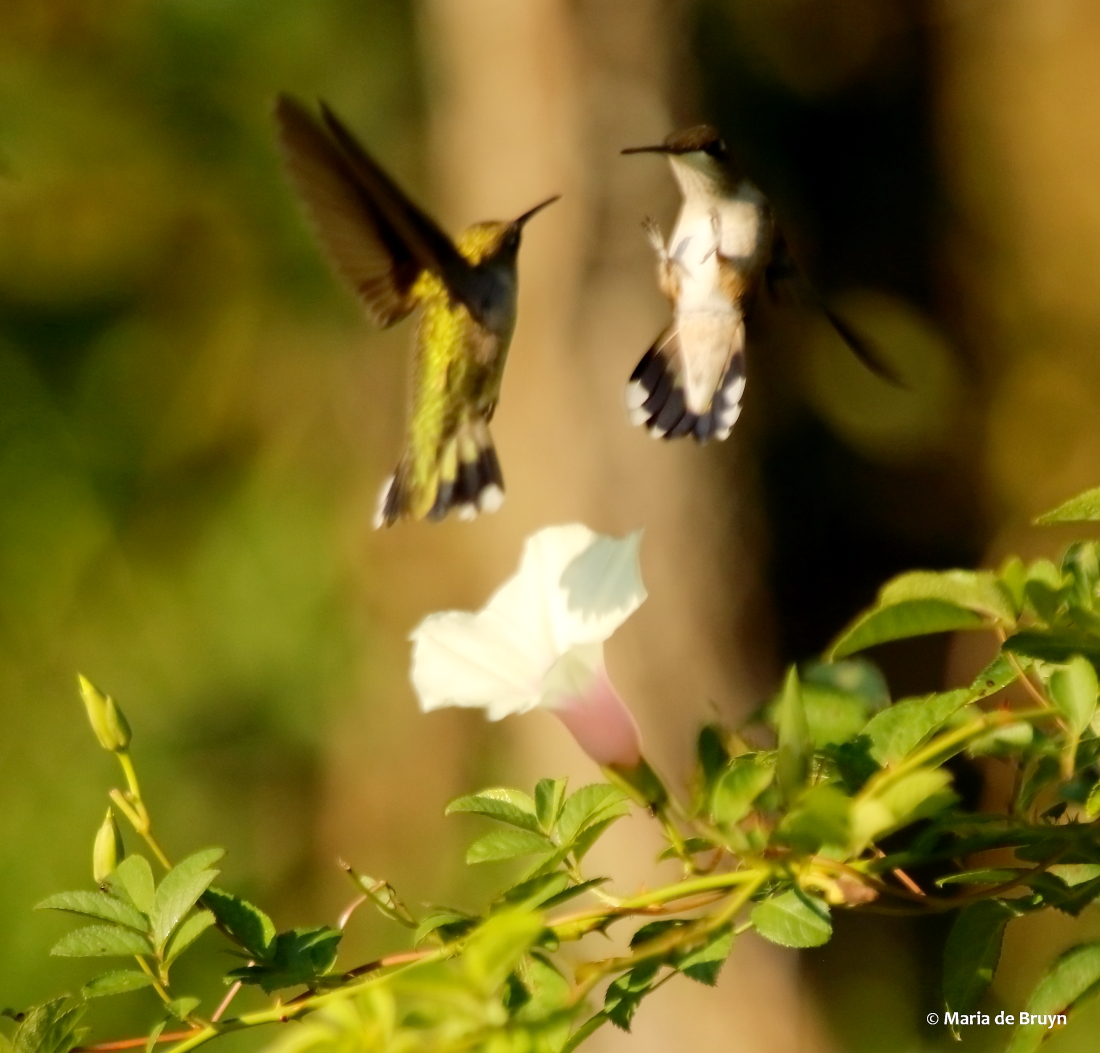
I witnessed a similar scenario at the Mason Farm Biological Reserve. There was a spot with plenty of blooming trumpet vines (Campsis radicans) and morning glories (Ipomoea pandurata), which were attracting a variety of pollinators. Three hummingbirds were also visiting and, again, chasing one another from the site as soon as they caught sight of their rivals.

ruby-throated hummingbird DK7A2117© Maria de Bruyn

ruby-throated hummingbird DK7A2116© Maria de Bruyn

In an area near the Haw River where many wildflowers bloom, a similar scenario took place.

ruby-throated hummingbird DK7A9401© Maria de Bruynruby-throated hummingbird DK7A9403© Maria de Bruyn

This is the time of year when the ruby-throated hummingbirds undertake their migration to Central America, a distance of at least 1000 miles. They need to store energy for this and may double their body mass while feeding during the preparatory phase. However, it seems to me that chasing away other birds from their preferred feeding sites must take an enormous amount of energy and it seems to be an endless activity. In my yard, it goes on all day long!

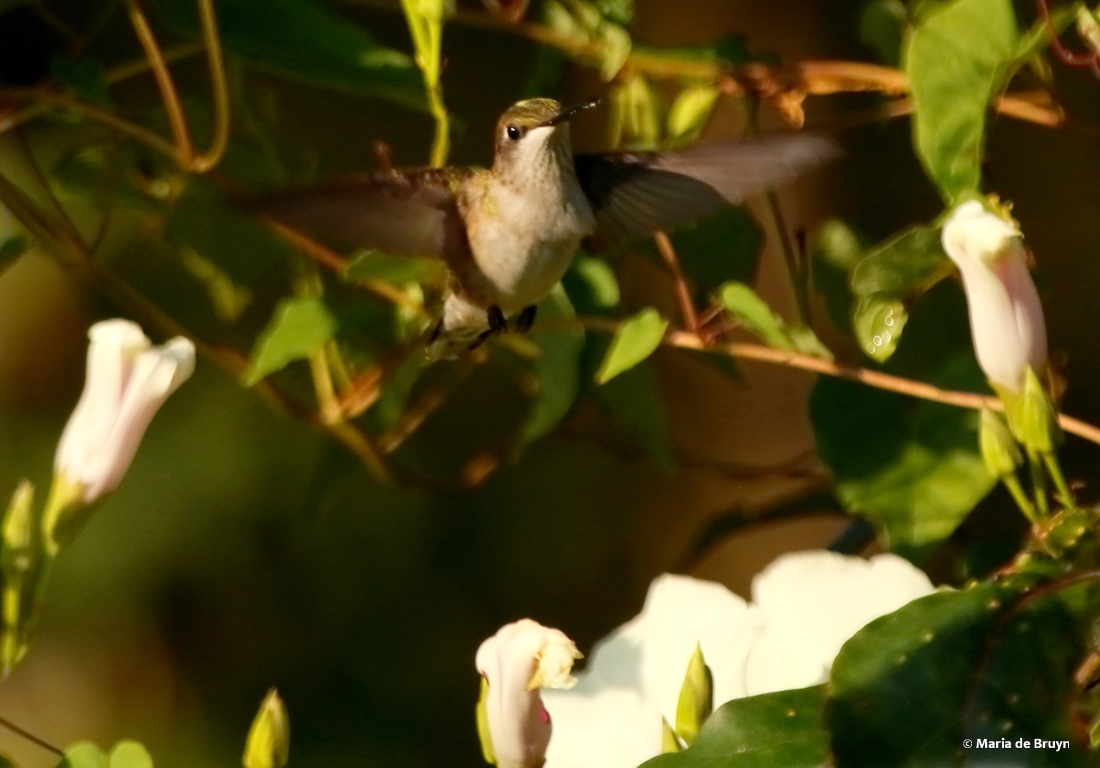
ruby-throated hummingbird DK7A1828© Maria de Bruyn resThese birds’ flight muscles take up 25% of their weight; when they rest, their hearts beat at a rate of 250 beats per minute but during flight, their hearts speed up to 1220, so the zipping back and forth and up and down in hot pursuits must use lots of calories and energy. They also may hover mid-air for a while rather than sitting on an outpost twig; the other day, one of Red’s rivals spent a quarter minute suspended about 18 inches from my face, looking me over until Red dive-bombed him.

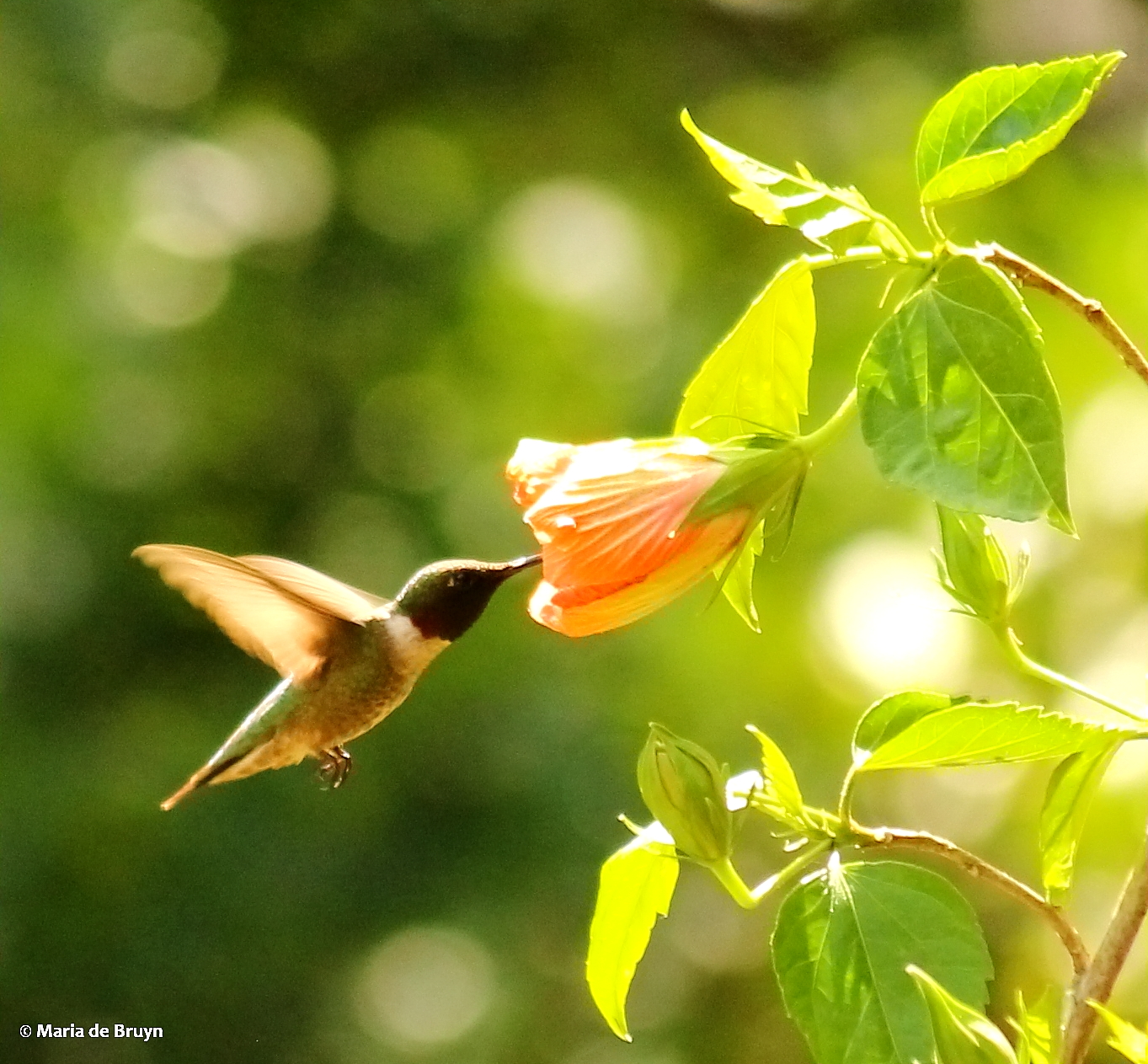
ruby-throated hummingbird DK7A2213© Maria de Bruyn resThis summer I’ve been lucky to see the hummers in several places, including Sandy Creek Park, near the Haw River and a farm cultivated by refugees from Myanmar. In all cases, the birds appeared unwilling to share their dining areas. Once in a while, though, one would have the space to him- or herself for a while and I could watch them feed, afterwards flicking out their long tongues.


ruby-throated hummingbird DK7A7940© Maria de Bruyn resruby-throated hummingbird DK7A0181© Maria de Bruyn res

When they return next year, I hope to learn more about these wonderful little birds through daily observation in my garden habitat.

ruby-throated hummingbird DK7A1673© Maria de Bruyn (2) res

More interesting information on ruby-throated hummingbirds can be found here:

http://www.rubythroat.org/rthufactsmain.html

http://www.allaboutbirds.org/guide/ruby-throated_hummingbird/lifehistory

http://www.worldofhummingbirds.com/behavior.php

A lucky, lucky day with monarch guardian angels!

Yesterday my day turned out quite differently from my modest expectations – it was very lucky and truly a day for gratitude.

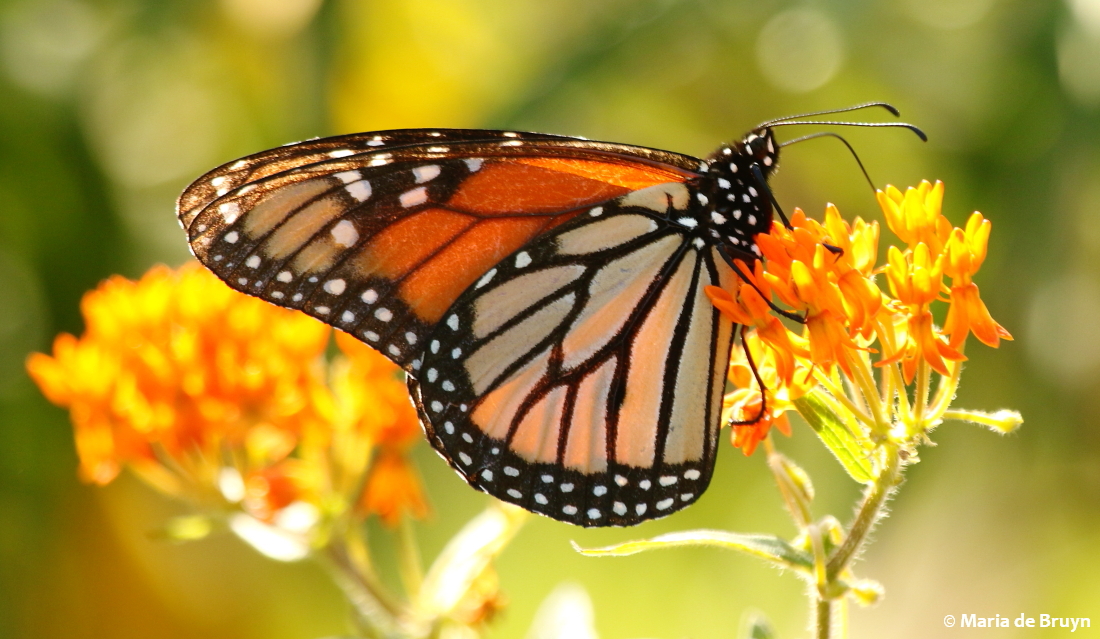
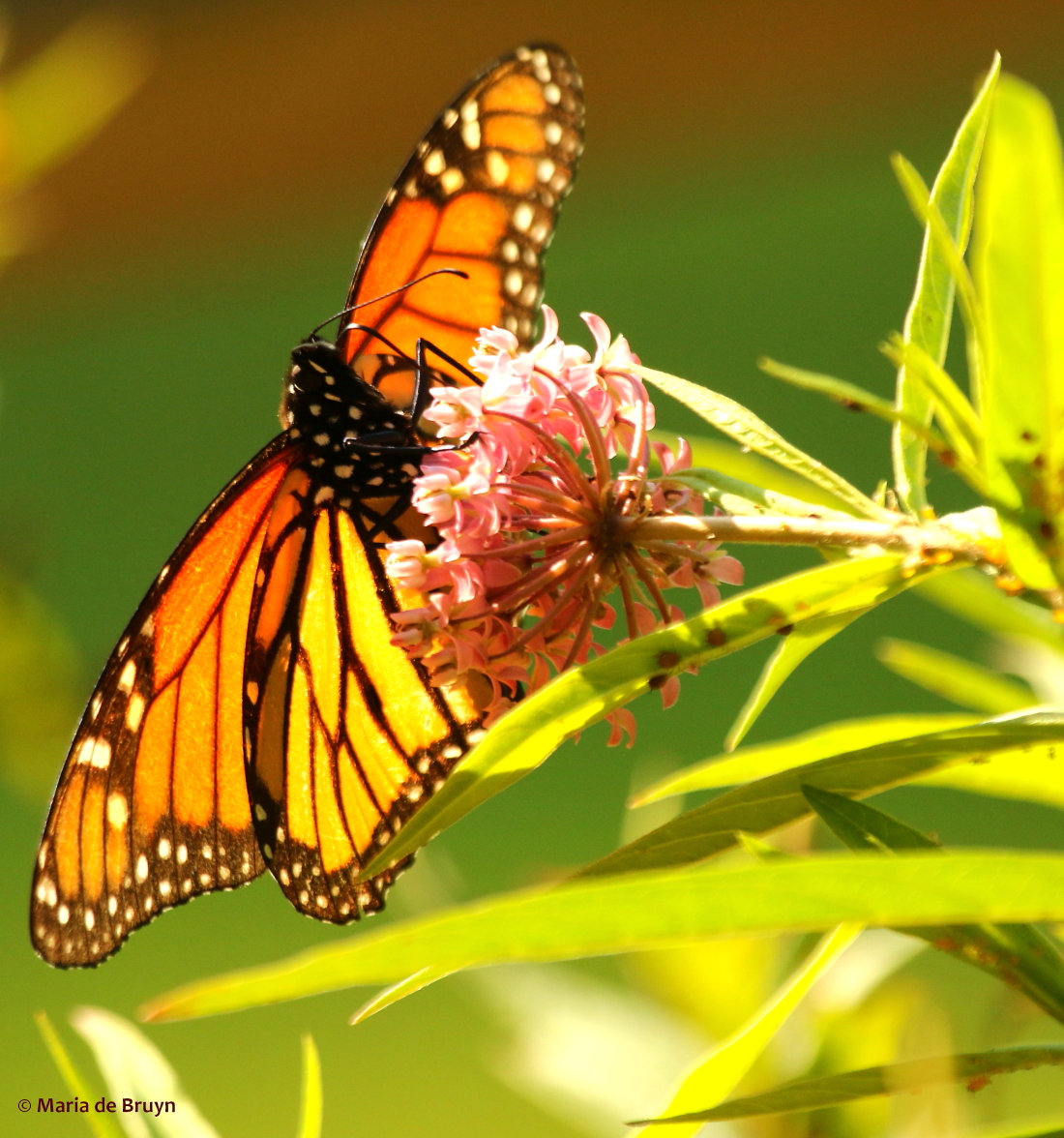
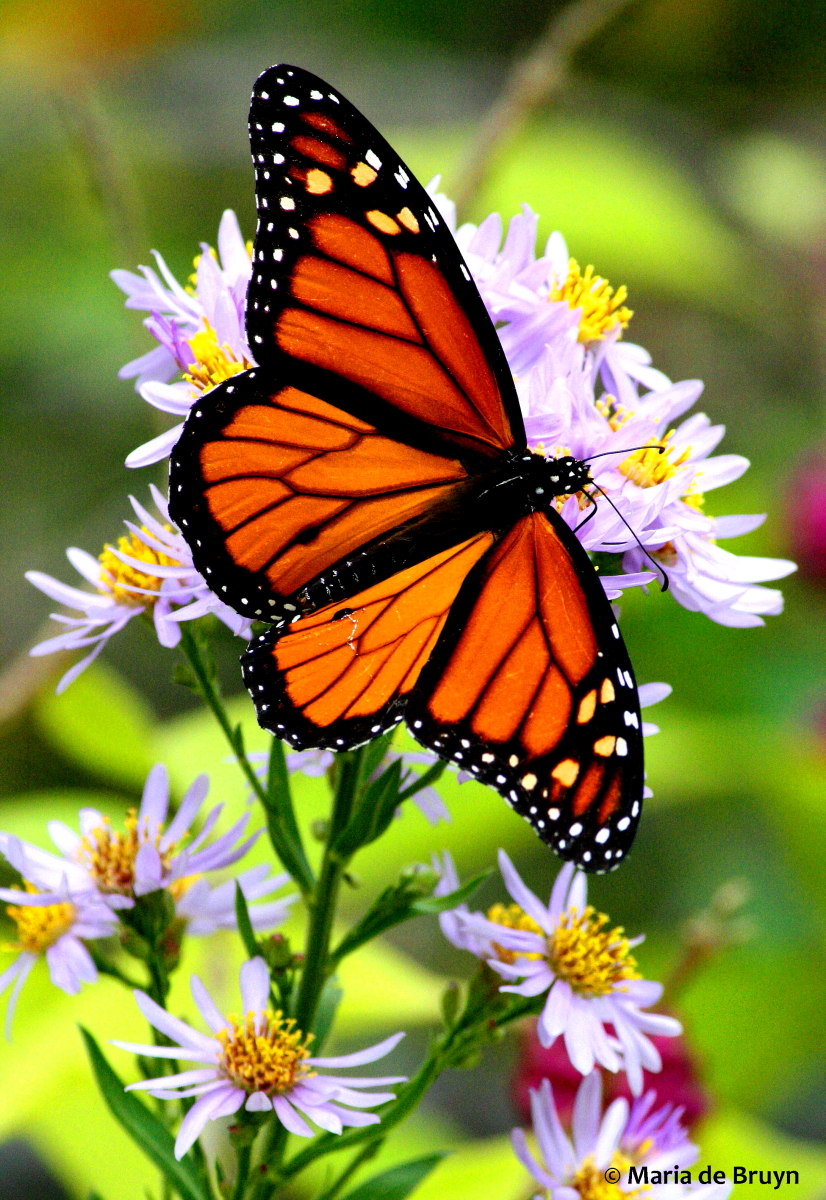
In mid-August, I had seen a female monarch butterfly (Danaus plexippus) at Sandy Creek Park, an exciting find and testimony to the usefulness of planting milkweed there. John Goebel, Sandy Creek patron, manager and care-taker extraordinaire, had planted about five types of milkweed in anticipation of welcoming these guests and it had paid off.

monarch DK7A7941© Maria de Bruyn res monarch DK7A7842© Maria de Bruyn res

A few days ago, on Facebook, the Friends of Sandy Creek Park group announced that the one male and two female monarch butterflies spotted in the butterfly garden had left behind quite a few offspring. As I had not seen a monarch caterpillar in person before, I took off early for the park, where I found three people assembled to count them.  John Goebel kindly told me something about the monarch life cycle.

monarch DK7A6427© Maria de Bruyn resmonarch DK7A6518© Maria de Bruyn res

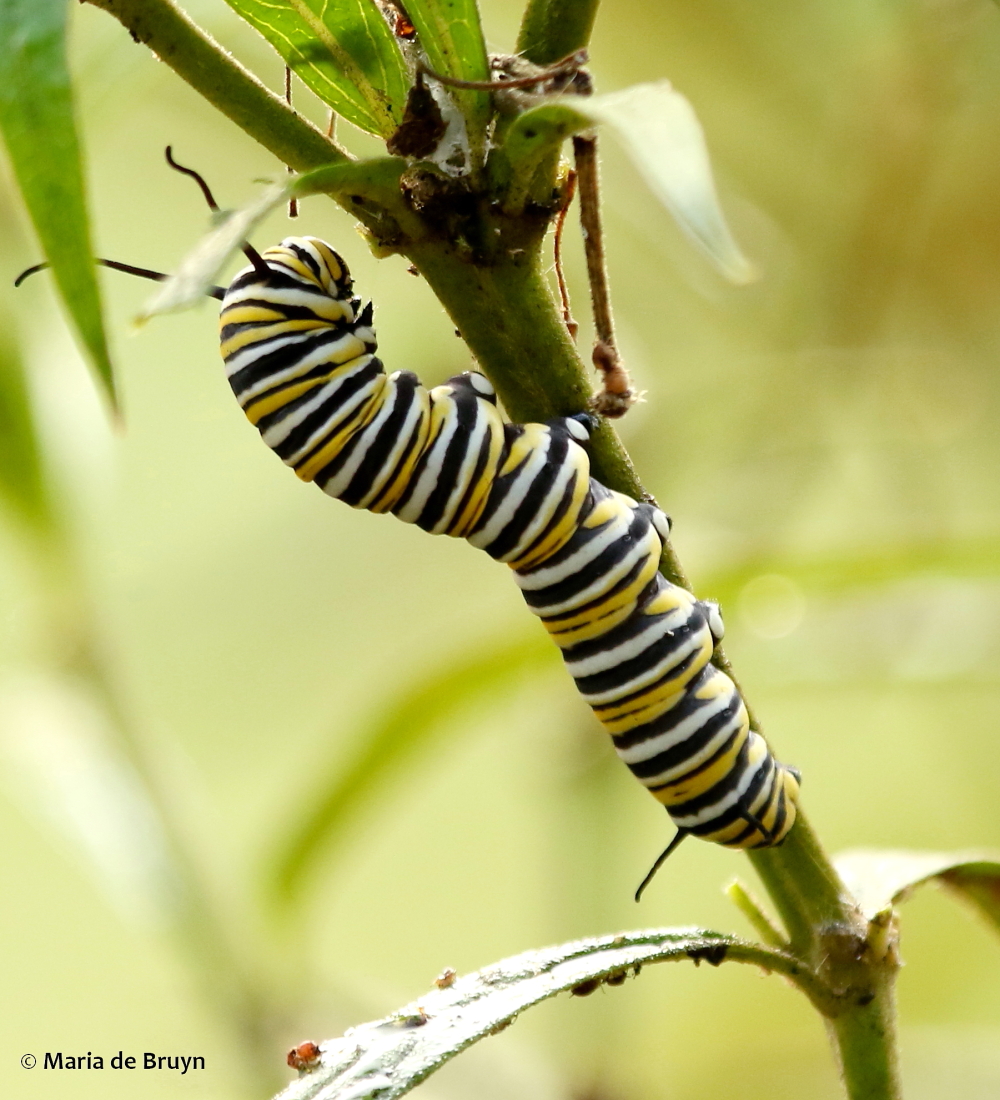
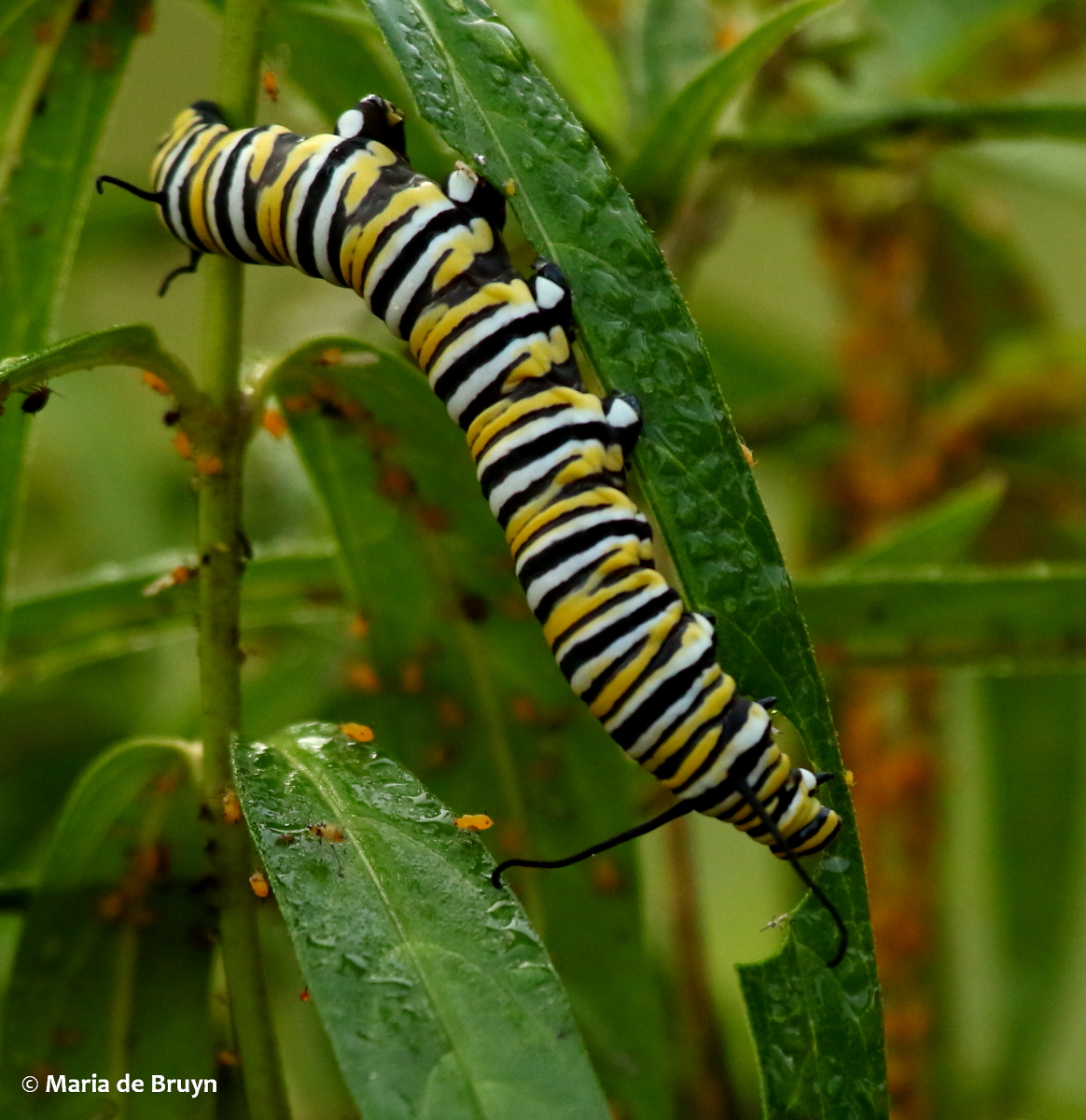
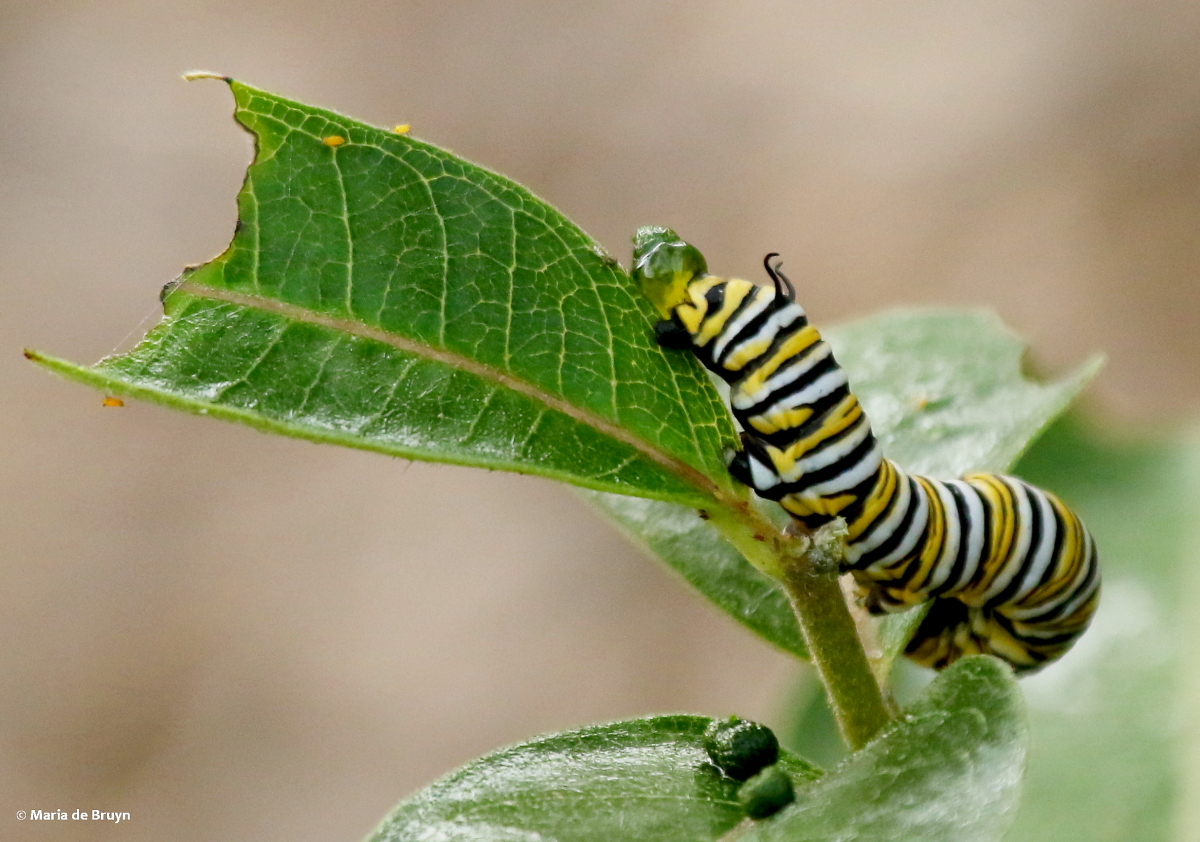
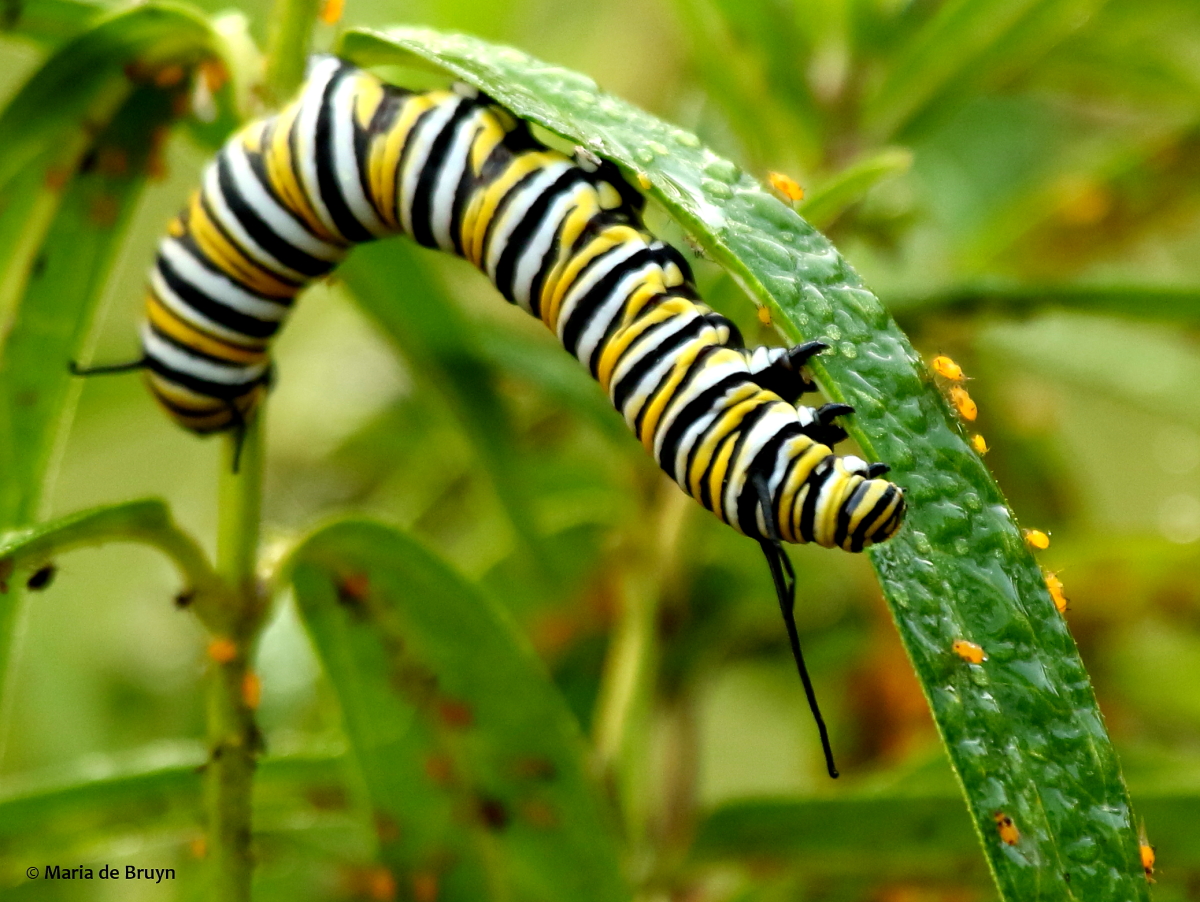
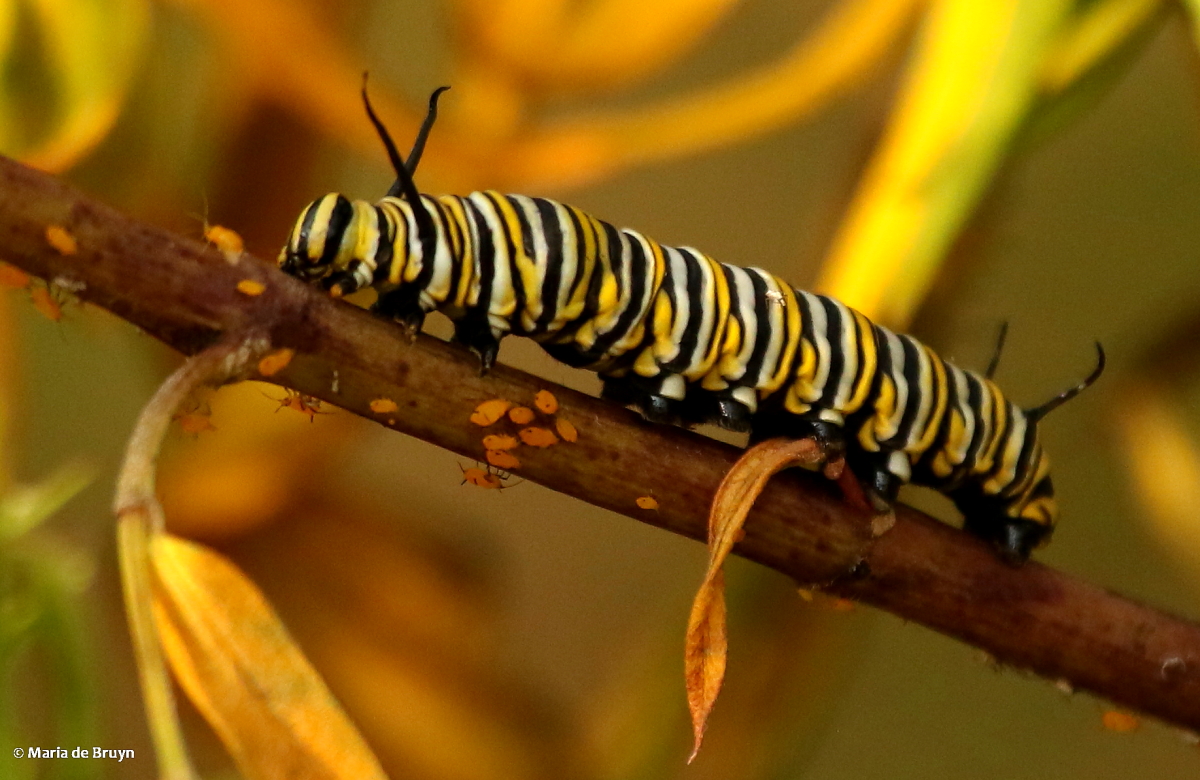
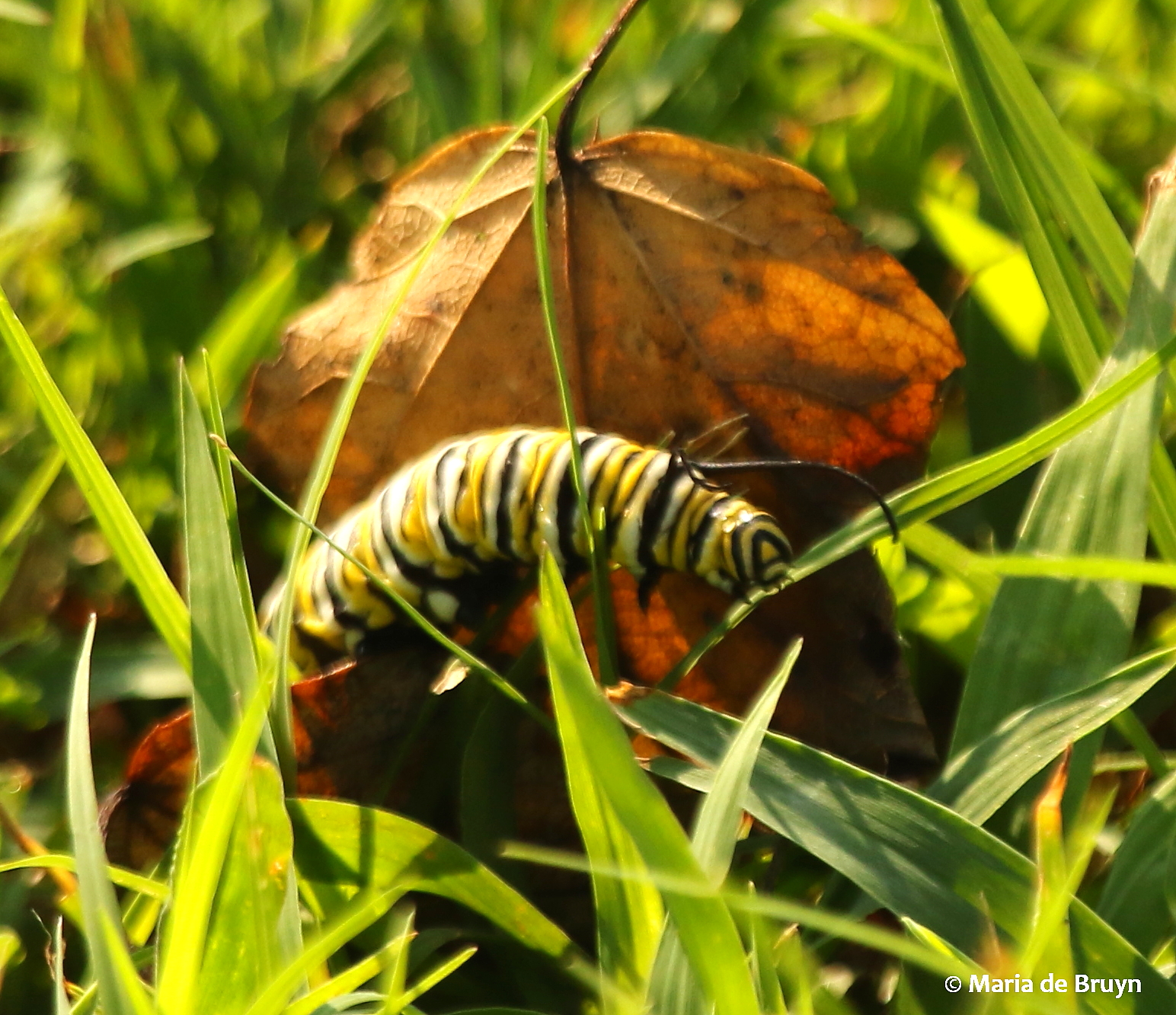
He pointed out several larger caterpillars, noting that they were stage 4 or 5 larva. The eggs hatch about 4 days after being laid. The larvae eat the plant on which they were born, shedding their skins four times as they grow, a process taking 10 to 14 days. These stages of growth are called instars.

monarch munching © Maria de Bruyn res monarch DK7A6460© Maria de Bruyn res

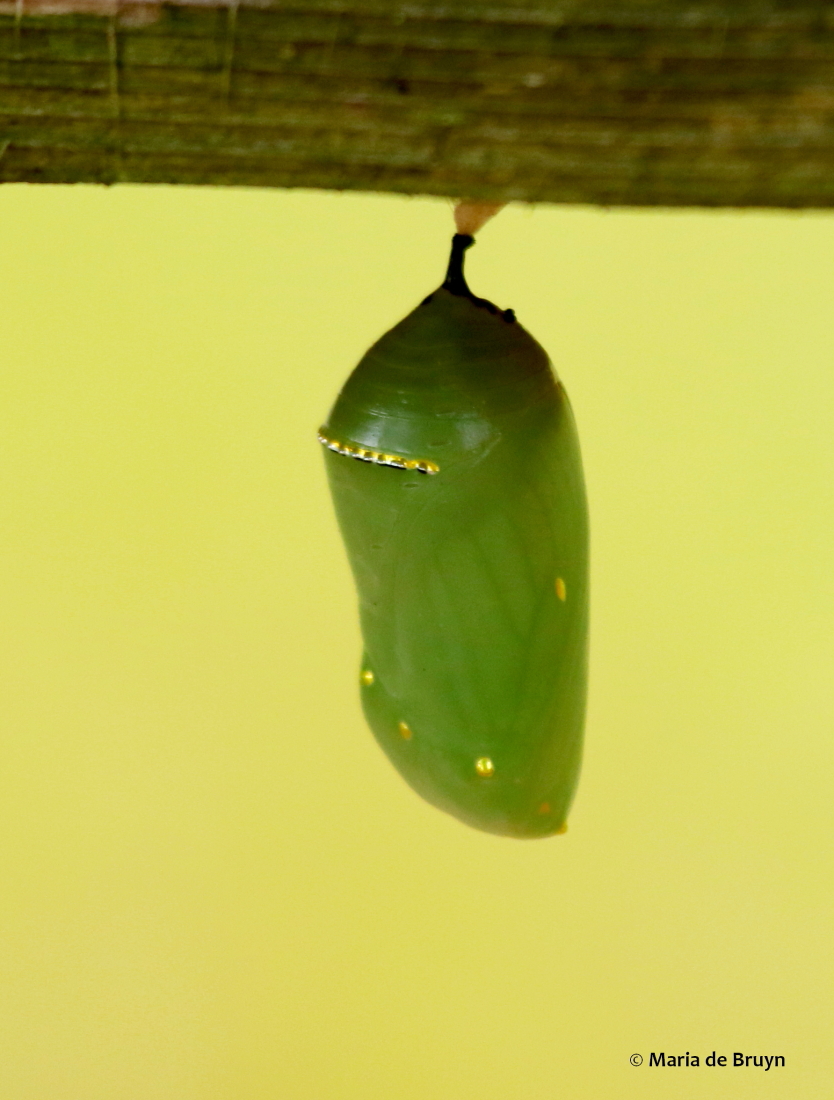
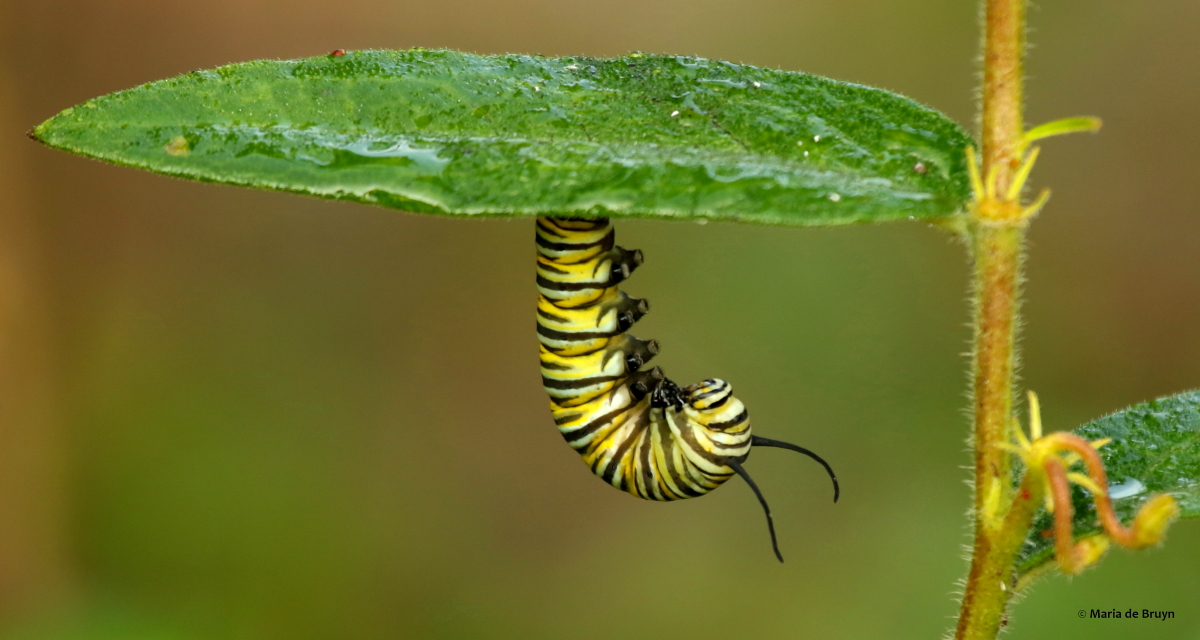
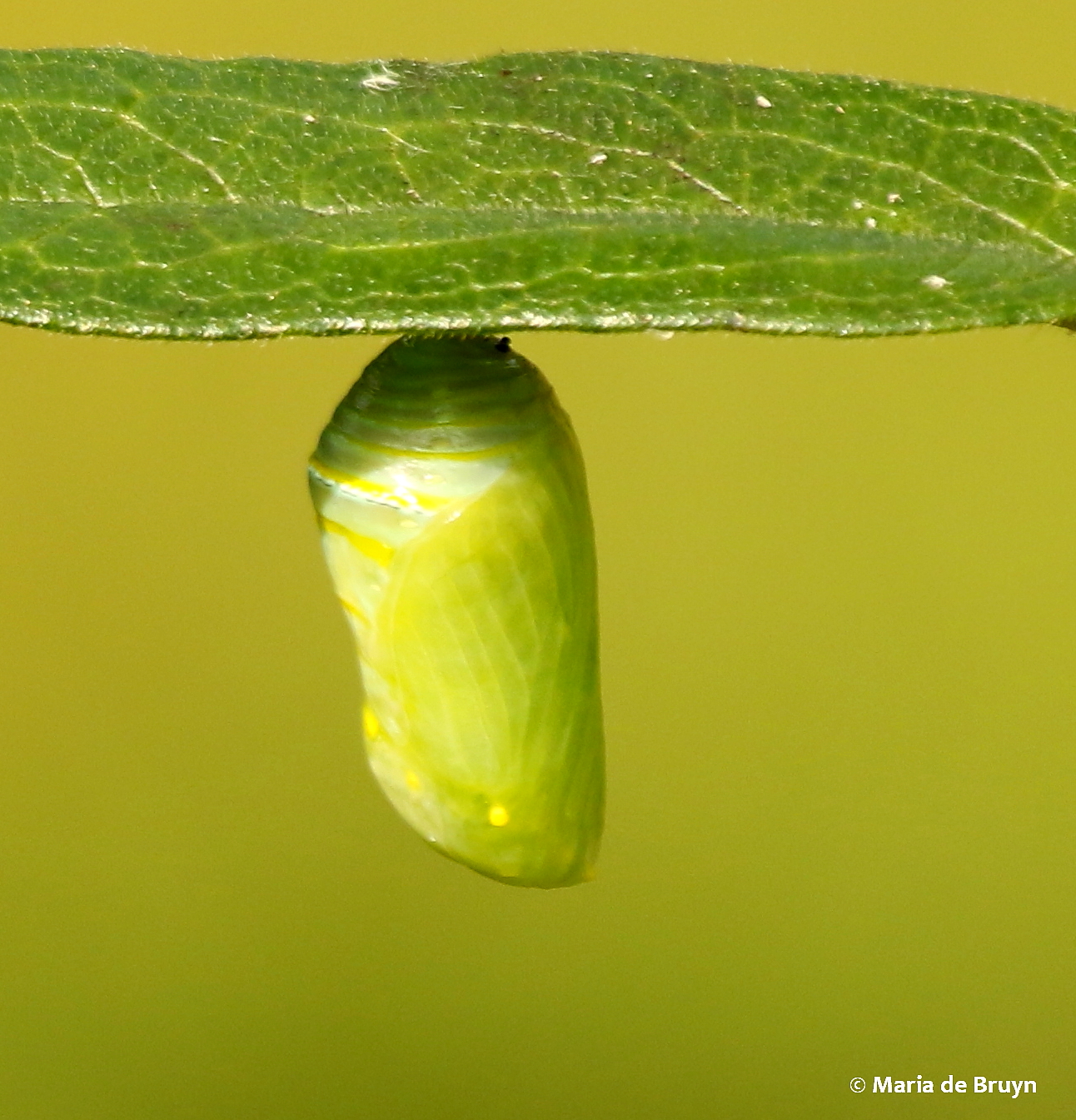
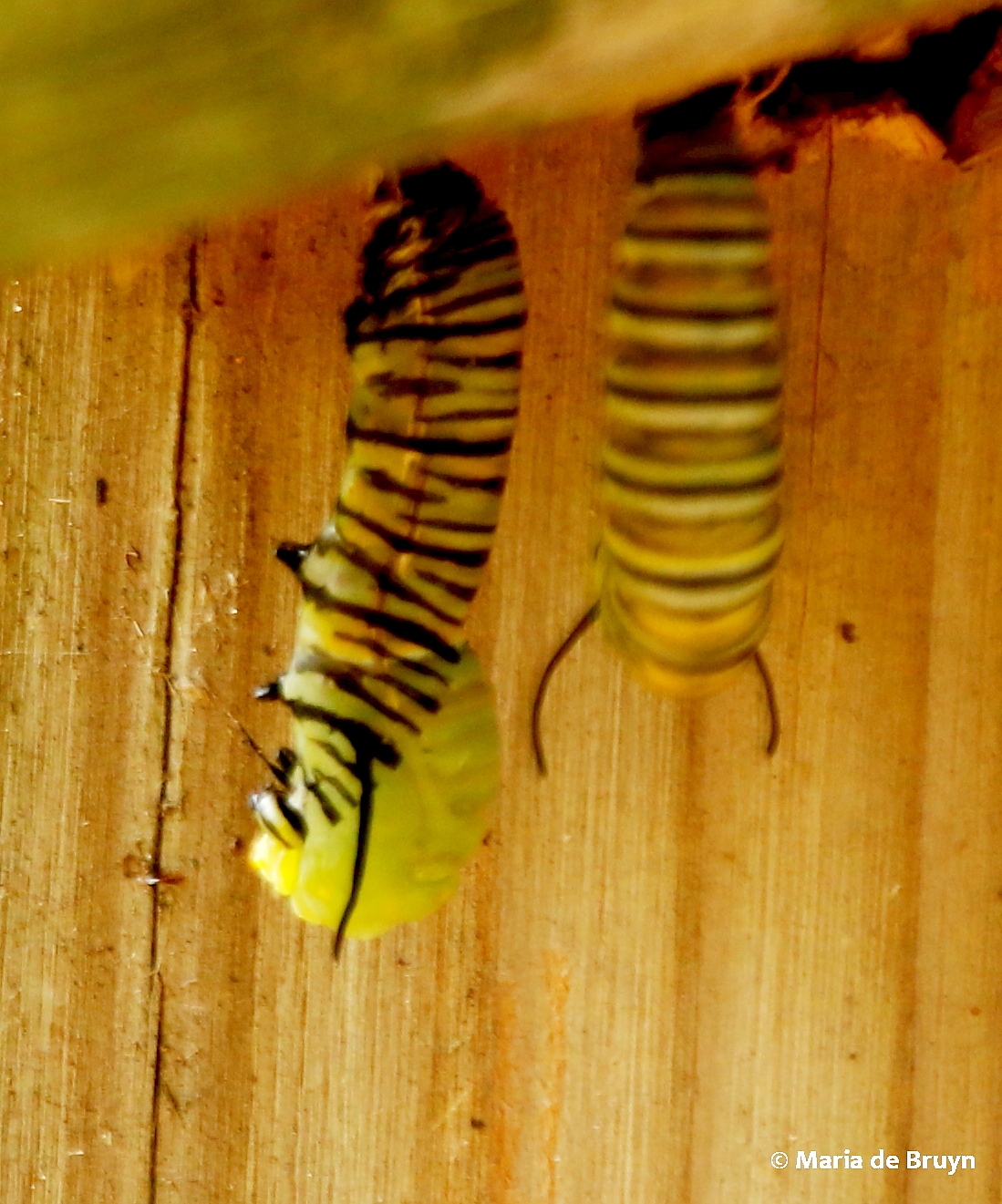
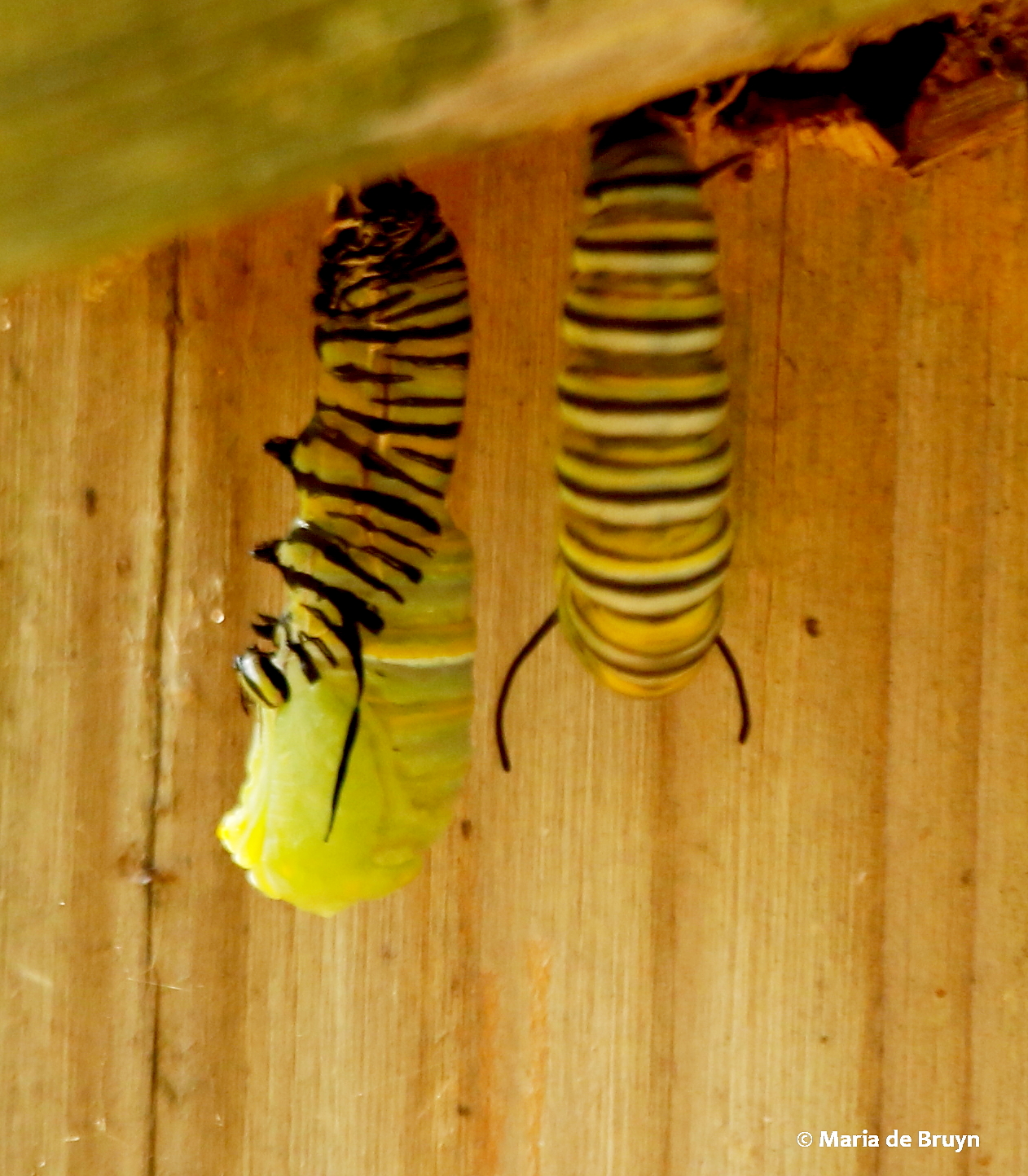
monarch DK7A6441© Maria de Bruyn resIn stage 5, the large larvae look for a protected and hidden spot where they can attach themselves vertically. They use their spinneret (not only spiders have them!) to make a silk pad from which they then suspend themselves, hanging down in the form of a letter J. The culmination of this procedure occurs when they straighten out, a sign, John told me, that pupation was imminent, with the caterpillar turning into a bright green chrysalis. There was already one chrysalis when I arrived with two other caterpillars hanging nearby.


The milkweed plants were attracting plenty of insect action. Many stems were yellow and orange as they were covered with milkweed bug nymphs and aphids. I photographed several of the 43 caterpillars counted, including a small early-stage newbie, and a number of large specimens that were very busy munching on leaves.

monarch DK7A6489© Maria de Bruyn res

After a while, I moved on to photographing caterpillars of moth species and looked around for birds or other interesting insects. Then an unexpected and unfortunate event arose and I had to high-tail it to the bathroom (thank goodness Sandy Creek has one that is open much of the year!).

Emerging from the bathroom and walking down the path to my car to go home, I felt chagrin that my nature walk had to be cut short. But if it hadn’t been for the bathroom visit near the milkweed plants necessitated by my gastrointestinal emergency, I would have missed a first-time experience. As I strolled to my car, I glanced again at the hanging caterpillars and noticed one had straightened out. I balanced the need to go home to shower and change clothes with the desire to see a caterpillar become a chrysalis. I had cleaned myself as well as possible and no one else was around, so I stayed.

monarch DK7A7327© Maria de Bruyn resmonarch DK7A6569© Maria de Bruyn res

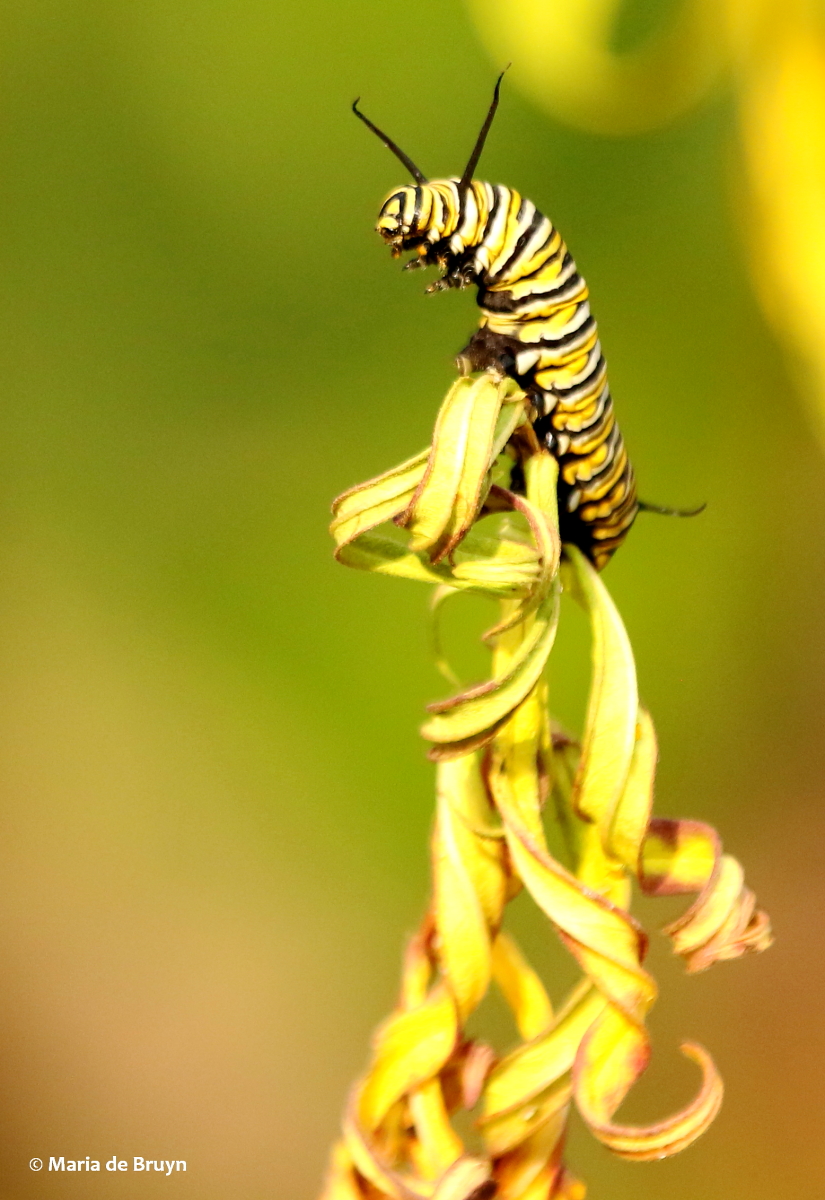
The caterpillar that I was watching was hanging quietly on a leaf; the only action came from a small milkweed bug (Lygaeus kalmia) and a large milkweed bug (Oncopeltus fasciatus) that marched back and forth on top, so I turned to the side to photograph an adventurous sibling that had climbed to the top of a nearby plant.

monarch DK7A7265© Maria de Bruyn resmonarch DK7A7357© Maria de Bruyn res

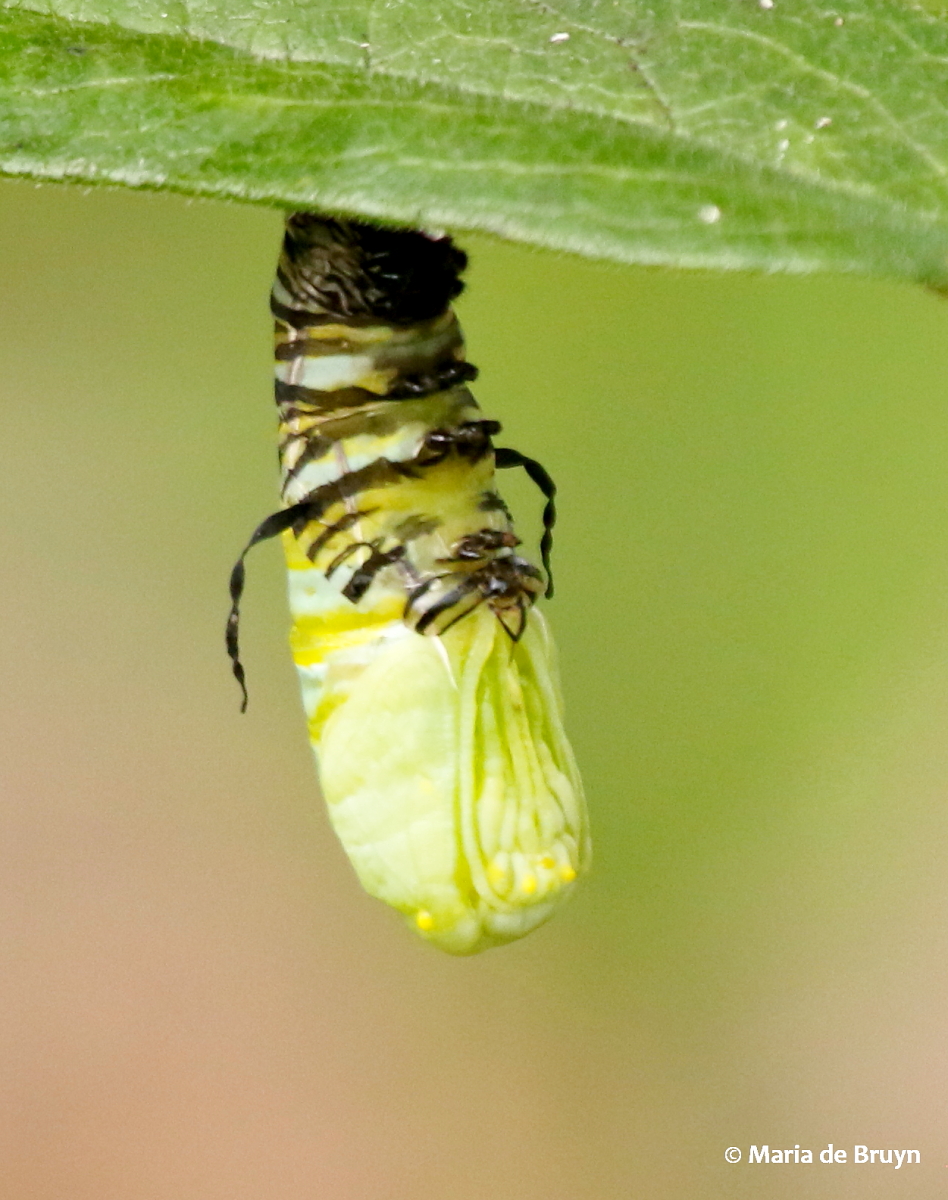
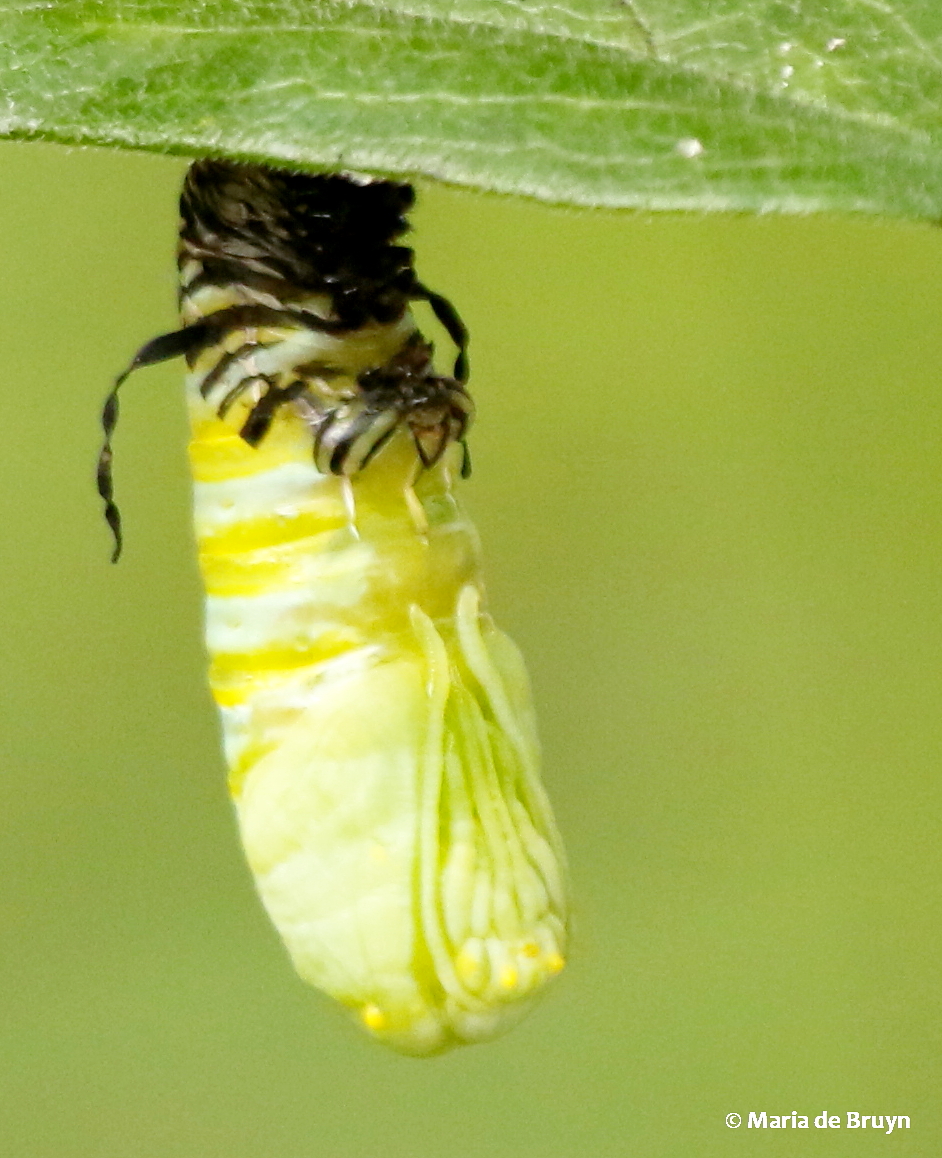
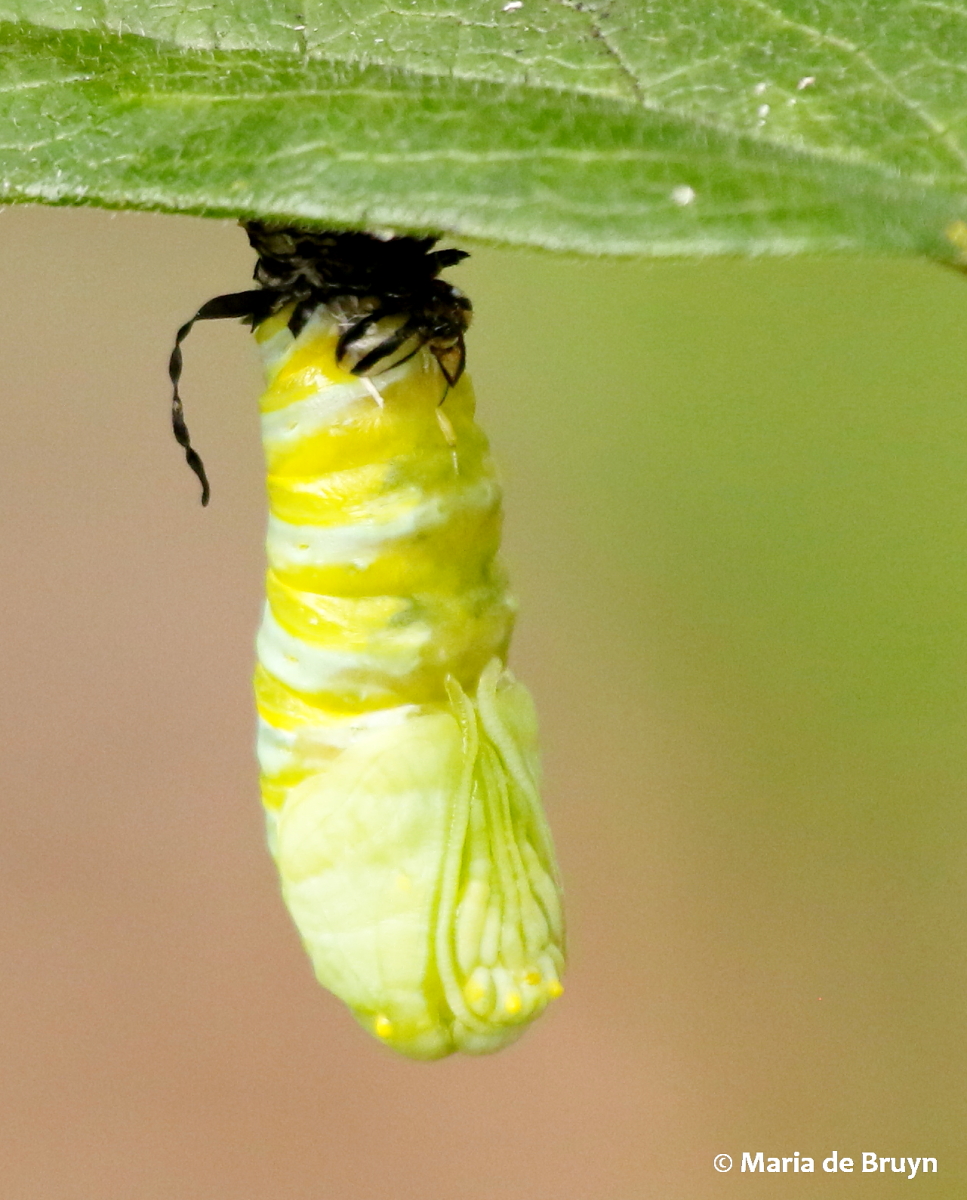
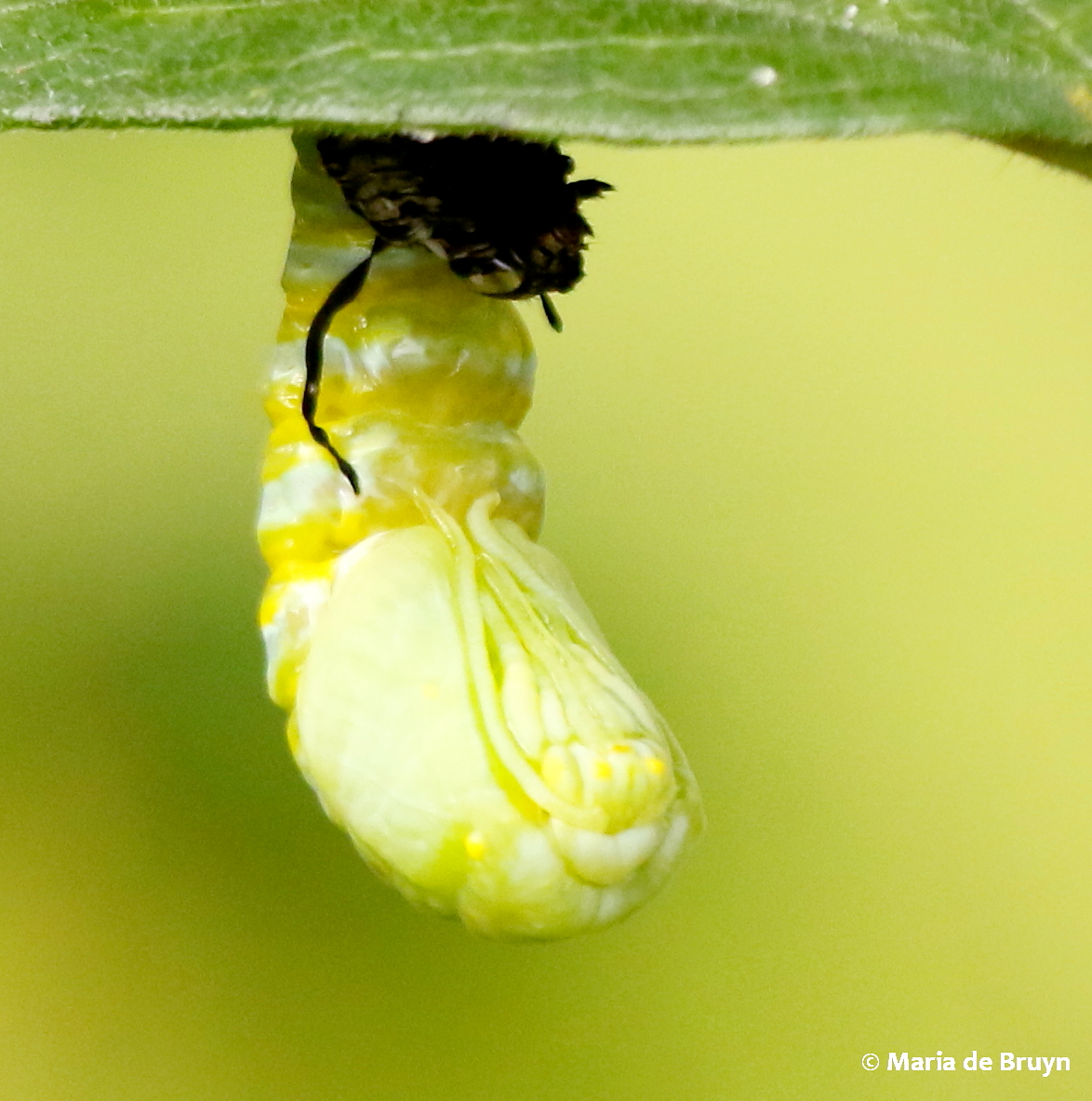
When I looked back, the pupation had already begun and was progressing apace.

monarch DK7A7391© Maria de Bruyn resmonarch DK7A7447© Maria de Bruyn

monarch DK7A7467© Maria de Bruyn resmonarch DK7A7526© Maria de Bruyn

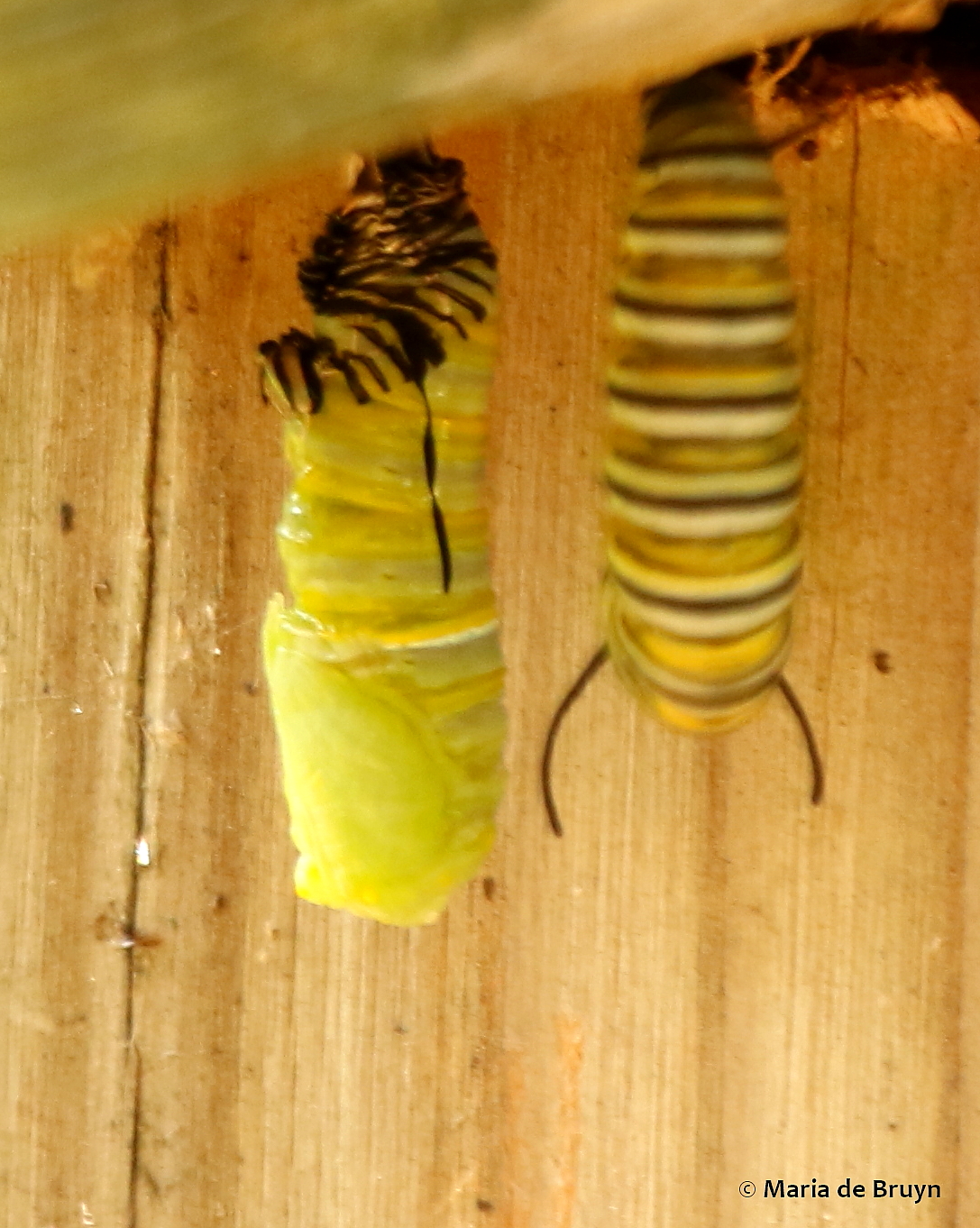
John had mentioned that it could take under a minute; this caterpillar was a little bit slower but the transformation was quick indeed. I’d seen videos of this before but seeing it live in the wild was awesome. And I got my own bit of video showing the last bit of larval skin dropping off the chrysalis.

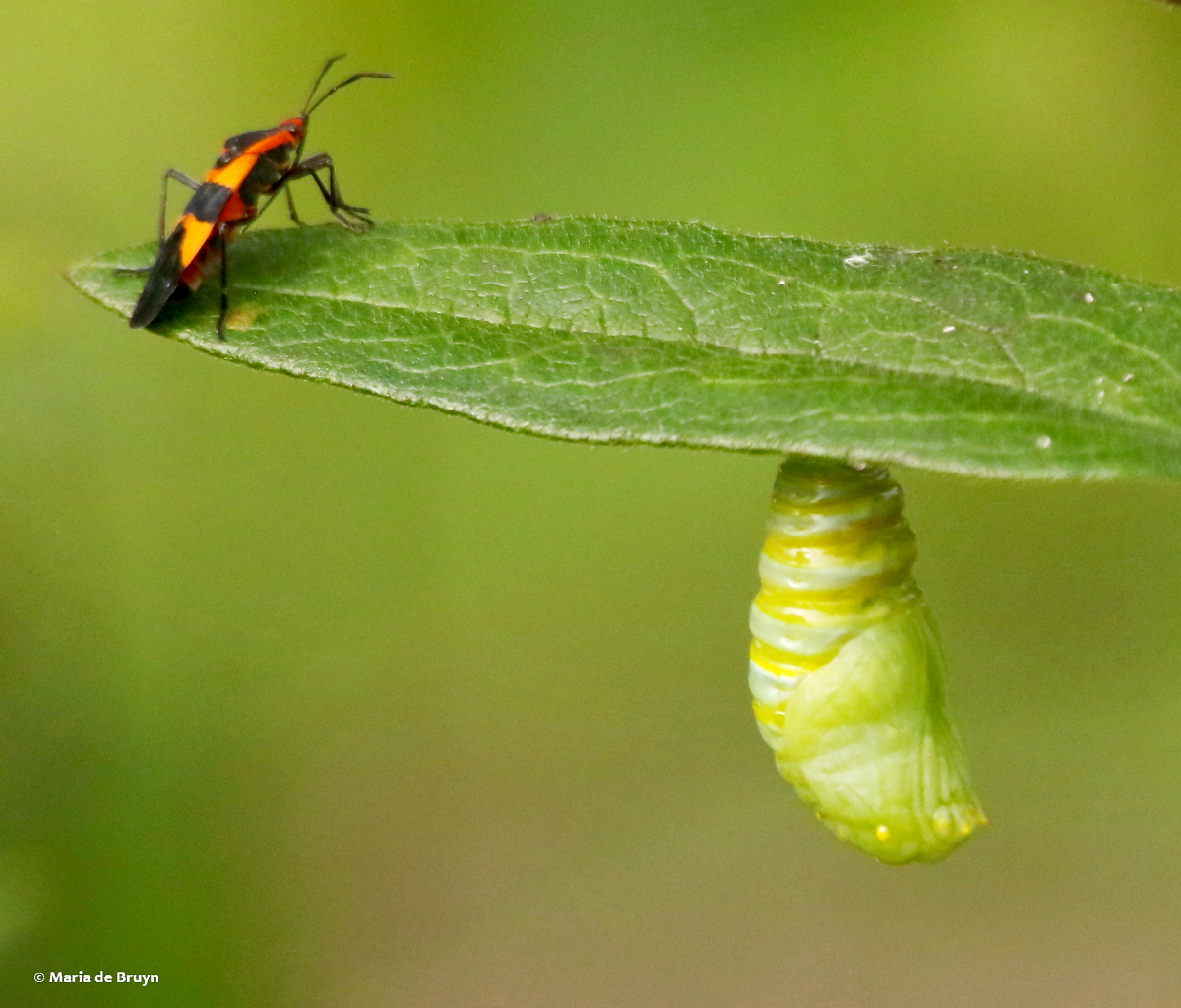
monarch DK7A7623© Maria de Bruyn resThe large milkweed bug came back to perch over the chrysalis. Later, John moved this chrysalis because the leaf of the plant could fall off before the 10- to 14-day pupation period is over – everyone wants all the larvae to become full-grown adult butterflies who can undertake the long migration to Florida or, more likely, Mexico. Their loss of habitat in both the United States and Mexico is devastating to the species and action to prevent further losses is still needed.

monarch DK7A8180© Maria de Bruyn

As I again prepared to leave, I noticed that one of the other hanging caterpillars was straightening out, so I decided to wait a little while in the hope I would see a second pupation. After watching one caterpillar approach and climb a nearby tree and seeing another trundling through the grass toward the parking lot (presumably headed for a tree further away), I focused on the hanging caterpillar.

monarch DK7A8532© Maria de Bruynmonarch DK7A8481© Maria de Bruyn res

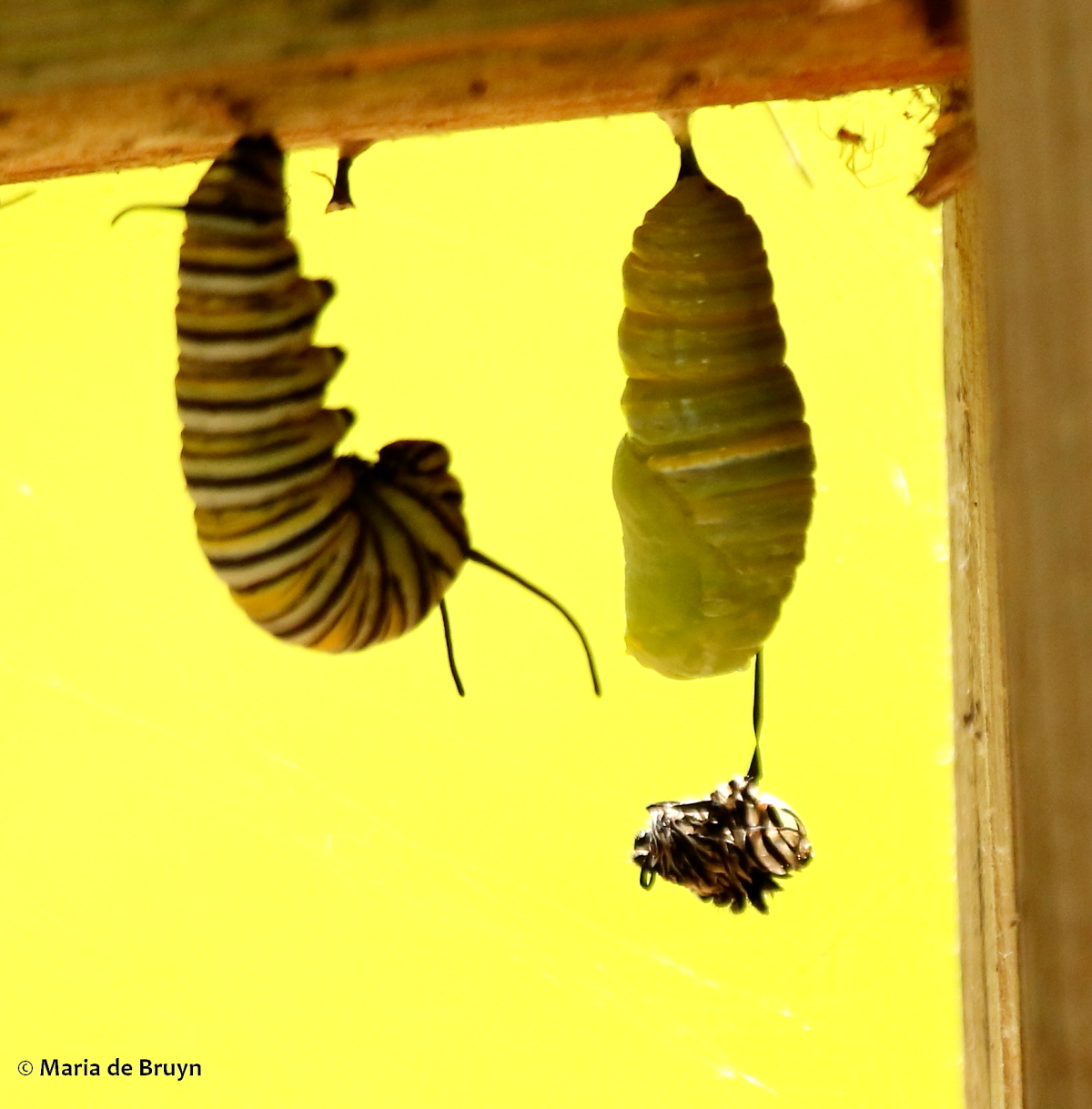
Sure enough, the pupation began – in this case, even more rapidly than the first one I witnessed.

monarch DK7A8552© Maria de Bruynmonarch DK7A8588© Maria de Bruyn

monarch DK7A8642© Maria de Bruynmonarch DK7A8961© Maria de Bruyn res

A difference with this transformation was that the last little bit of caterpillar did not drop off but remained suspended at the bottom of the chrysalis. Most likely, it will fall off later, which is important; if it remains attached, it could damage the emerging butterfly.

MONARCH buttterfly 1© Maria de Bruyn resWatching this part of the butterflies’ metamorphosis was an exciting event. I didn’t wait fora third pupation, however, as I really did need to get home. On the way back, I nearly had a collision with another car – perhaps leading the other driver to need a shower, too. At home, I later almost fell on my face as one of my cats wound himself through my legs as I walked so that I came very close to tripping. Both accidents in the making didn’t happen, thank goodness, so maybe the monarch pupae had become my guardian angels for the day. In any event, I did have lots to be thankful for!


For more information:

http://monarchlab.org/biology-and-research/biology-and-natural-history/breeding-life-cycle/life-cycle

http://www.learner.org/jnorth/tm/monarch/ChrysalisFormationLPB.html