The dance of the sandhill cranes

sandhill crane I77A7926© Maria de Bruyn resDuring my trip to Yellowstone National Park, I had the privilege of seeing what birders call “lifers” – bird species that one sees for the first time. One spectacular sighting – for me – was of sandhill cranes (Grus canadensis). I didn’t spot them first; I was traveling with two photographers from Michigan who were used to seeing these beautiful birds in their backyards. We had already passed but they kindly returned so I could take a few photos – and then to our delight, the pair of birds performed their mating dance for us!

These birds mate for life and may live to a considerable age. The oldest known sandhill crane was 36.5 years old.

sandhill crane I77A7910© Maria de Bruyn resWhile many of these birds are grayish in color, some have rusty orange coloring, attributable to iron-rich mud in their environment. In Yellowstone, the birds use their long bills to spread the reddish mud over their feathers when they preen and this helps to camouflage them when nesting. Cranes that are not yet mature also have reddish upper parts. Their heads are topped by a red patch.


sandhill crane I77A7925© Maria de Bruyn res


These birds have very long legs and necks as you can see. Their windpipes curl up in the sternum and give their sounds a lower pitch. Mated pairs will sing in unison, with the female calling twice for every call that her mate makes.


The males dance when they display to one another. Courtship dances can involve bowing followed by leaps into the air. They may stretch their wings and pump their heads as well.

SANDHILL CRANE I77A7932© Maria de Bruyn RES

sandhill crane I77A7934© Maria de Bruyn res

The pair would dance and stop, dance and stop. A real pas de deux (in French and ballet terms)!

sandhill crane I77A7931© Maria de Bruyn res

sandhill crane I77A7936© Maria de Bruyn ressandhill crane I77A7938© Maria de Bruyn res

sandhill crane I77A7955© Maria de Bruyn ressandhill crane I77A7974© Maria de Bruyn res

Perhaps some ballet terminology was inspired (unconsciously) by the graceful cranes.

sandhill crane I77A7915© Maria de Bruyn res

Grand jeté (jump from one foot to the other)

sandhill crane I77A8005© Maria de Bruyn res

Sur les pointes (on tiptoes)

sandhill crane I77A7935© Maria de Bruyn res

Demi-plié (Half-bend of the knees)

`11111111111111111 sandhill crane I77A7940© Maria de Bruyn

Fondu (sinking down)

Dancers have tried to mimic cranes and while they created a beautiful dance, the sandhill cranes had more varied moves.

sandhill crane I77A7947© Maria de Bruyn res sandhill crane I77A7952© Maria de Bruyn res

sandhill crane I77A8010© Maria de Bruyn ressandhill crane I77A7917© Maria de Bruyn2 res


sandhill crane I77A7928© Maria de Bruyn res


The courtship dance was a tour de force and a highlight of my first day at this national park. In hindsight, I wish I had taped it but I was so enthralled, I forgot. 🙂


Youthful exuberance in Yellowstone

bison IMG_8457© Maria de Bruyn resOne of the frequent wildlife sightings during a visit to Yellowstone National Park are the bison, also known as American buffalo (Bison bison). Sometimes you see a single individual, sometimes a group of 3-5 animals and often larger groups or even huge herds. Females and their calves and males usually hang out in separate groups except when it is breeding season. The males can be distinguished by their somewhat longer horns, larger size (up to 2000 lbs) and heavier beards.  The babies are reddish-brown for their first 2.5 months of life, whereafter they begin to develop the dark brown coloring of their species.

bison I77A7891© Maria de Bruyn res

bison IMG_4583© Maria de BruynDuring my recent visit, I learned that you should not get out of your car near a buffalo – they may look placid but they will attack if they feel provoked and can run over 30 mph. From 1980-1999, triple the number of people were injured by bison as by bears in Yellowstone! In 2015, five people were gored by buffalo.Unfortunately, some people still will approach, as shown in this 1992 video showing some frightening consequences. You may then have to photograph them through (dirty) unopened car windows, which doesn’t make for excellent photos, but you can record what you see as memory reminders.

bison IMG_4562© Maria de Bruyn resIn the wintertime, the bison have thick shaggy coats and these are shed in the spring, so that you see individuals with bare patches of skin alternating with woolly areas.

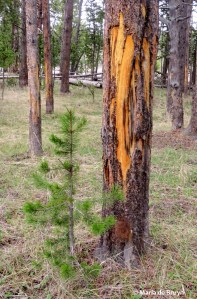
A park ranger told me that they rub on trees to help remove their winter coats; there are whole areas of forest where many trees have bare spots devoid of bark as a result. The bison also “horn” trees, mostly in the autumn, rubbing their horns on cedars and pines by preference; the trees then emit a fragrance which is thought to be an insect deterrent.
bison IMG_4573© Maria de Bruyn res bison IMG_4569© Maria de Bruyn res

Another sign that buffalo are nearby are the bison wallows – these shallow depressions in the ground are used year after year, both during dry and rainy weather. The wallows have multiple functions, including offering dust and mud covering to protect against insects, a place for resting, grooming and play.

I77A6602© Maria de Bruyn resbison I77A6605© Maria de Bruyn res

bison IMG_4578© Maria de Bruyn res

When walking in meadows, along roads and on hillsides, you can often come across bison dung, popularly known as meadow muffins and buffalo chips. These large deposits used to be used as a fire source as they burn well and could be easily gathered.

Given the bison’s size and their habituation to people in the Park, human beings will find that they not infrequently have to share the road with these mammals. They will cross the road from one side to another and sometimes spend some time ambling down the road, so that you can have one pass within about a foot of your car window.

bison IMG_4563© Maria de Bruyn resbison I77A7869© Maria de Bruyn res

bison I77A7490© Maria de Bruyn res

During these “bison jams”, cars are supposed to stop and give them right of way – we are the intruders in their home after all. You then may see an individual through the car window who has been collared or tagged, presumably for research.

bison I77A1714© Maria de Bruyn resbison I77A1739© Maria de Bruyn res

The bison can have very expressive faces, even if at first sight it seems they always have the same expression. This mother demonstrated when she was nursing her calf.

bison I77A1679© Maria de Bruyn res bison I77A1667© Maria de Bruyn res

bison I77A1624© Maria de Bruyn res

bison I77A1473© Maria de Bruyn res

If you had asked me a month ago which adjectives I might associate with bison, my answer likely would have been something like: massive, placid when undisturbed, woolly, furry, huge, plodding. Playful would not have been on the list, but I discovered that American buffalo babies can be very exuberant and know how to have a good time!

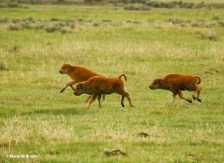
A group of three spent quite some time chasing one another, jumping and leaping – one in particular seemed to be the instigator of the play session.
bison I77A1539© Maria de Bruyn res bison I77A1519© Maria de Bruyn res

bison I77A1441© Maria de Bruyn res  bison I77A1453© Maria de Bruyn res

bison I77A1525© Maria de Bruyn res

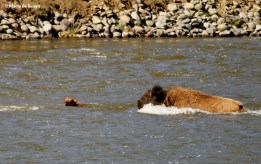
bison I77A9171© Maria de Bruyn resAt one point, I was in a car where I could observe a group of bison fording a river very near to the road. It was shallow where they entered but grew deeper toward the middle and other side and it turned out there was a strong current. It posed a challenge to the pregnant bison and the babies were really having a tough go. We watched them struggle across, keeping their chins above water as they slowly progressed while being swept downstream from the adults.
bison I77A9113© Maria de Bruyn res bison I77A9103© Maria de Bruyn res

bison I77A9135© Maria de Bruyn res

Luckily, all of the babies made it to the other side, including one who thought s/he was going after her/his mother when s/he got to the top of the riverbank. s/he trotted after a smaller bison, then was followed by a much larger female who began butting her/him – turned out the baby may have been confused after the strenuous river crossing because the smaller bison was not going to nurse. The mother kept after the baby until finally the young one turned and realized who mom really was!

bison I77A9283© Maria de Bruyn resbison I77A9293© Maria de Bruyn res

bison I77A9321© Maria de Bruyn res

bison I77A1450© Maria de Bruyn resBefore Europeans came to the United States, these magnificent mammals ranged as far as the Atlantic seaboard, meaning they could have been in my neighborhood at one time! Now the wild bison are largely confined to some national parks after almost going extinct in the 19th century and the most genetically pure ones are in Yellowstone. So I’m lucky that I had the chance to observe them several times during my recent trip out West and I’d love to see them there again. 🙂
Living above a restaurant

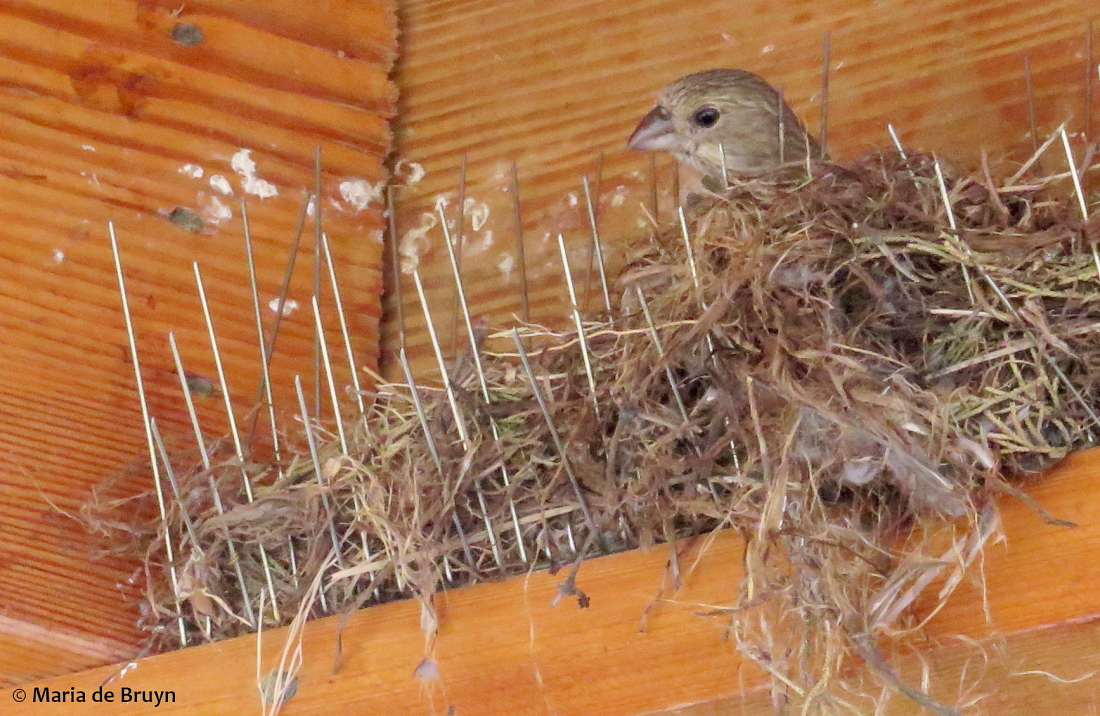
house finch nest 1 IMG_4358© Maria de Bruyn resAt one point in Amsterdam, I lived in a room with a shared kitchen and toilet above a butcher shop. It was a cramped space but I made some nice friends there. Eventually, I painted the hallway with flowers and snails to bring a bit of nature inside. Today, on my way to a prompt writing session, I saw that some birds also choose to live above commercial establishments, including those who established homes above one of my favorite restaurants, El Tigre.

House finch nest 1IMG_4373© Maria de Bruyn res


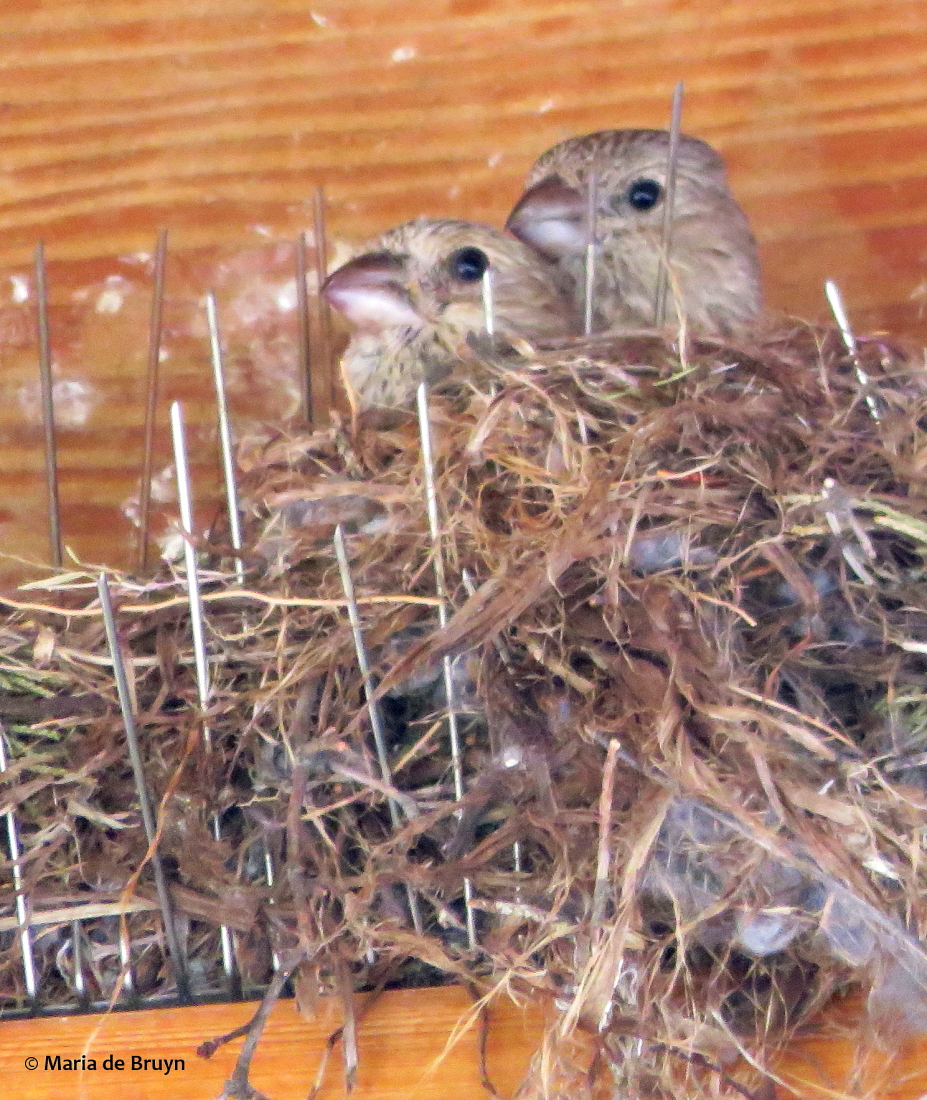
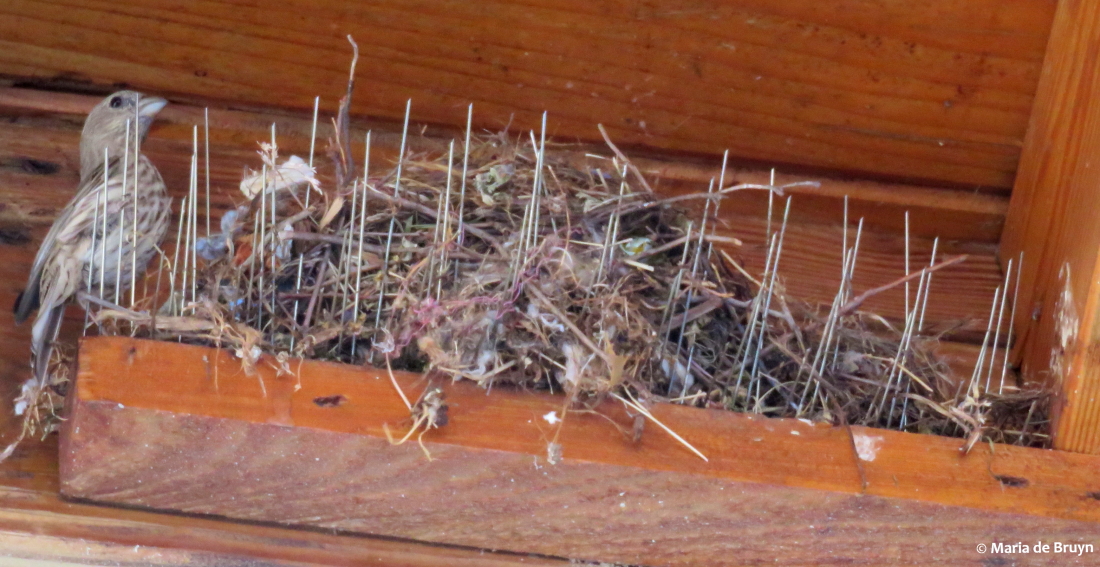
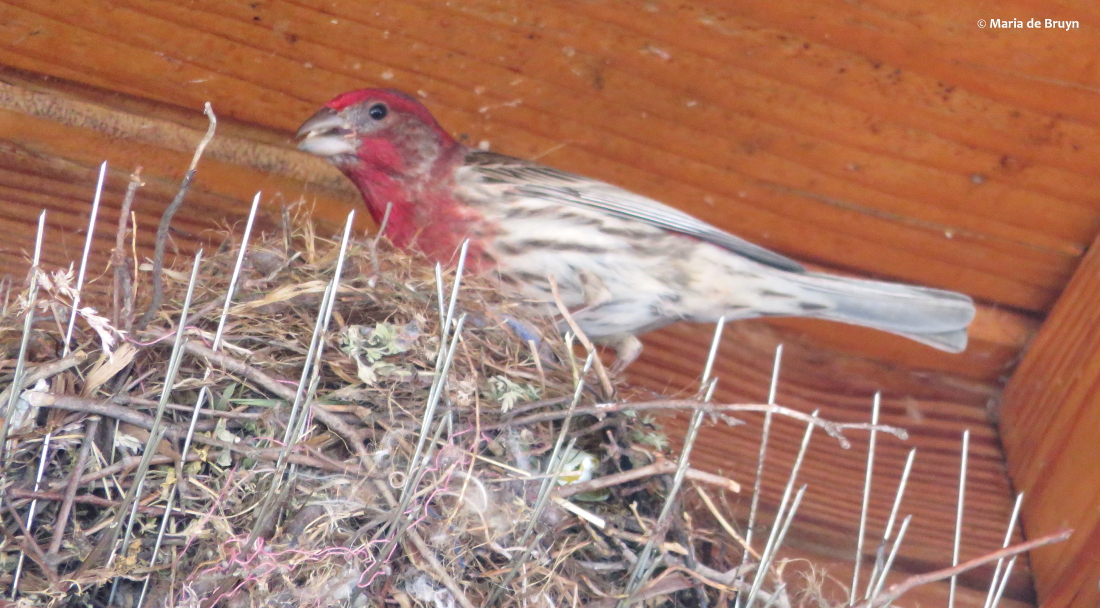
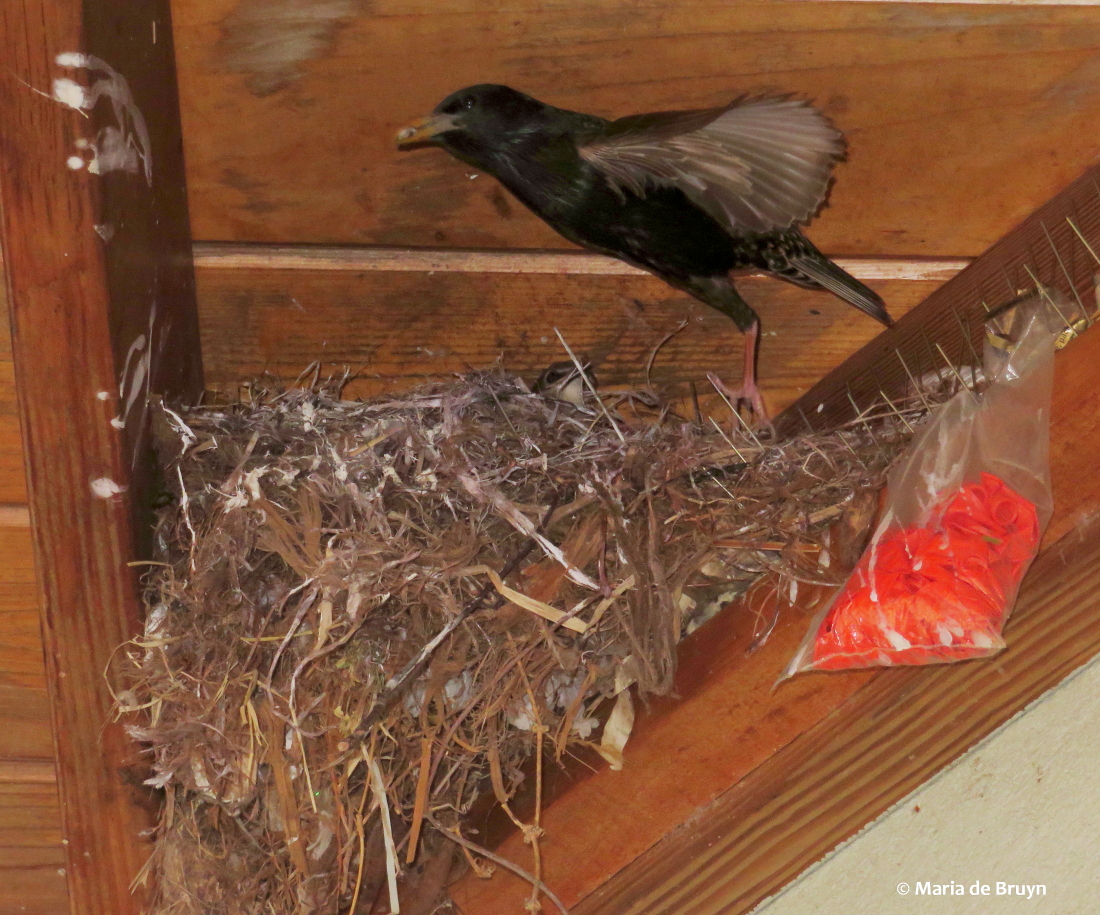
There were three nests (at least – I didn’t look around to the other wall), with house finches (Haemorhous mexicanus) on either side of a European starling (Sturnus vulgaris) home in the middle. Nest 1 had a female bird visiting while a couple stayed inside.


The other finch nest was attended by both mother and father.

house finch nest 3 IMG_4375© Maria de Bruyn res house finch nest 3 IMG_4351© Maria de Bruyn res

house finch nest 3 IMG_4396© Maria de Bruyn res

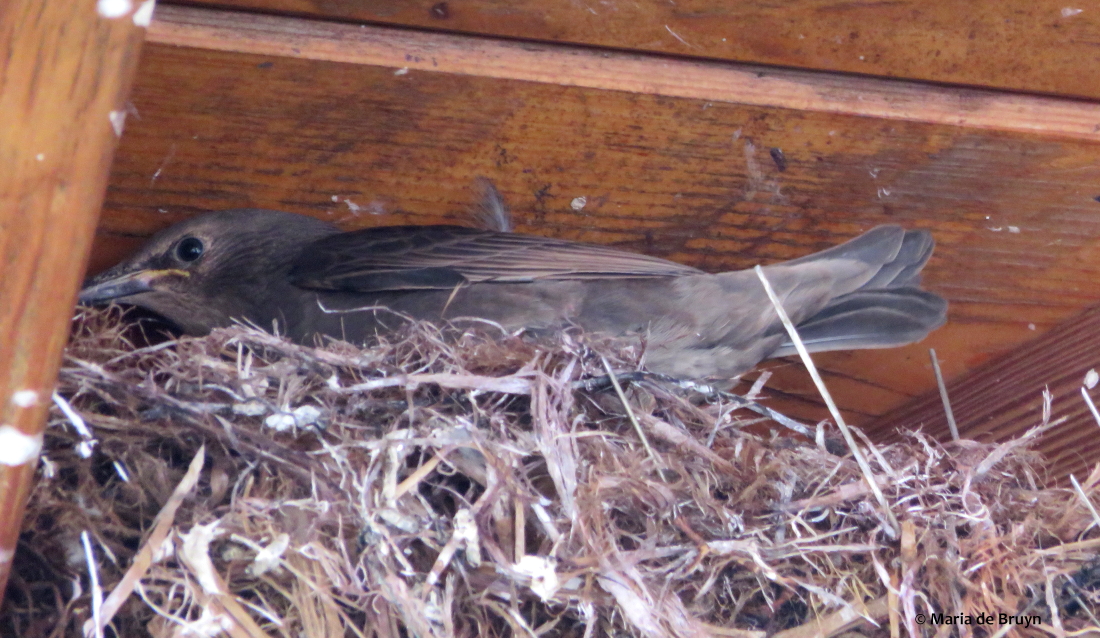
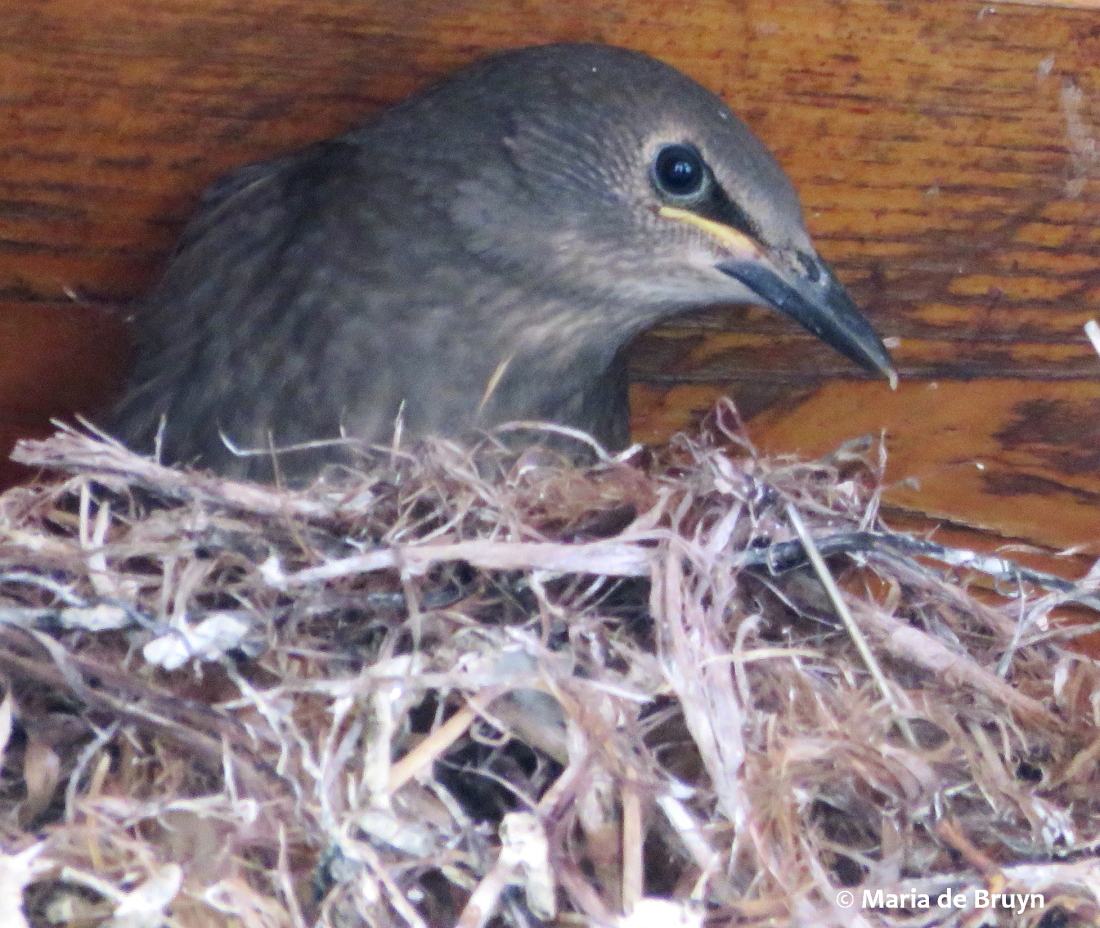
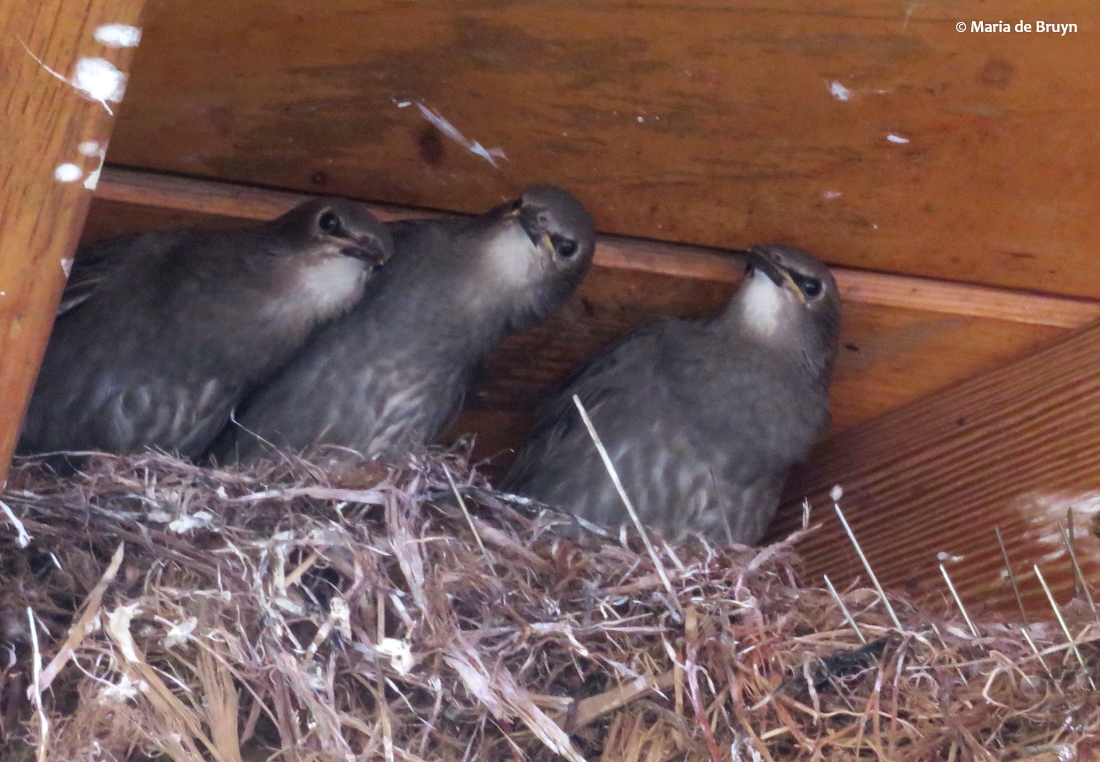
European starling IMG_4390© Maria de Bruyn resThe nest with starlings had rather large babies in it. At one point, an adult bird flew in with a worm or insect but then took off before feeding anyone – perhaps alarmed when it saw me watching the nest. The babies didn’t say much, in contrast to the somewhat older baby starlings in my yard who make quite a racket asking to be fed.

European starling IMG_4387© Maria de Bruyn resEuropean starling IMG_4347© Maria de Bruyn res


European starling IMG_4397© Maria de Bruyn res

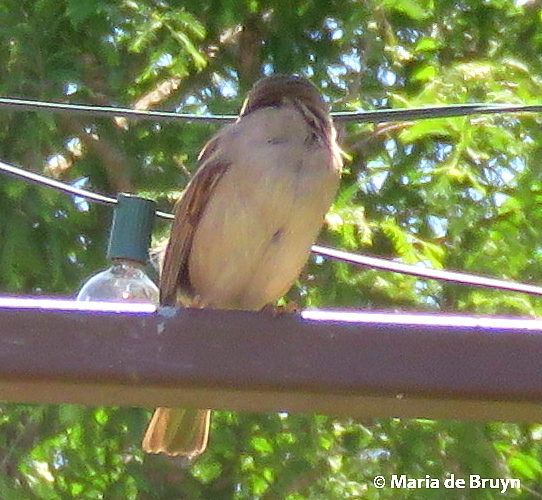
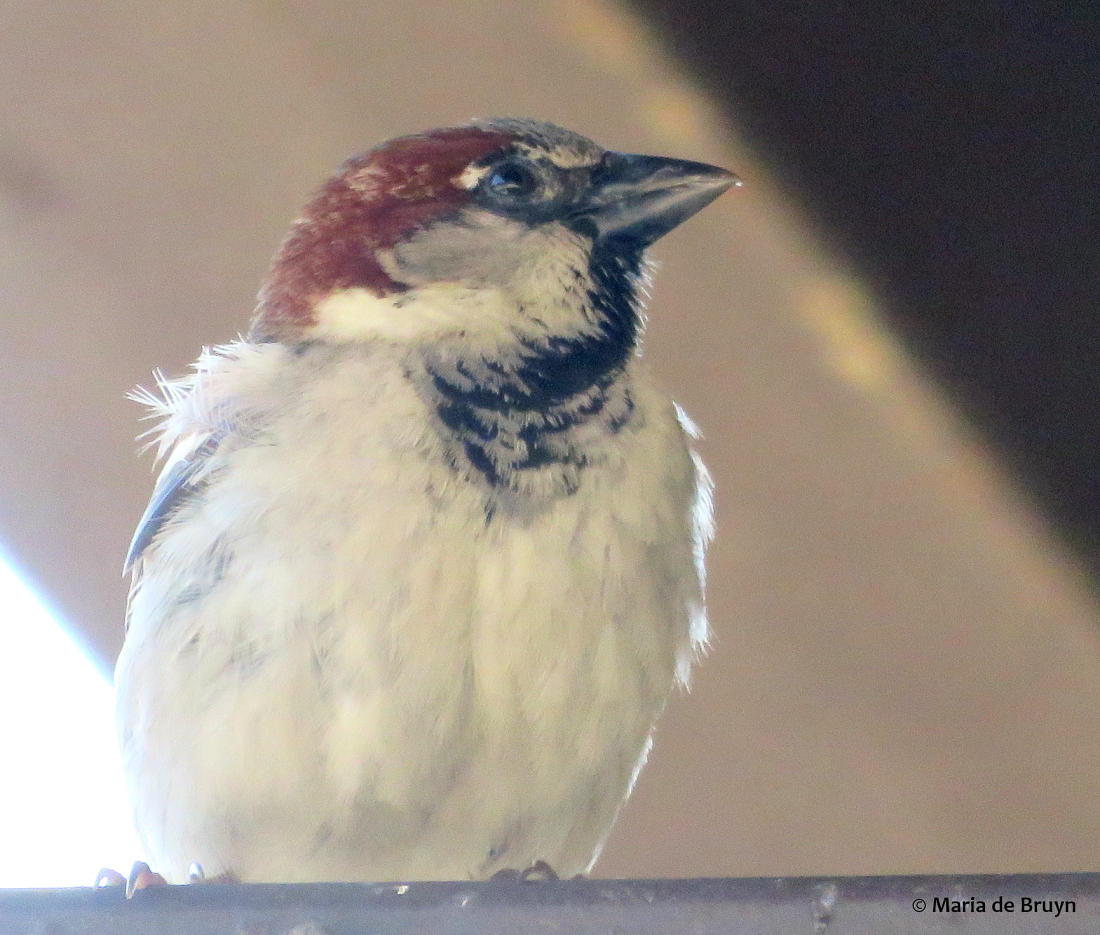
I wasn’t the only observer, however; a couple house sparrows (Passer domesticus) were also observing the comings and goings to and from the nests.

house sparrow IMG_4412© Maria de Bruyn res house sparrow IMG_4355© Maria de Bruyn res

I had a busy day and didn’t think I’d get to do much nature observation – but then those adaptable birds showed me that even in an urban environment, I can grab a few moments to see what other species are doing on a lovely spring day!


Nest Watch citizen science – 2016 edition

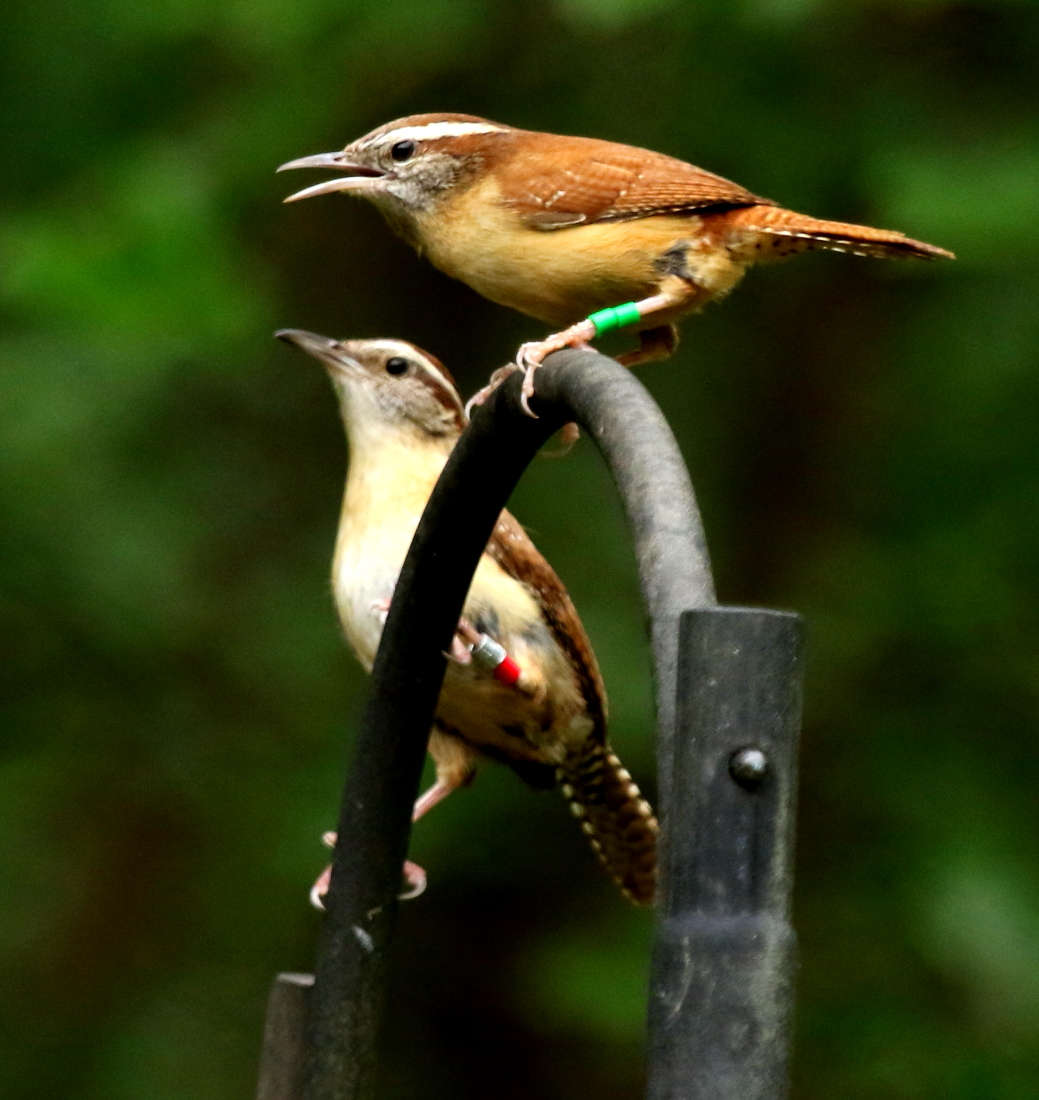
Carolina wren Renee and Riley I77A9074© Maria de Bruyn resLast year, I became a Nest Watch volunteer, which involves having birds banded in your yard so that you can follow and report to researchers the birds’ presence over time as they visit and leave your yard.

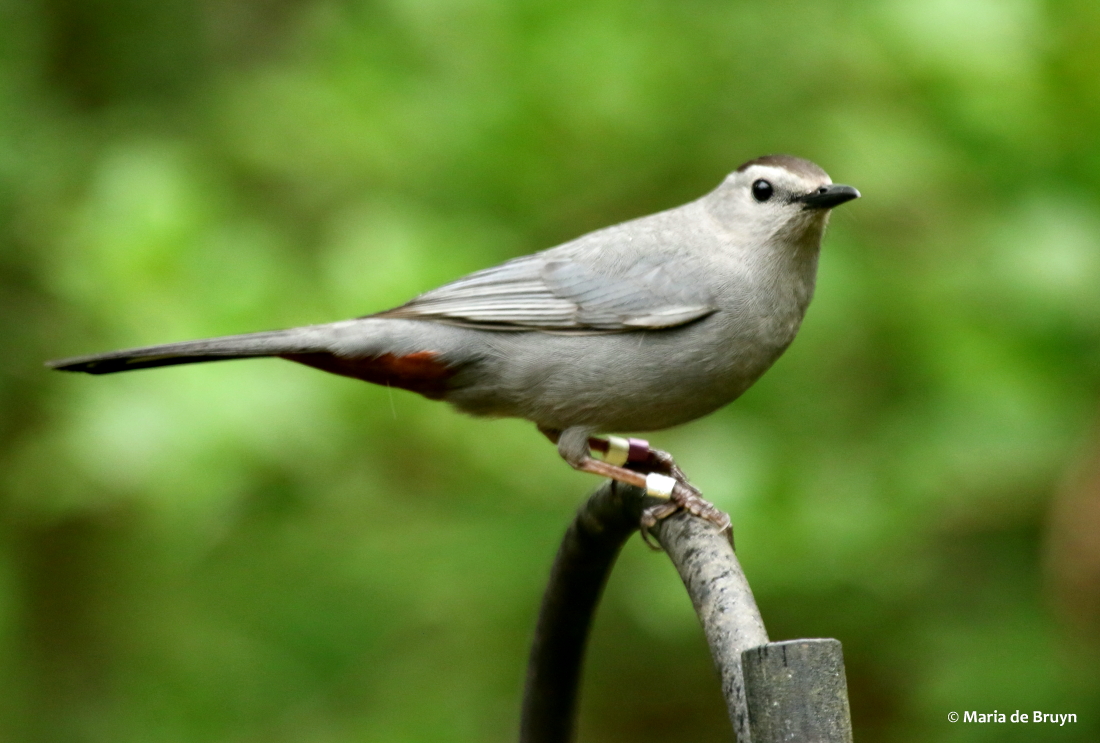
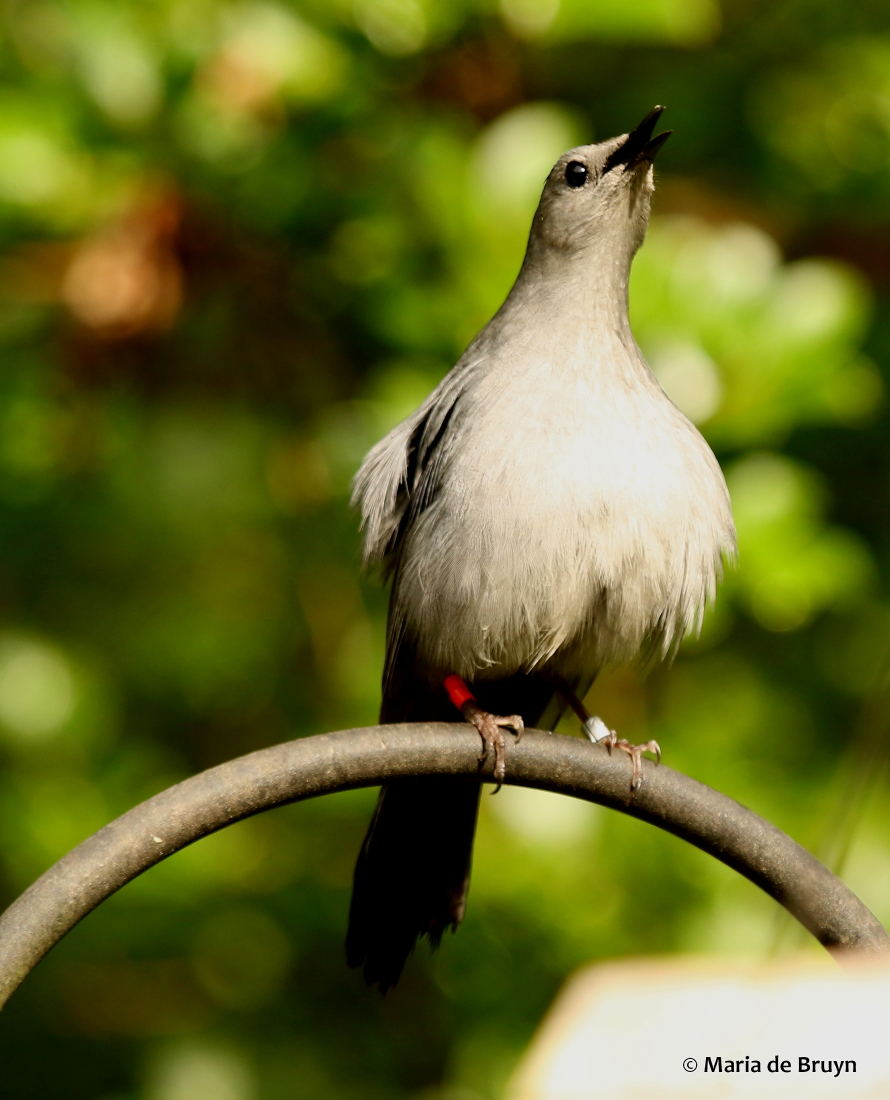
In 2015, we banded six birds. If a bird is only a temporary visitor or if it died outside the yard due to disease, old age or predation, you just won’t see it again and have no idea what became of it. The American robin (Turdus migratorius) that was banded last year never returned. If the birds stick around, however, you have the enjoyment of observing birds you get to know. The three gray-headed catbirds (Dumetella carolinensis) stayed around all summer and fall, and two of them – Camden and Corey – returned to my yard from winter migration a few days ago. They have been accompanied by females whom they appear to be assiduously courting.
gray-headed catbird Camden I77A8990© Maria de Bruyn res

gray-headed catbird Corey I77A8083© Maria de Bruyn res

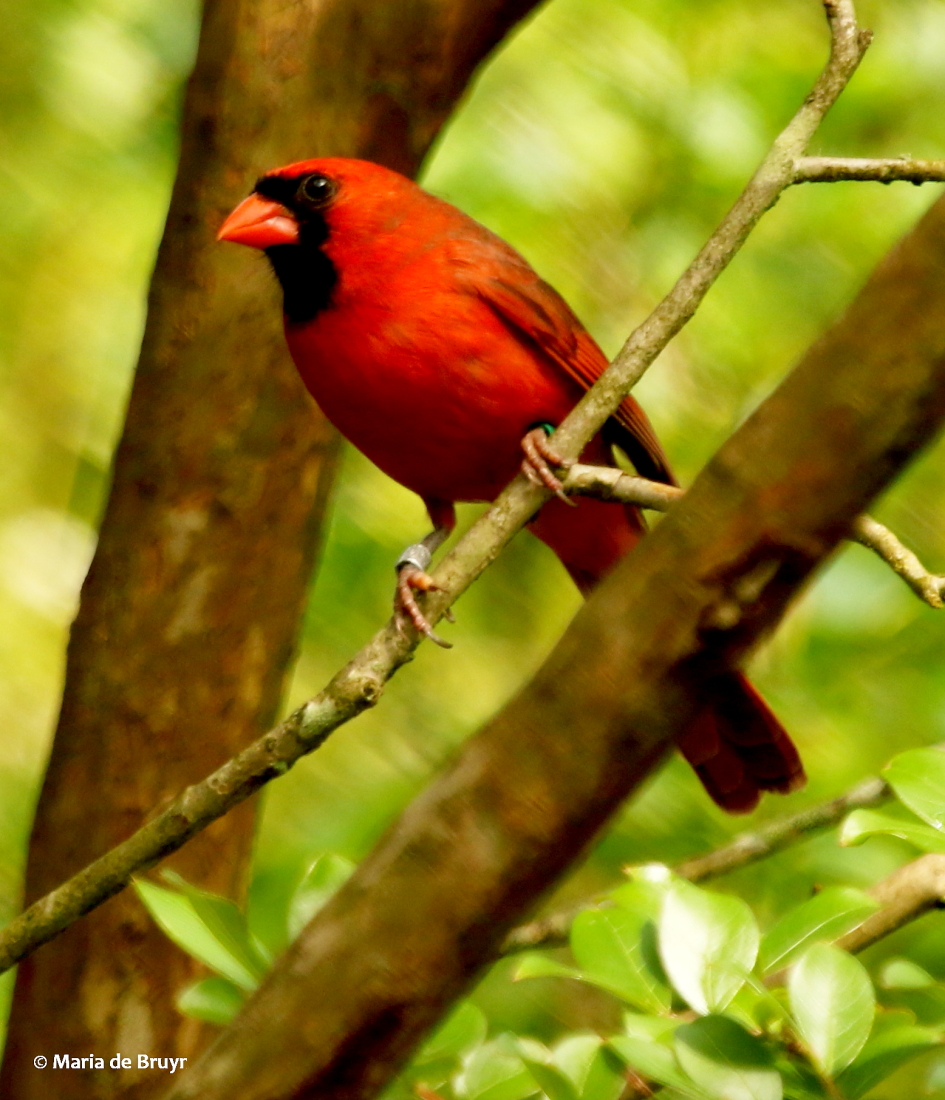
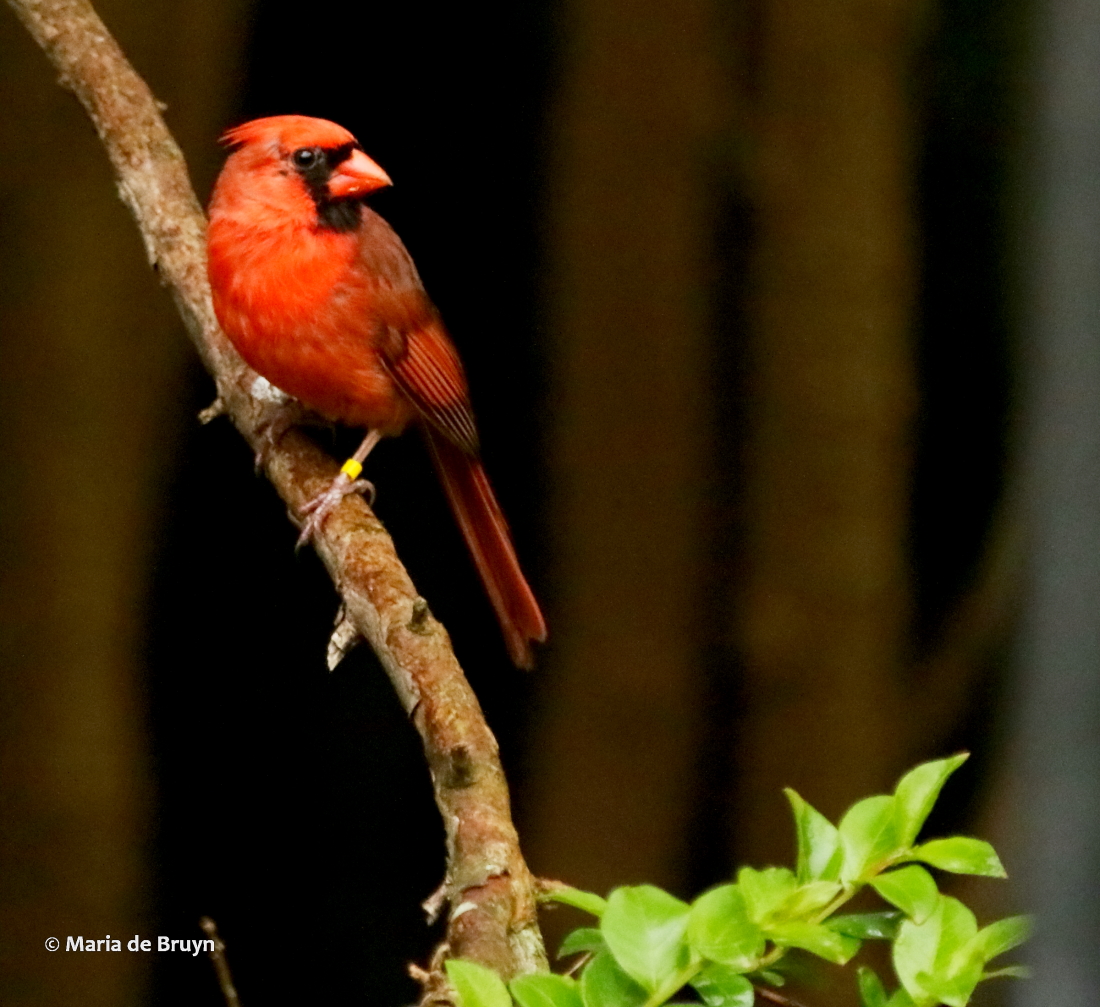
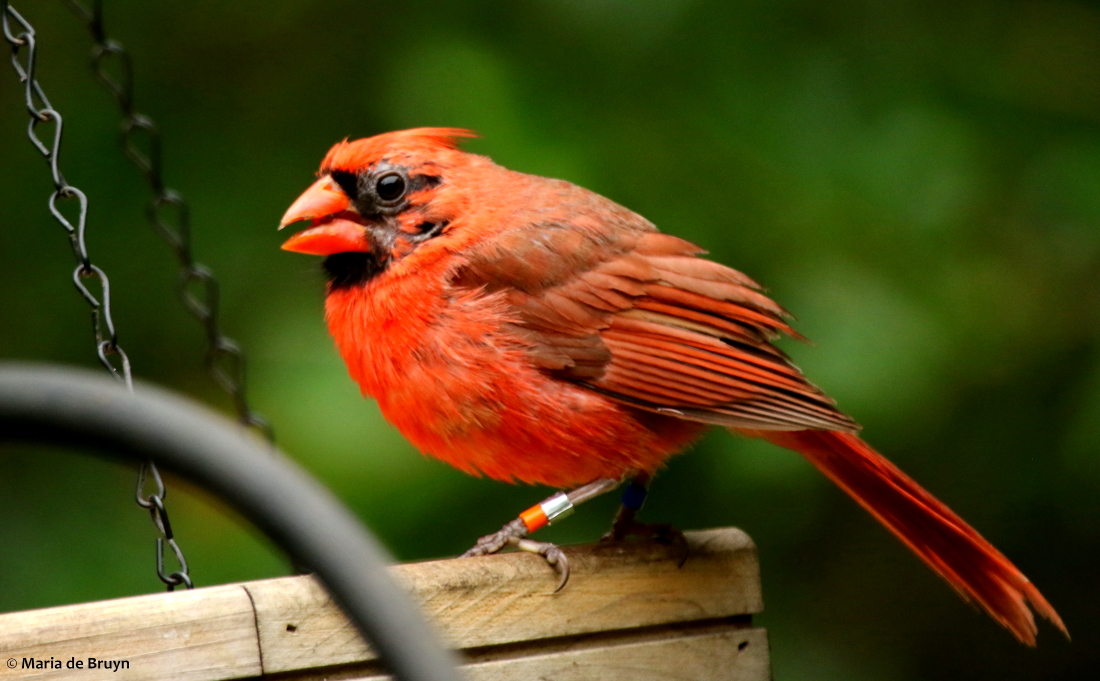
Northern cardinal Clancy I77A8123© Maria de Bruyn resOne Northern cardinal (Cardinalis cardinalis) was banded last year, but Clancy only stayed a few days and then disappeared for the rest of the summer, fall and winter. He suddenly appeared yesterday – perhaps encouraged to spend time at the feeders by the other birds with bracelets.

Three days ago, a second round of banding was done and we put the colorful anklets on a total of 10 birds. They were caught in two mist nets – one near my back garden and one near the backyard feeders.

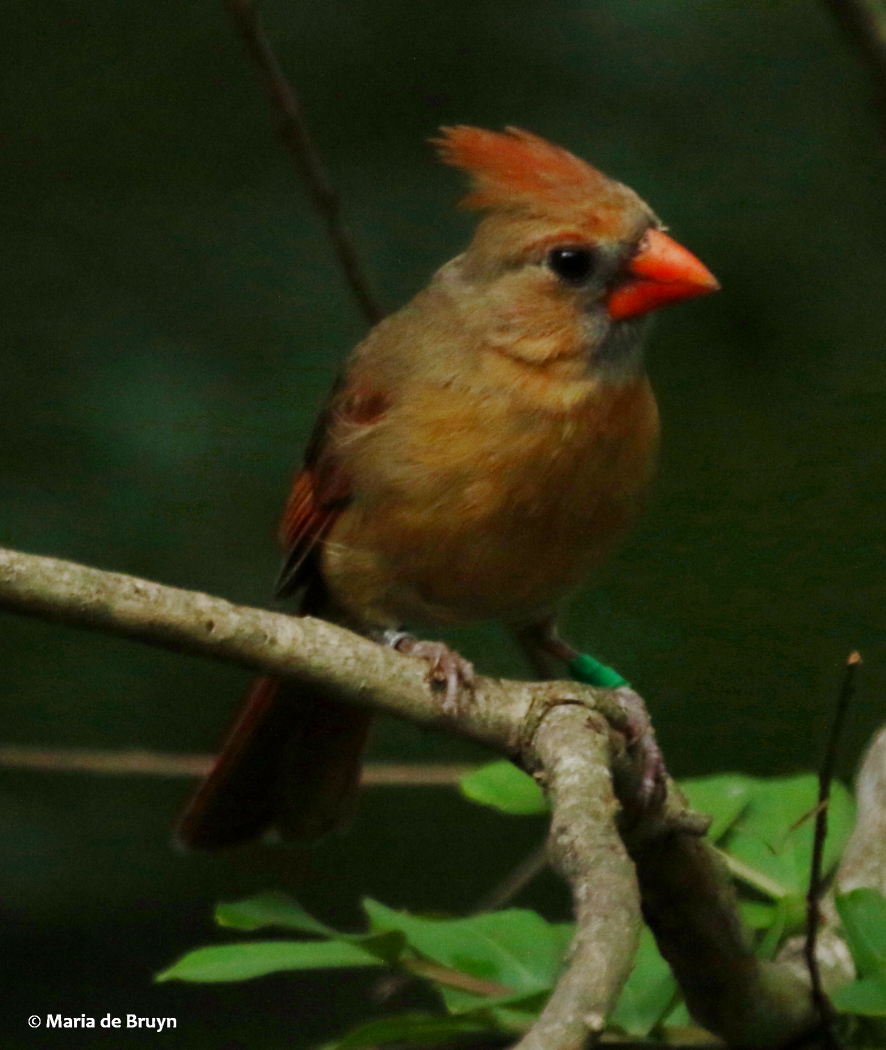
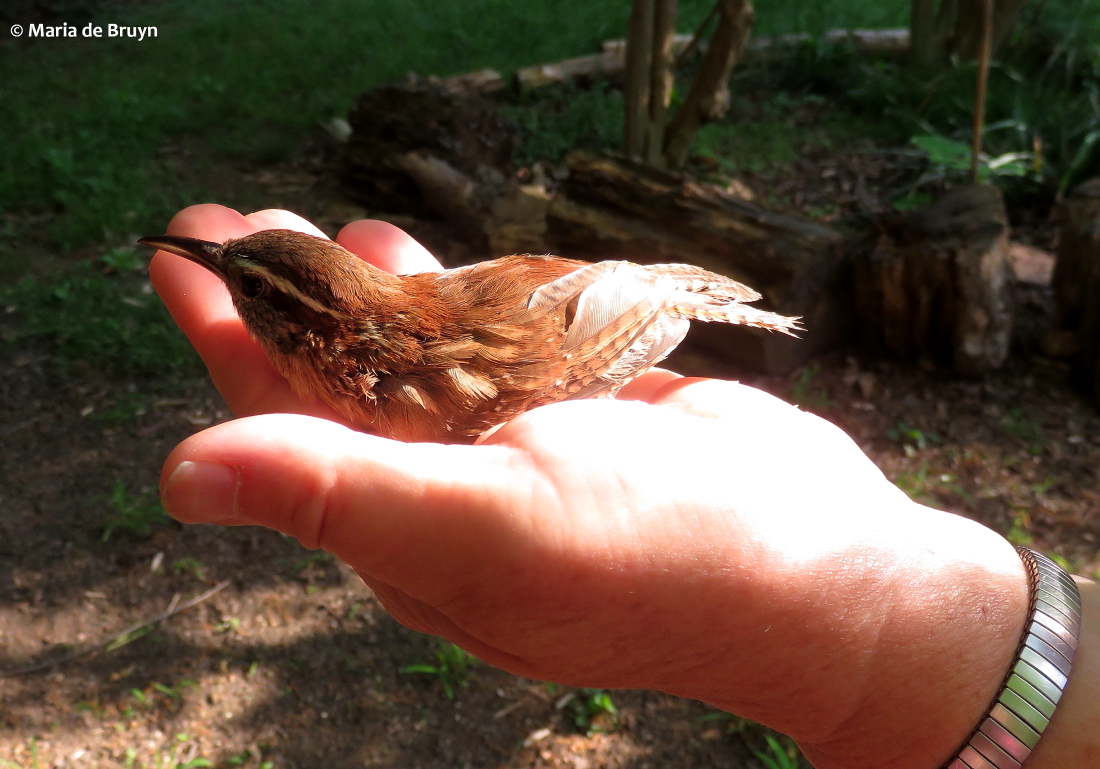
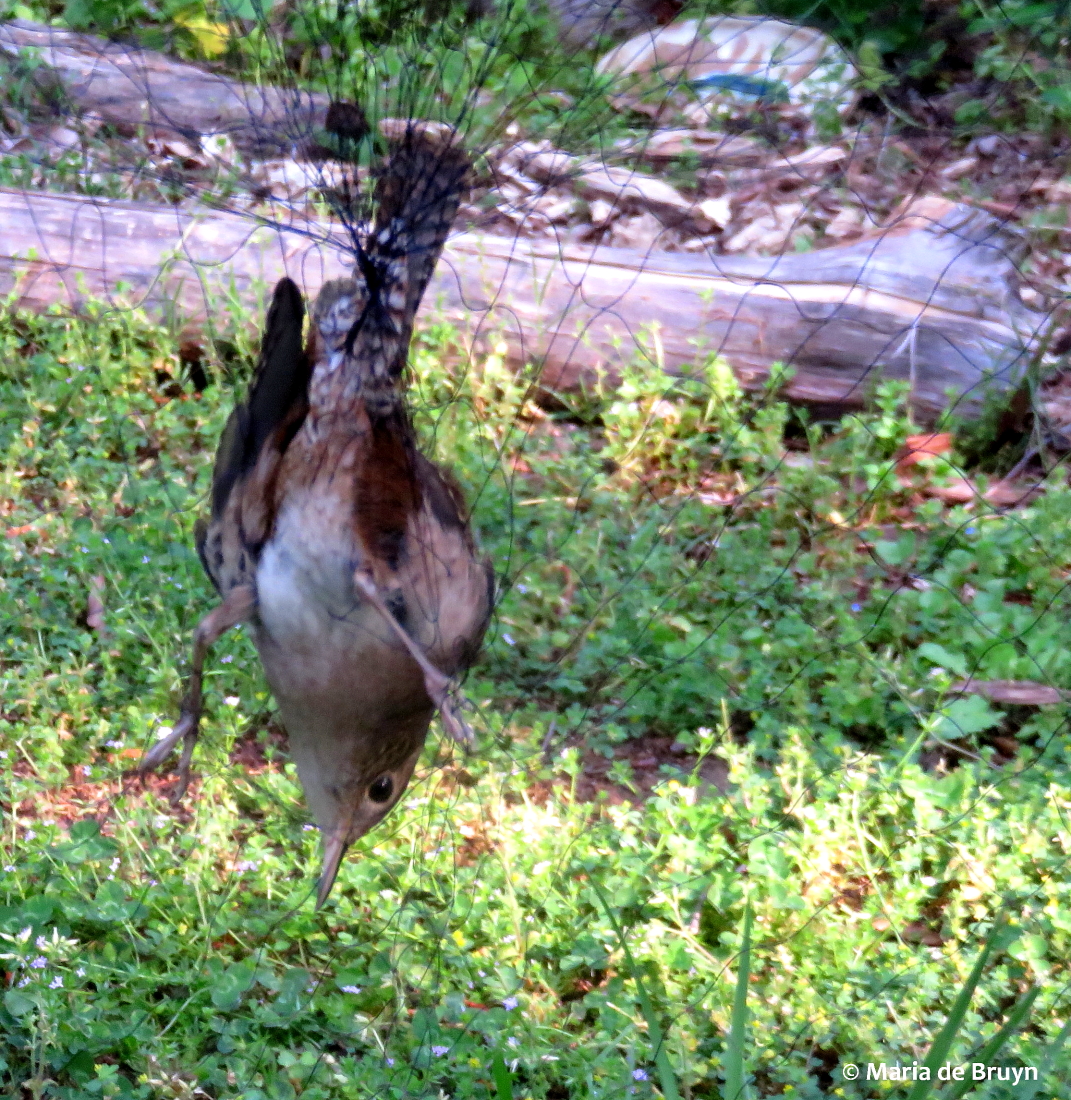
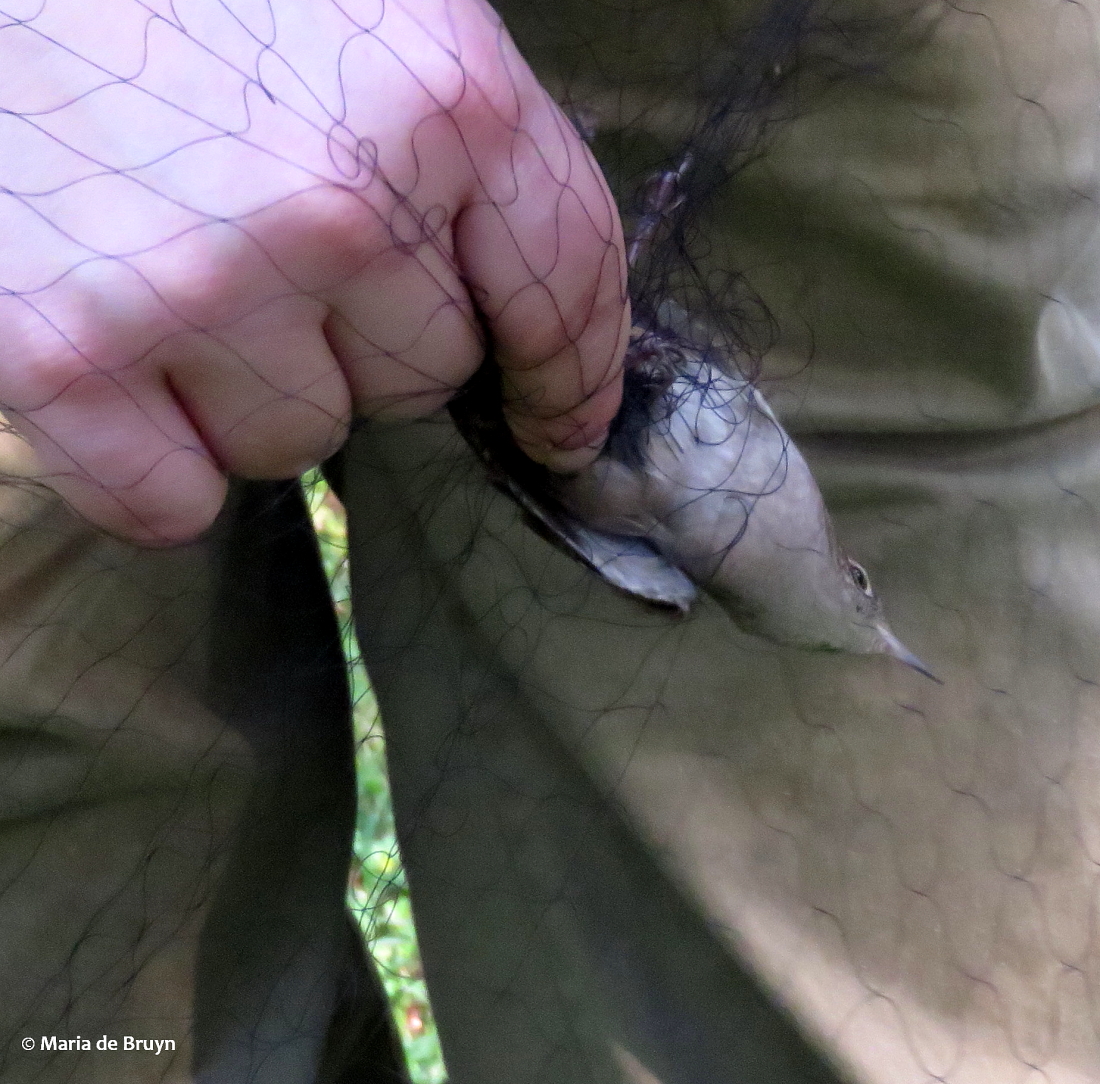
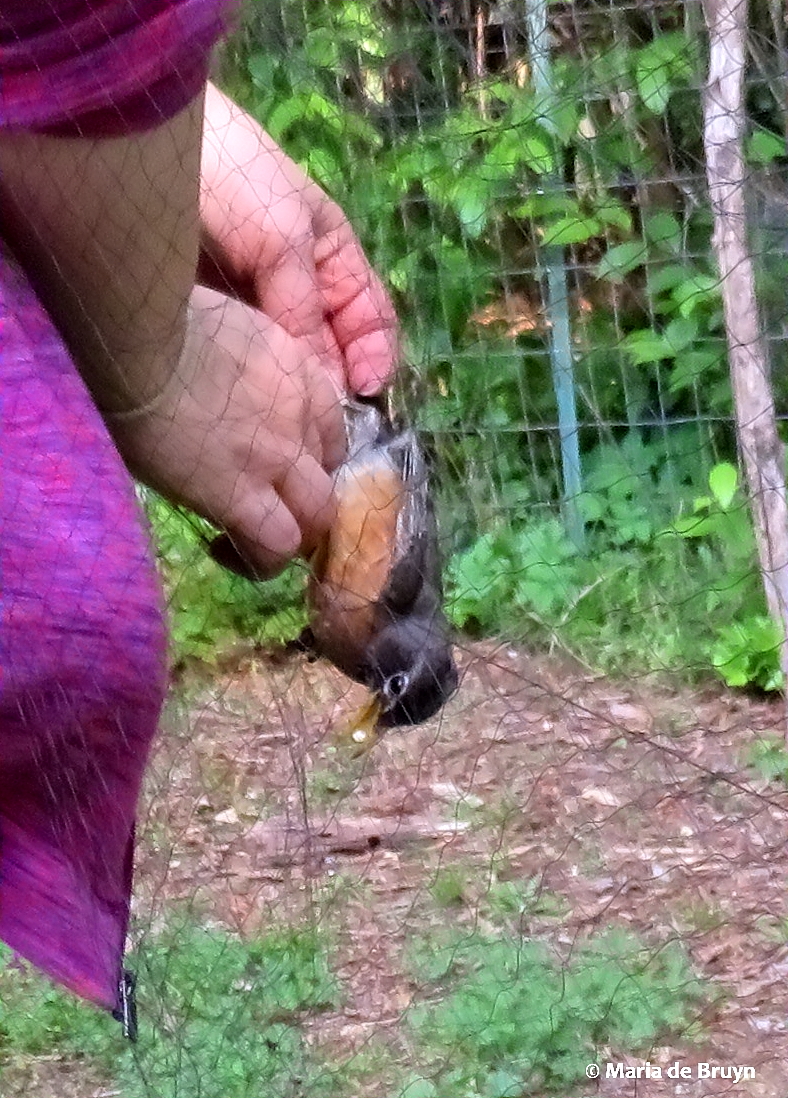
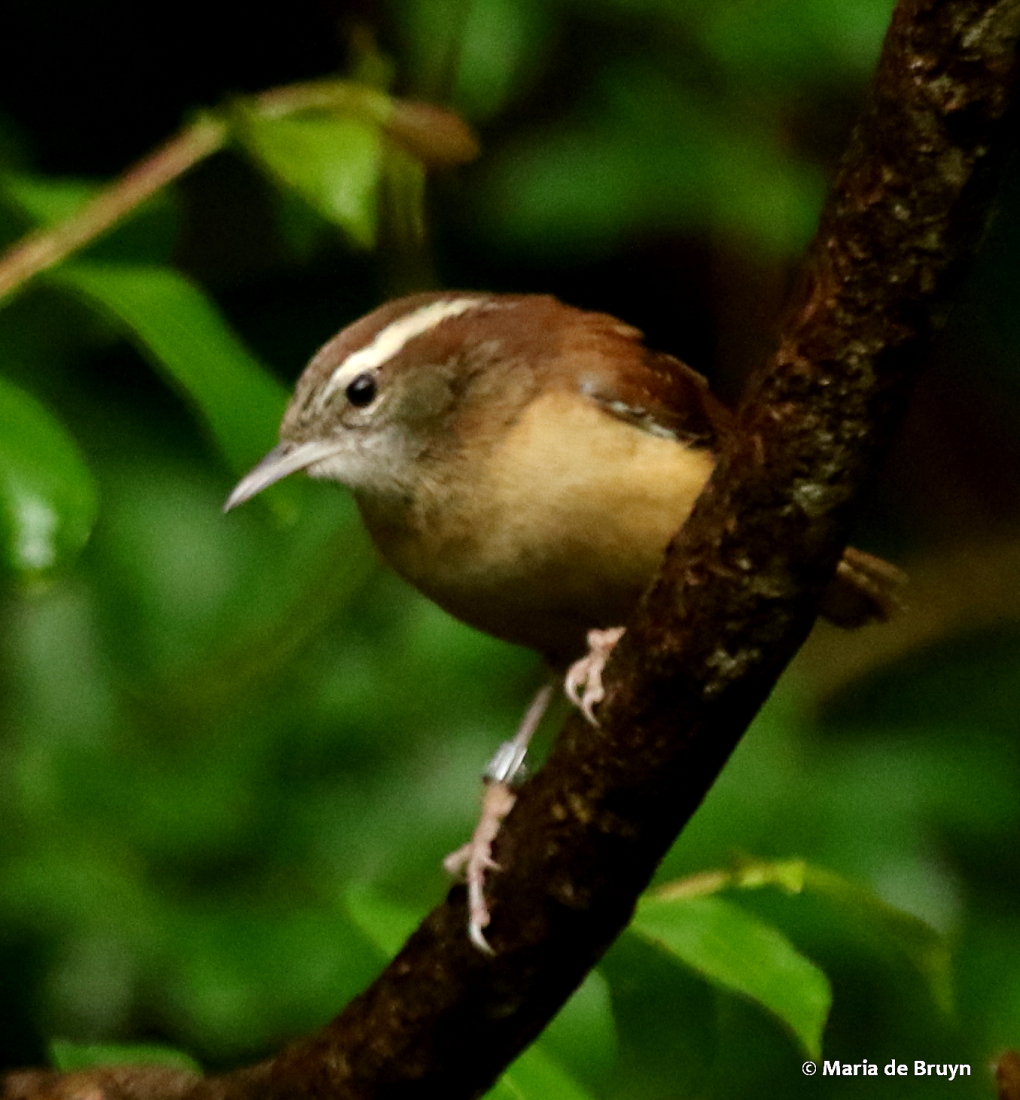
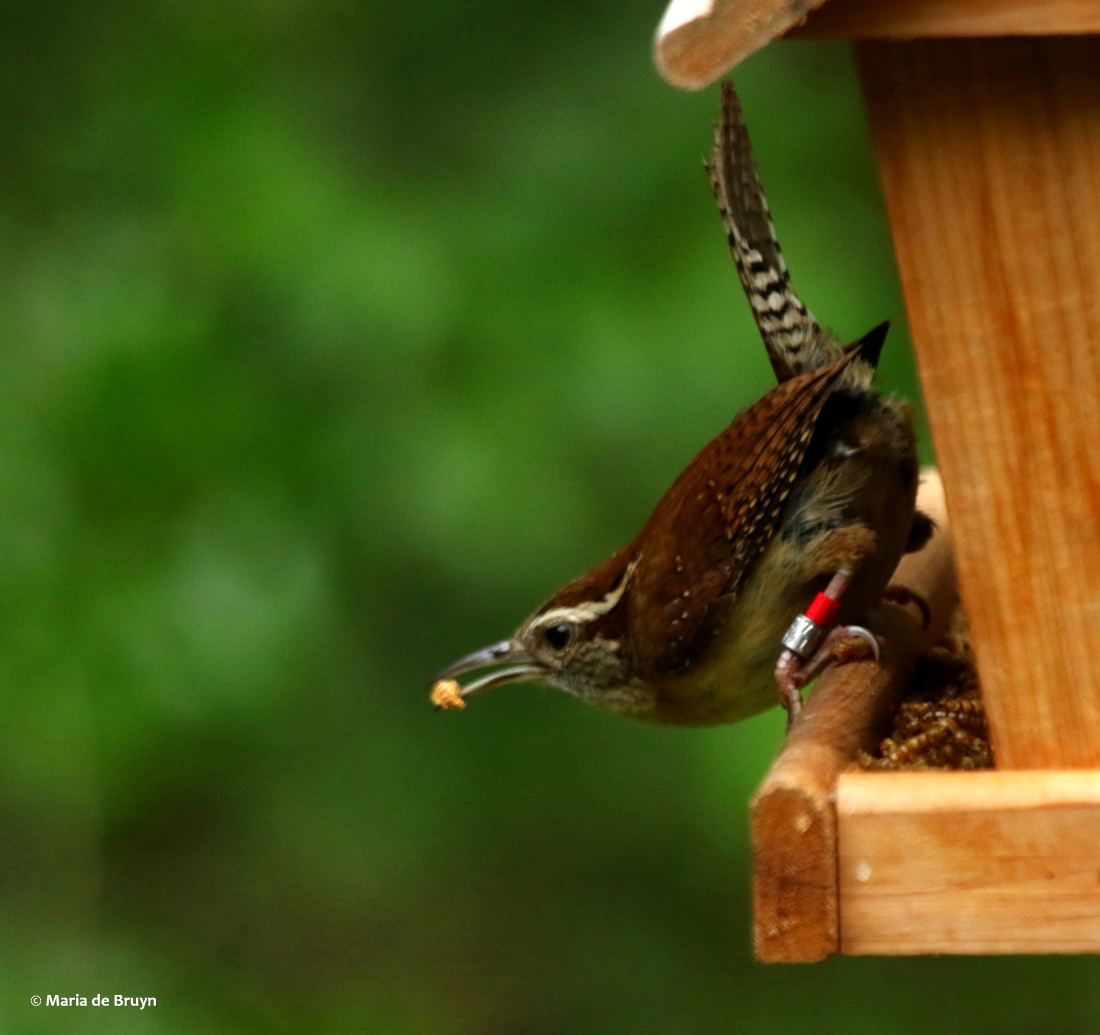
Northern cardinal Camilla I77A9127© Maria de Bruyn resThe nets had just been installed when our first visitor, a female Northern cardinal, was caught. She was not happy and when put in a bag until she could be banded, weighed, examined and measured, she did not remain still and calm. She had a little wait, however, as a female Carolina wren (Thryothorus ludovicianus) flew into the other net at just about the same time, followed by her mate within seconds. As the cardinals can tolerate being in a bag better than the smaller birds, the two wrens were banded first. Alicia let the first one go and then I released the second one, who rested on my palm for a bit. He felt so nice and soft!

Carolina wren Riley IMG_3832© Maria de Bruyn res

Forty-five minutes later, playback of a house wren’s song (Troglodytes aedon) led to the capture of a male who immediately came to investigate who was invading his territory. His mate, who was busy putting the finishing touches on a nest in a box near the mist net, didn’t go near the net.

house wren Hans IMG_3842© Maria de Bruyn reshouse wren Hans IMG_3844© Maria de Bruyn res

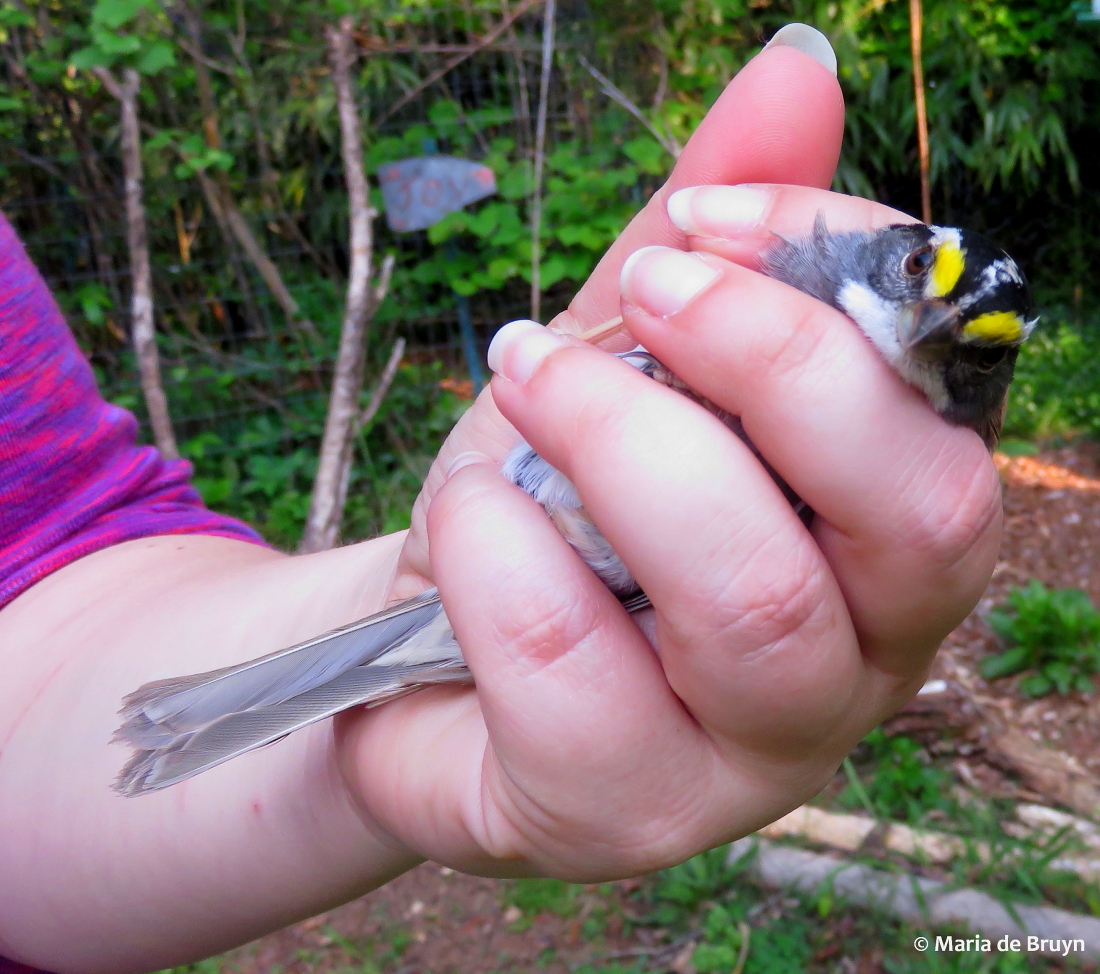
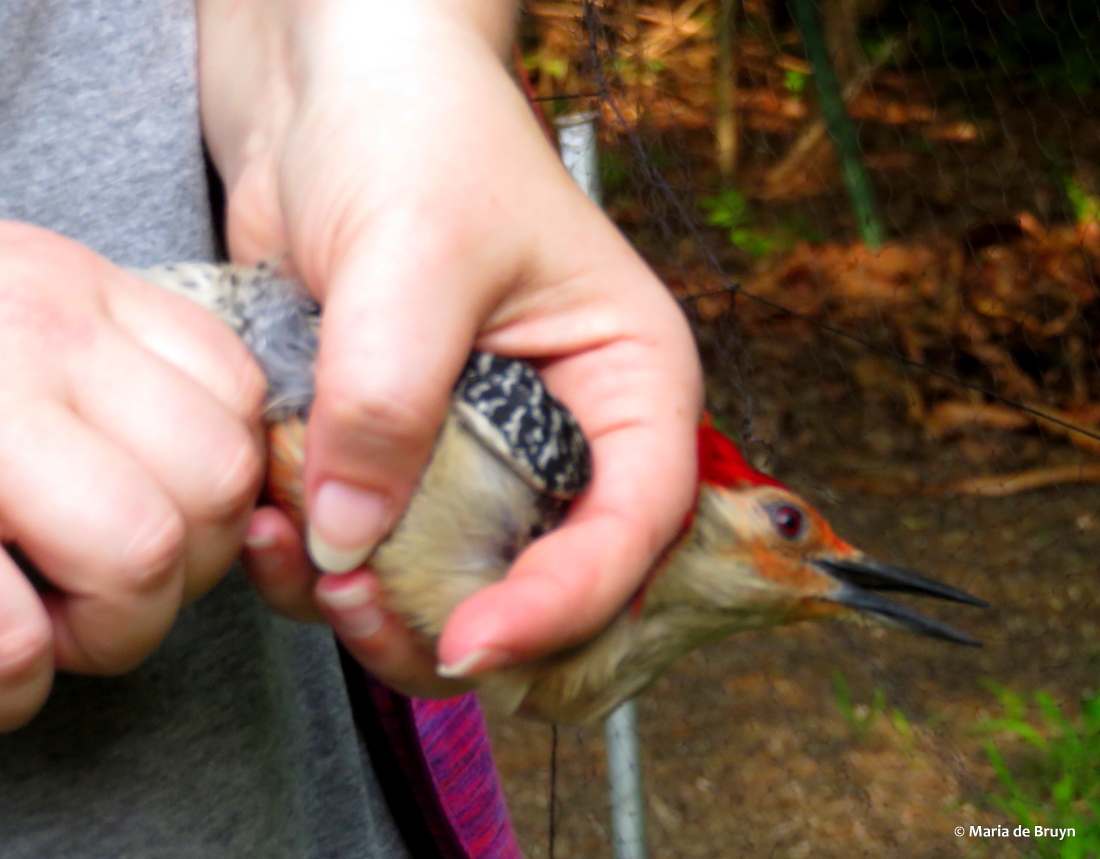
A few birds not targeted for the study ended up tangled in a net. A white-throated sparrow (Zonotrichia albicollis) had beautiful vivid breeding colors on his head. A red-bellied woodpecker (Melanerpes carolinus) was not calm like the sparrow, fluttering his wings constantly as Alicia, the bird bander, got him loose.

white-throated sparrow IMG_3837© Maria de Bruyn res red-bellied woodpecker IMG_3822© Maria de Bruyn res

Next up were a male cardinal and a female American robin. Like last year, the birds were measured and weighed. Although about the same length, the weight difference between the heaviest Northern cardinal we banded (41.2 oz) and the American robin was striking (79.6oz). The robin’s fondness for worms and other dietary preferences helps account for this. When I let her go, she didn’t feel very heavy in my hand as she rested a second before flying off.

American robin Raisin IMG_3854© Maria de Bruyn

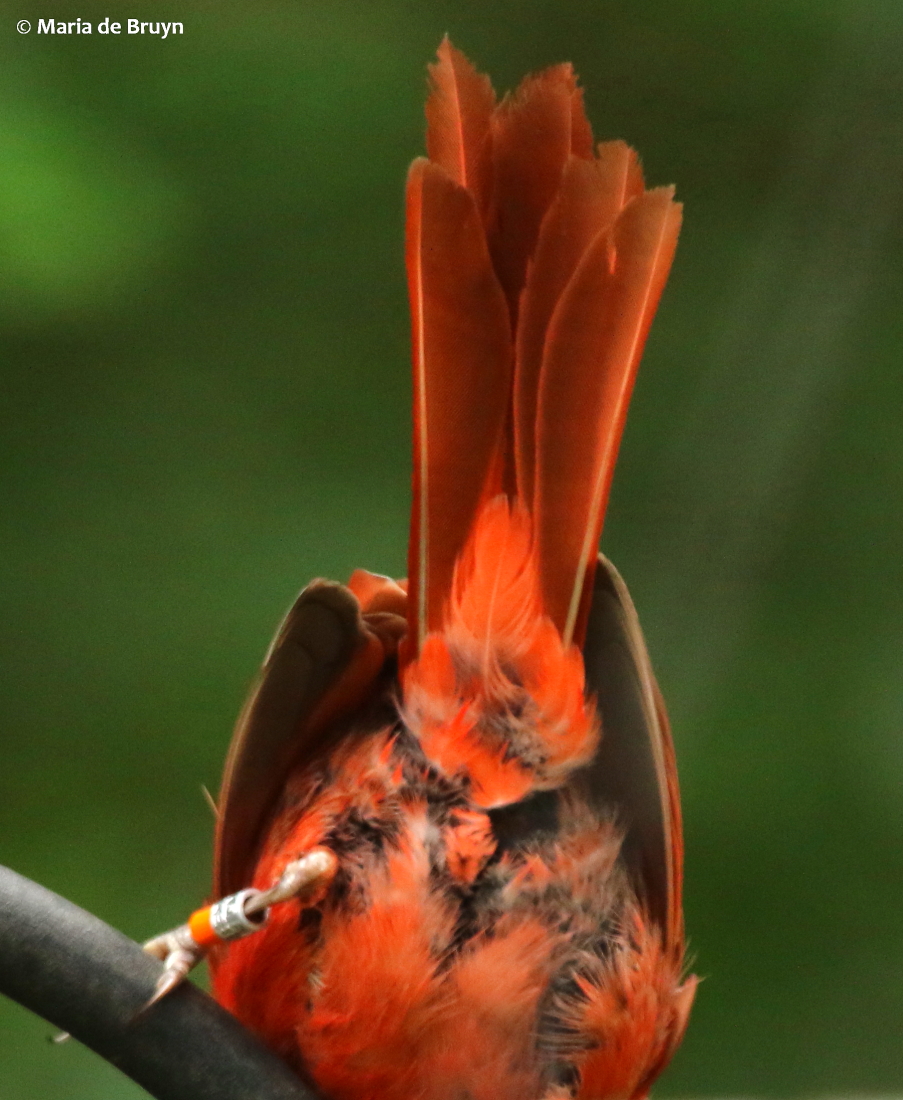
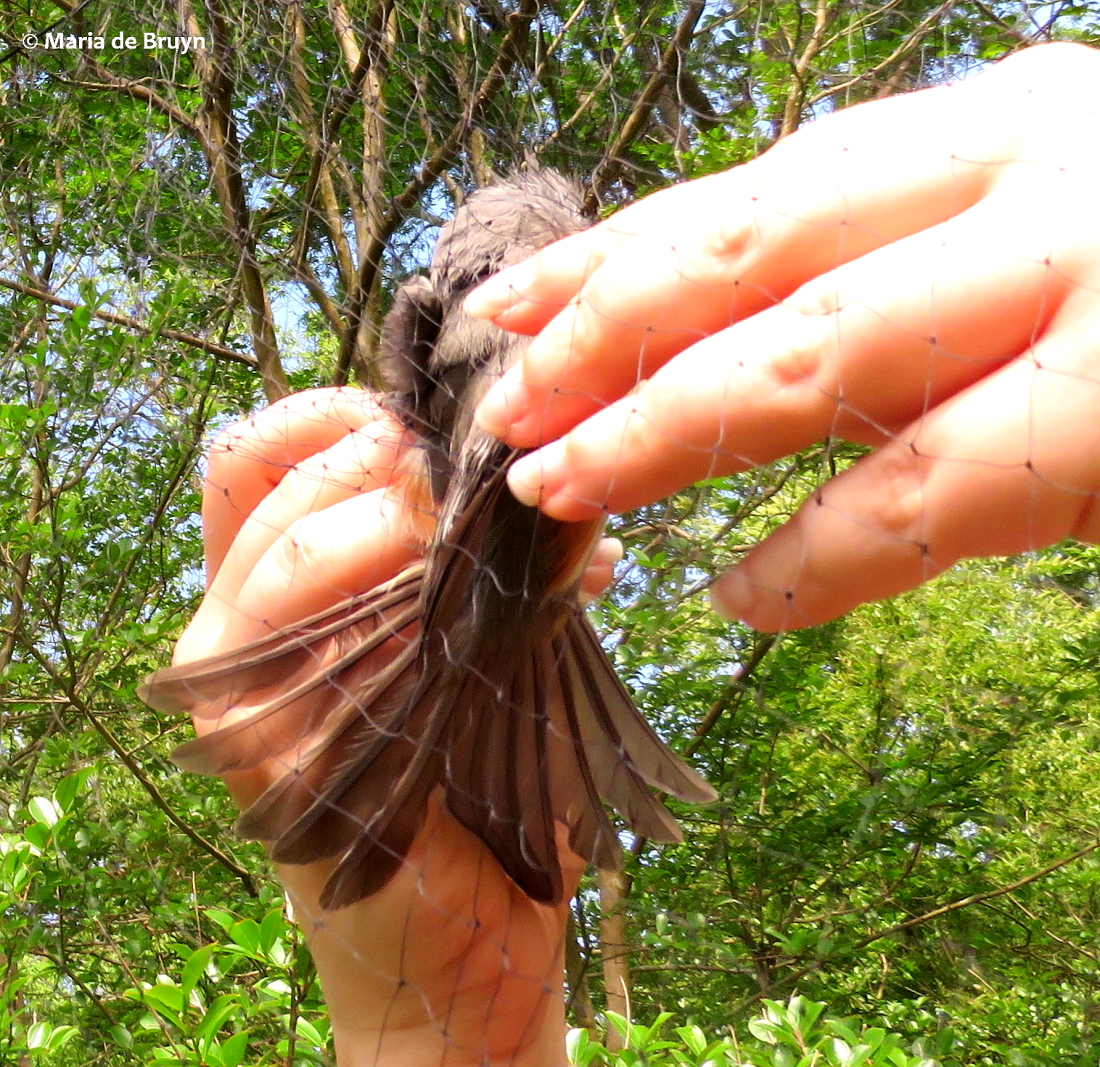
Except for birds that were molting their tail feathers, Alicia also removed the third left tail feather; this is done primarily for stable isotope analysis, which allows a researcher to estimate where the bird was when that feather was grown.

Northern cardinal Crake I77A0559© Maria de Bruyn res

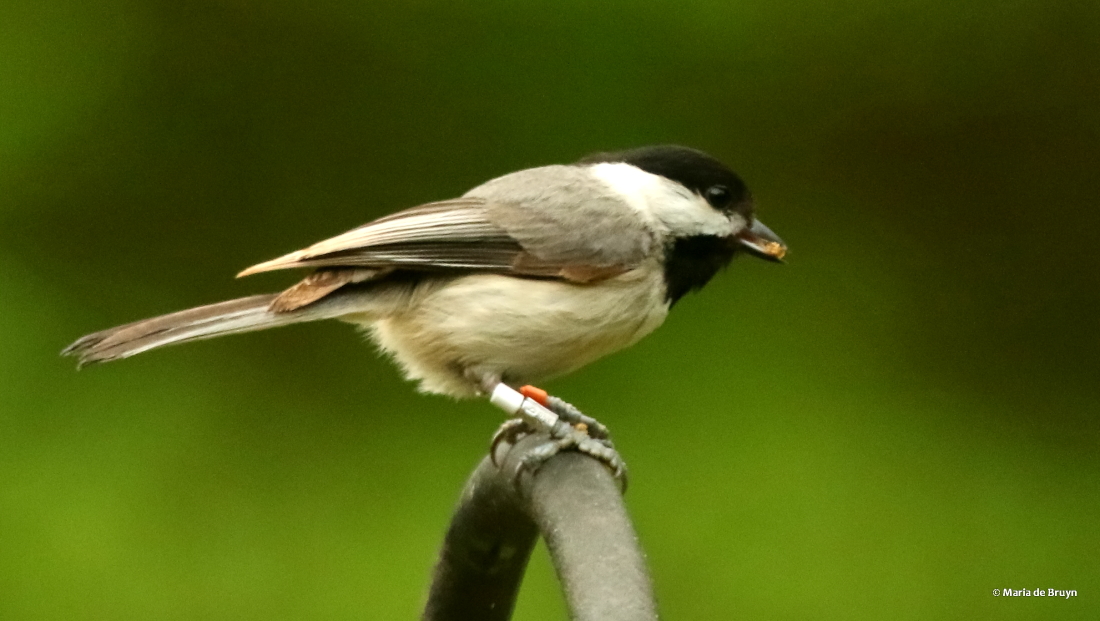
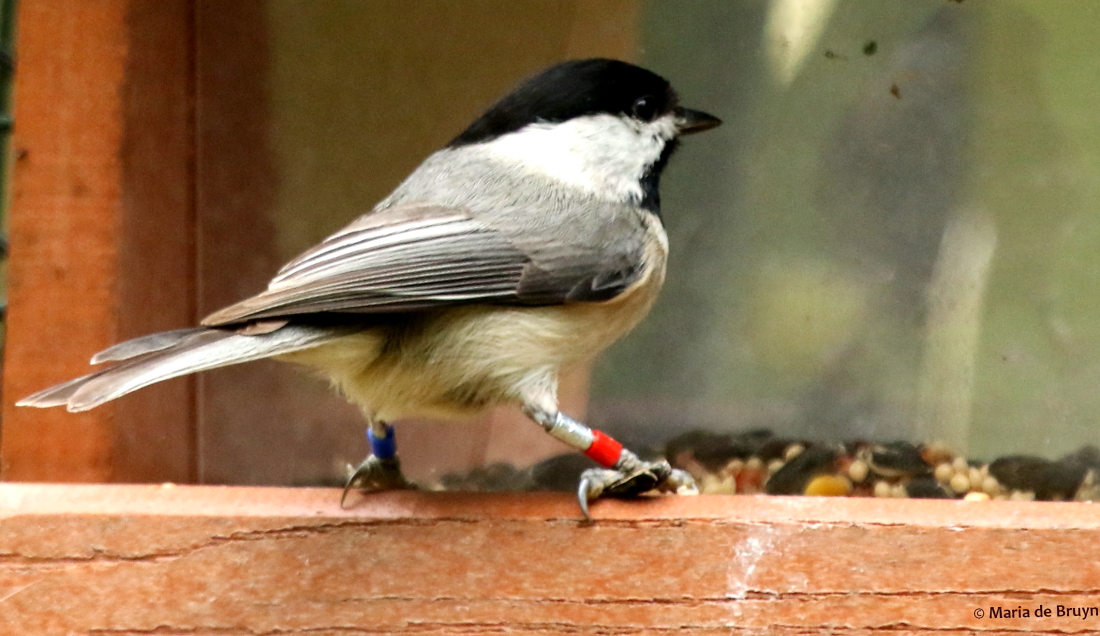
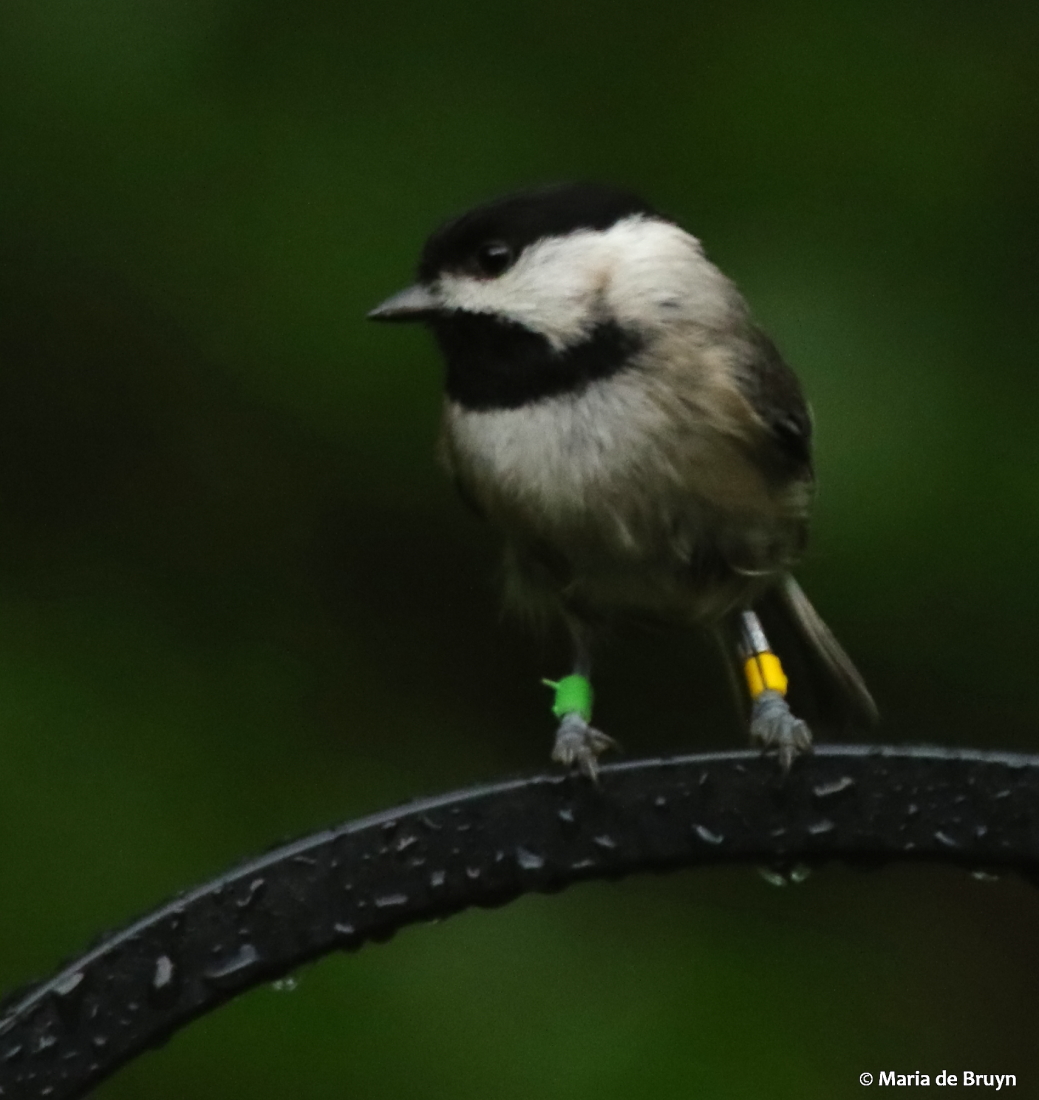
Carolina chickadee Chancey I77A7762© Maria de Bruyn resThe catbirds avoided the mist nets skillfully this year. Playback of their songs drew them to the vicinity but the two pairs visiting the feeders were more interested in chasing each other away from the territory. Alicia hoped that we could get a Carolina chickadee (Poecile carolinensis); with playback we got a male and then, 45 minutes later after banding another cardinal, we got a pair of them.

Carolina chickadee Chase I77A0348© Maria de Bruyn res Carolina chickadee Chantal I77A9525© Maria de Bruyn res

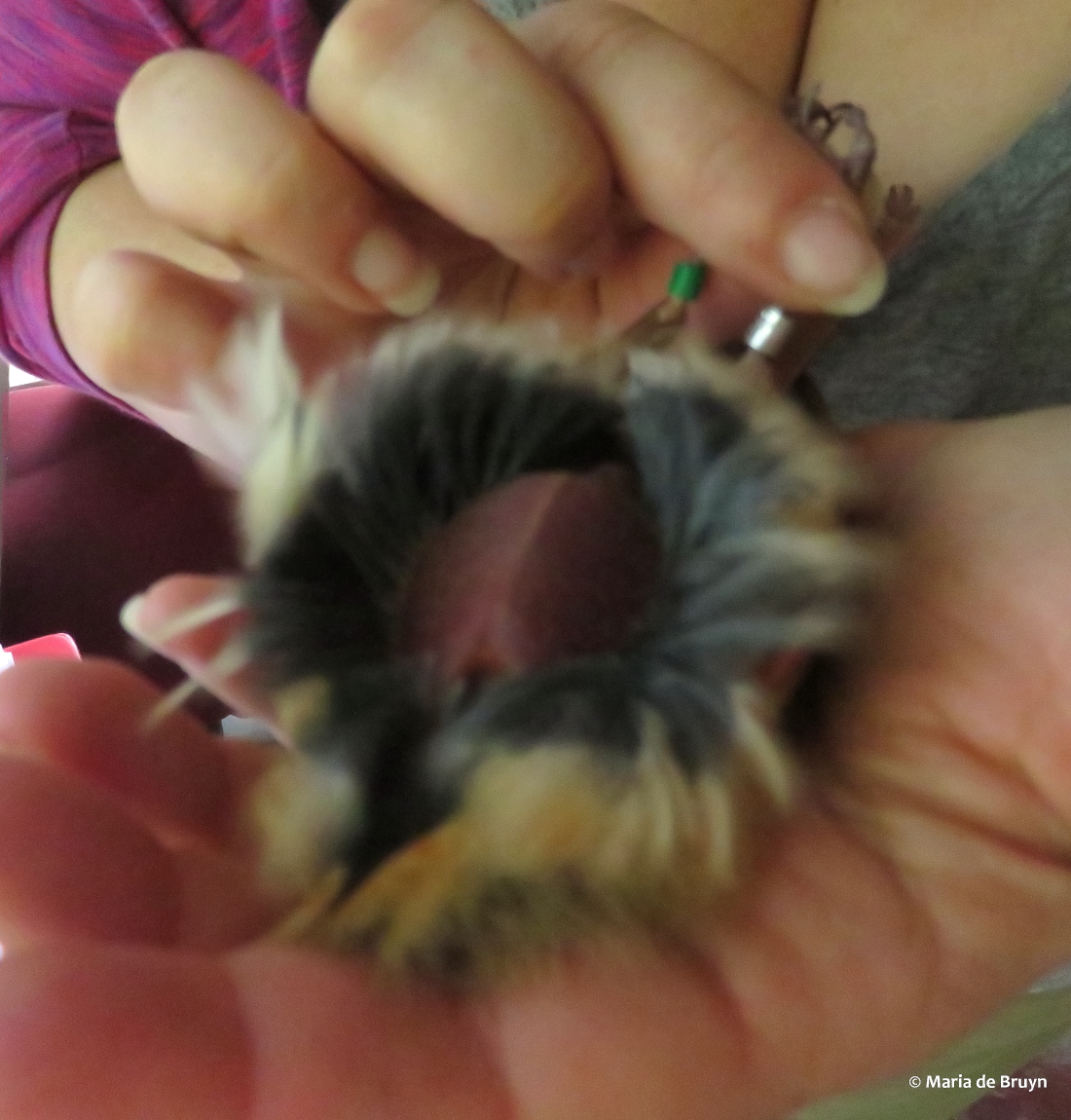
Alicia blew on the birds’ undersides (forgive the blurry photo) to assess fat reserves, which are stored along the flanks and up near the furcula by the collar bone. She could also determine sex that way and thought that one chickadee might be developing an egg – hopefully, one of the females who lost a nest to predators in my yard a week ago. The last male chickadee released was out of sorts after the experience; before leaving my hand to fly off rapidly, he turned and bit me as a parting shot.

Carolina wren Renee IMG_3813© Maria de Bruyn res Carolina chickadee IMG_3856© Maria de Bruyn res

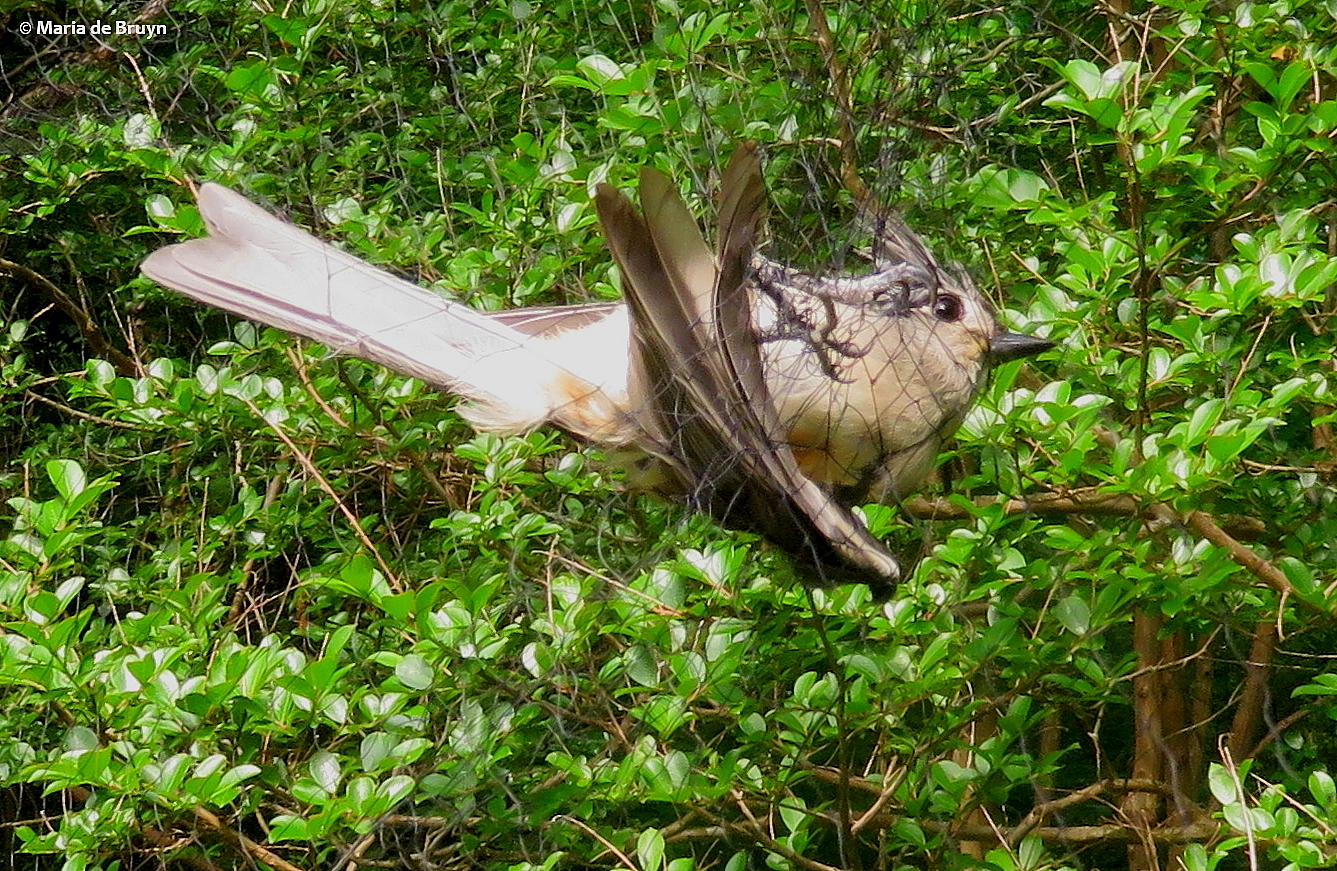
Alicia had remarked that she hoped no tufted titmouse (Baeolophus bicolor) would be caught; they are not part of the study and she said they are so feisty that their bites can be a bit painful like those of the cardinals. Unfortunately, one leaving a feeder did end up in a net and lived up to its reputation as a feisty bird. A chipping sparrow (Spizella passerina), who was the last bird in a net remained fairly calm as the net was removed from its claws.

tufted titmouse IMG_3858© Maria de Bruyn res

Tufted titmouse IMG_3861© Maria de Bruyn res

Yesterday, I spent some time watching the feeders and yard to see if all the banded birds had left. Luckily, some of them showed up and were here again today. So here are a few of “my birds” with bling – this is a truly enjoyable citizen science project. 🙂

Northern cardinal Clarence I77A0124© Maria de Bruyn res Northern cardinal Crake I77A0593© Maria de Bruyn res

Clarence                                                                       Crake

Carolina wren Renee I77A9354© Maria de Bruyn resCarolina wren Riley I77A0508© Maria de Bruyn res

Renee and Riley Carolina wrens


A wildflower walk with surprises!

owl IMG_3036© Maria de Bruyn resThis past Saturday morning, we awoke to water streaming from the heavens in quite a heavy downpour. A local conservation group, Friends of Bolin Creek, had scheduled a wildflower walk to see some of our ephemeral spring blooms but the wet conditions were not inviting. A decision to postpone the walk to early afternoon was taken – and the weather-people had gotten it right – the sun began shining at mid-day and the temperature rose, creating lovely conditions for a walk after all. A large owl (later revealed to be granddaughter Kate of the group’s president) greeted the small group of intrepid walkers and we set off to see what we could find.

Southern arrowwood IMG_3039© Maria de Bruyn res

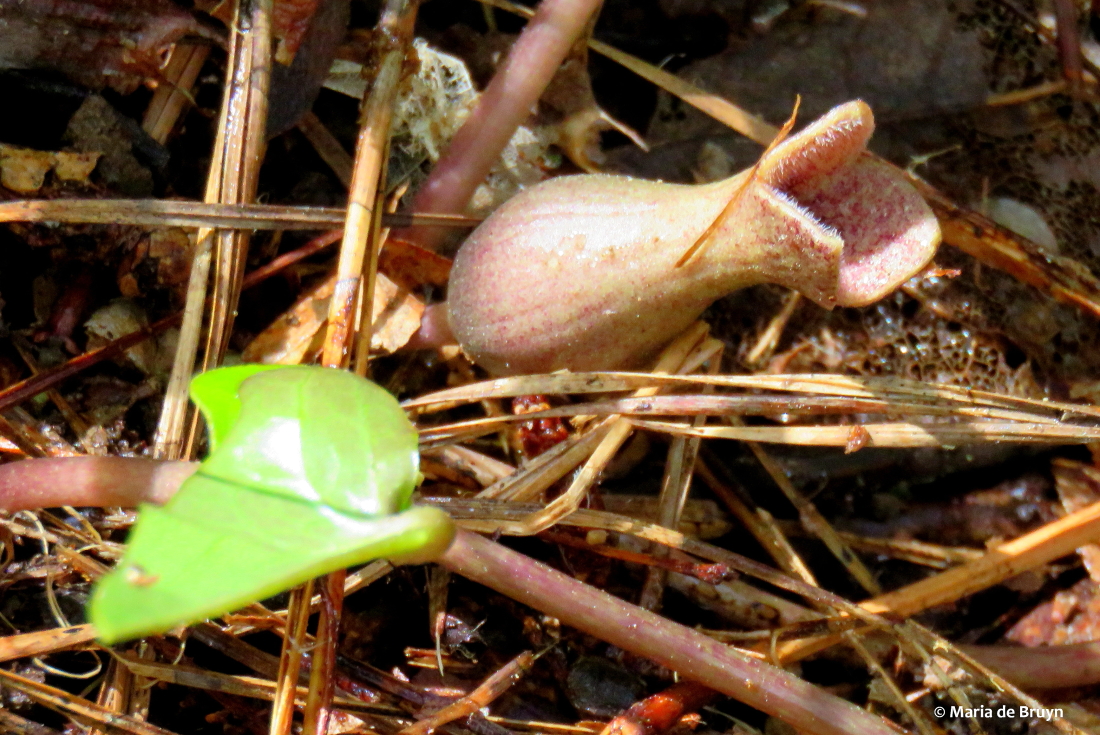
Our first flowers were the not-yet-open blooms of a Southern arrowwood (Viburnum dentatum). We passed numerous black and yellow millipedes on the paths and then found another millipede species (Narceus americanus) curled up next to a little brown jug (also known as arrowleaf heartleaf, Hextastylis arifolia var arifolia).

millipede IMG_3052© Maria de Bruynlittle brown jug IMG_3048© Maria de Bruyn

We came across other nice specimens of the plant, including one with four small flowers.

little brown jug IMG_3138© Maria de Bruynlittle brown jug IMG_3141© Maria de Bruyn

The painted buckeye trees (Aesculus sylvatica) were blooming profusely with their greenish-yellow flowers.

painted buckeye IMG_3070© Maria de Bruynpainted buckeye IMG_3492© Maria de Bruyn


Eastern spring beauty IMG_3089© Maria de Bruyn


Clusters of Eastern spring beauties (Claytonia virginica) were in their vicinity.


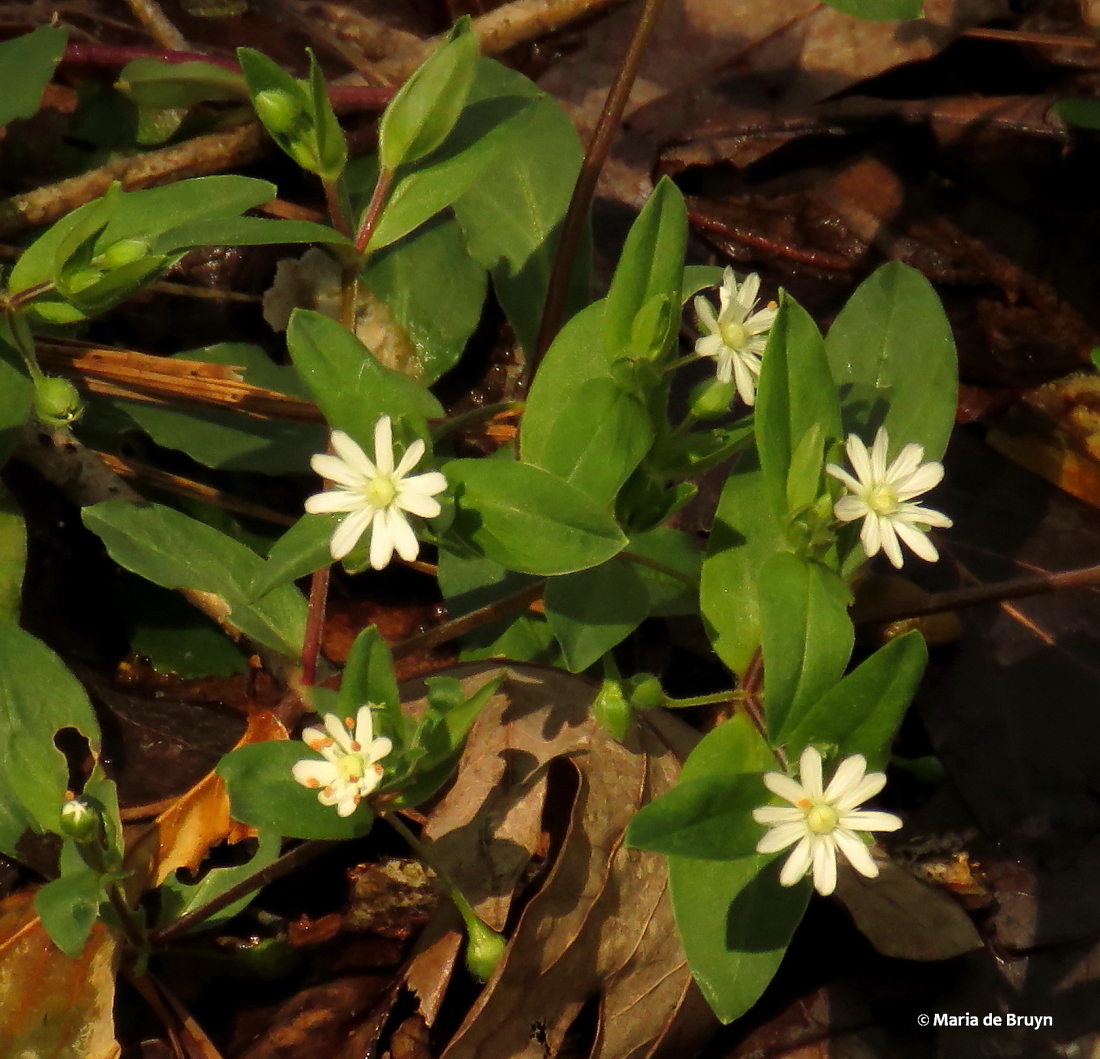
star chickweed IMG_3095© Maria de Bruyn


Some of the star chickweeds (Stellaria pubera) were near another white bloom, the rue anemones (Thalictrum thalictroides).


rue anemone IMG_3110© Maria de Bruyn rue anemone IMG_3109© Maria de Bruyn

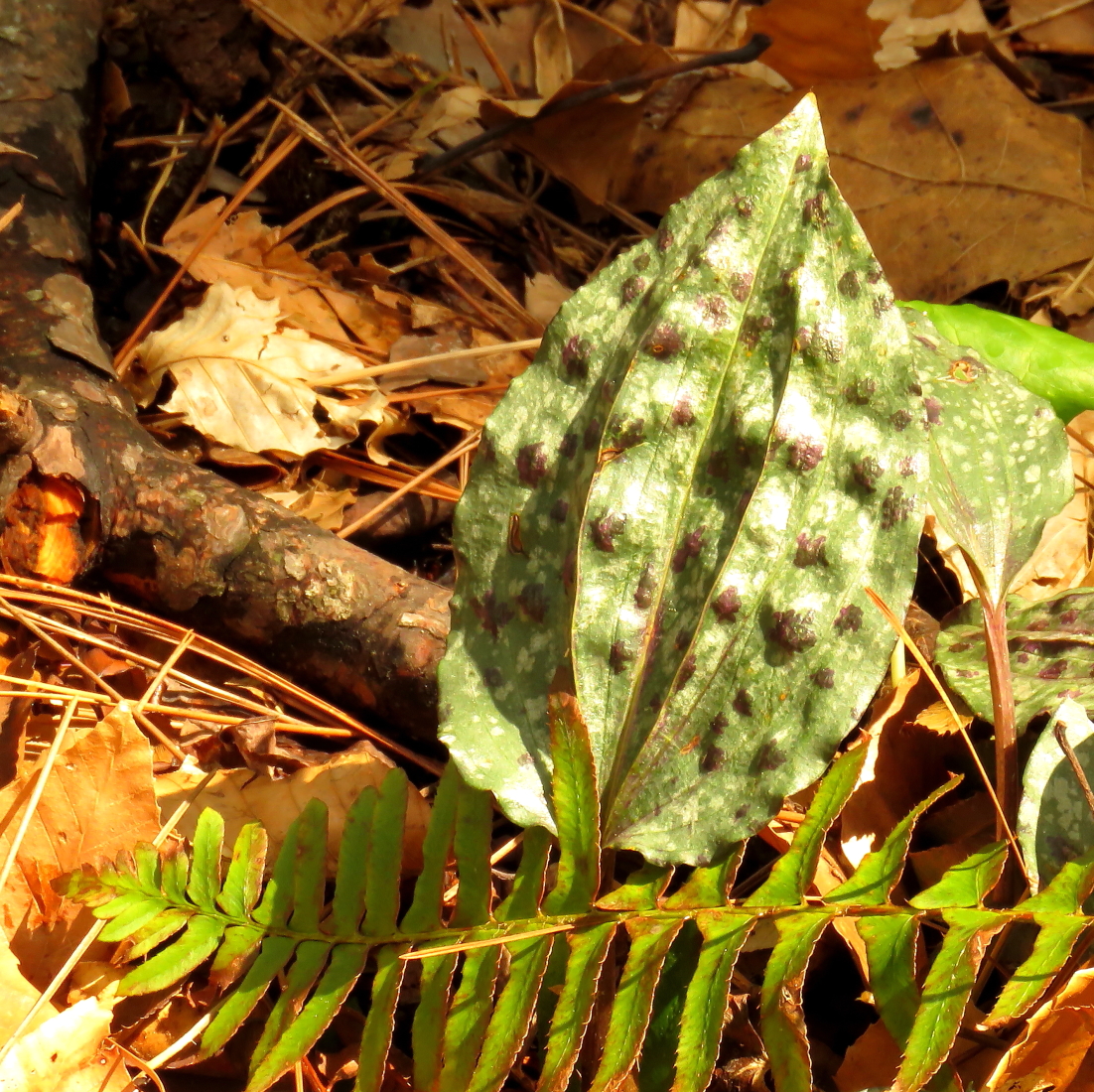
Both the trout lilies (Erythronium americanum) and cranefly orchids (Tipularia discolor) had already bloomed, the trout lilies about 7-10 days ago and the orchids in the winter (when there are no leaves). One orchid had left behind its brown stalk as a witness to the flower that had seen the light.

trout lily IMG_3156© Maria de Bruyncranefly orchid IMG_3148© Maria de Bruyn

Tiny bluets (Houstonia pusilla) in clusters here and there provided some variation from the ubiquitous white blooms that we were seeing. The mayapples (Podophyllum peltatum) were just emerging and it will be a little while before we see their flowers emerge underneath the leafy umbrellas.

tiny bluet IMG_3118© Maria de Bruynmayapple IMG_3196© Maria de Bruyn


Bolin creek IMG_3165© Maria de BruynThe creek was running high and fast and we debated on crossing it at the first branch. Only two of us had wellingtons (and one lady found that her boots leaked); others were wearing running and walking shoes but everyone made it across by using stones, canes and walking sticks that some of our group had brought along. Our immediate reward was a view of a gorgeous pinxterbloom wild azalea (Rhododendron periclymenoides).

pinxterbloom azalea IMG_3174© Maria de Bruyn

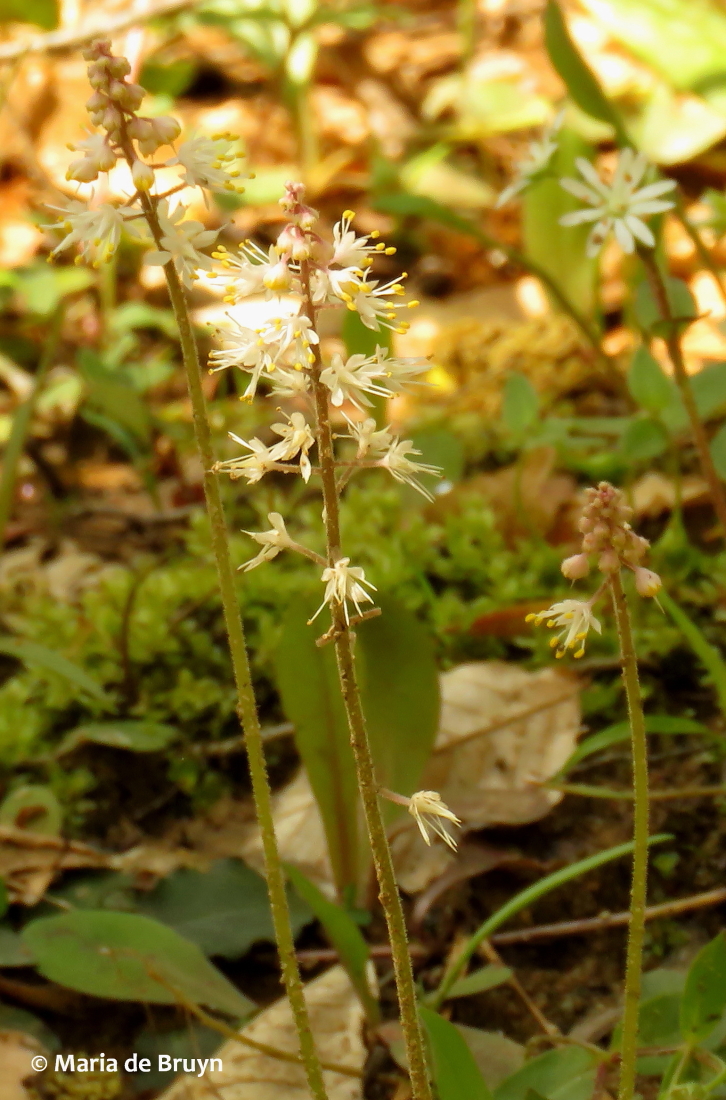
foamflower IMG_3180© Maria de Bruyn


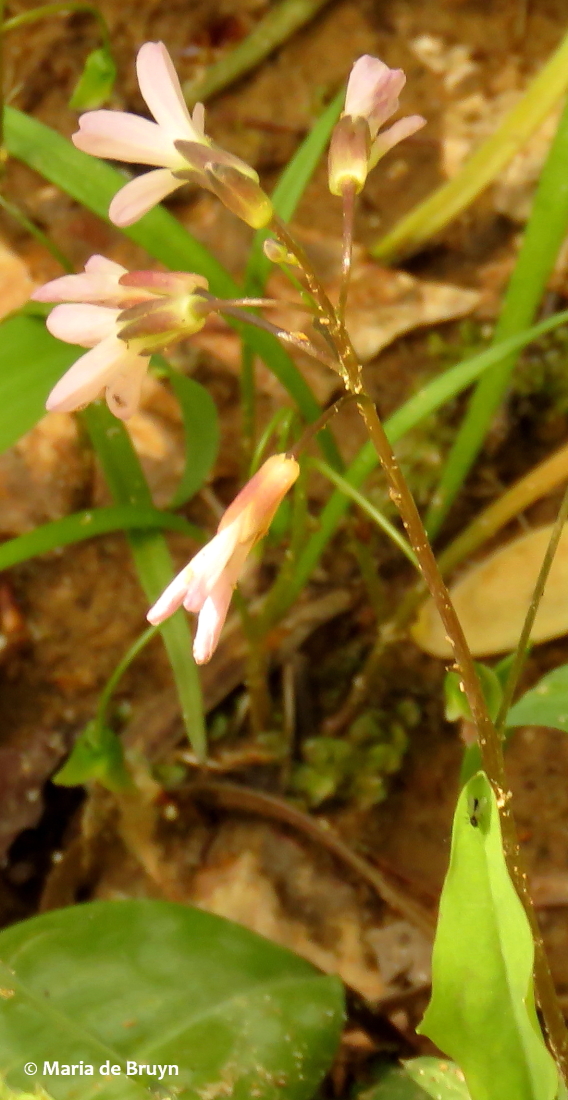
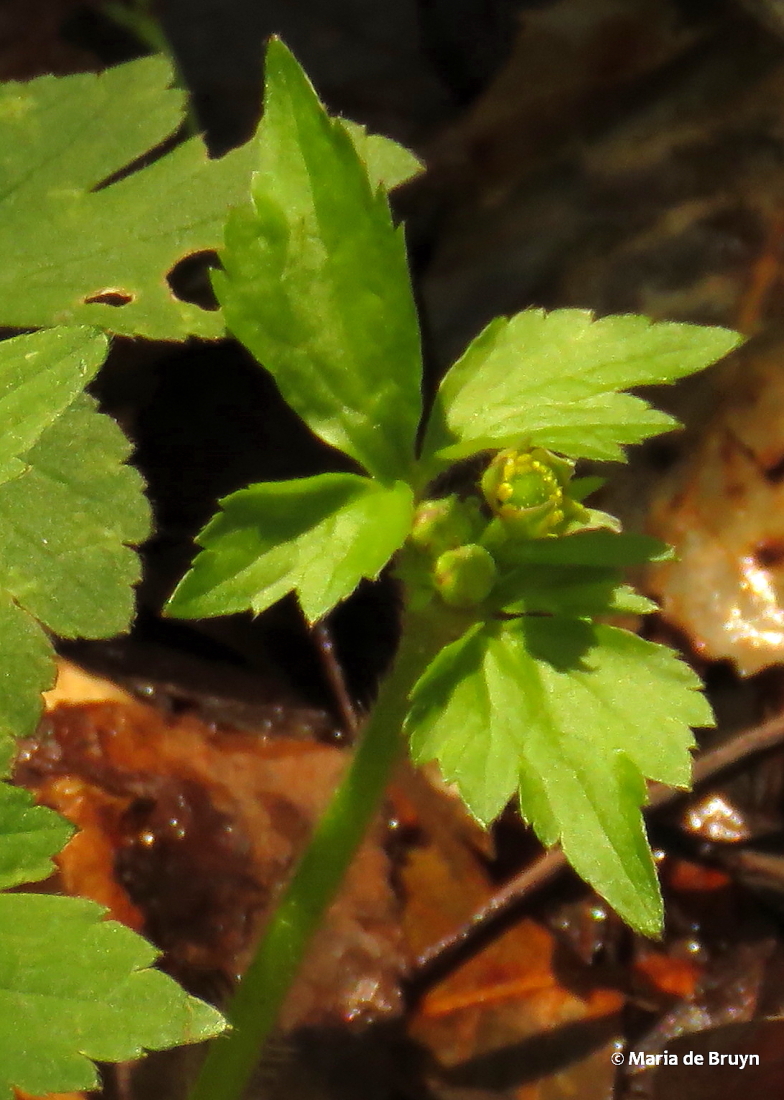
A sighting of a foamflower (Tiarella cordifolia), followed by a cutleaf toothwort (Cardamine concatenata) provided a bit more color, as did the littleleaf buttercup (Ranunculus abortivus), although its blooms were not fully expanded yet.


cutleaf toothwort IMG_3187© Maria de Bruynlittle leaf buttercup IMG_3092© Maria de Bruyn

Only the jigsaw puzzle-like leaves of the bloodroot (Sanguinaria canadensis) were in evidence as that flower had stopped blooming already. A tufted titmouse singing overhead (Baeolophus bicolor) gave us a nice little concert as compensation.

bloodroot IMG_3198© Maria de Bruyn tufted titmouse IMG_3201© Maria de Bruyn

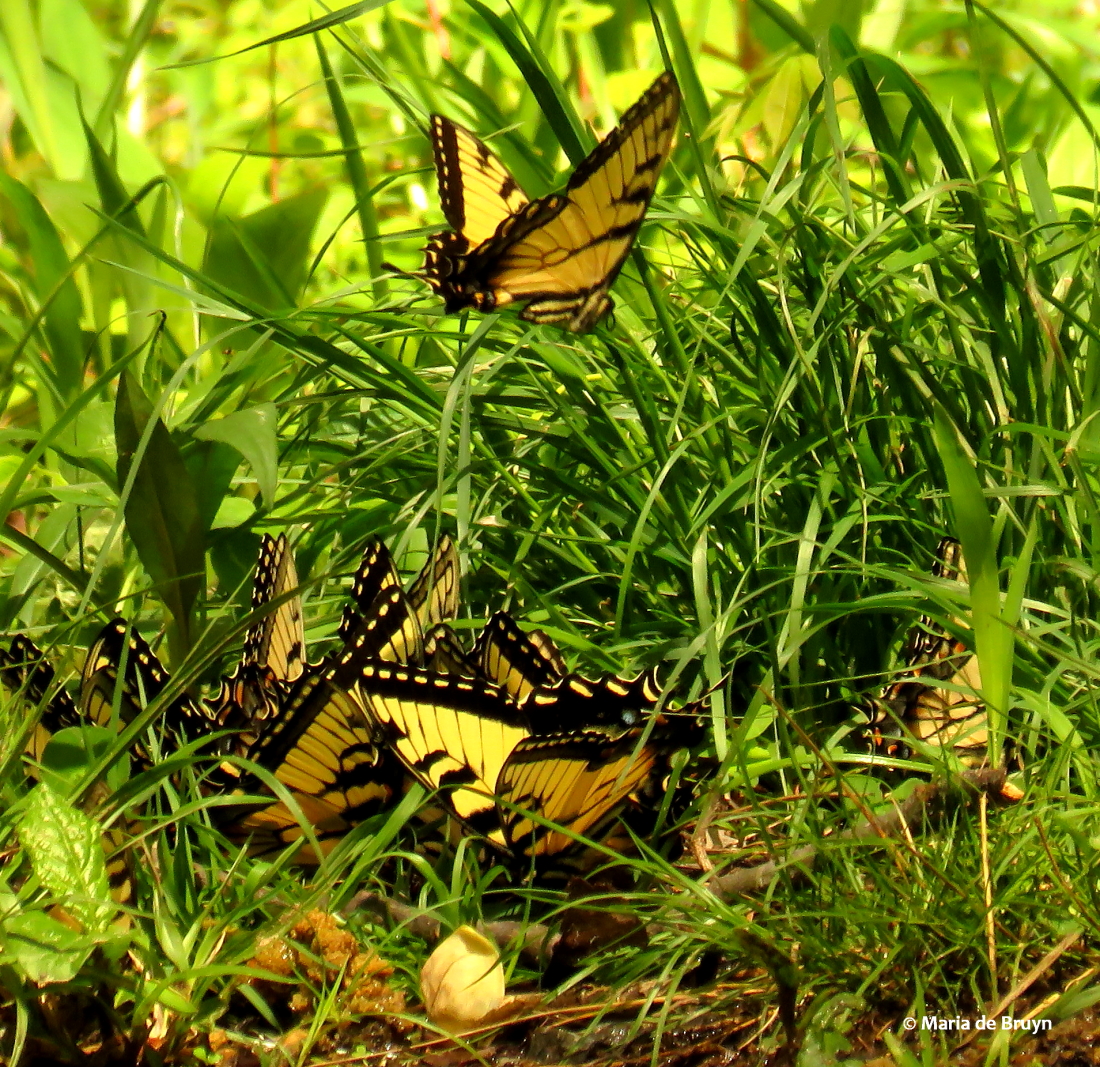
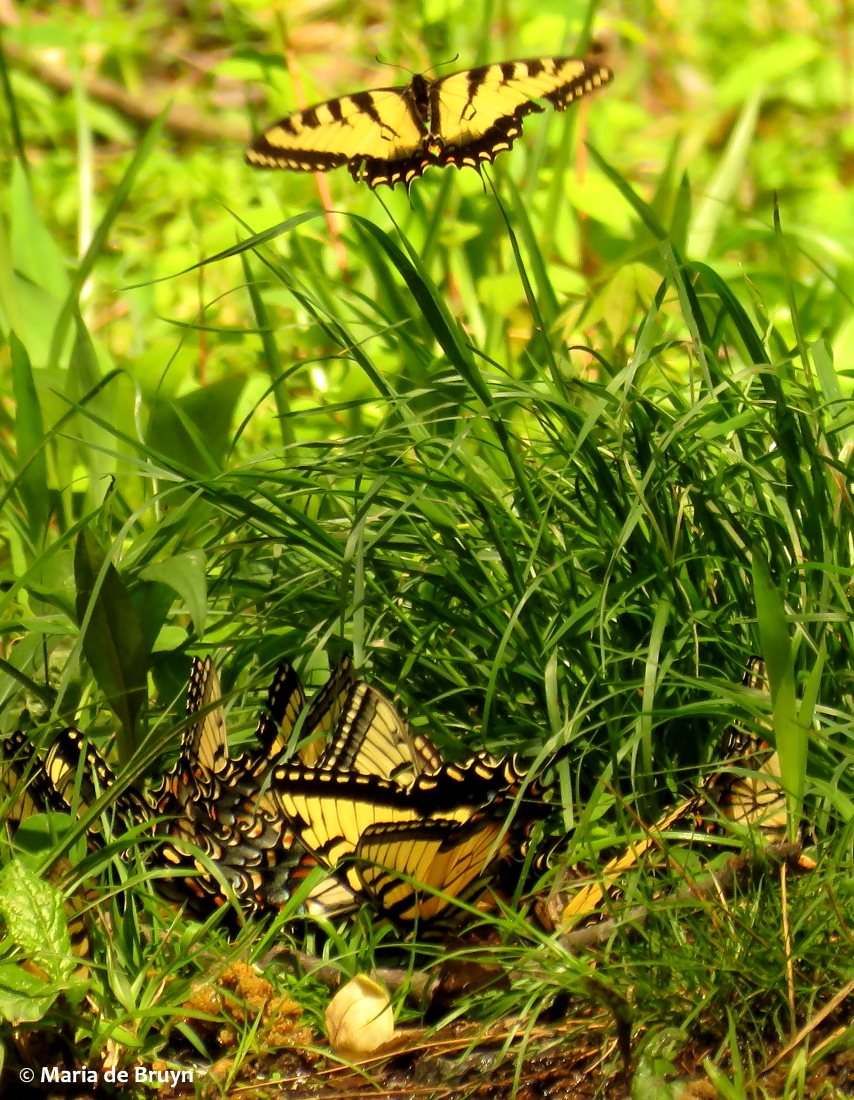
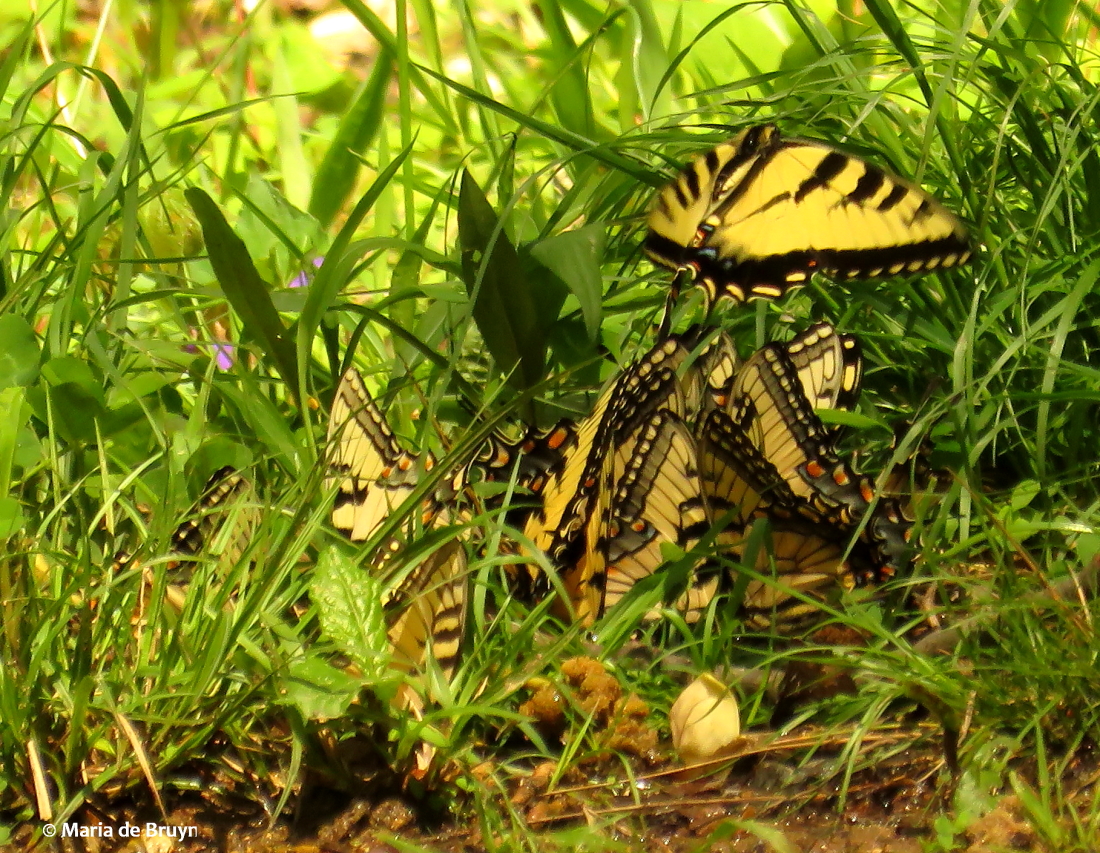
Eastern tiger swallowtail IMG_3428© Maria de Bruyn resAnd then we came across our three surprises of the walk. We had already seen several Eastern tiger swallowtail butterflies (Papilio glaucus) fluttering by in one’s and two’s and we remarked how welcome they were because of the paucity of butterflies we had had the past couple years. But then across another branch of the creek, we spotted some 12-20 butterflies congregating over some delicacy of unknown (to us) origin.

Eastern tiger swallowtail IMG_3259© Maria de Bruyn res Eastern tiger swallowtail IMG_3263© Maria de Bruyn res

The water was fairly deep and flowing fast, so we did not cross but we surmised that someone’s dog had left a pile of poo to provide a mud-puddling butterfly feast.

Eastern tiger swallowtail IMG_3443© Maria de Bruyn res Eastern tiger swallowtail IMG_3447© Maria de Bruyn res

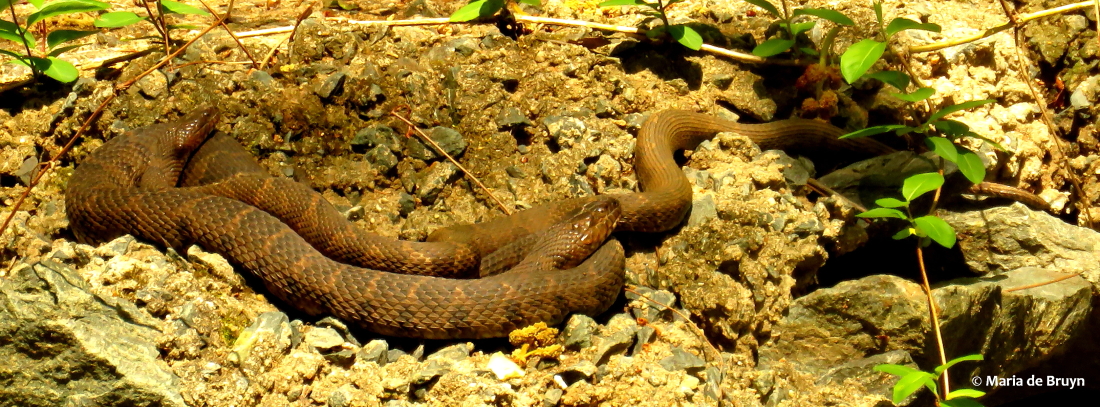
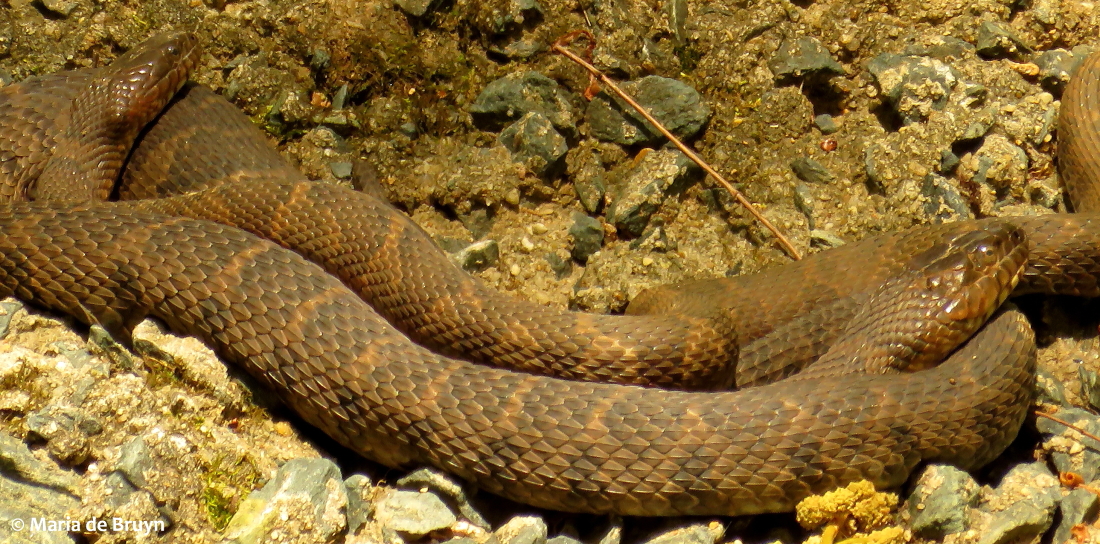
Then we noticed on a rock just below the bank under the butterflies where two Northern watersnakes (Nerodia sipedon) were having a little rest.

northern watersnake IMG_3406© Maria de Bruyn

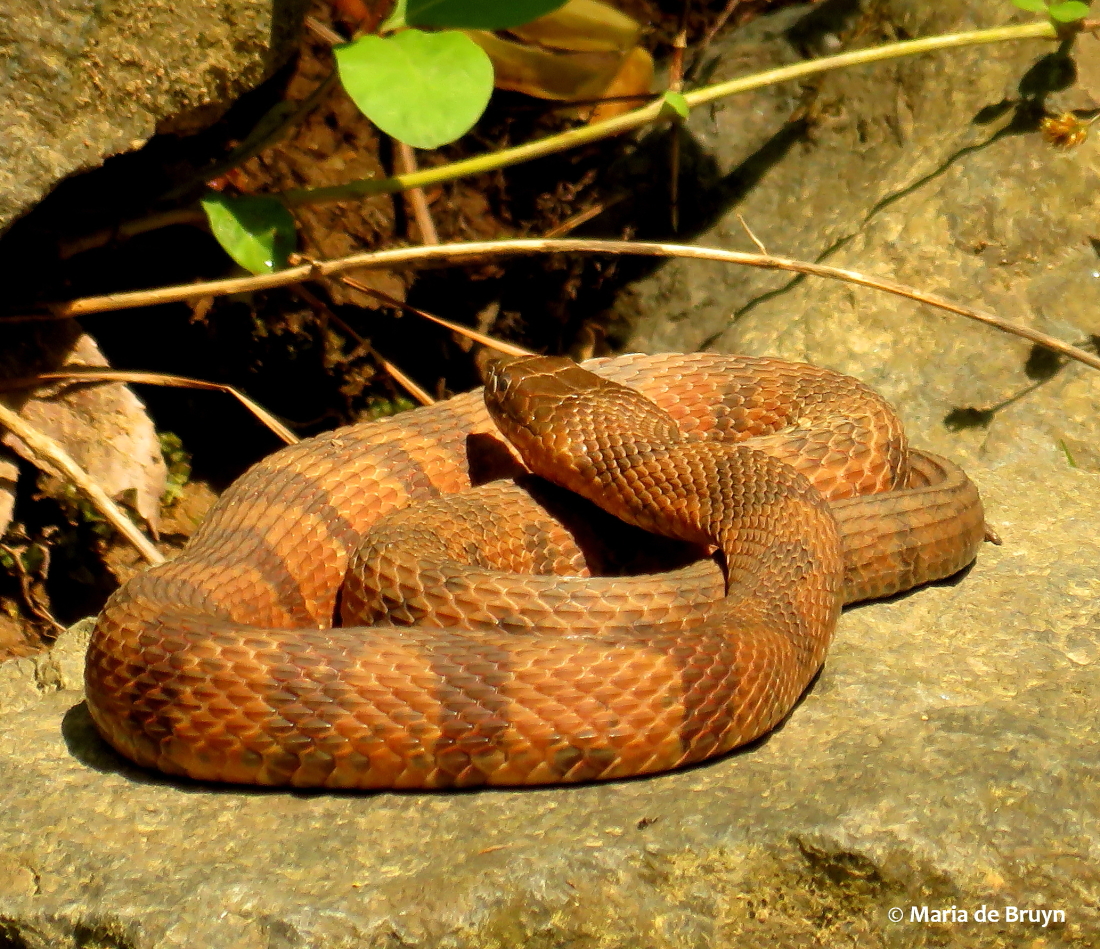
northern watersnake IMG_3408© Maria de BruynThey were a bit dull in color, which became quite obvious when compared to a third northern watersnake that we spotted on a rock closer to the creek – perhaps a younger individual who had decided that a sunbath was just the thing for a Saturday afternoon.

northern watersnake IMG_3241© Maria de Bruyn northern watersnake IMG_3349© Maria de Bruyn

While we were all enamored with the flowers we’d seen, the butterflies and snakes gave our walk a special feel.

bugleweed IMG_3501© Maria de Bruyn


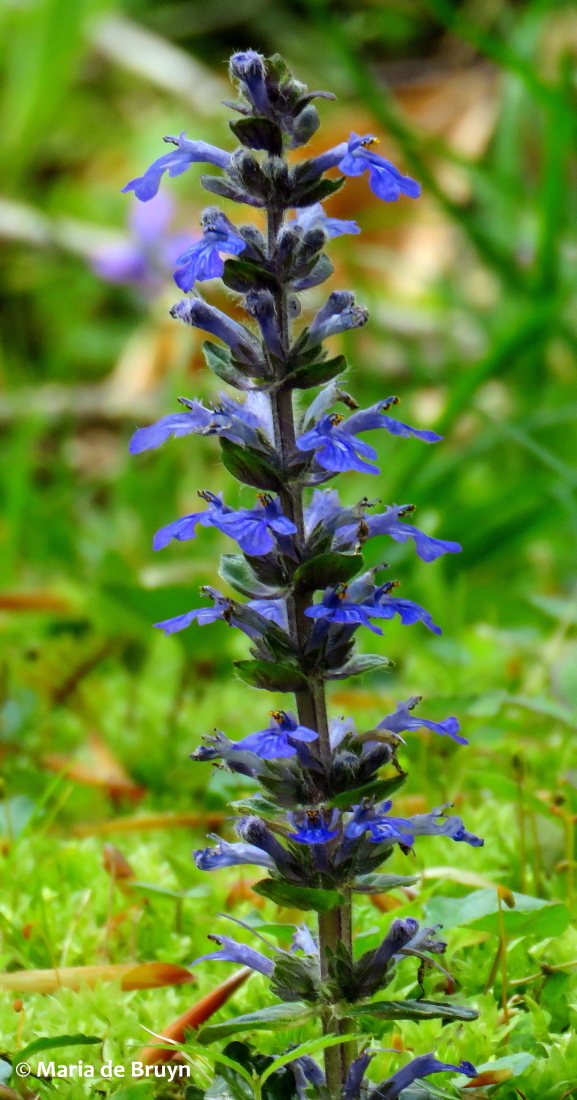
On our return trip through the woods to reach our transportation, we came across an invasive plant, the bugleweed (Ajuga reptans). We had already seen plenty of Japanese wisteria, mahonia, privet and autumn olive and agreed that another volunteer day to weed out some invasives would be a good contribution to the preserve. But that is for the future – right now, we are happy to think back to our surprise spottings!