Braeburn Farm is for the birds!

I don’t often get the chance to visit a farm (other than organized farm tours, which are a bit pricey and then might be crowded). Last year, I was invited to one during an annual llama shearing, which was educational. This year, however, I’ve had the chance to visit Braeburn Farm four times so far because the owner and manager have decided to make it a nature reserve as well as a cattle farm. Nick, the land manager, is a birder who is more than willing to share his knowledge with the visitors.

pond I77A6227© Maria de Bruyn res

My first visit to this farmland/nature reserve was in the early spring to see Wilson’s snipes at one of the five ponds. By late June, these birds had moved on but the ponds were now harboring mallards (Anas platyrhynchos), red-winged blackbirds (Agelaius phoeniceus), belted kingfishers (Megaceryle alcyon) and killdeer (Charadrius vociferous).

mallard duck I77A7320© Maria de Bruyn res     red-winged blackbird I77A6920© Maria de Bruyn res

belted kingfisher I77A6936© Maria de Bruyn (2)   killdeer I77A6934© Maria de Bruyn res

My quest to see green herons at one pond was unsuccessful, but my 20-minute walk there was accompanied by the non-stop screaming of a red-tailed hawk (Buteo jamaicensis), who called both from tree tops and the air as she circled overhead.

red-tailed hawk I77A6030© Maria de Bruyn res   red-tailed hawk I77A6044© Maria de Bruyn res

A non-native bird who might greet you as you come down the road near the farm manager’s home is a helmeted guineafowl (Numida meleagris), the sole survivor of a neighbor’s flock. This bird now comes to visit the domestic chickens (Gallus gallus domesticus) at Braeburn, perhaps seeking some companionship in addition to the easily available chicken feed.

helmeted guineafowl I77A5648© Maria de Bruyn res    chicken I77A6958© Maria de Bruyn (2)

chicken I77A6949© Maria de Bruyn resThe farm chickens are in a large pen while other chickens run free, including one with a wild hairdo.

A trio of wild turkeys left the woods and entered a field during one of my visits but they were at a considerable distance; still, I could say I had seen them that day! The Eastern meadowlarks (Sturnella magna) have often been visible at a distance in the fields, but on my last visit I saw one a bit closer on a fence post, giving me the chance to enjoy its beautiful plumage.


Eastern meadowlark I77A8597© Maria de Bruyn    Eastern meadowlark I77A5898© Maria de Bruyn

Eastern kingbird I77A5683© Maria de Bruyn res


Eastern kingbirds (Tyrannus tyrannus) can be seen in many of the fields and on wires. They take advantage of the ponds to snag dragonfly meals and the dry grasses provide materials for nests.


Eastern kingbird I77A7653© Maria de Bruyn        Eastern kingbird I77A7099© Maria de Bruyn res

They also pose very prettily on the shrubbery!

Eastern kingbird I77A7007© Maria de Bruyn   Eastern kingbird I77A6380© Maria de Bruyn res

grasshopper sparrow I77A7118© Maria de Bruyn res


The grasshopper sparrows (Ammodramus savannarum) are numerous, which was lovely for me as this species was a lifer for me. If you approach on foot, they fly off, but Nick said they are so used to his motorized cart, they stay put as he chugs on by!


grasshopper sparrow I77A6976© Maria de Bruyn res      grasshopper sparrow I77A5738© Maria de Bruyn res

Savannah sparrow I77A8690© Maria de Bruyn res


In the spring, when we had gone to see the snipes, we were lucky to see savannah sparrows (Passerculus sandwichensis) running about in the grass (I had at first thought we were seeing field mice scurrying about).


orchard oriole I77A7271© Maria de Bruyn resIn June, a pair of orchard orioles (Icterus scpurius) had built a nest in a tree bordering one pond and I was excited to see two babies just days before they fledged. The father was feeding them and brought one baby a large cricket, which seemed to be too large for it swallow easily. Dad tried to help by pushing it down but when I left, the insect was still sticking out of baby’s mouth and its sibling was still hungry, too.

orchard oriole I77A7475© Maria de Bruyn res

orchard oriole I77A7510© Maria de Bruyn    orchard oriole I77A7500© Maria de Bruyn

barn swallow I77A7161© Maria de Bruyn resThe barn swallows (Hirundo rustica) adopted an abandoned barn as their hotel of choice. When I visited in June, the young had just been fledging; they and their parents were circling the barn and resting on fences nearby, showing off their beautiful colors.

In July, a few stragglers remained in nests. Some that had taken the great leap were hanging around outside, even clutching the barn wall.

barn swallow I77A7062© Maria de Bruyn res        barn swallow IMG_4527© Maria de Bruyn

barn swallow I77A7145© Maria de Bruyn res

barn swallow I77A7139© Maria de Bruyn res

Others were enjoying the view on a wire line, together with some purple martins.

barn swallow I77A6990© Maria de Bruyn res

The fence posts and other farm structures offer resting places for various birds, like the Eastern wood peewee (Contopus virens), chipping sparrow (Spizella passerina), house finches (Haemorhous mexicanus) and Eastern bluebirds (Sialia sialis).

Eastern wood-peewee I77A6694© Maria de Bruyn res    Eastern wood peewee I77A6675© Maria de Bruyn res

chipping sparrow I77A6665© Maria de Bruyn res   house finch I77A6529© Maria de Bruyn res

Eastern bluebird I77A5859© Maria de Bruyn res  Eastern bluebird I77A5847© Maria de Bruyn res

turkey vulture I77A7105© Maria de Bruyn res


The turkey vultures (Cathartes aura) take advantage of the cattle’s well-water stations to get a drink, but then may retire to a tree branch for a bit of sunning. Nick likes them better than the black vultures, who had killed a newborn calf when its mother wasn’t taking care of it.


turkey vulture I77A7107© Maria de Bruyn res    turkey vulture IMG_4469© Maria de Bruyn res

Northern mockingbird I77A7669© Maria de Bruyn res


Other birds, like the Northern mockingbirds (Mimus polyglottos) and great-crested flycatchers (Myiarchus crinitus) enjoy the view from the vantage of high branches in trees.


great-crested flycatcher I77A7199© Maria de Bruyn res     great-crested flycatcher I77A7193© Maria de Bruyn res

While the 500-acre farm is mostly advertised in relation to its beef and opportunities to hold events such as receptions there, the farm management is now increasingly promoting it as a place for wildlife observation as well. The biodiversity in birds, mammals, insects, reptiles and plants is wonderful and my next blog will focus on examples of the non-avian wildlife to be seen there. If you’d like to visit the farm, do contact them!

Youthful exuberance in Yellowstone

bison IMG_8457© Maria de Bruyn resOne of the frequent wildlife sightings during a visit to Yellowstone National Park are the bison, also known as American buffalo (Bison bison). Sometimes you see a single individual, sometimes a group of 3-5 animals and often larger groups or even huge herds. Females and their calves and males usually hang out in separate groups except when it is breeding season. The males can be distinguished by their somewhat longer horns, larger size (up to 2000 lbs) and heavier beards.  The babies are reddish-brown for their first 2.5 months of life, whereafter they begin to develop the dark brown coloring of their species.

bison I77A7891© Maria de Bruyn res

bison IMG_4583© Maria de BruynDuring my recent visit, I learned that you should not get out of your car near a buffalo – they may look placid but they will attack if they feel provoked and can run over 30 mph. From 1980-1999, triple the number of people were injured by bison as by bears in Yellowstone! In 2015, five people were gored by buffalo.Unfortunately, some people still will approach, as shown in this 1992 video showing some frightening consequences. You may then have to photograph them through (dirty) unopened car windows, which doesn’t make for excellent photos, but you can record what you see as memory reminders.

bison IMG_4562© Maria de Bruyn resIn the wintertime, the bison have thick shaggy coats and these are shed in the spring, so that you see individuals with bare patches of skin alternating with woolly areas.

A park ranger told me that they rub on trees to help remove their winter coats; there are whole areas of forest where many trees have bare spots devoid of bark as a result. The bison also “horn” trees, mostly in the autumn, rubbing their horns on cedars and pines by preference; the trees then emit a fragrance which is thought to be an insect deterrent.

bison IMG_4573© Maria de Bruyn res bison IMG_4569© Maria de Bruyn res

Another sign that buffalo are nearby are the bison wallows – these shallow depressions in the ground are used year after year, both during dry and rainy weather. The wallows have multiple functions, including offering dust and mud covering to protect against insects, a place for resting, grooming and play.

I77A6602© Maria de Bruyn resbison I77A6605© Maria de Bruyn res

bison IMG_4578© Maria de Bruyn res

When walking in meadows, along roads and on hillsides, you can often come across bison dung, popularly known as meadow muffins and buffalo chips. These large deposits used to be used as a fire source as they burn well and could be easily gathered.

Given the bison’s size and their habituation to people in the Park, human beings will find that they not infrequently have to share the road with these mammals. They will cross the road from one side to another and sometimes spend some time ambling down the road, so that you can have one pass within about a foot of your car window.

bison IMG_4563© Maria de Bruyn resbison I77A7869© Maria de Bruyn res

bison I77A7490© Maria de Bruyn res

During these “bison jams”, cars are supposed to stop and give them right of way – we are the intruders in their home after all. You then may see an individual through the car window who has been collared or tagged, presumably for research.

bison I77A1714© Maria de Bruyn resbison I77A1739© Maria de Bruyn res

The bison can have very expressive faces, even if at first sight it seems they always have the same expression. This mother demonstrated when she was nursing her calf.

bison I77A1679© Maria de Bruyn res bison I77A1667© Maria de Bruyn res

bison I77A1624© Maria de Bruyn res

bison I77A1473© Maria de Bruyn res

If you had asked me a month ago which adjectives I might associate with bison, my answer likely would have been something like: massive, placid when undisturbed, woolly, furry, huge, plodding. Playful would not have been on the list, but I discovered that American buffalo babies can be very exuberant and know how to have a good time!

A group of three spent quite some time chasing one another, jumping and leaping – one in particular seemed to be the instigator of the play session.

bison I77A1539© Maria de Bruyn res bison I77A1519© Maria de Bruyn res

bison I77A1441© Maria de Bruyn res  bison I77A1453© Maria de Bruyn res

bison I77A1525© Maria de Bruyn res

bison I77A9171© Maria de Bruyn resAt one point, I was in a car where I could observe a group of bison fording a river very near to the road. It was shallow where they entered but grew deeper toward the middle and other side and it turned out there was a strong current. It posed a challenge to the pregnant bison and the babies were really having a tough go. We watched them struggle across, keeping their chins above water as they slowly progressed while being swept downstream from the adults.

bison I77A9113© Maria de Bruyn res bison I77A9103© Maria de Bruyn res

bison I77A9135© Maria de Bruyn res

Luckily, all of the babies made it to the other side, including one who thought s/he was going after her/his mother when s/he got to the top of the riverbank. s/he trotted after a smaller bison, then was followed by a much larger female who began butting her/him – turned out the baby may have been confused after the strenuous river crossing because the smaller bison was not going to nurse. The mother kept after the baby until finally the young one turned and realized who mom really was!

bison I77A9283© Maria de Bruyn resbison I77A9293© Maria de Bruyn res

bison I77A9321© Maria de Bruyn res

bison I77A1450© Maria de Bruyn resBefore Europeans came to the United States, these magnificent mammals ranged as far as the Atlantic seaboard, meaning they could have been in my neighborhood at one time! Now the wild bison are largely confined to some national parks after almost going extinct in the 19th century and the most genetically pure ones are in Yellowstone. So I’m lucky that I had the chance to observe them several times during my recent trip out West and I’d love to see them there again. 🙂

A walk in the woods with a bit of local history

Ken Moore IMG_6384© Maria de Bruyn resOn a sunny afternoon in mid-April, volunteers at the North Carolina Botanical Garden (NCBG) had the chance to learn about Bill Hunt, a horticultural expert who donated hundreds of acres of land for environmental conservation to the University of North Carolina. Hunt’s work laid the foundations for the expansion of the Garden with the Hunt Arboretum and the Piedmont Nature Trails in woods behind the cultivated gardens. The trails were “re-dedicated” during a walk to commemorate the Garden’s first public offering, which was originally dedicated on 10 April 1966. A walk in the woods was quite a nice way to help celebrate the NCBG’s 50th birthday.

Ken Moore IMG_6398© Maria de Bruyn resWe learned about how the Nature Trails were created and maintained from Ken Moore, retired assistant director of the NCBG and the Garden’s first employee.

Moore was accompanied by other Garden staff who offered other interesting tidbits of information. For example, Johnny Randall, NCBG Director of Conservation, told us about how Mr. Hunt visited his rhododendron bushes along Morgan Creek and invited friends to swim at Elephant Rock and to forest picnics at his personal grill located creekside, all the while wearing a suit and tie in his beloved woods.

elephant rock IMG_6443© Maria de Bruyn resHunt barbecue IMG_6436© Maria de Bruyn res

Staff pointed out some of the lovely native plants seen in the springtime woods, including plants that were rescued from other sites such as the trilliums.

Sweet Betsy IMG_6405© Maria de Bruyn res Virginia pennywort IMG_6411© Maria de Bruyn res

Sweet Betsy (Trillium cuneatum)                 Virginia pennywort (Obolaria virginica)

The woodsorrels have three-lobed, clover-like leaves.

Common yellow woodsorrelIMG_6429© Maria de Bruyn   Violet woodsorrel IMG_6423© Maria de Bruyn res

.Common yellow woodsorrel (Oxalis stricta)   Violet woodsorrel (Oxalis violacea)

Indian plantain IMG_6439© Maria de Bruyn res         Spotted wintergreen IMG_6434© Maria de Bruyn res

Indian plantain (Arnoglossum plantagineum)   Spotted wintergreen (Chimaphila maculata)

We also heard about the non-native and invasive plants that were planted along the Nature Trails before conservationists were aware of how they out-competed native plants for space and nutrients. They pointed out that we should remove such vegetation during our volunteer hours and from our own gardens at home, such as Oriental false hawksbeard (Youngia japonica (L.)), which I realized is nestling in in my yard, too.

Special attention was given to the plant with the delightful name of Italian lords-and-ladies (Arum italicum). There were many clumps of these large-leaved flowers and numerous specimens were blooming. While Ken told us how to identify male and female plants so we could eradicate them, other staff demonstrated how to uproot them with gusto.

Italian lords-and-ladies IMG_6481© Maria de Bruyn res          Italian lords-and-ladies IMG_6494© Maria de Bruyn res

Listening IMG_6499© Maria de Bruyn res

As we climbed out of the woods after a couple hours, some last words were said about invasive plants and then Ken sped ahead to greet everyone as we re-entered the demonstration gardens. He kindly offered participants a small booklet about Bill Hunt’s life, a nice gift to commemorate 50 years of the Garden. It will be interesting to think about what the next 50 years might bring.

Ken Moore Ed Harrison IMG_6524© Maria de Bruyn resrue anemone windflower IMG_6450© Maria de Bruyn res                       IMG_6466© Maria de Bruyn res

IMG_6468© Maria de Bruyn res                   IMG_6458© Maria de Bruyn res Wild comfrey (right, Cynoglossum virginianum)

A lucky, lucky day with monarch guardian angels!

Yesterday my day turned out quite differently from my modest expectations – it was very lucky and truly a day for gratitude.

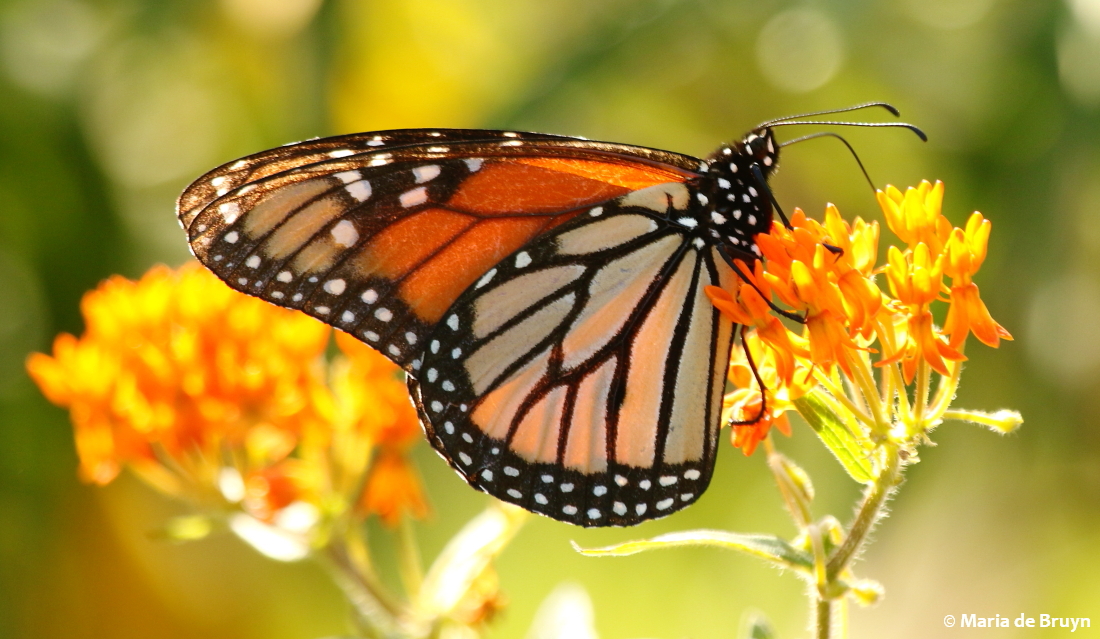
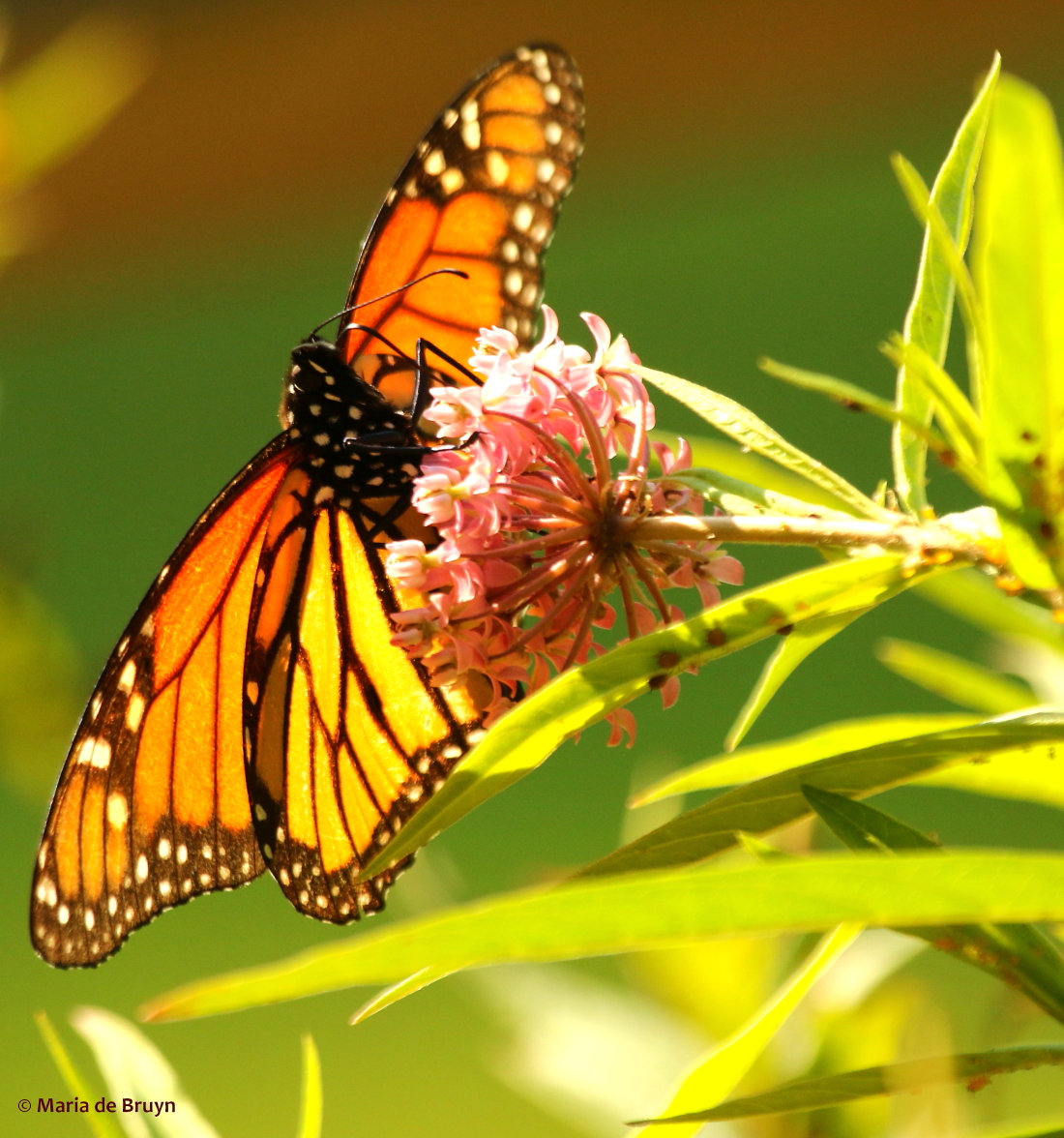
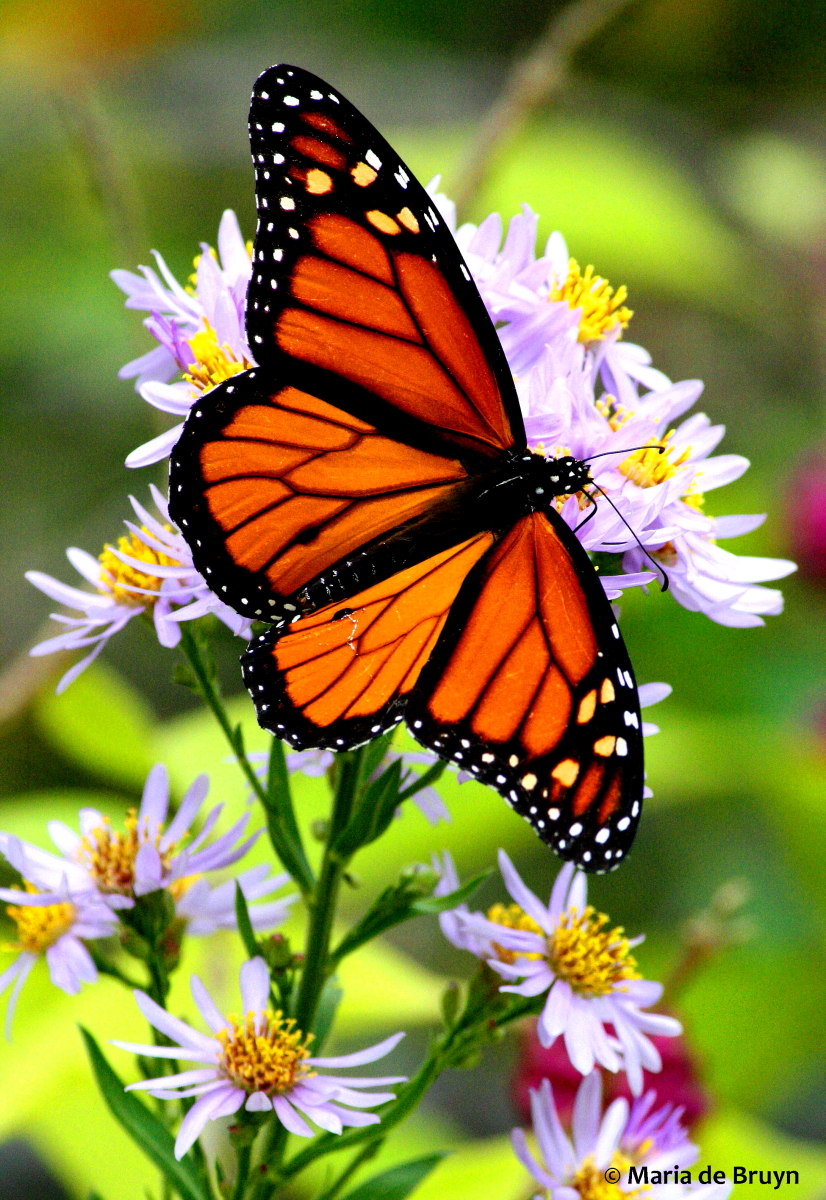
In mid-August, I had seen a female monarch butterfly (Danaus plexippus) at Sandy Creek Park, an exciting find and testimony to the usefulness of planting milkweed there. John Goebel, Sandy Creek patron, manager and care-taker extraordinaire, had planted about five types of milkweed in anticipation of welcoming these guests and it had paid off.

monarch DK7A7941© Maria de Bruyn res monarch DK7A7842© Maria de Bruyn res

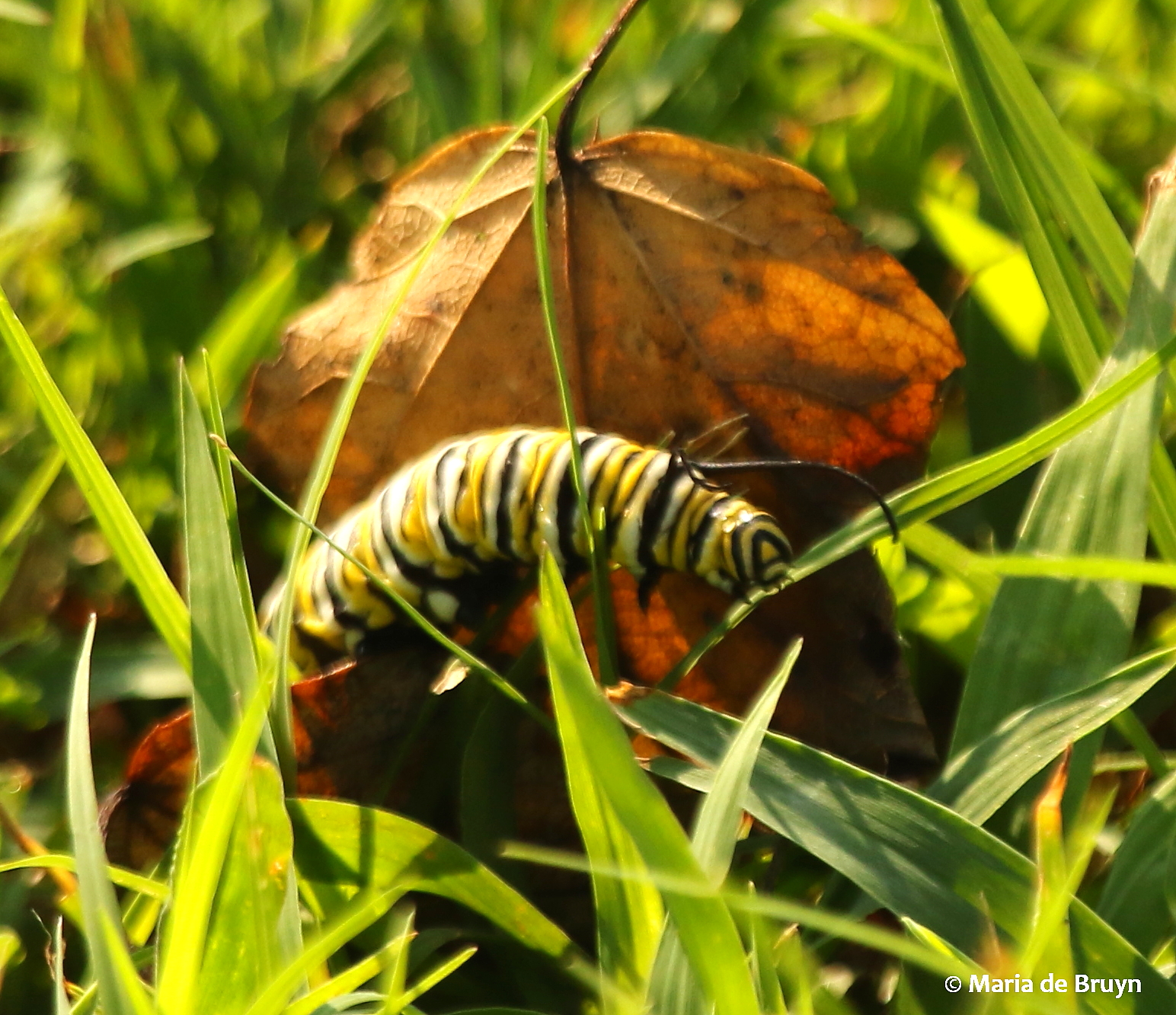
A few days ago, on Facebook, the Friends of Sandy Creek Park group announced that the one male and two female monarch butterflies spotted in the butterfly garden had left behind quite a few offspring. As I had not seen a monarch caterpillar in person before, I took off early for the park, where I found three people assembled to count them.  John Goebel kindly told me something about the monarch life cycle.

monarch DK7A6427© Maria de Bruyn resmonarch DK7A6518© Maria de Bruyn res

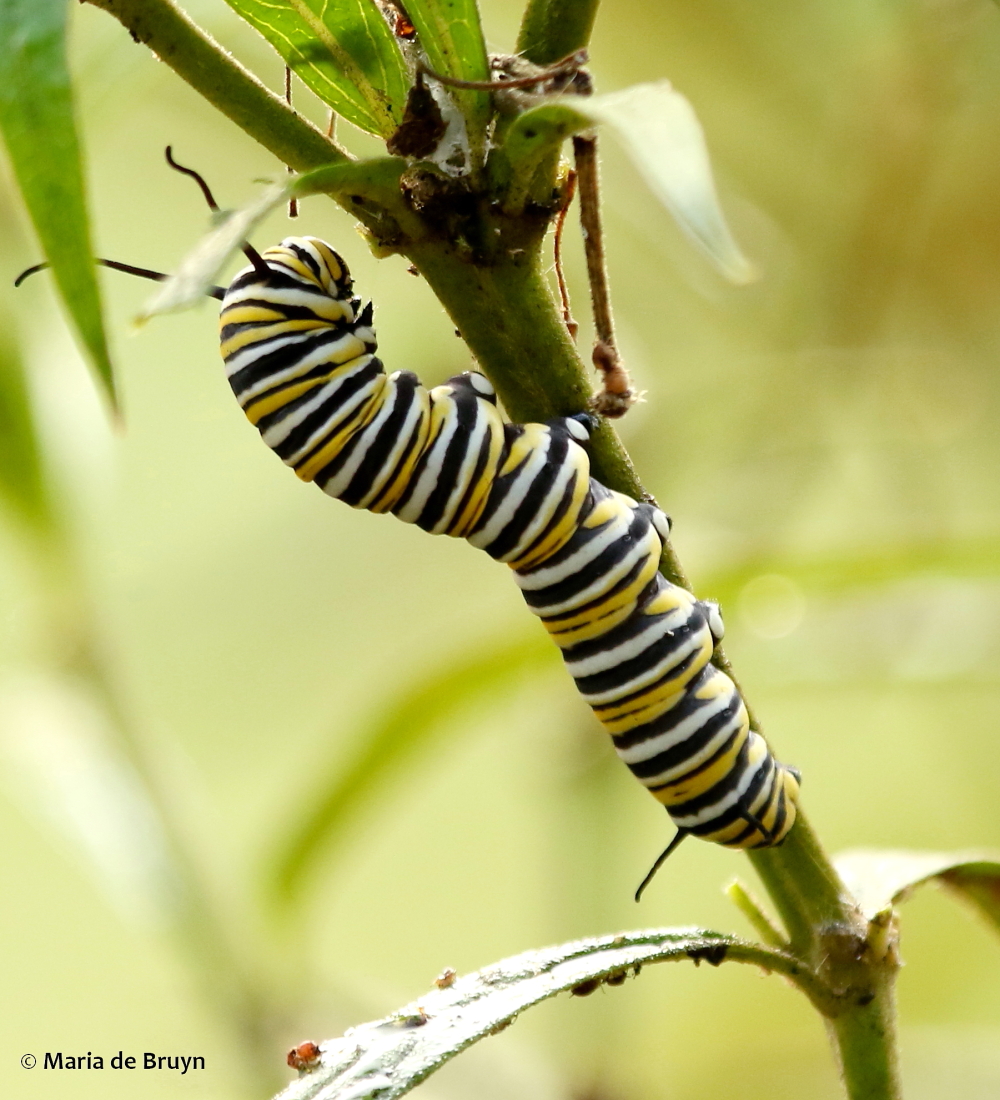
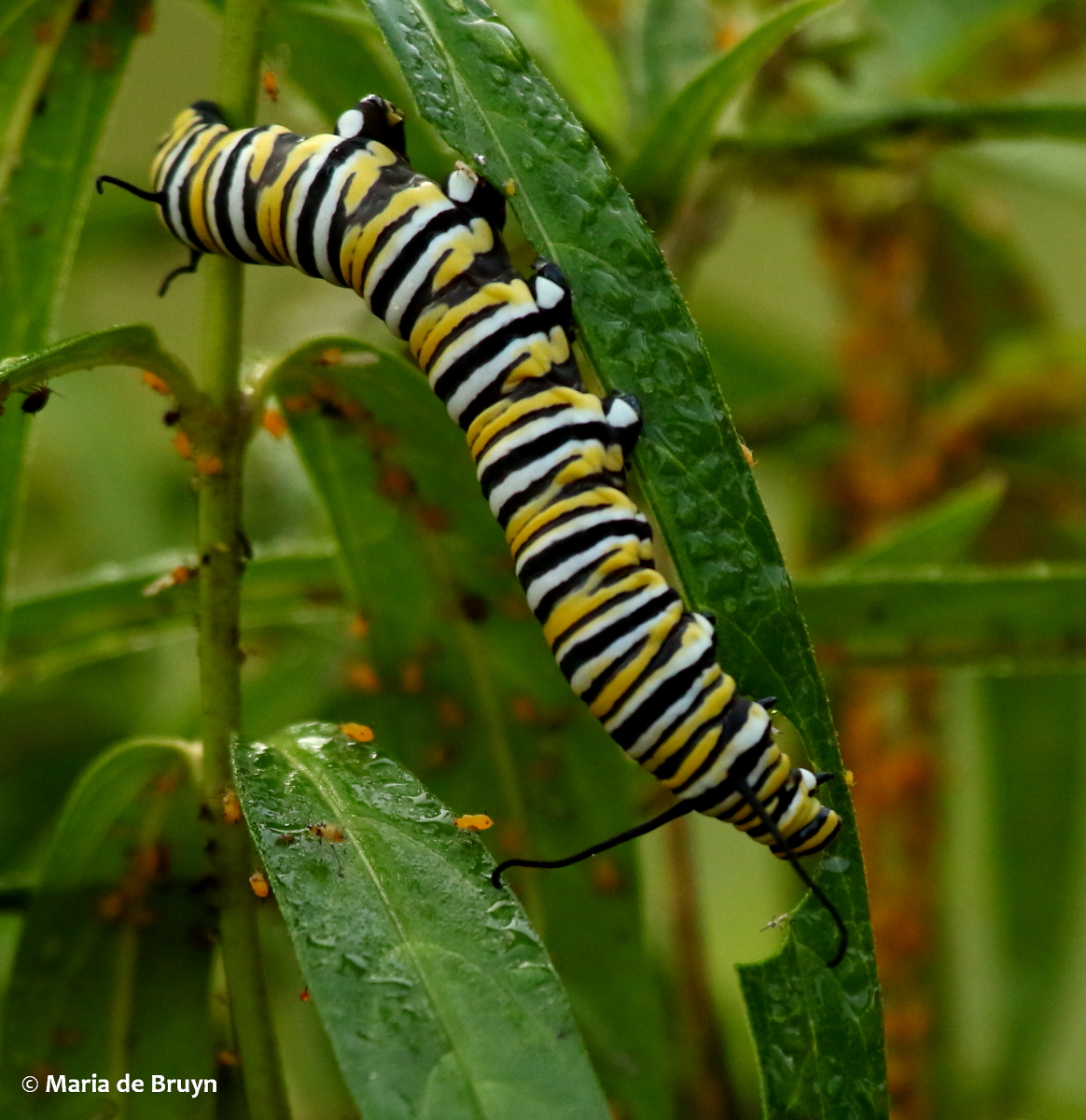
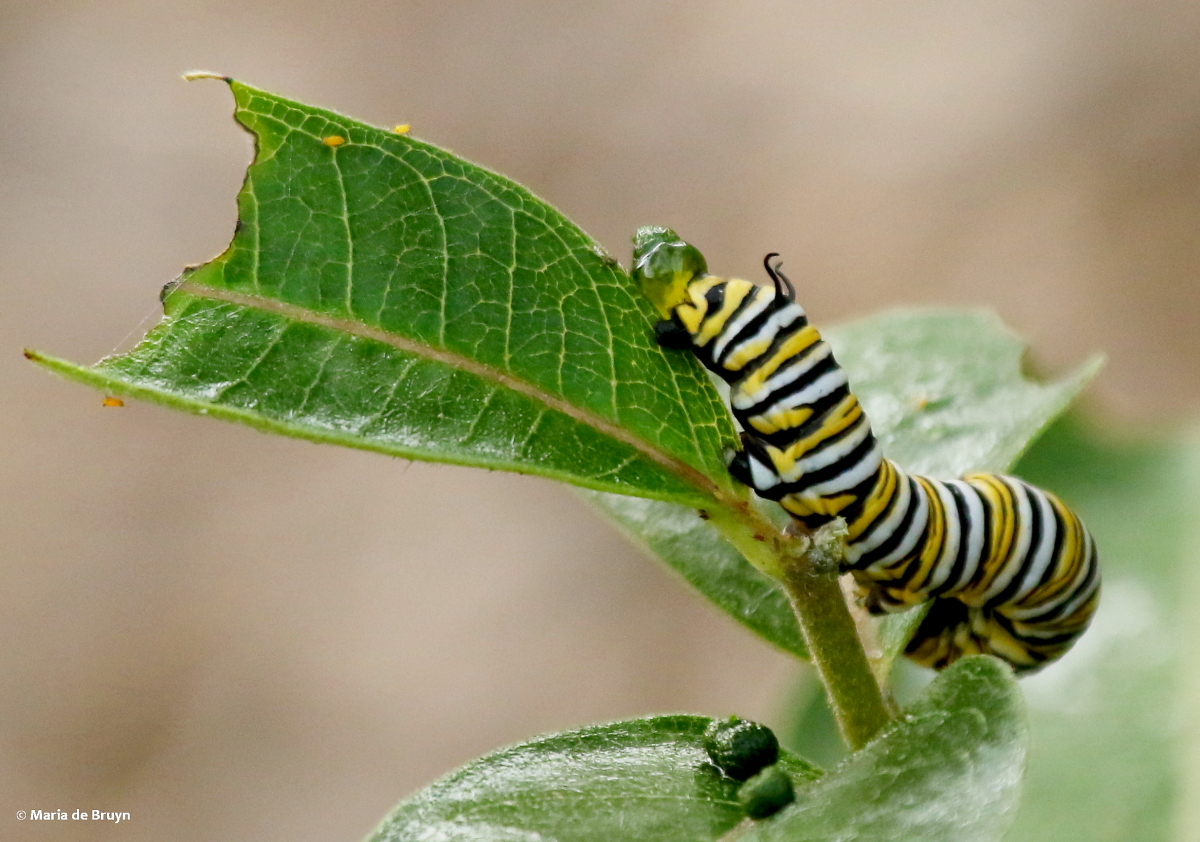
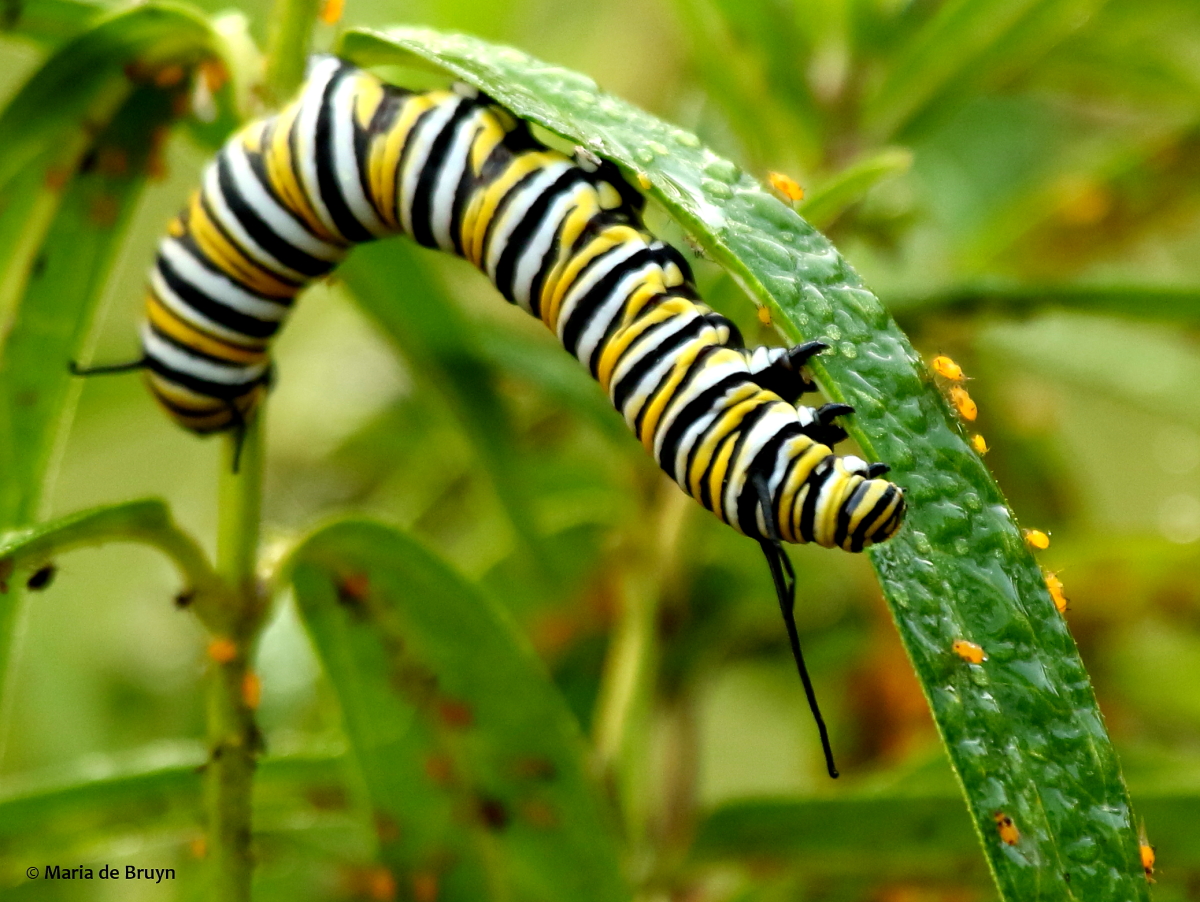
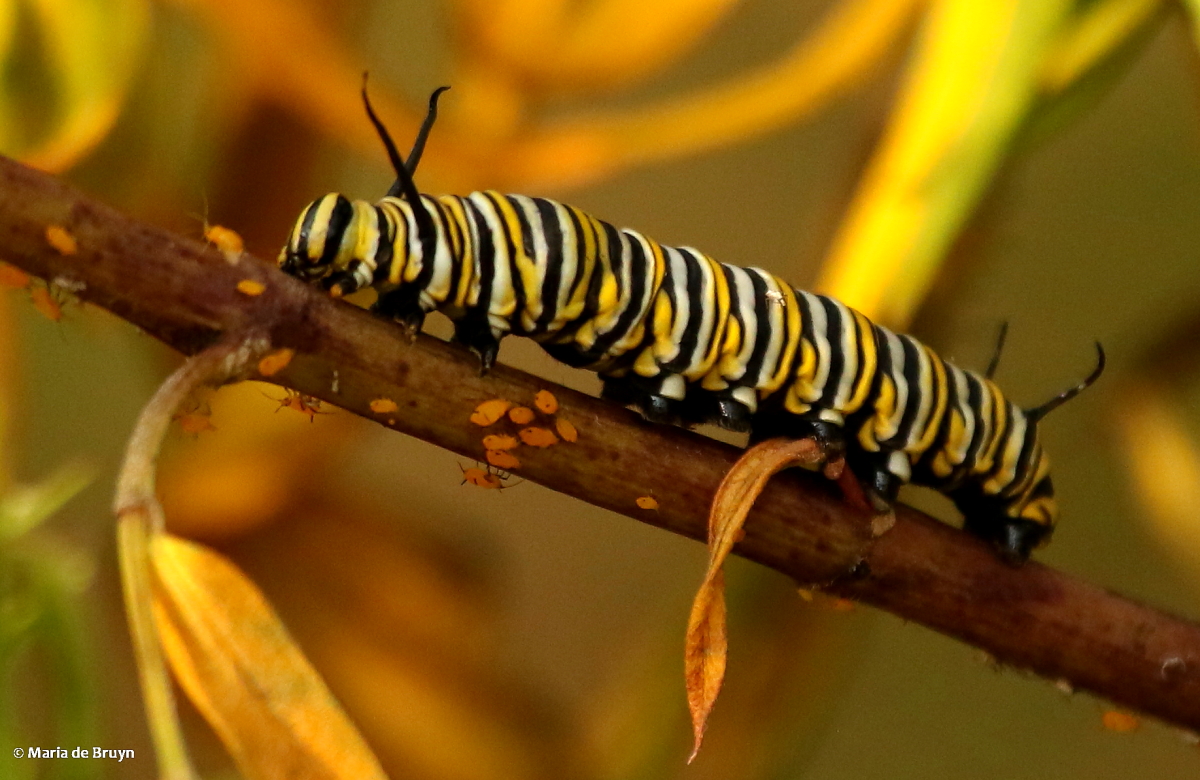
He pointed out several larger caterpillars, noting that they were stage 4 or 5 larva. The eggs hatch about 4 days after being laid. The larvae eat the plant on which they were born, shedding their skins four times as they grow, a process taking 10 to 14 days. These stages of growth are called instars.

monarch munching © Maria de Bruyn res monarch DK7A6460© Maria de Bruyn res

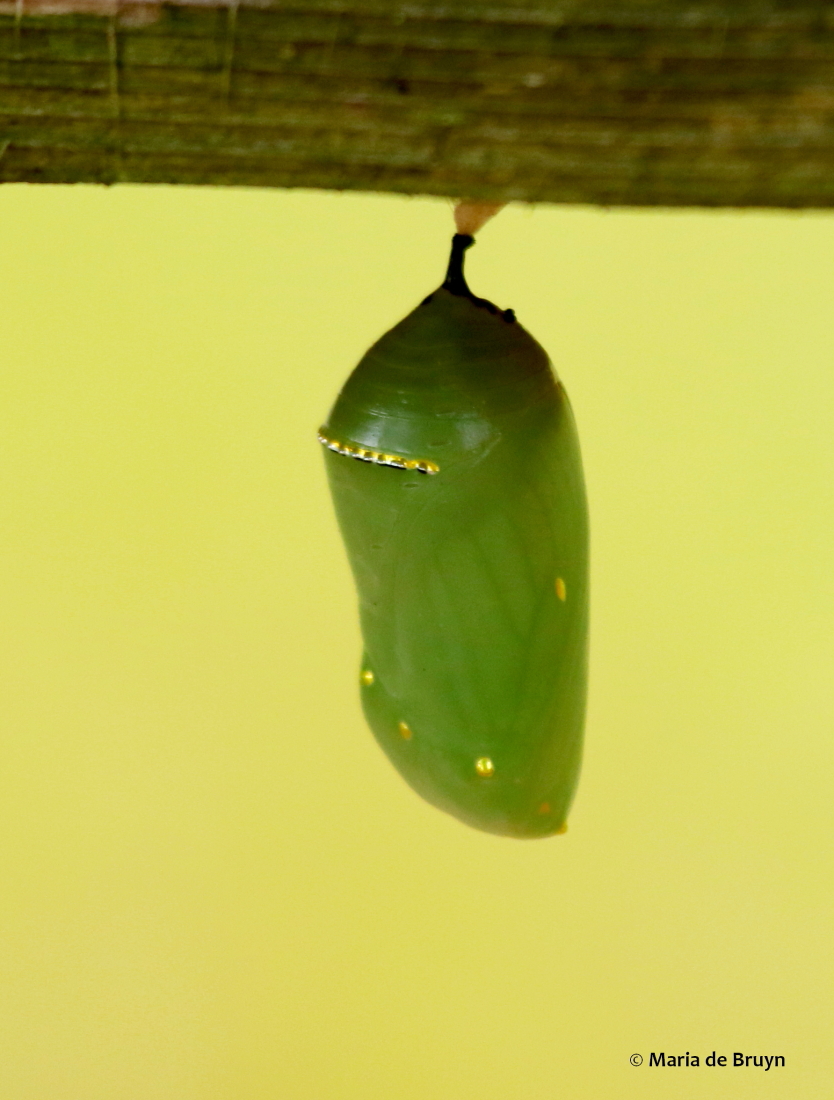
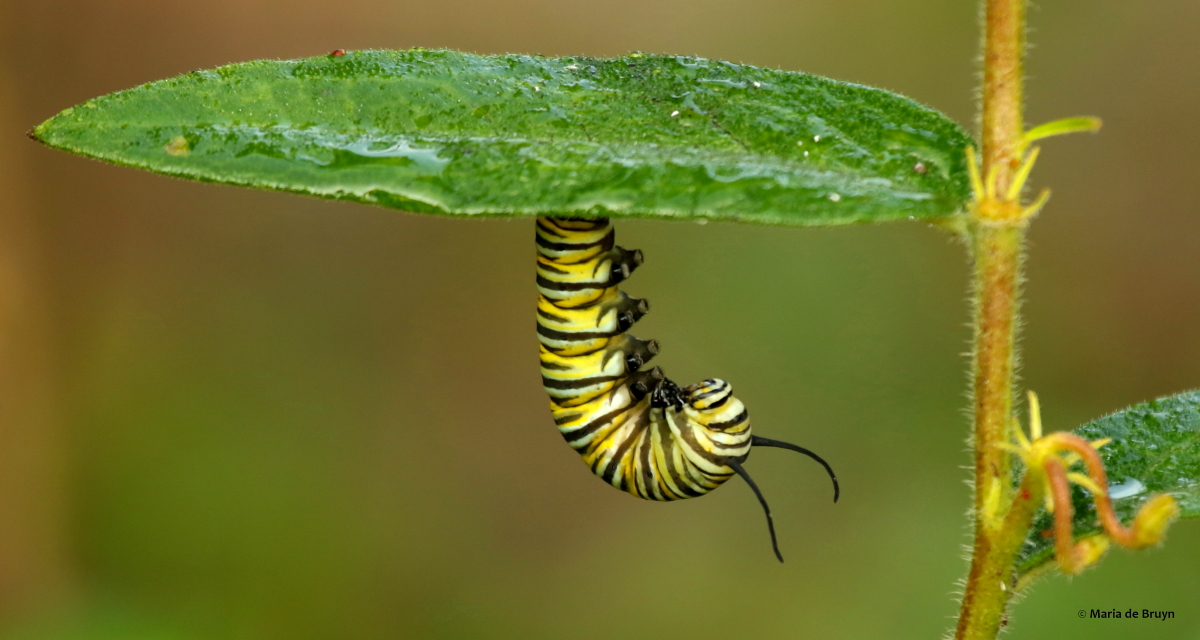
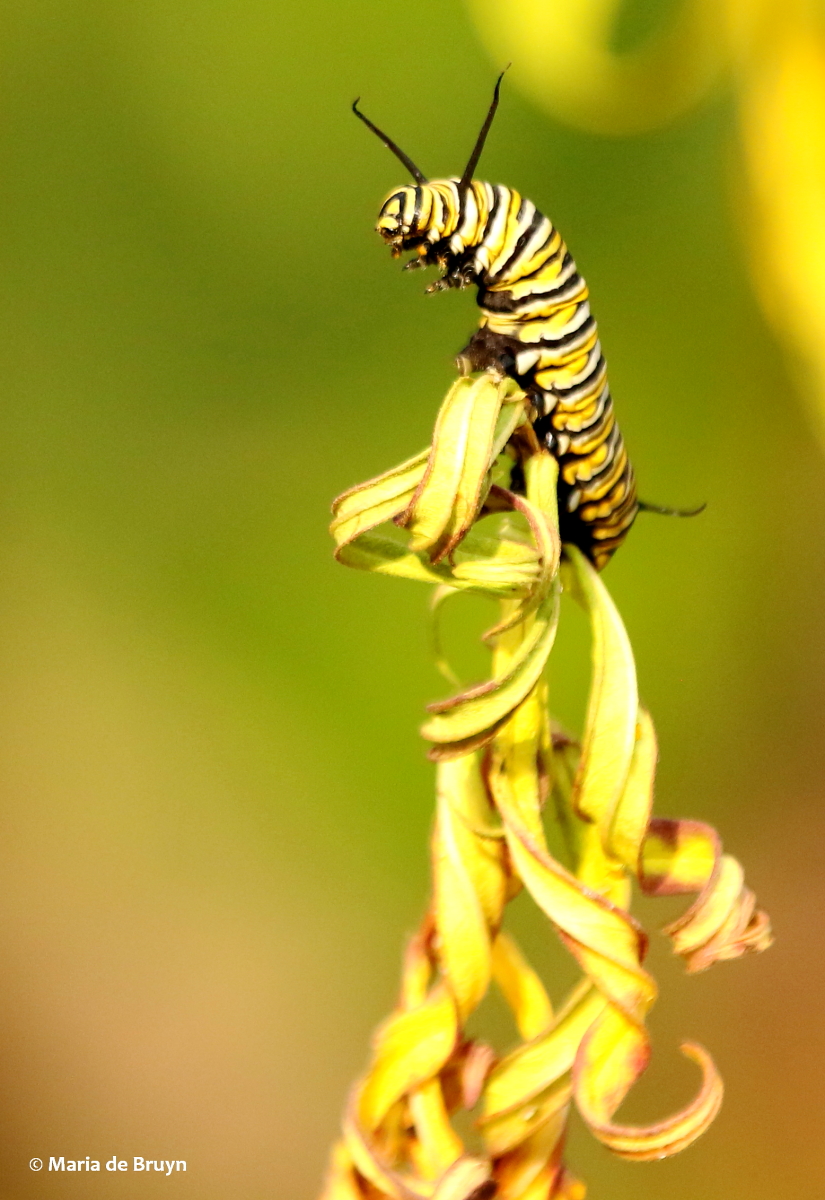
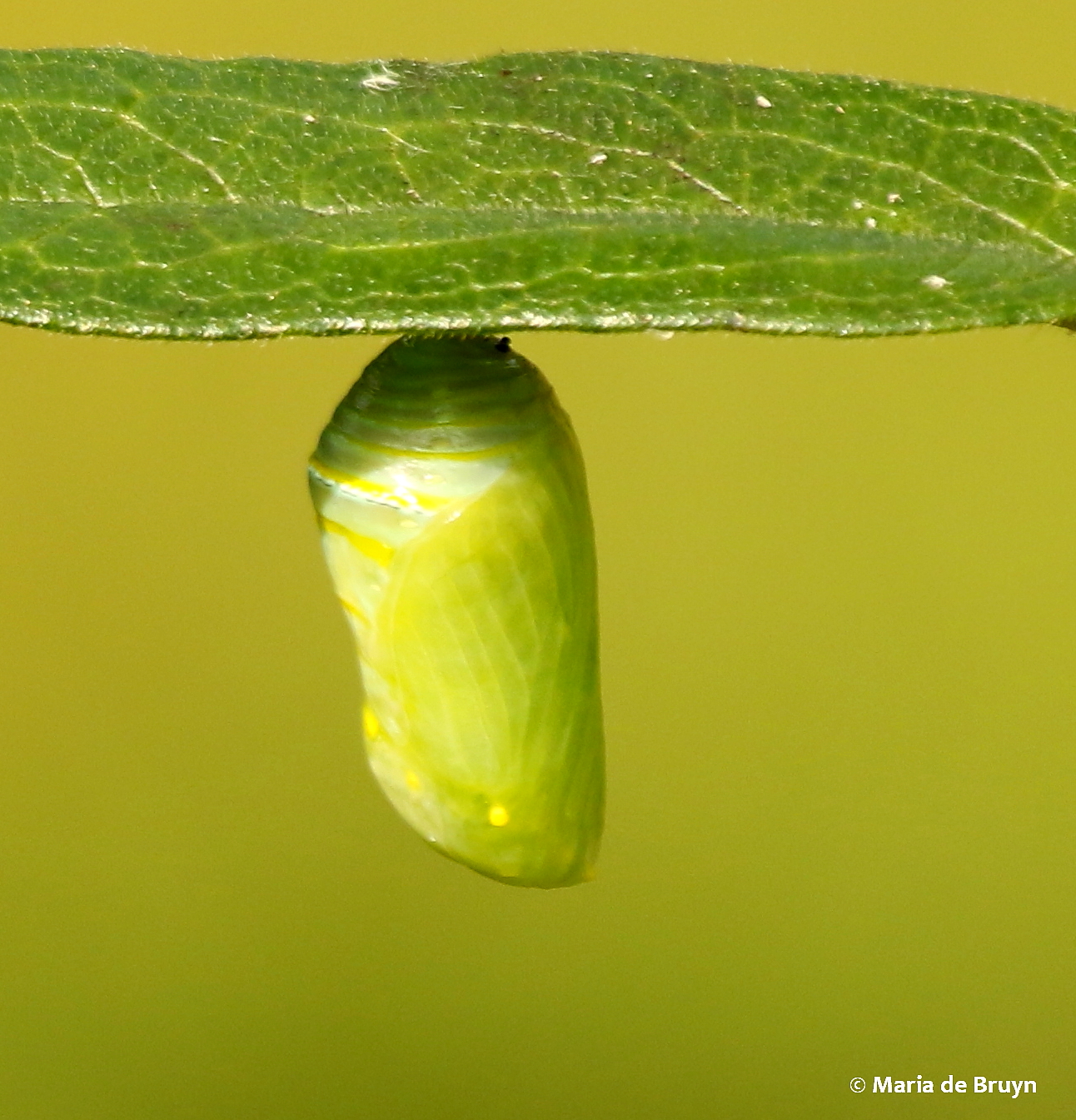
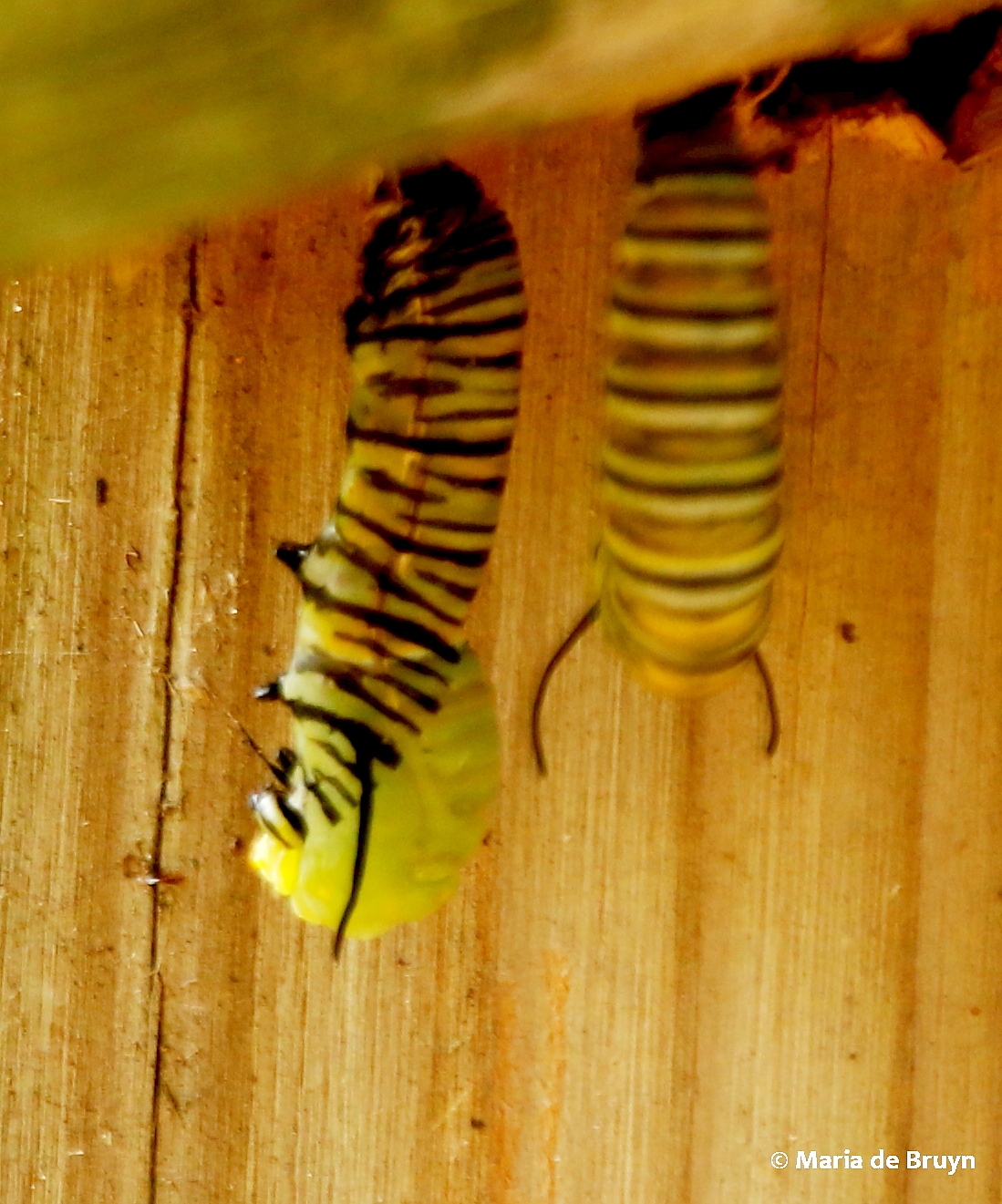
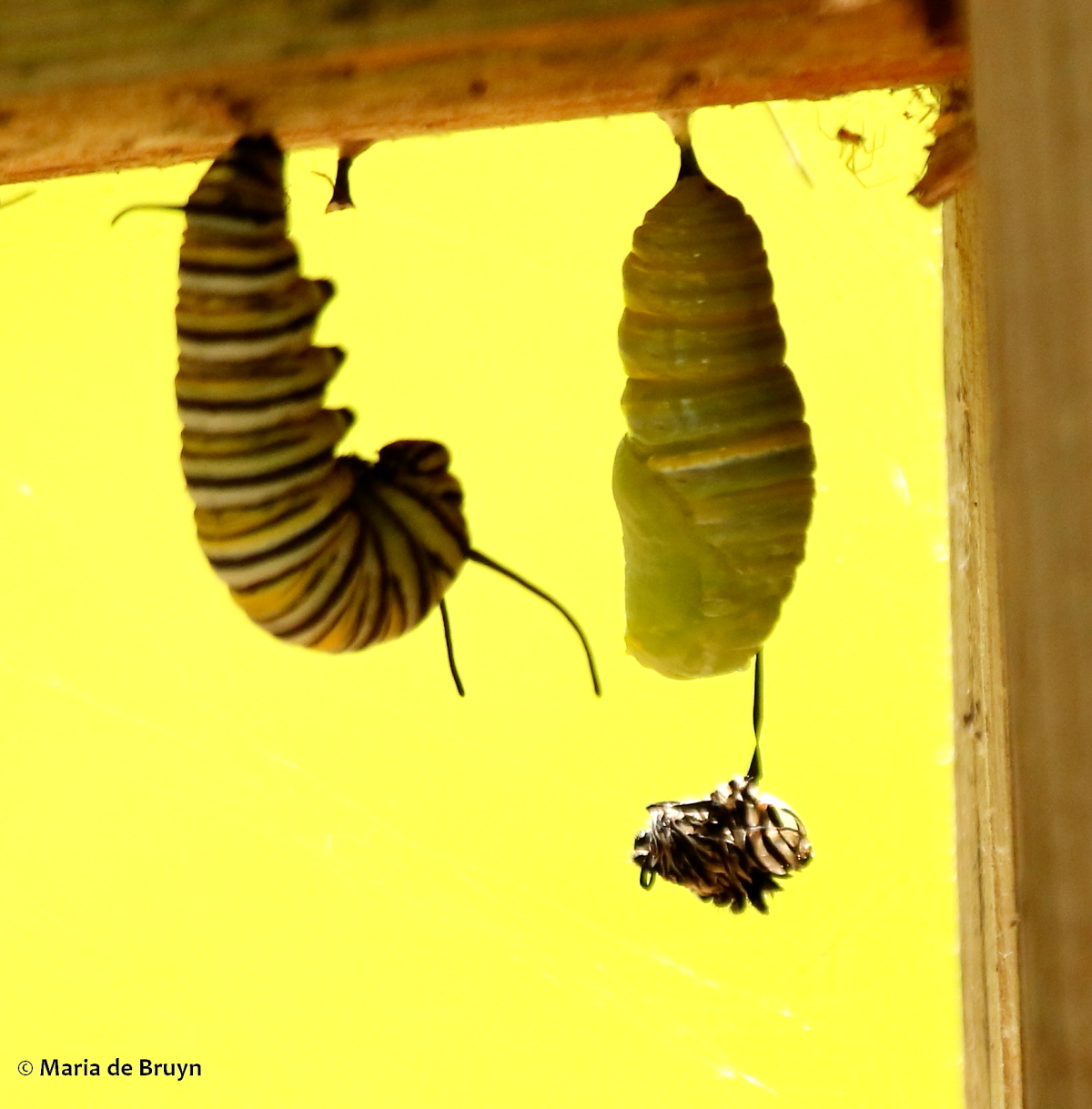
monarch DK7A6441© Maria de Bruyn resIn stage 5, the large larvae look for a protected and hidden spot where they can attach themselves vertically. They use their spinneret (not only spiders have them!) to make a silk pad from which they then suspend themselves, hanging down in the form of a letter J. The culmination of this procedure occurs when they straighten out, a sign, John told me, that pupation was imminent, with the caterpillar turning into a bright green chrysalis. There was already one chrysalis when I arrived with two other caterpillars hanging nearby.


The milkweed plants were attracting plenty of insect action. Many stems were yellow and orange as they were covered with milkweed bug nymphs and aphids. I photographed several of the 43 caterpillars counted, including a small early-stage newbie, and a number of large specimens that were very busy munching on leaves.

monarch DK7A6489© Maria de Bruyn res

After a while, I moved on to photographing caterpillars of moth species and looked around for birds or other interesting insects. Then an unexpected and unfortunate event arose and I had to high-tail it to the bathroom (thank goodness Sandy Creek has one that is open much of the year!).

Emerging from the bathroom and walking down the path to my car to go home, I felt chagrin that my nature walk had to be cut short. But if it hadn’t been for the bathroom visit near the milkweed plants necessitated by my gastrointestinal emergency, I would have missed a first-time experience. As I strolled to my car, I glanced again at the hanging caterpillars and noticed one had straightened out. I balanced the need to go home to shower and change clothes with the desire to see a caterpillar become a chrysalis. I had cleaned myself as well as possible and no one else was around, so I stayed.

monarch DK7A7327© Maria de Bruyn resmonarch DK7A6569© Maria de Bruyn res

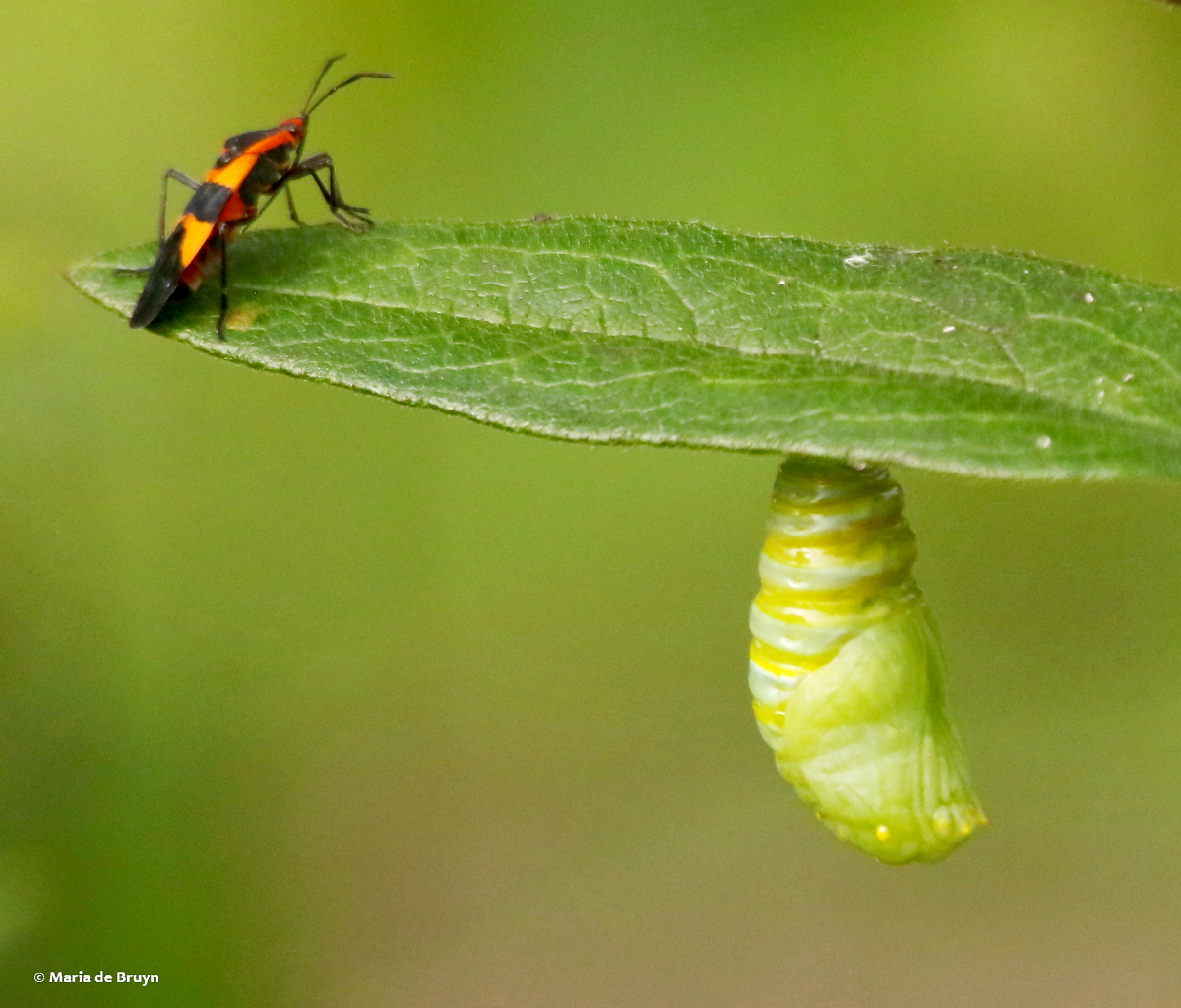
The caterpillar that I was watching was hanging quietly on a leaf; the only action came from a small milkweed bug (Lygaeus kalmia) and a large milkweed bug (Oncopeltus fasciatus) that marched back and forth on top, so I turned to the side to photograph an adventurous sibling that had climbed to the top of a nearby plant.

monarch DK7A7265© Maria de Bruyn resmonarch DK7A7357© Maria de Bruyn res

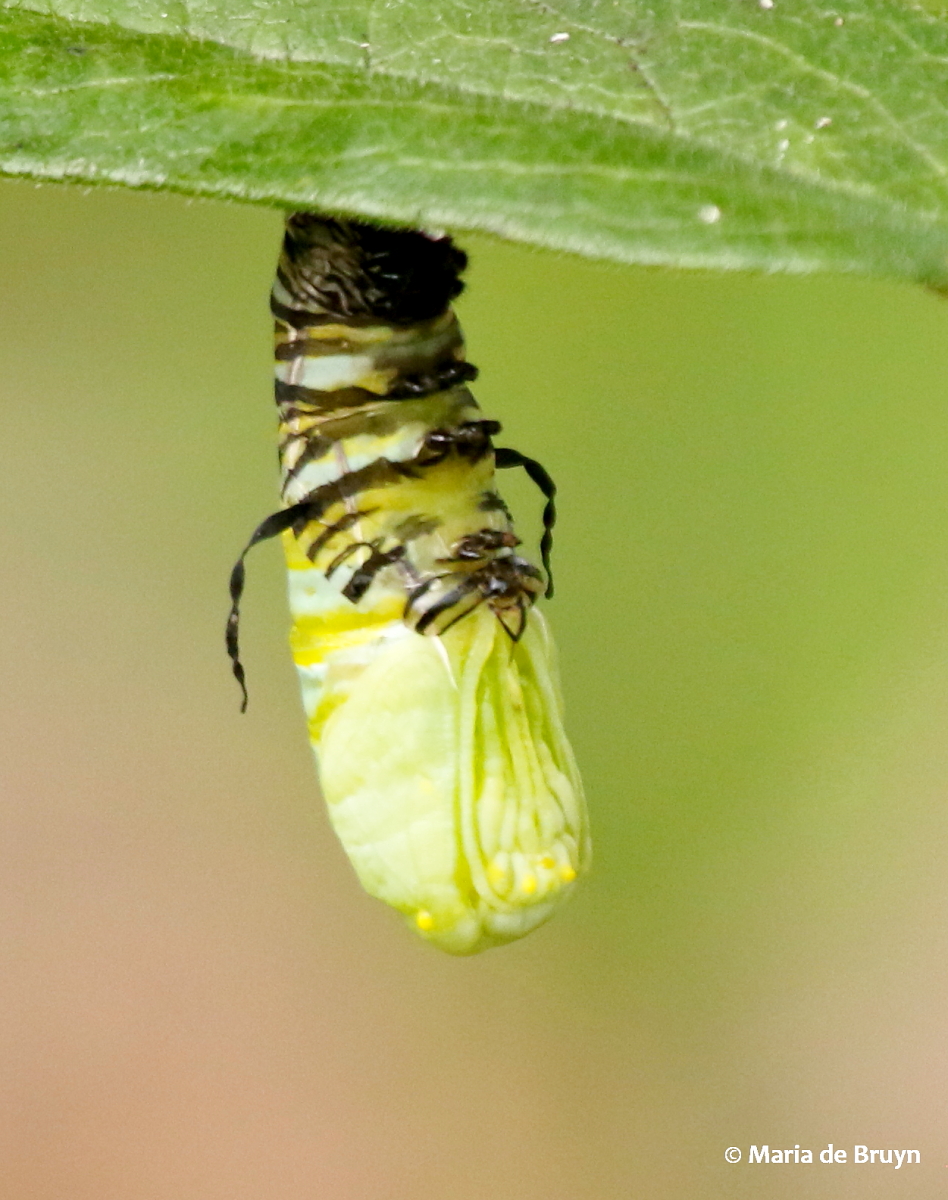
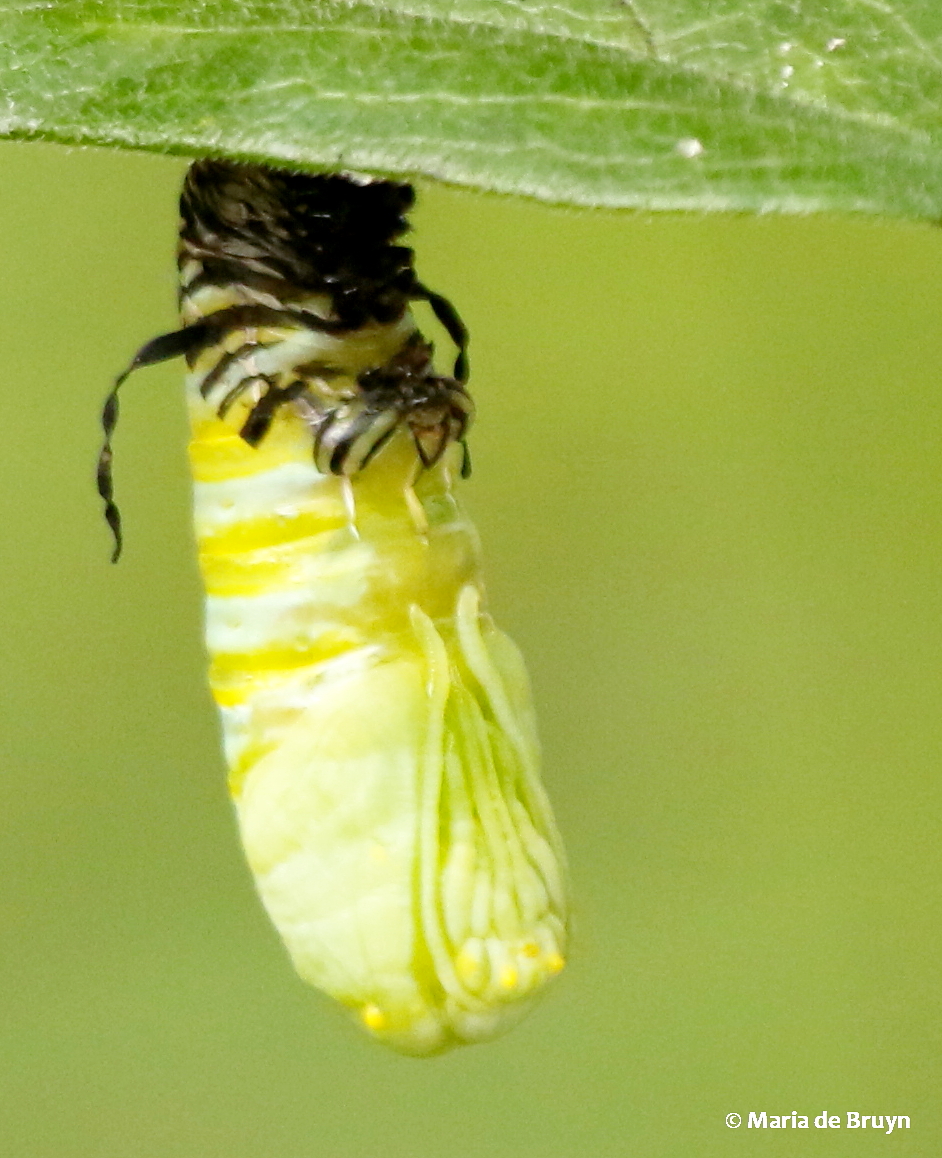
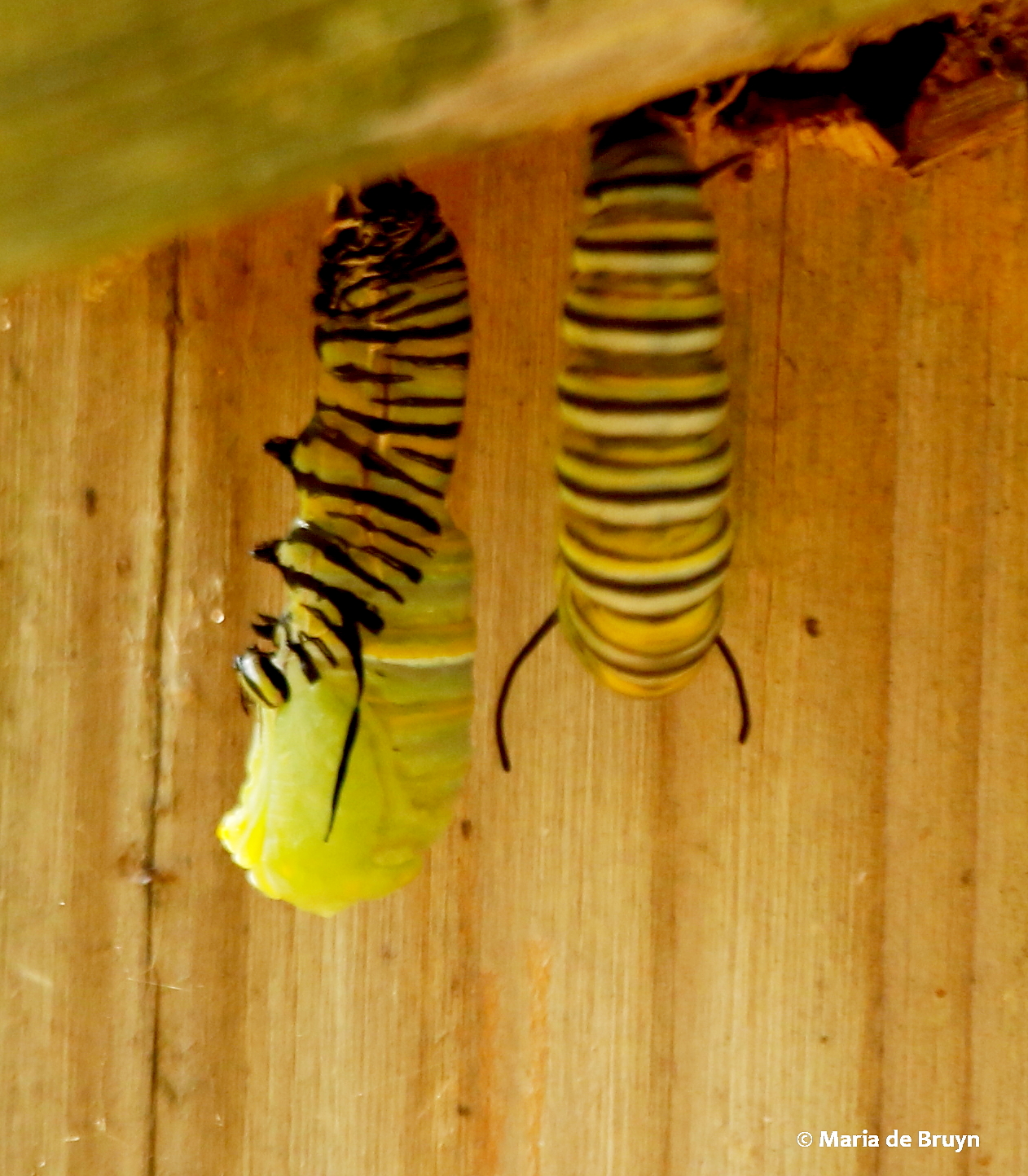
When I looked back, the pupation had already begun and was progressing apace.

monarch DK7A7391© Maria de Bruyn resmonarch DK7A7447© Maria de Bruyn

monarch DK7A7467© Maria de Bruyn resmonarch DK7A7526© Maria de Bruyn

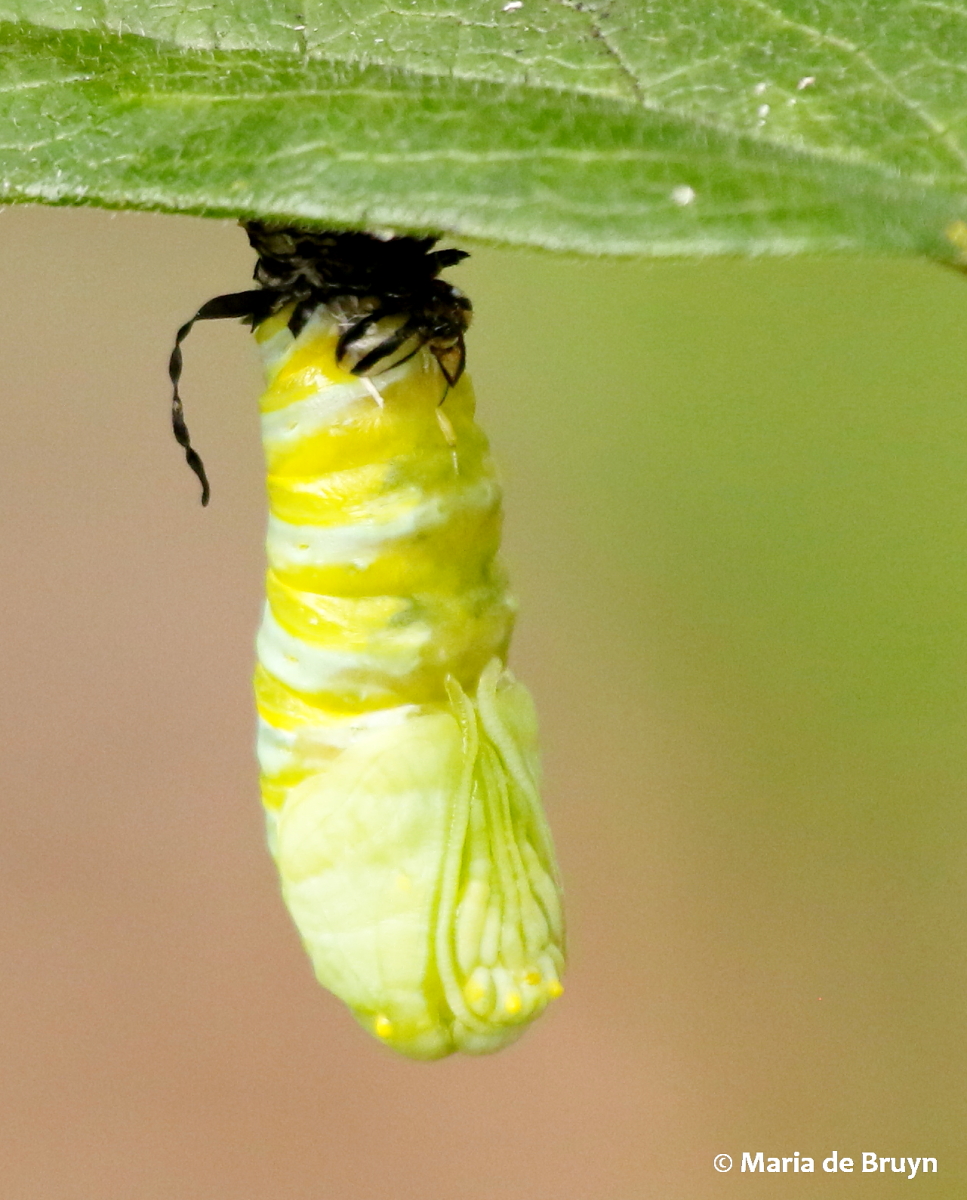
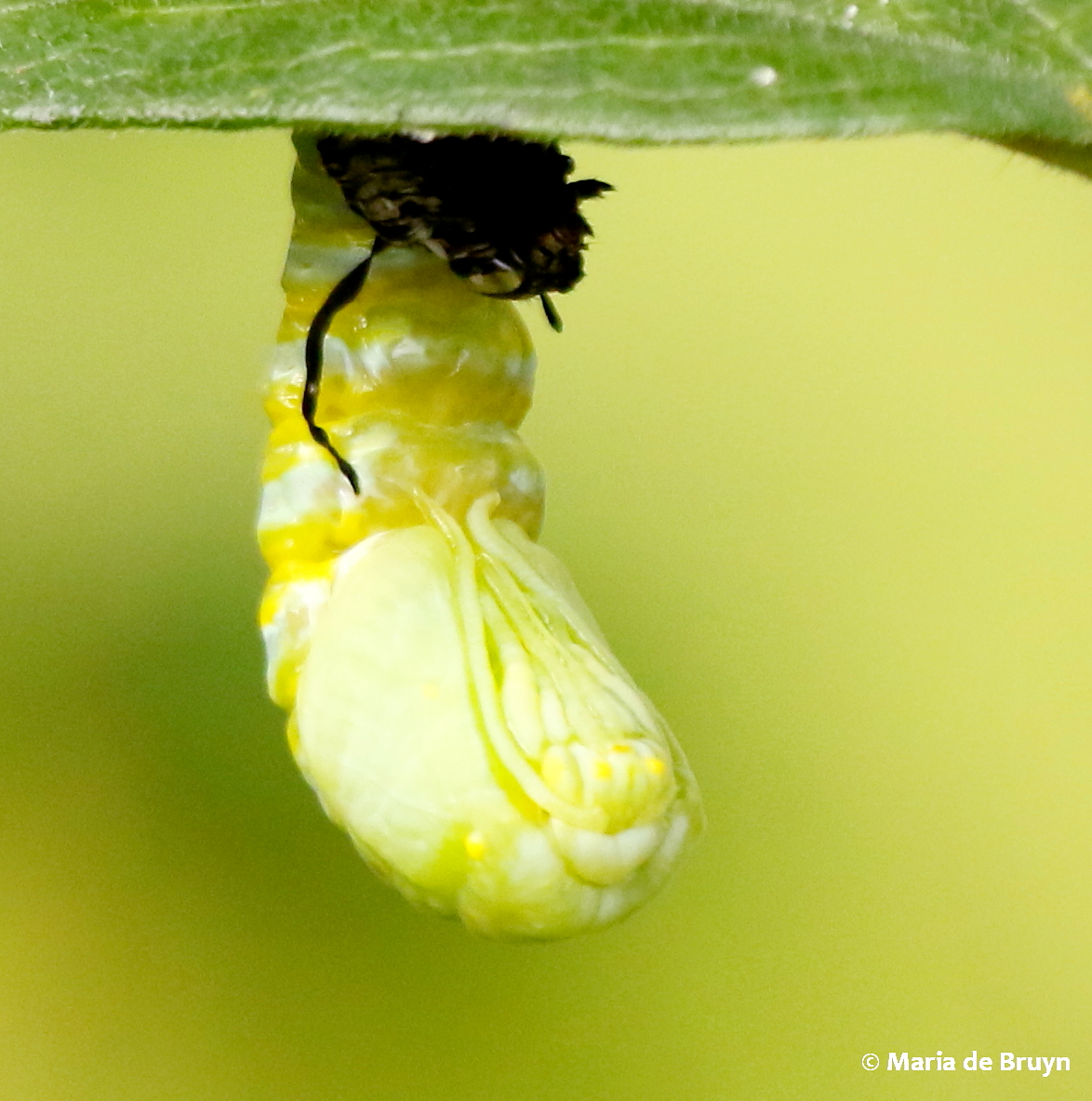
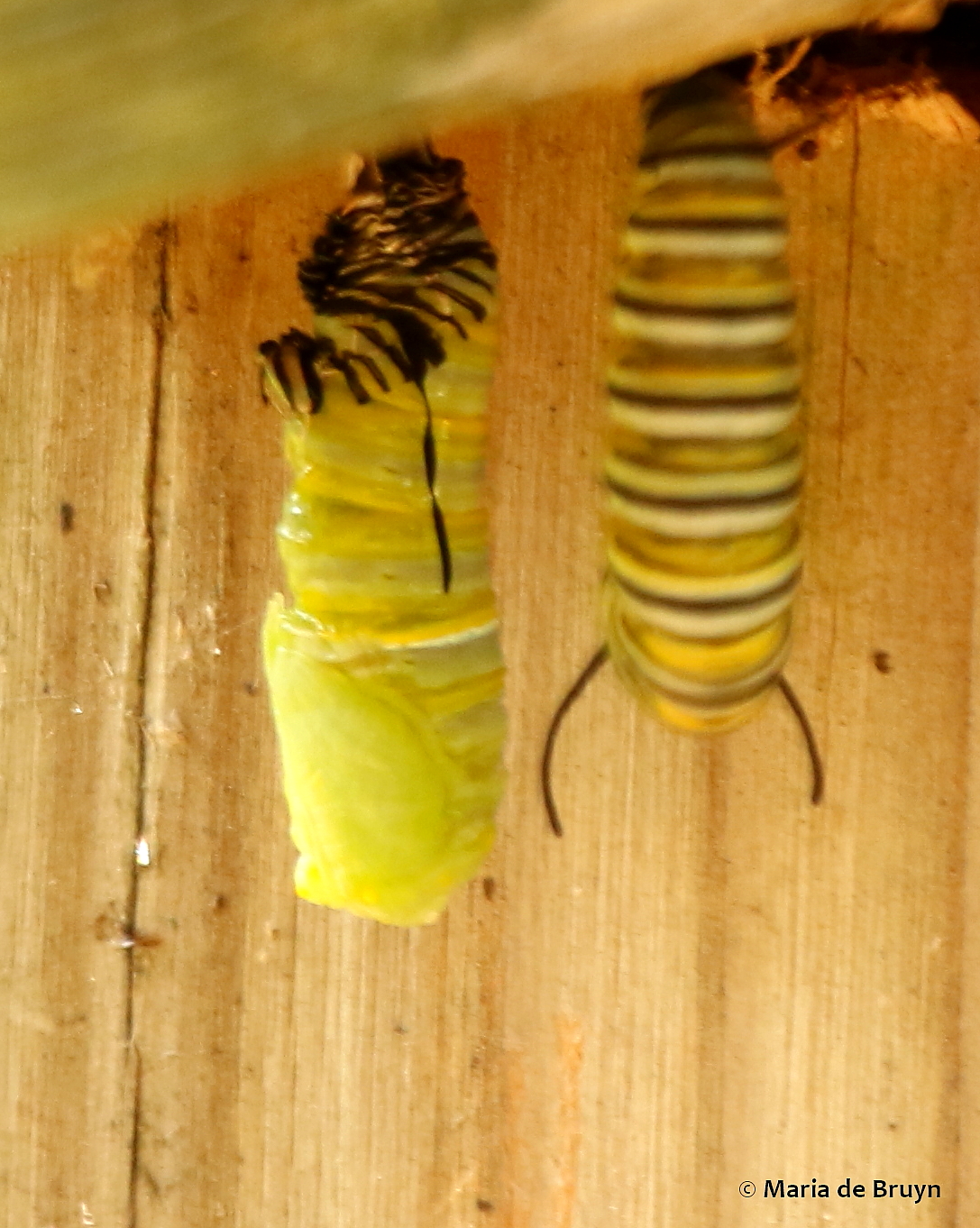
John had mentioned that it could take under a minute; this caterpillar was a little bit slower but the transformation was quick indeed. I’d seen videos of this before but seeing it live in the wild was awesome. And I got my own bit of video showing the last bit of larval skin dropping off the chrysalis.

monarch DK7A7623© Maria de Bruyn resThe large milkweed bug came back to perch over the chrysalis. Later, John moved this chrysalis because the leaf of the plant could fall off before the 10- to 14-day pupation period is over – everyone wants all the larvae to become full-grown adult butterflies who can undertake the long migration to Florida or, more likely, Mexico. Their loss of habitat in both the United States and Mexico is devastating to the species and action to prevent further losses is still needed.

monarch DK7A8180© Maria de Bruyn

As I again prepared to leave, I noticed that one of the other hanging caterpillars was straightening out, so I decided to wait a little while in the hope I would see a second pupation. After watching one caterpillar approach and climb a nearby tree and seeing another trundling through the grass toward the parking lot (presumably headed for a tree further away), I focused on the hanging caterpillar.

monarch DK7A8532© Maria de Bruynmonarch DK7A8481© Maria de Bruyn res

Sure enough, the pupation began – in this case, even more rapidly than the first one I witnessed.

monarch DK7A8552© Maria de Bruynmonarch DK7A8588© Maria de Bruyn

monarch DK7A8642© Maria de Bruynmonarch DK7A8961© Maria de Bruyn res

A difference with this transformation was that the last little bit of caterpillar did not drop off but remained suspended at the bottom of the chrysalis. Most likely, it will fall off later, which is important; if it remains attached, it could damage the emerging butterfly.

MONARCH buttterfly 1© Maria de Bruyn resWatching this part of the butterflies’ metamorphosis was an exciting event. I didn’t wait fora third pupation, however, as I really did need to get home. On the way back, I nearly had a collision with another car – perhaps leading the other driver to need a shower, too. At home, I later almost fell on my face as one of my cats wound himself through my legs as I walked so that I came very close to tripping. Both accidents in the making didn’t happen, thank goodness, so maybe the monarch pupae had become my guardian angels for the day. In any event, I did have lots to be thankful for!


For more information:

http://monarchlab.org/biology-and-research/biology-and-natural-history/breeding-life-cycle/life-cycle

http://www.learner.org/jnorth/tm/monarch/ChrysalisFormationLPB.html


Maintaining culture through plants

Burmese farmer IMG_5217© Maria de Bruyn resChapel Hill’s largest refugee community comprises three ethnic groups who fled the country of Myanmar (Burma); a number of them lived in refugee camps in Thailand before they came to the USA. Some 30 of these families have been receiving assistance since 2010 at the Transplanting Traditions Community Farm, through which they are able to grow many of the plants on which they relied as farmers in their home country. The gardens they maintain not only help feed members of their families and community, but also enable them to maintain some of their original culture through dietary customs. The farm also helps the families earn an income through the crops they sell via farmers’ markets and a community supported agricultural (CSA) project wherein customers commit to buying a box of vegetables from them every week.

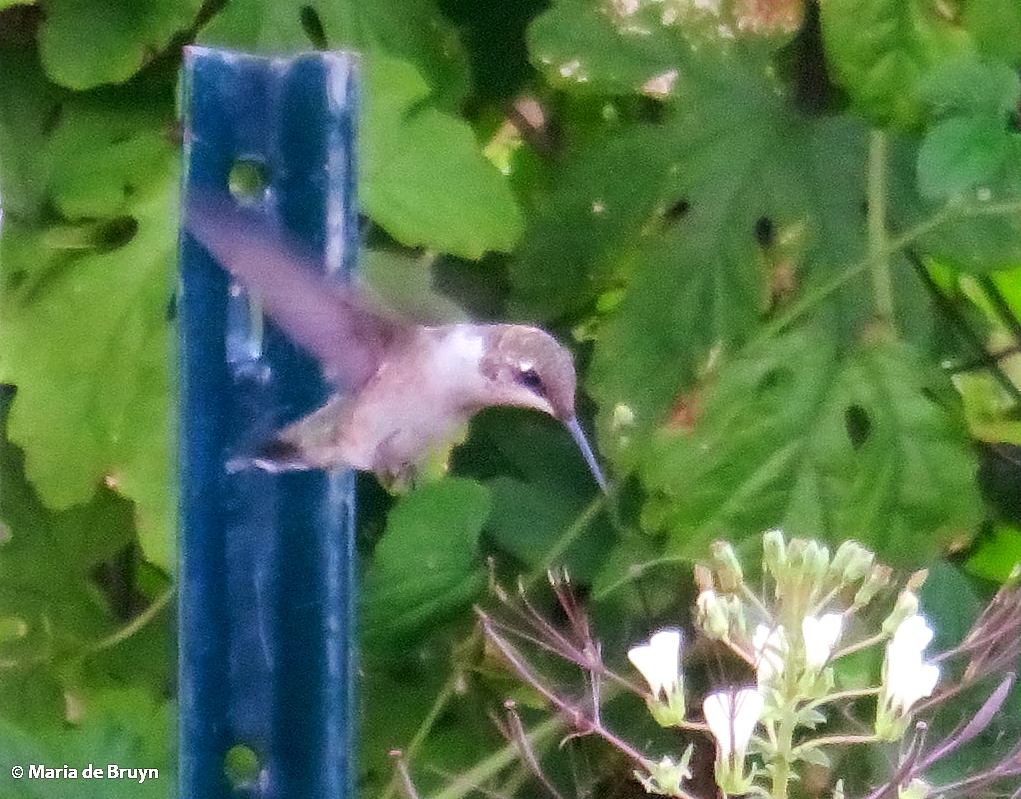
IMG_5230© Maria de BruynThis evening, the Community offered the general public a chance to tour their gardens and sample some of their traditional dishes, a delightful experience to be sure. When I arrived for the event, I first toured one of the plots with shared vegetable gardens. What first struck me was the large number of birds that were in the garden, including American goldfinches (Spinus tristis), chipping sparrows (Spizella passerina), ruby-throated hummingbirds (Archilochus colubris) and great-crested flycatchers (Myiarchus crinitus) among others.

American goldfinch IMG_5117© Maria de Bruyn res

chipping sparrow IMG_5063© Maria de Bruyn res flycatcher IMG_5075© Maria de Bruyn res

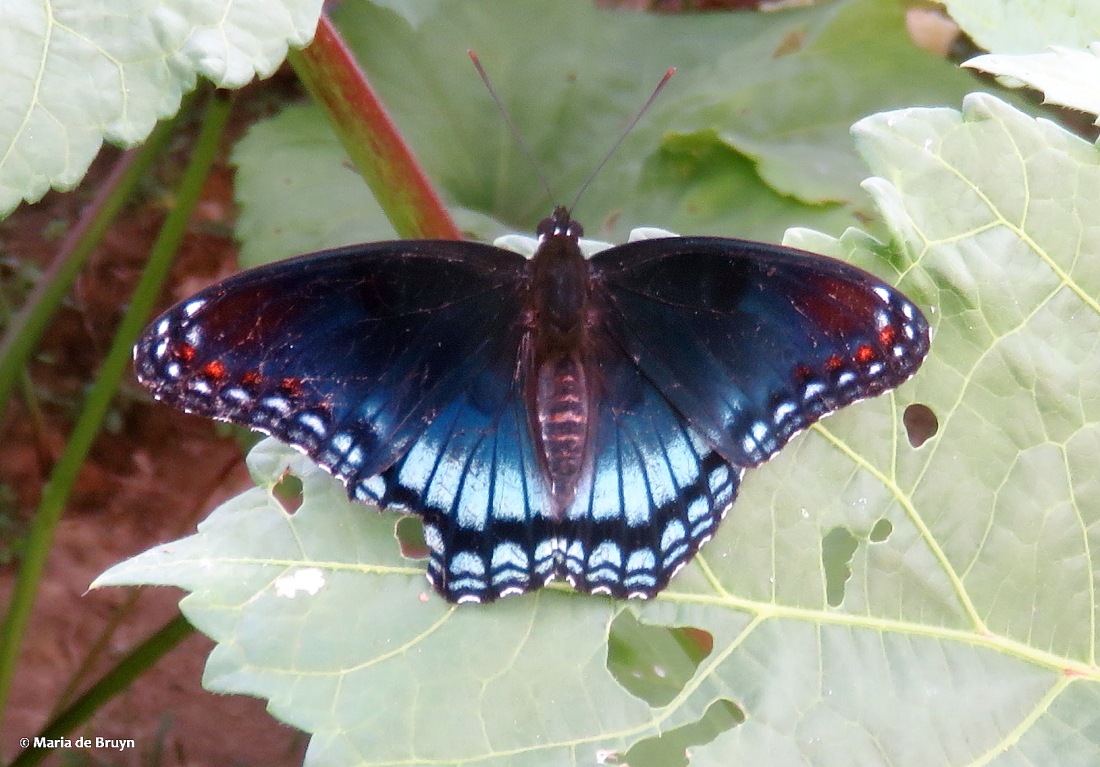
ruby-throated hummingbird IMG_5088© Maria de BruynThe air was alive with bird calls and song and as dusk fell, you could see the birds flitting from ground to plant to plant. Butterflies, like this red-spotted purple (Limenitis arthemis astyanax), were also flying about the garden, which had a mix of full-grown vegetables and blossoms promising more crops to come.

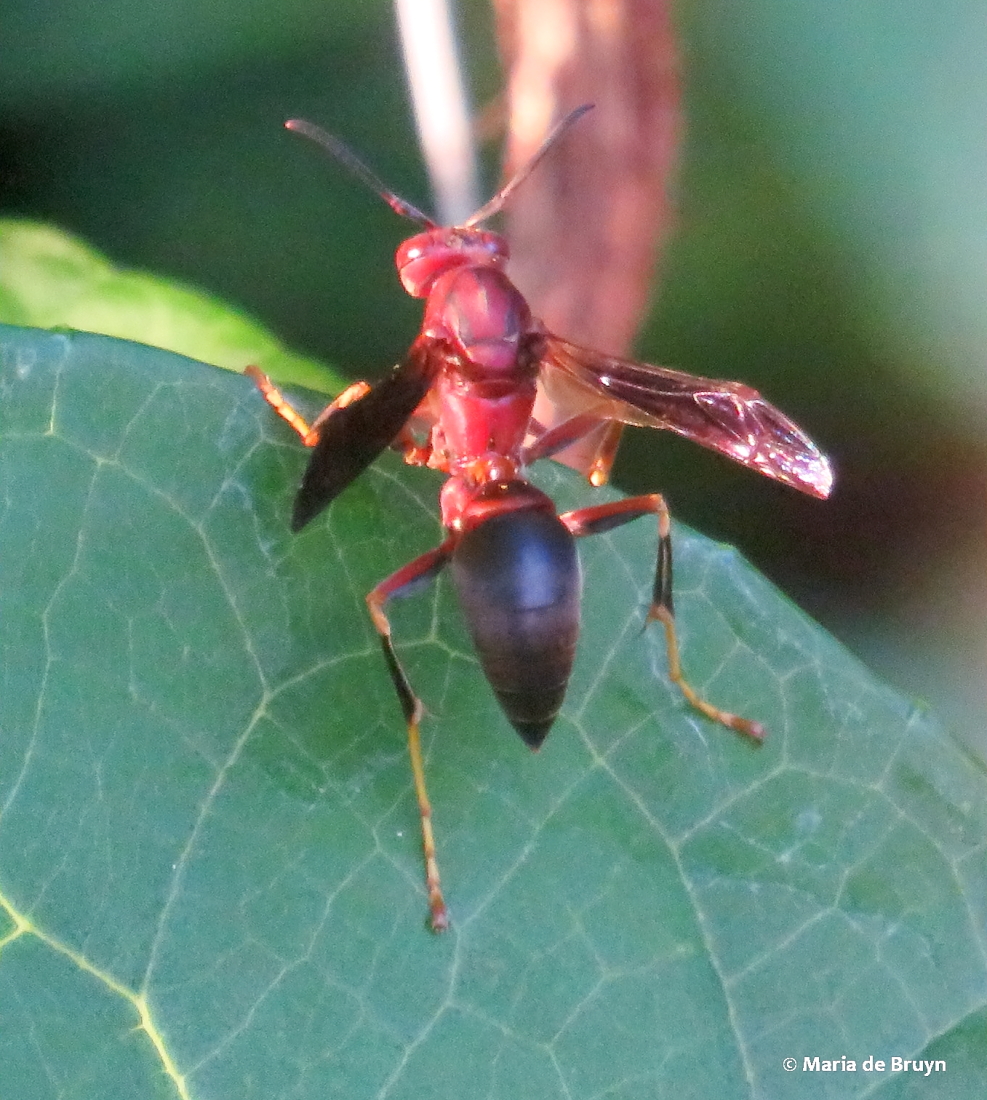
Paper wasps (Polistes) and other insects were also plentiful.

red-spotted purple IMG_5151© Maria de Bruyn res Paper wasp IMG_5182© Maria de Bruyn res

squash IMG_5095© Maria de Bruyn res vegetable blossom IMG_5065© Maria de Bruyn res

The event was co-sponsored by The Conservation Trust for North Carolina, Orange County Partnership for Young Children, and Triangle Land Conservancy, which provided the Community Farm with space in its Irvin Nature Preserve. Representatives of the organizations said a few words about their work and then we were led on a guided tour of a newer part of the Community Farm by Kelly Owensby, the Project Director, and one of the Karen teenagers participating in the project, Joe.

IMG_5194© Maria de Bruyn

We had some tasty beer, provided by a donor, and were given a bit of the Farm’s history as we walked along the path to the new section.  The 5-acre Farm is on land in the rural outskirts of Chapel Hill and, while it is a wonderful site on this 269-acre Preserve, it is not served by public transportation, a circumstance that has made it impossible for some refugee families to participate in the project. The 30 families that have managed to get there daily, in addition to their regular jobs, have made over $125,000 over the past three years with their produce sales.

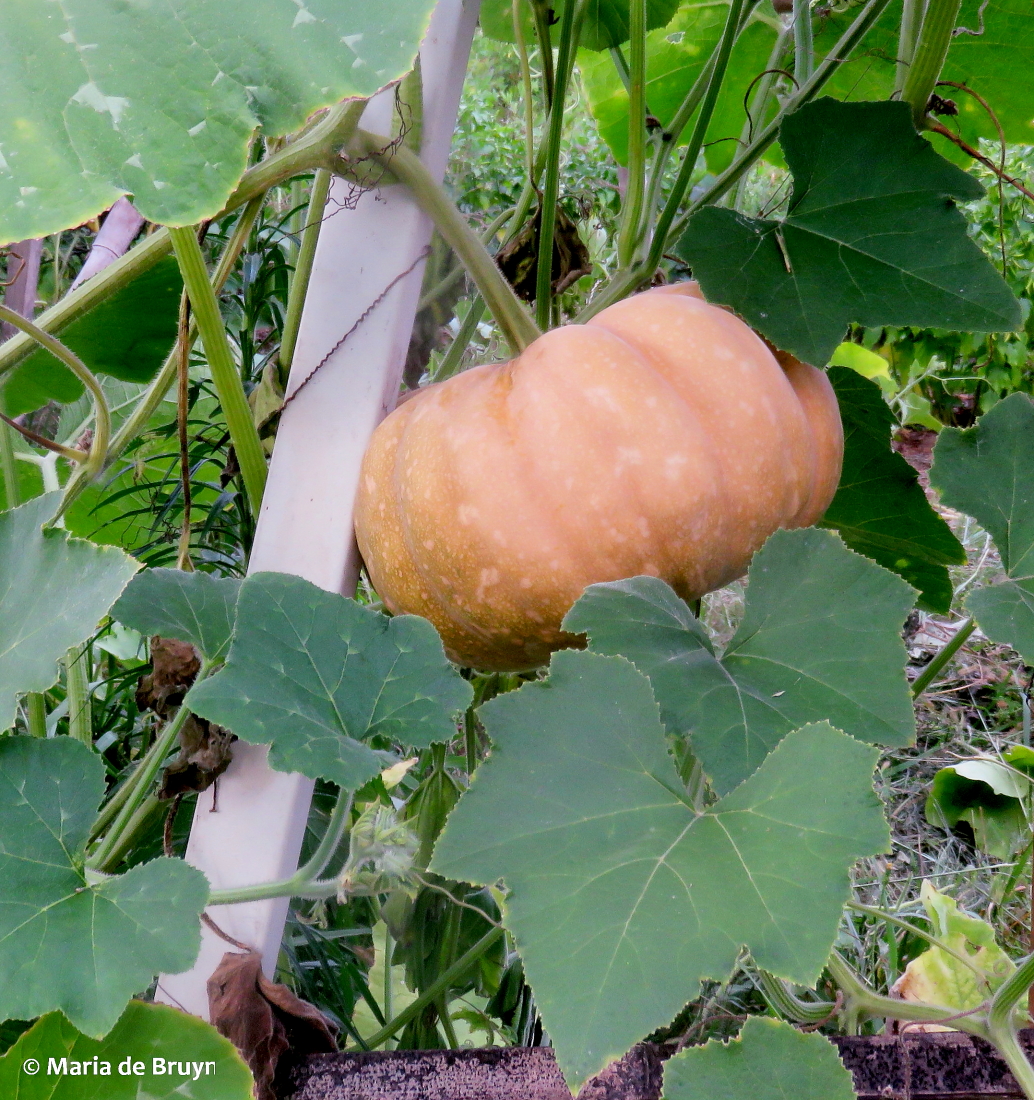
pumpkin IMG_5070© Maria de Bruyn resKaren plant IMG_5139© Maria de Bruyn res

Joe told us about a Karen holiday that are celebrated by these ethnic families here in North Carolina. The wrist-tying ceremony recalls how the Karen people fled through Mongolia a long time ago; elders bind the wrists of young people by winding white thread around them three times wound three times with white string, which wards off misfortune and evil.

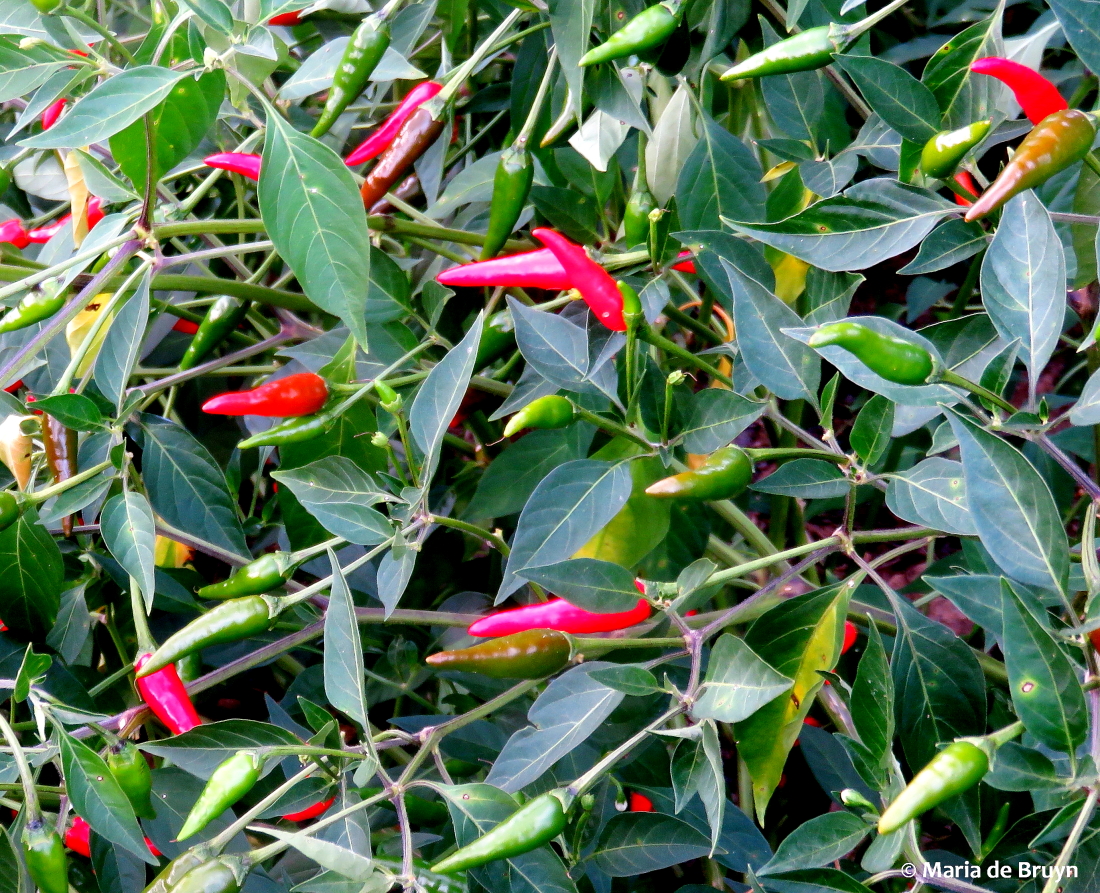
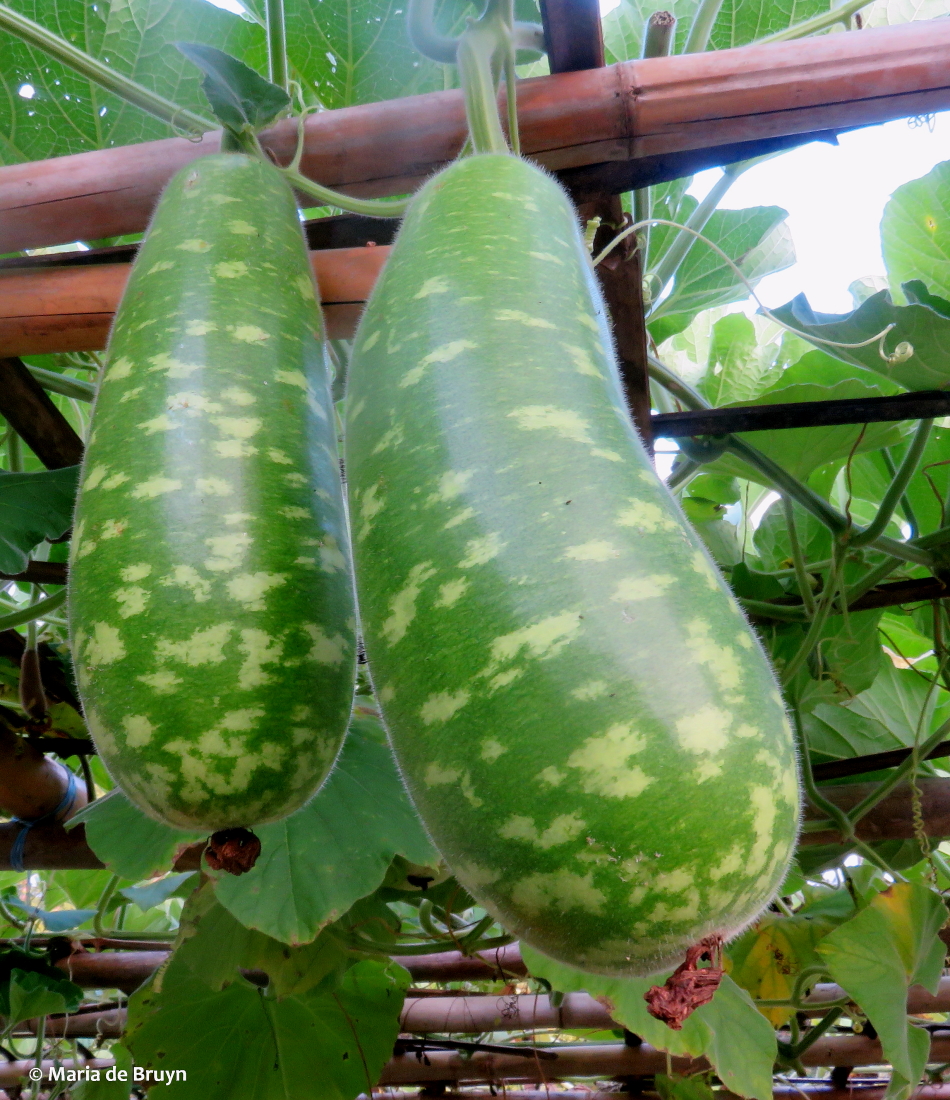
Papaya IMG_5176© Maria de BruynThe farmers grow some 40 plants native to Burma. These plants need to be re-planted from seeds each year since the North Carolina climate is too cold in winter for them to survive as perennials. The papayas don’t bear fruit but the Burmese refugees use their leaves in various dishes. Some of the native plants include gourds, turmeric, bitter melons, ginger, taro root, medicinal herbs and lemongrass. Plain green gourds could be seen hanging near spotted water gourds.

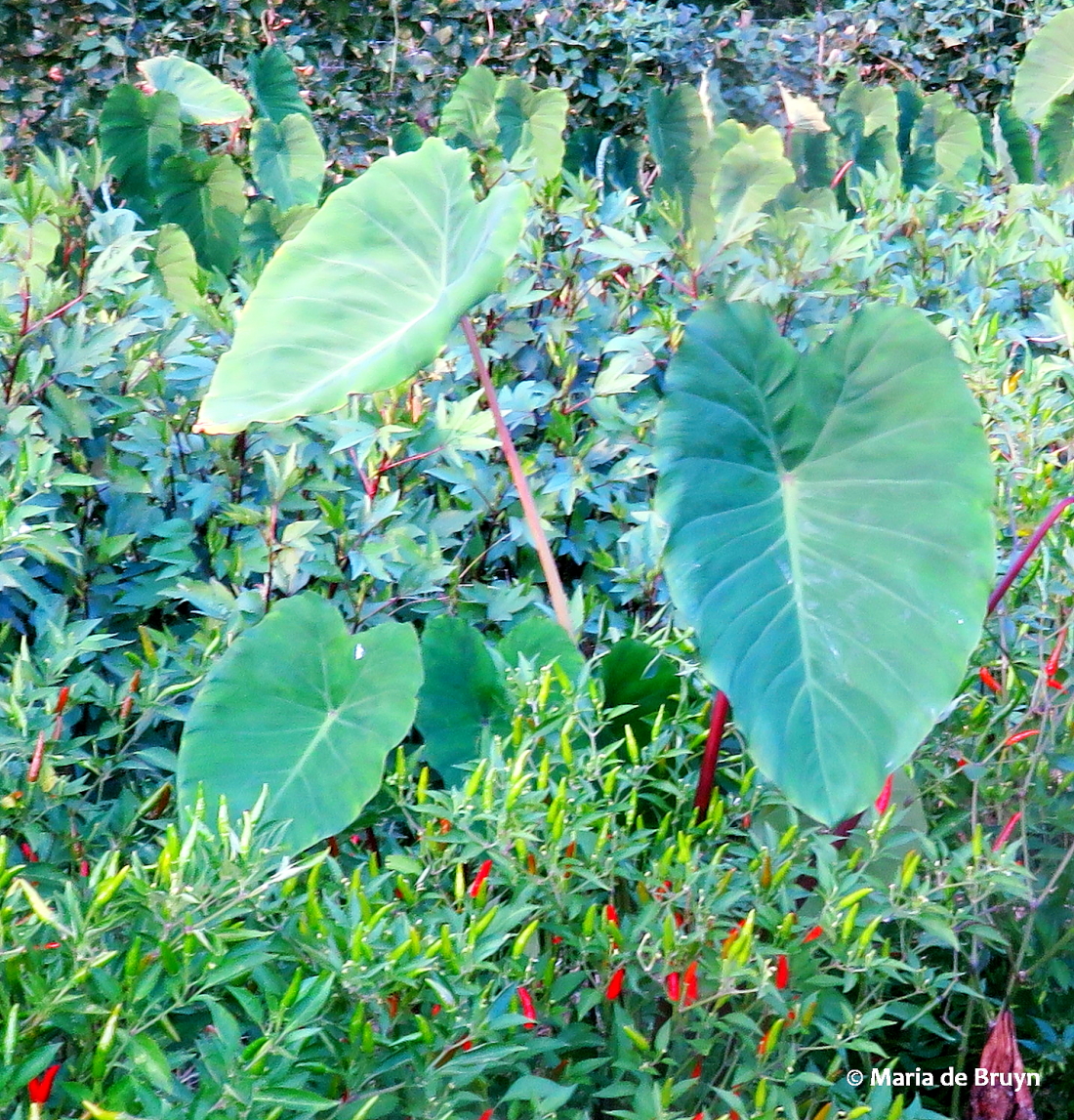
taro IMG_5201© Maria de Bruyn respepper IMG_5115© Maria de Bruyn res

gourd IMG_5211© Maria de Bruyn res water gourd IMG_5204© Maria de Bruyn res

Sesame IMG_5187© Maria de Bruyn resOne female farmer had begun growing sesame seed, a crop she had had in her native country and which she was very glad to be growing here. The bamboo trellises are commonly used to suspend gourds and provide shade for crops that need protection from constant sun such as ginger and turmeric.


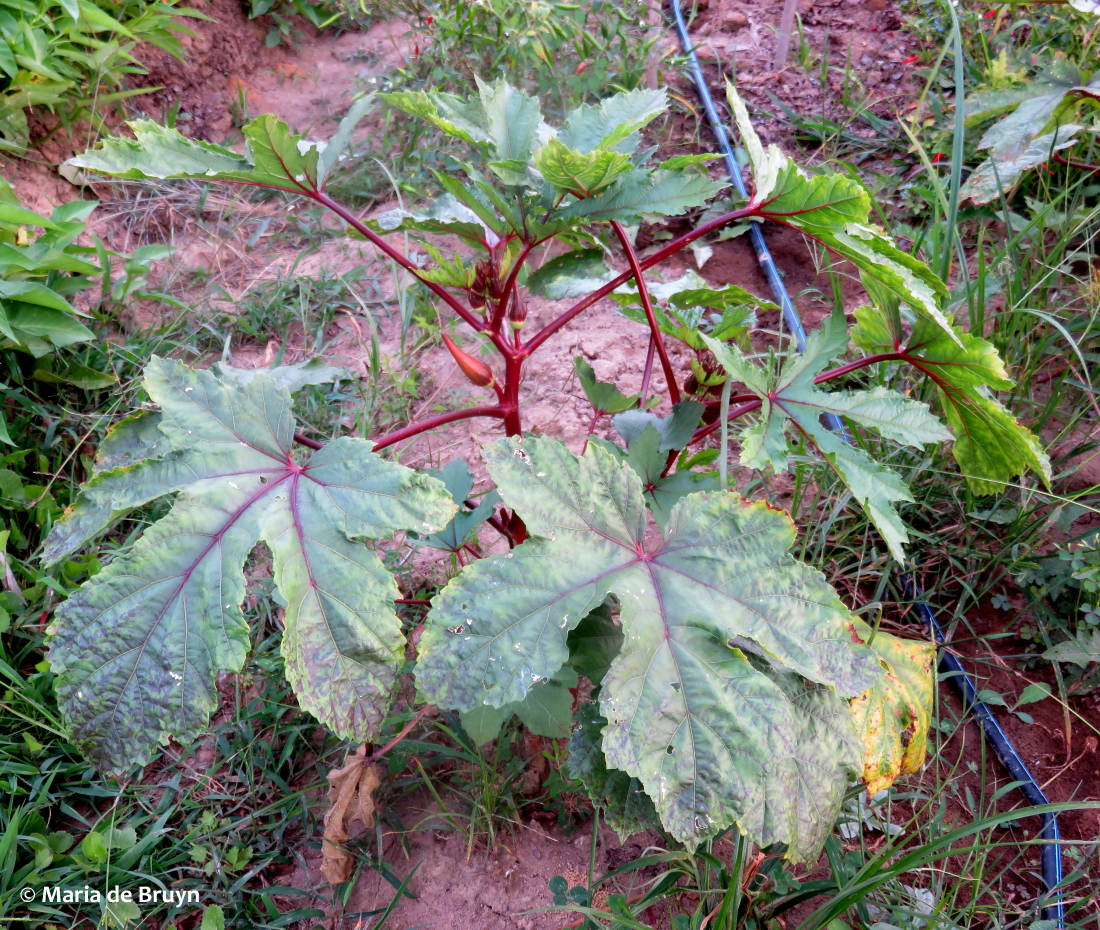
The farmers are also growing plants native to North Carolina, such as okra.

okra IMG_5199© Maria de Bruyn res

IMG_5231© Maria de Bruyn


Burmese vegetables IMG_5219© Maria de Bruyn resBurmese meal IMG_5229© Maria de Bruyn res

The okra featured alongside water gourd and ridge gourd as part of our meal appetizer of vegetable tempura. We were also treated to a delicious soup incorporating okra along with lemon grass and shitake mushrooms, a delicious and slightly spicy pumpkin curry and a salad with some bitter elements that went well with the other dishes.

gourd IMG_5113© Maria de Bruyn res Karen plant IMG_5156© Maria de Bruyn res

I had told four people about this opportunity to sample Karen and other Burmese cuisine but none of them came; they missed a really delicious meal! I hope many more people attend the evening next year.