My friends, the ruby-crowned kinglets!

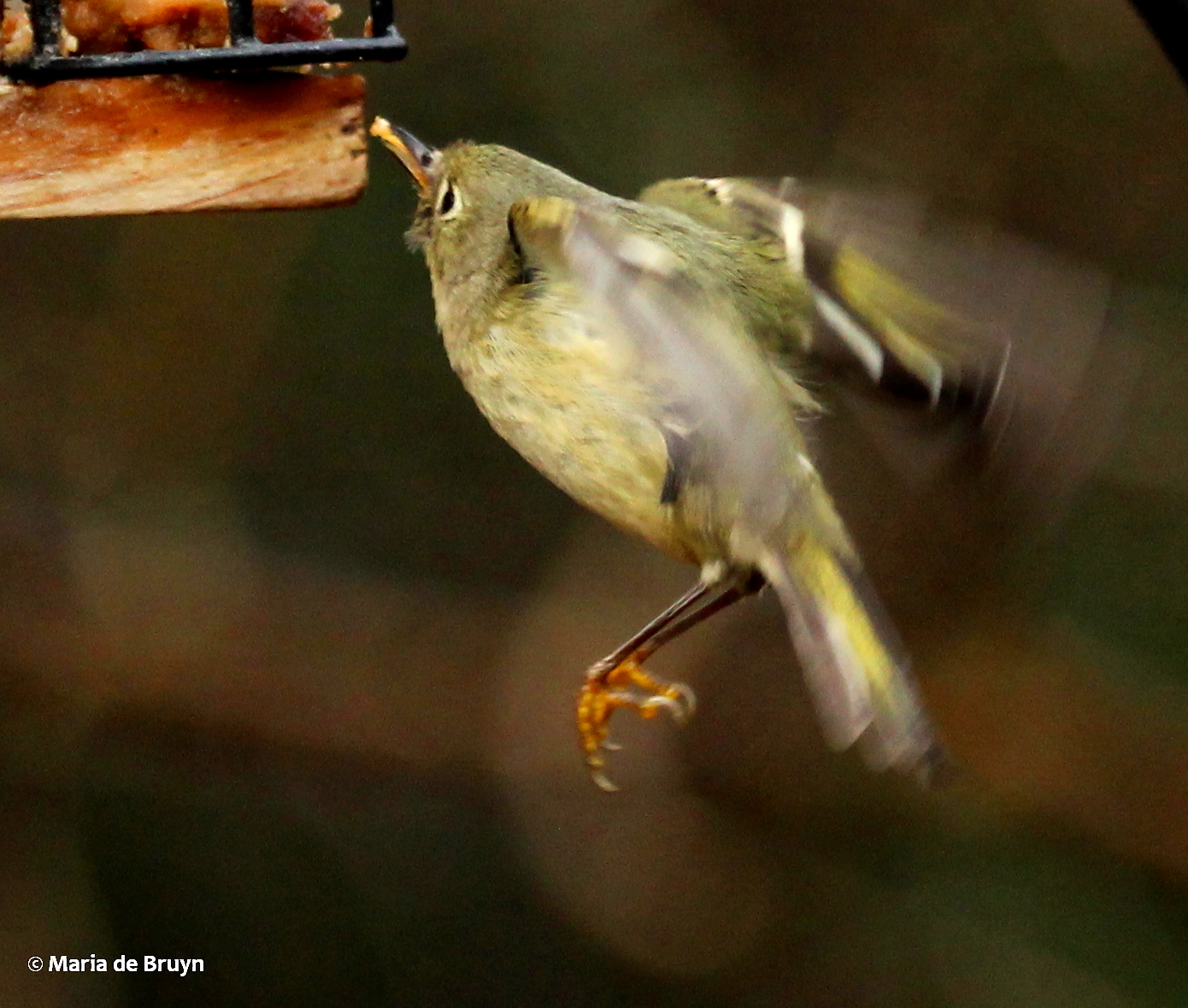
ruby-crowned kinglet IMG_8776© Maria de Bruyn resAs I mentioned in November, ruby-crowned kinglets (Regulus calendula) are one of my favorite bird species. These tiny, yellowish bundles of energy are fascinating to watch as they perch on twigs, hover in mid-air by feeders and branches, and generally look delightful when they stop to catch a breath for a minute.

Adjusting your camera to be able to photograph them with the best speed and lighting can be quite challenging as their constant motion leads them in and out of the sun and above and below branches.

ruby-crowned kinglet IMG_9428© Maria de Bruyn ruby-crowned kinglet IMG_9419© Maria de Bruyn  ruby-crowned kinglet IMG_9377© Maria de Bruyn resruby-crowned kinglet IMG_9406© Maria de Bruyn res

ruby-crowned kinglet IMG_4734© Maria de Bruyn resOn a rainy day, they may sit still for a tiny bit longer but their flight is not impeded though they may look waterlogged.

This has been a good autumn and winter for my being able to photograph these adorable avians, not only in my yard at the feeders but also in venues such as the Jordan Lake woods, Mason Farm Biological Reserve and Sandy Creek Park. This blog will focus on some of the portraits I’ve been able to capture.
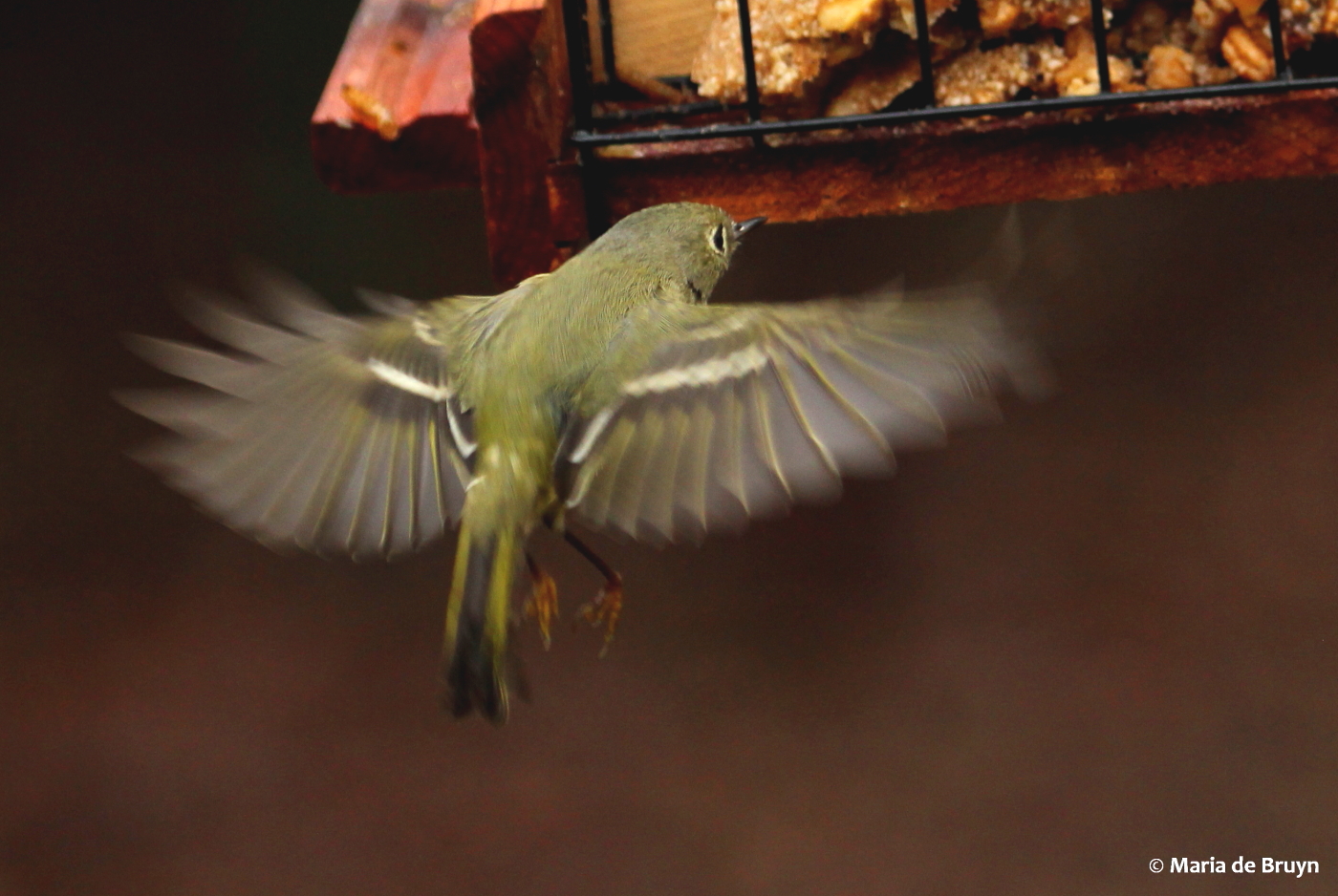


ruby-crowned kinglet IMG_0378© Maria de Bruyn resWhen they are flying around rapidly, you could mistake them for first-year, less brightly hued blue-winged warblers (Vermivora cyanoptera). That happened to me in South Carolina where I thought I had gotten a shot of a blue-winged warbler and instead saw a kinglet in the photo.

ruby-crowned kinglet IMG_0271© Maria de Bruyn res

ruby-crowned kinglet IMG_0272© Maria de Bruyn

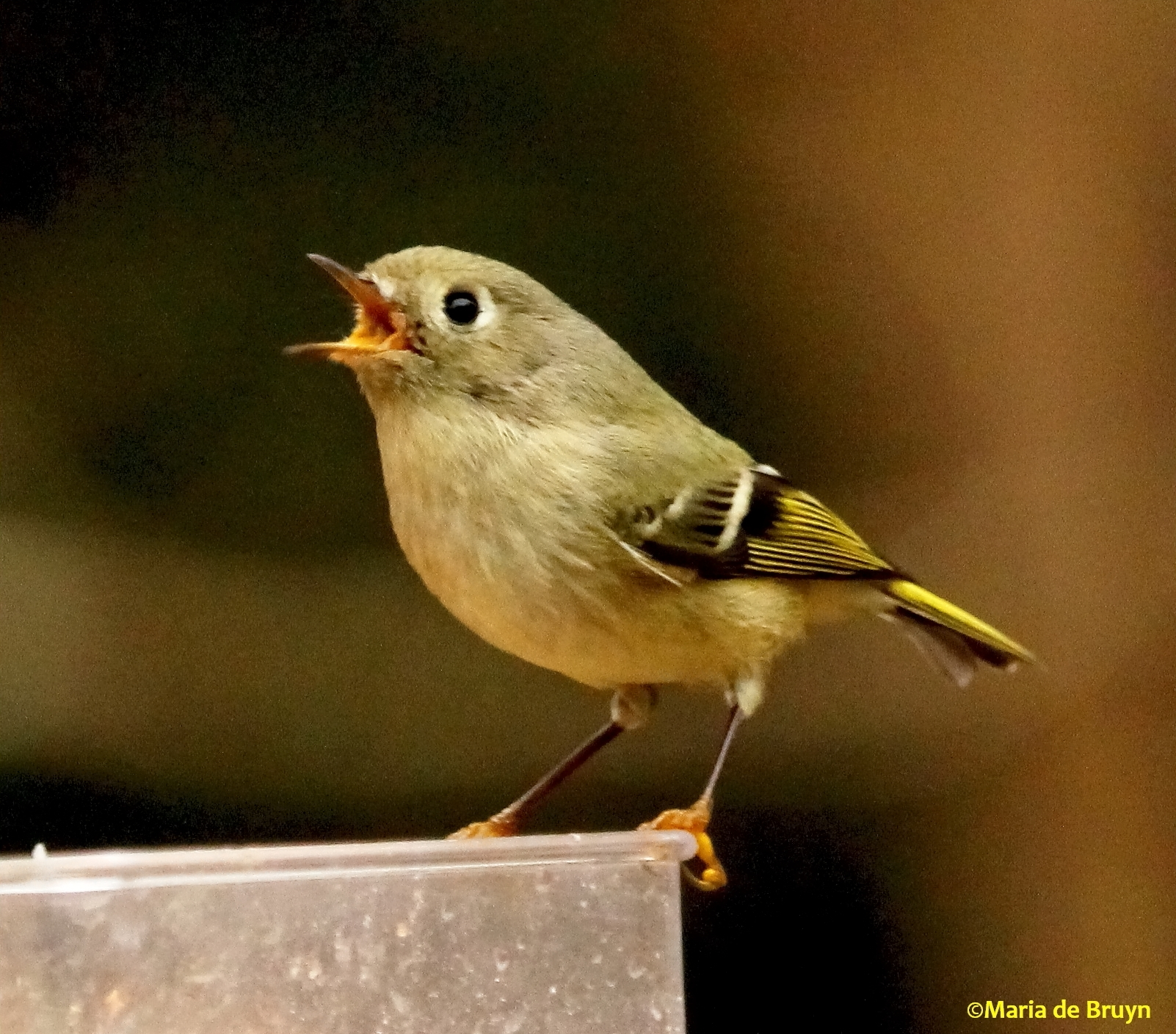
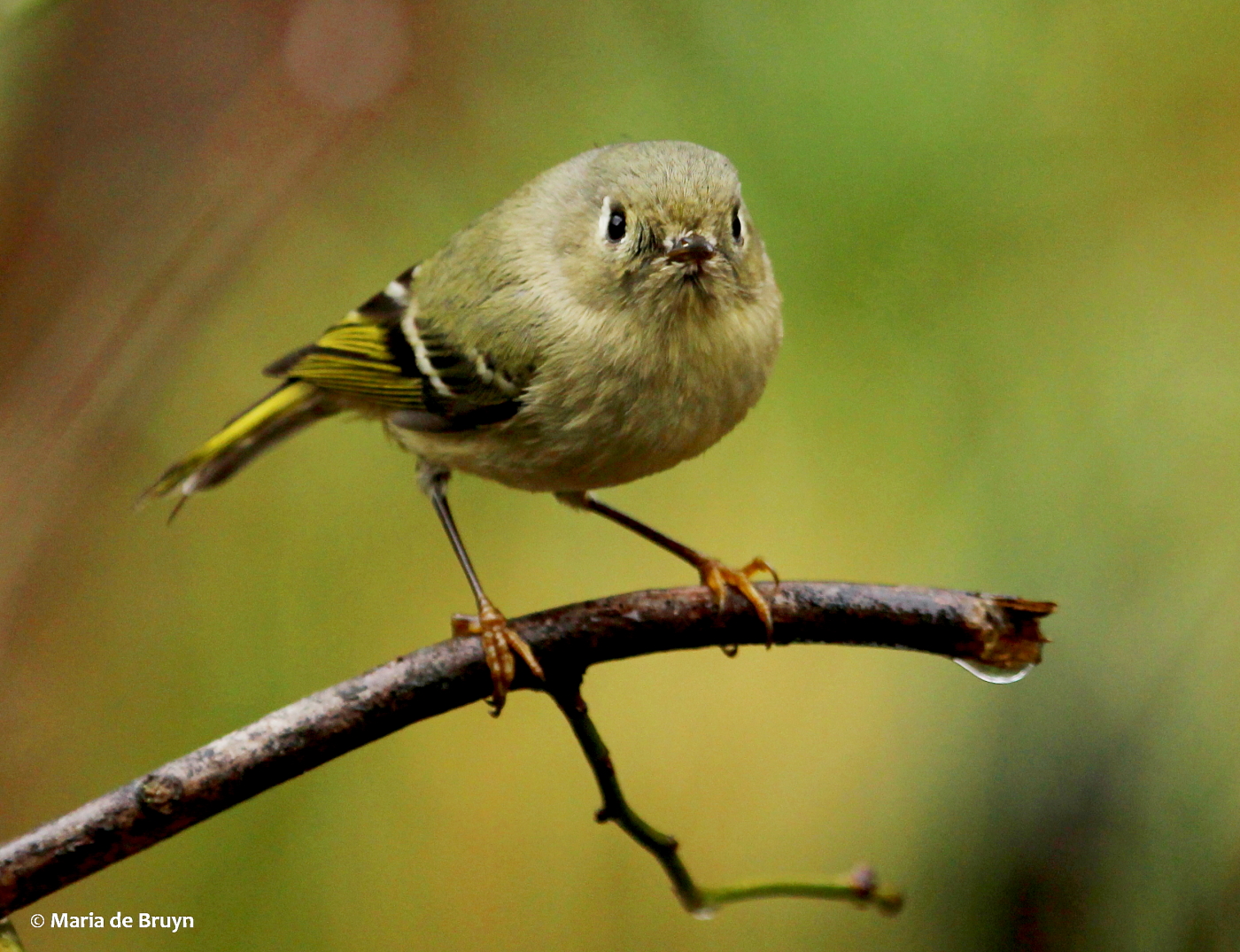
The kinglets’ yellow-olive color, white wing bars, broken white ring around their eyes and fluttering flight help identify them. Very occasionally, you catch sight of the red crown or get a peek at a couple of the normally hidden red feathers.

ruby-crowned kinglet IMG_8791© Maria de Bruyn 2ruby-crowned kinglet IMG_4174 ©Maria de Bruyn res signed

The Latin species name, which means little king, has led to a number of “royal” terms for a group of kinglets: a castle, a court, and a princedom. My favorite, however, is a dynasty – a grand description for a collection of these tiny fliers.

ruby-crowned kinglet IMG_8747© Maria de BruynI think I might have a particular fondness for birds with black or dark legs and yellow feet. I love snowy egrets (Egretta thula) with their large feet resembling yellow rubber gloves and melt at the sight of those dainty kinglet feet.


It’s amazing to think of these small birds migrating to North Carolina from as far North as Canada and Alaska. Just think about how many wing-beats and how much energy this demands of these birds! I’m glad they make the trip though!
ruby-crowned kinglet IMG_0409© Maria de Bruyn res2 ruby-crowned kinglet IMG_3539©Maria de Bruyna”?

ruby-crowned kinglet IMG_5641©Maria de Bruyn resI hope you have found these photos as cute as I did – have a great day!

Crabs save human lives!

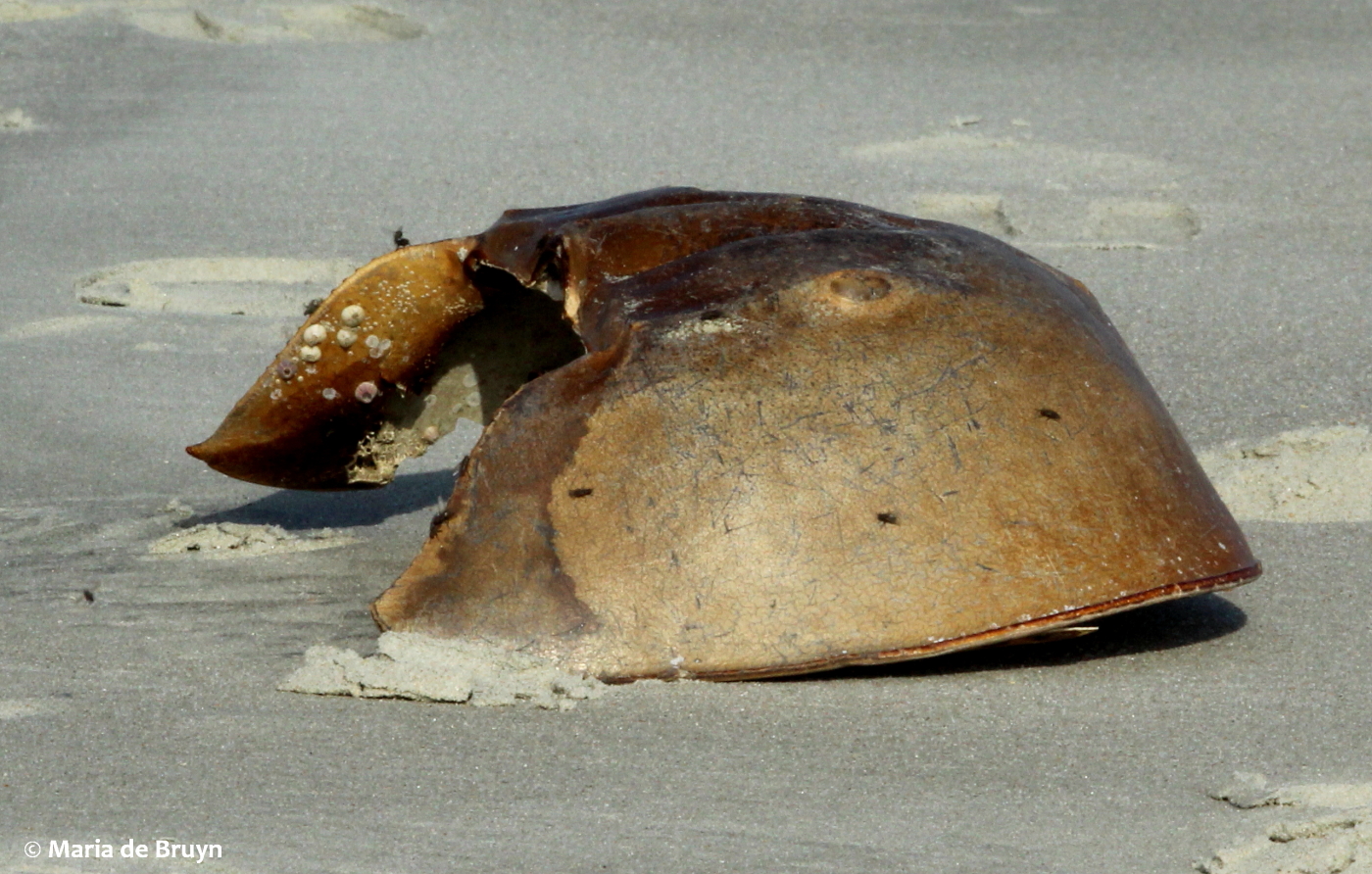
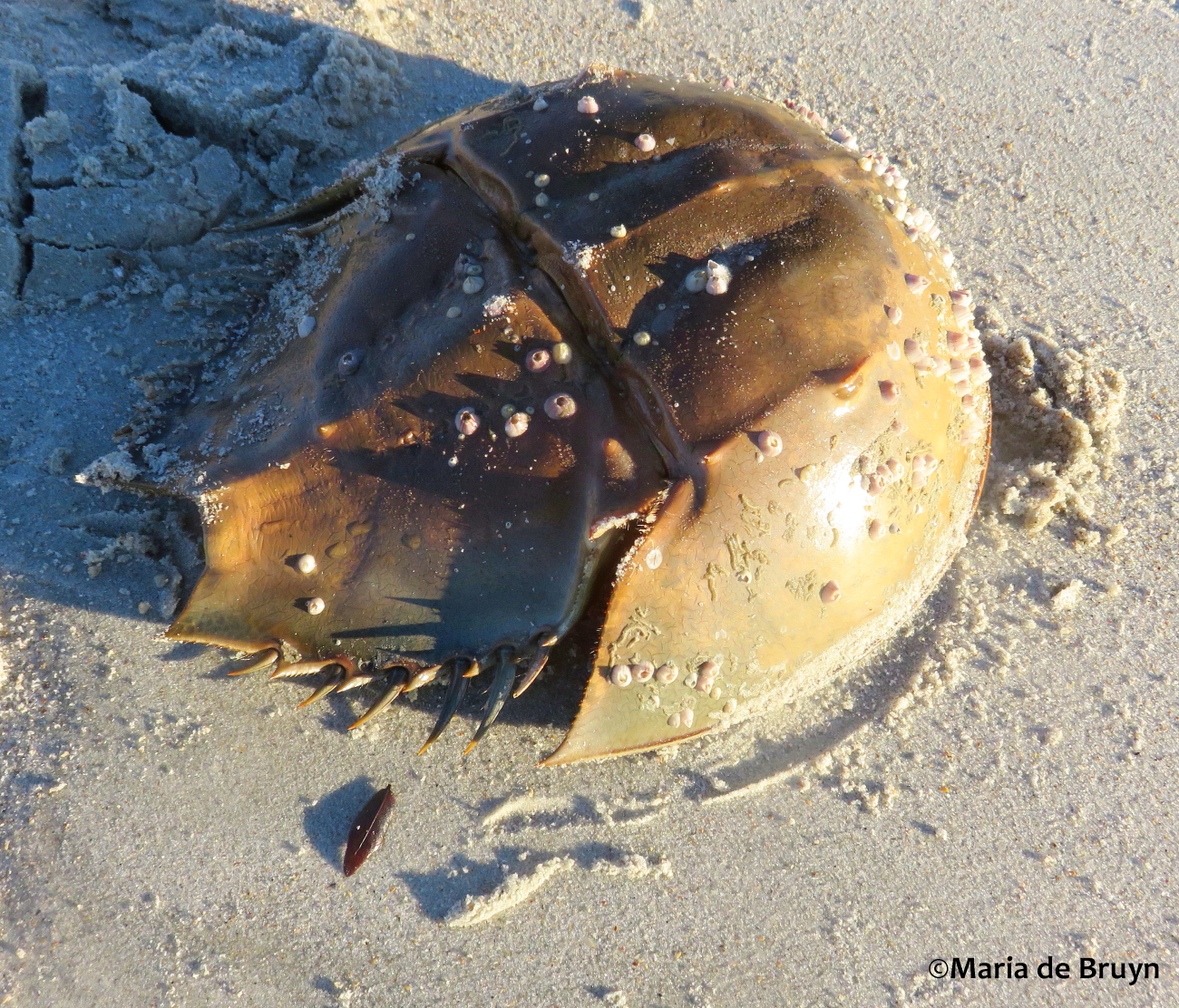
horseshoe crab IMG_0182_1©Maria de Bruyn resOn a trip to Huntington Beach State Park in South Carolina, we took a few walks along the Atlantic shoreline. There I saw the remains of numerous horseshoe crabs (Limulus polyphemus) as their empty shells were scattered among sea pork and sea weed on the beach.

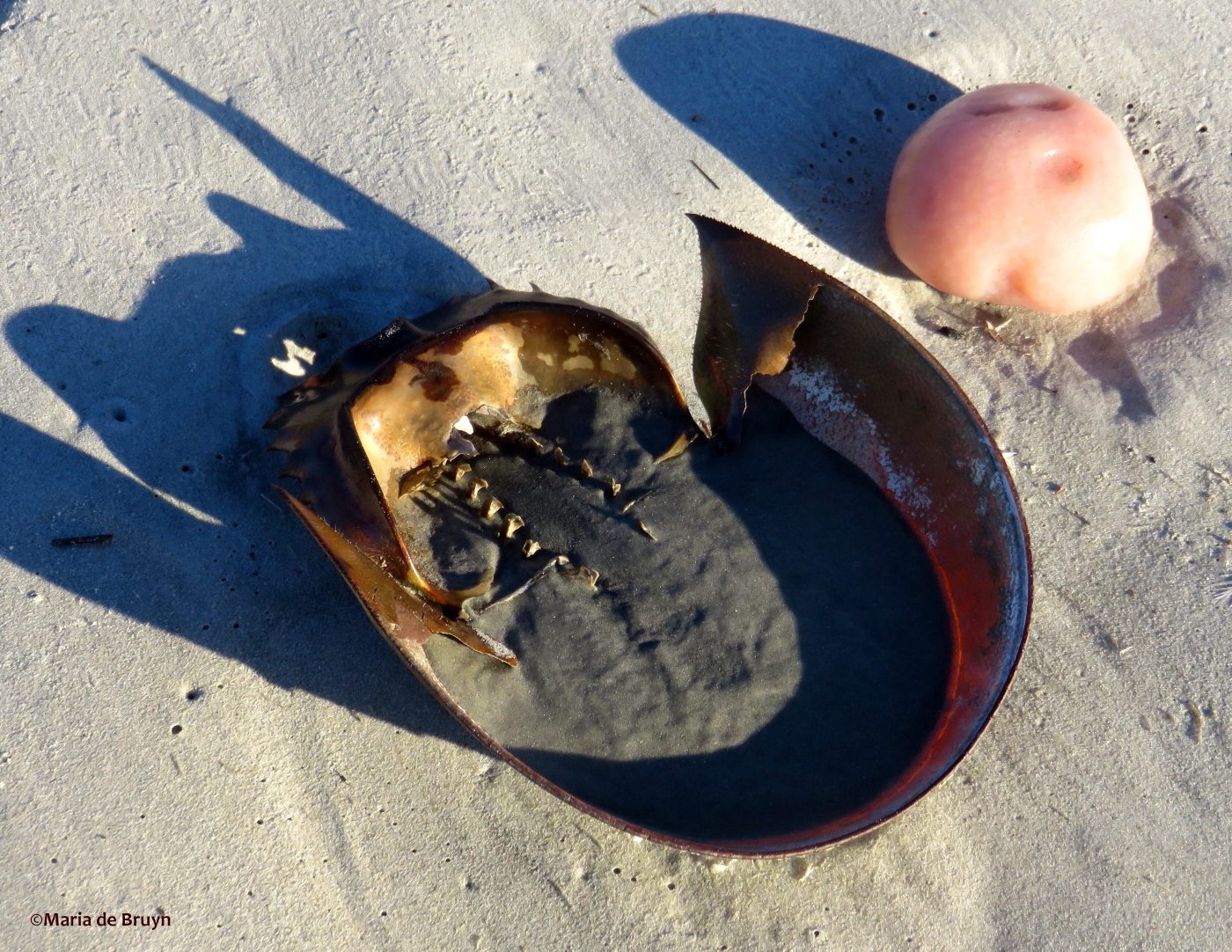
Horseshoe crabs, which can become quite large, live in shallow ocean waters on soft sandy or muddy bottoms. They occasionally come on shore to mate. Behind their five sets of legs (the remains of which are seen in the photos below), they have book gills, which exchange respiratory gases. Two gills are seen sticking up in the center of the first photo.

horshoecrab IMG_0115_1©Maria de Bruyn horseshoe crab IMG_0117_1©Maria de Bruyn res

The gills are also occasionally used by the crabs to swim, which they usually do upside down.

horseshoe crab IMG_8506©Maria de Bruyn resWhen I posted photos of my crab shell spottings on Project Noah, a fellow Noah member informed me that the horseshoe crabs are used in medicine. So I decided to read up on them and discovered how they are utilized. These crabs have hemocyanin instead of hemoglobin in their blood to carry oxygen (this colors their blood blue). Their blood also contains amebocytes, which defend these creatures against pathogens. The blood of the horseshoe crabs is harvested to obtain the amebocytes to make a product that used to detect bacterial endotoxins in human medical applications.

The US Food and Drug Administration mandates that any intravenous drugs and forms of medical equipment that come into contact with patients’ bodies must pass through horseshoe crab blood to help rule out contamination with endotoxins. This includes items such as needles, surgical implants and pacemakers.

horseshoe crab IMG_8503©Maria de Bruyn res horseshoe crab IMG_0124_1©Maria de Bruyn res

horseshoe crab IMG_0164_1©Maria de Bruyn resTo obtain the supplies, about 600,000 crabs are caught each year and drained of about 30% of their blood before being returned to the ocean. Some 10-30% of the crabs do not survive the procedure and others are injured, becoming unable to mate and reproduce. As a consequence of the harvests, these magnificent arthropods, whose lineage dates back 450 million years ago, are now becoming threatened and alternative toxin-detection methods are needed. There is a website devoted to these interesting crabs. Walks on the beach can lead to new knowledge as well as enjoyment!

Russet-colored shorebird beauties – feminists among the waders!

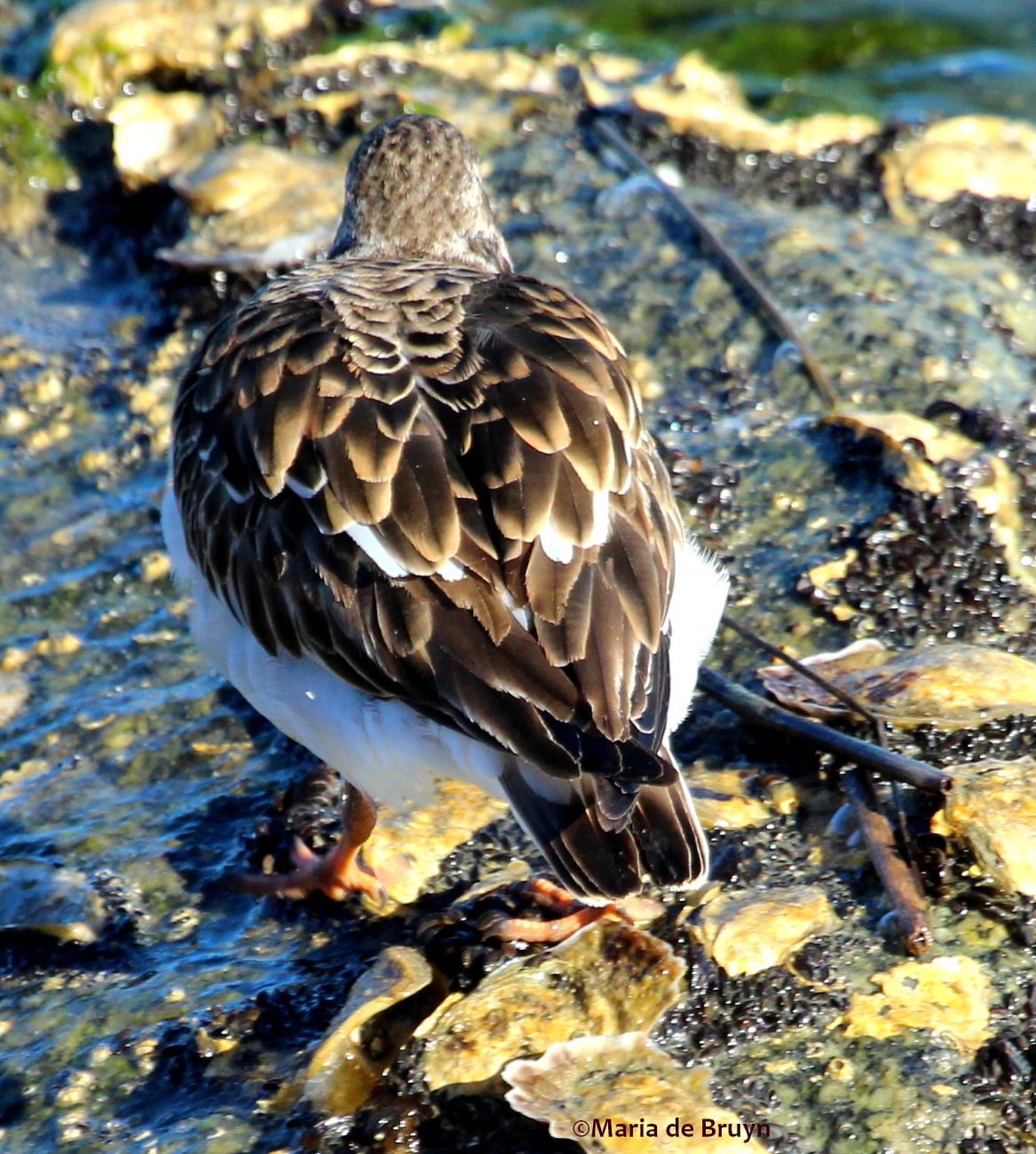
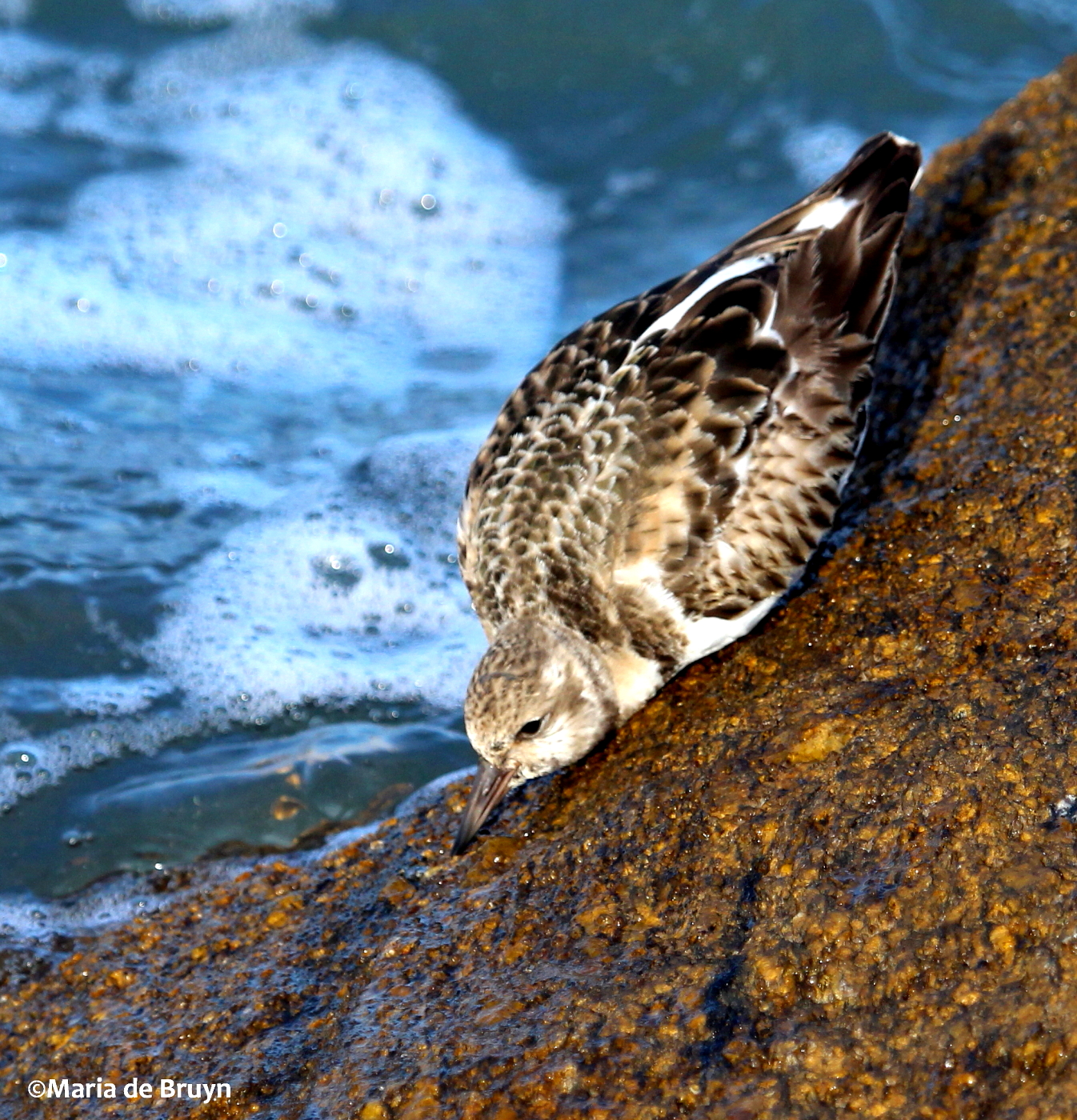
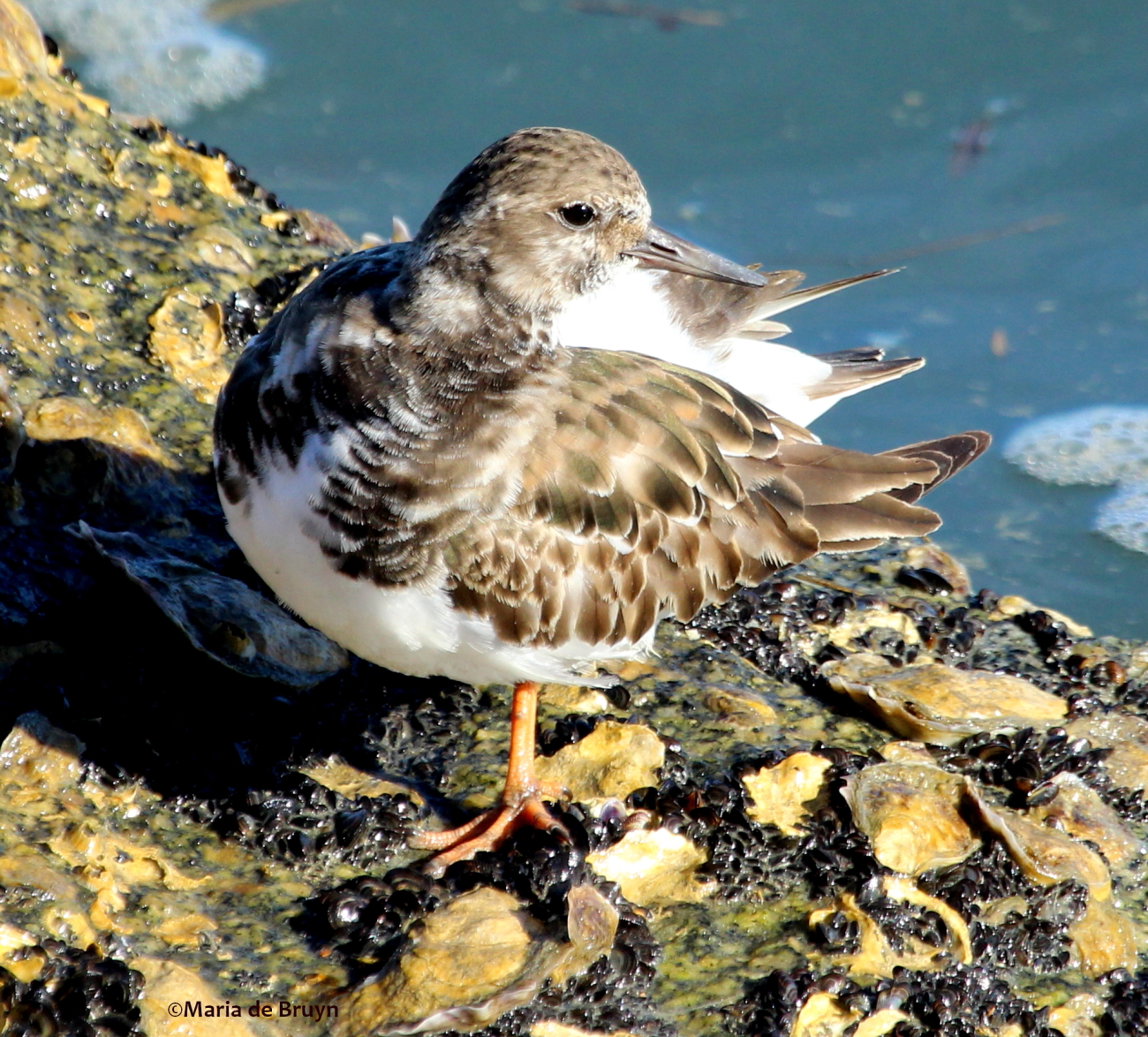
ruddy turnstone IMG_8605©Maria de Bruyn resOne of my favorite shorebirds is the small sandpiper called a ruddy turnstone (Arenaria interpres). Their coloring is a mix of black, white and reddish colors, with adults being more brightly colored when mating and breeding.

These birds are very territorial during the breeding season; they recognize variations in plumage patterns and can identify individuals, which helps them chase away intruders into their territories. Pairs are monogamous when breeding and may mate for several years.

ruddy turnstone IMG_0329©Maria de Bruyn resruddy turnstone IMG_8596©Maria de Bruyn res

ruddy turnstone IMG_8651©Maria de Bruyn resWhen they fly, a stunning pattern is revealed in their spread wings, with striking white patches and bars.

The name turnstone comes from the fact that the birds tend to turn over stones while foraging for insects, crustaceans, worms and mollusks. Several birds may cooperate to overturn larger rocks. This carnivorous diet is supplemented with moss, fruit and berries. Occasionally, the turnstones have also been seen to prey on the eggs of other birds but this behavior appears to be uncommon.

ruddy turnstone IMG_0337©Maria de Bruyn resruddy turnstone IMG_8654©Maria de Bruyn res

They search for their food on rocky outcroppings, among stones, in sand and the ground, inserting their bills into the earth or flipping over seaweed to find meals hidden there.

ruddy turnstone IMG_8629©Maria de Bruyn res ruddy turnstone IMG_8619©Maria de Bruyn res

ruddy turnstone IMG_8782©Maria de BruynThese small birds breed in Northern arctic and tundra regions and then migrate South in the winter, quite often returning to the same wintering grounds each year. Their chicks leave the nest within hours after hatching and abandon the nest within a day. It is the males who take on the major childrearing tasks, guarding the territorial perimeters and warning the female when predators (owls, merlins, gulls, foxes) are near. They also show the young fledglings where to find food after the females have left to pursue other activities.

Outside breeding season and during winter migration, the birds are quite sociable. They have been seen preening and grooming for long periods.

ruddy turnstone IMG_0284©Maria de Bruyn res ruddy turnstone IMG_0305©Maria de Bruyn res

ruddy turnstone IMG_0278©Maria de Bruyn resruddy turnstone IMG_0317©Maria de Bruyn resruddy turnstone IMG_0206©Maria de Bruyn res

The populations of ruddy turnstones are fairly stable and they are not threatened at this time – good news for the bird lovers among us!

A marine mystery for the uninitiated

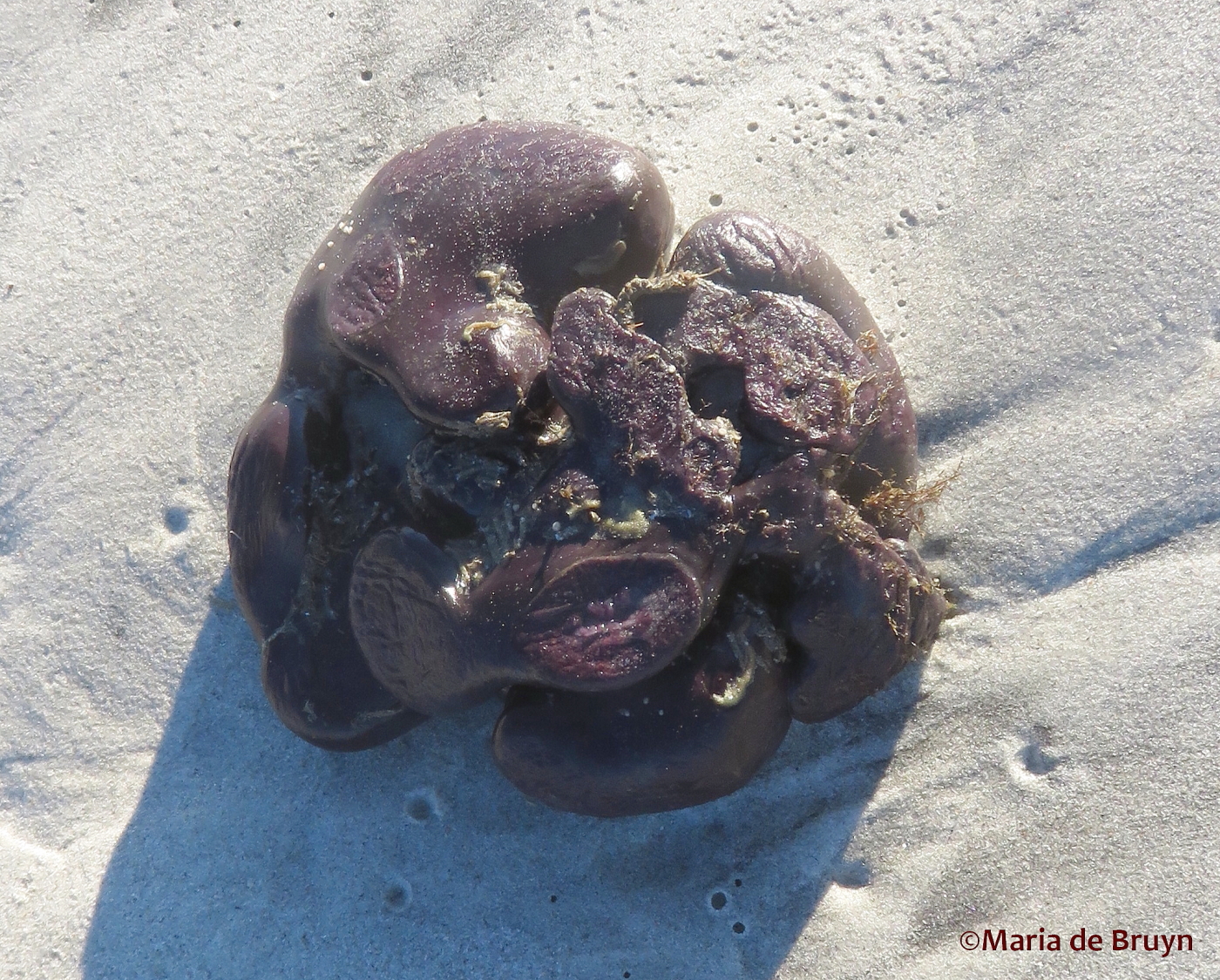
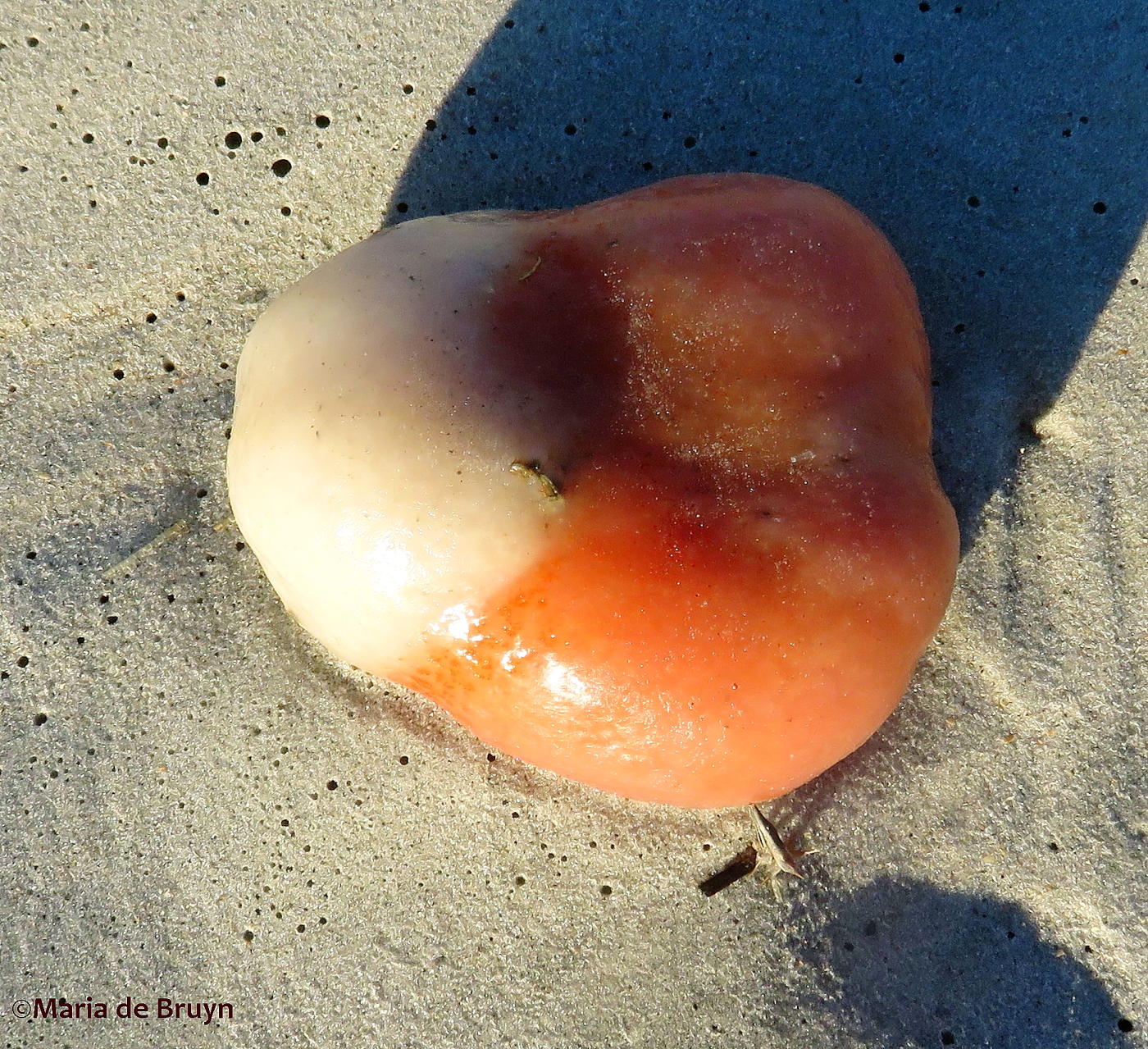
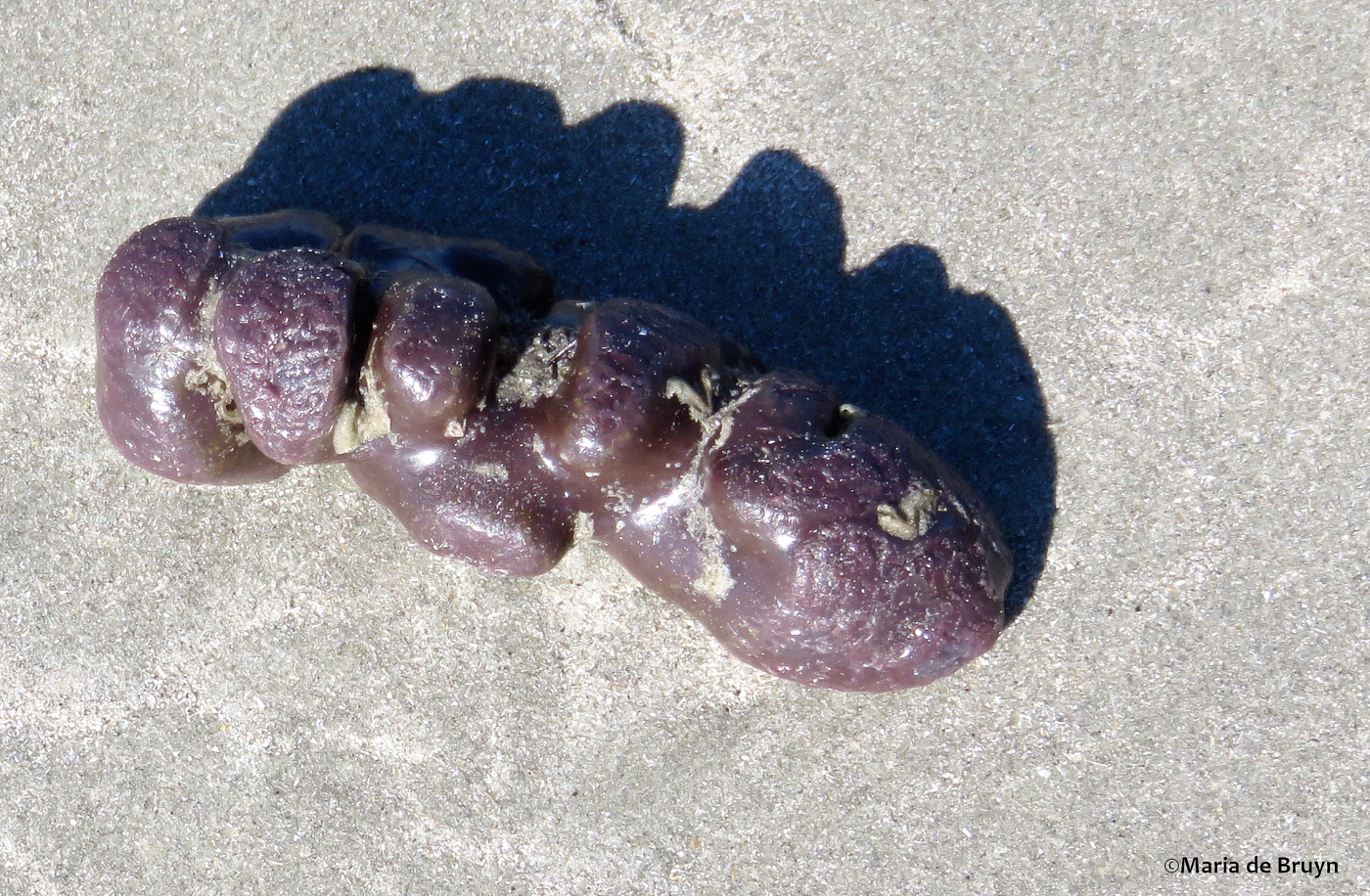
sea pork IMG_0159_1©Maria de Bruyn resFor my friends who know me as a staunch vegetarian, it might come as a surprise that I have become fascinated with sea pork (Aplidium stellatum). It is one of the most colorful yet odd forms of sea life I have personally encountered.

My introduction to this interesting creature occurred on Topsail Island in May 2013, where I found two specimens on the beach.

Sea pork IMG_7631© Maria de Bruynres sea pork IMG_7029© Maria de Bruyn

sea pork IMG_0136_1©Maria de Bruyn res

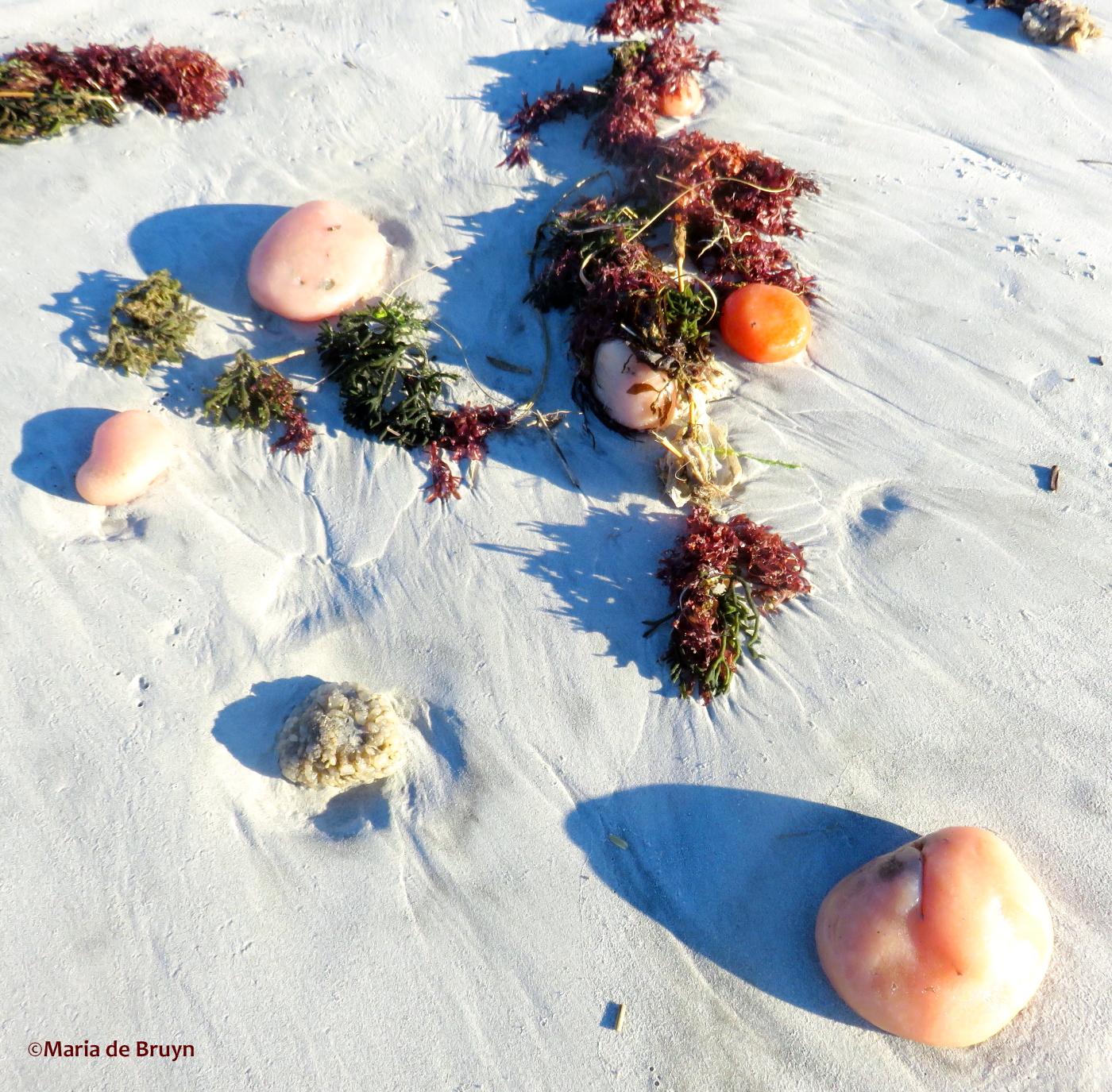
Then, on 19 January this year, I saw some sea pork again – oodles and oodles of it, actually, accompanied by sea liver as well!

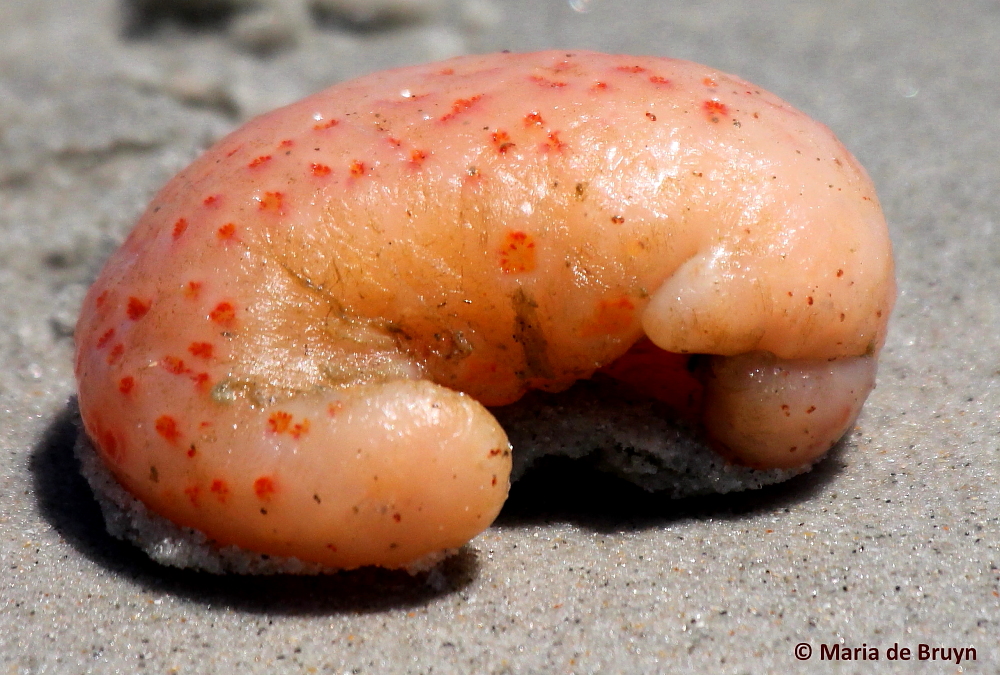
So what is sea pork, you might ask? Each blob or globule is a tunicate: an invertebrate animal that can be one individual or a collection of individuals that reproduce to form colonies measuring an inch or more in height. The larvae look a bit like tadpoles until they join to create the colonies, living in water-filled sac-like structures that are rubbery or cartilaginous to the touch.

sea pork IMG_0152_1©Maria de Bruyn ressea pork IMG_0161_1©Maria de Bruyn resThese creatures are marine filter feeders. The sacs have two tubular siphons, through which water is drawn in and expelled during feeding and respiration. The zooids extract nutrients from the water.

What are zooids? These are the reddish-colored individuals that form a colony. You can see them in circular groups under the sac’s tunic, which varies in color, including creamy pinks, orange, green, red, lavender, deep purple and black. The colonies can become large, spreading 12 inches or more and weighing up to 10 pounds.

sea pork IMG_0153_1©Maria de Bruyn res sea pork IMG_0154_1©Maria de Bruyn res
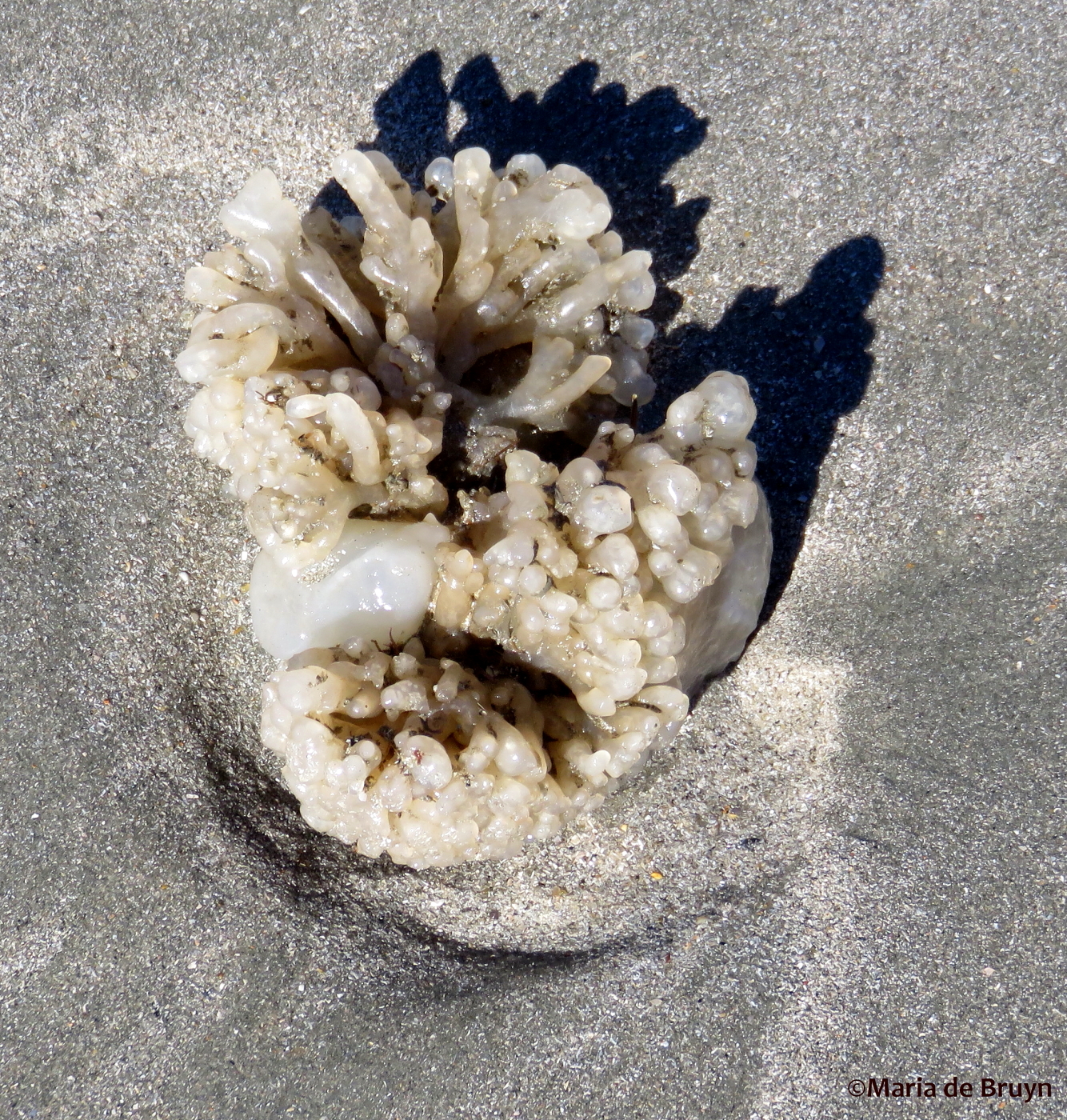
Sea pork was given this name because the rubbery tunic bleaches to white, resembling salt pork or fatback, after the colony dies. While alive, sea pork is eaten by bottom-dwelling fish, sharks and skates.

sea pork IMG_0144_1©Maria de Bruyn res sea pork IMG_0190_1©Maria de Bruyn res
Apparently other creatures also find a home on sea pork, including barnacles and sea whips (Leptogorgia).

Sea pork with barnacle IMG_0141_1©Maria de Bruyn ressea pork and sea whip IMG_0126_1©Maria de Bruyn resSea liver (Eudistoma hepaticum) looks similar to sea pork, but the tunic is softer. It is said to feel slimy in comparison to sea pork but the consistency seemed the same to me.

sea liver IMG_0186_1©Maria de Bruyn ressea pork IMG_0147_1©Maria de Bruyn resHowever, the difference may be more apparent when they are in their natural habitat, fastened to the sea floor or some other substrate rather than torn loose from their underground homes and cast ashore.

I spent some time throwing live sea pork back into the ocean until I came on a stretch of beach that was covered with these blobs; I hoped the tide would come in and carry the creatures back to their watery homes where they might continue their colonial lives.


unknown alga IMG_0177_1©Maria de Bruyn resI now have a query in to a Smithsonian marine botanist for help in identifying this organism. A scientist at the North Carolina Museum of Natural Sciences ruled it out as a marine invertebrate and said he and colleagues surmised it is a marine alga. Suggested IDs are welcome!


Pines, habitat loss and endangered woodpeckers

longleaf pine IMG_0016©Maria de Bruyn resLongleaf pine trees (Pinus palustris) grow for 100-150 years before they reach full size and they can live as long as 500 years. Their extremely long needles give the young trees the look of a spike with grass growing out of it. At the tops of trees, the long, fanned out needles paint a pretty picture when silhouetted against the sky, even on overcast and dull days.

longleaf pine IMG_0015©Maria de Bruyn res

RED-COCKADED WOODPECKER IMG_9109©Maria de Bruyn RESUnfortunately, the longleaf pine forests have dwindled in size as a result of logging and this has contributed to the endangerment of a unique bird – the red-cockaded woodpecker (Picoides borealis).


The longleaf pine has a rough bark and plentiful resin, so much so that tree stumps impregnated with the resin will not rot. The heartwood of the old pines also becomes saturated with the resin.

longleaf pine IMG_9042©Maria de Bruyn reslong-leaf pine IMG_9025©Maria de Bruyn res

When the longleaf pine forests were still plentiful, the red-cockaded woodpecker evolved into a very specialized bird species as far as nesting is concerned. They mainly nest in longer-lived longleaf pines, preferring trees that are infected with red heart fungus as this softens the wood and makes it easier for the birds to dig out a nest cavity. They are the only woodpecker species that makes nest cavities in living rather than dead trees.

longleaf pine IMG_9035©Maria de Bruyn resThe nest cavities are constructed by a family of birds and completing one can take as long as two years (or longer). The families work on several cavities at a time and you will find clusters of trees with nest holes in given areas. The cavities are pecked out in such a way that the tree releases resin around the nest hole and you will see trees that are covered with long thick strands of resin coming down from nests.

The woodpeckers employ this tactic because the heavy flow of resin helps to keep tree-climbing snakes away from their nests, eggs and chicks. A breeding male will scout various nest cavities and then roost in the most recent cavity with the heaviest flow of pitch. The female lays the eggs and then the male incubates them during the night-time hours.

red-cockaded woodpecker IMG_9103©Maria de Bruyn resRaising the young becomes a cooperative effort as older sons remain with the parents and help incubate, brood and feed the babies. Family groups can range from three to nine or more members. The female offspring only rarely stay with their breeding parents as they move off in search of their own mates.

These woodpeckers mainly eat insects, including ants, beetles, roaches, and wood-boring insects as well as caterpillars and spiders. The family will forage as a group and sometimes also eat fruit and berries. Their abandoned nest cavities are used by other birds and small mammals.

red-cockaded woodpecker IMG_9152 ©Maria de BruynThe species is now considered vulnerable to extinction, with only about 12,500 of these birds remaining in the Southern United States. This is equivalent to about one per cent of the original population of this woodpecker. In response, there are now conservation efforts being undertaken to preserve the longleaf pine forests as habitat for the red-cockaded woodpeckers.


long-leaf pine IMG_0013©Maria de Bruyn resAt the Santee Coastal Reserve Wildlife Management Area in South Carolina, as well as in the Sandhills areas of South and North Carolina, forest rangers and others are working to enhance the longleaf pine forests for the birds. Controlled burns are clearing out dense undergrowth as the woodpeckers prefer sites with less deciduous growth; you can see them foraging quite low on trees.

In some areas, wildlife management projects are trying to help out the birds by creating artificial cavities, into which man-made nests are inserted. Restrictor plates around the holes also serve to stop other species from enlarging the holes or shape of the nest hole so that the red-cockaded woodpeckers will keep using them.

longleaf pine IMG_9040©Maria de Bruyn res longleaf pine IMG_9030©Maria de Bruyn res

At the Santee Coastal Reserve, several such nest holes can be observed alongside other trees where the birds are making their own nest cavities. Trees with nest holes are banded with white tape so that rangers can keep an eye on the woodpeckers’ activity.

longleaf pine IMG_9046©Maria de Bruyn resRED-COCKADED WOODPECKER IMG_9229©Maria de Bruyn RES

It is heartwarming to see the efforts being made to restore the longleaf pine forests and the habitat for the woodpeckers – perhaps this will prevent this species from going extinct. And the National Wildlife Federation has stated that research shows that long-leaf pine forests will be especially well adapted to coping with environmental changes caused by global warming.

RED-COCKADED WOODPECKER IMG_9214©Maria de Bruynred-cockaded woodpecker IMG_9165 ©Maria de Bruyn